

Submitted:
07 June 2026
Posted:
09 June 2026
You are already at the latest version
Abstract
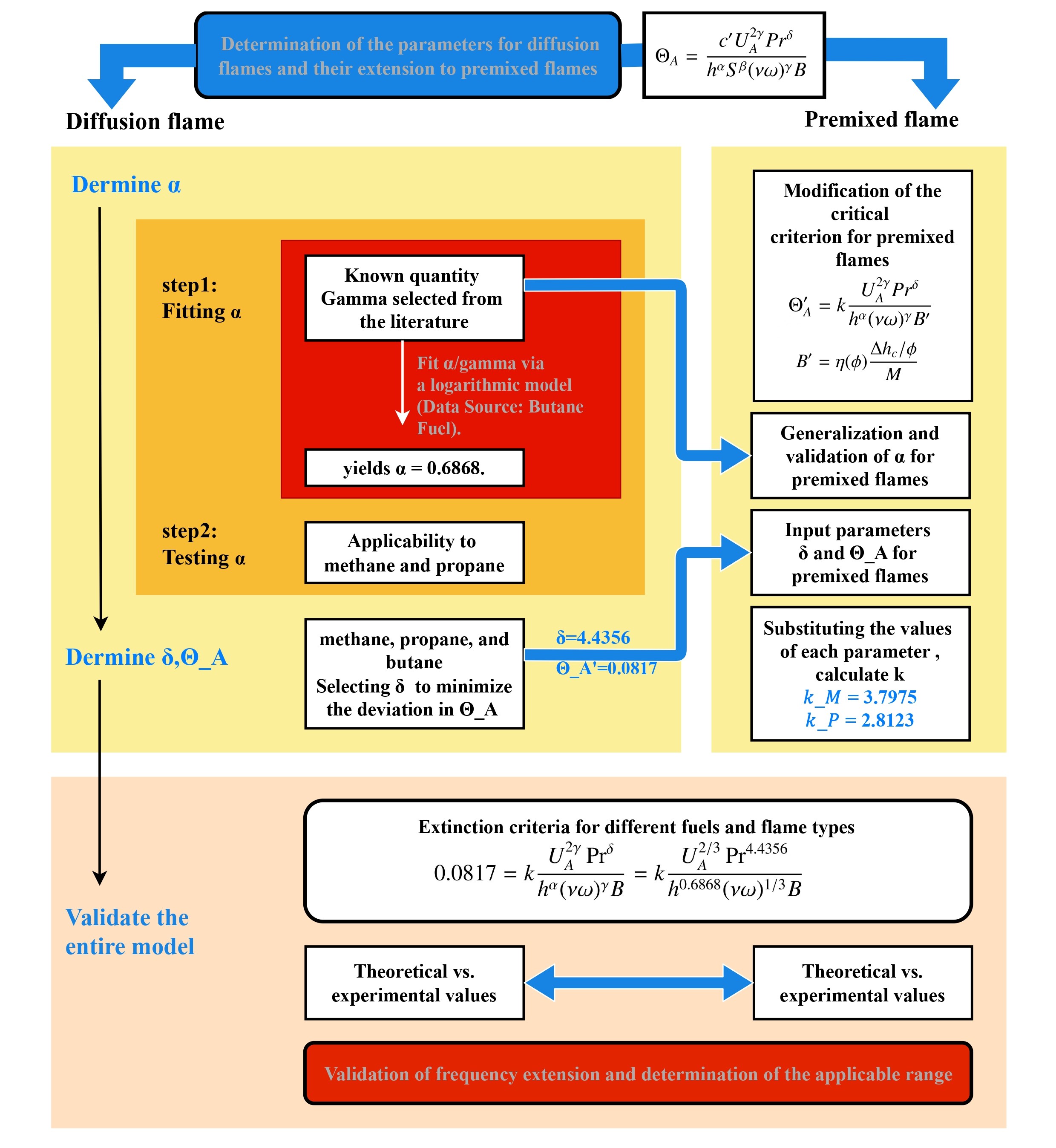
To investigate the critical extinction criterion for fire extinguishment through acoustic oscillation and achieve the transition from empirical qualitative studies to quantitative precision applications in acoustic fire extinguishment, this study conducts systematic extension research on the threefold limitations of the flame–fuel cycle model by Friedman, A. N.—namely, its restriction to liquid fuels, neglect of Prandtl number variations, and undefined frequency applicability boundaries. By modifying the Quintiere–Spalding B-number model for gaseous fuels and premixed combustion, and introducing flame geometric characteristic terms and combustion type correction terms, a generalized acoustic extinction criterion model applicable to gaseous fuels is established, breaking through the severe limitation that the original theory was only applicable to liquid fuels with similar Prandtl numbers. Through logarithmic fitting of methane, propane, and butane diffusion flames, the flame height term exponent is quantitatively determined as α = 0.6868; for methane and propane gas premixed flames at an equivalence ratio ϕ ≈ 1, the flame type terms are determined as kM = 3.7975 and kP = 2.8123, respectively, and the Prandtl number exponent term as δ = 4.4356, ultimately yielding the critical extinction criterion for gaseous fuel flames as Θ′A = 0.0817. The study further reveals the phenomena of flame necking and fracture under acoustic field interference, providing independent morphological corroboration for the physical validity of this extinction criterion. Of particular importance, this research discovers, for the first time through broadband experiments, the anomalous increase in the critical particle velocity for acoustic fire extinguishment in the relatively high-frequency band above 90 Hz, experimentally defining the upper frequency limit for the applicability of the linearized equivalent dominant model of acoustic fire extinguishment and revealing the mechanism transition caused by nonlinear acoustic streaming contributions above this frequency. This study provides theoretical support for the engineering application of acoustic fire extinguishment technology, equipment frequency selection, and in-depth exploration of the mechanism of sound-induced flame extinction.
Keywords:
acoustic flame extinction
; air particle vibration
; multi-factor flame-fuel cycle model
; critical criterion
; flame morphology
; frequency applicability boundaries
Novelty and Significance Statement
This study significantly extends the flame-fuel cycle model originally developed for liquid fuels to gaseous diffusion and premixed flames, establishing a generalized multi-factor critical extinction criterion. By introducing modifications for flame geometry and fuel properties, and conducting rigorous experimental validation, the work overcomes the severe limitation of the original model that required fuels to have similar Prandtl numbers. A quantitative formula is derived that can predict the acoustic particle velocity required for extinction across different fuels, flame sizes, and frequencies, thereby transforming acoustic fire extinguishment from a qualitative empirical approach to a quantitative predictive tool. The discovery of the dual influence of frequency and the acoustically induced flame necking phenomenon further deepens the understanding of the underlying physical mechanisms.
1. Introduction
With the accelerating urbanization of human society, the threat of fires to urban safety and the lives of residents has become increasingly prominent. [1]. As a novel fire-extinguishing method that has attracted considerable attention in recent years, acoustic fire extinguishing, owing to its advantages of being non-contact, pollution-free and highly adaptable, exhibits great application potential in microgravity environments and fire protection for precision equipment, and its feasibility has been widely verified by experiments [2,3,4].
However, academic research on acoustic fire extinguishing still mainly focuses on investigating the influence of a single specific factor and often remains only at a qualitative level. Some studies, such as that by Gore et al. [5], suggest that the local flame temperature drop caused by pressure waves generated by acoustic waves is the main factor affecting the effectiveness of acoustic fire extinguishing, based on the ideal gas law. Research by Alexander, A. A. [2] considers the sound pressure level as the dominant indicator for extinguishing, and an increase in sound pressure level results in enhanced fire extinguishing effectiveness. Niegodajew P. et al. [3] find that an increase in burner power leads to a significant rise in speaker extinction power, and this increase becomes more pronounced as the distance between the burner and the sound source increases. Shi et al. [4] further emphasize that the alteration of the combustion environment due to sound pressure-induced airflow disturbances is the key factor in extinguishing.
In contrast, regarding the physical essence of acoustic fire extinguishment, sustained controversy persists in the academic community. Xiong et al. [6], through baffle-controlled comparative experiments, revealed the existence of an incompressible pulsating airflow ("diaphragm wind") driven by the diaphragm motion in the near field of the loudspeaker, and accordingly proposed that this airflow generated by the mechanical displacement of the loudspeaker diaphragm constitutes an important factor in near-field flame destabilization, attempting to define the flame extinction boundary using critical displacement; Cliftmann et al. [7], through time-reversal focusing experiments, confirmed that acoustic streaming—the unidirectional net flow produced by nonlinear acoustic effects—plays a key role in flame displacement and extinction. Recent Schlieren diagnostics by Zhang et al. [8] further revealed the cumulative effects of acoustic streaming and oscillatory perturbation. The aforementioned controversies indicate that the dominant mechanism of acoustic fire extinguishment has not yet reached consensus in the current field, and that in quantitative work, if the physical connotation of the perturbation parameter is not explicitly defined, it is difficult to establish a predictive model applicable across different acoustic source types.
In view of the above research gap in the quantitative critical extinction criteria considering multiple factors of acoustic fire extinguishing, this study addresses the threefold limitations of Friedman’s flame-fuel cycle model by introducing correction terms for flame geometry and fuel properties, extending the theory from liquid fuels to gaseous premixed flames, and establishes a generalized multi-factor extinction criterion that uniformly considers flame size, type, and fuel properties. Research indicates that the Prandtl number of gaseous fuels significantly influences the critical particle velocity for acoustic flame extinction. For gas diffusion and premixed flames ranging from 2.00 to 5.00, critical linearized equivalent acoustic extinguishment velocity exhibits an approximately proportional relationship with flame height. Of particular significance, by extending the experimental frequency band from the conventional 30–80 Hz to 130, this study discovers for the first time through experiments the anomalous increase in the critical particle velocity for acoustic fire extinguishment in the relatively high-frequency band above 90, revealing the mechanism transition caused by nonlinear acoustic streaming contributions above this frequency band, thereby experimentally defining for the first time the upper frequency limit for the applicability of the linearized equivalent dominant model of acoustic fire extinguishment. This discovery not only completes the understanding of the applicable scope of the Friedman model, but also provides theoretical basis for the specialized frequency selection of acoustic waves under different application scenarios. Furthermore, through in-depth analysis of dynamic behaviors such as flame necking and fracture under broadband conditions, this study also points out new directions for subsequent research on the mechanism of acoustic fire extinguishment.
It should be specially noted that this study adopts from the Friedman model as the core measure of perturbation intensity, but redefines its physical connotation: strictly speaking, characterizes the critical linearized equivalent acoustic extinguishment velocity rather than the reciprocating vibration velocity of fluid microclusters driven by linear acoustic waves as described in Friedman’s original model. The "diaphragm wind" observed by Xiong et al. and the parameter in this study are not opposing mechanisms; rather, they constitute the incompressible and compressible components of the loudspeaker near-field velocity field, respectively. Within the primary experimental frequency band of this study (3080), their proportional relationship remains stable, thus as a linearized equivalent velocity can lumpedly characterize the comprehensive perturbation intensity; however, when nonlinear contributions become significant (≥90), the applicability boundary of this linearized parameter will be revealed through broadband experiments in the subsequent sections. This treatment enables the model to maintain theoretical continuity while clarifying its applicable scope, and provides experimental evidence for the necessity of introducing additional nonlinear parameters (such as acoustic streaming intensity) when exceeding the linear assumption.
2. Extension Study of the Multi-Factor Critical Criterion
This study adopts the flame-fuel cycle model proposed by Friedman, A. N. [9] as the core framework for acoustic flame extinction (i.e., the flame is displaced by acoustic disturbance away from the fuel bed, reducing the heat flux between the flame and the fuel, leading to extinction). The Spalding B-number and local Nusselt number are used to describe the stability of flame combustion and the disturbance caused by acoustic waves. However, since the study by Friedman, A. N. [9] employed a fixed-size burner to deliberately maintain identical flames and only used liquid fuel diffusion flames, its applicability to diffusion and premixed flames of different physical sizes and fuel states is severely underexplored. This limitation hinders the revelation of the significant influence of these factors on the acoustic flame extinction process and renders the theoretical model largely impractical. To address this, the present paper attempts to introduce additional factors not originally considered, such as flame height and combustion type, while simultaneously extending the theory to gaseous fuel flames.
2.1. Theoretical Extension
A model for the mass transfer Spalding B-number in gaseous fuel combustion is first constructed. The theoretical model developed by Quintiere [10] for small-scale flames is adopted, with its original formula as follows:
where is the mass fraction of oxygen in the ambient air; denotes the heat of combustion per unit mass of fuel in ; r is the stoichiometric oxygen-to-fuel mass ratio; represents the specific heat capacity of air at constant pressure in ; is the boiling point of the fuel at one standard atmospheric pressure; is the ambient temperature in ; and L is the latent heat of vaporization in .
Since this formula is primarily designed for liquid fuels, the mass transfer driving force and heat loss resistance of gaseous fuels are considered. The following modified B-number expression for gaseous fuel diffusion flames, denoted as Eq. (2), is therefore given.
where M represents the combustion heat loss per unit mass of fuel in . The ambient oxygen mass fraction is assumed as . For gaseous fuels, the latent heat of phase change is omitted since the fuel is already in the gaseous state.
Due to the flame displacement caused by the acoustic excitation, part of the fuel bed becomes directly exposed to the cold air under the action of the oscillatory airflow, leading to enhanced convective heat transfer between the unburned fuel and the cold air. To quantify this effect, a local Nusselt number is employed to characterize the alteration in convective heat transfer intensity, thereby representing the perturbation imposed by the oscillatory particle motion on the flame-fuel feedback cycle. The Nusselt number is calculated as follows:
where c and are empirical parameters dependent on the ambient conditions; and is taken as based on the findings of Friedman, A. N. [9]. and denote the Prandtl and Reynolds numbers, respectively, defined in Eqs. (4) and (5).
Here, is the specific heat capacity at constant pressure of the fluid (air, herein), in ; is the dynamic viscosity, in ; and is the thermal conductivity, in .
For the Reynolds number, the characteristic length l is first defined as the root-mean-square (RMS) particle displacement per acoustic cycle, in . The expression for can thus be transformed as:
where is the fluid density in ; is the kinematic viscosity in ; is the RMS acoustic-induced particle velocity in ; and is the acoustic wave frequency in Hz.
To characterize the perturbation–stability competition by , the flame geometric characteristic term and combustion type term k ( for diffusion flames) are introduced, Under identical burner conditions, is constant; letting yields the generalized critical extinction criterion :
It is noteworthy that Friedman, A.N. [9] employed a waveguide tube in their experiments to focus acoustic energy, which enabled flame extinction at a relatively low input power and possesses clear engineering application value. However, this device also alters the propagation mode of sound waves (tending towards plane wave/standing wave) and generates a significant accompanying flow, making the observed phenomena the result of “waveguide-constrained acoustic streaming coupling”. To investigate the fundamental physics of the interaction between the basic acoustic near-field and the flame without such complex boundary conditions, the present experiment does not employ a waveguide tube and directly examines the conditions in the acoustic near-field, aiming to reveal a more essential mechanism of acoustic fire extinguishment and provide a basis for the selection of technical approaches in different application scenarios. Although certain nonlinear acoustic effects are present under this configuration, the following plane-wave conversion formula between sound pressure and acoustic-induced particle velocity [11] has been proven to remain valid under the experimental conditions of this work.
Here, p represents the sound pressure, in ; and z denotes the acoustic impedance, in . is the critical linearized equivalent acoustic extinguishment velocity, obtained from near-field sound pressure through conversion under plane-wave conditions, with a magnitude typically on the order of several mm/s. Its physical essence is a comprehensive perturbation intensity indicator lumping both the compressible acoustic wave component and the incompressible diaphragm-induced flow component. Strictly speaking, this parameter is not equivalent to the pure acoustic particle velocity. However, within the 30–80 Hz range, the empirical parameters , , and k absorb the average effects of near-field non-idealities in a reproducible manner, enabling to maintain a deterministic mapping with the critical extinction condition. The self-consistency validation of this treatment lies in: within 30–80 Hz, the critical conforms to the scaling law with flame height and frequency (see Section 1.2.2), indicating that near-field non-idealities couple to the extinction process in a stable manner; the systematic breakdown of the scaling law above 90 Hz corresponds to the transition of nonlinear contributions (such as the "diaphragm wind" described by Xiong et al. [6], and acoustic streaming effects [7,12,13]) from absorbable concomitant effects to dominant nonlinear mechanisms, exceeding the applicable scope of the linear model.
All thermophysical data used in this experiment were obtained from the NIST Chemistry WebBook [14]. For properties at specific temperatures not available in the database, values were derived through methods such as interpolation, fitting and extrapolation, combined with theoretical models including the power-law model and the ideal gas law.
2.2. Experimental Analysis
2.2.1. Analytical Approach and Procedure
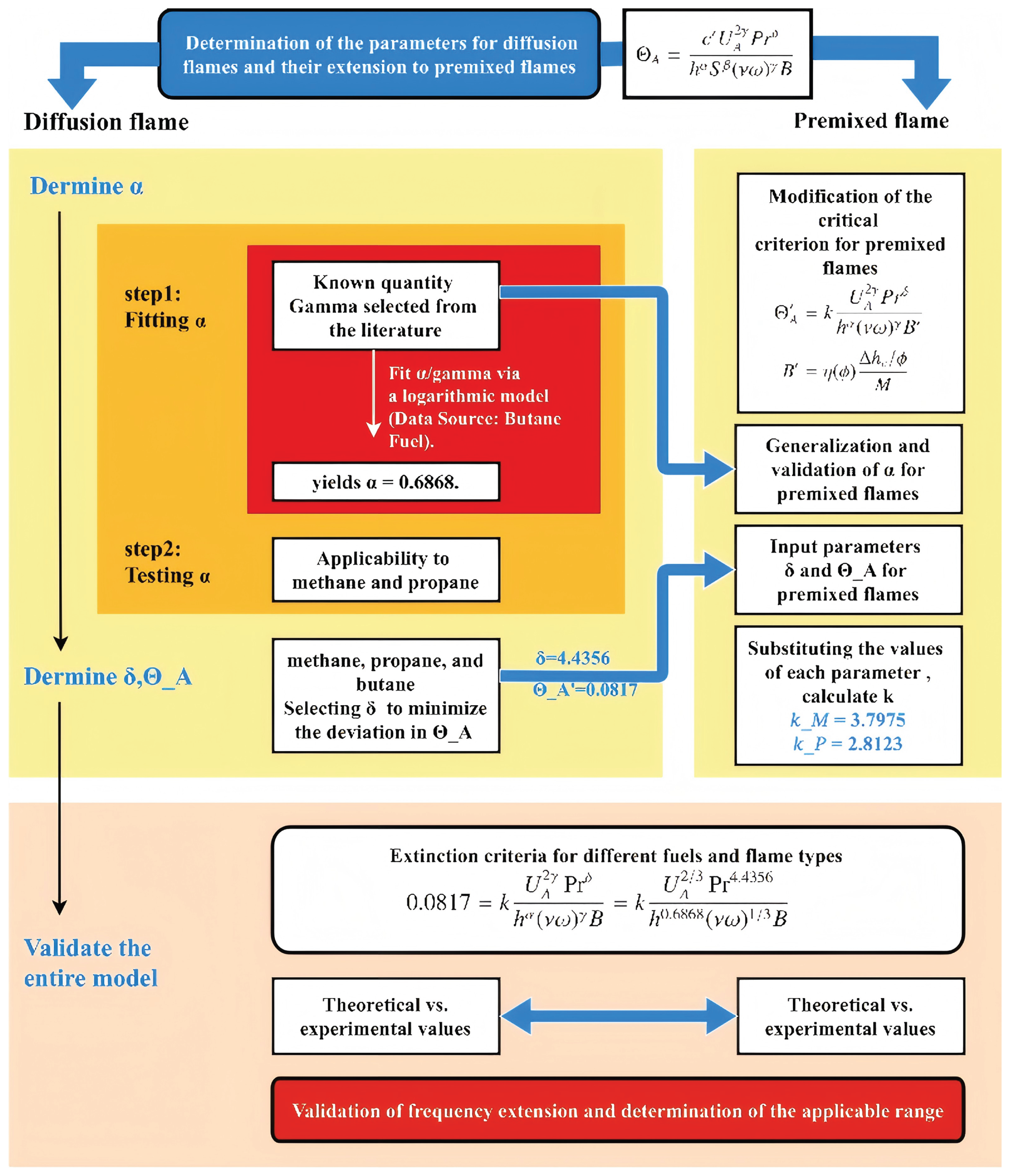
In the study by Friedman, A. N. [9], due to the selection of liquid fuels with similar Prandtl numbers, the influence of was considered approximately equal and thus directly neglected. Applying such an assumption to gaseous fuel diffusion and premixed flames is highly imprecise and would severely limit the theoretical applicability. Therefore, this study incorporates it into the discussion, and subsequent experiments demonstrate its significant impact on the critical extinction criterion for gaseous fuels. To simultaneously account for both the combustion type term k and the flame size term , the analytical approach and procedure for the experimental section of this paper are designed as follows, thereby yielding through experimental design a substantially expanded and more practically valuable multi-factor critical extinction criterion for acoustic fire extinguishment.
Figure 1.
Flowchart of the experimental analysis approach.
2.2.2. Fitting and Validation of the Flame Height Exponent for Diffusion Flames
Based on the mathematical characteristics of Equation (7) derived from the theoretical analysis, it can be fitted as follows to first obtain the empirical flame height parameter .
Considering experiments conducted with the same fuel under identical experimental conditions, and remain constant. The flame type factor k is defined as for diffusion flames, leading to Equation (9).
where C is a constant. Taking the logarithm of the above equation and rearranging terms yields Eq. (10).
After rearrangement, Eq. (11) is obtained.
By treating as a linear function of , the coefficient can be fitted using the least squares method based on experimental data.
Following the above fitting principle, MATLAB was used to fit the experimental data (covering different flame heights and acoustic frequencies). The calibration was performed using experimental data from butane gas diffusion flames. The average value from multiple fitting results was taken, yielding , and the fitting plot is shown in Figure 2.
As shown in Figure 2, the measured and fitted values of the critical acoustic particle velocity for extinction agree well for butane gas diffusion flames when (the slope of the fitted line in Figure 2 is 2.0603, which corresponds to , allowing the calculation of ).
Furthermore, to verify whether this value is applicable to other fuels, experiments were repeated using methane and propane gas fuels, substituting for validation, as shown in Figure 3.
It can be seen from Figure 3 that this value exhibits good applicability, with MREs all below 0.03. Therefore, is determined as the empirical flame height parameter for the experimental environment in this study.
It is worth noting that the value of is close to the exponent for , suggesting a possible proportional relationship between and the flame height h. Consequently, at the same frequency, there may exist a proportional relationship between the acoustic-induced particle velocity and the flame height h. Linear fitting of versus h with zero intercept was performed. The regression metrics for various fuels and flame types (Table 1) show and , confirming the validity of the scaling law (residual and fitting analysis plots are provided in the supplementary material).
It should be noted that this conclusion is limited to the experimental parameter range of this study; the value is still adopted in actual calculations to enhance universality. Nevertheless, this finding remains noteworthy.
2.2.3. Determination of the Prandtl Number Exponent and the Critical Extinction Criterion for Diffusion Flames
After determining , the determination and validation of the Prandtl number exponent are further considered. From Eq. (6), if the experimental environment remains unchanged, should be constant for different fuels, and the values of B and are determined under the same experimental conditions. For a given value of , the average of calculated within a specific fuel is taken as the value for that fuel under this . Using this method, the functions of versus for the three fuels are obtained. Since should remain the same across different fuels, the value that minimizes the coefficient of variation of is selected, simultaneously yielding , as illustrated in Figure 4.
Here, with a relatively large magnitude indicates that an increase in will significantly reduce the critical extinction velocity—a decrease in thermal diffusivity causes the unburned gas cooled after acoustic wave disturbance to be unable to receive prompt heat replenishment from the flame zone, thereby rendering the flame–fuel cycle more susceptible to disruption.
2.2.4. Validation of the Critical Extinction Criterion Model for Diffusion Flames
At this stage, the theoretical critical acoustic particle velocity for extinction can be calculated for diffusion flames. Data were selected for cases where either the flame heights of different fuels were identical or the acoustic excitation frequencies were the same, to validate the universality of the critical extinction criterion model for acoustic fire extinguishment under different experimental conditions. The validation results for propane are shown in Figure 5, with good agreement between theoretical and measured values (). The validation for methane under identical conditions is provided in the supplementary material; both results demonstrate that the model is applicable across different experimental condictions.
2.2.5. Generalization of Empirical Parameters for Premixed Flames and Determination of Flame Type Term k
For premixed flames, the calculation method for the mass transfer number B is first modified. Since in premixed flames the fuel and air are pre-mixed, the limiting factor for their burning rate differs from that of diffusion flames, which is limited by the air diffusion rate. Consequently, the terms and r in Eq. (2) for the mass transfer number of gaseous fuel diffusion flames are removed. The equivalence ratio (defined as the ratio of the theoretical air required for complete combustion to the actual air supplied) is used to describe the calorific value per unit mass of the premixed gas. Simultaneously, considering that unrealistically large mass transfer numbers may occur when the equivalence ratio is small, a combustion efficiency factor is introduced, as shown in Eq. (11).
For the critical extinction criterion of gaseous fuel premixed flames, is substituted for calculation, and different values of the flame type term k are considered. Since the equivalence ratio was controlled at in the experiments, is assumed by default.
To verify the applicability of the empirical parameters to premixed flames, the flame height term is first generalized. The fitted values calculated using are compared with the actual experimental data for acoustic extinction of methane and propane premixed flames, as shown in Figure 6.
From Figure 6, it can be seen that the diffusion flame height term also shows strong applicability to premixed flames under the experimental conditions. Therefore, by substituting the empirical parameters obtained from the diffusion flame study along with the critical particle velocity data for gaseous fuel premixed flame extinction, the flame type terms for methane and propane gas premixed flames at are derived as and , respectively. The k values for premixed flames calculated using the premixed flame experimental data and the empirical parameters are shown in Figure 7.
When the flame type and equivalence ratio remain constant, the k value is relatively stable across different frequencies. This indirectly reflects the universality of the empirical parameters determined under diffusion flame conditions when applied to premixed flames. It should be noted that Figure 7 is a summary of k values calculated separately under various factors such as different flame heights and acoustic frequencies, aiming to verify the applicability of the empirical parameters to different experimental conditions and the stability of the k value.
From Figure 7, it is evident that the k values for methane and propane premixed flames are not identical. The fuel dependence of the premixed flame type term k () reflects the fundamental differences among different fuels in terms of premixed combustion rate, reaction zone structure, and thermal diffusion characteristics [15]. It should be emphasized that the original flame–fuel cycle model was designed based on diffusion flames rather than premixed flames; however, its core lies in characterizing the disruption process of external aerodynamic perturbation on the flame–fuel thermal coupling, and this perturbation–response chain exhibits commonality between diffusion and premixed flames. The differences between the two are mainly manifested in the stability baseline (mass transfer B-number vs. modified B’-number) and response sensitivity ( vs. ). This study incorporates k as an empirical parameter into the generalized criterion; revealing its physical roots under a broader range of fuel types and equivalence ratios will refine the theoretical completeness of the model.
2.2.6. Determination of the Critical Extinction Criterion
After completing the above work, the values for different gaseous fuels and combustion types are plotted as shown in Figure 8.
As shown in Figure 8, the critical extinction criterion values for different fuels and flame types exhibit a stable and concentrated distribution. The value is adopted as the critical extinction criterion for gaseous fuel flames. It is noteworthy that this value was determined alongside in the diffusion flame experiments, and the determination process did not involve premixed flames. Nevertheless, after theoretical correction for premixed flames, this value is applicable to both diffusion flames and premixed flames at (where should be substituted for premixed flames).
Finally, the generalized quantitative critical extinction criterion formula for acoustic flame extinction based on the flame-fuel cycle model is as follows:
In this equation, is the root-mean-square critical linearized equivalent acoustic extinguishment velocity (on the order of mm/s), a reference velocity obtained from near-field sound pressure through conversion under plane-wave conditions. Its physical essence is a comprehensive perturbation intensity indicator lumping both the compressible acoustic wave component and the incompressible diaphragm-induced flow component. Within the 30–80 Hz range, this linearized parameter suffices to characterize the dominant perturbation intensity, with serving as a dimensionless extinction parameter capturing the stability threshold of the flame–fuel thermal coupling system; the applicable boundary of this linear model will be revealed through broadband experiments in subsequent sections.
The flame type term for diffusion flames; for methane and propane gas premixed flames at , the values are and , respectively.
2.2.7. Comparison of Critical Particle Velocities between Premixed and Diffusion Flames
Furthermore, a comparison is made of the critical particle velocities required for acoustic extinction between methane and propane diffusion flames and premixed flames at under the same flame height and identical acoustic frequency, as shown in Figure 9.
In Figure 9, it can be clearly observed that, under otherwise identical experimental conditions, the critical particle velocity required to extinguish premixed flames with is significantly higher than that for diffusion flames. Substituting the previously determined premixed flame type term into Eq. (7) does not imply a decrease in the critical particle velocity. The primary reason for the increased critical particle velocity for premixed flames here is the significant increase in the mass transfer number B and the kinematic viscosity of air . The magnitude of increase in these two factors exceeds the actual increase in the critical particle velocity observed in the premixed flame experiments. The condition precisely reflects the more macroscopic adjustment role of the flame type term in calculating the critical particle velocity for different flame combustion types.
3. Discussion and Implications of Derived Phenomena
3.1. Acoustic-Induced Flame Necking–Fracture: Morphological Evidence of Pre-Extinction Precursors and Dynamic Instability Pathways
Observations from high-speed camera experiments reveal that, due to acoustic interference during upward development, diffusion flames exhibit localized significant thinning, which subsequently leads to partial flame fracture. We term this phenomenon “acoustically induced flame necking and fracture.” To investigate this phenomenon in depth, while keeping other conditions constant, a comparison of the single-cycle flame necking and fracture behavior was conducted for propane diffusion flames with heights of 3.00, 4.00, and 5.00 under a 30 acoustic frequency, as shown in Figure 10.
From the aforementioned phenomena, it can be clearly observed that as the flame height continuously increases, the flame volume separated from the main body likewise increases. One plausible explanation for this phenomenon is that the acoustic-induced oscillatory flow excites instabilities in the flame shear layer (such as Kelvin–Helmholtz-type shear instability) [16], leading to intense periodic shearing and stretching effects on the flame surface, and potentially generating vortex structures that cause its detachment [17], thereby resulting in flame necking and fracture. It is noteworthy that this phenomenon becomes pronounced only when the acoustic-induced particle velocity approaches the critical extinction value , suggesting that necking–fracture may serve as a visualizable precursor of flame–fuel cycle destabilization, which provides independent morphological corroboration for the physical validity of as an extinction criterion. This concomitant relationship indicates that the acoustic fire extinguishment process follows a well-defined flame dynamic instability pathway, which holds independent value for understanding the extinction boundary. The aforementioned mechanism is currently proposed based on high-speed imaging, and direct diagnosis of its flow field structure awaits deepening through advanced experimental techniques.
3.2. The 90 Critical Transition: Mechanism Breakthrough Transition from Linear Acoustic-Induced Vibration to Nonlinear Acoustic Streaming and Model Failure Boundary
3.2.1. Experimental Discovery of the Anomalous Phenomenon
In the preceding experiments, the critical particle velocities for extinction of both methane and propane diffusion flames exhibited a trend where the actual values increased with acoustic frequency at a rate exceeding theoretical predictions. Although for the primary frequency range of acoustic fire extinguishment at 80 Hz and below, this deviation remained within acceptable limits, this systematic departure implies that the flame–fuel cycle model proposed by Friedman, A. N. possesses an inherent frequency applicability boundary. To clarify this applicable limit and investigate the transition of fire extinguishment mechanisms in the high-frequency regime, this study extended the experimental frequency band to 130, conducting systematic measurements of the critical particle velocities for extinction of methane and propane gaseous fuels under both diffusion and premixed flame conditions across a broader frequency range.
The experimental results are shown in Figure 11. It can be clearly observed that when the frequency is below 90, the measured critical particle velocities agree well with the theoretical values calculated from Equation (14), with relative errors maintained within ±5%, validating the predictive capability of the generalized extinction criterion in this frequency band. However, when the frequency exceeds 90, the growth rate of the measured critical particle velocity with increasing frequency accelerates significantly, producing a systematic deviation from the model theoretical values, with the magnitude of deviation expanding sharply as the frequency rises. At 130, the measured values exceed the theoretical predictions by over 140%, indicating that the original linear model has completely failed.
3.2.2. Physical Mechanism of the Breakthrough Transition
The essence of the aforementioned 90hertz critical transition phenomenon lies in the transition of the dominant fire extinguishment mechanism from "periodic thermal coupling weakening driven by acoustic-induced linearized equivalent particle vibration" to "combined action of linear vibration and nonlinear acoustic streaming," stemming from the nonlinear enhancement of the incompressible component (diaphragm-induced flow) relative to the compressible component (acoustic wave) in the loudspeaker near-field velocity field, causing the linearized equivalent indicator to become invalid. This transition is synergistically driven by the following physical factors:
1) Stokes viscous boundary layer thinning and sharp increase in velocity gradient:
The oscillatory flow induced by acoustic waves within the fluid boundary layer possesses a characteristic penetration depth—the Stokes viscous boundary layer thickness (, unit: m), defined as [16]:
where is the angular frequency, in rad/s. Estimating with air at room temperature (300K ), m²/s, at 30hertz 0.40mm, while at 100hertz 0.22mm —a thinning magnitude of approximately 45%. The boundary layer thinning causes the velocity gradient near the flame surface to increase sharply, significantly enhancing the energy dissipation required for acoustic waves to penetrate the flame shear layer; the linearized reciprocating particle motion is no longer sufficient to characterize the actual momentum transport intensity.
2) Significant enhancement of nonlinear acoustic streaming effects:
When the acoustic pressure amplitude is high and the frequency increases, the acoustic streaming produced by second-order nonlinear acoustic effects—that is, the unidirectional net flow in the time-averaged sense—begins to contribute significantly to flame perturbation. According to the classical theories of Lighthill [12] and Nyborg [13], the acoustic streaming velocity (unit: m/s) is proportional to the square of the acoustic pressure (), with the scaling relation:
where is the ambient fluid density, in kg/m³; is the ambient sound speed, in m/s. This implies that even if converted from grows only linearly with frequency, the actual acoustic streaming transport intensity may nonlinearly enhance due to the relationship. In the frequency band above 90 Hz, the unidirectional net flow induced by acoustic streaming superimposes upon the linear oscillatory perturbation, transforming the flame–fuel cycle disruption mechanism from a "periodic alternating thermal coupling weakening" mode to a composite mode of "unidirectional net flow transport enhancement + periodic perturbation." The original model, lacking explicit inclusion of acoustic streaming contributions, cannot capture this mechanism transition.
3) Nonlinear transformation of flame response modes:
Wang et al. [18] studied the high-frequency response of non-premixed flames, demonstrating that under 100 Hz acoustic excitation, flames exhibit multiple heat release regions and significant length contraction, with the flame response to high-frequency perturbation displaying strong nonlinear characteristics fundamentally distinct from the overall oscillation mode at low frequencies. The anomalous increase in critical particle velocity above 90 Hz observed in this study forms a cross-experimental correspondence with Wang et al.’s findings, jointly pointing to the essential transformation of flame dynamic behavior in the high-frequency regime: the flame no longer acts as a "rigid body" passively responding to acoustic oscillation, but rather actively dissipates acoustic energy through nonlinear processes such as internal vortex generation, local strain rate enhancement, and heat release pulsation, causing the effective perturbation intensity required for fire extinguishment to far exceed linear predictions. This nonlinear response mode is well-supported by combustion literature [15, 18], with its physical root lying in the inherent nonlinear characteristics of the flame surface as a strong density discontinuity.
3.2.3. Self-Consistency Validation of Linear Model Assumptions, Failure Boundary Definition, and Extension Directions
The treatment logic of defining as the "critical linearized equivalent acoustic extinguishment velocity" in this study receives self-consistent validation in this critical transition analysis:
30–80 Hz validation zone: The relationship between critical and flame height h and frequency conforms to the linear scaling law (see Section 1.2.2), indicating that the critical linearized equivalent acoustic extinguishment velocity suffices to characterize the dominant perturbation intensity, and the model assumption holds;
90–130 Hz failure zone: The scaling law breaks down systematically, with the linear growth of unable to compensate for the nonlinear growth of the actual required perturbation intensity, and the model assumption fails.
This failure boundary reveals the necessity of introducing additional nonlinear parameters when exceeding the linear assumption. Based on the above mechanism analysis, the following modified criterion can be proposed:
This extended model (Equation 15) provides a theoretical framework for unified description of linear and nonlinear acoustic fire extinguishment mechanisms; its rigorous validation requires calibration of the coupling coefficient through PIV flow field diagnostics. This direction will propel acoustic fire extinguishment theory from "linearized equivalent description" toward "nonlinear mechanism resolution."
4. Conclusion
Addressing the research gap in multi-factor quantitative critical extinction criteria for acoustic fire extinguishment, this study adopts the acoustic fire extinguishment model proposed by Friedman, A. N. [9], which centers on the flame–fuel cycle, and performs corrections and supplements to its physical logic chain, systematically breaking through the threefold limitations of the original model—fuel state limitation (only liquid fuels with similar Prandtl numbers), physical property assumption limitation (neglect of Prandtl number differences), and frequency blind zone (undefined applicability boundary).
1) Theoretical framework breakthrough: establishment of the generalized multi-factor extinction criterion. By constructing the Spalding B-number for gaseous fuel combustion, and introducing the flame geometric characteristic term , L and the combustion type term k, this study extends the original theory from liquid fuels to gas premixed flames and diffusion flames, establishing a generalized acoustic extinction criterion model that uniformly considers flame size, combustion type, and fuel physical properties. The key parameters of the generalized extinction criterion (Equation 14) are determined experimentally; this criterion is applicable to both diffusion flames (k = 1) and premixed flames ( = 3.7975, = 2.8123). The successful transition from qualitative description to quantitative predictive toolization is achieved.
2) Key mechanism discovery: first experimental definition of the linear/nonlinear mechanism transition and frequency applicability boundary. By extending the experimental frequency band to 130hertz, this study discovers for the first time through experiments the anomalous increase in the critical particle velocity for fire extinguishment above 90hertz. The research demonstrates that within the 30–80 Hz range, the critical linearized equivalent acoustic extinguishment velocity dominates the fire extinguishment process; above 90hertz, the Stokes viscous boundary layer thins significantly, nonlinear acoustic streaming effects begin to contribute substantially, and the fire extinguishment mechanism undergoes an essential transition. The experimental definition of this failure boundary provides a critical supplement to the completeness of acoustic fire extinguishment theory, and also offers theoretical basis for the design of high-frequency acoustic fire extinguishment equipment.
3) Correlational cognition of flame dynamic behavior and pre-extinction precursors. Through high-speed imaging systems, this study captures the acoustic-induced flame necking and fracture phenomena, discovering that these phenomena become pronounced only when the particle velocity approaches the critical extinction value , suggesting that necking–fracture may serve as a visualizable precursor of flame–fuel cycle destabilization, providing independent morphological corroboration for the physical validity of as an extinction criterion.
The generalized extinction criterion established in this study has already covered the linearized equivalent acoustic fire extinguishment frequency band (3080hertz) for gaseous fuel diffusion and premixed flames, and has experimentally defined for the first time the mechanism transition boundary above 90hertz. The following three aspects constitute priority paths for subsequent systematic research, to propel acoustic fire extinguishment theory from a "linearized equivalent description" toward a complete framework of "nonlinear mechanism resolution":
- Core completion: refinement of the model’s geometric universality. The current criterion has been validated under controlled burner size conditions. Extension to non-uniform combustion scenarios awaits systematic calibration of the function form.
- Mechanism deepening: The nonlinear modified criterion proposed in Equation (15) provides a theoretical framework for unified description of linear and nonlinear mechanisms; subsequent research will combine PIV flow field diagnostics to calibrate the coupling coefficient , establishing a unified predictive model covering the full frequency band, and revealing the morphological transformation of flame dynamic behavior in the high-frequency regime.
- Fuel expansion: The response differences of different fuels and combustion types to the nonlinear mechanism transition await systematic revelation under a broader range of fuel types and operating conditions, to refine the theoretical foundation of the model.
Funding
This work was supported by the National Training Program of lnnovation and Entrepreneurship for Undergraduates.
Author Contributions: Guo Mengze
Conceptualization, Methodology, Validation, Investigation, Resources, Data Curation, Writing - Original Draft, Writing - Review & Editing, Project administration. Zhang Jieming: Methodology, Software, Validation, Formal analysis, Data Curation. Guo Yuning: Writing - Review & Editing, Supervision, Resources. Pan Jiani: Software, Writing - Original Draft, Visualization. Zhao Shumin: Writing - review & editing, Writing - original draft, Supervision, Methodology, Investigation. Deng Qinghua: Resources, Funding Acquisition, Supervision. Fang Aiping: Resources, Supervision, Funding Acquisition. Cao Wen: Writing - Review & Editing, Supervision, Resources, Project Administration, Funding Acquisition.
Conflicts of Interest
The authors declare that they have no known competing financial interests or personal relationships that could have appeared to influence the work reported in this paper.
References
- Zhu, J.; She, P.; Li, W.; et al. Dynamic planning of indoor fire escape routes based on navigation grid. J. Southwest Jiaotong Univ. (in Chinese). 2020, 55, 1103–1110. [Google Scholar]
- Alexander, A.A. Study of Sound Wave as a Flame Extinguisher. Master’s thesis, Universiti Teknologi PETRONAS, Bandar Seri Iskandar, Malaysia, 2015. [Google Scholar]
- Niegodajew, P.; ukasiak, K.; Radomiak, H.; Musial, D.; Zajemska, M.; Poskart, A.; Gruszka, K. Application of acoustic oscillations in quenching of gas burner flame. Combust. Flame 2018, 194, 245–249. [Google Scholar] [CrossRef]
- Shi, X.; Zhang, Y.; Chen, X.; et al. Instability characteristics of pool fire flame under transverse acoustic perturbation. J. Southwest Jiaotong Univ. (in Chinese). 2022, 57, 1293–1302. [Google Scholar]
- Gore, S.R.; Panchpor, J.U.; Vaidya, S.M.; Patkar, K.S. Study of Acoustic Waves for Fire Extinguishment: A Review. MIT Int. J. Mech. Eng. 2018, 4, 23–27. [Google Scholar]
- Xiong, C.; Wang, Z.; Huang, X. Acoustic flame extinction by the sound wave or speaker-induced wind? Fire Saf. J. 2021, 126, 103479. [Google Scholar] [CrossRef]
- Cliftmann, J.M.; Anderson, B.E. Remotely extinguishing flames through transient acoustic streaming using time reversal focusing of sound. Sci. Rep. 2024, 14, 30049. [Google Scholar] [CrossRef] [PubMed]
- Zhang, Y.; Jamil, H.; Wei, Y.; Yang, Y. Displacement and Extinction of Jet Diffusion Flame Exposed to Speaker-Generated Traveling Sound Waves. Appl. Sci. 2022, 12(24), 12978. [Google Scholar] [CrossRef]
- Friedman, A.N. Interaction of Acoustic Waves with a Laminar Line-Flame. Master’s thesis, University of Maryland, College Park, MD, USA, 2016. [Google Scholar]
- Quintiere, J.G. Fundamentals of Fire Phenomena; John Wiley & Sons: Chichester, UK, 2006. [Google Scholar]
- Du, G. Fundamentals of Acoustics, (in Chinese), 2 ed.; Nanjing University Press: Nanjing, China, 2009. [Google Scholar]
- Lighthill, M. Acoustic streaming. J. Sound. Vib. 1978, 61(3), 391–418. [Google Scholar] [CrossRef]
- Nyborg, W. Acoustic streaming. Phys. Acoust. 1965, 2(B), 265–331. [Google Scholar]
- Linstrom, P.J.; Mallard, W.G. NIST Chemistry WebBook, NIST Standard Reference Database Number 69; National Institute of Standards and Technology: Gaithersburg, MD, 2023; Available online: https://webbook.nist.gov2023); (accessed on Nov 2025).
- Peters, N. Turbulent Combustion; Cambridge University Press: Cambridge, UK, 2000. [Google Scholar]
- Schlichting, H.; Gersten, K. Boundary-Layer Theory, 11 ed.; Springer-Verlag: Berlin Heidelberg, 2017. [Google Scholar]
- Ahn, K.; Yu, K.H. Effects of Damköhler number on vortex–flame interaction. Combust. Flame 2012, 159, 686–696. [Google Scholar] [CrossRef]
- Wang, H.; et al. Acoustic streaming. Phys. Acoust. 1965, 2(B), 265–331. [Google Scholar]
Figure 2.
Calibration fitting for the butane diffusion flame height term.
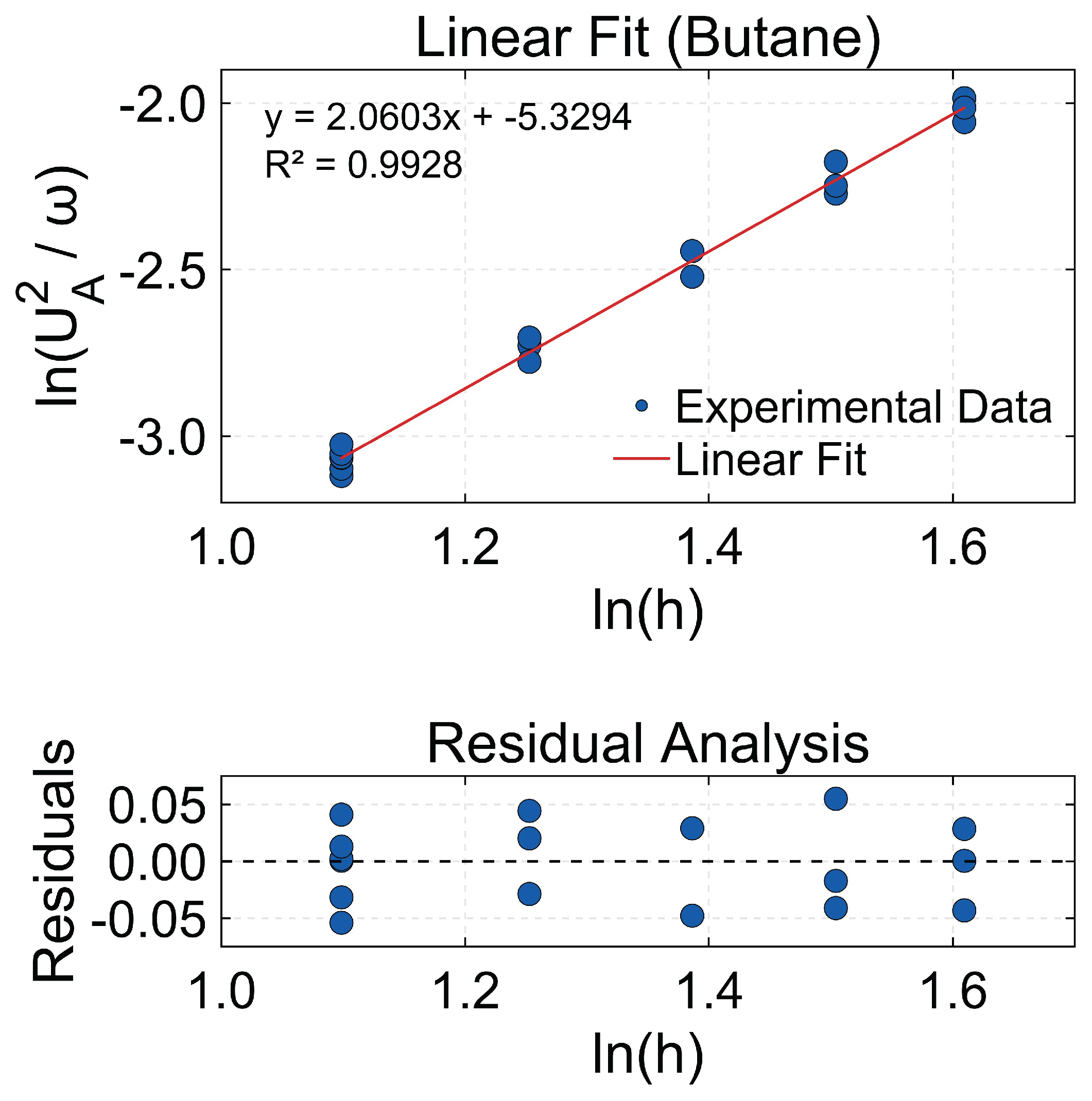
Figure 3.
Validation of the flame height term for diffusion flames () (a) Methane(b) Propane .
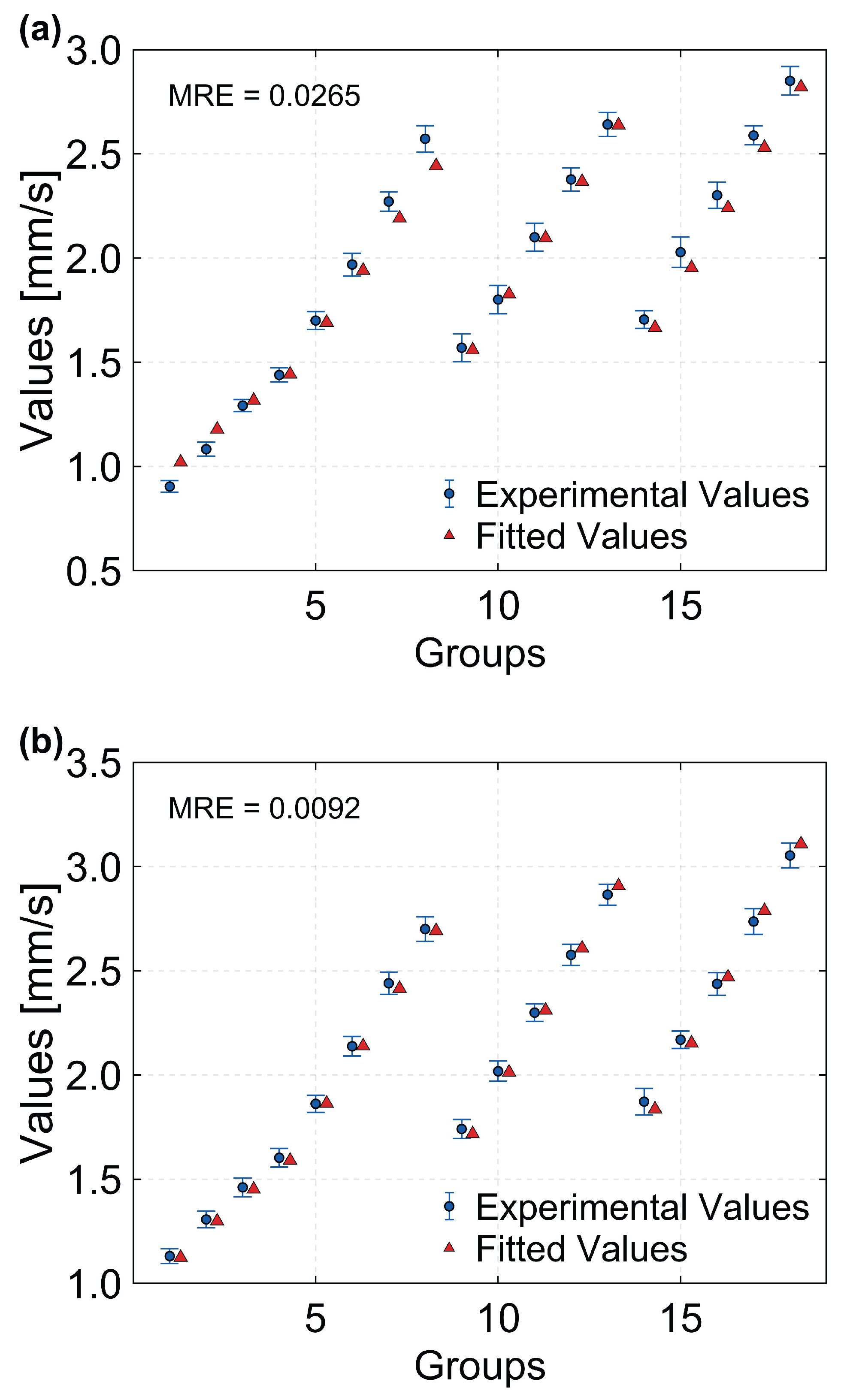
Figure 4.
Determination of and (; ).
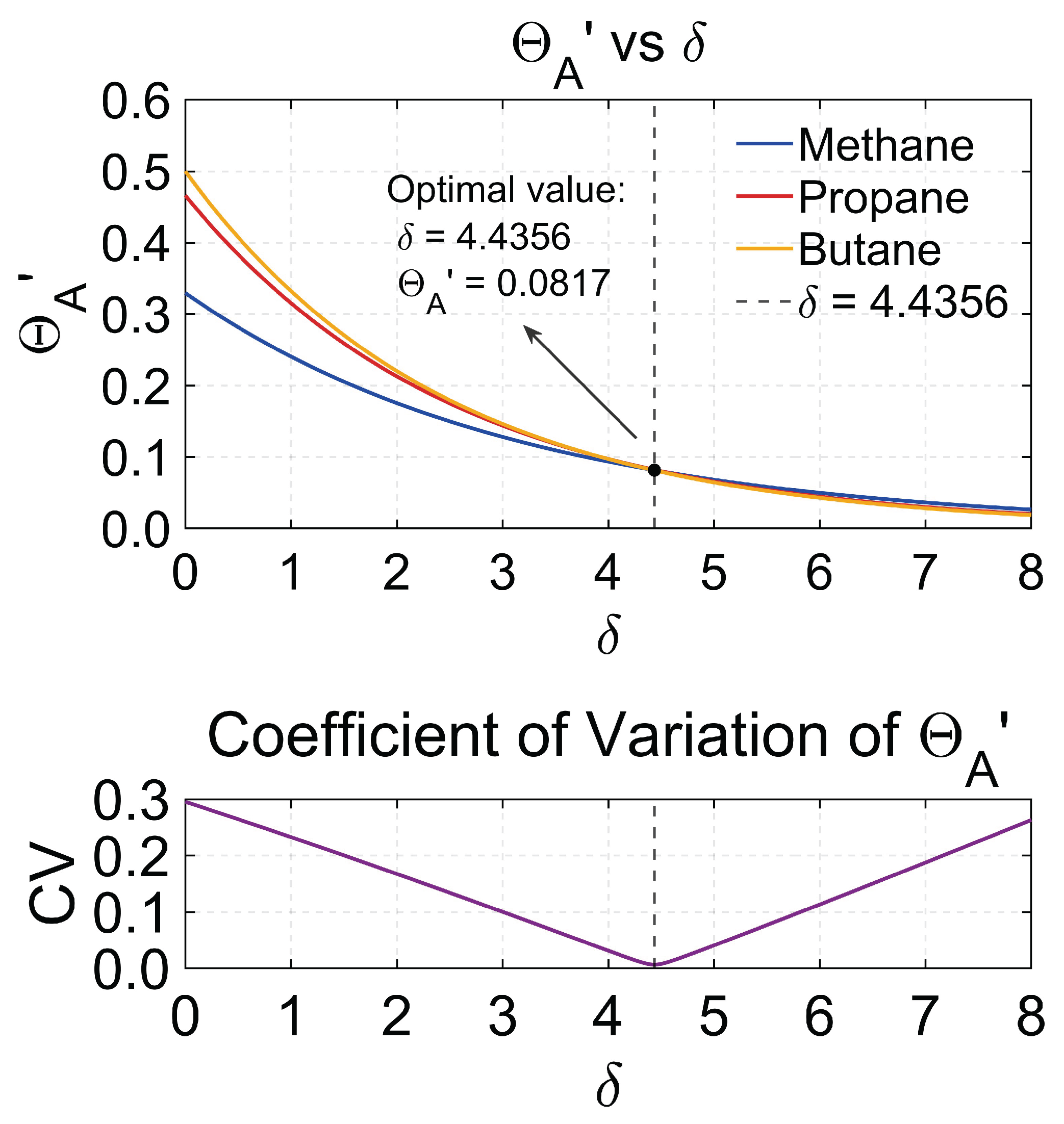
Figure 5.
Validation of the universality of the critical extinction criterion for propane diffusion flames under different experimental conditions (; ; ) (a) , Hz (b) Hz, –5.0 (c) Hz, –5.0 (d) Hz, –5.0 .
Figure 5.
Validation of the universality of the critical extinction criterion for propane diffusion flames under different experimental conditions (; ; ) (a) , Hz (b) Hz, –5.0 (c) Hz, –5.0 (d) Hz, –5.0 .
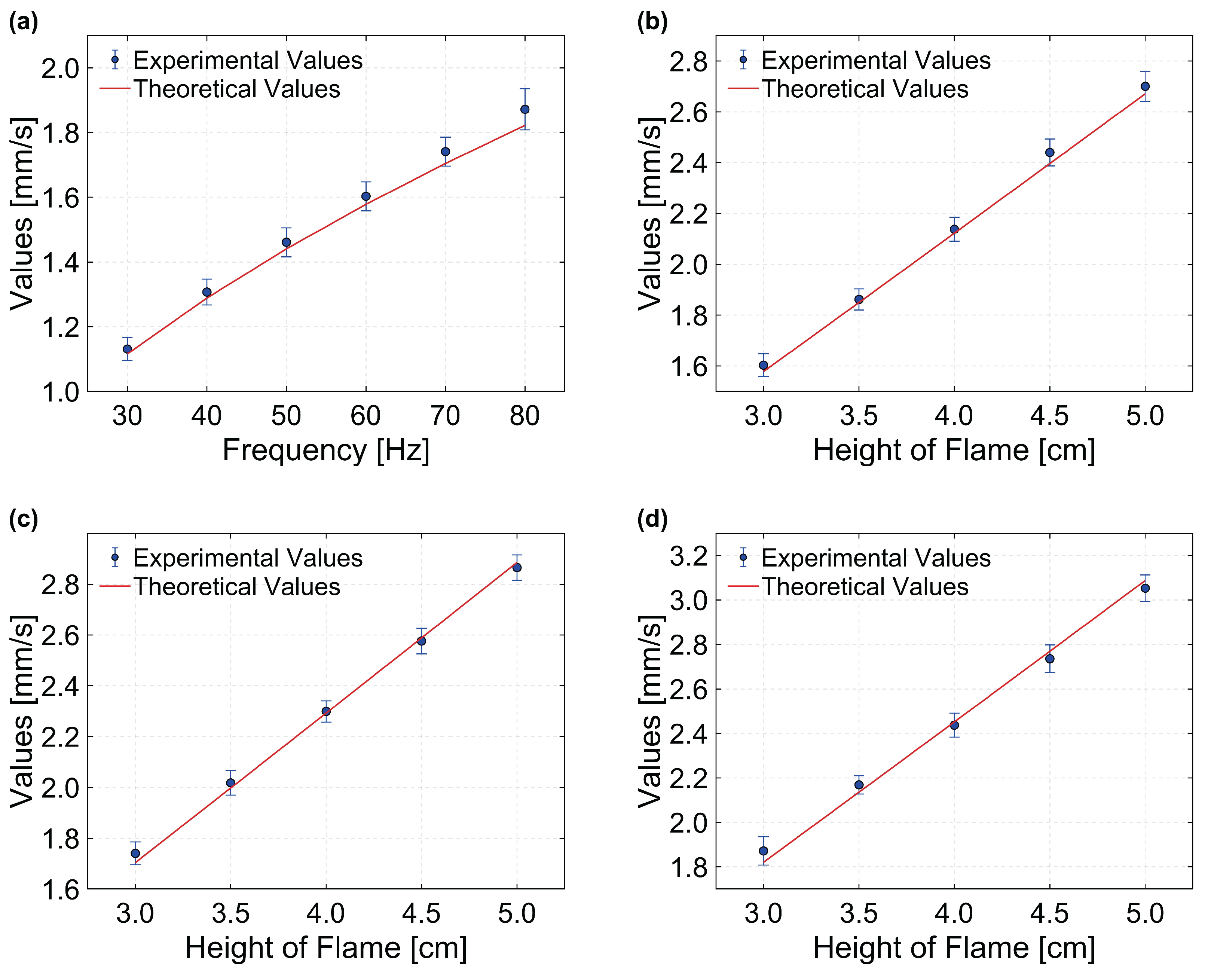
Figure 6.
Validation of the flame height term for methane and propane premixed flames () (a) Methane (b) Propane.
Figure 6.
Validation of the flame height term for methane and propane premixed flames () (a) Methane (b) Propane.
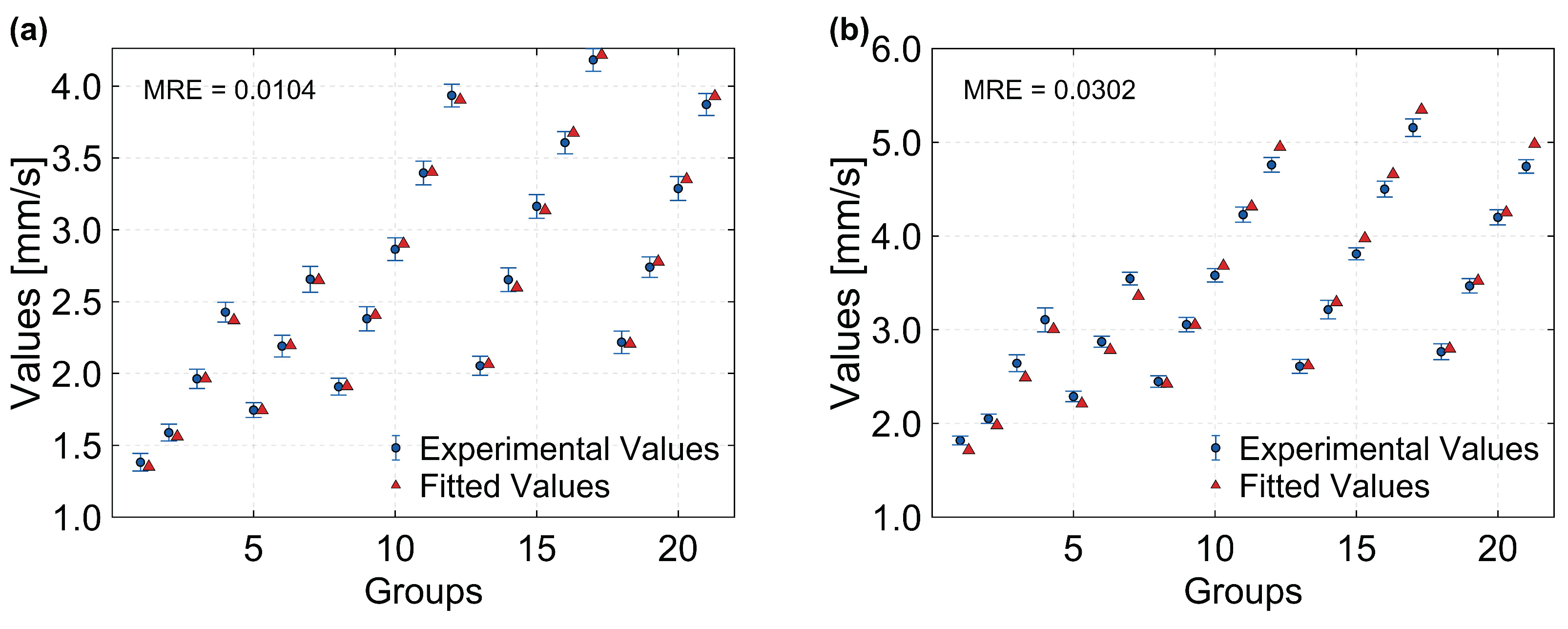
Figure 7.
Flame type term k for methane and propane premixed flames at equivalence ratio .
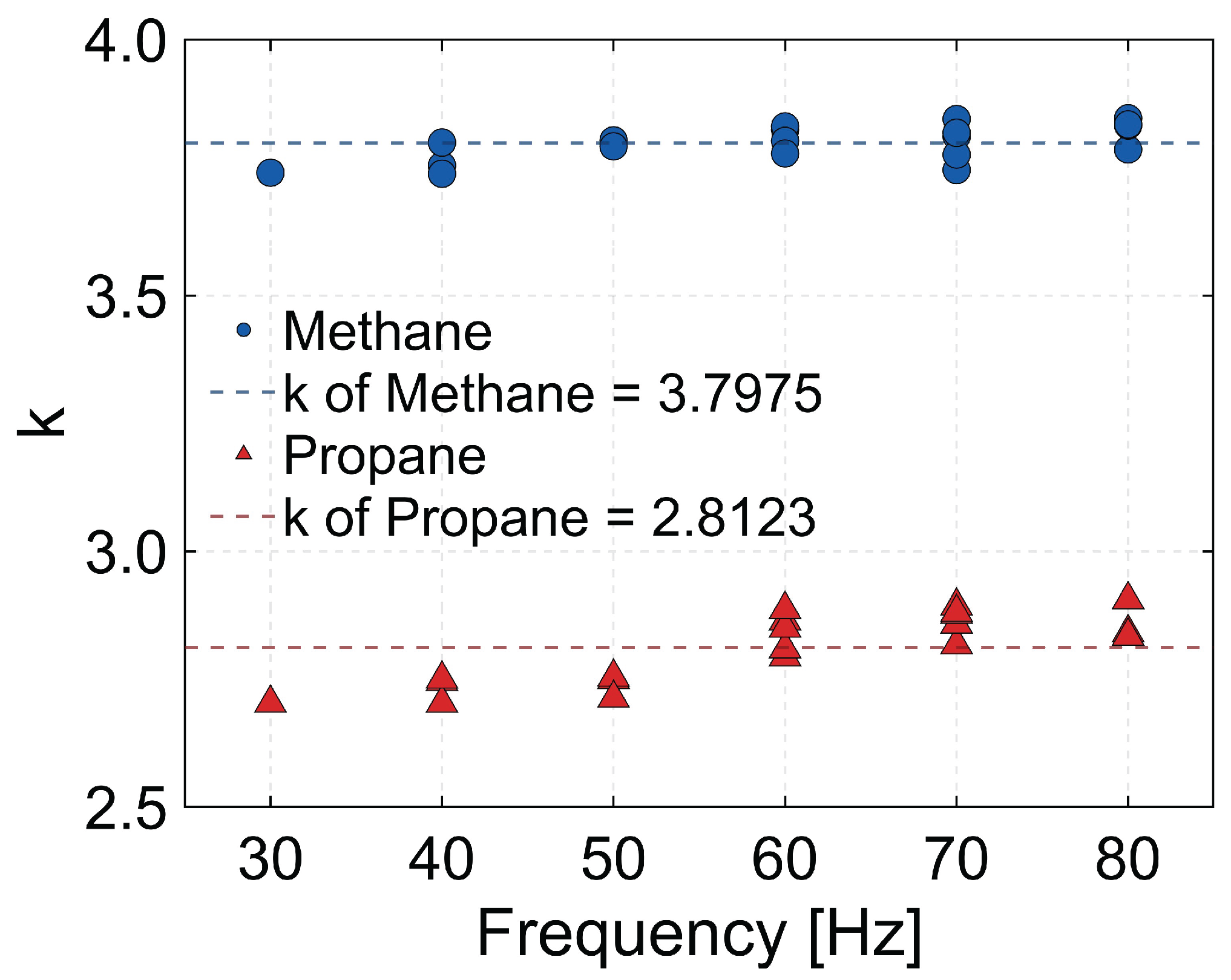
Figure 8.
Critical extinction criterion for different fuels and flame types.
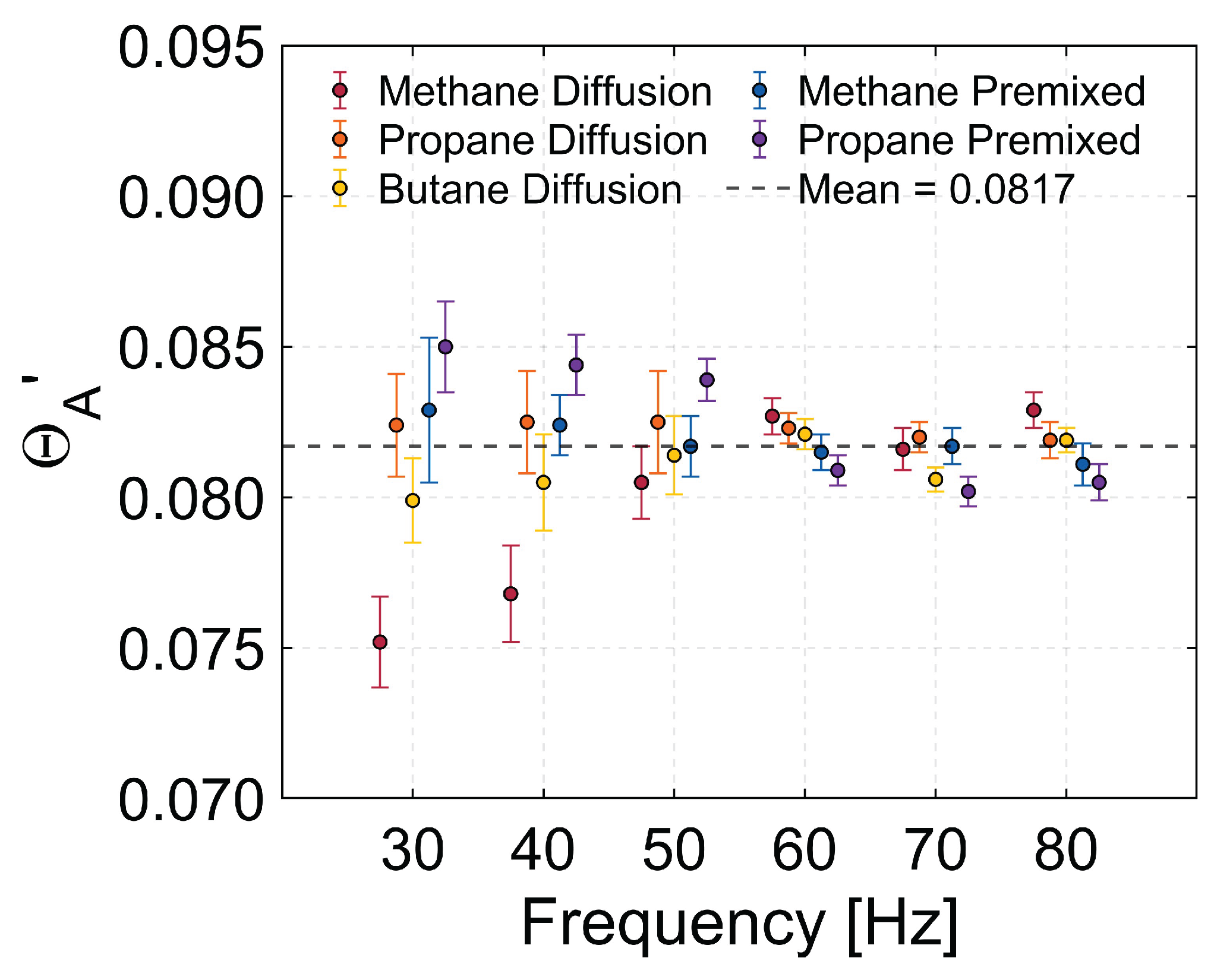
Figure 9.
Comparison of critical particle velocities between diffusion and premixed flames (a) Methane (b) Propane.
Figure 9.
Comparison of critical particle velocities between diffusion and premixed flames (a) Methane (b) Propane.
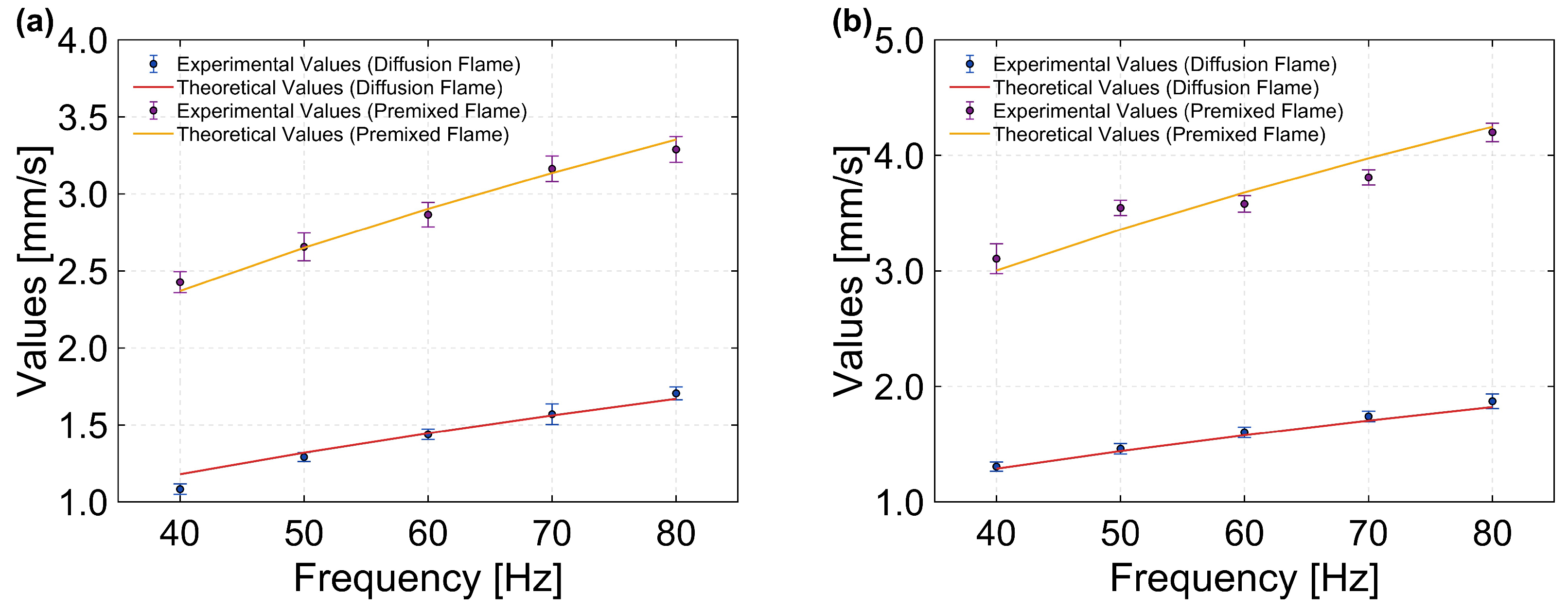
Figure 10.
Single-cycle flame necking and fracture phenomena (30 Hz sine wave, propane diffusion flames) (a) 3.00 (b) 4.00 (c) 5.00.
Figure 10.
Single-cycle flame necking and fracture phenomena (30 Hz sine wave, propane diffusion flames) (a) 3.00 (b) 4.00 (c) 5.00.
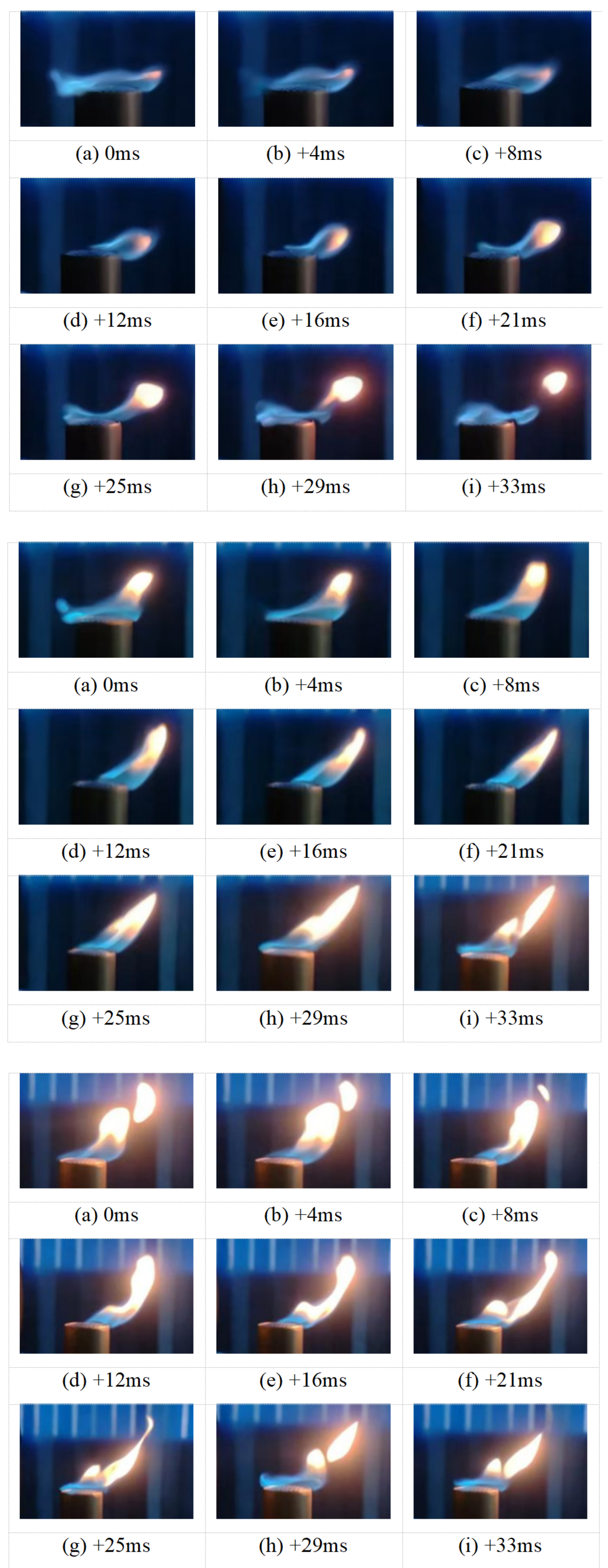
Figure 11.
Comparison of theoretical and measured critical particle velocities at 30–130 Hz: (a) methane diffusion flame; (b) methane premixed flame; (c) propane diffusion flame; (d) propane premixed flame.
Figure 11.
Comparison of theoretical and measured critical particle velocities at 30–130 Hz: (a) methane diffusion flame; (b) methane premixed flame; (c) propane diffusion flame; (d) propane premixed flame.
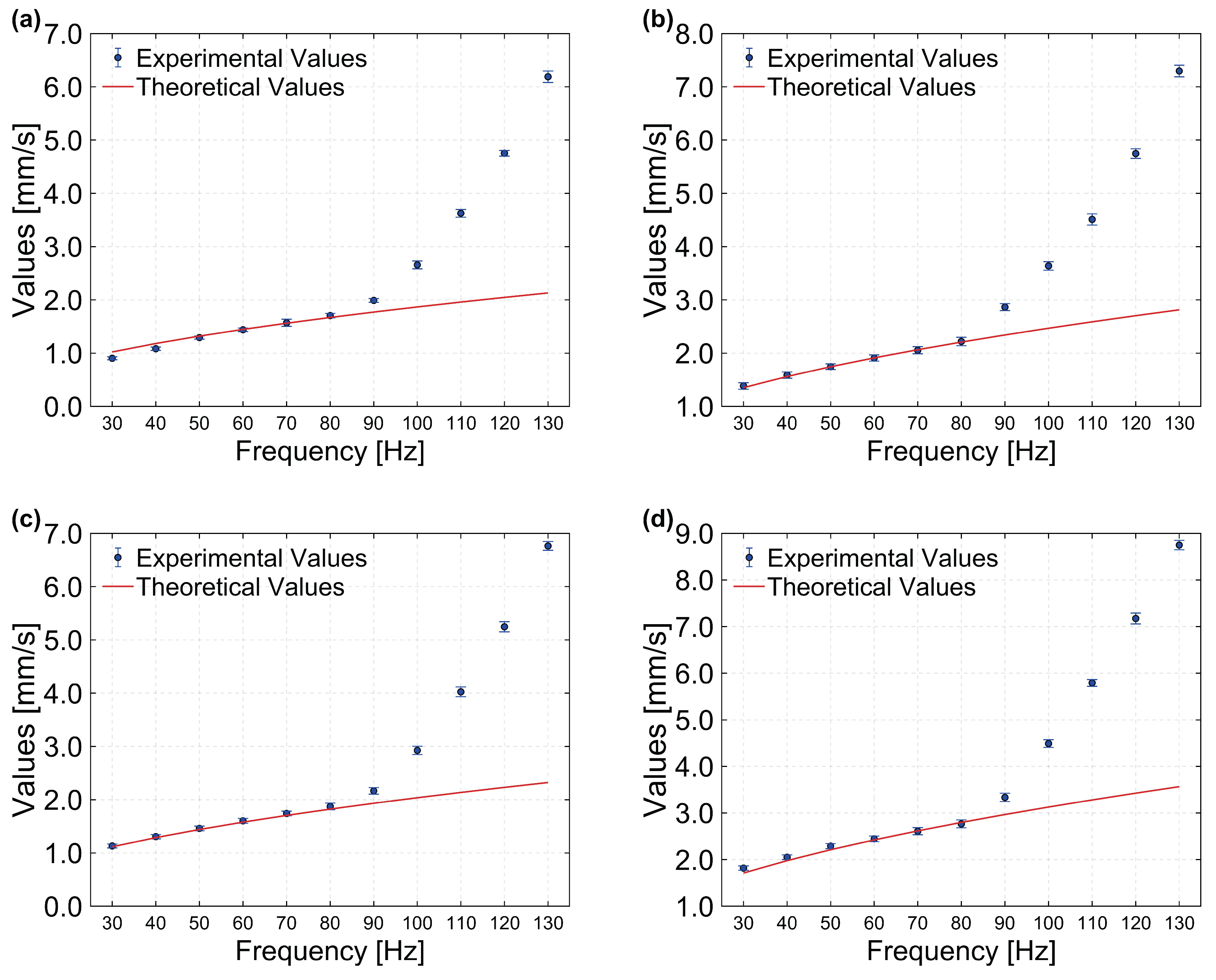

Table 1.
Regression model metrics for different fuels and flame types.
| Fuel | Flame type | K estimate | Std. Error | T value | p-value |
|---|---|---|---|---|---|
| Butane | Diffusion | ||||
| Methane | Diffusion | ||||
| Methane | Premixed | ||||
| Propane | Diffusion | ||||
| Propane | Premixed |
Disclaimer/Publisher’s Note: The statements, opinions and data contained in all publications are solely those of the individual author(s) and contributor(s) and not of MDPI and/or the editor(s). MDPI and/or the editor(s) disclaim responsibility for any injury to people or property resulting from any ideas, methods, instructions or products referred to in the content. |
© 2026 by the authors. Licensee MDPI, Basel, Switzerland. This article is an open access article distributed under the terms and conditions of the Creative Commons Attribution (CC BY) license (http://creativecommons.org/licenses/by/4.0/).
Copyright: This open access article is published under a Creative Commons CC BY 4.0 license, which permit the free download, distribution, and reuse, provided that the author and preprint are cited in any reuse.


