
Submitted:
14 May 2026
Posted:
15 May 2026
You are already at the latest version
Abstract
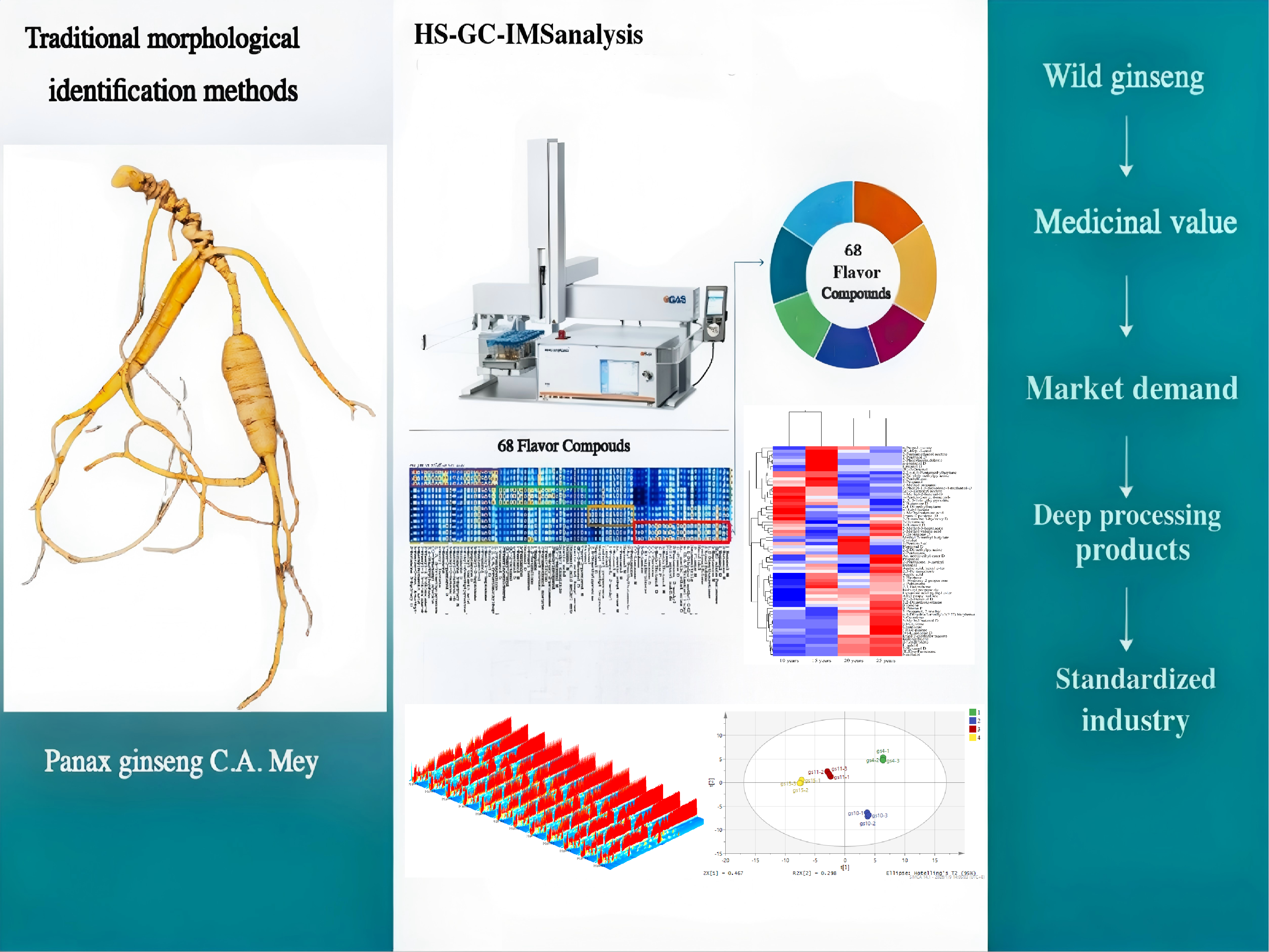
The volatile compounds(VOCs) evolution of wild ginseng (WG) across growth years is not a unidirectional process but a divergent remodeling of the chemical fingerprint. In this study, HS-GC-IMS combined with chemometrics was employed to characterize the dynamic changes of VOCs in WG at four growth stages(10, 15, 20, and 25 years; n≥15 per group). A total of 68 VOCs were tentatively identified and semi-quantified, encompassing terpenes, aldehydes, ketones, alcohols, esters, pyrazines, and other classes. Among them, terpenes and pyrazines exhibited the most pronounced directional trends, marking the divergent evolution: terpenes such as camphene, (E,E)-α-farnesene, and β-ionone accumulated progressively (increases of 242%, 74.6%, and 93.4% from 10 to 25 years, respectively), whereas pyrazines including 2,3,5-trimethylpyrazine and 2,5-dimethylpyrazine declined continuously (decreases of 58.2% and 53.3%, respectively). In contrast, the majority of compounds(66%) displayed non-monotonic patterns, including stage-specific metabolic peaks and environmentally driven fluctuations, underscoring the complexity of this divergent evolution. Partial least squares-discriminant analysis (PLS-DA) effectively distinguished samples across growth years (R²Y=0.997, Q²=0.993), with a 200-times permutation test confirming no overfitting(R²=0.136,Q² intercept=−0.505). Twenty-nine differential compounds with variable importance in projection (VIP)>1 were identified as potential chemical markers, and a multi-marker combinatorial system was tentatively established for discriminating three growth stages (10–15, 15–20, and 20–25 years). These findings provide chemical evidence that WG flavor quality evolves divergently over time, suggesting that VOCs fingerprint could serve as a supplementary tool for growth-year assessment, particularly for "high-quality but poor-shape" specimens that are undervalued by traditional morphology-based methods.
Keywords:
wild ginseng
; growth years
; quality assessment
; flavor compounds
; gas chromatographyion mobility spectrometry (GC-IMS)
; chemical fingerprint
; partial least squares-discriminant analysis (PLS-DA)
Copyright: This open access article is published under a Creative Commons CC BY 4.0 license, which permit the free download, distribution, and reuse, provided that the author and preprint are cited in any reuse.


