
Submitted:
13 May 2026
Posted:
15 May 2026
You are already at the latest version
Abstract
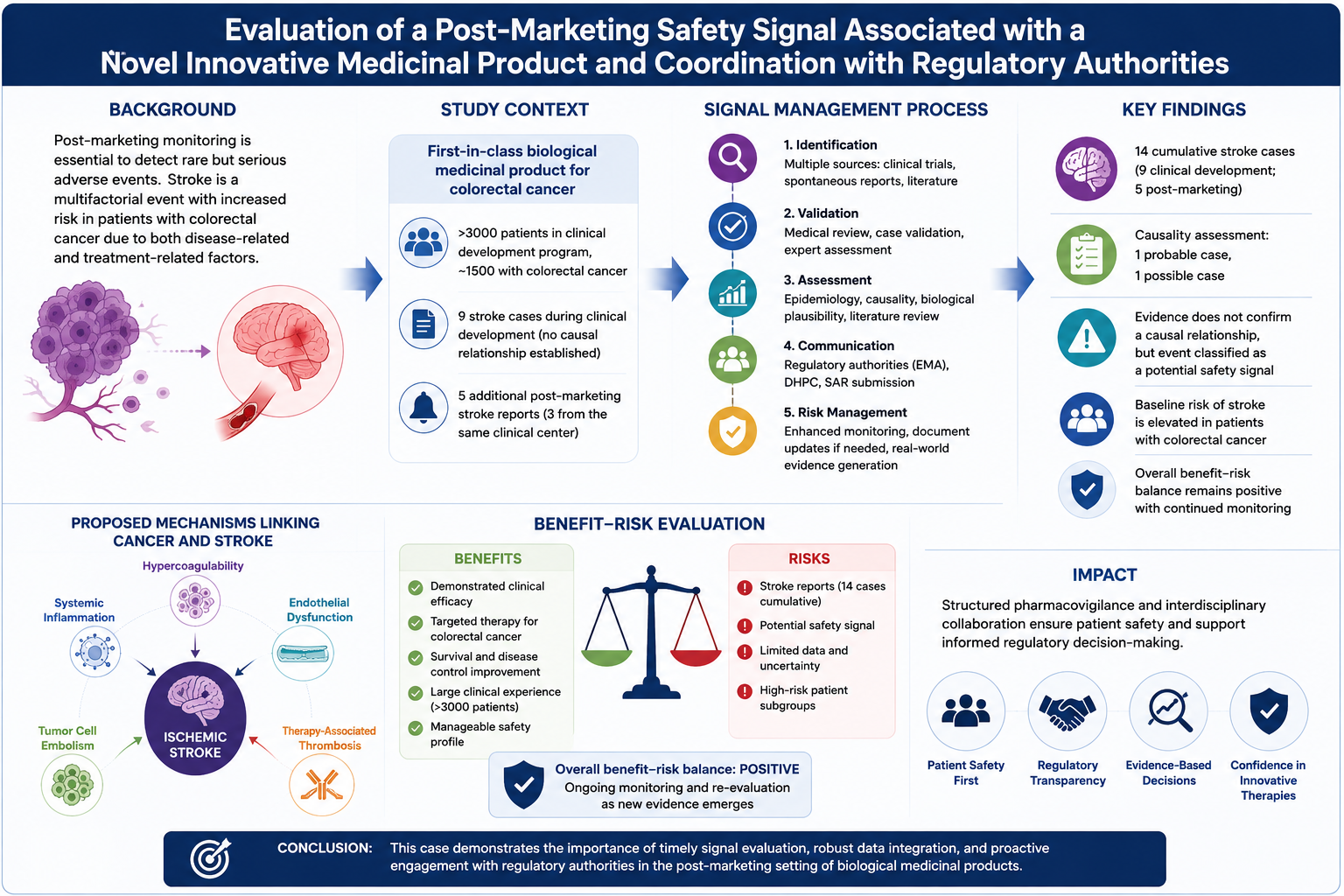
Background/Objectives: Following the market authorization of innovative medicinal products, continuous monitoring of safety signals is essential to ensure a favorable benefit–risk balance. This is particularly relevant for biological therapies used in oncology, where complex mechanisms of action and patient-related risk factors may contribute to rare but serious adverse events. The objective of this paper is to describe and critically evaluate the internal pharmacovigilance processes applied by a pharmaceutical company in response to a potential post-marketing safety signal of stroke associated with a newly authorized biological medicinal product for colorectal cancer. Methods: A structured signal management approach was applied in line with international regulatory guidance. The evaluation included detailed clinical assessment of reported post-marketing cases, review of safety data from completed and ongoing clinical trials, epidemiological comparison with background stroke incidence, assessment of potential risk factors, and review of the pharmacological and biological plausibility. Additional data sources, including scientific literature, safety databases, and periodic safety reports, were systematically reviewed. Multidisciplinary collaboration among pharmacovigilance, medical, and regulatory teams supported the assessment and regulatory interactions. Results: The cumulative evidence did not allow confirmation of a definitive causal relationship between the medicinal product and stroke but identified the event as a potential safety signal requiring close monitoring. The assessment supported the preparation of an evidence-based company position and informed discussions with regulatory authorities, including the European Medicines Agency. Conclusions: This case illustrates the practical implementation of structured signal management in the post-marketing setting. Timely evaluation, interdisciplinary coordination, and regulatory engagement are essential to ensure patient safety, maintain regulatory compliance, and support informed benefit–risk decision-making for innovative biological medicinal products.
Keywords:
pharmacovigilance
; safety signal
; biological medicinal product
; stroke
; benefit–risk assessment
; post-marketing surveillance
Copyright: This open access article is published under a Creative Commons CC BY 4.0 license, which permit the free download, distribution, and reuse, provided that the author and preprint are cited in any reuse.


