
Submitted:
14 May 2026
Posted:
15 May 2026
You are already at the latest version
Abstract
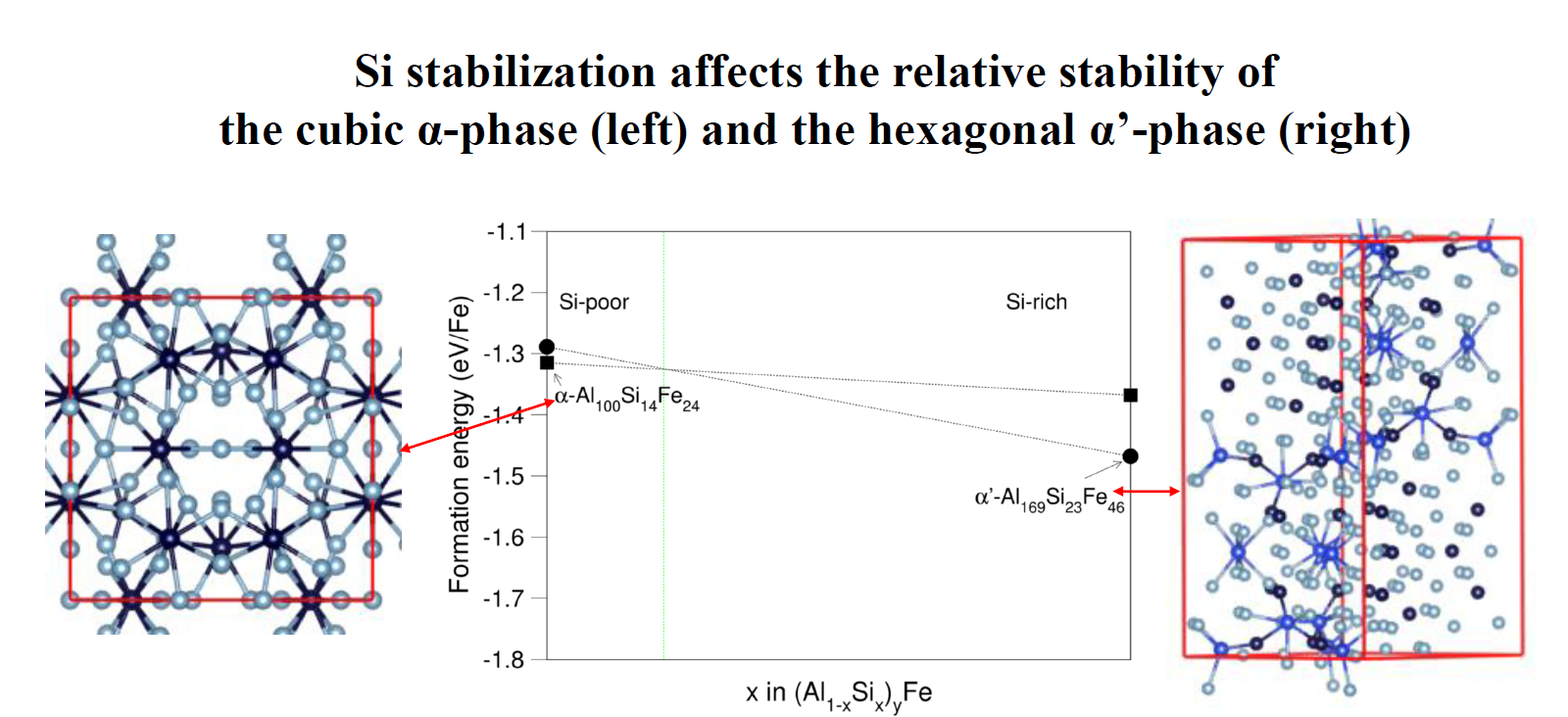
Commercial aluminum (Al) metals contain unavoidably iron (Fe) and silicon (Si) as impurities. Due to its low solubility and high chemical affinity to Al, Fe exists in the form of Fe-containing intermetallic compounds (Fe-IMCs) which act crucially in solidification processes, determining the micro-structure and consequently the mechanical performance of the cast parts. Meanwhile, Si as impurity or addition may join the binary Fe-IMCs. Here, we investigate the Si stabilization effects on the frequently observed Al-rich Fe-IMCs in a comprehensive and systematical way using a first-principles density-functional theory (DFT) approach. The study revealed different Si stabilization effects on the cubic α- and hexagonal αʹ-phase, as well as other binaries: Al12Fe, η-Al6Fe, τ4-, β- and θ-phases. The enhancement of stability for the α-phase is moderate while it is strong for the αʹ-phase. For the stability series (from higher to lower) is θ-Al13Fe4 > η-Al6Fe >α-Al4.75Fe in the binary system, while it becomes τ4-(Al,Si)5Fe>β-Al4.5SiFe >αʹ-(Al,Si)4.174Fe for the ternary Fe-IMCs. The information obtained here helps understand the formation of Fe-IMCs particles during casting of Al-Si alloys, and design of novel Al alloys of fine micro-structures and desired mechanical performances of the products from the primary Al and the scraps and wastes.
Keywords:
Si stabilization
; Fe-containing intermetallic compounds
; cubic α-phase
; hexagonal αʹphase
; first-principles calculations
; density-functional theory
Copyright: This open access article is published under a Creative Commons CC BY 4.0 license, which permit the free download, distribution, and reuse, provided that the author and preprint are cited in any reuse.


