
Submitted:
13 May 2026
Posted:
15 May 2026
You are already at the latest version
Abstract
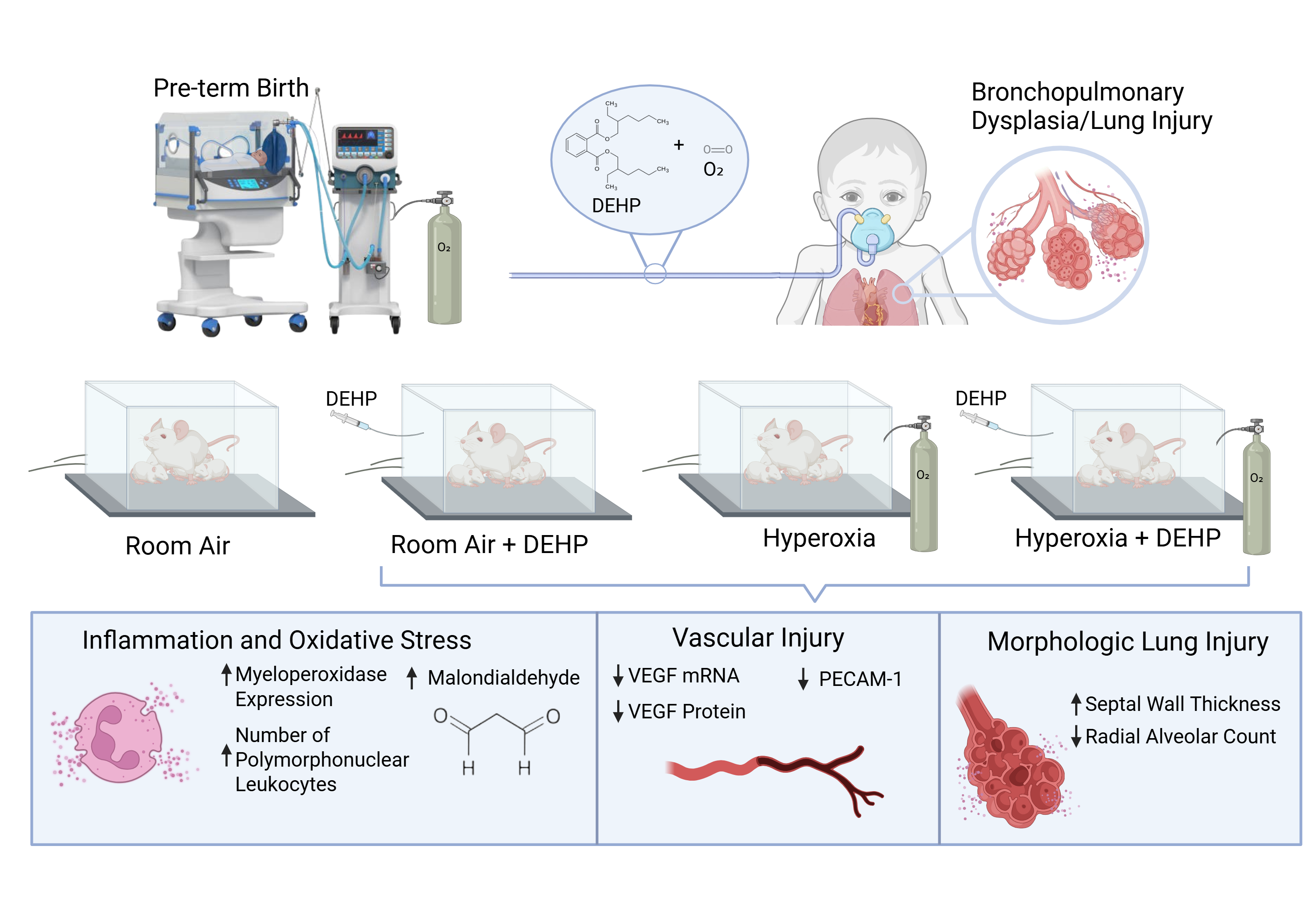
Chronic lung disease of prematurity (CLD) is a common complication of preterm birth with a com-plex pathology. Recent epidemiologic studies have identified a link between neonatal exposure to di(2-ethylhexyl) phthalate (DEHP), frequently used in medical equipment, and the development of CLD. We hypothesize that DEHP exposure in the early neonatal period contributes to lung injury in newborn rats. Newborn rat pups were raised in one of the following environments: room air (RA), RA + DEHP, hyperoxia (60% oxygen), and hyperoxia + DEHP. Ambient DEHP was inhaled in a dose of 25mg/m3 for 6 hours daily for 14 days. Lung tissue and blood samples were collected on day 14 of life. Independent exposure to DEHP and hyperoxia resulted in thicker pulmonary septal walls, fewer alveoli, increased pulmonary polymorphonuclear leukocytes and myeloperoxidase (MPO) activity and decreased expression of CD31 on endothelial cells in lung tissue. Additionally, DEHP-exposed rats showed higher serum malondialdehyde (MDA) levels and reduced vascular endothelial growth factor (VEGF) mRNA and protein levels compared to controls. Our experiments demonstrate that inhaled DEHP, with or without hyperoxia, resulted in a similar pattern of morphological lung injury and inflammation characteristic of CLD, and a causative link to CLD of prematurity.
Keywords:
phthalates
; environmental toxin
; bronchopulmonary dysplasia
; chronic lung disease
; lung injury
; prematurity
; animal model
Copyright: This open access article is published under a Creative Commons CC BY 4.0 license, which permit the free download, distribution, and reuse, provided that the author and preprint are cited in any reuse.


