
Submitted:
13 May 2026
Posted:
14 May 2026
You are already at the latest version
Abstract
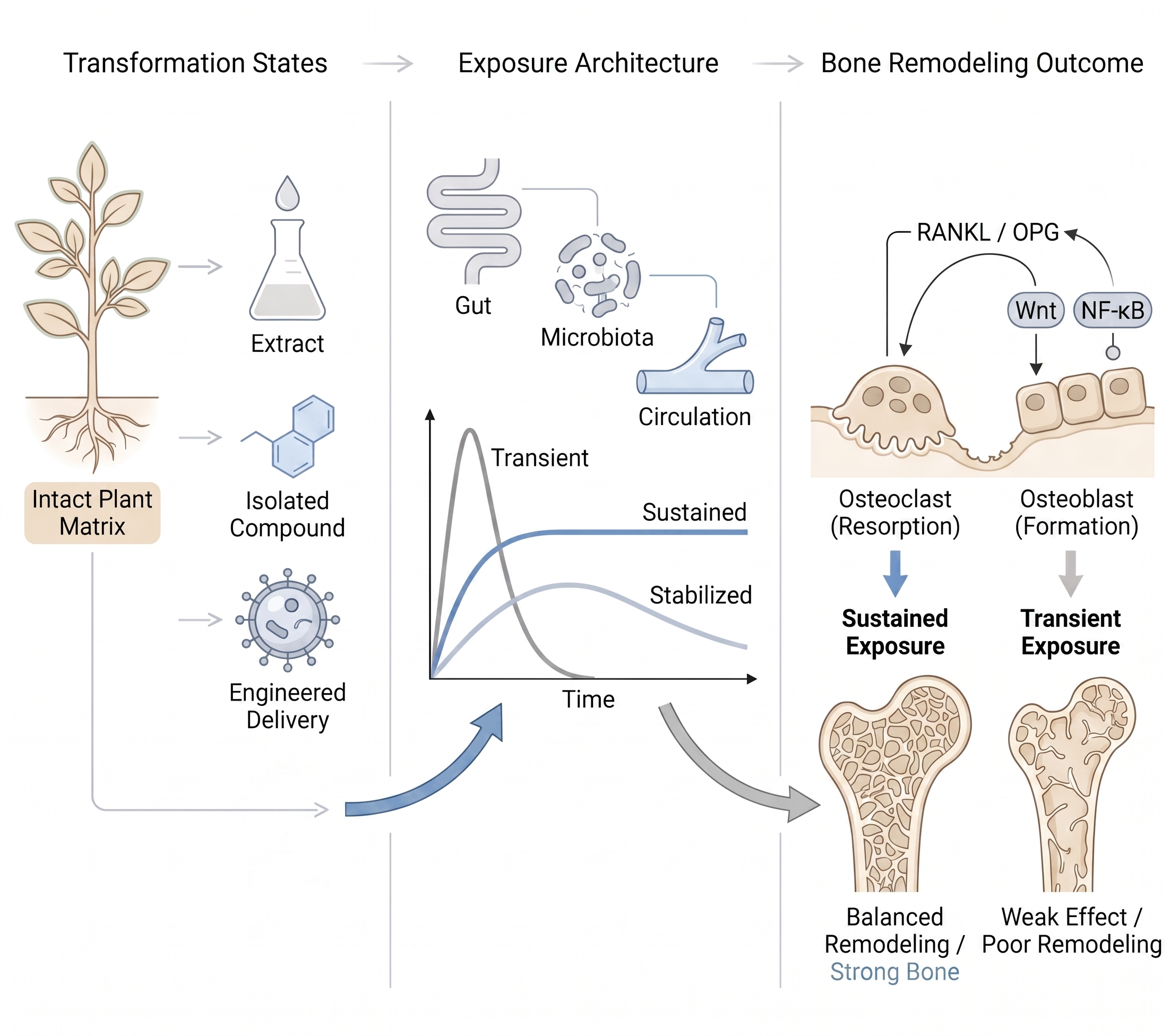
Plant-derived compounds exhibit well-documented osteogenic and anti-resorptive activities; however, their translation into consistent skeletal benefits remains limited. This review proposes a transformation-state–dependent framework in which the efficacy of plant-based interventions is interpreted through the exposure architectures they generate rather than solely through intrinsic molecular activity. By integrating plant matrix organization, gastrointestinal processing, microbial biotransformation, and formulation-driven pharmacokinetics with the temporal dynamics of bone remodeling, the review addresses a critical gap in current literature, which largely evaluates phytochemicals independent of their delivery context. Across a continuum ranging from intact plant matrices to isolated compounds and advanced delivery systems, distinct pharmacokinetic regimes emerge, characterized by differences in release kinetics, metabolic transformation, systemic persistence, and target-site exposure. Evidence indicates that sustained, metabolite-mediated exposure profiles are more compatible with the prolonged, cumulative nature of bone remodeling, whereas transient exposure often limits efficacy despite mechanistic activity. Formulation strategies, including phospholipid complexes, bioenhancers, and nano- or vesicle-based systems, can partially overcome these limitations by modulating exposure behavior. By reframing plant-based interventions as dynamic exposure systems, this framework provides a unifying basis for interpreting variability across studies and offers a rational foundation for designing strategies that align pharmacokinetic behavior with skeletal biology, thereby improving translational potential.
Keywords:
bone remodeling
; exposure architecture
; plant-derived compounds
; pharmacokinetics
; bioavailability
; plant matrix
; microbiota
; nanodelivery systems
Copyright: This open access article is published under a Creative Commons CC BY 4.0 license, which permit the free download, distribution, and reuse, provided that the author and preprint are cited in any reuse.


