
Submitted:
01 May 2026
Posted:
15 May 2026
You are already at the latest version
Abstract
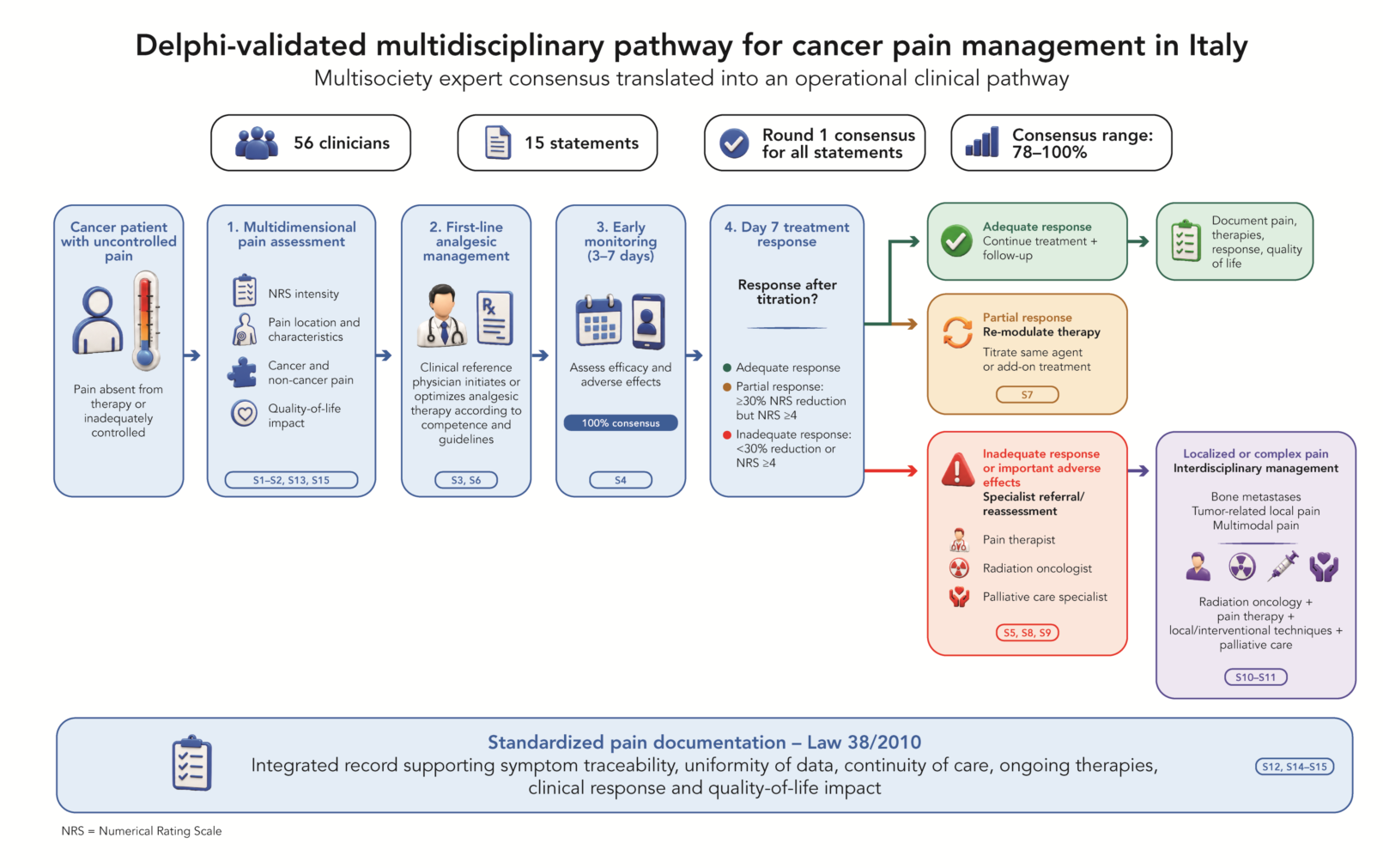
Background: Cancer pain remains highly prevalent and undertreated despite established guidelines. In Italy, Law 38/2010 mandates systematic pain assessment, yet only 26% of clinicians routinely evaluate pain at each clinical visit, and fewer than one-quarter have received formal training in pain medicine or palliative care. A national multidisciplinary roundtable, convened in Rome in March 2025, formally identified four systemic gaps – insufficient education, fragmented care pathways, unclear professional roles, and challenges in implementing shared diagnostic and therapeutic pathways – and planned the development of a structured Delphi consensus. Methods: A Delphi study was conducted in accordance with CREDES guidelines. The Steering Committee, comprising representatives of six Italian scientific societies (AIRO, AIOM, AISD, Federdolore-SICD, SICP, ACD-SIAARTI) and a patient advocacy group (Fondazione Nora e Alberto Gentili), developed 15 clinical statements addressing pain assessment, management, referral criteria, monitoring, and documentation. Sixty-six Italian clinicians from various specialties were invited to participate. Consensus was defined as ≥75% agreement (scoring 4 or 5 on a 5-point Likert scale). Results: Fifty-six clinicians completed the voting rounds (response rate: 84.8%), representing medical oncology, radiation oncology, pain therapy, and palliative care specialties. All statements reached consensus in the first round (78–100%), precluding the need for a second voting round. Panelists’ qualitative comments informed minor wording refinements; substantial content was unchanged. Conclusions: The Delphi process produced a validated, multidisciplinary clinical pathway for cancer pain management in the Italian NHS - National Health System. The pathway establishes structured roles for the clinical reference physician and specialist consultants, objective decision thresholds for analgesic titration and referral, and minimum requirements for standardized pain documentation. These consensus-based statements provide actionable clinical guidance that may help address analgesic undertreatment and support the implementation of Law 38/2010 across Italian oncology centers.
Keywords:
cancer pain management
; clinical pathway
; Delphi consensus
; multidisciplinary approach
; opioid prescribing
; pain assessment
; palliative care
Copyright: This open access article is published under a Creative Commons CC BY 4.0 license, which permit the free download, distribution, and reuse, provided that the author and preprint are cited in any reuse.


