
Submitted:
14 May 2026
Posted:
14 May 2026
You are already at the latest version
Abstract
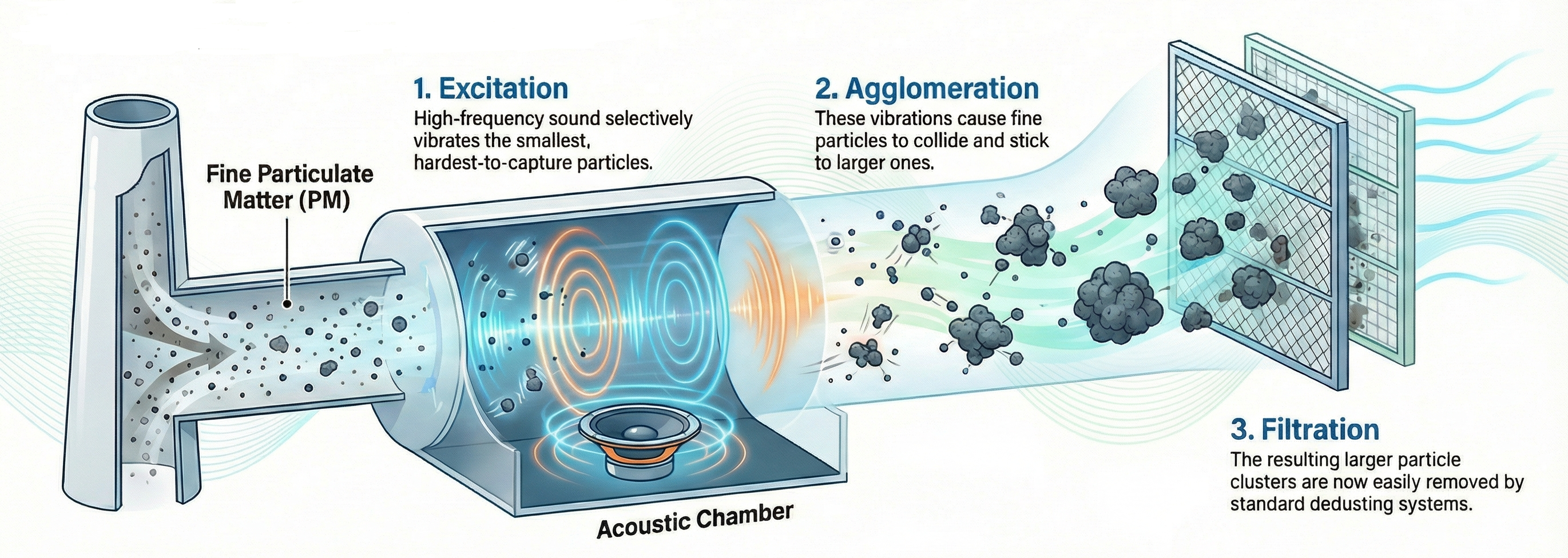
Particle pollution has been recognized as a major part of environmental pollution. More specifically, the inhalation of very small (ultrafine) airborne particulate matter (PM) that is emitted from the burning of fossil fuels poses the most serious threat to human health. High-efficiency retention of these particles is one of the most challenging environmental problems, since conventional techniques like electrostatic precipitators, bag filters or cyclones have low collection efficiency in the respirable range (0.1 μm–1.0 μm). Acoustically induced agglomeration of ultrafine particles is a promising technique to increase the size of small particles before they enter a conventional filter. During this process, high-intensity acoustic fields are applied to the flue gas stream, inducing interaction effects among suspended particles that give rise to collisions and agglomeration. The preconditioned aerosol can then be filtered within conventional filters with higher collection efficiency. The present work reports the results of a numerical investigation of the effect of ultrasound preconditioning on the particle size distribution as a function of parameters related to the ultrasound system design, such as the acoustic frequency and intensity, and the initial mass loading. Particle agglomeration is modeled via the solution of the population balance equation (PBE) with the Multi-Monte Carlo (MMC) method. Results show that acoustic agglomeration can shift particle size distribution towards larger values of diameters and reduce the total number concentration of particles, thus leading to increased capture efficiency of conventional filters.
Keywords:
acoustic agglomeration mechanisms
; ultrafine particles
; Multi-Monte Carlo (MMC)
Copyright: This open access article is published under a Creative Commons CC BY 4.0 license, which permit the free download, distribution, and reuse, provided that the author and preprint are cited in any reuse.


