
Submitted:
13 May 2026
Posted:
14 May 2026
You are already at the latest version
Abstract
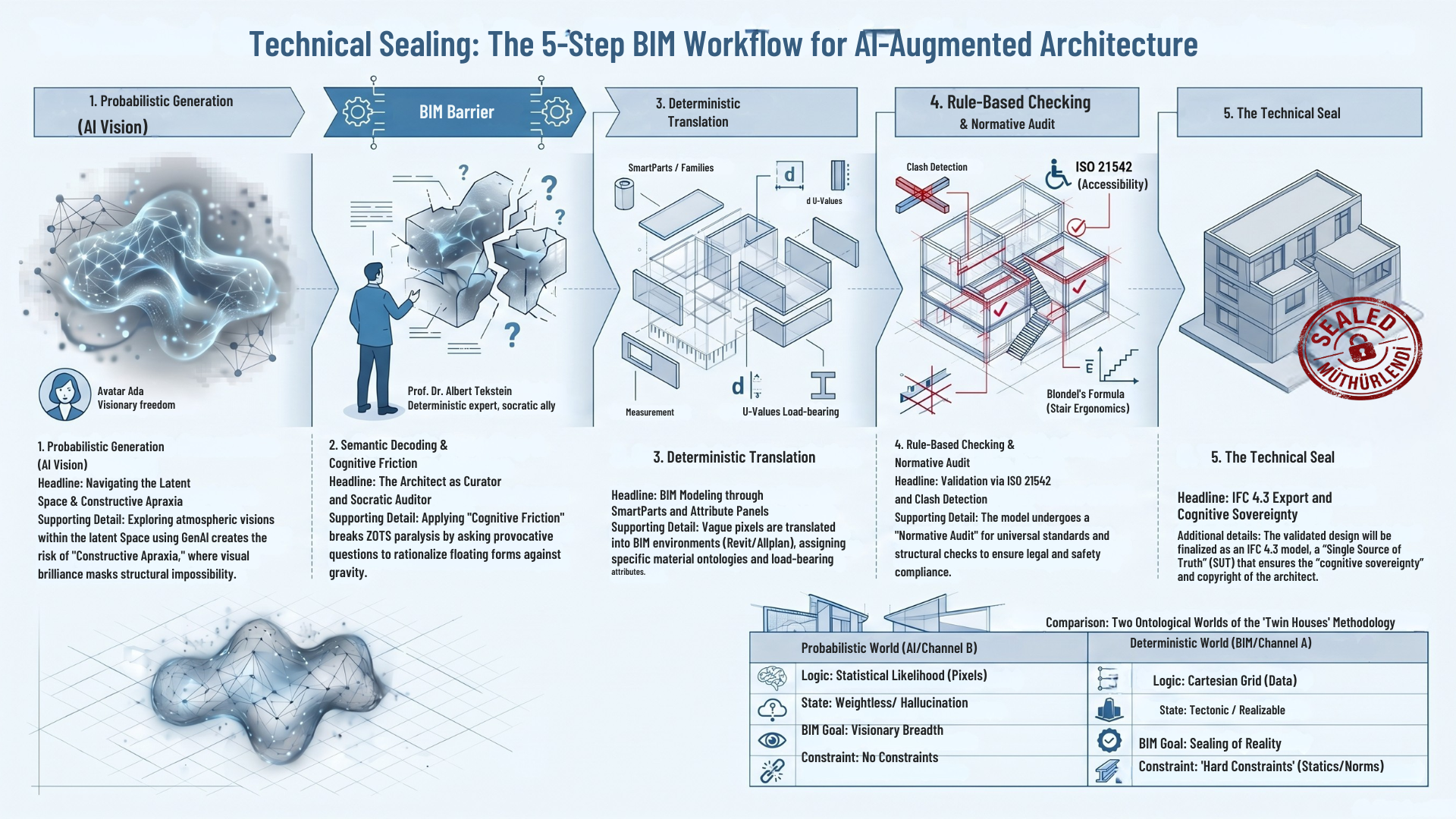
Generative Artificial Intelligence (GenAI) is driving a fundamental paradigm shift in architectural design, transitioning from deterministic drafting to algorithmic curation. While the Architecture, Engineering, and Construction (AEC) sector rapidly adopts these tools, academic curricula face a critical "Techno-Instructional Void." This gap risks inducing a "Zero Order Thinking State" (ZOTS)—a cognitive passivity rooted in Cognitive Load Theory, where students uncritically accept unbuildable machine hallu-cinations. Developed through comprehensive preliminary consultations with academ-ic colleagues and longitudinal studio observations, this study introduces the "Twin Houses" methodology and the "Technical Sealing" protocol. By enforcing "Cognitive Friction," the framework compels students to validate probabilistic GenAI outputs against deterministic physical laws (e.g., Blondel's Formula 2R + T = 63 cm) and safety norms. Crucially, Building Information Modeling (BIM) acts as an automated Proof-Assistant, utilizing visual programming APIs (Revit Dynamo, Allplan Python-Parts) and IFC 4.3 data schemas for rigorous Rule-Based Checking (RBC). To confirm cross-border transferability and optimize the time-costs of curriculum integration via an asynchronous AI-TPACK module, the framework is currently undergoing verifica-tion interviews with a bilateral expert panel (n=8) from Germany and Türkiye. Ulti-mately, this framework provides a structured pedagogical approach, equipping in-structors to guide students in transforming machine hallucinations into legally builda-ble, tectonic realities. Sample videos showcasing student works are available in the Supplementary Materials.
Keywords:
architectural pedagogy
; generative AI
; technical sealing
; zero order thinking state (ZOTS)
; BIM
; instructor training
; architectural conductor
Copyright: This open access article is published under a Creative Commons CC BY 4.0 license, which permit the free download, distribution, and reuse, provided that the author and preprint are cited in any reuse.


