
Submitted:
13 May 2026
Posted:
14 May 2026
You are already at the latest version
Abstract
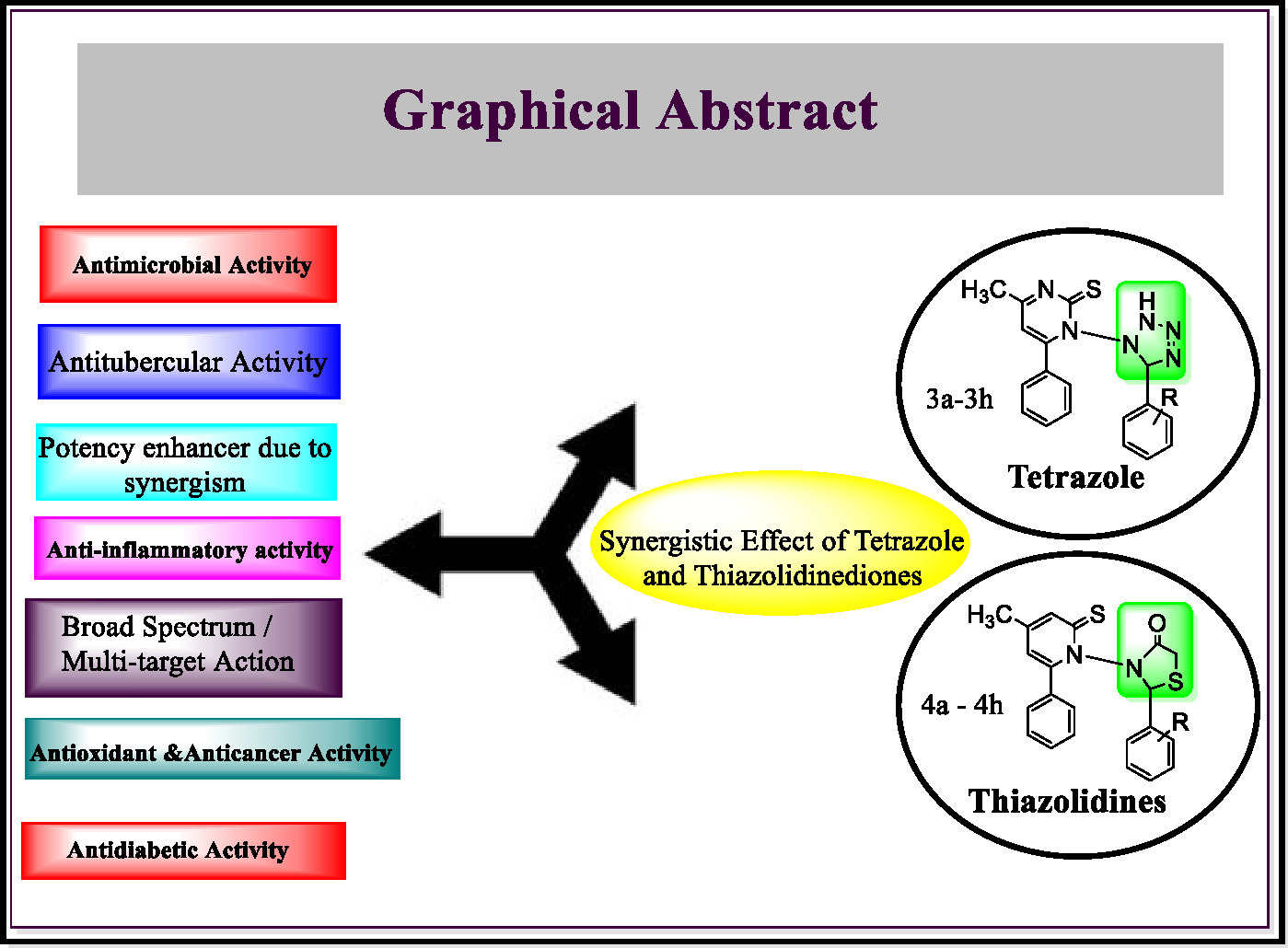
Introduction: Tetrazole and thiazolidine-4-one derivatives are important heterocyclic scaffolds with diverse pharmacological activities, including antimicrobial and antioxidant effects. This study focuses on the design and synthesis of novel Schiff base–derived analogues using a green synthetic approach to improve biological efficacy and reduce environmental impact. Methods: Schiff bases (2a–2h) were synthesized using tetrabutylammonium iodide as a green catalyst in aqueous medium. These were further converted into tetrazole (3a–3h) and thiazolidine-4-one (4a–4h) derivatives using sodium azide and thioglycolic acid. Structures were confirmed by FTIR, ¹H NMR, and ¹³C NMR spectroscopy. Antioxidant activity was evaluated using the DPPH assay, while antimicrobial activity was assessed by the zone of inhibition method. Molecular docking was performed against Penicillin-Binding Protein 4 (3ZG8), CYP51 (5V5Z), and 1OAF. Results: Compounds 2a, 2b, 3a, and 4a showed strong antifungal activity, exceeding standard drugs. Compounds 2d, 3b, and 4b exhibited superior antibacterial activity. Several derivatives demonstrated higher antioxidant activity than ascorbic acid. Docking studies confirmed stable ligand–protein interactions, with compound 4f showing the highest binding affinity. Discussion: Substituent variation influenced biological activity. Electron-donating and withdrawing groups affected potency. Docking results supported experimental findings and confirmed target interactions. The green synthesis improved efficiency and reduced environmental risk. Conclusion: These derivatives show promising antimicrobial and antioxidant potential. Compound 4f emerged as a lead candidate for further optimization and drug development.
Keywords:
schiff bases
; ionic liquids
; tetrazole analogues
; thiazolidine-4-one analogues
; antioxidant activity
; antimicrobial activity
; molecular docking
Copyright: This open access article is published under a Creative Commons CC BY 4.0 license, which permit the free download, distribution, and reuse, provided that the author and preprint are cited in any reuse.


