

Submitted:
13 May 2026
Posted:
14 May 2026
You are already at the latest version
Abstract
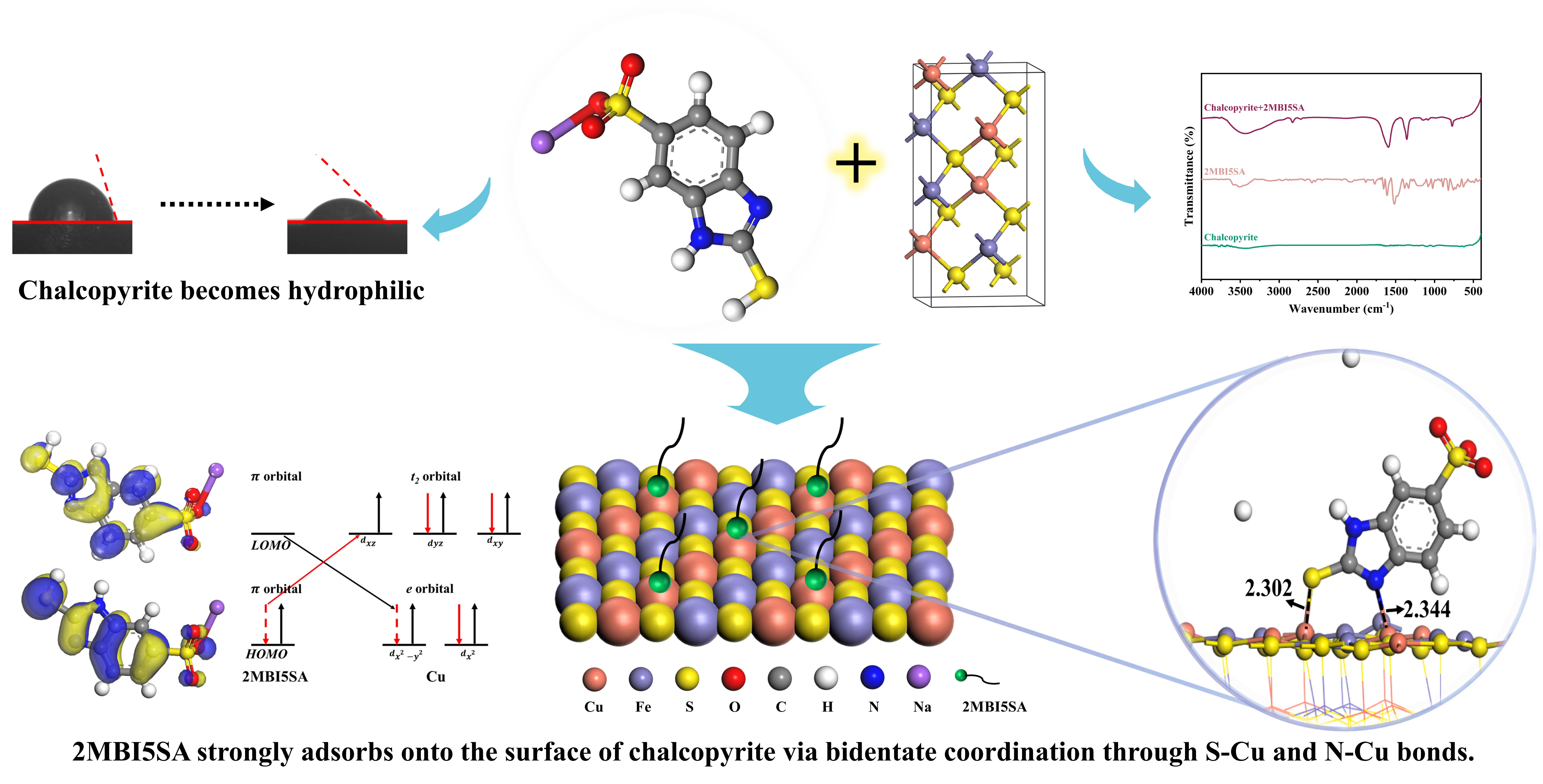
Chalcopyrite and molybdenite exhibit similar surface wettability and high floatability, which has long hindered their efficient and selective separation in mineral processing. In this work, the novel chalcopyrite depressant 2-mercapto-5-benzoimidazole sulfonate dihydrate (2MBI5SA) was investigated for its effect on the flotation behavior of chalcopyrite and molybdenite. Compared with the conventional depressant sodium sulfide (Na2S), 2MBI5SA exhibited stronger selective depression toward chalcopyrite; under conditions yielding Mo recovery of 81.46% and a Mo grade of 4.46%, the Cu recovery decreased to 13.03%. To clarify the origin of this selectivity, interfacial properties were systematically characterized using adsorption measurements, contact angle measurements, zeta potential measurements, FT-IR, XPS, and SEM-EDS, and the adsorption mechanism was further elucidated using SCC-DFTB calculations. The results demonstrate that 2MBI5SA chemisorbs onto the chalcopyrite surface via bidentate coordination, forming a stable adsorption layer that effectively suppresses chalcopyrite flotation. Moreover, structure-function relationship analysis confirmed that introducing hydrophilic and ionizable functional groups into the collector framework can convert a collector into a selective depressant, thereby providing new insight into the design of environmentally benign flotation depressants.
Keywords:
depressant
; chemisorption chalcopyrite
; Cu-Mo separation
; molecular design
; adsorption mechanism
1. Introduction
Molybdenum is a critical material for power electronics, advanced manufacturing, aerospace, chemical catalysis, and high-end alloys, making its stable supply and efficient utilization strategically important [1,2,3]. Approximately 75% of global copper resources [4,5] and 50% of molybdenum resources [6] are associated with Cu-Mo associated ores [7], which are predominantly hosted in porphyry Cu-Mo sulfide deposits [8]. Because chalcopyrite (CuFeS2) and molybdenite (MoS2) commonly occur together and exhibit similar natural floatability [9], their flotation separation is challenging and has long limited efficient resource recovery. Therefore, advancing the theoretical understanding and process technology for Cu-Mo separation is important for improving resource utilization efficiency.
In industrial practice, flotation separation of Cu-Mo bulk concentrates typically follows a strategy of depress chalcopyrite-while floating molybdenite [10,11], the core of which lies in developing highly selective chalcopyrite depressants [12,13]. An ideal depressant should weaken the interaction between chalcopyrite and the collector while enhancing the hydrophilicity of the mineral surface, thereby amplifying the interfacial differences between chalcopyrite and molybdenite to achieve effective separation [14]. Traditionally, inorganic depressants have been the most mature class of chalcopyrite depressants, and owing to their wide availability, low cost, and ease of integration into flotation circuits, they remain widely used in many mineral processing plants. These inorganic reagents mainly include sulfide-based depressants [15,16,17], cyanides, Knox-type reagents [12,18], oxidants [19,20,21,22,23,24,25], and precipitation-coverage type depressants [24,26,27,28]. However, with increasing demands for environmental protection and safety, the limitations of inorganic depressants: such as insufficient selectivity, high dosage requirements, and significant environmental impact: have become increasingly apparent. In particular, the industrial use of cyanide and Knox-type reagents has declined due to their high toxicity and associated pollution risks.
In contrast, organic depressants have demonstrated significant advantages in selectivity and tunability, and are therefore regarded as a promising alternative to traditional inorganic depressants for achieving environmentally benign Cu-Mo separation. The structures of such organic molecules typically consist of a surface-affinitive moiety and a hydrophilic group [29,30,31,32], and their major structural motifs include thiourea-based [33,34,35,36,37,38],, mercaptan-based [39,40,41,42,43,44,45,46], carbonyl-based [47,48,49,50,51], hydroxyl-based [52], and xanthate-based depressants [53]. Among them, mercaptan-containing (-SH) organic depressants are of particular interest due to their relatively low toxicity, favorable environmental compatibility, and strong propensity to adsorb onto surface metal active sites, factors that have been shown to facilitate selective separation of chalcopyrite and molybdenite in multiple studies [41,43,44,54,55]. However, current screening of depressant molecules still largely relies on empirical trial-and-error, and the structure-function relationships and rational design strategies remain unclear, thereby limiting the predictive design of new depressants.
Building on this understanding, we propose a novel design strategy in which introducing hydrophilic and ionizable functional groups into a collector framework can convert such molecules from collectors into functioning selective depressants toward target minerals. To validate this strategy, 2-mercapto-5-benzimidazole was chosen as the parent compound and modified by incorporating a sulfonate group to form 2-mercapto-5-benzimidazole sulfonate dihydrate (2MBI5SA), which was then investigated as a chalcopyrite depressant for Cu-Mo separation. We hypothesize that 2MBI5SA operates through a synergistic mechanism: its mercapto group and benzimidazole nitrogen atoms serve as cooperative coordination sites that strongly chemisorb onto metal active sites on the chalcopyrite surface to form stable chelate complex; meanwhile, its sulfonate group [56,57] enhances hydration and electrostatic repulsion, thereby suppressing the floatability of chalcopyrite.
To elucidate the surface interaction mechanisms underlying the observed behavior, this study systematically characterized interfacial properties including adsorption measurements, contact angle measurements, zeta potential measurements, FT-IR, XPS, and SEM-EDS, and further elucidated the adsorption process using SCC-DFTB simulations. The results demonstrate that 2MBI5SA chemisorbs onto the chalcopyrite surface through a bidentate coordination mode, forming a stable surface adsorption layer that substantially alters the surface electronic structure and wettability. Structure-function relationship analysis further confirms that introducing hydrophilic and ionizable functional groups into a collector framework can convert its role from facilitating flotation to serving as a selective depressant. These findings contribute to a deeper understanding of surface adsorption chemistry in flotation systems and provide guidance for the rational design of environmentally friendly flotation depressants.
2. Experiments
2.1. Materials and Depressants
Chalcopyrite and molybdenite samples used for microflotation tests were obtained from a mining site in Panzhihua, Sichuan Province, and another mining site in Jiangxi Province, China, respectively. The two ores were subjected to crushing, hand sorting, gangue removal, ceramic ball milling, and sieving to produce particle size fractions of 58-109 µm and ≤58 µm. The f58-109 µm fraction was used for flotation tests and adsorption measurements, while the ≤58 µm fraction was further ground in an agate mortar to ≤2 µm for FT-IR and XPS analyses. Phase identification and chemical composition of chalcopyrite and molybdenite were determined by X-ray diffraction using a Bruker D8 Advance diffractometer (BRUKER AXS GmbH, Germany) and X-ray fluorescence spectrometry using an S8 TIGER XRF analyzer (BRUKER, Germany), and the results are shown in Supplementary material Figures S1 and S2. The purities of chalcopyrite and molybdenite were determined to be 99% and 96%, respectively, which meets the requirements of the present study.
Industrial Cu-Mo bulk concentrate samples for flotation tests were collected from the Dexing copper mine , a typical porphyry Cu-Mo deposit in Jiangxi Province, China. X-ray diffraction analysis of the bulk concentrate identified chalcopyrite, pyrite, enargite, and molybdenite as the main metallic minerals, with quartz and, minor muscovite as the main gangue minerals. The XRD patterns and particle size distribution are presented in Supplementary material Figure S3, and the multi-element chemical composition is listed in Supplementary material Table S1.
Hydrochloric acid and sodium hydroxide used for pH adjustment were purchased from Chengdu Cologne Chemical Co., Ltd. The depressant 2-mercapto-5-benzimidazole sulfonate dihydrate and frother methyl isobutyl carbinol (MIBC) were obtained from Shanghai Aladdin Biochemical Technology Co., Ltd., while kerosene was obtained from Guangdong Linshi Chemical Depressants Co., Ltd. MIBC was of industrial grade, whereas all other depressants were of analytical grade. Deionized water was used in all experiments and analytical measurements.
2.2. Microflotation Tests
Single-mineral and synthetic bulk-mineral flotation tests were conducted using an XFGC II air-sparged flotation cell (40 mL) with a constant agitation speed of 1740 rpm. Before flotation, 2.0 g of mineral sample was placed in a beaker containing 40 mL of deionized water, ultrasonically dispersed for 2 min, and then allowed to settle for 2 min; the supernatant was discarded thereafter. The resulting slurry was transferred to the flotation cell and pre-agitated for 1 min. pH modifiers, depressants, collectors, and frothers were then added sequentially, with stirring times of 1 min, 3 min, 3 min, and 2 min, respectively. Thereafter, air was introduced and froth collection was initiated; froth products were collected at 10 s intervals over a total flotation time of 3 min. After flotation, froth products and tailings were filtered, dried, and weighed to calculate recovery. All flotation tests were performed in triplicate, and average values were reported.
For synthetic Mixed-mineral flotation tests, an synthetic mixture of chalcopyrite and molybdenite at a mass ratio of 1:1 was used, and the flotation procedure was the same as that of the single-mineral tests. Flotation recoveries for single minerals and synthetic mixed minerals were calculated using Equations (1) and (2), respectively. The complete flotation procedure is illustrated in Supplementary material Figure S4.
where and denote the flotation recoveries (%) of single minerals and synthetic bulk minerals, respectively. and represent the weights (g) of the concentrate and tailings, respectively. corresponds to the grade (%) of Cu or Mo in the concentrate, and indicates the grade (%) of Cu or Mo in the synthetic bulk sample.
2.3. Adsorption Capacity Measurement
The adsorption capacity of 2MBI5SA on the mineral surface was quantified using a Shimadzu UV-2450 ultraviolet-visible spectrophotometer (Shimadzu Corporation, Japan). The characteristic absorption peak of 2MBI5SA occurs at a wavelength of 240 nm. A series of standard solutions of 2MBI5SA were prepared, and their absorbance at 240 nm was measured to construct a calibration curve. Adsorption tests were conducted at 25 °C and pH 7: 0.50 g sample of ultrasonically cleaned chalcopyrite or molybdenite (58-109 µm) was bulk with 40 mL of deionized water and stirred for 1 min. After adding 2MBI5SA at predetermined concentrations, the suspension was magnetically stirred for 10 min until adsorption equilibrium was reached. The mixture was then filtered through a 0.45 µm membrane, and the absorbance of the filtrate at 240nm was measured to determine the residual concentration of 2MBI5SA. The adsorption amount was calculated using Equation (3). All tests were performed in triplicate, and the results were reported as average values.
In the equation, denotes the amount of reagent adsorbed on the mineral surface at equilibrium (mg/g); and represent the initial reagent concentration and the equilibrium concentration of the reagent in the supernatant after reaction (mg/L), respectively; is the solution volume (mL); and is the mass of the mineral sample (g).
2.4. Contact Angle Measurement
To assess changes in surface wettability of the minerals before and after 2MBI5SA treatment, the contact angles of chalcopyrite and molybdenite under different treatment were measured using a DSA100E optical video contact angle goniometer (Germany). High-purity chalcopyrite and molybdenite blocks were cut into specimens of approximately 2 cm × 2 cm × 2 cm and sequentially polished with 200, 500, and 2000 grit sandpapers to obtain smooth surfaces. The specimens were then ultrasonically cleaned in deionized water and vacuum-dried at 30 °C prior to testing.
Reagent-treated samples were prepared as follows: the specimens were immersed in a 2MBI5SA solution (1×10⁻³ mol/L, Ph 7) for 15 min; and one set of specimens was subsequently immersed in a collector solution for an additional 10 min. After treatment, all samples were rinsed three times with deionized water and vacuum-dried before analysis. Control specimens were prepared using the same procedure but without reagent treatment.
2.5. Zeta Potential Measurement
The zeta potentials of chalcopyrite and molybdenite before and after reagent treatment were measured at 25 °C using a multi-angle particle size and high-sensitivity zeta potential analyzer (Brookhaven, USA) to evaluate the effects of reagent adsorption [58]. In each test, 2.0 g of ultrasonically cleaned chalcopyrite or molybdenite powder was added to 40 mL of deionized water and magnetically stirred for 15 min, after which the slurry pH was adjusted to the target value. The suspension was allowed to stand for 10 min to allow the solid to settle, and the supernatant was collected with a syringe and transferred into disposable centrifuge tubes for zeta potential analysis.
2.6. Fourier Transform Infrared (FT-IR) Spectroscopy
The fourier transform infrared spectra of chalcopyrite before and after 2MBI5SA treatment were recorded using an IRTracer-100 spectrometer (Shimadzu Corporation, Japan). Samples were prepared by the KBr pellet method. Spectra were collected at a resolution of 4 cm⁻¹ over the range of 400-4000 cm-1, with 32 co-added scans per sample. To minimize scattering effects, only mineral powders with a particle size of < 2 µm were used. For sample preparation, 2.0 g of chalcopyrite was bulk with 40 mL of deionized water containing 2MBI5SA at a predetermined concentration in the flotation cell, and stirred for 30 min to allow reagent adsorption. The treated slurry was then filtered, rinsed at least three times with deionized water, and dried in a vacuum oven at 30 °C for 24 h prior to measurement.
2.7. X-ray Photoelectron Spectroscopy (XPS)
The surface chemical compositions of chalcopyrite before and after 2MBI5SA treatment was analyzed by X-ray photoelectron spectroscopy using a Thermo Fisher Scientific K-Alpha instrument (USA). For sample preparation, 2.0 g of chalcopyrite was ultrasonically pretreated for 3 min, then bulk with 40 mL of deionized water containing 2MBI5SA at a specified concentration in the flotation cell, and magnetically stirred for 30 min. The slurry was subsequently filtered, and the recovered solids were rinsed three times with deionized water and dried in a vacuum oven at 30 °C prior to XPS analysis.
2.8. Scanning Electron Microscopy with Energy Dispersive Spectroscopy (SEM-EDS)
For morphological and elemental analysis, treated and untreated chalcopyrite samples were affixed directly onto conductive adhesive and examined using a Sigma 300 scanning electron microscope (Carl Zeiss, Germany) at an accelerating voltage of 8 kV to observe surface morphology changes induced by 2MBI5SA treatment. In addition, elemental distributions were characterized by energy dispersive X-ray spectroscopy (EDS) in area scan mode at an accelerating voltage of 20 kV to investigate changes in surface chemical composition.
2.9. SCC-DFTB Computational Modeling
Quantum chemical calculations have become an important approach for elucidating the adsorption mechanisms of depressants on mineral surfaces [59,60]. The self-consistent charge density functional tight-binding (SCC-DFTB) method, as an approximate quantum mechanical technique that balances computational efficiency and accuracy, accelerates calculations by approximately two orders of magnitude compared with conventional density functional theory (DFT). Moreover, it has been shown to yield adsorption configurations, bond lengths, and Mulliken charge distributions that are in strong agreement with results from high-accuracy DFT for large sulfide systems [61,62,63,64].
In this study, the adsorption of 2MBI5SA on the chalcopyrite surface was systematically investigated using the SCC-DFTB method as implemented in Materials Studio (MS) 2019. All calculations were performed without spin restriction and under symmetry constraints. Geometry optimizations were carried out using the DFTB+ program, employing the CuFeOrg Slater-Koster parameter set which includes Cu, Fe, C, H, O, N, and S elements [62,64]. The experimental unit-cell parameters of chalcopyrite are a = b = 5.290 Å, c = 10.422 Å, and the optimized values from DFTB+ were a = 5.1147 Å, b = 5.1137 Å, c = 10.4083 Å [65]. Verification based on Equation (S1) in the Supplementary material [66] showed a deviation of only 0.07% from the experiment values, confirming the reliability of the selected method and parameter set. The thermodynamically most stable chalcopyrite (112) surface was selected for modeling, as supported by interatomic potential analyses and literature DFT results [67]. The surface energies are detailed in Supplementary material Equation (S5) and Table S2. A 2×1×1 supercell model was constructed, consisting of five atomic layers and a 20 Å vacuum gap. To mimic bulk constraints, the bottom three atomic layers were fixed during optimization, while the top two layers and adsorbate molecule were allowed to relax. The self-consistent field (SCF) convergence criterion was set at 1×10⁻⁵ eV/atom, with medium precision and a 1×2×1 k-point grid. Adsorption energies were calculated according to Equation (4).
represents the total energy of the reagent molecule adsorbed on the chalcopyrite surface, and denotes the total energy of the optimized isolated reagent molecule. A more negative value indicates a stronger interaction between the reagent and the chalcopyrite surface.
To further evaluate the adsorption strength and bonding nature, density of states (DOS), charge density, and Mulliken charge analyses were performed using the CASTEP module. Calculations were carried out within the generalized gradient approximation (GGA) using the PW91 exchange-correlation functional, with a plane-wave cutoff energy of 400 eV. The self-consistent field (SCF) convergence criterion was set to 2.0×10⁻⁵ eV/atom.
2.10. Laboratory Flotation Tests on Actual Cu-Mo Bulk Concentrate
Laboratory flotation tests on actual Cu-Mo bulk concentrate samples were conducted using a 0.75 L XFD flotation machine. For each test, 340 g of ore was used, and the impeller speed was maintained at 1992 rpm. After conditioning with the depressant only, without collector or frother) for 3 min, flotation was carried out for an additional 3 min. Finally, the resulting concentrate and tailings were filtered, dried, and analyzed to determine Cu and Mo grades and recoveries.
3. Results and Discussion
3.1. Single-Mineral Microflotation Tests
Figure 1 illustrates the influence of 2MBI5SA dosage on the flotation behavior of chalcopyrite and molybdenite using kerosene as the collector at pH 7. The results demonstrate that 2MBI5SA exerts a strong selective depression toward chalcopyrite. Specifically, chalcopyrite recovery decreased sharply with increasing 2MBI5SA dosage, and when the dosage reached 1×10⁻⁴ mol/L, the chalcopyrite recovery declined to 1%, indicating excellent depressing performance; further increases in dosage did not lead to significant additional changes in recovery. In contrast, increasing the 2MBI5SA dosage resulted in only a slight decrease in molybdenite recovery, which remained above 66.0% throughout the tested range. The depressing effect of 2MBI5SA was markedly stronger for chalcopyrite than for molybdenite, and the recovery difference between the two minerals exceeded 50% upon treatment with 2MBI5SA, confirming that 2MBI5SA can effectively improve the flotation separation of chalcopyrite and molybdenite.
Figure 2 shows the effct of slurry pH on the flotation behavior of chalcopyrite and molybdenite at a fixed 2MBI5SA concentration of 1×10⁻⁴ mol/L, together with the results obtained in the absence of depressant. Without 2MBI5SA, chalcopyrite maintained a high recovery (90%) across a wide pH range of 3-13, indicating that its inherent floatability was only slightly affected by pH. In contrast, molybdenite recovery remained high in the pH 3-7 but decreased markedly at pH 11 and above. Upon addition of 2MBI5SA, the flotation behaviors of the two minerals diverged significantly. Chalcopyrite recovery decreased sharply with increasing pH, dropping to as low as 0.3%, and then remianed nearly constant at pH 7 and above. This trend may be attributed to progressive deprotonation of the sulfonic acid group (-SO3H to SO3-) at higher pH, which increases the negative charge and hydrophilicity of 2MBI5SA, thereby rendering the chalcopyrite surface more hydrophilic and more effectively suppressing the adsorption and spreading of kerosene. In contrast, molybdenite maintained relatively high recovery under 2MBI5SA treatment. Overall, a pH range of 7-13 was favorable for the efficient separation of chalcopyrite and molybdenite.
3.2. Flotation Tests of Synthetic Bulk Minerals
Single-mineral flotation tests confirmed the strong depressing effect of 2MBI5SA on chalcopyrite. Figure 3 presents the effect of 2MBI5SA dosage on the flotation behavior of synthetic bulk minerals (Chalcopyrite : Molybdenite = 1:1) using kerosene as the collector. In the absence of depressant, the Mo and Cu recoveries in the concentrate were 99.01% and 99.02%, respectively, indicating that the two minerals could not be effective separated. With increasing 2MBI5SA dosage, molybdenite recovery remained high initially and then exhibited a gradual decline, whereas Cu recovery decreased progressively with increased dosage. At a dosage of 15×10-5 mol/L, Mo recovery and grade reached 66.47% and 39.2%, respectively, while Cu recovery and grade were 16.68% and 7.42%. Further increasing the dosage led to higher molybdenite grade but eventual molybdenite loss due to over-dosage. It is noteworthy that, compared with single-mineral tests, synthetic mixed minerals flotation required a higher 2MBI5SA dosage to effectively suppress chalcopyrite.
3.3. Industrial Ore Flotation Tests
To further validate the selective depression of chalcopyrite by 2MBI5SA under industrial conditions, flotation tests were conducted on actual Cu-Mo bulk concentrate. Figure 4 compares the flotation separation performance of 2MBI5SA with that of the conventional depressant sodium sulfide (Na2S). Under the 2MBI5SA system, Mo recovery and grade increased with increasing dosage, reaching maxima of 81.41% and 4.46%, respectively, at 5 kg/t. However, further increases in dosage resulted in declines in both Mo recovery and grade, indicating that excessive addition was detrimental to separation indices. In the Na2S system, Mo recovery and grade also increased with dosage, but Cu recovery remained generally higher than in the 2MBI5SA system, suggesting that Na2S, while enhancing Mo recovery, more readily promoted non-selective Cu flotation, thereby limiting concentrate grade. Importantly, 2MBI5SA demonstrated stronger separation performance at lower dosages: at 1 kg/t, Mo recovery and grade reached 66.75% and 3.90%, respectively, significantly outperforming the Na2S system at 3 kg/t, where corresponding values were only 30.98% and 1.09%. These results suggest that 2MBI5SA offers a clear dosage advantage, achieving more effective molybdenite enrichment and recovery at lower addition levels.
3.4. Adsorption Capacity Results
The calibration curve of 2MBI5SA constructed over a range of concentrations (Figure 5) shows an R2 value of 0.99993, indicating that the UV-Vis spectrophotometric method is reliable. Figure 5(b) shows the relationship between the initial 2MBI5SA concentration and the amount on chalcopyrite and molybdenite surfaces at pH 7. With increasing initial concentration, the adsorption amounts on both minerals increased monotonically. At an initial concentration of 1×10⁻⁴ mol/L, the adsorption amounts of 2MBI5SA on the chalcopyrite and molybdenite were 13.09 mg/g and 5.77 mg/g, respectively. These results demonstrate that 2MBI5SA preferentially adsorbs onto chalcopyrite, exhibiting higher selectivity than for molybdenite.
3.5. Contact Angle Measurements
Contact angle is a important parameter for evaluating the wettability of minerals [68]. In general, a smaller contact angle indicates increased higher hydrophilicity and lower floatability, whereas a larger contact angle implies stronger hydrophobicity and higher floatability. Figure 6 shows the contact angles of chalcopyrite and molybdenite under different reagent-treatment conditions to evaluate the effect of 2MBI5SA on surface wettability. Untreated chalcopyrite and molybdenite exhibited contact angles of 74.8° and 82.5°, respectively, indicating relatively hydrophobic surfaces and higher floatability for both minerals. After conditioning with 2MBI5SA, the contact angle of chalcopyrite decreased markedly to 39.0°, indicating a shift toward a much more hydrophobic surface; by contrast, the contact angle of molybdenite decreased to 68.4°. After combined treatment with 2MBI5SA and kerosene, the contact angle of chalcopyrite increased slightly to 44.1°, suggesting that the hydrophilic induced by 2MBI5SA largely persists and suppresses the restoration of hydrophobicity by kerosene on chalcopyrite. In contrast, the contact angle of molybdenite increased to 78.9°, indicating substantial adsorption of kerosene on molybdenite. Overall, these results indicates that 2MBI5SA amplifies the wettability contrast between chalcopyrite and molybdenite, which is favorable for selective flotation separation.
3.6. Zeta Potential Analysis
Zeta potential is widely used to assess the surface charge state of mineral particles and their interfacial behavior during flotation, providing important insight into reagent adsorption mechanisms [69]. Figure 7 shows the variation of zeta potential as a function of pH for chalcopyrite and molybdenite under different treatment conditions. For both minerals, the zeta potentials became more negative with increasing pH, which can be mainly attributed to enhanced surface deprotonation and adsorption of OH-. Chalcopyrite exhibited an isoelectric point at approximately pH 4.0, whereas molybdenite remained negatively charged over the examined pH range. After conditioning with 2MBI5SA, chalcopyrite showed a larger negative shift in zeta potential than molybdenite, indicating preferential adsorption of 2MBI5SA on chalcopyrite and a more negatively charged surface. Moreover, after combined treatment with 2MBI5SA and kerosene, chalcopyrite retained negatively charged, suggesting that the adsorption effect of 2MBI5SA largely persists in the presence of kerosene, while molybdenite exhibited only minor changes. In summary, preferential adsorption of 2MBI5SA on chalcopyrite increases the surface charge contrast between chalcopyrite and molybdenite, thereby promoting improving selectivity in Cu-Mo flotation separation.
3.7. FT-IR Analysis
Fourier transform infrared spectroscopy (FT-IR) is widely employed to probe the adsorption of flotation reagents on mineral surfaces. Figure 8 shows the FT-IR spectra of 2MBI5SA and chalcopyrite before and after conditioning with 2MBI5SA. The characteristic bands of 2MBI5SA are summarized in Table S3, the molecular contains functional groups such as -SO3-, C-S, S-H, C=N and C-N. For untreated chalcopyrite, the bands at 522.71 cm-1 can be assigned to Cu-S and Fe-S lattice vibrations, while the broad band at 3425.57 cm-1 is attributed to O-H stretching of adsorbed water or surface hydroxyls.
After treatment with 2MBI5SA, pronounced spectral changes were observed. The intensified band at 3434.84 cm-1 may be associated with N-H stretching and overlapping contributions from adsorbed water, suggesting involvement of the nitrogen-containing heterocycle. A band of at 2827.60 cm-1 (possibly related to C-H stretching) and bands at 1592.36 cm-1 and 1356.46 cm-1, attributable to the C=N or C-N skeletal vibrations of the midazole or benzimidazole moiety, further support the interaction of 2MBI5SA with the chalcopyrite surface. A new band at 773.49 cm-1 may correspond to aromatic or heterocyclic C-H bending or possible C-S stretching.
Notably, the S-H band at 2578.83 cm-1 disappeared after treatment, suggesting deprotonation of the mercapto and its interaction with surface metal sites, consistent with stronger chemisorption. Moreover, red shifts of 2MBI5SA-related bands are likely associated with coordination-induced changes in the bonding environment (and possible electron redistribution). Overall, these spectral features confirm the adsorption of 2MBI5SA on the chalcopyrite surface.
3.8. XPS Analysis
To further clarify the adsorption behavior of 2MBI5SA on chalcopyrite X-ray photoelectron spectroscopy (XPS) was performed on samples before and after conditioning with 2MBI5SA. The XPS survey spectra are presented in Figure 9. After treatment, a distinct N 1s signal appeared on the chalcopyrite surface, together with increased C 1s and O 1s signal intensities, indicating adsorption of the nitrogen-containing organic reagent. In addition, the surface elemental composition changed noticeably: the atomic percentages of Cu, Fe, O, and S decreased by 2.14%, 0.74%, 9.12%, and 2.7%, respectively, whereas the atomic percentage of carbon increased by 13.7%. These results suggest substantial surface coverage by 2MBI5SA and the formation of an organic layer on chalcopyrite. Meanwhile, no pronounced change in the Cu 2p and S 2p core-level features were observed, suggesting that the chalcopyrite sulfide lattice remained largely intact upon adsorption.
Figure 10(a) shows the high-resolution Cu 2p spectra of chalcopyrite before and after 2MBI5SA conditioning with 2MBI5SA. For the untreated sample, the Cu 2p region exhibits typical spin-orbit doublets. The peaks at 931.93 eV and 933.85 eV can be assigned to Cu (I) and Cu (II) in the Cu 2p3/2 component, while those at 951.75 eV and 954.56 eV correspond to Cu (I) and Cu (II) in Cu 2p1/2, respectively. After treatment with 2MBI5SA, the corresponding peaks shift to 931.96 eV, 932.69 eV, 954.34 eV, and 951.71 eV, respectively. These slight shifts suggest that the local electronic environment of Cu sites was modified after adsorption, consistent with interactions between the reagent functional groups and surface metal centers.
Figure 10(b) shows the C 1s spectra. In untreated chalcopyrite, the peaks at 284.80 eV, 286.51 eV, and 288.59 eV are attributed to C-C, C-O, and C-O species, respectively [70]. After 2MBI5SA adsorption, the C-O and C=O components shifted to 286.45 eV and 288.45 eV respectively. The decrease in binding energy suggests an altered local environment (enhanced electronic shielding) for these oxygen-containing carbon species upon adsorption, consistent with interfacial interactions or charge redistribution.
The O 1s spectra are shown in Figure 10(c). In the untreated sample, peaks at 529.70 eV, 531.64 eV, and 533.71 eV are assigned to O2- (oxide or lattice oxygen), O-H (hydroxyl species), and H-O-H (adsorbed water), respectively, suggesting the presence of surface oxidation products and hydration species. After treatment with 2MBI5SA, the O2- and H-O-H components shifted to 530.03 eV and 533.10 eV, corresponding to changes of +0.33 eV and ‒0.61 eV, respectively. No new O 1scomponents were detected, indicating that no additional oxygen-containing species formed, while the shifts imply an altered local bonding environment and/or surface hydration state upon adsorption.
Figure 10(d) shows the Fe 2p spectra of chalcopyrite before and after reagent treatment with 2MBI5SA. In the untreated sample, the Fe 2p3/2 components at 708.22 eV and 711.81 eV are assigned to Fe (II) and Fe (III), respectively, while the Fe 2p1/2 components at 719.93 eV and 724.55 eV correspond to Fe(II) and Fe(III). After adsorption of 2MBI5SA, the Fe (II) and Fe (III) components of Fe 2p3/2 were located at 707.74 eV and 711.20 eV, whereas those of Fe 2p1/2 appeared at 719.56 eV and 724.07 eV. Relative to the untreated sample,this four peaks exhibited negative shifts of 0.48 eV, 0.61 eV, 0.37 eV, and 0.48 eV, respectively. The overall negative shift suggests increased electronic shielding at Fe sites, indicating that adsorption of 2MBI5SA altered the local electronic distribution near Fe atoms without introducing new dominant oxidation-state.
Figure 10(e) depicts the S 2p spectra spectra of chalcopyrite before and after 2MBI5SA treatment. Three characteristic sulfur species were identified in untreated chalcopyrite sample: S2- (S 2p3/2 at 161.23 eV and S 2p1/2 at 162.21 eV), Sn2-/S0 (S 2p3/2 at 163.16 eV and S 2p1/2 at 164.82 eV), and SO42- (S 2p3/2 at 168.90 eV). After adsorption of 2MBI5SA, the S2- peaks showed only slight changes to 161.25 eV and 162.23 eV. The Sn2-/S0 peaks shifted to 163.05 eV and 164.41 eV, while the SO42- component moved to 168.32 eV, corresponding to binding-energy decreases of 0.11 eV, 0.41 eV, and 0.58 eV, respectively. No new sulfur-related components were observed. observed. These results indicate that the chalcopyrite sulfide framework remains intact, while the electronic environment of surface sulfur species undergoes partial redistribution upon 2MBI5SA adsorption.
Taken together, the XPS results indicate that adsorption of 2MBI5SA on chalcopyrite is associated with interactions between its S- and N-containing functionalities and surface Cu or Fe sites. The systematic changes observed in both the survey spectra and high-resolution spectra suggest that adsorption is accompanied by interfacial electronic redistribution and consistent with the formation of an adsorbed organic layer on the chalcopyrite surface. In addition, In addition, the shifts observed in the S 2p spectra imply that surface sulfur species also experience partial electronic perturbation upon 2MBI5SA adsorption, suggesting their involvement in interfacial interactions.
3.9. SEM-EDS Analysis
Figure 11 presents SEM images of chalcopyrite at different magnifications before and after 2MBI5SA treatment, revealing pronounced changes in surface morphology. After treatment, distinct surface deposits and increased particle agglomeration were observed, together with a more uniform surface coverage, which is consistent with the formation of an adsorbed reagent layer. Semi-quantitative EDS analysis of the chalcopyrite surface before and after 2MBI5SA treatment is shown in Figure 12. In the untreated sample, the EDS-derived atomic percentages of O, S, Fe, and Cu were 17.52%, 33.13%, 24.49%, and 24.85%, respectively. After treatment, the O content decreased to 7.55%, whereas S, Fe, and Cu increased to 38.75%, 26.05%, and 26.13%, respectively. in addition, a small amount of Na (1.52%) was detected. These changes suggest that a 2MBI5SA-derived layer partially covered he original oxygen-containing surface species, consistent with the formation of a surface coating, which may contribute to enhanced hydrophilicity. The SEM-EDS observations are consistent with the decreased contact angle, the appearance of a new N 1s signal in XPS, and the emergence of reagent-related bands in the FT-IR spectra. Collectively, these results provide additional evidence for 2MBI5SA adsorption on chalcopyrite and suggest the involvement of its N- and S-containing functionalities in strong interfacial interactions with the mineral surface.
3.10. Density Functional Theory (DFT) Calculations
3.10.1. Electronic Structure Characteristics of the Reagent
The chemical reactivity of a molecule is largely governed by its electronic structure, in particular, the highest occupied molecular orbital (HOMO) and the lowest unoccupied molecular orbital (LUMO) play a crucial role in influencing intermolecular interactions [71,72]. Accordingly, analysis of frontier molecular orbitals (FMOs) provides valuable insight into the adsorption propensity of flotation depressants on mineral surfaces. The optimized geometry and frontier-orbital distributions of 2MBI5SA are shown in Figure 13. The calculated HOMO is mainly localized on the S1 and N1 atoms and exhibits pronounced π-type character, suggesting that these atoms have strong electron-donating capability. These electronic features imply that S1 and N1 are probable electron-donor sites for interacting with surface metal centers. Meanwhile, the LUM[71,72O also exhibits appreciable contributions in the same region, indicating that these sites may also participate in electron acceptance during interfacial interactions. On chalcopyrite, surface Cu or Fe sites are generally Lewis-acidic and possess d orbitals that can overlap with the π-type orbitals of organic ligands, enabling orbital hybridization at the interface. Such electronic compatibility can facilitate interfacial charge transfer (or charge redistribution) between the reagent and the mineral surface.
To further evaluate the electronic activity of individual atoms, the partial density of states (PDOS) of key atoms in 2MBI5SA was analyzed (Figure 14). The results show that the N1 2p and S1 3p orbitals contribute substantially in the frontier-energy region (near Ef the HOMO-LUMO region), suggesting that these sites are electronically active and may participate in interfacial charge transfer with the mineral surface. By contrast, the N2 2p and S2 3p states are mainly distributed at deeper energies and show negligible contributions near Ef, implying lower electronic activity. Although the O1, O2, and O3 2p states also contribute near the frontier-energy region, their intensities are comparatively low and are dominated by deeper-lying states, suggesting that they may play a secondary role in interfacial charge transfer. Overall, these PDOS results indicate that N1 and S1 are the most electronically active sites in 2MBI5SA and are therefore likely to contribute to its interaction with the chalcopyrite surface.
The reactive sites were further evaluated based on Mulliken charge analysis and condensed Fukui functions(Table 1). The calculated Mulliken charges indicate that N1, N2, S1, and the O atoms in 2MBI5SA carry negative charge making these sites favorable for interaction with positively charged surface metal centers on chalcopyrite. The Fukui analysis shows that S1, N1, O1, and O2 have relatively large nucleophilic Fukui indices, with S1 exhibiting the highest electron-donating ability, followed by N1. Together, these results suggest that S1 and N1 are the primary reactive sites and likely play key roles in adsorption on the chalcopyrite surface.
3.10.2. Adsorption Behavior of the Reagent on the Chalcopyrite Surface
To elucidate the adsorption mechanism of 2MBI5SA on chalcopyrite, self-consistent charge density-functional tight-binding (SCC-DFTB) calculations were performed. The optimized chalcopyrite (112) surface slab model is shown in Figure 15. The slab comprises five atomic layers built from a (2×2×1) supercell, and a 20 Å vacuum region was introduced to minimize interactions between periodic images. Based on the structural characteristics of the chalcopyrite (112) surface, surface Cu1 or Cu2 and Fe site were selected as potential adsorption sites. Five adsorption configurations were constructed (Figure S5) to represent plausible binding modes of 2MBI5SA on the chalcopyrite surface, and the calculated adsorption energies are summarized in Table 2. All calculated adsorption energies are negative, indicating that adsorption of 2MBI5SA on chalcopyrite is exothermic and energetically favorable. Moreover, the bidentate configurations generally exhibit more negative adsorption energies than the monodentate ones, suggesting that multidentate coordination enhances interfacial binding. Among the examined structures, the bidentate configuration with S1-Cu1 and N1-Cu2 coordination shows the most negative adsorption energy, indicating that this binding mode is the most favorable.
The optimized adsorption configuration is shown in Figure 16(a). During the adsorption, the S1site is assumed to deprotonate, and the resulting thiolate coordinates with a surface metal center. After adsorption, the S1-Cu1 and N1-Cu2 bond lengths are 2.302 Å and 2.344 Å, respectively, which are consistent with the formation of coordination bonds between 2MBI5SA and surface metal sites. The electron density map in Figure 16(b) shows clear electron-density overlap between N1-Cu1 and S1-Cu2, suggesting appreciable covalent character at the interface. The calculated adsorption energy is 444.15 kJ·mol-1, indicating highly exothermic adsorption, which can be attributed to bidentate coordination involving the mercapto (thiolate) group and the imine-like (C=N) nitrogen site.
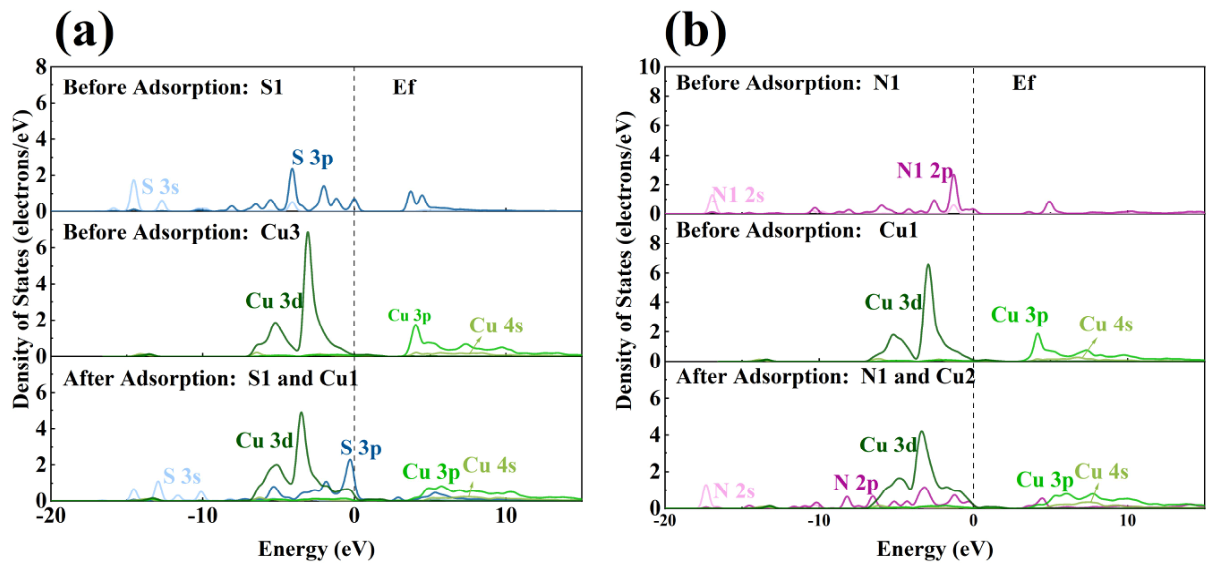
Figure 17 compares the PDOS of the key interfacial atoms before and after adsorption. After adsorption, the S1 3p and N1 2p states shift to lower energies and broaden in the -7 to 0 eV range, showing substantial overlap with the Cu 3d states. These features suggest pronounced orbital hybridization and interfacial charge redistribution. Meanwhile, the Cu 3d peaks decrease in intensity and broaden, implying enhanced electron delocalization, which may contribute to stabilizing the interfacial bonding. Notably, the hybridized states associated with S1-Cu bonding extend toward the Fermi level, whereas those related to N1-Cu remain below Ef, suggesting that the S-Cu interaction plays a larger role in interfacial charge transfer.
Figure 17.
Adsorption of 2MBI5SA on the chalcopyrite surface: (a) adsorption model; (b) electron density map.
Figure 17.
Adsorption of 2MBI5SA on the chalcopyrite surface: (a) adsorption model; (b) electron density map.
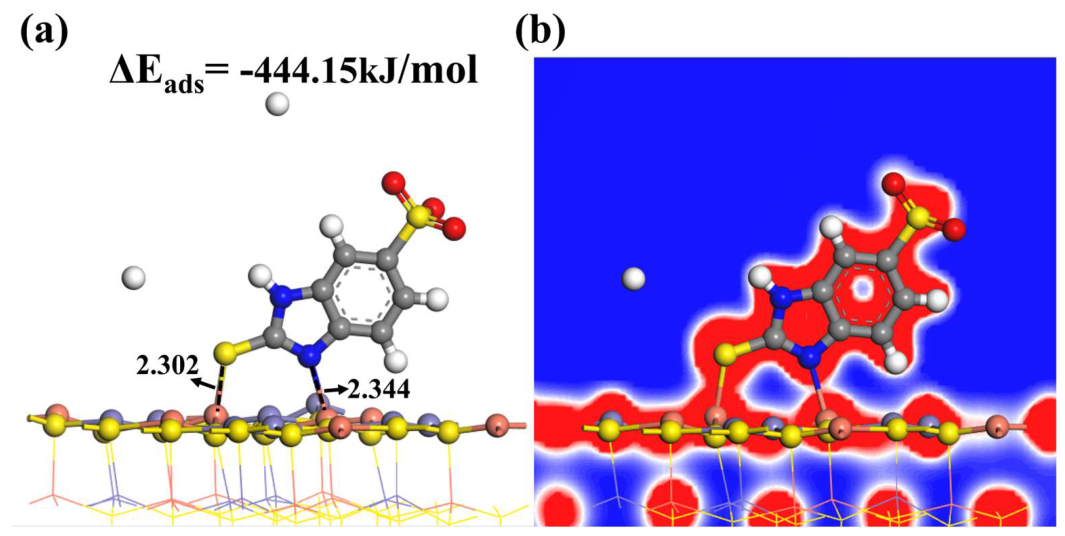
Figure 17.
Partial density of states (PDOS) of interacting atoms before and after 2MBI5SA adsorption on chalcopyrite.
Figure 17.
Partial density of states (PDOS) of interacting atoms before and after 2MBI5SA adsorption on chalcopyrite.
Mulliken charge analysis was further conducted to quantify charge redistribution upon adsorption (Table 3). The results indicate charge transfer from S1 to Cu1, along with partial electron-density redistribution from Cu2 toward N1, consistent with strong interfacial bonding and a pronounced chemisorption character.
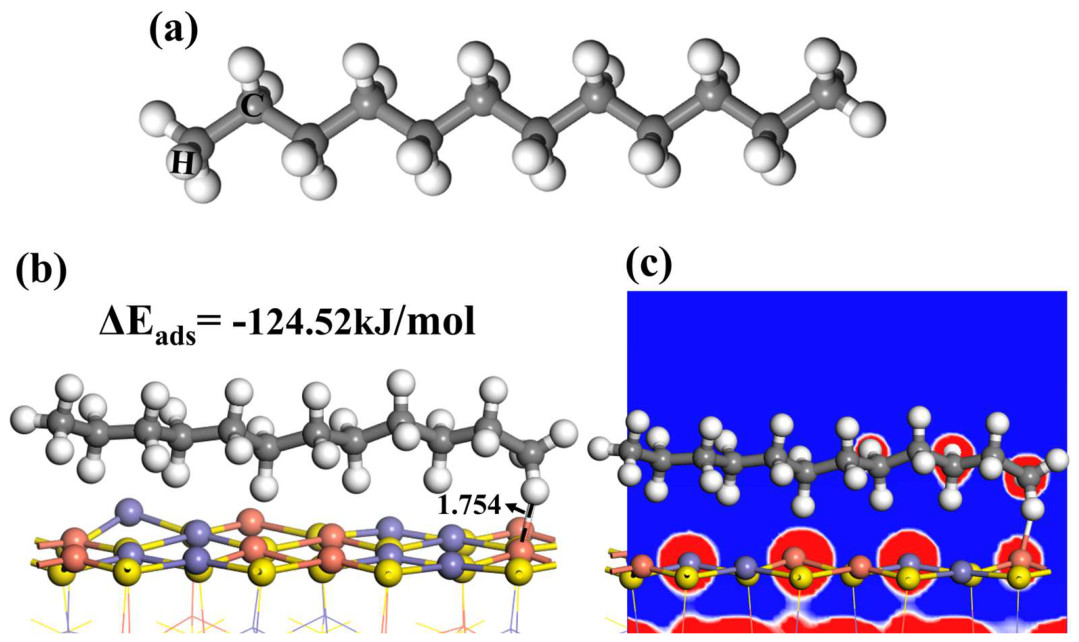
Kerosene mainly consists of hydrocarbon mixtures predominantly in the C12-C16 range, with dodecane (C12H26) commonly used as a representative component [73,74]. Accordingly, C12H26 was employed as a kerosene surrogate in adsorption simulations to probe how 2MBI5SA influences chalcopyrite flotation recovery. The molecular structure of C12H26 is shown in Figure 18a, while the adsorption configuration and electron-density map are provided in Figure 18b, c. The electron-density map shows no new bond formation or appreciable electron-density overlap between C12H26 and the chalcopyrite surface, indicating that kerosene adsorption is dominated by physisorption rather than chemisorption [75]. Moreover, the calculated adsorption energy (−124.52 kJ·mol-1) indicates that, compared with 2MBI5SA, kerosene exhibits substantially weaker affinity for the chalcopyrite surface. Therefore, even in the presence of kerosene, 2MBI5SA is expected to remain effective in suppressing chalcopyrite flotation by outcompeting kerosene for surface sites.
Figure 19.
Molecular model of C12H26 (a) and its adsorption configurations on the chalcopyrite surface (b), and the electron density map (c).
Figure 19.
Molecular model of C12H26 (a) and its adsorption configurations on the chalcopyrite surface (b), and the electron density map (c).
4. Conclusions
This study is the first to report the application of 2-mercapto-5-benzoimidazole sulfonate dihydrate (2MBI5SA) as a chalcopyrite depressant in the flotation separation of Cu-Mo bulk concentrate flotation separation. The results indicate that 2MBI5SA can selectively depress chalcopyrite flotation by forming stable chemisorbed complexes with surface Cu sites via its -SH and -C=N functional groups. The work also confirms that introducing hydrophilic and ionizable functional groups into a collector framework can convert a collector from a flotation promoter into a selective depressant, thereby enabling targeted suppression of specific minerals. This study provides a foudantion for the development of effective chalcopyrite depressants for Cu-Mo flotation separation.
(1) Contact angle measurements showed that 2MBI5SA markedly increased the hydrophilicity of the chalcopyrite surface while having minimal influence on molybdenite. Furthermore, after 2MBI5SA adsorption on the chalcopyrite surface, subsequent kerosene treatment had little effect on the contact angle, suggesting that 2MBI5SA adsorption effectively suppress kerosene adsorption and spreading on chalcopyrite. In contrast, for molybdenite, pre-adsorption of 2MBI5SA followed by kerosene treatment caused negligible change. Zeta potential analysis further supported these observations. Microflotation tests confirmed that over a pH range of 7-13, 2MBI5SA effectively suppressed chalcopyrite flotation while exerting only a minor effect on molybdenite recovery, demonstrating good selectivity.
(2) Industrial flotation tests of actual Cu-Mo bulk concentrate revealed that, compared with the conventional depressant sodium sulfide (Na2S), 2MBI5SA exhibited stronger selective depression toward chalcopyrite. Under conditions where molybdenite recovery reached 81.46% and the Mo grade in the concentrate was 4.46%, chalcopyrite recovery decreased to 13.03%.
(3) SCC-DFTB calculations showed that 2MBI5SA adsorbs onto Cu sites on the chalcopyrite surface, forming stable adsorption configurations with Cu-heteroatom bond lengths of 2.302 Å and 2.344 Å, and an adsorption energy of -444.15 kJ·mol-1. In contrast, kerosene adsorption on the chalcopyrite surface is significantly weaker, indicating that 2MBI5SA can effectively suppress chalcopyrite flotation even in the presence of a collector. Although these SCC-DFTB simulations were performed under vacuum conditions, the trends obtained are consistent with experimental observations.
Supplementary Materials
The following supporting information can be downloaded at the website of this paper posted on Preprints.org.
Author Contributions
Conceptualization, Jianhua Chen; Software, Lujing Liang; Validation, Lujing Liang; Resources, Jianhua Chen and Xufu Zhang; Data curation, Lujing Liang; Writing – original draft, Lujing Liang; Writing – review & editing, Jianhua Chen and Anruo Luo; Visualization, Lujing Liang; Supervision, Xufu Zhang and Anruo Luo; Project administration, Jianhua Chen; Funding acquisition, Jianhua Chen. All authors have read and agreed to the published version of the manuscript.
Funding
The authors are grateful for the financial support provided by the Major Science and Technology Projects in Yunnan Province (grant number 202402AB080010), the Key Technologies Research and Development Program (grant number 2024YFC2909600) and the National Natural Science Foundation of China (NSFC) (grant number 52374264).
Data Availability Statement
The original contributions presented in this study are included in the article/supplementary material. Further inquiries can be directed to the corresponding author(s).
Conflicts of Interest
The authors declare no conflict of interest.
References
- Dutta, S.K.; Lodhari, D.R. Extraction of nuclear and non-ferrous metals; Springer Singapore: Singapore, 2018. [Google Scholar]
- Lasheen, T.; El-Ahmady, M.; Hassib, H.; Helal, A. Molybdenum metallurgy review: hydrometallurgical routes to recovery of molybdenum from ores and mineral raw materials. Mineral. Process. Extr. Metall. Rev. 2015, 36(3), 145–173. [Google Scholar] [CrossRef]
- Yin, Z.; Xu, L.; He, J.; Wu, H.; Fang, S.; Khoso, S.A.; Hu, Y.; Sun, W. Evaluation of l-cysteine as an eco-friendly depressant for the selective separation of MoS2 from PbS by flotation. J. Mol. Liq. 2019, 282, 177–186. [Google Scholar] [CrossRef]
- Yang, B.; Yan, H.; Zeng, M.; Huang, P.; Jia, F.; Teng, A. A novel copper depressant for selective flotation of chalcopyrite and molybdenite. Miner. Eng. 2020, 151, 106309. [Google Scholar] [CrossRef]
- Córdoba, E.; Muñoz, J.; Blázquez, M.; González, F.; Ballester, A. Leaching of chalcopyrite with ferric ion. Part I: General aspects. Hydrometallurgy 2008, 93(3-4), 81–87. [Google Scholar] [CrossRef]
- Liu, G.-y.; Lu, Y.-p.; Zhong, H.; Cao, Z.-f.; Xu, Z.-h. A novel approach for preferential flotation recovery of molybdenite from a porphyry Cu-Mo ore. Miner. Eng. 2012, 36, 37–44. [Google Scholar] [CrossRef]
- Yi, G.; Macha, E.; Van Dyke, J.; Macha, R.E.; McKay, T.; Free, M.L. Recent progress on research of molybdenite flotation: A review. Adv. Colloid Snd Interface Sci. 2021, 295, 102466. [Google Scholar] [CrossRef] [PubMed]
- Zhang, N.; Liu, W.; Liu, W.; Chen, X. Flotation separation of molybdenite from chalcopyrite using mechanically degraded polyacrylamide as a novel depressant. Colloids Surf. A Physicochem. Eng. Asp. 2022, 652, 129897. [Google Scholar] [CrossRef]
- Chen, J.; Wang, J.; Li, Y.; Liu, M.; Liu, Y.; Zhao, C.; Cui, W. Effects of surface spatial structures and electronic properties of chalcopyrite and pyrite on Z-200 selectivity. Miner. Eng. 2021, 163, 106803. [Google Scholar] [CrossRef]
- Liu, Z.; Liu, D.; Liu, Y.; Xu, L.; Wen, S. Selective depressing of chalcopyrite and molybdenite flotation by captopril: Mechanisms and insights. Appl. Surf. Sci. 2025, 695, 162906. [Google Scholar] [CrossRef]
- Xiao, J.; Liu, G.; Zhong, H.; Huang, Y.; Cao, Z. The flotation behavior and adsorption mechanism of O-isopropyl-S-[2-(hydroxyimino) propyl] dithiocarbonate ester to chalcopyrite. J. Taiwan Inst. Chem. Eng. 2016, 71, 38–46. [Google Scholar] [CrossRef]
- Prasad, M.S. Reagents in the mineral industry- recent trends and applications. Miner. Eng. 1992, 5(3-5), 279–294. [Google Scholar] [CrossRef]
- Poorkani, M.; Banisi, S. Industrial use of nitrogen in flotation of molybdenite at the Sarcheshmeh copper complex. Miner. Eng. 2005, 18(7), 735–738. [Google Scholar] [CrossRef]
- Liu, Q. Synthetical technological research of Cu- Mo separation inhibitor sodium thioglycollate, North West Univ. (2010) 3-5.
- Lei, G.C. Experimental study on Cu-Mo separation process of a Cu-Mo ore, China Molybdenum Industry. 28(5) (2004) 4.
- ZHANG, L.-r.; Feng, X. Flotation of Xinhua molybdenite using sodium sulfide as modifier. Trans. Nonferrous Met. Soc. China 2010, 20(4), 702–706. [Google Scholar] [CrossRef]
- Mehrabani, J.V.; Mousavi, S.M.; Noaparast, M. Evaluation of the replacement of NaCN with Acidithiobacillus ferrooxidans in the flotation of high-pyrite, low-grade lead–zinc ore, Separation and Purification Technology. 2011, 80(2), 202–208. [Google Scholar] [CrossRef]
- Cao, Q.B.; Wen, S.M.; Li, C.X.; Bai, S.J.; Liu, D. Investigation on molybdenite separation from a complex sulfide ore. Adv. Mater. Res. 2013, 634, 3408–3411. [Google Scholar] [CrossRef]
- Liao, R.; Feng, Q.; Wen, S.; Liu, J. Flotation separation of molybdenite from chalcopyrite using ferrate(VI) as selective depressant in the absence of a collector. Miner. Eng. 2020, 152, 106369. [Google Scholar] [CrossRef]
- Suyantara, G.P.W.; Hirajima, T.; Miki, H.; Sasaki, K.; Yamane, M.; Takida, E.; Kuroiwa, S.; Imaizumi, Y. Selective flotation of chalcopyrite and molybdenite using H2O2 oxidation method with the addition of ferrous sulfate. Miner. Eng. 2018, 122, 312–3326. [Google Scholar] [CrossRef]
- Hirajima, T.; Miki, H.; Suyantara, G.P.W.; Matsuoka, H.; Elmahdy, A.M.; Sasaki, K.; Imaizumi, Y.; Kuroiwa, S. Selective flotation of chalcopyrite and molybdenite with H2O2 oxidation. Miner. Eng. 2017, 100, 83–92. [Google Scholar] [CrossRef]
- Castellón, C.I.; Toro, N.; Gálvez, E.; Robles, P.; Leiva, W.H.; Jeldres, R.I. Froth Flotation of Chalcopyrite/Pyrite Ore: A Critical Review. Materials 2022, 15(19), 6536. [Google Scholar] [CrossRef]
- Hu, J.; Zi, F.; Tian, G. Extraction of copper from chalcopyrite with potassium dichromate in 1-ethyl-3-methylimidazolium hydrogen sulfate ionic liquid aqueous solution. Miner. Eng. 2021, 172, 107179. [Google Scholar] [CrossRef]
- Chen, Y.; Chen, X.; Peng, Y. The depression of molybdenite flotation by sodium metabisulphite in fresh water and seawater. Miner. Eng. 2021, 168, 106939. [Google Scholar] [CrossRef]
- Huang, Y.; Yao, J.; Yu, B.; Zhang, L.; Song, X.; Peng, W. Enhancing separation of chalcopyrite and molybdenite via ozone micro-nano bubble oxidation and flotation. Process Saf. Environ. Prot. 2025, 197, 107064. [Google Scholar] [CrossRef]
- Yan, H.; Yang, B.; Zeng, M.; Huang, P.; Teng, A. Selective flotation of Cu-Mo sulfides using xanthan gum as a novel depressant. Miner. Eng. 2020, 156, 106486. [Google Scholar] [CrossRef]
- Miki, H.; Hirajima, T.; Muta, Y.; Suyantara, G.P.W.; Sasaki, K. Effect of Sodium Sulfite on Floatability of Chalcopyrite and Molybdenite. Minerals 2018, 8(4), 172. [Google Scholar] [CrossRef]
- Semoto, Y.; Suyantara, G.P.W.; Miki, H.; Sasaki, K.; Hirajima, T.; Tanaka, Y.; Aoki, Y.; Ura, K. Effect of Sodium Metabisulfite on Selective Flotation of Chalcopyrite and Molybdenite. Minerals 2021, 11(12), 1377. [Google Scholar] [CrossRef]
- Pradip, Applications of chelating agents in mineral processing. Miner. Metall. Process. 1988, 5(2), 80–89. [CrossRef]
- Feng, Q.M.; Chen, J.H. Research Progress on Organic Depressants for Sulfide Mineral Flotation Separation, Foreign Metal Ore Beneficiation. 1998. [Google Scholar]
- Geng, Z.Q. Research on new technologies and mechanisms of potential-regulated flotation and separation of complex copper–molybdenum ores; Central South University, 2010. [Google Scholar]
- Wang, D.Z. Principles and Applications of Flotation Reagents; Metallurgical Industry Press, 1982. [Google Scholar]
- Wang, X.; Zhao, B.; Liu, J.; Zhu, Y.; Han, Y. Dithiouracil, a highly efficient depressant for the selective separation of molybdenite from chalcopyrite by flotation: Applications and mechanism. Miner. Eng. 2021, 175, 107287. [Google Scholar] [CrossRef]
- Xu, H.; Ye, T.; Zhang, X.; Lu, L.; Xiong, W.; Zhu, Y. Insights into the adsorption mechanism of N-thiourea-maleamic acid on chalcopyrite surface in the flotation separation of Cu-Mo sulfide ores. J. Mol. Liq. 2022, 350, 118554. [Google Scholar] [CrossRef]
- Guan, C.; Yin, Z.; Ahmed Khoso, S.; Sun, W.; Hu, Y. Performance Analysis of Thiocarbonohydrazide as a Novel Selective Depressant for Chalcopyrite in Molybdenite-Chalcopyrite Separation. Minerals 2018, 8(4), 142. [Google Scholar] [CrossRef]
- Yin, Z.; Sun, W.; Hu, Y.; Zhang, C.; Guan, Q.; Zhang, C. Separation of Molybdenite from Chalcopyrite in the Presence of Novel Depressant 4-Amino-3-thioxo-3,4-dihydro-1,2,4-triazin-5(2H)-one. Minerals 2017, 7(8), 146. [Google Scholar] [CrossRef]
- Zhang, X.; Lu, L.; Cao, Y.; Yang, J.; Che, W.; Liu, J. The flotation separation of molybdenite from chalcopyrite using a polymer depressant and insights to its adsorption mechanism. Chem. Eng. J. 2020, 395, 125137. [Google Scholar] [CrossRef]
- Yin, Z.; Sun, W.; Hu, Y.; Zhang, C.; Guan, Q.; Liu, R.; Chen, P.; Tian, M. Utilization of acetic acid-[(hydrazinylthioxomethyl)thio]-sodium as a novel selective depressant for chalcopyrite in the flotation separation of molybdenite, Separation and Purification Technology. 2017, 179, 248–256. [Google Scholar] [CrossRef]
- Taheri, B.; Hossein Darvishnejad, M.; Rezaei, F. Depression Effect of Thioglycolic Acid (TGA) on Flotation Separation of Molybdenite from Copper Sulfides with different Collectors: An Experimental and Theoretical Study. ChemistrySelect 2022, 7, e202200026. [Google Scholar] [CrossRef]
- Qin, W.; Wu, J.; Jiao, F.; Zeng, J. Mechanism study on flotation separation of molybdenite from chalcocite using thioglycollic acid as depressant. Int. J. Min. Sci. Technol. 2017, 27(6), 1043–1049. [Google Scholar] [CrossRef]
- Li, M.-y.; Wei, D.-z.; Shen, Y.-b.; Liu, W.-g.; Gao, S.-l.; Liang, G.-q. Selective depression effect in flotation separation of Cu-Mo sulfides using 2,3-disulfanylbutanedioic acid. Trans. Nonferrous Met. Soc. China 2015, 25(9), 3126–3132. [Google Scholar] [CrossRef]
- Yan, H.; Yang, B.; Zhu, H.; Huang, P.; Hu, Y. Selective flotation of Cu-Mo sulfides using dithiothreitol as an environmental-friendly depressant. Miner. Eng. 2021, 168, 106929. [Google Scholar] [CrossRef]
- Tang, M.; Chen, Y.; Feng, B.; Corin, K.C. Considering the mechanism of a depressant 2-Amino-5-mercapto-1,3,4-thiadiazole in the flotation of chalcopyrite and molybdenite. Colloids Surf. A Physicochem. Eng. Asp. 2023, 680, 132666. [Google Scholar] [CrossRef]
- Yin, Z.; Chen, S.; Xu, Z.; Zhang, C.; He, J.; Zou, J.; Chen, D.; Sun, W. Flotation separation of molybdenite from chalcopyrite using an environmentally-efficient depressant L-cysteine and its adsoption mechanism. Miner. Eng. 2020, 156, 106438. [Google Scholar] [CrossRef]
- Yang, B.; Yan, H.; Zeng, M.; Zhu, H. Tiopronin as a novel copper depressant for the selective flotation separation of chalcopyrite and molybdenite, Separation and Purification Technology. 2021, 266, 118576. [Google Scholar] [CrossRef]
- Liao, X.J.; Mu, X. A Study on Dexing Cu-Mo Flotation Separation With A New Low- molecule Inhibitor. Adv. Mater. Res. 2011, 396-398, 867–871. [Google Scholar] [CrossRef]
- Zhong, C.; Feng, B.; Wang, H.; Chen, Y.; Guo, M. The depression behavior and mechanism of tragacanth gum on chalcopyrite during Cu-Mo flotation separation. Adv. Powder Technol. 2021, 32, 2712–2719. [Google Scholar] [CrossRef]
- Wang, C.; Liu, R.; Wu, M.; Xu, Z.; Tian, M.; Yin, Z.; Sun, W.; Zhang, C. Flotation separation of molybdenite from chalcopyrite using rhodanine-3-acetic acid as a novel and effective depressant. Miner. Eng. 2021, 162, 106747. [Google Scholar] [CrossRef]
- Gutierrez, L.; Uribe, L.; Hernandez, V.; Vidal, C.; Texeira Mendonça, R. Assessment of the use of lignosulfonates to separate chalcopyrite and molybdenite by flotation. Powder Technol. 2020, 359, 216–225. [Google Scholar] [CrossRef]
- Chen, J.-h.; Lan, L.-h.; Liao, X.-j. Depression effect of pseudo glycolythiourea acid in flotation separation of Cu-Mo. Trans. Nonferrous Met. Soc. China 2013, 23, 824–831. [Google Scholar] [CrossRef]
- Yuan, D.; Cadien, K.; Liu, Q.; Zeng, H. Adsorption characteristics and mechanisms of O-Carboxymethyl chitosan on chalcopyrite and molybdenite. J. Colloid Interface Sci. 2019, 552, 659–670. [Google Scholar] [CrossRef]
- Dai, L.; Feng, B.; Tang, M.; Chen, Y. Effect and mechanism of environmentally friendly depressant 2, 4-Diamino-6-hydroxypyrimidine in separation of chalcopyrite and molybdenite. Process Saf. Environ. Prot. 2024, 187, 993–999. [Google Scholar] [CrossRef]
- Yin, Z.-g.; Sun, W.; Hu, Y.-h.; Guan, Q.-j.; Zhang, C.-h.; Y.-s. Gao, J.-h. Zhai, Depressing behaviors and mechanism of disodium bis (carboxymethyl) trithiocarbonate on separation of chalcopyrite and molybdenite. Trans. Nonferrous Met. Soc. China 2017, 27, 883–890. [Google Scholar] [CrossRef]
- Huang, W.-x.; Tang, H.-h.; Cao, Y.; R.-h. Liu, W. Sun, Separation of molybdenite from chalcopyrite with thiolactic acid depressant: Flotation behavior and mechanism. Trans. Nonferrous Met. Soc. China 2023, 33(10), 3157–3167. [Google Scholar] [CrossRef]
- Zhang, X.; Lu, L.; Luo, A.; Xiong, W.; Chen, J. Interface adsorption of 5-amino-1,3,4-thiadiazole-2-thiol on chalcopyrite surface as flotation depressant in Cu/Mo separation. Appl. Surf. Sci. 2022, 611, 155703. [Google Scholar] [CrossRef]
- Liu, Y.-F.; Lee, Y.-L.; Yang, Y.-C.; Jian, Z.-Y.; Dow, W.-P.; Yau, S.-L. Effect of Chloride Ions on the Adsorption of 3-Mercapto-1-propanesulfonic acid and Bis(3-sulfopropyl)-disulfide on a Au(111) Surface. Langmuir 2010, 26(16), 13263–13271. [Google Scholar] [CrossRef]
- Xu, S.; Lu, X.; Dai, Z.; Li, S.; Xiao, G.; Huai, Y. Effect of Surfactants on Eliminating Stable Ultrafine Chalcopyrite Froth. ACS Omega 2024, 9(36), 38088–38095. [Google Scholar] [CrossRef]
- Zhang, H.; Zhang, F.; Sun, W.; Chen, D.; Chen, J.; Wang, R.; Han, M.; Zhang, C. The effects of hydroxyl on selective separation of chalcopyrite from pyrite: A mechanism study. Appl. Surf. Sci. 2022, 608, 154963. [Google Scholar] [CrossRef]
- Feng, Y.; Li, Z.; Chen, J.; Chen, Y. Effect of content and spin state of iron on electronic properties and floatability of iron-bearing sphalerite: A DFT+U study. Int. J. Min. Sci. Technol. 2023, 33(12), 1563–1571. [Google Scholar] [CrossRef]
- Luo, A.; Chen, J. Effect of hydration and hydroxylation on the adsorption of metal ions on quartz surfaces: DFT study. Appl. Surf. Sci. 2022, 595, 153553. [Google Scholar] [CrossRef]
- Liu, H.; Seifert, G.; Di Valentin, C. An efficient way to model complex magnetite: Assessment of SCC-DFTB against DFT. J. Chem. Phys. 2019, 150(9), 094703. [Google Scholar] [CrossRef]
- Zhang, Y.; Chen, J.; Li, Y.; Zhao, C.; Chen, Y. Application of a new self-consistent-charge density-functional tight-binding(SCC-DFTB) parameter set for simulating the adsorption of flotation reagents on the surface of typical lead minerals. Miner. Eng. 2024, 209, 108631. [Google Scholar] [CrossRef]
- Niehaus, T.A.; Elstner, M.; Frauenheim, T.; Suhai, S. Application of an approximate density-functional method to sulfur containing compounds. J. Mol. Struct. THEOCHEM 2001, 541(1-3), 185–194. [Google Scholar] [CrossRef]
- Chen, J.; Zhang, Y. Large system study of chalcopyrite and pyrite flotation surfaces based on SCC-DFTB parameterization method. Int. J. Min. Sci. Technol. 2025, 35(7), 1037–1055. [Google Scholar] [CrossRef]
- Knight, K.S.; Marshall, W.G.; Zochowski, S.W. The low-temperature and high-pressure thermoelastic and structural properties of chalcopyrite, CuFeS2. Can. Mineral. 2011, 49(4), 1015–1034. [Google Scholar] [CrossRef]
- Li, M.Y. Mechanistic study on the effect of inhibitor molecular configuration on copper–molybdenum separation; Northeastern University, 2017; Volume 334, pp. 366–373. [Google Scholar]
- de Oliveira, C.; de Lima, G.F.; de Abreu, H.A.; Duarte, H.A. Reconstruction of the Chalcopyrite Surfaces-A DFT Study. J. Phys. Chem. C 2012, 116(10), 6357–6366. [Google Scholar] [CrossRef]
- Ferrari, J.V.; Silveira, B.M.d.O.; Arismendi-Florez, J.J.; Fagundes, T.B.; Silva, M.A.d.T.; Skinner, R.; Ulsen, C.; Carneiro, C.d.C. Influence of carbonate reservoir mineral heterogeneities on contact angle measurements. J. Pet. Sci. Eng. 2020, 199, 108313. [Google Scholar] [CrossRef]
- Ban, X.; Yao, J.; Yin, W.; Xie, Y.; Du, W.; Zhang, T.; Wang, Y. High-efficiency reverse flotation separation of magnesite from quartz using a novel collector, N-[3-(Isodecyloxy)propyl]propane-1,3-diamine: Mechanistic Insights into surface selective adsorption. Appl. Surf. Sci. 2025, 704, 163478. [Google Scholar] [CrossRef]
- Cao, J.; Liao, R.; Wu, D.; Zuo, Q.; Liu, J.; Wen, S. Utilizing phosphonyl carboxylic acid copolymer as an efficient depressant for flotation separation of chalcopyrite from galena: Experimental and DFT study, Separation and Purification Technology. 2024, 348, 127725. [Google Scholar] [CrossRef]
- Liu, M.; Chen, J.; Chen, Y.; Zhu, Y. Interaction between smithsonite and carboxyl collectors with different molecular structure in the presence of water: a theoretical and experimental study. Appl. Surf. Sci. 2020, 510, 145410. [Google Scholar] [CrossRef]
- Chen, J.; Li, Y. Orbital symmetry matching study on the interactions of flotation reagents with mineral surfaces. Miner. Eng. 2022, 179, 107469. [Google Scholar] [CrossRef]
- Lissitsyna, K.; Huertas, S.; Quintero, L.C.; Polo, L.M. PIONA analysis of kerosene by comprehensive two-dimensional gas chromatography coupled to time of flight mass spectrometry. Fuel 2014, 116, 712–722. [Google Scholar] [CrossRef]
- Gerasimov, G.Y.; Losev, S.A. Kinetic models of combustion of kerosene and its components. J. Eng. Phys. Thermophys. 2005, 78, 1059–1070. [Google Scholar] [CrossRef]
- Liao, Y.; Mao-Yan, A.; Xia, W. Reaserch on kerosene emulsifier as collector in fine coal flotation. Clean. Coal Technol. 2010, 16, 17–19. [Google Scholar]
Figure 1.
Effect of 2MBI5SA Dosage on Flotation Performance of Chalcopyrite and Molybdenite.
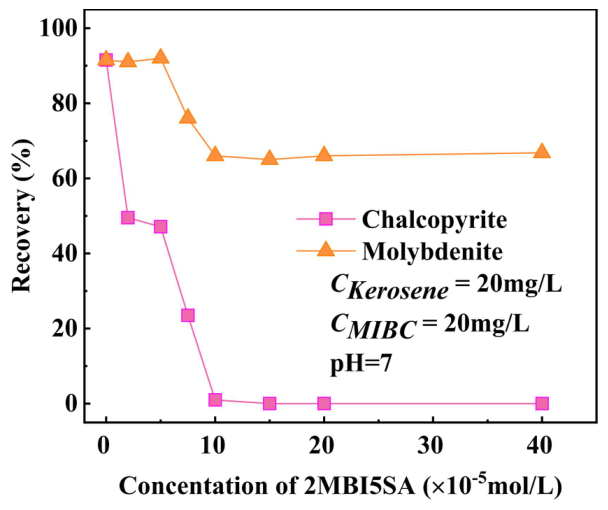
Figure 2.
Effect of 2MBI5SA on the floatability of chalcopyrite and molybdenite at different pH values.
Figure 2.
Effect of 2MBI5SA on the floatability of chalcopyrite and molybdenite at different pH values.
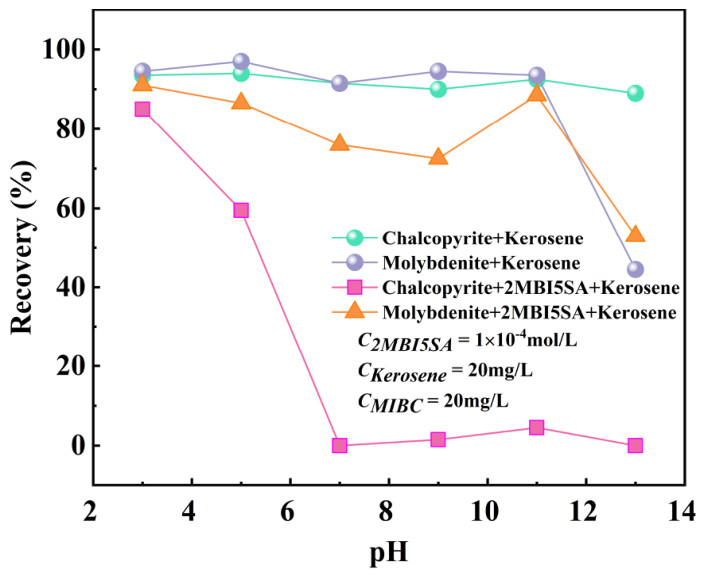
Figure 3.
Flotation recoveries and grades of Cu and Mo in the froth products during the separation of an artificial bulk mineral system under different depressant conditions. (Chalcopyrite : Molybdenite = 1 : 1, pH = 7, Kerosene 20 mg/L).
Figure 3.
Flotation recoveries and grades of Cu and Mo in the froth products during the separation of an artificial bulk mineral system under different depressant conditions. (Chalcopyrite : Molybdenite = 1 : 1, pH = 7, Kerosene 20 mg/L).
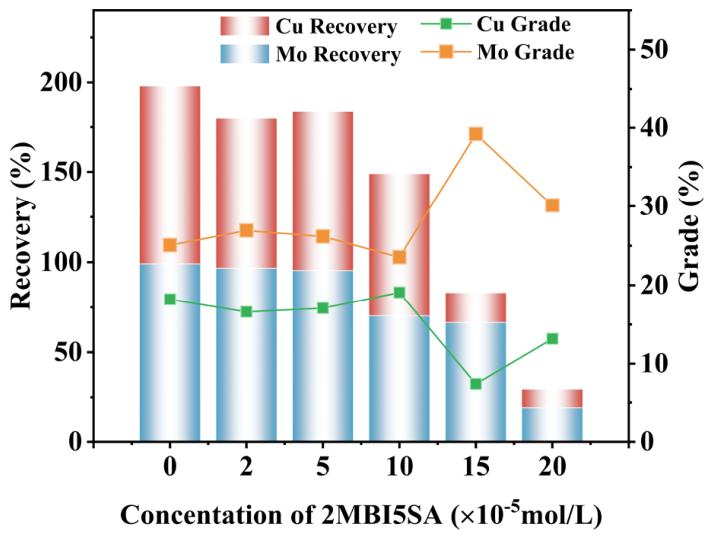
Figure 4.
Comparison of 2MBI5SA and Na2S on the flotation separation performance of a real Cu-Mo bulk concentrate.
Figure 4.
Comparison of 2MBI5SA and Na2S on the flotation separation performance of a real Cu-Mo bulk concentrate.
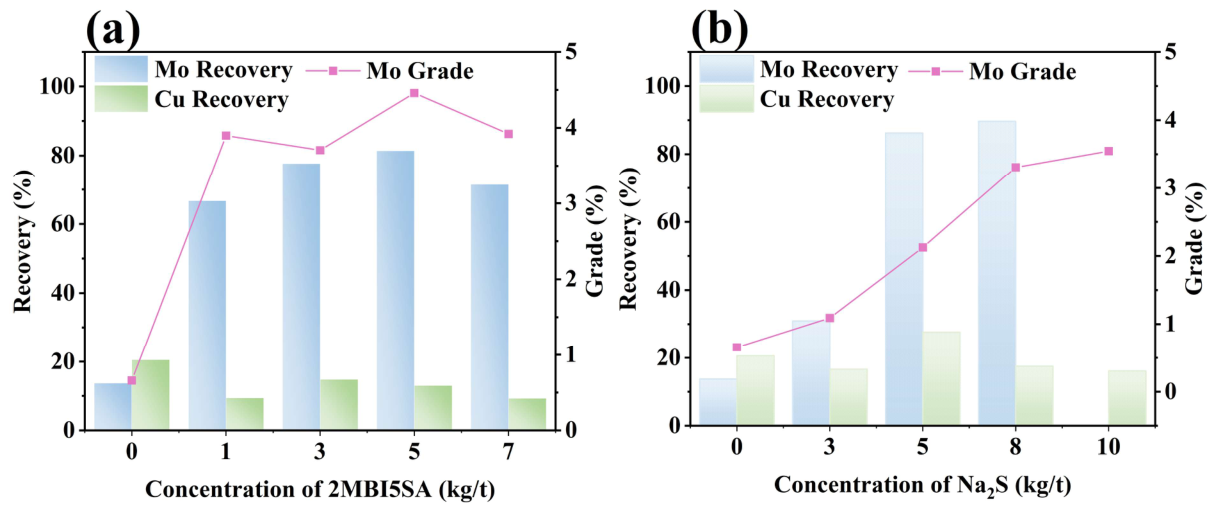
Figure 5.
Calibration curve of 2MBI5SA at different concentrations (a), and adsorption amounts of 2MBI5SA on chalcopyrite and molybdenite (b).
Figure 5.
Calibration curve of 2MBI5SA at different concentrations (a), and adsorption amounts of 2MBI5SA on chalcopyrite and molybdenite (b).
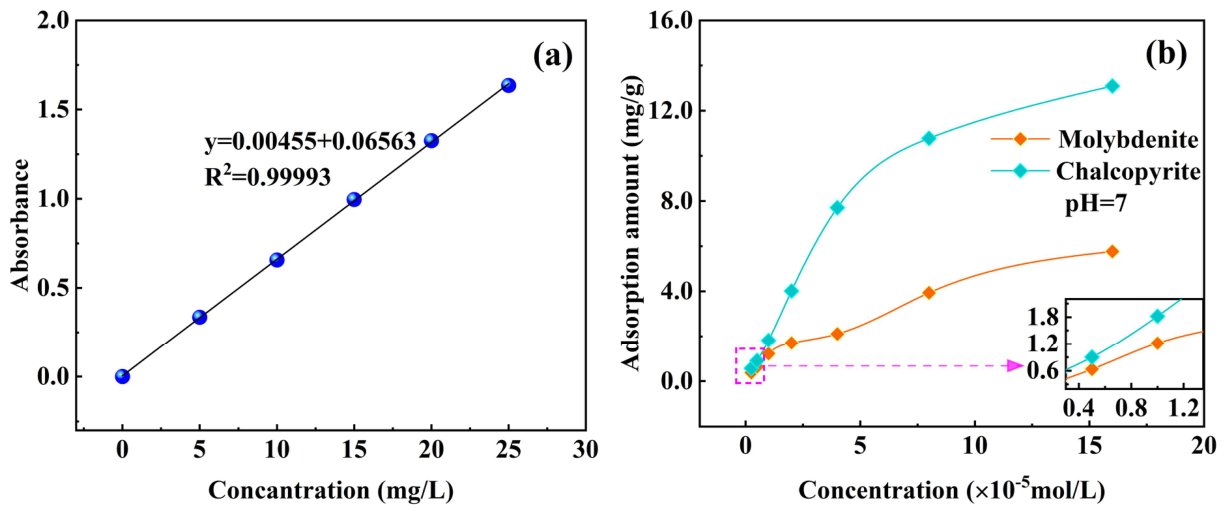
Figure 6.
Contact angles of chalcopyrite and molybdenite under different treatment conditions (Pristine, 2MBI5SA-treated, and (2MBI5SA + Kerosene)-treated).
Figure 6.
Contact angles of chalcopyrite and molybdenite under different treatment conditions (Pristine, 2MBI5SA-treated, and (2MBI5SA + Kerosene)-treated).
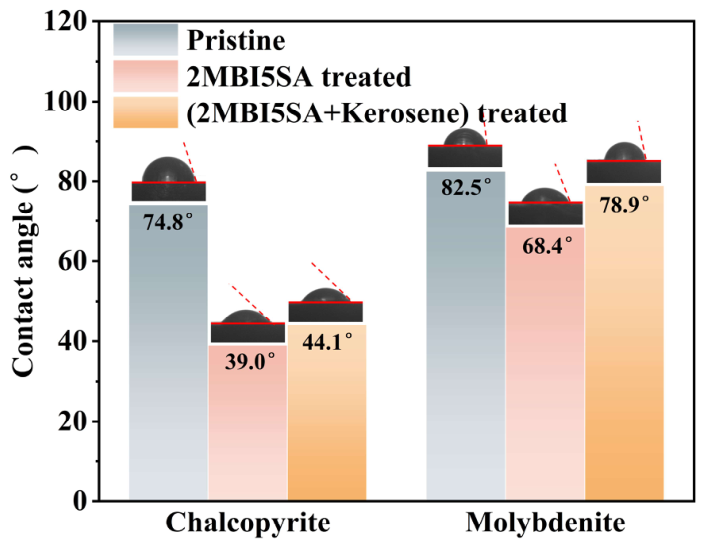
Figure 7.
Zeta potential versus pH curves for chalcopyrite (a) and molybdenite (b) under different conditions. (2MBI5SA 10×10-5 mol/L, Kerosene 20 mg/L).
Figure 7.
Zeta potential versus pH curves for chalcopyrite (a) and molybdenite (b) under different conditions. (2MBI5SA 10×10-5 mol/L, Kerosene 20 mg/L).
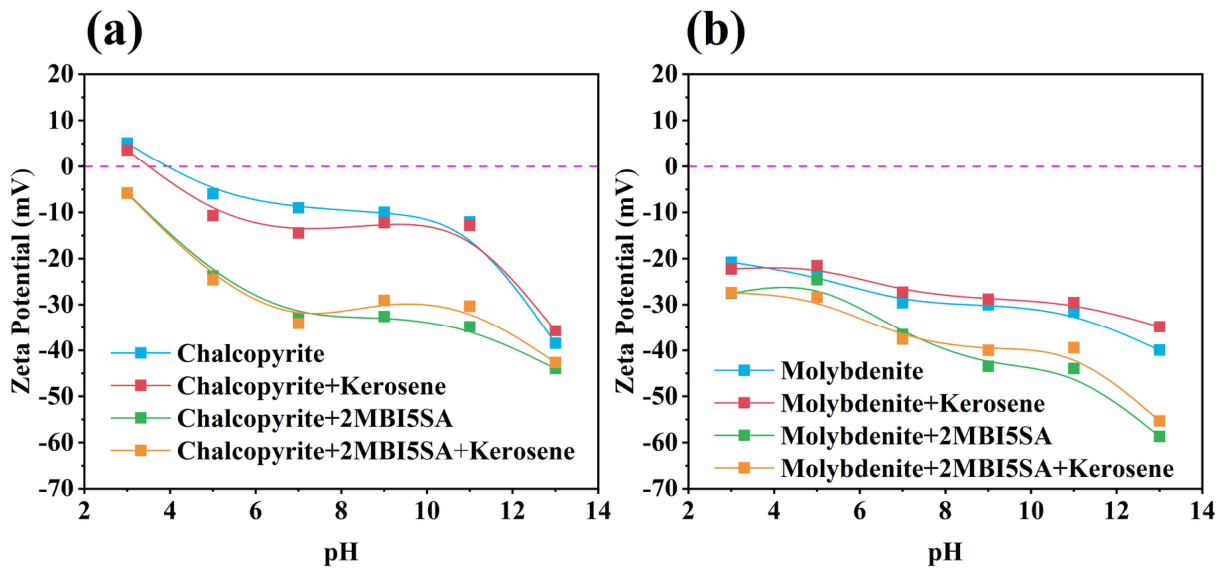
Figure 8.
FT-IR spectra of 2MBI5SA, 2MBI5SA-treated chalcopyrite, and untreated chalcopyrite samples.
Figure 8.
FT-IR spectra of 2MBI5SA, 2MBI5SA-treated chalcopyrite, and untreated chalcopyrite samples.
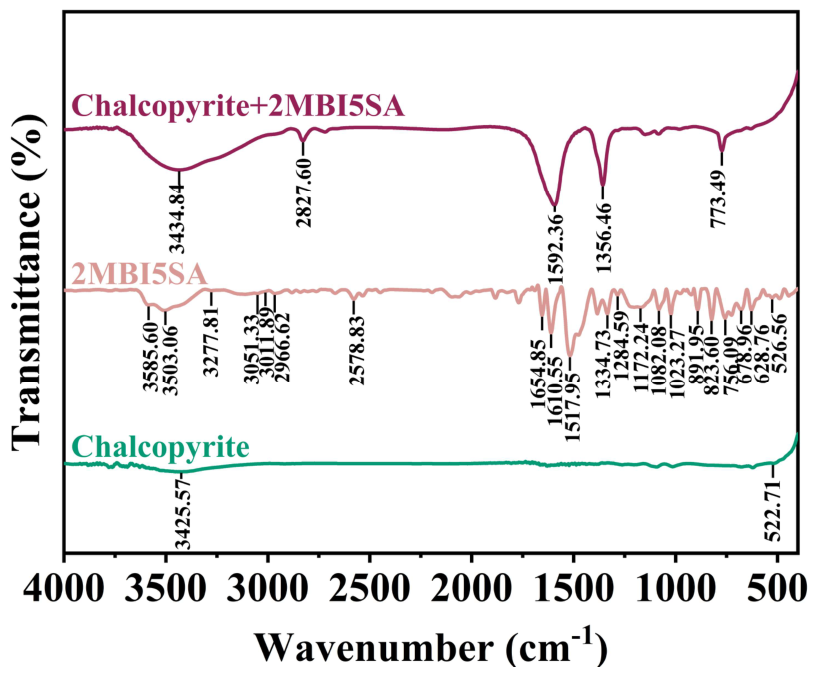
Figure 9.
XPS spectra of chalcopyrite samples before and after 2MBI5SA treatment.
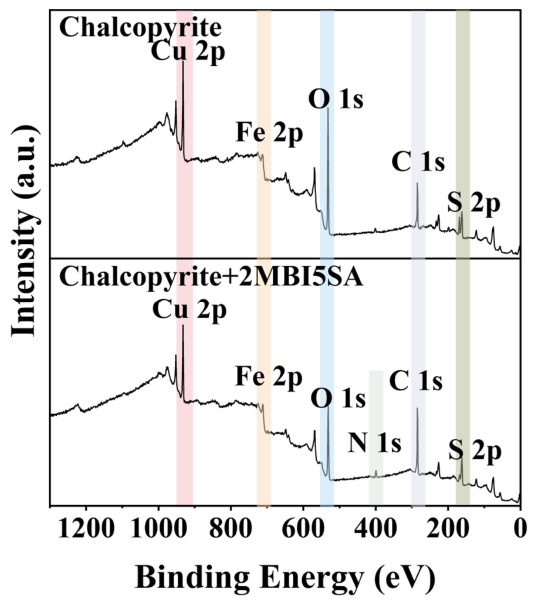
Figure 10.
XPS spectra of 2MBI5SA, treated and untreated chalcopyrite samples by 2MBI5SA: (a)Cu 2p; (b) C 2p; (c)O 1s; (d)Fe 2p; (e)S 2p.
Figure 10.
XPS spectra of 2MBI5SA, treated and untreated chalcopyrite samples by 2MBI5SA: (a)Cu 2p; (b) C 2p; (c)O 1s; (d)Fe 2p; (e)S 2p.
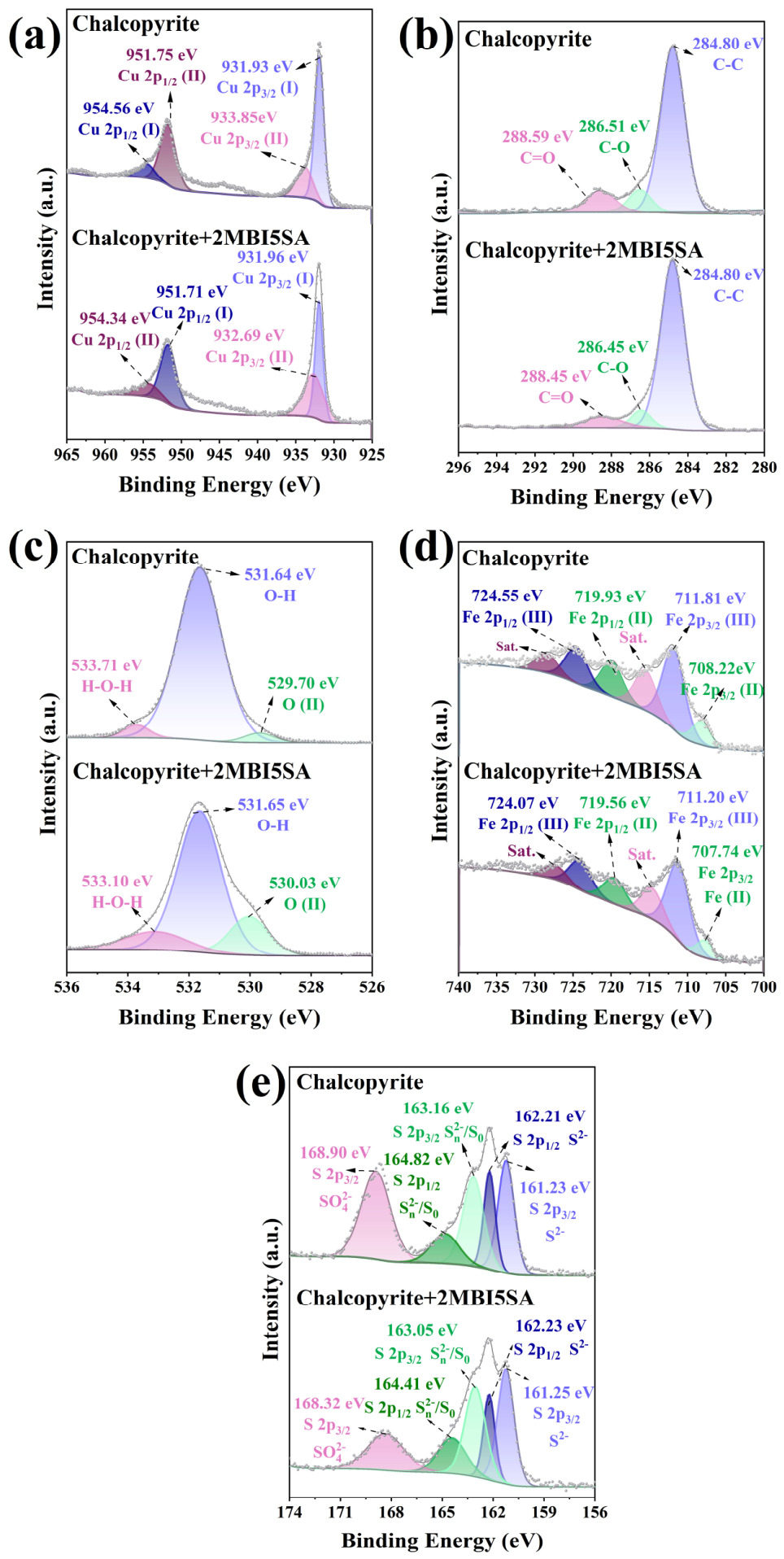
Figure 11.
SEM images of untreated chalcopyrite at 100 μm (a), 20 μm (b), and 1 μm (c) and of treated chalcopyrite by 2MBI5SA at 100 μm (d), 20 μm (e), and 1 μm (f).
Figure 11.
SEM images of untreated chalcopyrite at 100 μm (a), 20 μm (b), and 1 μm (c) and of treated chalcopyrite by 2MBI5SA at 100 μm (d), 20 μm (e), and 1 μm (f).
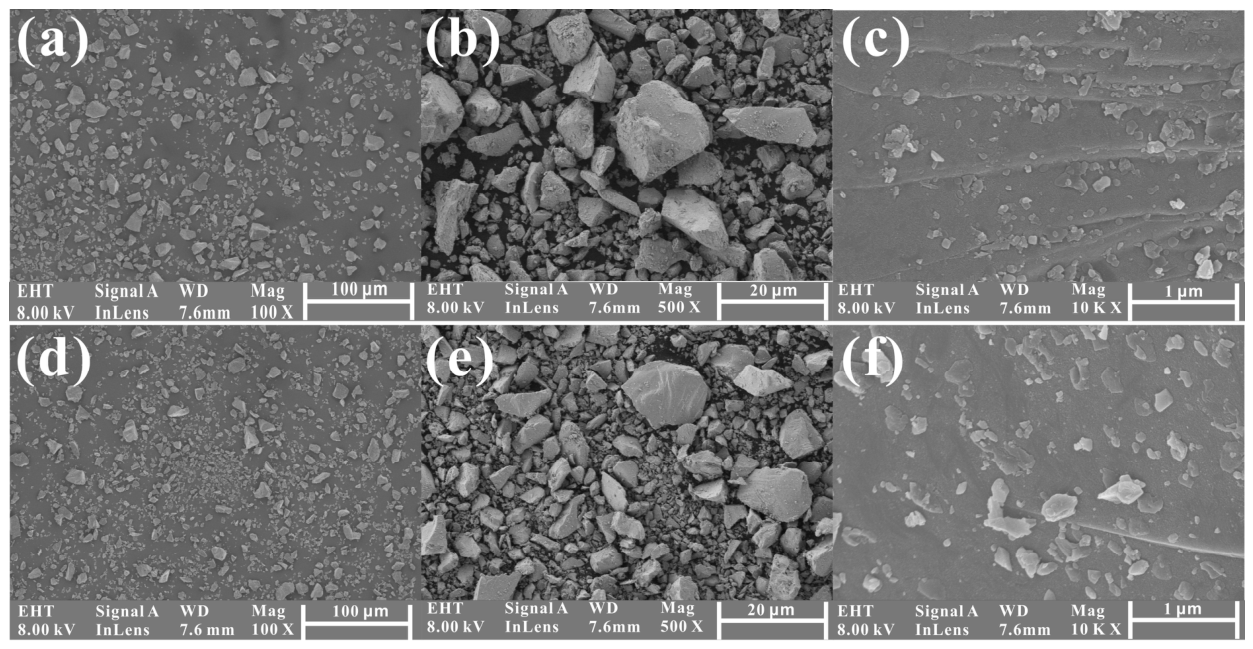
Figure 12.
SEM-EDS surface compositional analysis of chalcopyrite before and after treatment with 2MBI5SA.
Figure 12.
SEM-EDS surface compositional analysis of chalcopyrite before and after treatment with 2MBI5SA.
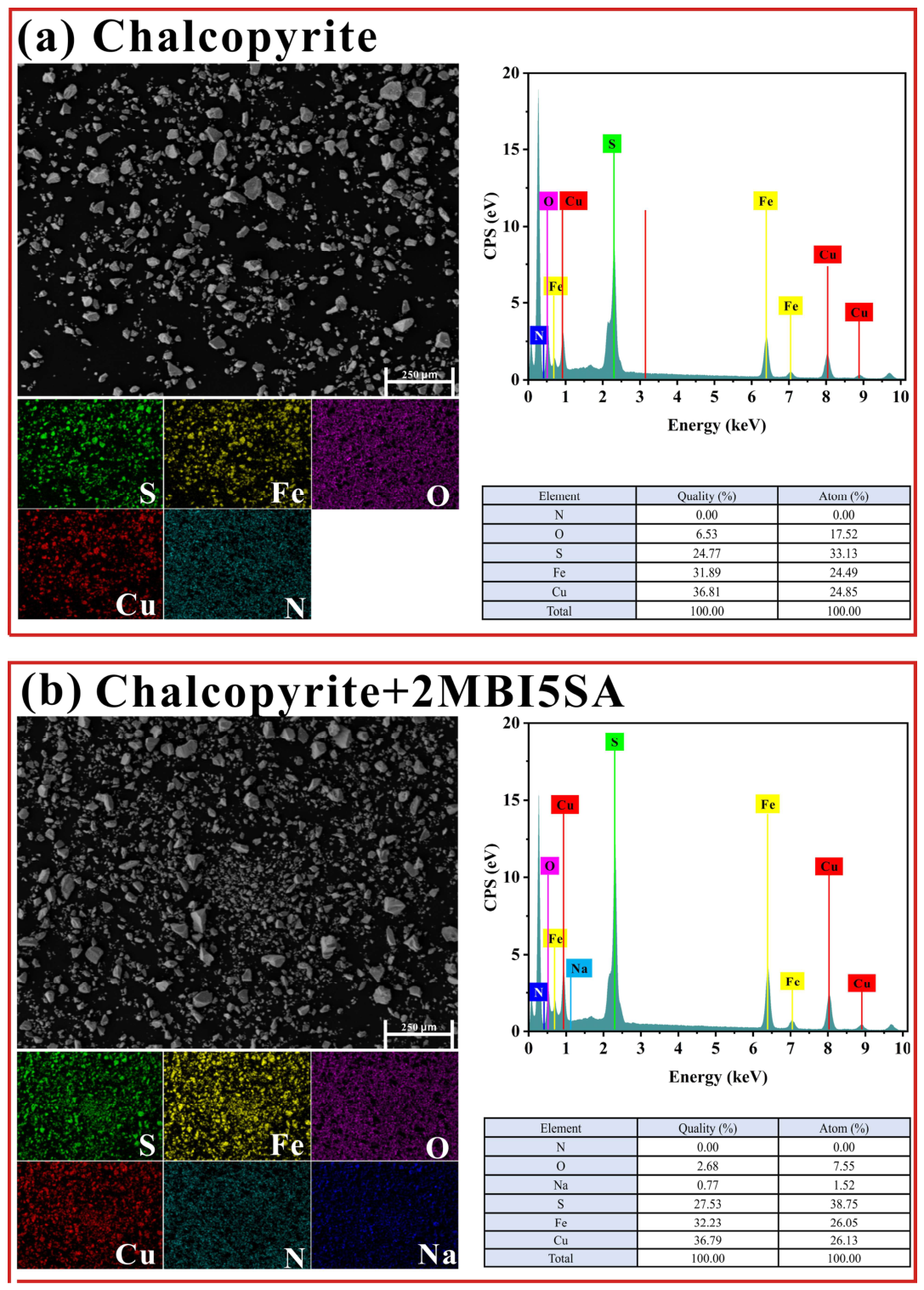
Figure 13.
(a) Molecular structure and (b) schematic of frontier molecular orbitals of 2MBI5SA.
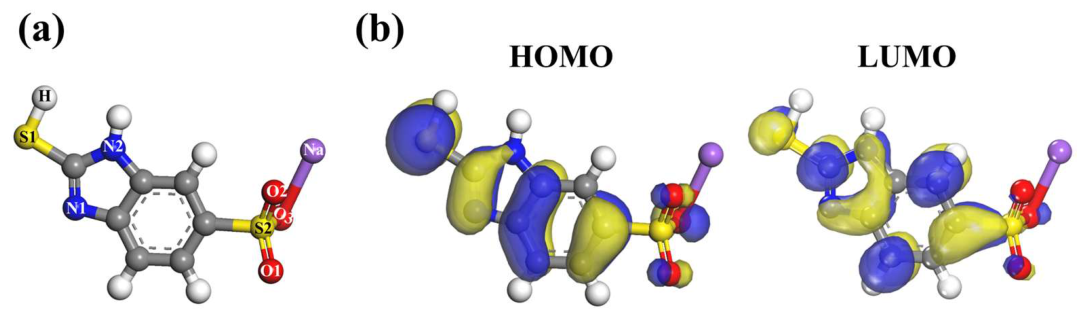
Figure 14.
Partial density of states (PDOS) plot of 2MBI5SA.
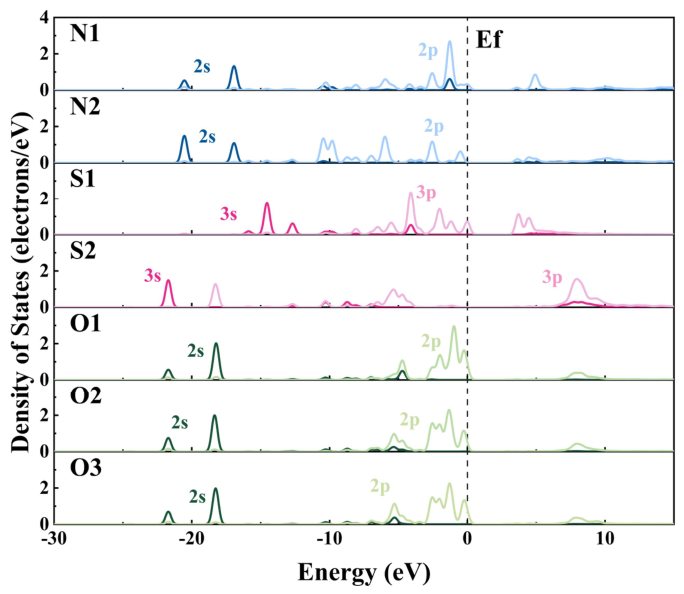
Figure 15.
Chalcopyrite unit cell model (a), (112) surface model (b), and schematic illustration of adsorption sites on the chalcopyrite (112) surface (c).
Figure 15.
Chalcopyrite unit cell model (a), (112) surface model (b), and schematic illustration of adsorption sites on the chalcopyrite (112) surface (c).
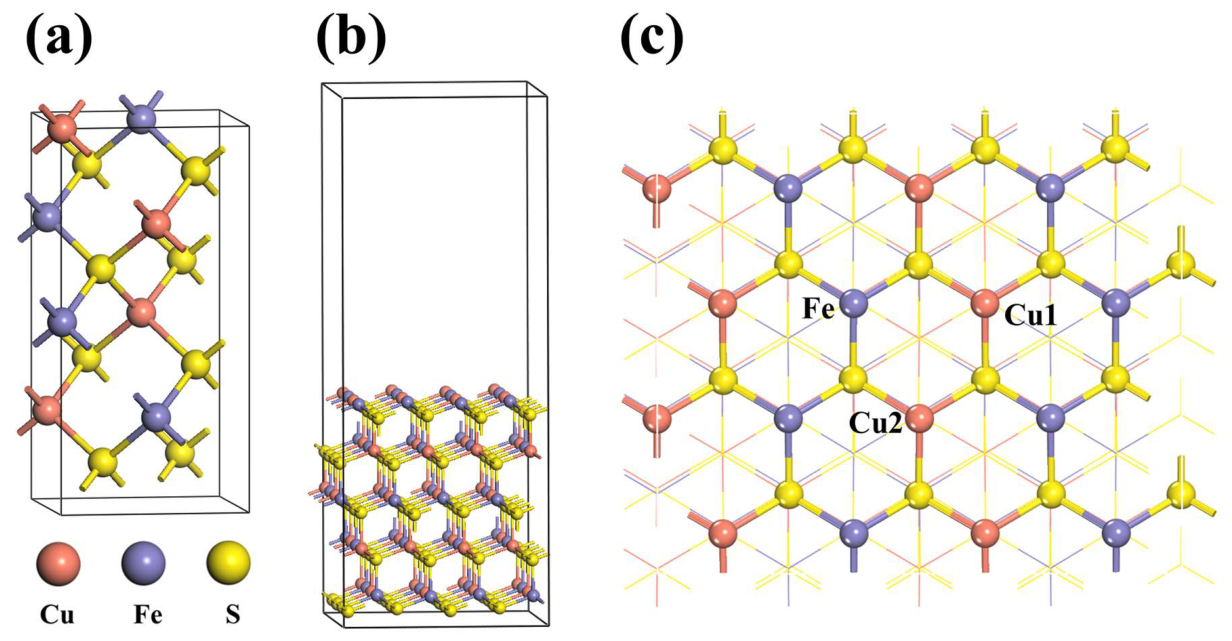

Table 1.
Calculated results of Mulliken charges and Fukui functions for the 2MBI5SA molecule.
| Atomic | N1 | N2 | S1 | S2 | O1 | O2 | O3 |
|---|---|---|---|---|---|---|---|
| Mulliken charges | -0.352 | -0.242 | -0.264 | 0.572 | -0.493 | -0.538 | -0.531 |
| Fukui(f+) | 0.031 | 0.022 | 0.117 | 0.020 | 0.031 | 0.031 | 0.025 |
Table 2.
Adsorption Energy of 2MBI5SA on the Different Sites of the Chalcopyrite (112) Surface.
| Adsorption site | Adsorption energy (kJ/mol) |
|---|---|
| S1-Cu | -383.55 |
| S1-Fe1 | -331.54 |
| S1-Fe1 and N1-Fe2 | -381.24 |
| S1-Cu1 and N1-Cu2 | -444.15 |
| S1-Cu1 and N1-Fe1 | -404.84 |
Table 3.
Mulliken Charge of interacting atoms before and after 2MBI5SA adsorption.
| Atom | Mulliken Charge | D-value | |
|---|---|---|---|
| Before Adsorption | After Adsorption | ||
| Cu1 | 0.27 | 0.2 | -0.07 |
| Cu2 | 0.26 | 0.34 | 0.08 |
| S1 | -0.26 | -0.16 | 0.10 |
| N1 | -0.35 | -0.42 | -0.07 |
Disclaimer/Publisher’s Note: The statements, opinions and data contained in all publications are solely those of the individual author(s) and contributor(s) and not of MDPI and/or the editor(s). MDPI and/or the editor(s) disclaim responsibility for any injury to people or property resulting from any ideas, methods, instructions or products referred to in the content. |
© 2026 by the authors. Licensee MDPI, Basel, Switzerland. This article is an open access article distributed under the terms and conditions of the Creative Commons Attribution (CC BY) license (http://creativecommons.org/licenses/by/4.0/).
Copyright: This open access article is published under a Creative Commons CC BY 4.0 license, which permit the free download, distribution, and reuse, provided that the author and preprint are cited in any reuse.


