
Submitted:
11 May 2026
Posted:
12 May 2026
You are already at the latest version
Abstract
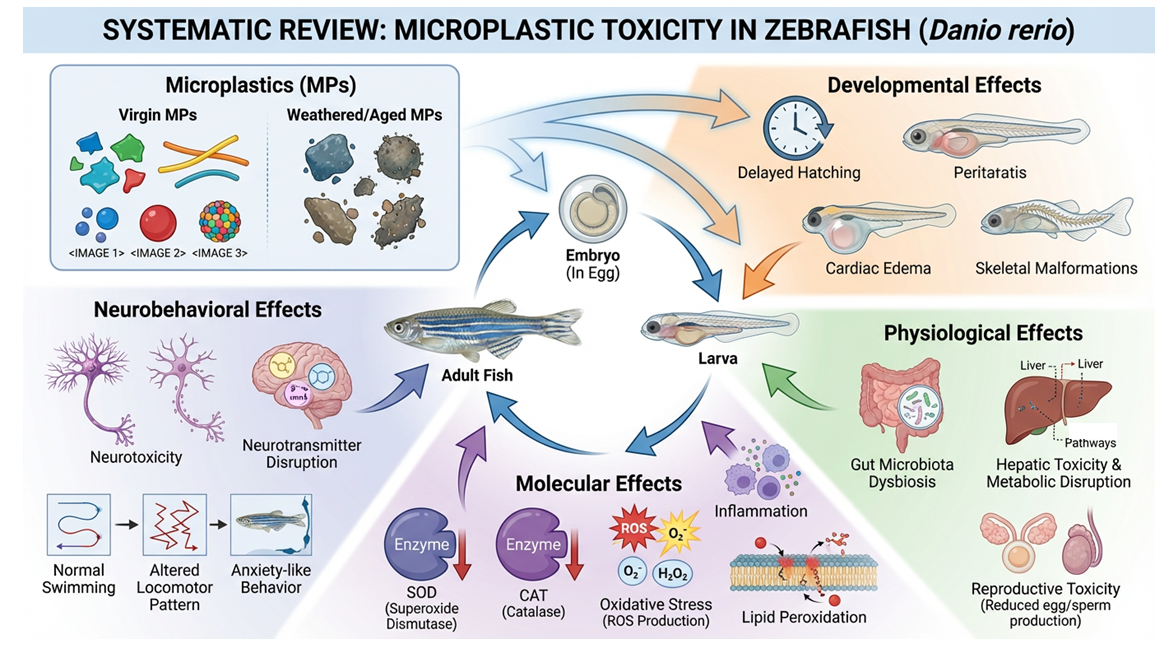
Microplastics (MPs) are widespread pollutants in aquatic environments, but their impacts throughout the life cycle remains of organisms are still not well understood. This systematic review integrates recent experimental results on the developmental, physiological, and neurobehavioral effects of MPs exposure on zebrafish (Danio rerio), a popular model organism for ecotoxicology research. A PRISMA-guided search using Web of Science (WoS) and Scopus as databases generated 371 articles, which was screened to 60 eligible articles. The collated results showed that MP toxicity strongly related to concentration, size, and extent of weathering or aging at various life stages of zebrafish. For developmental toxicity, a concentration-dependent yielded peer-reviewed publications assessing specific MPs properties, such as polymer identity, size, concentration, shape, and aging status. At various life stages, the toxicity of MPs was most affected by concentration, size, and aging. The developmental toxicity showed a concentration-dependent decrease in the rate of hatching, growth inhibition, and cardiac dysfunction, while, an increase in malformations, especially at concentrations of ≥100 µg/L or ≥10 mg/L has been reported. Non-monotonic and threshold effects have also been observed, the complexity of particle-based versus mass-based concentrations. Weathered and photo-aged MPs were found to exhibit higher embryotoxicity and neurodevelopmental toxicity, including changes in gene expression of neurons, decreased integrity of motor neurons, and impaired retinal development, compared with virgin MPs. Furthermore, physiological endpoints showed that oxidative imbalance was a key mechanistic process, which included changes in the activity of antioxidant enzymes (SOD, CAT, GPx), lipid peroxidation, inflammation, and disruption of tight junctions. Chronic MP exposures caused changes in the gut microbiota, hepatic metabolism, endocrine disruption, reproductive damage, thyroid function disruption, and genotoxicity in zebrafish. Neurobehavioral alterations, such as changes in locomotor activity, anxiety response, neurotransmitter homeostasis, and acetylcholinesterase function, occurred in both larvae and adults, with a potentiation effect in aged MP exposure. Previous, experimental data have also shown that zebrafish are very sensitive to MPs exposure in various biological systems, with toxicity being a function of physicochemical properties and exposure conditions. Finally, this review found major limitations for inter-study comparisons because of inconsistencies and differences in methodology related to MP concentration, simulation of MP aging, and MP dose measurements.
Keywords:
microplastics
; zebrafish
; developmental
; physiological
; behavioral
Copyright: This open access article is published under a Creative Commons CC BY 4.0 license, which permit the free download, distribution, and reuse, provided that the author and preprint are cited in any reuse.


