
Submitted:
07 May 2026
Posted:
12 May 2026
You are already at the latest version
Abstract
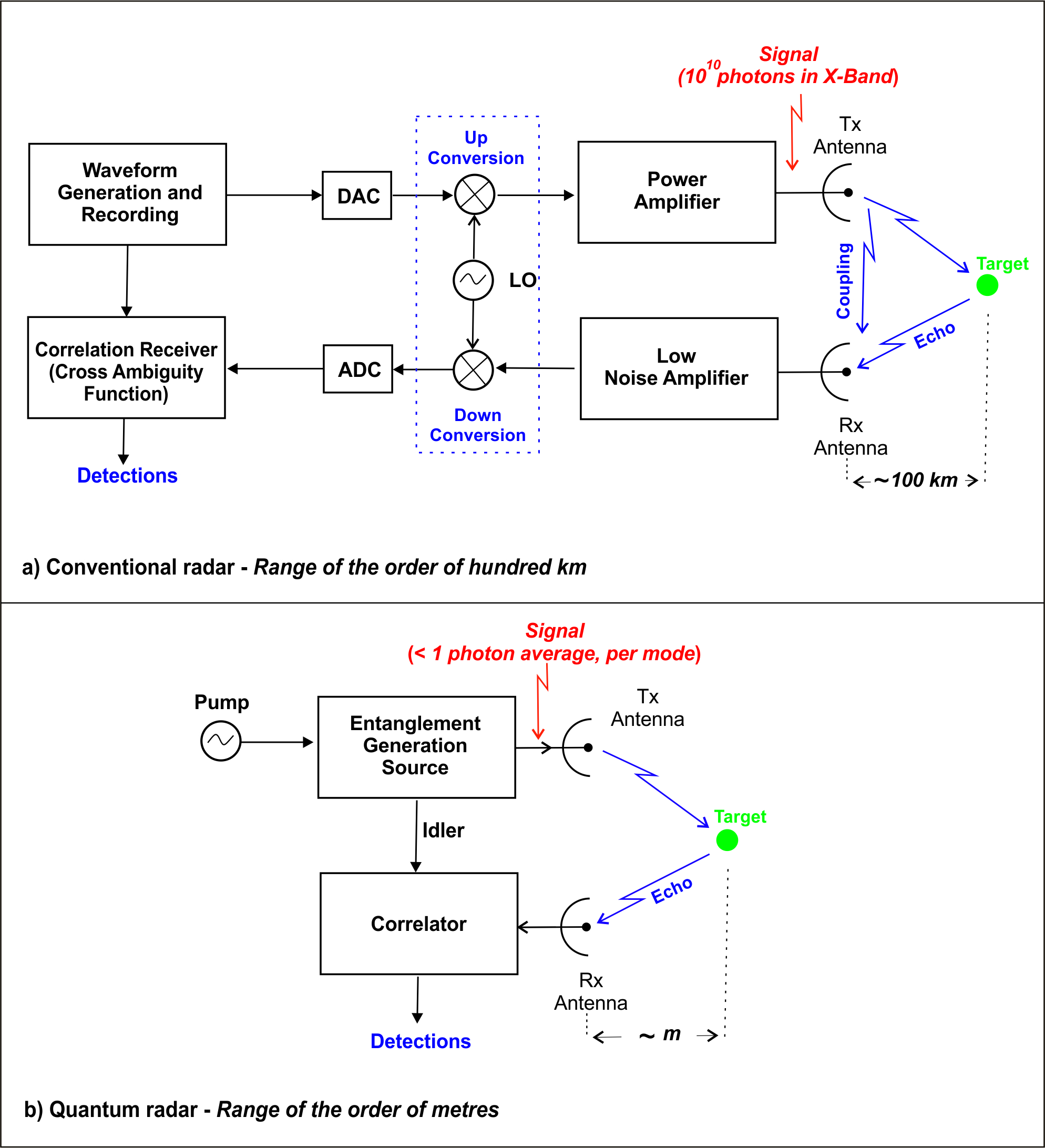
Both Noise Radar (NR) and Quantum Radar (QR), with alleged common features, aim to use the randomness of the transmitted signal to enhance radar covertness and to reduce mutual interference. While NR has been prototypically developed and successfully tested in many environments by different organizations, research and development investments on QR did not bring to practically operating prototypes. Starting from the well-known fact that radar detection depends on the energy transmitted on the target, the detailed evaluations in this work show that the detection performance of all the QR types proposed in the literature are well below the ones of a much simpler and cheaper equivalent “classical” radar set, for example of the NR type. Moreover, the absence of a “Quantum radar cross section” different from the well-known radar cross section is explained. From these facts it results that, in spite of alleged advantages in some literature, Quantum Radar proposals cannot lead to useful results, including, of course, the detection of stealth targets.
Keywords:
quantum radar
; quantum illumination
; noise radar
; radar range
; quantum two-mode squeezing radar
Copyright: This open access article is published under a Creative Commons CC BY 4.0 license, which permit the free download, distribution, and reuse, provided that the author and preprint are cited in any reuse.


