
Submitted:
09 May 2026
Posted:
11 May 2026
You are already at the latest version
Abstract
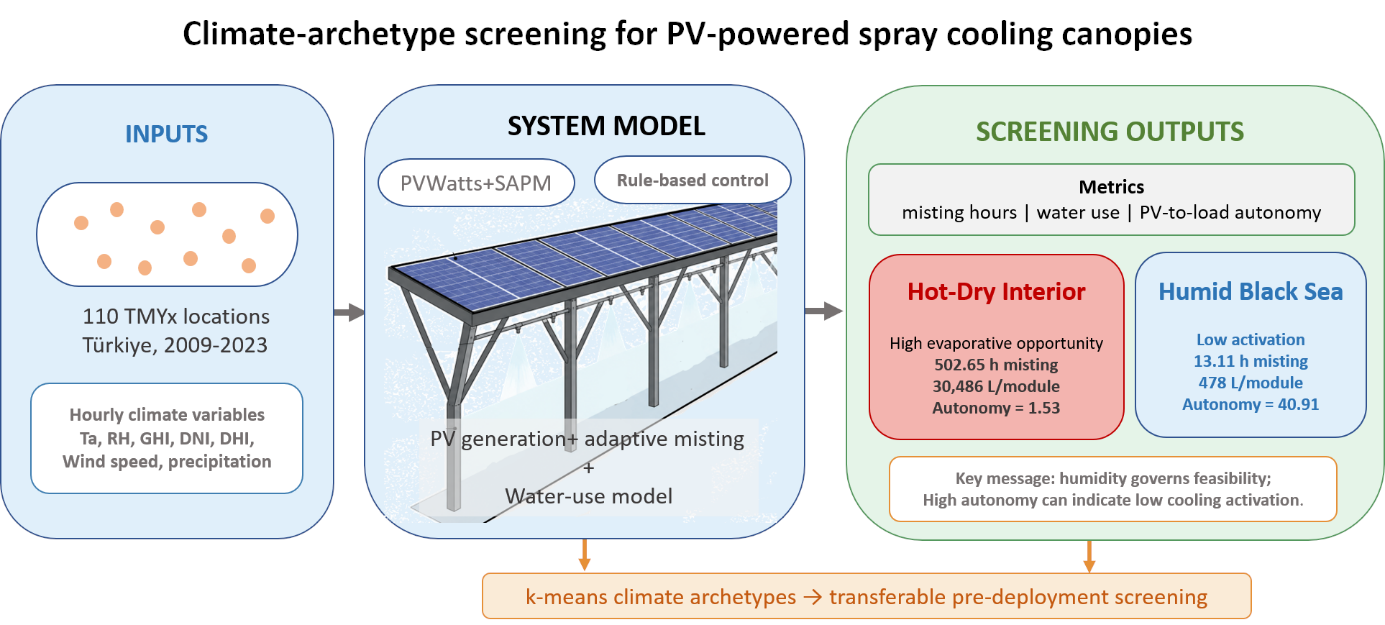
This research examines how climate change intensifies urban heat stress, particularly in public spaces where mechanical cooling is impractical. A climate-driven, systems-level numerical model is developed to evaluate the pre-installation feasibility of portable, solar-powered misting canopies. Hourly Typical Meteorological Year data (TMYx, 2009–2023) are analyzed for each city to estimate photovoltaic (PV) energy yield, electrical load, potential misting duration, water demand, and PV-to-load autonomy under summer daytime conditions. Misting operation is governed by an adaptive, rule-based control strategy based on air temperature, relative humidity, and solar radiation. To enable systematic comparison, K-means clustering is applied to classify the cities into six archetypal summer climate zones. Results indicate that evaporative cooling feasibility is driven more by ambient humidity than by air temperature. Hot-dry interior cities achieve the longest average misting duration (502.65 hours) and highest water consumption (30,486 L per module), but exhibit the lowest PV-to-load autonomy ratio (1.53) due to high energy demand for pumping. In contrast, humid Black Sea cities show minimal misting duration (13.11 hours) and water use (478 L) yet achieve the highest autonomy (40.91) because of limited system operation. It is important to note that the autonomy ratio reflects a seasonal energy balance rather than continuous off-grid capability. Overall, the adaptive control approach effectively aligns water and energy use with climatic suitability across all clusters. The proposed framework offers a scalable and quantitative screening tool to inform the design and deployment of PV-powered outdoor cooling systems across diverse urban environments.
Keywords:
urban heat island
; evaporative cooling
; photovoltaic energy autonomy
; adaptive misting control
; climate archetype
; pre-deployment screening
Copyright: This open access article is published under a Creative Commons CC BY 4.0 license, which permit the free download, distribution, and reuse, provided that the author and preprint are cited in any reuse.


