
Submitted:
09 May 2026
Posted:
11 May 2026
You are already at the latest version
Abstract
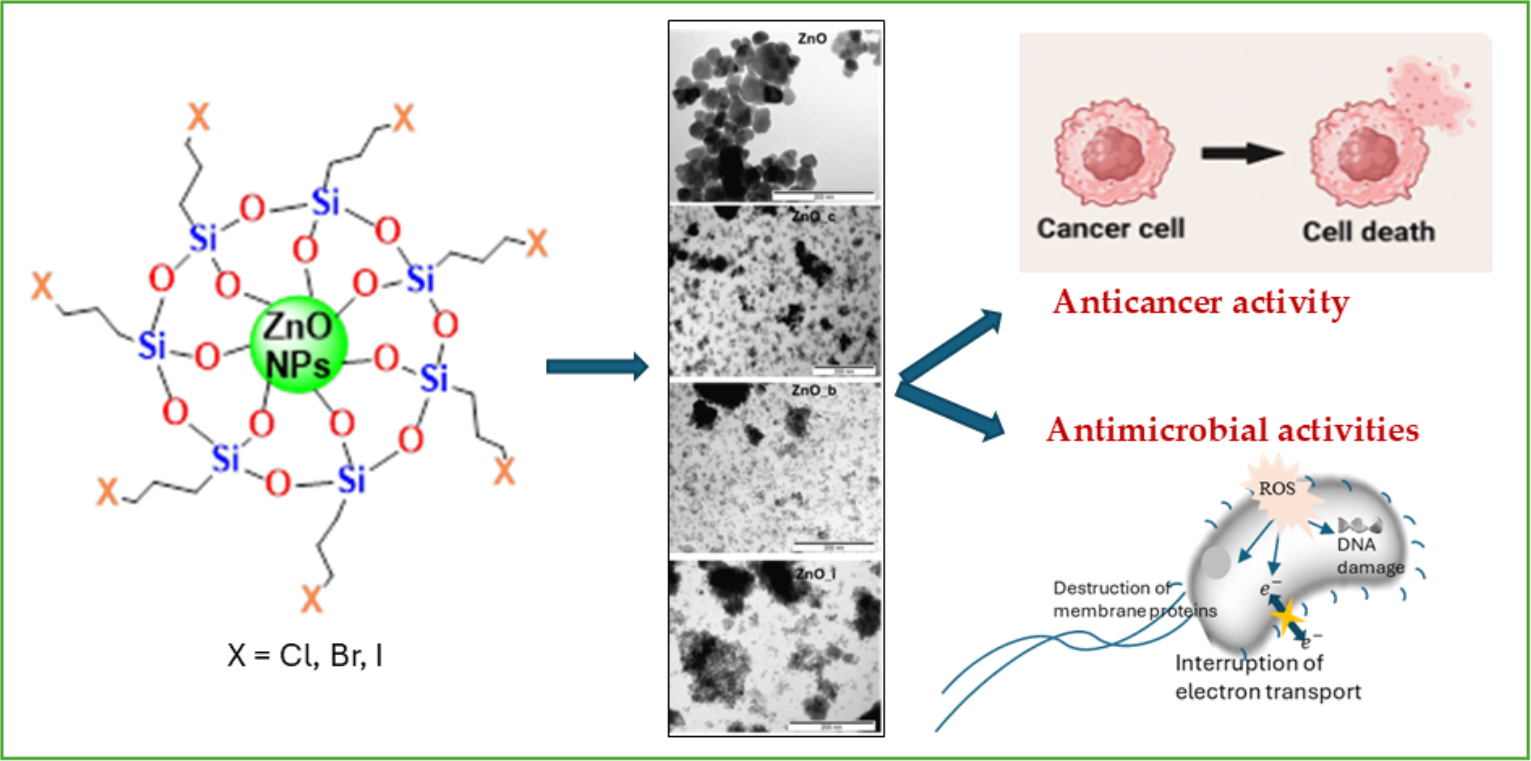
Surface modification of zinc oxide nanoparticles (ZnO NPs) with organosilane capping agents represents an effective strategy to control their physicochemical and biological properties. In this work, we report for the first time the use of halogenosilanes, namely (3- chloropropyl)trimethoxysilane (CPTMS), (3-bromopropyl)trimethoxysilane (BPTMS) and (3-iodopropyl)trimethoxysilane (IPTMS), for the surface functionalization of ZnO NPs obtained by chemical precipitation. Structural and morphological characterization (PXRD, TEM, SEM-EDX and FTIR) confirmed successful surface modification and revealed a significant particle size reduction from ~31 nm for unmodified ZnO to ~8 nm for BPTMS-modified ZnO (ZnO_b). The biological evaluation showed that halogenosilane-modified ZnO NPs exhibit enhanced cytotoxic activity against prostate cancer cell lines (PC3 and 22Rv1), with ZnO_b displaying the highest activity, likely associated with improved cellular uptake and increased reactive oxygen species (ROS) generation. In contrast, antimicrobial assays revealed only moderate bactericidal effects against Escherichia coli and Staphylococcus aureus at relatively high concentrations (≥1250 µg mL⁻¹), while no significant activity was observed against Pseudomonas aeruginosa, Burkholderia contaminans or Candida spp. within the tested range. These findings suggest that halogenosilane functionalization modulates the biological profile of ZnO nanoparticles by enhancing anticancer effects while also influencing microbiocidal activity, highlighting the role of surface chemistry in tuning biological selectivity. The present study supports the concept that rational surface engineering of ZnO-based nanoplatforms can be exploited to favor tumor-targeted activity over broad-spectrum antimicrobial effects, providing new perspectives for the design of application-oriented nanomaterials.
Keywords:
zinc oxide nanoparticles
; surface modification
; halogenosilanes
; antitumor activity
; antimicrobial response
Copyright: This open access article is published under a Creative Commons CC BY 4.0 license, which permit the free download, distribution, and reuse, provided that the author and preprint are cited in any reuse.


