
Submitted:
09 May 2026
Posted:
11 May 2026
You are already at the latest version
Abstract
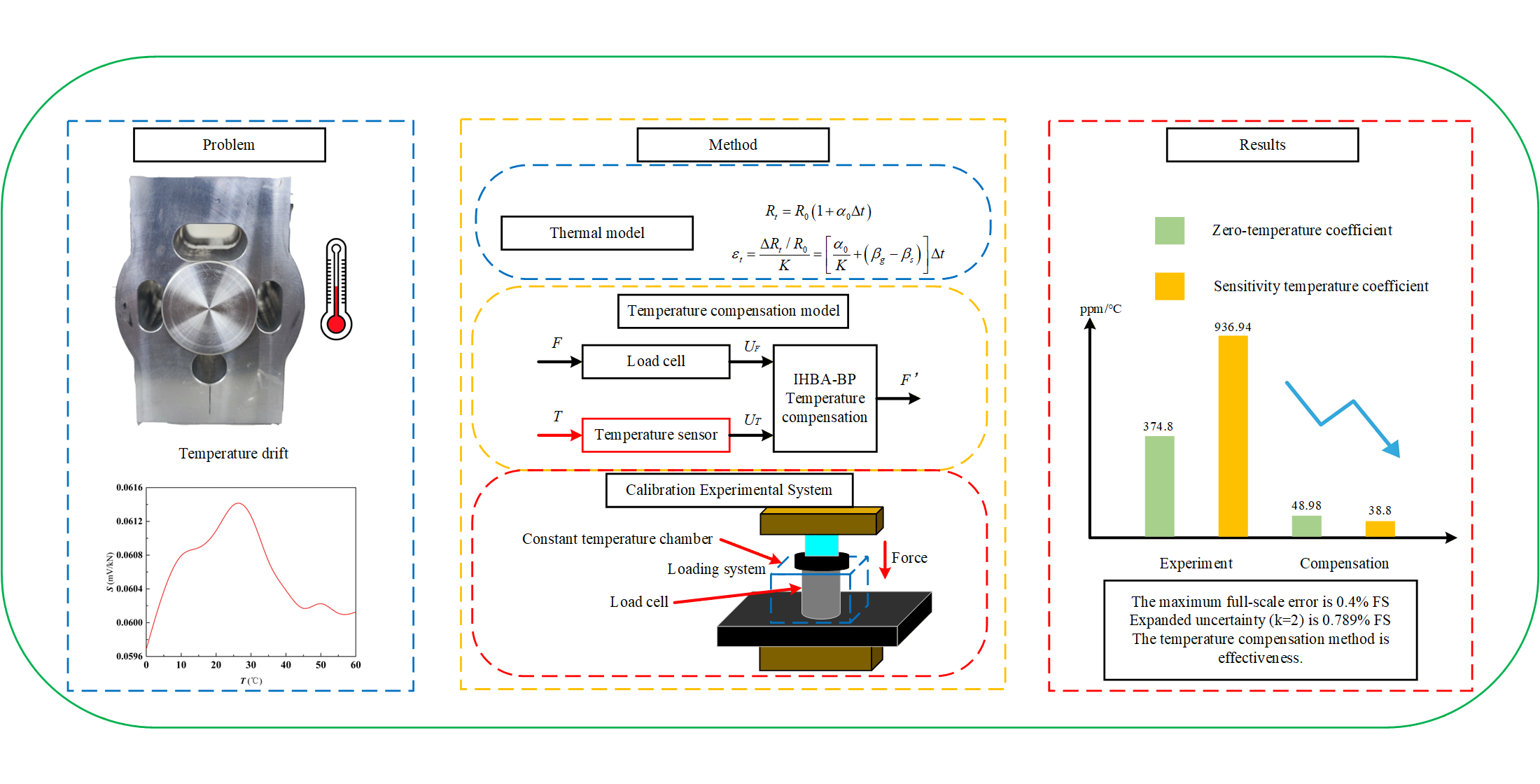
During the measurement process, load cells are susceptible to temperature variations, which can significantly degrade measurement accuracy. To address this problem, this paper presents a temperature compensation method based on an improved neural network. First, the mechanism of sensor temperature drift is analyzed from a thermodynamic perspective. Subsequently, an Improved Honey Badger Algorithm (IHBA) is developed to optimize the initial weights and biases of a Back-Propagation (BP) neural network, aiming to enhance global search capability and convergence stability. To validate the proposed method, a dedicated calibration experimental system was constructed, and temperature-dependent output data were collected over a range of 0 °C to 60 °C. Comparative experiments with conventional methods, including IMA-BP, PSO-BP, standard BP, and polynomial fitting, were conducted. In addition, an ablation study was performed to verify the effectiveness of the proposed improvements. The results demonstrate that the IHBA-BP model achieves superior compensation performance. The temperature drift coefficient and sensitivity temperature coefficient are reduced by 86.6% and 95.86%, respectively. The proposed method shows strong potential for improving measurement accuracy of load cells under varying temperature conditions and provides a practical solution for industrial sensor calibration applications.
Keywords:
temperature compensation
; load cell
; IHBA-BP model
; experimental calibration system
Copyright: This open access article is published under a Creative Commons CC BY 4.0 license, which permit the free download, distribution, and reuse, provided that the author and preprint are cited in any reuse.


