
Submitted:
10 May 2026
Posted:
11 May 2026
You are already at the latest version
Abstract
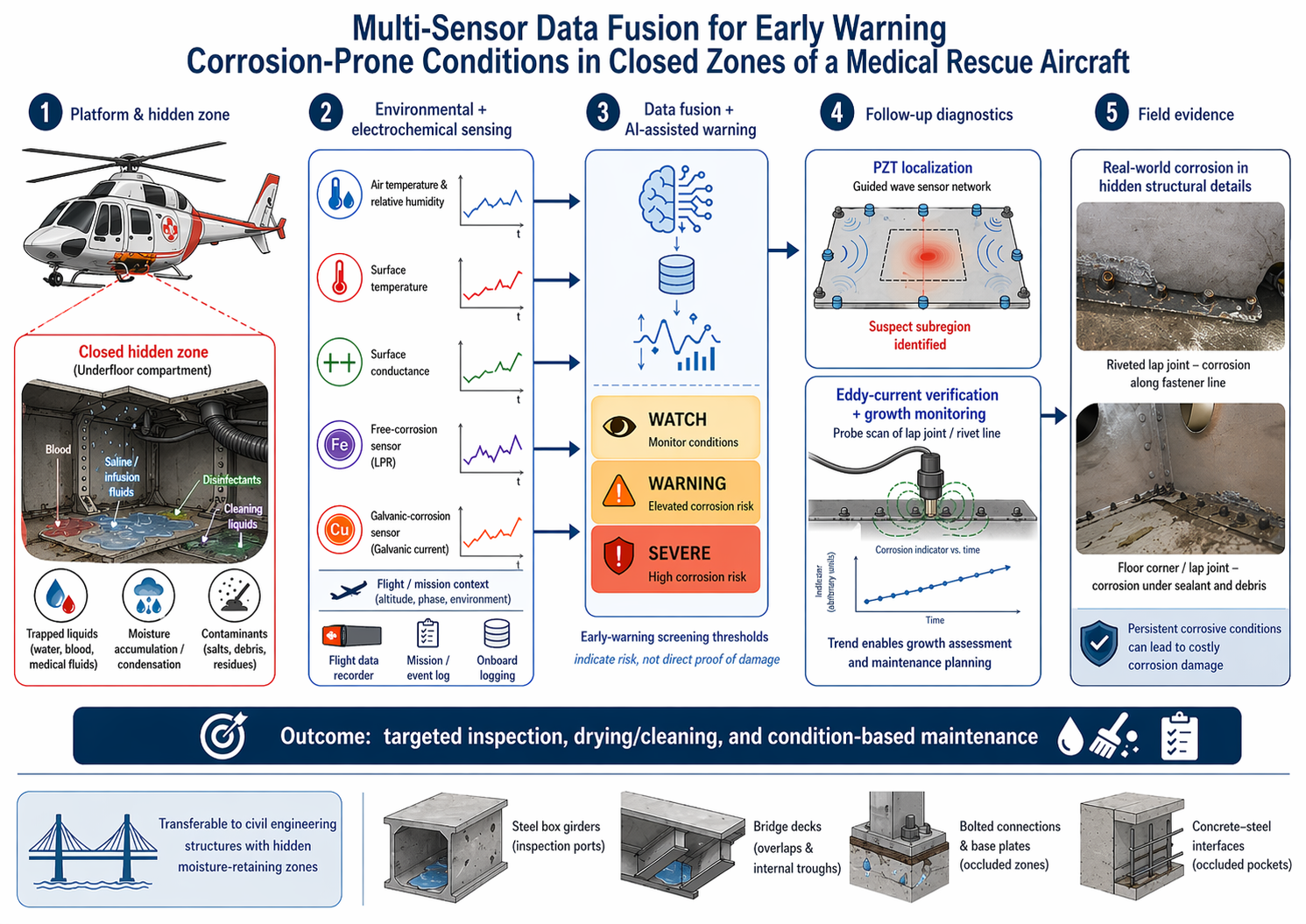
Early identification of corrosion-prone conditions remains a major maintenance challenge in closed, hard-to-access structural zones. This paper presents a multi-sensor data fusion approach for early warning of corrosion-prone conditions in selected closed zones of a medical rescue aircraft, as part of a structural health monitoring framework. The study combines sensor selection, installation in restricted-access compartments, and analysis of in-service data collected during helicopter operation. The workflow includes data acquisition, preprocessing, feature extraction, fused interpretation of multi-channel data, and assignment of warning levels linked to maintenance actions. Environmental, conductance, and electrochemical channels provide a first-stage early-warning layer that indicates persistent conditions favorable to long-term corrosion development, rather than direct proof of existing damage. Persistent warning states are intended to trigger staged follow-up diagnostics: PZT sensing localizes suspect subregions, while eddy-current sensing verifies and monitors the growth of local metallic degradation. Field inspection evidence of corrosion in hidden zones supports the practical relevance of this approach. Although demonstrated on an aircraft, the methodology is transferable to other closed or poorly accessible structural zones, including civil engineering applications.
Keywords:
multi-sensor data fusion
; structural health monitoring
; corrosion-prone conditions
; early warning
; condition-based maintenance
; medical rescue aircraft
; PZT sensing
; eddy-current testing
; hidden structural zones
; civil engineering applications
Copyright: This open access article is published under a Creative Commons CC BY 4.0 license, which permit the free download, distribution, and reuse, provided that the author and preprint are cited in any reuse.


