
Submitted:
09 May 2026
Posted:
11 May 2026
You are already at the latest version
Abstract
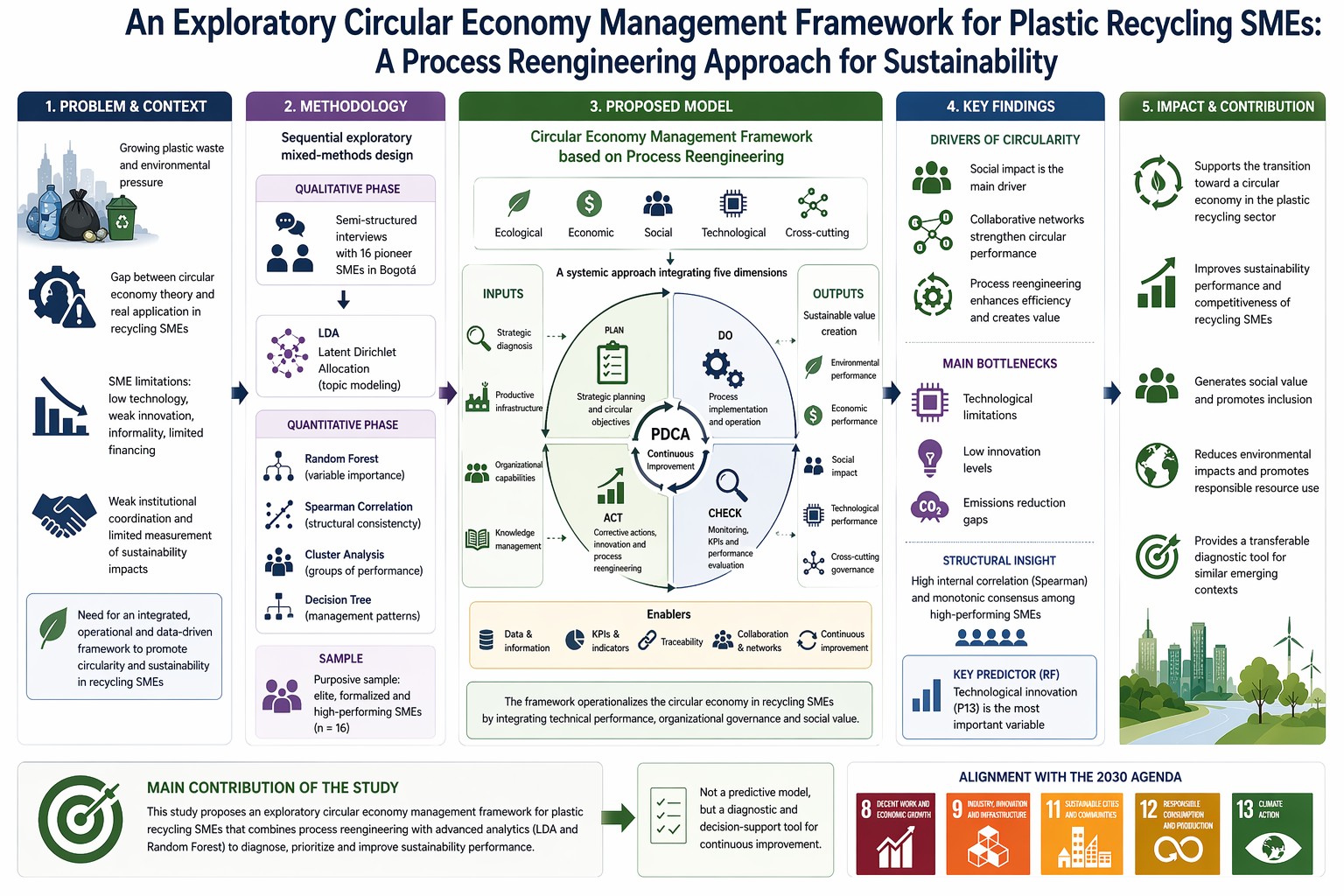
The transition toward a circular economy (CE) in the plastic recycling sector requires integrated management frameworks that align technical performance with organizational governance. This study proposes an exploratory diagnostic framework for formalized recycling SMEs, integrating Latent Dirichlet Allocation (LDA) and Random Forest (RF) algorithms. Given the specialized nature of the sector, a purposive sample of 16 ‘pioneer’ SMEs in Bogotá was analyzed. Data were standardized through a 5-point ordinal scale, and the Spearman rank correlation analysis (ρ≥0.85) revealed high internal consistency and structural synchronization. This high correlation reflects the operational homogeneity of the analyzed vanguard rather than a universal statistical generalization. The findings suggest that for these leading firms, circularity is driven by social impact, collaborative networks, and systemic process reengineering. The proposed framework serves as a methodological blueprint for analytical generalization, providing an adaptable diagnostic tool that can be iteratively refined as the sector matures and data availability increases.
Keywords:
circular economy
; plastic recycling
; SMEs
; Random Forest
; Latent Dirichlet Allocation
; process engineering
; sustainability indicators
; Bogotá
Copyright: This open access article is published under a Creative Commons CC BY 4.0 license, which permit the free download, distribution, and reuse, provided that the author and preprint are cited in any reuse.


