
Submitted:
08 May 2026
Posted:
11 May 2026
You are already at the latest version
Abstract
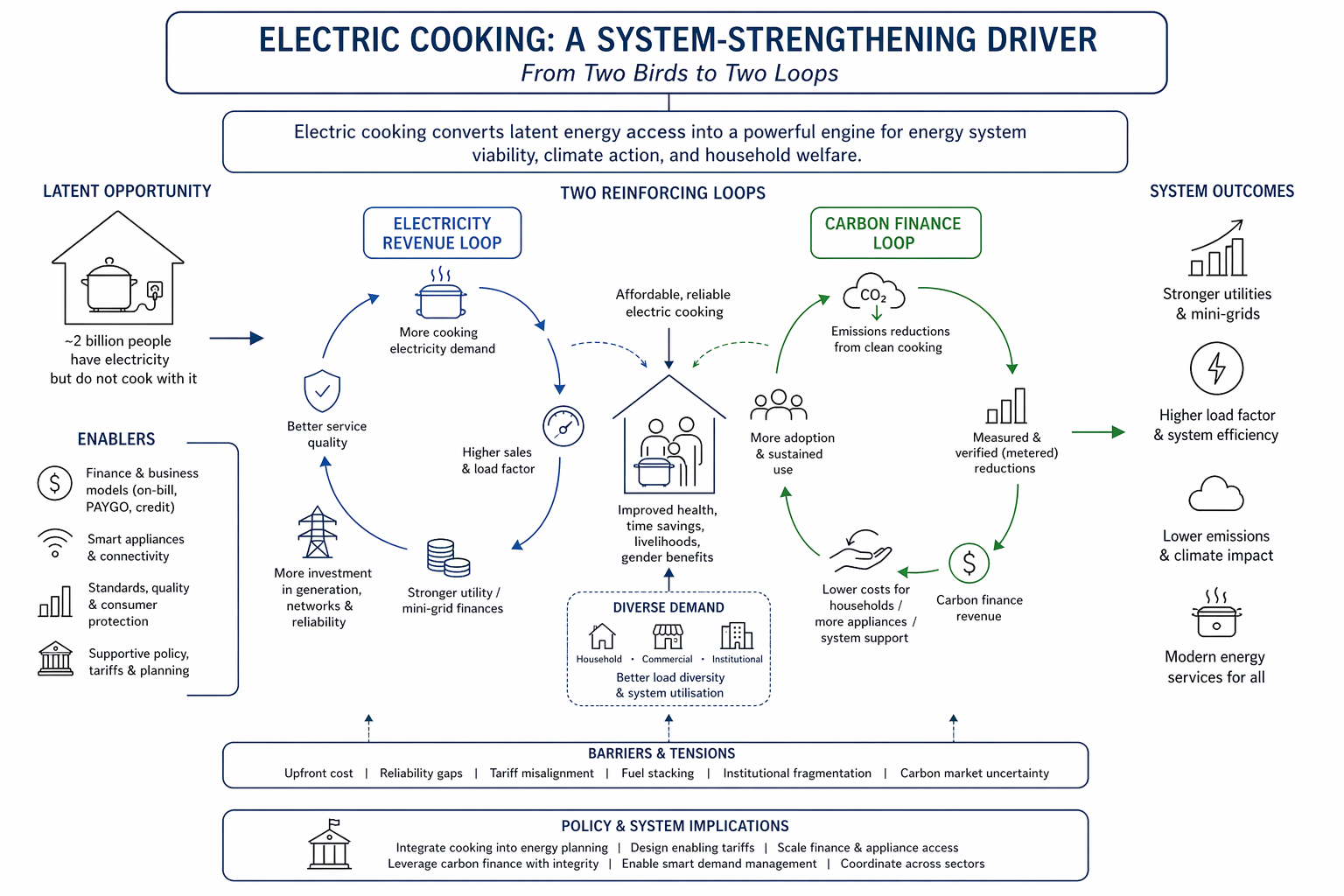
This paper examines how the body of research and innovation on electric cooking for low and middle income countries has evolved to the extent that electric cooking is now influencing energy system performance. Methods: The paper synthesises recent evidence from pilots, market developments, and system-level analysis across Africa and Asia, focusing on demand patterns, utility economics, carbon finance mechanisms, and emerging digital and financing models. Results: Electric cooking is increasingly acting as a system-strengthening demand, rather than a system stressor. Two reinforcing mechanisms are identified: (i) an electricity revenue loop, in which increased consumption improves utility and mini-grid viability and supports further investment; and (ii) a carbon finance loop, enabled by metered methodologies and measurable emissions reductions, which can improve household affordability and accelerate adoption. The analysis also highlights the importance of diversified demand (household, commercial, and institutional), which improves load factors and aligns demand with generation. However, a persistent planning blind spot remains, with cooking demand largely excluded from energy models. Conclusions: Electric cooking is moving from proof of concept toward system integration, but scale is constrained by affordability, reliability, tariff design, fuel stacking, institutional fragmentation, and carbon market uncertainty. The findings suggest that electric cooking should be treated as a core component of energy system design, requiring coordinated policy, planning, and financing to realise its full potential.
Keywords:
biomass cooking
; SDG 7
; grid extension
; off-grid electricity
; renewable energy
; climate change policies
; integrated planning
; urbanisation
; Africa
; developing Asia
Copyright: This open access article is published under a Creative Commons CC BY 4.0 license, which permit the free download, distribution, and reuse, provided that the author and preprint are cited in any reuse.


