
Submitted:
08 May 2026
Posted:
09 May 2026
You are already at the latest version
Abstract
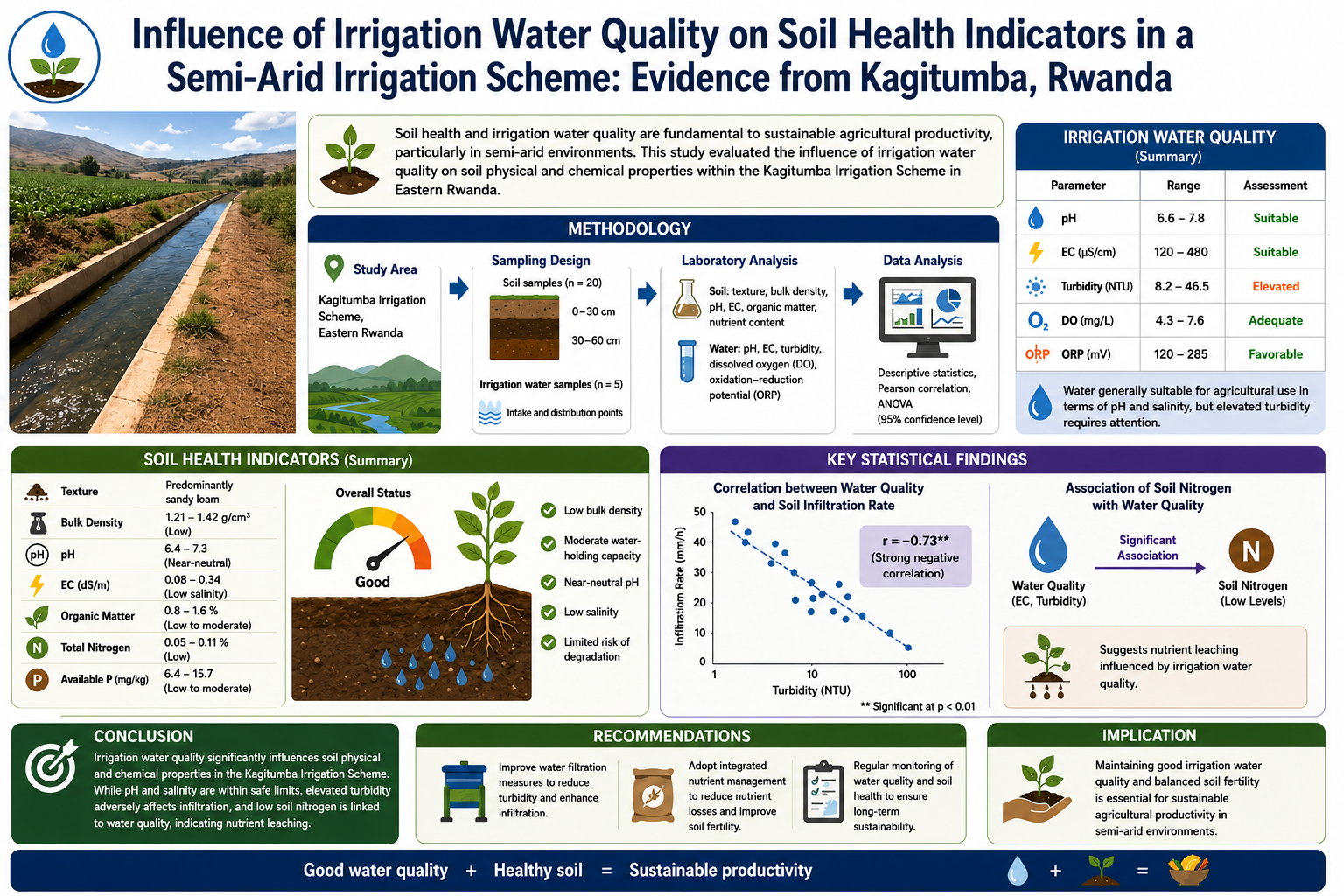
Soil health and irrigation water quality are fundamental to sustainable agricultural productivity, particularly in semi-arid environments. This study evaluated the influence of irrigation water quality on soil physical and chemical properties within the Kagitumba Irrigation Scheme in Eastern Rwanda. An observational analytical design integrated field sampling, laboratory analysis, and statistical evaluation. Soil samples (n = 20) were col-lected at depths of 0–30 cm and 30–60 cm, alongside irrigation water samples (n = 5) from intake and distribution points. Soil parameters analyzed included texture, bulk density, pH, electrical conductivity (EC), organic matter, and nutrient content, while water quality assessment focused on pH, EC, turbidity, dissolved oxygen (DO), and oxidation–reduction potential (ORP). Data were subjected to descriptive statistics, Pearson correlation, and ANOVA at a 95% confidence level. Findings revealed predominantly sandy loam soils with low bulk density, moderate water-holding capacity, and near-neutral pH. Soil salin-ity remained low, indicating limited risk of degradation. Irrigation water was generally suitable for agricultural use in terms of pH and salinity; however, elevated turbidity showed a strong negative correlation with infiltration rate (r = −0.73). Additionally, low soil nitrogen levels were significantly associated with water quality, suggesting nutrient leaching. These results underscore the critical role of irrigation water quality in shaping soil health and emphasize the need for improved water filtration and integrated nutrient management to enhance long-term sustainability.
Keywords:
soil health
; irrigation water quality
; turbidity
; sustainable irrigation and nutrients leaching
Copyright: This open access article is published under a Creative Commons CC BY 4.0 license, which permit the free download, distribution, and reuse, provided that the author and preprint are cited in any reuse.


