

Submitted:
08 May 2026
Posted:
09 May 2026
You are already at the latest version
Abstract
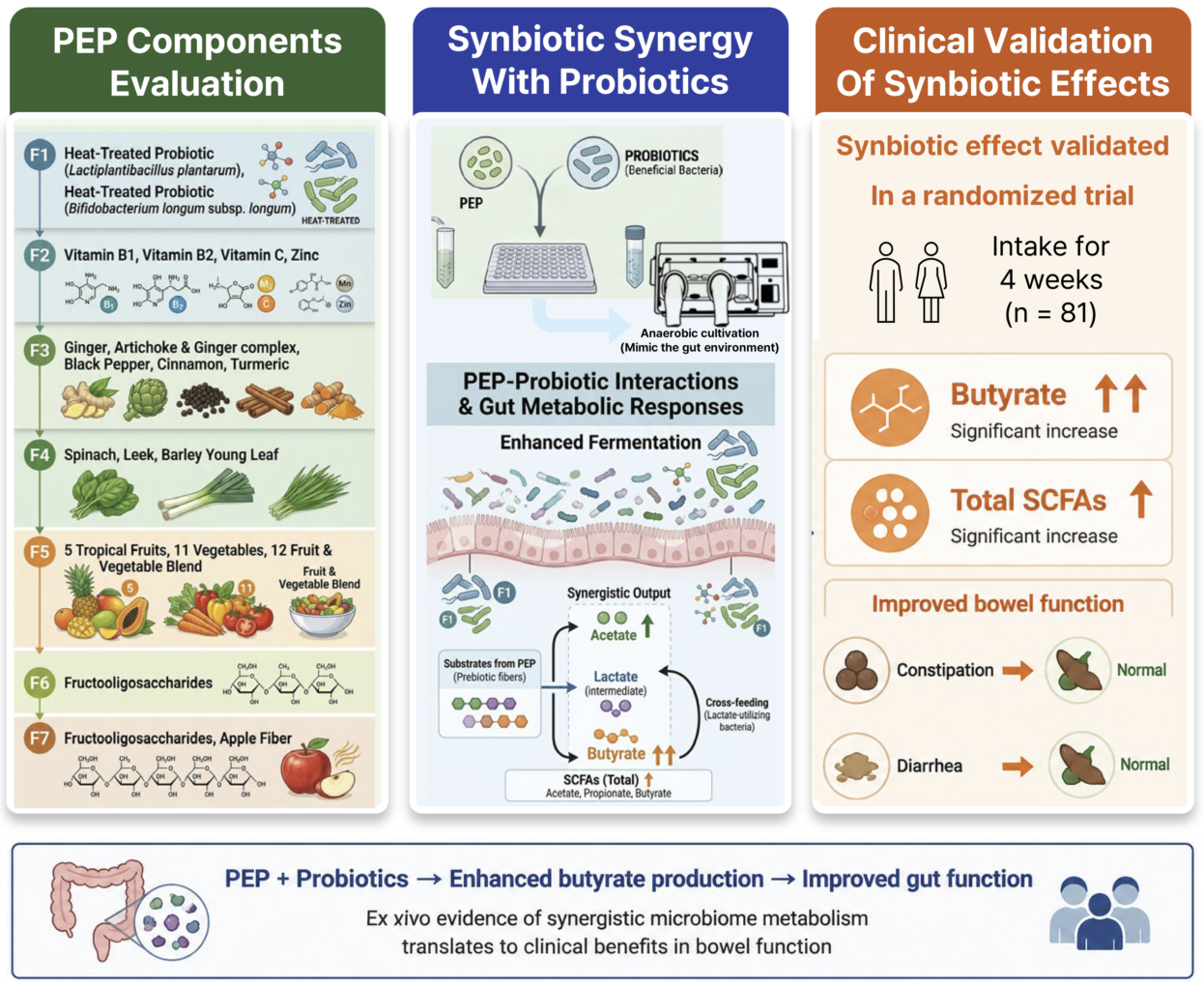
Phytonutrient-enriched prebiotic mixtures (PEPs), composed of phytonutrients and prebiotics that serve as substrates for beneficial gut microbes, are widely recognized for their potential to promote gut health. However, despite this established role, direct evidence demonstrating their synergistic effects when co-administered with probiotics remains limited. To address this gap, we employed a three-phase design integrating ex vivo evaluation and clinical validation to assess how individual components influence microbial responses, how PEP interacts with probiotics, and whether these effects translate to humans. In ex vivo analyses, PEP components were associated with increased levels of acetate, butyrate, total short-chain fatty acids (SCFAs), and lactate, with fiber-rich components showing the strongest effects. Co-treatment with probiotics further enhanced these metabolite levels compared to single treatments, particularly for butyrate and total SCFAs, along with elevated lactate levels. Notably, these effects became more pronounced with higher doses of co-administered probiotics, suggesting a dose-dependent enhancement of microbial metabolic activity and cross-feeding–mediated metabolic flux. In a randomized clinical study including PEP-only, probiotic-only, and combined PEP plus probiotic groups, all groups showed increases in fecal metabolites. However, the combined PEP and probiotic group exhibited the greatest increases in butyrate (~6 µmol/g) and total SCFAs (22.9 µmol/g). Across all groups, participants with constipation-type stool patterns shifted toward normal stool types, as assessed by the Bristol stool scale. These findings demonstrate that PEP modulates microbiome-derived metabolic activity, and that its combination with probiotics further enhances the production of butyrate and total SCFAs. Overall, this study provides both mechanistic and clinical evidence supporting synbiotic strategies and demonstrates the potential of PEP as an effective approach to improve gut microbial metabolism.
Keywords:
phytonutrient-enriched prebiotic mixture
; synbiotic interaction
; short-chain fatty acids
; butyrate production
; ex vivo
; PMAS
Copyright: This open access article is published under a Creative Commons CC BY 4.0 license, which permit the free download, distribution, and reuse, provided that the author and preprint are cited in any reuse.


