
Submitted:
08 May 2026
Posted:
08 May 2026
You are already at the latest version
Abstract
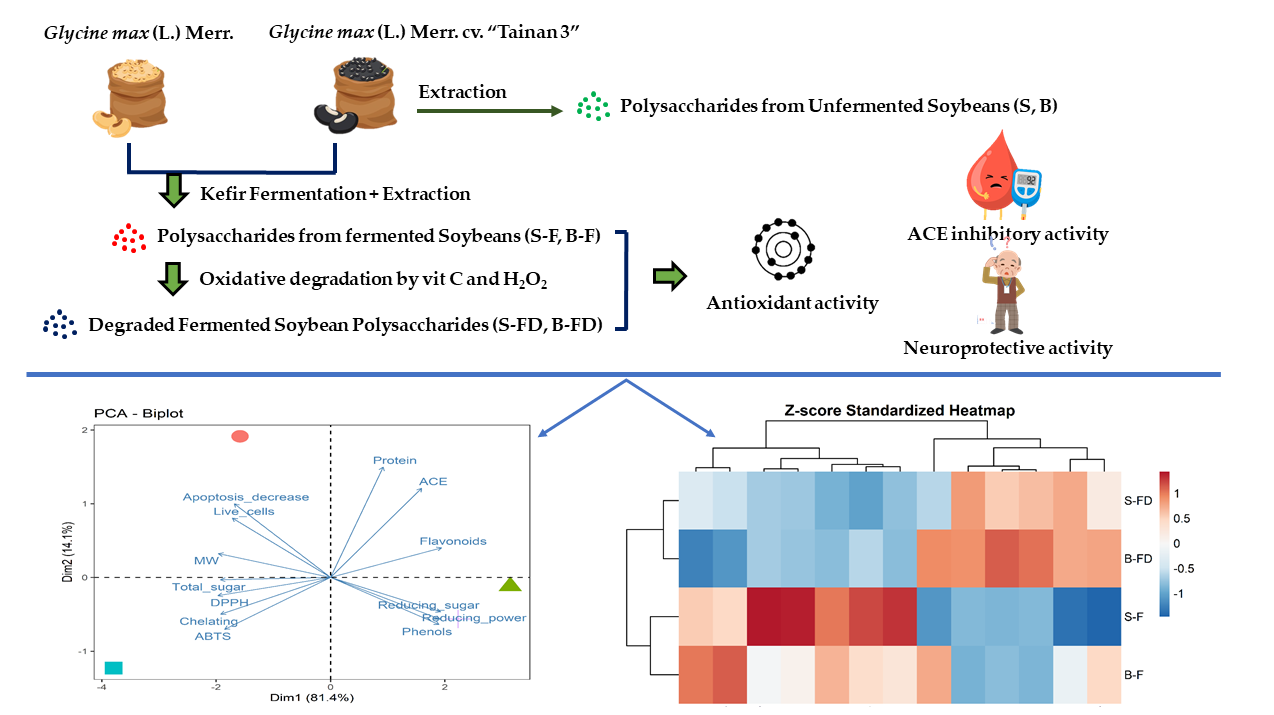
Kefir is a probiotic beverage produced by symbiotic bacteria and yeasts. Polysaccharides from yellow and black soybeans (S, B) were extracted, fermented to obtain S-F and B-F, and further oxidatively degraded using ascorbic acid and hydrogen peroxide to produce S-FD and B-FD. Compositional analyses revealed distinct differences in sugar content, protein, phenolics, monosaccharide composition, molecular weight, and Fourier transform infrared spectra among S-F, S-FD, B-F, and B-FD. Fermentation enhanced angiotensin converting enzyme inhibitory activity, and subsequent degradation further improved this effect. Both fermented and degraded polysaccharides exhibited strong antioxidant activities, including radical scavenging capacity, ferrous ion chelation, and reducing power, with degraded samples showing superior performance. Neuroprotective effects were evaluated using SH-SY5Y cells. No cytotoxicity was observed at concentrations up to 400 μg/mL. Treatment at 200 μg/mL significantly increased cell viability and reduced apoptosis in rotenone-induced cells. However, multivariate analysis indicated that oxidative degradation, while enhancing antioxidant and ACE inhibitory activities, may attenuate neuroprotective effects. Overall, soybean derived kefir polysaccharides show potential for applications in blood pressure regulation, antioxidant defense, and neuroprotection.
Keywords:
structure-function relationship
; bioactive polysaccharides
; oxidative stress modulation
; SH-SY5Y cell model
; neuroprotection
; multivariate statistical analysis
; heatmap clustering
Copyright: This open access article is published under a Creative Commons CC BY 4.0 license, which permit the free download, distribution, and reuse, provided that the author and preprint are cited in any reuse.


