
Submitted:
07 May 2026
Posted:
08 May 2026
You are already at the latest version
Abstract
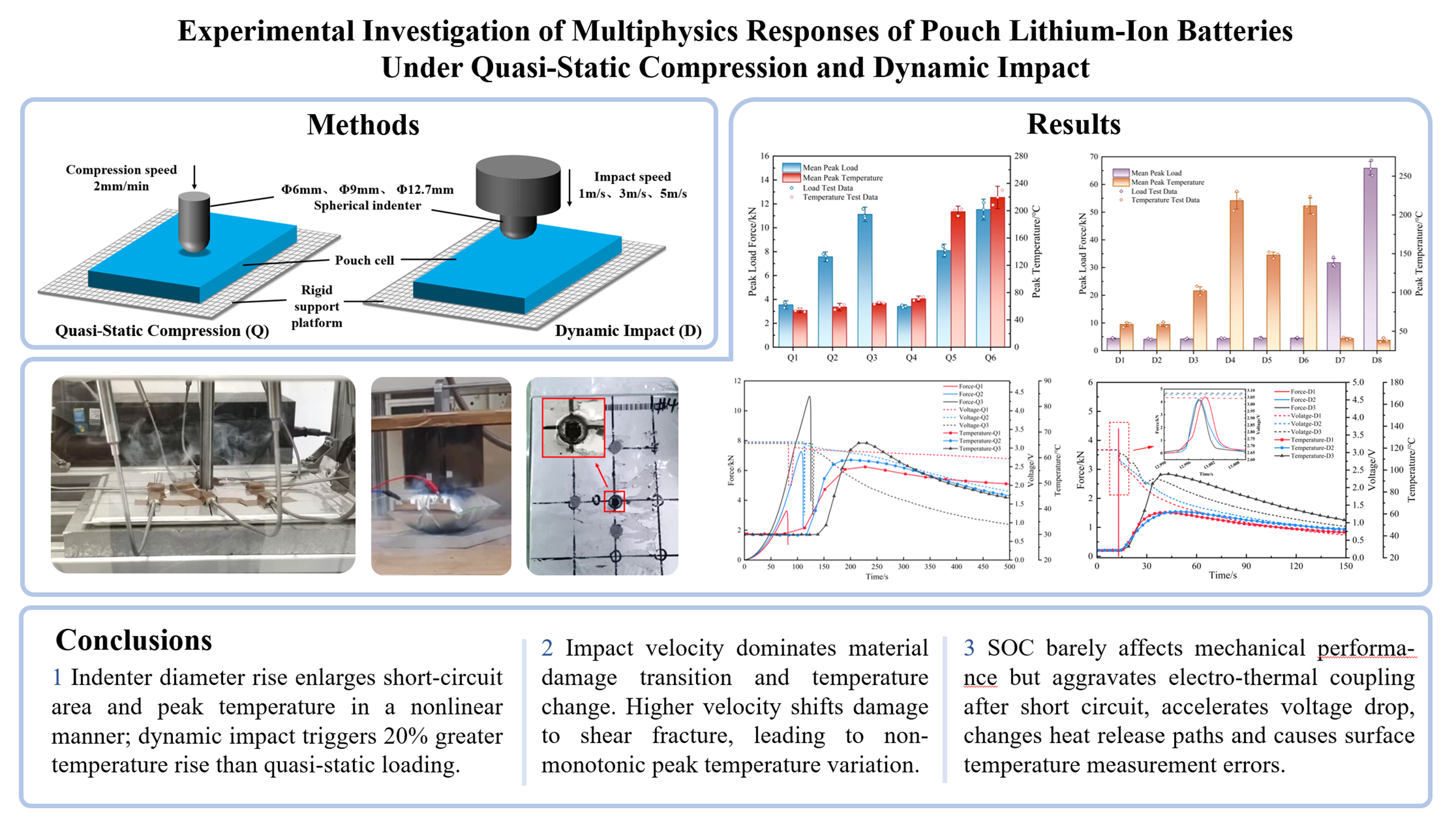
Lithium-ion batteries are prone to internal short circuits and subsequent thermal runaway under compression and impact loads during electric vehicle crashes, posing a critical safety challenge for the industry. However, existing studies lack systematic comparative analysis between quasi-static and dynamic loading conditions. In this study, 26 Ah ternary pouch lithium-ion batteries were used as research objects. A test platform for synchronous acquisition of mechanical load, electrical voltage and thermal temperature was established. Quasi-static compression and drop-weight impact tests were conducted to investigate the effects of indenter diameter, impact velocity and state of charge (SOC) on the multiphysics responses of batteries. The results show significant differences in failure modes between the two loading conditions: quasi-static loading causes progressive plastic deformation and stable short-circuit voltage decay, while dynamic loading induces brittle shear fracture and soft short-circuit voltage rebound. Under non-thermal runaway conditions, the temperature rise amplitude under dynamic impact is approximately 20% higher than that under quasi-static compression. High SOC alters the heat release pathway during thermal runaway, leading to deviations in surface temperature measurements. These findings provide critical experimental support for the crash safety design of power batteries and the formulation of thermal runaway prevention and control strategies.
Keywords:
pouch lithium-ion ba
Copyright: This open access article is published under a Creative Commons CC BY 4.0 license, which permit the free download, distribution, and reuse, provided that the author and preprint are cited in any reuse.


