
Submitted:
07 May 2026
Posted:
07 May 2026
You are already at the latest version
Abstract
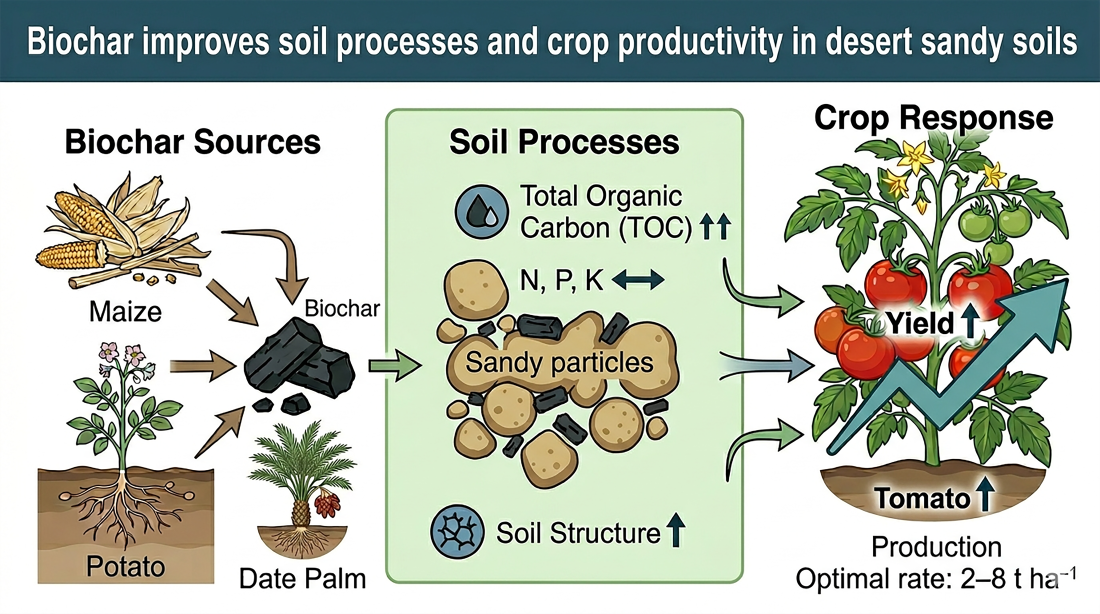
Biochar amendment offers a promising strategy to enhance soil physicochemical performance and yield response in nutrient-poor sandy soils; however, its effectiveness depends strongly on feedstock type and application rate. This field study assessed the agronomic and sandy soil responses of tomatoes to biochars derived from date palm, maize, and potato residues, applied at 0, 2, 4, 8, and 16 t·ha⁻¹ under desert conditions in southeastern Algeria. Biochars were characterized for physicochemical and structural properties, and their effects on soil carbon, nutrient availability, and tomato yield were evaluated. The results showed that biochar application significantly increased soil total organic carbon (TOC) and total yield, particularly at low application rates. Date palm biochar applied at 2 t·ha⁻¹ produced the highest yield improvement, whereas excessive application tended to suppress yield. In contrast, soil N, P, and K did not show statistically significant differences among treatments, although slight numerical increases were observed compared to the control at medium application rates (4–8 t·ha⁻¹). These findings highlight the importance of optimizing biochar application rates according to feedstock type to maximize agronomic benefits. Overall, moderate biochar application represents a promising strategy for improving soil organic carbon status and crop productivity in desert sandy soils agroecosystems.
Keywords:
biochar
; desert sandy soil
; tomato yield
; nutrient dynamics
; total organic carbon (TOC)
; sustainable soil management
Copyright: This open access article is published under a Creative Commons CC BY 4.0 license, which permit the free download, distribution, and reuse, provided that the author and preprint are cited in any reuse.


