
Submitted:
06 May 2026
Posted:
07 May 2026
You are already at the latest version
Abstract
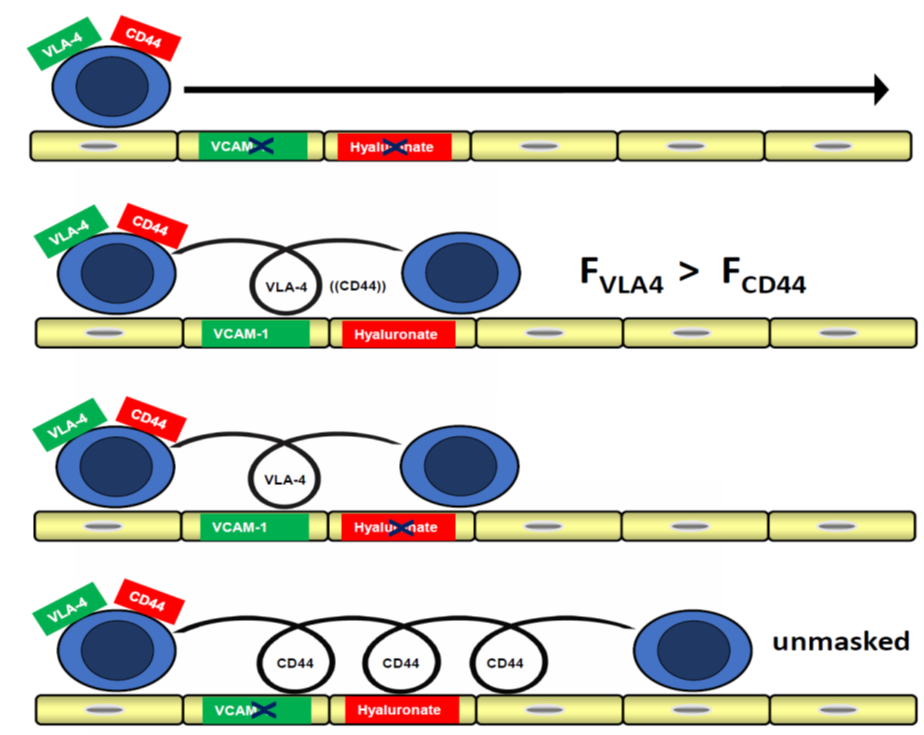
Leukocyte recruitment from blood into tissues usually involves sequential adhesive interactions, including selectin-mediated rolling followed by integrin-dependent ar-rest. Although CD44–hyaluronan interactions are known in leukocyte adhesion, their functional contribution to monocyte rolling under defined experimental conditions remains incompletely resolved. Here, we use controlled cell-based model systems dif-fering in α4-integrin ligand availability to dissect the relative contributions of CD44 and integrins to monocyte rolling under physiologic shear. Using mouse monocytoid WEHI 78/24 cells and primary human monocytes, we show that CD44-hyaluronan in-teractions support rolling and adhesion on hyaluronan-presenting cellular monolayers lacking VCAM-1–mediated integrin engagement, whereas α4-integrin–dependent in-teractions dominate when VCAM-1 is available. Functional blockade of CD44, soluble hyaluronan competition, and enzymatic hyaluronan removal consistently reduced rolling and adhesion under these conditions. These findings demonstrate that CD44-mediated rolling represents a context-dependent adhesion pathway that be-comes functionally apparent when dominant integrin-mediated interactions are lim-ited, but is masked when VCAM-1 is present. By experimentally minimizing integrin engagement, this study provides a reductionist framework to resolve the hierarchical relationship between CD44 and integrin pathways in monocyte adhesion.
Keywords:
CD44
; hyaluronan (hyaluronate
; HA)
; monocyte rolling
; leukocyte trafficking
; flow-dependent adhesion
; leukocyte migration
Copyright: This open access article is published under a Creative Commons CC BY 4.0 license, which permit the free download, distribution, and reuse, provided that the author and preprint are cited in any reuse.


