

Submitted:
06 May 2026
Posted:
07 May 2026
You are already at the latest version
Abstract
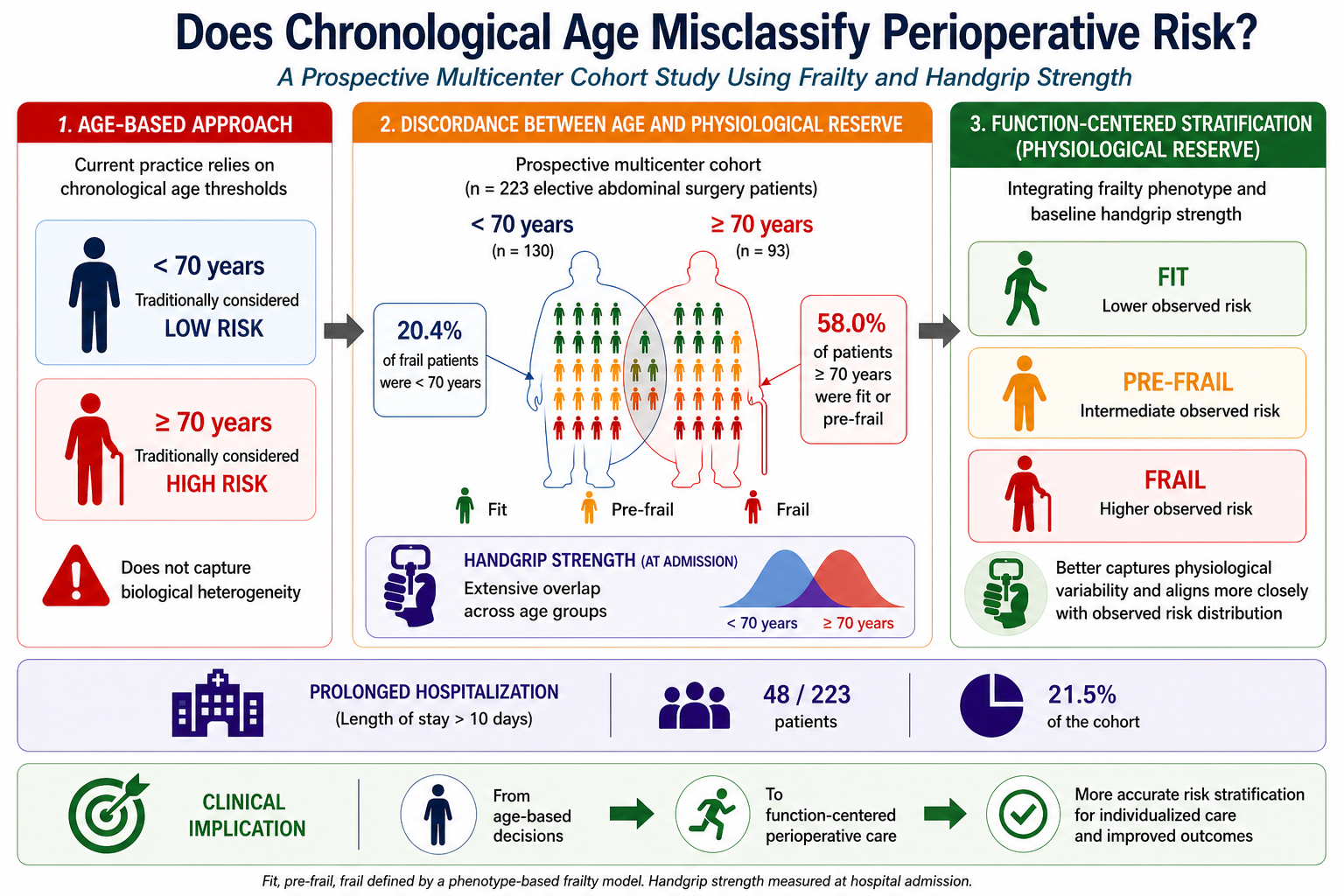
Background: Chronological age remains deeply embedded in perioperative risk assessment because it is readily available and intuitively linked to adverse outcomes. In clinical practice, however, patients of similar age frequently experience markedly different postoperative trajectories. This observation may suggest that physiological reserve, rather than years lived, more accurately reflects vulnerability to surgical stress. We therefore examined whether age-based stratification misclassifies perioperative risk when compared with functional phenotyping using frailty status and baseline handgrip strength. Methods: We conducted a prospective, multicenter observational cohort study including 223 adults undergoing elective abdominal surgery between January 2023 and June 2025. Chronological age was evaluated both continuously and using a conventional threshold (<70 vs ≥70 years). Physiological reserve was characterized using a phenotype-based frailty model (fit, pre-frail, frail) and baseline handgrip strength measured at hospital admission. Prolonged hospitalization, defined a priori as a length of stay exceeding 10 days, was used as an external benchmark to examine classification performance. Analyses were primarily descriptive and classificatory, focusing on discordance, overlap, and risk re-ranking across age and functional strata rather than outcome prediction. Results: Substantial discordance was observed between chronological age and frailty phenotype. Among patients younger than 70 years, 7.7% met criteria for frailty, whereas 58.0% of patients aged 70 years or older were classified as fit or pre-frail. Prolonged hospitalization occurred in 48 patients (21.5%) and varied markedly by frailty status within each age group. Frail individuals consistently exhibited the highest hospitalization burden regardless of age, while fit and pre-frail older patients often demonstrated outcomes comparable to, or better than, younger fit patients. Baseline handgrip strength showed wide dispersion and extensive overlap between age groups, indicating substantial inter-individual variability in physiological reserve that chronological age alone did not capture. Conclusions: Chronological age appears to provide limited discriminatory resolution for perioperative risk stratification. Functional phenotyping using frailty status and baseline handgrip strength may better reflect underlying physiological reserve and support more individualized, function-centered perioperative decision-making.
Keywords:
frailty
; handgrip strength
; length of stay
; perioperative risk stratification
; abdominal surgery
Copyright: This open access article is published under a Creative Commons CC BY 4.0 license, which permit the free download, distribution, and reuse, provided that the author and preprint are cited in any reuse.


