

Submitted:
04 May 2026
Posted:
05 May 2026
You are already at the latest version
Abstract
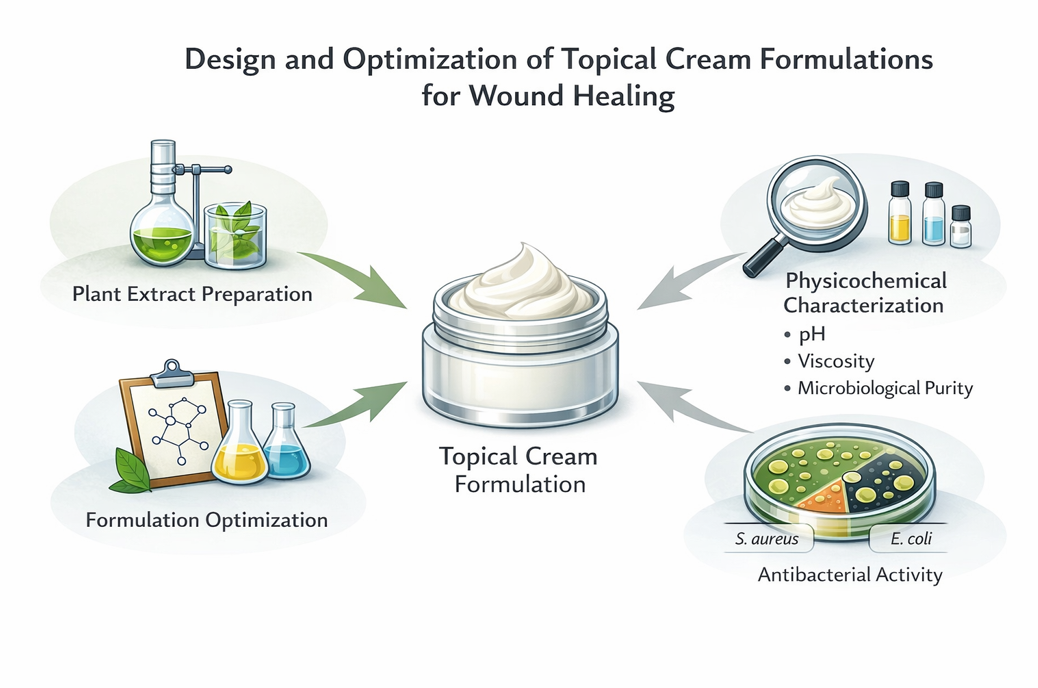
This study focuses on the development and optimization of topical cream formulations based on biopolymers and plant-derived extracts for potential wound-healing applications. Initial formulations prepared using conventional excipients exhibited insufficient viscosity and structural stability. The incorporation of xanthan gum as a stabilizing agent significantly improved the consistency and homogeneity of the systems. Hydroalcoholic extracts of Hypericum perforatum and Calendula officinalis were subsequently incorporated into the optimized formulations, resulting in satisfactory consistency and improved sensory properties. Formulations containing individual extracts demonstrated better homogeneity compared to combined extract systems. In parallel, an alternative formulation strategy based on biopolymers, namely gellan gum and chitosan, was investigated. The gellan-based formulation exhibited superior structural integrity and stability due to the formation of a three-dimensional polymeric network, whereas the chitosan-based system showed limited stability, likely associated with pH-dependent solubility and interpolymer interactions. Preliminary physicochemical evaluation confirmed the formation of semisolid systems with shear-dependent flow behavior suitable for topical application. These findings highlight the importance of polymer selection and formulation strategy in the development of stable cream systems. Overall, the developed formulations demonstrate promising potential for topical wound-healing applications. Further studies, including detailed pH analysis, rheological characterization, and biological activity evaluation, are required to confirm their therapeutic efficacy.
Keywords:
topical cream
; biopolymer
; gellan gum
; chitosan
; xanthan gum
; plant extracts
; wound healing
; rheology
; viscosity
; physicochemical properties
Copyright: This open access article is published under a Creative Commons CC BY 4.0 license, which permit the free download, distribution, and reuse, provided that the author and preprint are cited in any reuse.


