
Submitted:
30 April 2026
Posted:
05 May 2026
You are already at the latest version
Abstract
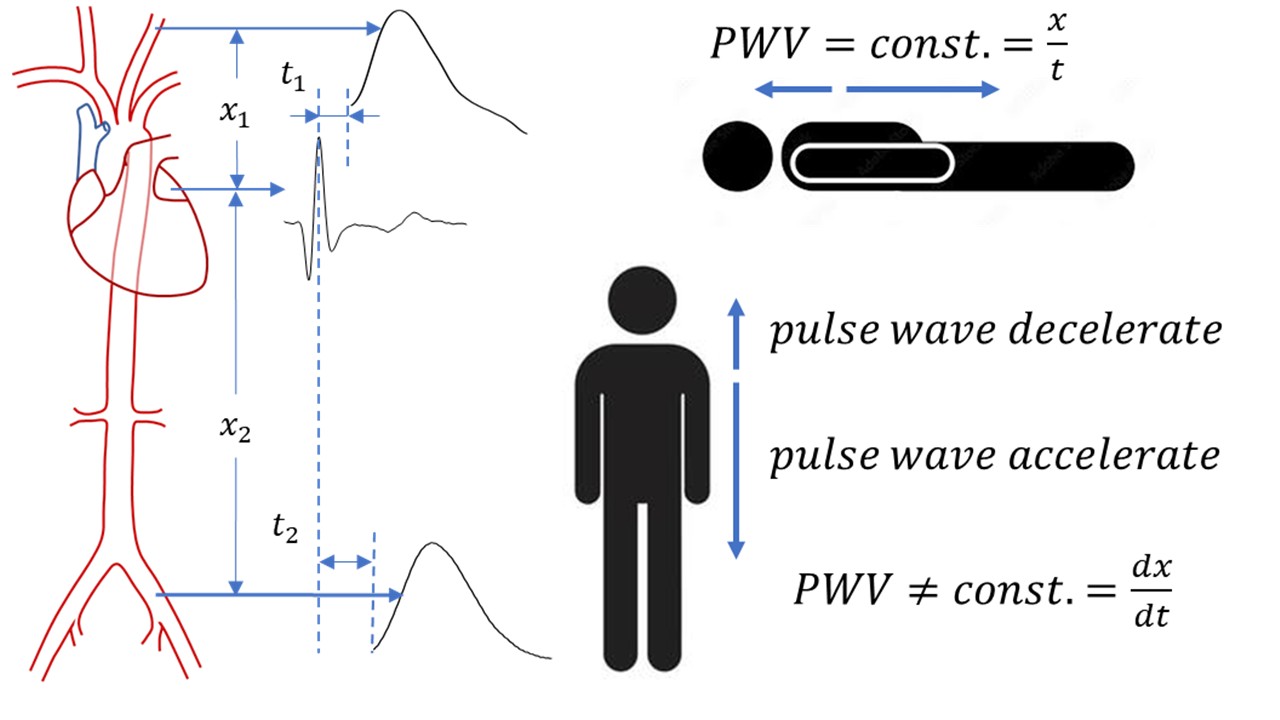
Pulse wave propagation through blood vessels is affected by many biophysical parameters that change with aging. The aim of this study was to investigate both theoretically and experimentally how the pulse wave velocity changes in the vertical position and to introduce a new parameter in biophysics - pulse wave acceleration - PWA. On a biophysical model of the cardiovascular system, placed in horizontal and vertical position, pressure waveforms were measured along the arterial tree at several sites at different diastolic pressures and pump frequencies. Blood flow waveforms on the carotid and femoral arteries in the supine and standing position were measured on the subjects. The results showed that the pulse pressure wave accelerates in the direction of gravity and decelerates in the opposite direction both in the model and in humans. A new biophysical parameter - PWA - was defined, and the experimental results are in agreement with the mathematical model. Due to the acceleration of the pulse wave, the reflected wave in the standing position arrives earlier in systole and affects the increase in pressure. The novel biophysical parameter provides a more accurate assessment of the age of the cardiovascular system and a more precise diagnosis of increased blood pressure.
Keywords:
pulse wave acceleration
; wave reflection
; biophysical model
; diastolic pressure
Copyright: This open access article is published under a Creative Commons CC BY 4.0 license, which permit the free download, distribution, and reuse, provided that the author and preprint are cited in any reuse.


