

Submitted:
04 May 2026
Posted:
05 May 2026
You are already at the latest version
Abstract
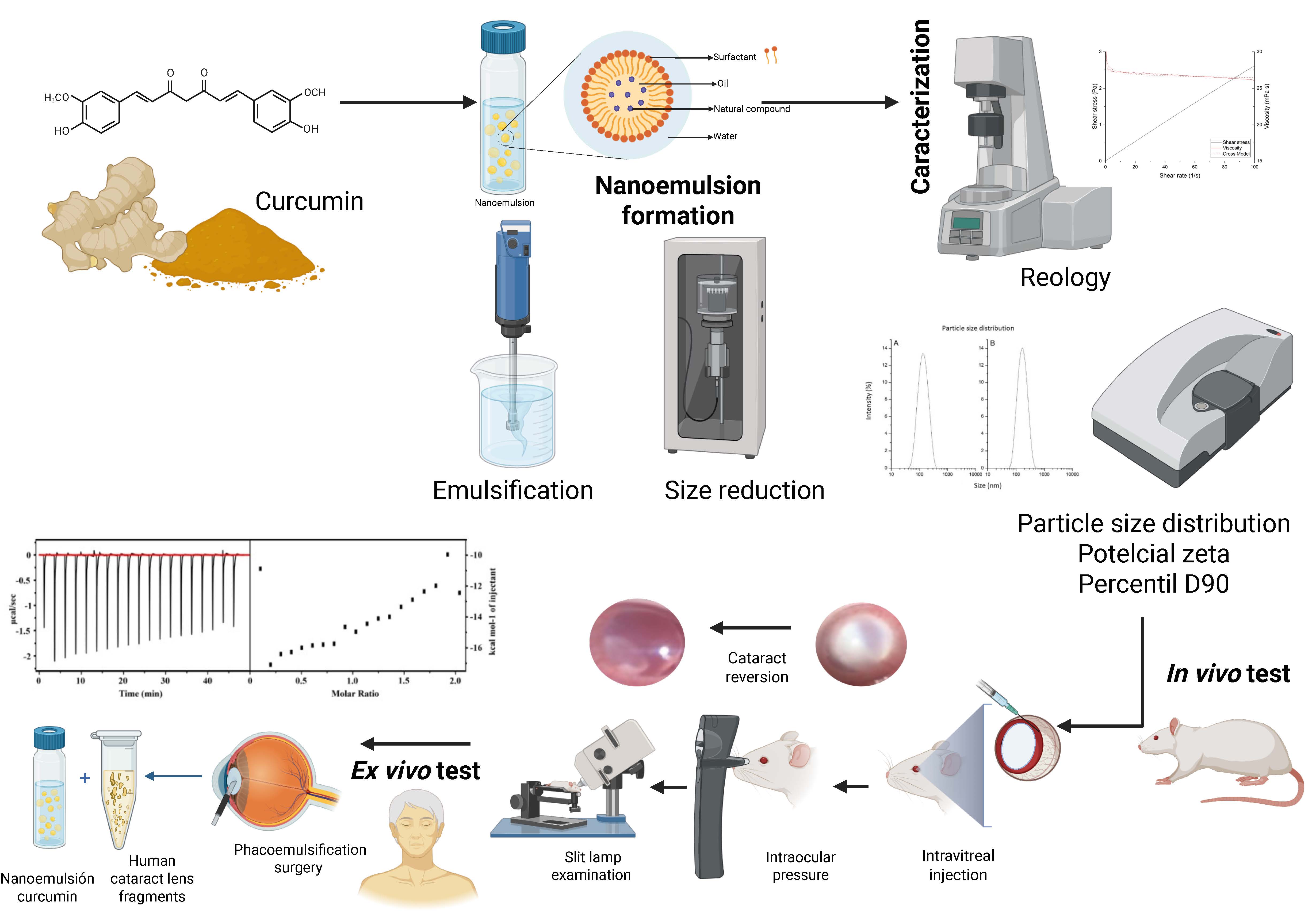
Cataracts are the leading cause of reversible blindness worldwide, this condition results from the aggregation of lens proteins. Currently, surgery remains the only effective treatment; however, there is growing interest in non-surgical approaches, including the use of bioactive compounds incorporated into nanostructured delivery systems designed to enhance solubility, enable controlled release, and improve bioavailability and bioactivity. Among the bioactive compounds investigated, curcumin has attracted considerable attention due to its antioxidant and anti-inflammatory properties, positioning it as a potential anticataractogenic agent. In the present study, a curcumin-loaded nanoemulsion was developed via ultrasonication and characterized in terms of average particle size, D90 percentile, ζ potential, temporal stability, and rheological behaviour. In addition, its anti-cataract efficacy was evaluated both using an in vivo model in rats and an ex vivo model employing human cataract samples. The resulting curcumin-carrying nanoemulsion exhibited an average particle size of 152 ± 19.79 nm with a monomodal distribution, along with good physical stability over time. On the other hand, the nanoemulsion exhibited viscosity values of 31.36 ± 1.88 to 25.96 ± 0.81 mPa·s and a near Newtonian flow behavior. Regarding the effect on cataracts, in the in vivo model, cataract reversal of at least two grades was observed. Furthermore, ex vivo isothermal titration calorimetry analyses confirmed exothermic binding interactions between the curcumin nanoemulsions and cataract fragments, suggesting the involvement of multiple binding sites within lens components, most likely crystallin proteins. These findings support the potential of curcumin-based nanoemulsions as promising therapeutic candidates for the treatment of cataracts.
Keywords:
nanoemulsions
; curcumin
; cataract reversal
; human lenses
; animal model
Copyright: This open access article is published under a Creative Commons CC BY 4.0 license, which permit the free download, distribution, and reuse, provided that the author and preprint are cited in any reuse.


