
Submitted:
03 May 2026
Posted:
05 May 2026
You are already at the latest version
Abstract
Environmental governance fundamentally depends on effective collaboration among multiple stakeholders. Classical wicked problem theory maintains that corporate environmental engagement must be grounded in intrinsic motivation to yield genuinely collaborative outcomes; however, this demanding premise has substantially constrained the participation of firms in environmental governance. Addressing this limitation, the present study concentrates on China’s logistics industry—an energy-intensive sector with significant emissions—and constructs a tripartite evolutionary game model encompassing government authorities, logistics enterprises, and the public. The model systematically investigates the effects of three distinct reputation mechanisms—institutional incentives, market-based feedback, and social supervision—on corporate green behavioral choices. The results demonstrate that: (1) logistics enterprises exhibit stronger behavioral responsiveness to market-based reputational feedback than to institutionally incentivized reputation mechanisms; (2) under conditions of weak government regulation or limited public participation, institutional incentive–based reputation mechanisms play a critical role in promoting the adoption of green practices; (3) as government regulation and public participation simultaneously intensify, the marginal effectiveness of institutional incentive–based reputation mechanisms diminishes; and (4) social supervision–based reputation exerts a significant positive effect on corporate green behavior only when complemented by institutional incentive mechanisms. Overall, the findings indicate that reputation-based governance can facilitate behavioral transformation among reactive logistics enterprises confronting wicked environmental challenges in China. Accordingly, this study proposes policy implications emphasizing the enhancement of public participation and the strengthening of governmental governance capacity to maximize the effectiveness of reputational mechanisms.
Keywords:
corporate green behavior
; logistics
; wicked problems
; reputation mechanism
; evolutionary game
1. Introduction
The global logistics and transportation sector accounts for approximately 24% of worldwide carbon emissions, with China alone contributing nearly 10% of total emissions from passenger and freight activities (IEA, 2024). As the world’s largest developing economy, China’s rapidly expanding logistics infrastructure presents both significant decarbonization challenges and substantial mitigation opportunities. In this context, China’s Action Plan for Carbon Dioxide Peaking Before 2030 identifies green transportation and low-carbon mobility as a dedicated policy priority, explicitly calling for the accelerated development of green and low-carbon transport systems, the promotion of low-carbon transitions in transportation equipment, and the enhancement of green standards for transport infrastructure.
The logistics industry—encompassing core operational segments such as transportation, distribution, packaging, and inventory management—constitutes a major source of energy consumption and carbon emissions. As a critical interface between production and consumption, the adoption of green practices by logistics enterprises can catalyze coordinated environmental transformation along both upstream and downstream supply chains, thereby generating substantial bidirectional spillover effects for economy-wide carbon mitigation. In China, several leading logistics firms have undertaken proactive initiatives in this regard. For instance, JD Logistics’ Green Stream Initiative promotes end-to-end supply chain decarbonization by engaging partner firms in comprehensive greening measures, with steadily increasing participation from environmentally conscious clients. Similarly, SF Express’ Zero Carbon Future Program provides carbon-neutral service options to individual consumers, leveraging carbon-credit incentives to encourage broader participation in low-carbon logistics.
However, the majority of logistics enterprises in China remain reluctant to invest in green transformation due to internal resource constraints and the dominance of short-term economic objectives. Investments in low-carbon technologies and green operational models are often perceived as increasing operational costs, while their environmental and economic returns materialize over longer time horizons and offer limited immediate competitive advantages. As a central node within global supply chains, the logistics sector’s persistently high levels of energy consumption and carbon emissions, if left unaddressed, will undermine coordinated decarbonization efforts among upstream and downstream partners, constrain technological innovation, and impede industrial upgrading. Prolonged inaction not only risks the forfeiture of emerging opportunities associated with the low-carbon transition but also exposes logistics enterprises to international carbon-related trade barriers, thereby eroding export competitiveness. To facilitate a transition from passive compliance to proactive innovation, it is essential to establish a comprehensive policy framework that integrates financial incentives, technological support, and market-based instruments, thereby encouraging enterprises to adopt sustainable practices and positioning the logistics industry as a pivotal contributor to national carbon mitigation objectives.
2. Literature Review
Environmental issues have long been regarded in the academic literature as quintessential “wicked problems.” Rittel and Webber (1973) originally introduced the concept in the context of public policy and social system complexity, characterizing wicked problems by their ill-defined nature and indeterminate boundaries. These characteristics arise from two fundamental attributes. First, wicked problems are deeply interwoven with other societal challenges—such as pollution, poverty, education, and social security—often functioning as mutually reinforcing causal factors. Second, they involve a diverse array of stakeholders with heterogeneous and frequently conflicting interests, such that any proposed solution represents only a provisional equilibrium among competing values rather than a definitive resolution.
Consequently, effective responses to wicked problems require interdisciplinary collaboration and inclusive governance frameworks, rather than isolated technological or sector-specific interventions. Within such collaborative processes, each stakeholder must mobilize its comparative advantages and assume corresponding responsibilities, thereby facilitating simultaneous progress toward individual objectives and collective sustainability (Ackoff, 1974). Moreover, environmental degradation has been further conceptualized as a “super wicked problem” because of its pronounced temporal dimension: cumulative pollution may exceed critical ecological thresholds, irreversibly undermining ecosystem resilience and self-repair capacity and potentially leading to catastrophic and non-reversible outcomes (Levin et al., 2012). This inherent irreversibility underscores the urgency of proactive, systemic, and forward-looking environmental governance.
Enterprise green behavior refers to the proactive reduction of pollution and environmental impacts arising from production and service activities, with the objective of mitigating negative environmental externalities (Crame, 1998). Within the logistics sector, green practices typically originate in the decarbonization of core operational processes, including sustainable packaging and distribution, low-emission transportation, green warehousing, reverse logistics, and integrated waste management systems (Baah et al., 2020). These practices are subsequently diffused both upstream and downstream along the supply chain, encouraging suppliers and customers to adopt complementary green behaviors and to favor environmentally responsible products and services (Wang et al., 2011; Jazairy, 2020). Through such coordinated and cascading effects, enterprise-level green initiatives contribute to broader societal efforts and facilitate collective progress toward systemic sustainability.
Stringent government regulation and policy incentives constitute critical drivers of corporate green behavior. Through institutional instruments such as carbon taxation, emissions trading schemes, carbon offset mechanisms, and emissions allowance allocation, governments incentivize logistics enterprises to adopt environmentally friendly materials and low-carbon technologies, thereby fostering green innovation (Waltho, 2019; Chen et al., 2018). Complementary policy measures aligned with environmental regulations have been shown to significantly enhance the operational performance of green supply chains (Naini et al., 2022) and to improve green total factor productivity within the logistics sector (Wang et al., 2023). Moreover, such policy frameworks stimulate managerial and organizational innovation in logistics firms, particularly by integrating outsourcing strategies with supply chain optimization to reduce greenhouse gas emissions (Ameknassi et al., 2016). As a result, emerging operational models—including shared transportation networks, public warehousing systems, and collaborative distribution arrangements—have gained prominence as effective pathways toward systemic decarbonization (Cao et al., 2025). Notably, Lian and Xu (2022) find that differentiated carbon subsidy schemes outperform uniform carbon cap policies in promoting corporate green innovation.
In contrast to direct governmental regulation, social pressure exerted by the public functions as an indirect and non-coercive driver of corporate green behavior. This influence operates primarily through two channels: public oversight and consumer preferences. Public oversight encompasses both media scrutiny and citizen reporting. Empirical evidence indicates that heightened media attention to environmental issues is associated with increased corporate environmental investment, as greater public visibility amplifies reputational risks for firms (Yu et al., 2019). Notably, media outlets that emphasize negative environmental incidents exert particularly strong pressure, prompting firms to accelerate the abandonment of polluting practices and to pursue technological innovation (Wang et al., 2017). Concurrently, public reporting of regulatory inaction or corporate environmental violations can activate institutional responses. When public dissatisfaction becomes widespread, it erodes confidence in regulatory effectiveness and poses risks to social stability, thereby compelling authorities to intervene more decisively (Zhang et al., 2020). This mechanism is further reinforced by bureaucratic incentive structures that promote inter-regional “race-to-the-top” competition among local governments, magnifying the accountability effects of both public and media scrutiny (Wang et al., 2017).
Second, consumer purchasing preferences function as a market-based catalyst for corporate green behavior. Ahmed et al. (2022) show that higher-quality sustainable logistics services significantly enhance customer satisfaction, which in turn strengthens trust, dependence, and repurchase intentions. Favorable public perceptions are therefore translated into expanded market access and enhanced brand value (Wu et al., 2015). Importantly, Huang et al. (2016) find that customer-driven demand exerts a stronger influence on product innovation than formal institutional pressures, underscoring consumer choice as a powerful and autonomous force shaping corporate environmental strategies. As organizations with long-term institutional continuity, enterprises form persistent linkages between past conduct and future transaction opportunities. Stakeholders assess the likelihood and terms of collaboration based on the reputational capital accumulated through an enterprise’s historical behavior (George et al., 2016). At the same time, enterprises continuously learn from and adjust their strategies in response to the actions of other actors, generating complex, dynamic, and evolving game-theoretic interactions.
In recent years, green behavior in the logistics sector has attracted growing scholarly attention. An increasing body of research has applied evolutionary game theory to examine strategic interactions between governments and logistics platforms (Zhang et al., 2024), as well as between logistics enterprises and their upstream and downstream partners, such as green packaging suppliers (Wu & Zhao, 2025). In parallel, qualitative studies employing grounded theory have explored the determinants of government green logistics policy effectiveness, identifying logistics enterprises’ environmental awareness and the intensity of social oversight as key influencing factors (Zhang et al., 2020).
This study addresses a critical gap in the governance of wicked problems by incorporating public participation as a co-equal and integral dimension alongside government regulation and corporate action. As both monitors of logistics enterprises’ environmental performance and end users of their services, the public occupies a dual role that fundamentally reshapes stakeholder interaction and equilibrium dynamics. Specifically, this study examines how tripartite interactions among government authorities, logistics enterprises, and the public can achieve a stable and sustainable equilibrium; how the inclusion of public participation modifies the conditions and transmission mechanisms through which green policies influence corporate behavior; and whether reactive logistics enterprises—characterized by weak pro-environmental awareness and a tendency toward behavioral “regression” in conventional wicked problem settings—can stably adopt green practices once public participation is introduced.
To address these questions, this study adopts a wicked problems perspective and introduces reputation as a mediating construct linking intertemporal decision-making across heterogeneous actors. We develop a tripartite evolutionary game model to capture strategic interactions among government regulators, logistics enterprises, and the public, and examine how varying degrees of regulatory stringency and public engagement condition the role of reputation in shaping corporate green behavior. The findings uncover a novel governance paradigm in which reputation—cultivated through transparent monitoring, credible policy signals, and responsive consumer behavior—functions as a self-reinforcing institutional mechanism that aligns incentives across all three stakeholders, thereby enabling cooperative responses to otherwise intractable environmental challenges.
3. Evolutionary Game Analysis
3.1. Developing an Evolutionary Game Model
The governance of wicked problems requires coordinated engagement among multiple stakeholders. From the perspective of logistics enterprises, such coordination is reflected in a dynamic strategic equilibrium in which firms adjust their green behavior in response to the combined influence of government regulation and public participation. These decisions entail an intertemporal trade-off between external stakeholder pressures and internal organizational objectives, balancing short-term compliance costs against long-term strategic benefits. For other stakeholders, promoting corporate green behavior as an expression of social responsibility depends largely on the use of reputation-based mechanisms to reshape firms’ expected payoffs, thereby aligning private incentives with collective environmental goals (van Tulder et al., 2013).
Reputation functions as a key mediating variable shaping green behavior decisions in logistics enterprises, operating through three distinct yet interrelated channels. Institutional incentive–based reputation mechanisms (R1) refer to governmental efforts to shape corporate expectations by providing green subsidies and prioritizing firms with strong environmental performance in future public–private partnerships. This mechanism increases the long-term expected returns of adopting green practices. In the model, the reputation conversion coefficient β (0≤β≤1) captures the extent to which institutional incentives are transformed into tangible firm-level benefits, with higher values of β\betaβ indicating a stronger catalytic effect on green behavior adoption.
Market feedback–based reputation mechanisms (R2) operate through the public’s role as end consumers, who directly reward environmentally responsible logistics enterprises via increased patronage, brand loyalty, and market share, while penalizing non-compliant firms through media exposure, consumer boycotts, and consequent losses in commercial value, including downward pressure on stock prices. In the model, the level of public participation λ (0≤λ≤1) captures the intensity of this market-driven feedback mechanism, with higher values of λ indicating stronger consumer-based incentives for green behavior.
Social supervision–based reputation mechanisms (R3) operate indirectly through public scrutiny of governmental performance. When regulatory enforcement is perceived as inadequate, societal dissatisfaction activates political accountability mechanisms—such as public protests, legislative inquiries, or environmental litigation—thereby eroding the reputational capital of regulatory authorities and compelling stricter regulatory enforcement. In the model, the level of public participation λ (0≤λ≤1) also captures the intensity of social supervision, with higher values of λ amplifying the cascading effects of public accountability on corporate green behavior.
Enterprises, local governments (as regulators), and the public are modeled as boundedly rational agents in a tripartite evolutionary game concerning firms’ adoption of green behavior. Owing to information asymmetry, heterogeneous participation levels, and a dynamically evolving environment, their interactions unfold through continuous learning and strategic adjustment. The government adopts strict regulatory enforcement of logistics enterprises’ green practices with probability x, and weak or non-enforcement with probability 1−x. The cost of strict regulation is denoted by C1, while the cost of non-enforcement is C2, with C1>C2. The government derives a fixed baseline revenue Rz(e.g., regular tax revenues) and receives an additional incentive reward Ra(e.g., fiscal transfers or performance-based subsidies from higher-level authorities) conditional on effective environmental supervision.
Logistics enterprises adopt green environmental practices with probability y and engage in opportunistic behavior with probability 1−y. The cost of implementing green practices is denoted by C3, whereas the concealment cost associated with opportunistic behavior—such as greenwashing or data falsification—is C4, with C3 > C4. Firms earn a baseline operational revenue Re. When confronted with explicit regulatory and public demands, a firm may attempt to evade environmental responsibilities through rent-seeking behavior (e.g., bribery) with probability α (0 ≤ α ≤ 1), thereby incurring a rent-seeking cost Z.
The firm’s initial reputation level is denoted by S. Through institutional guidance, the government converts reputational capital into sustained financial returns according to Rs = βS, which materialize in the form of green subsidies, preferential access to public contracts, and enhanced collaboration opportunities. This conversion incentivizes firms to undertake strategic investments in green innovation—such as R&D in low-carbon technologies—by internalizing the positive externalities of environmental stewardship. In this framework, β\betaβ functions as a reputational insurance coefficient, reducing exposure to upfront costs and financial risks associated with green behavior and thereby increasing firms’ compliance incentives. The fundamental role of this mechanism is to correct market failure: by transforming environmentally generated external benefits into private expected returns, it aligns the incentives of government, enterprises, and society, facilitating a cooperative equilibrium that supports sustained environmental governance.
Public participation is represented by the parameter λ (0 ≤ λ ≤ 1). When logistics enterprises adopt green practices, they receive societal recognition and cooperative support, which can reduce operating costs or induce consumers to pay a price premium for environmentally responsible services, yielding an additional benefit of λRh. The incremental cost C5 associated with green behavior includes expenditures on technological and equipment upgrades, operational and material inputs, management and certification processes, and workforce training (Pan et al., 2023). Conversely, when firms engage in opportunistic behavior, they face a probability λ of public exposure, leading to an expected loss of λRb, such as declines in stock prices following environmental scandals. Moreover, the adoption of green behavior enhances corporate reputation, thereby generating future additional returns Rf, including increased consumer preference and expanded market share.
Under strict regulatory enforcement, logistics enterprises that engage in opportunistic behavior incur a penalty F1. When government oversight is weak, firms may still be exposed through public scrutiny with probability λ, resulting in reputational damage to the government and triggering an expected sanction of λF2, which includes mechanisms such as judicial litigation and political accountability. Conversely, when strict government regulation is combined with active public participation, the government obtains an additional benefit of λRd, reflecting reduced environmental governance costs, expansion of green consumption markets, and enhanced social stability.
3.2. Stability Analysis
The expected returns of strict supervision by government are as follows:
Ex=y(Rz+Ra+λRd–C1) + (1–y)( Rz+Ra+ F1–αZ–C1)
The expected returns of the government adopting lax regulatory are:
E1-x =y(Rz–C2) + (1-y)( Rz+αZ–C2–λF2)
Then, the average expected returns of government is:
Ēx=xEx + (1–x) E1-x
The replication dynamic equation of government is:
dx/dt=F(x)=x(1–x)(Ex–E1-x)=x(1–x)(Ra+yλRd+C2-C1+(1-y)(F1+λF2-2αZ)) (1)
The expected returns for logistics enterprises to adopt green environmental behaviors are:
Ey=x(Re+βS +λRh+Rf–C3–C5)+(1-x)( Re+βS +λRh+Rf–C3–C5)
The expected returns for logistics enterprises to adopt opportunistic behavior are:
E1-y=x(Re +α(F1–Z) –(1–α)F1–λRb–C4)+(1-x)( Re +α(F1–Z)– C4 –λRb)
Then the average expected returns of logistics enterprises are:
Ēy=yEy + (1–y) E1-y
The replication dynamic equation of logistics enterprises is:
dy/dt=F(y)=y(1–y)(Ey–E1-y)=y(1–y)(βS+λ(Rh+Rb)+Rf+x(1-α)F1+C4-C3-C5–α(F1–Z)) (2)
Setting the replication dynamic equation of government and logistics enterprises equal to zero, five equilibrium points can be obtained:
dx/dt=F(x)=x(1–x)( Ex–E1-x)= x(1–x) (Ra+yλRd+C2-C1+ (1-y)( F1+λF2-2αZ)) =0
dy/dt=F(y)=y(1–y)( Ey–E1-y)= y(1–y) (βS+λ(Rh+Rb)+Rf+x(1-α)F1+C4-C3-C5- α(F1–Z)) =0
The equilibrium points are P1(0,0), P2(1,0), P3(0,1), P4(1,1), and P5(x*,y*), among which
The Jacobian matrix of the differential equation system in conjunction with (1) and (2) is
Among them, A11=(1-2x) (Ra+yλRd+C2–C1 + (1-y)( F1+λF2–2αZ))
A12= -x(1–x) ( F1+λF2–2αZ–λRd)
A21= y(1–y) (1-α) F1
A22=(1-2y) ( C4-C3-C5+βS+λRh+Rf -α(F1–Z) +λRb+x(1-α)F1)
The system eigenvalues corresponding to P1(0,0), P2(0,1), P3(1,0), and P4(1,1) were obtained from the above Jacobian matrix and are shown in Table 2.
For point P5(x*,y*), based on its characteristic values, it can be determined that its local area must be an unstable point. Therefore, the local stability of P1(0,0), P2(0,1), P3(1,0) and P4(1,1) is analyzed next.
Situation 1: If 0λ, , the stability of the system is shown in Table 3.
The system converges to a unique stable equilibrium at P1(0, 0), characterized by a very low level of public participation (λ), which prevents the public from effectively evaluating governmental environmental oversight or generating meaningful market feedback on logistics enterprises’ green behavior. At the same time, the reputation conversion coefficient (β) remains insufficient, indicating weak institutional incentives provided by the government. This configuration reflects a classic market failure in which governmental environmental governance capacity is constrained and all three reputation-based mechanisms—institutional incentives, market feedback, and social supervision—fail to be activated.
Situation 2: If , , the stability of the system is shown in Table 4.
The system exhibits a single stable equilibrium at P2(1, 0). Compared with Scenario 1, the level of public participation (λ) is relatively higher, allowing the market feedback–based and social supervision–based reputation mechanisms to exert limited effects. However, the reputation conversion coefficient (β) remains low, indicating insufficient institutional incentives provided by the government to encourage corporate green behavior. Consequently, the system stabilizes in a state where government authorities adopt strict regulatory enforcement while logistics enterprises persist in opportunistic behavior. Although regulation is stringent, the absence of effective incentive mechanisms weakens its ability to induce substantive behavioral change. At the same time, public participation remains insufficient to fully activate market and social supervision channels. Under these conditions, opportunistic behavior constitutes the rational strategic choice for enterprises, as the expected benefits of compliance fail to outweigh its costs.
Situation 3: If, , the stability of the system is shown in Table 5.
The system converges to a single stable equilibrium at P3(0, 1). Relative to Scenarios 1 and 2, the level of public participation (λ) is substantially higher, enabling effective public evaluation of governmental environmental oversight and generating strong market feedback on logistics enterprises’ green behavior. At the same time, the reputation conversion coefficient (β) is markedly higher than in Scenario 1, indicating the presence of sufficient institutional incentives to support green practices. Under these conditions, the system evolves toward a stable configuration in which the government adopts a non-stringent regulatory stance while logistics enterprises consistently choose green behavior.
This result indicates that when governmental institutional incentives are sufficiently strong and public participation surpasses a critical threshold, sustainable practices emerge as a primary source of competitive advantage and value creation for enterprises, thereby reducing the necessity for stringent compliance-based regulation. The resulting equilibrium represents a self-sustaining governance regime in which market and reputational forces—rather than coercive regulatory intervention—effectively align corporate behavior with sustainability and social responsibility objectives.
Situation 4: If max{, }<λ<1, β<, the stability of the system is shown in Table 6.
The system converges to a unique stable equilibrium at P4(1, 1), characterized by a high level of public participation (λ)—substantially exceeding that in Scenarios 2 and 3—which fully activates both market feedback–based and social supervision–based reputation mechanisms. At the same time, the reputation conversion coefficient (β) approaches zero, indicating the absence of government-provided institutional incentives. Under these conditions, the system stabilizes in a configuration where the government maintains strict regulatory enforcement, while logistics enterprises consistently adopt green environmental practices.
3.3. Sensitivity Analysis
Sensitivity analysis assesses the responsiveness of model outcomes to changes in key parameters and underlying assumptions, thereby identifying critical drivers and evaluating model robustness. Consistent with the study’s focus on reputation mechanisms, this analysis concentrates on the sensitivity of logistics enterprises’ green behavior to variations in the level of public participation (λ) and the government’s reputation conversion coefficient (β).
Holding the government enforcement probability (x), the reputation conversion coefficient (β), and other parameters constant, the public participation level (λ) is varied from 0.1 to 0.5 and 1.0. As shown in Figure 2, the probability of logistics enterprises adopting green behavior (y) responds strongly to changes in λ, indicating high sensitivity to public engagement. This result highlights that, within the tripartite governance framework, public participation functions not merely as a contextual condition but as a dominant driver of corporate behavioral change, surpassing the influence of institutional incentives once critical thresholds are reached.
To examine the sensitivity of logistics enterprises’ green behavior to the reputation conversion coefficient (β), the public participation level (λ), government enforcement probability (x), and all other parameters are held constant, while β is varied from 0.1 to 0.5 and 1.0. Under both dual-low and dual-high configurations of λ and x (see the upper panels of Figure 3), the probability of firms adopting green behavior (y) exhibits only marginal variation, indicating low sensitivity to β. This result is consistent with the equilibrium outcomes observed in Scenarios 1 and 4.
By contrast, under asymmetric configurations—where one of λ or x is high and the other is low (see the lower panels of Figure 3)—firms’ green behavior decisions exhibit substantially greater sensitivity to β, consistent with the equilibrium outcomes in Scenarios 2 and 3. This pattern indicates that when either public participation or government regulation is insufficient, government-provided institutional reputation mechanisms play a critical compensatory role in inducing green behavior. Overall, these results confirm the robustness of the evolutionary game model and the reliability of its theoretical conclusions.
4. Numerical Simulation
To more intuitively analyze the evolutionary process of logistics firms’ behavior and their evolutionarily stable strategies under different reputation mechanisms, this section performs numerical simulations of the aforementioned evolutionary game model using MATLAB2024a. The stability and equilibrium outcomes of the evolutionary game model are highly dependent on the rationality of parameter specification, and the parameter values are derived from actual data of corresponding proxy indicators. The study distinguishes between two representative regional types in China, characterized by stringent and lax governmental regulatory regimes, and applies ratio-based normalization to eliminate dimensional disparities between the two government regulatory scenarios. In this process, this study tries to use the empirical data of one region as the reference baseline as much as possible to ensure methodological consistency and interpretability.
In China’s logistics carbon emissions regulation, the term “policy enclave” is commonly used to denote regions with less stringent government oversight. These areas are primarily located in energy-rich regions (e.g., Shanxi, Inner Mongolia), land border ports (e.g., Xinjiang, Guangxi) and central agricultural provinces (e.g., Henan, Anhui), where transportation efficiency or adherence to agricultural product freshness timelines is prioritized. In contrast, regions with stringent logistics carbon emissions regulation—such as the Yangtze River Delta Economic Zone (represented by Shanghai and Suzhou) and the Beijing-Tianjin-Hebei region—are characterized by robust policy enforcement. The former serves as a pilot area for carbon quota allocation among logistics enterprises, while the latter is subject to stringent oversight tied to air pollution prevention.
This study determines the parameter values by computing the ratios of mean indicators between the two representative regional types, or between the key logistics firms within each region, employing ratio-based normalization to ensure dimensionless comparability. The specific proxy indicators and their corresponding data sources are detailed in the appendix.
4.1. Reputation Effect When Government Supervision is Lax
(1) Institutional Incentive Reputation Mechanism (R1) Effect
The parameters in model are set as follows: Ra=1; C2=0.5; C1=2; F1=3; F2=1; C3=3; C4=1; C5=1; Rh=1; Rb=1; Rf=1; Rd=1; Z=4; α=0.4; S=2, with the reputation conversion coefficient (β) gradually increasing from 0.1 to 0.5 to 0.9.
Under the “double-low” scenario (x=0.1, λ=0.1), where government regulation is lax and public participation is low, the probability (y) of firms adopting green behavior increases only marginally with higher β values (the left of Figure 4). The reputation incentive mechanism proves ineffective due to its limited future monetization potential, leading firms to prefer opportunistic behavior.
In the “low-regulation, high-participation” scenario (x=0.1, λ=0.9), where public participation is high, y increases significantly with higher β values (the right of Figure 4). The institutional reputation mechanism exhibits a pronounced regulatory effect on reen behavior, as firms discount the future benefits promised by government incentives, favoring green decision-making.
(2) Market-Feedback Reputation Mechanism (R2) Effect
We set x=0.1 with a neutral β, keeping all other parameters constant, while varying public participation level (λ) from 0.1 to 0.5 to 0.9. Figure 5 demonstrates a significant increase in logistics firms’ willingness to adopt green behavior. The market-feedback incentive mechanism enhances future corporate returns, as public cooperation reduces the cost of green practices for logistics firms. Conversely, non-compliant firms face market penalties, confirming the pronounced effectiveness of the market-feedback reputation mechanism.
(3) Social Supervision Reputation Mechanism (R3)
We maintain β=0.5 as neutral while keeping all other parameters constant, varying public participation level (λ) from 0.1 to 0.5 to 0.9. The inset plot in Figure 6 shows government supervision level (x) increases marginally with λ, indicating limited public influence on regulatory effectiveness. We then incrementally raise x from initial values of 0.1, 0.2, to 0.3, observing the cumulative effect of enhanced public participation on government supervision and its impact on logistics firms’ green behavior. Figure 6 confirms the social supervision reputation mechanism still significantly promotes corporate green behavior. This suggests that merely increasing public participation is insufficient – a reputation conversion coefficient β above neutral is required to fully leverage the positive guiding role of the social supervision mechanism.
4.2. Reputation Effect When Government Supervision is Strict
(1) Institutional Incentive Reputation Mechanism (R1) Effect under Low Public Participation
The parameters in model are set as follows: x=0.9 (strict regulation), λ=0.1 (low public participation), with parameters: Ra=2; C2=0.5; C1=2; F1=2; F2=1; C3=1; C4=0.5; C5=2; Rh=2; Rb=2; Rf=1; Rd=2; Z=1; α=0.1; S=4. The reputation conversion coefficient (β) is incrementally increased from 0.1 to 0.5 to 0.9.
In this “high-regulation, low-participation” scenario (x=0.9, λ=0.1), the left of Figure 7 demonstrates a marked increase in the probability (y) of firms adopting green behavior as β rises. This indicates strong sensitivity of logistics firms to the government’s reputation incentive mechanism. Despite the limited effectiveness of market-feedback reputation mechanisms due to low public participation, the robust institutional incentive mechanism ensures firms can obtain clear and stable expected returns from green practices, highlighting the significant regulatory role of government-provided reputation mechanisms in promoting corporate green behavior.
(2) Institutional Incentive Reputation Mechanism (R1) Effect under the dual-high scenario
We still set x=0.9 and λ=0.9, with all other parameters held constant, the reputation conversion coefficient β is varied from 0.1 to 0.5 to 0.9. As shown in the right of Figure 7, changes in β have no significant effect on the probability of firms adopting green behavior, and the outcomes converge over time. This is because stringent government regulation imposes a strong constraint, effectively discounting the future value of reputation; simultaneously, high levels of public participation and cooperation substantially reduce the cost of green behavior for logistics firms, eliminating the need to weigh current versus future expected payoffs. Under the combined pressure of government and the public, green behavior has become a necessary condition for market entry, rendering the regulatory effect of the Institutional Incentive-Based Reputation mechanism negligible. This finding, not sufficiently demonstrated in prior research, offers new insights for policy instrument design.
5. Discussion and Conclusions
5.1. Contributions to the Wicked Problems Theory
Wicked problems are characterized by pronounced externalities and opaque causal relationships, giving rise to a typical evolutionary trajectory in actors’ attitudes and behavioral responses: passive, reactive, active, and ultimately collaborative (Path 1–2–3 in Figure 8). When environmental issues are perceived as non-critical or misaligned with immediate self-interests, actors tend to remain passive or engage in symbolic compliance—such as end-of-pipe treatments or greenwashing—primarily in response to external pressure. As the severity and urgency of these problems become more salient, behavior shifts from externally induced passivity to internally motivated proactivity. Once actors recognize the systemic interdependence between environmental degradation and other wicked problems, and the consequent necessity of collective action, they increasingly pursue multi-stakeholder collaboration to achieve coordinated solutions (van Tulder et al., 2013). Within this framework, endogenous motivation constitutes a necessary precondition for collaborative governance—a threshold that many firms struggle to attain.
While certain triggering events can disrupt established routines and induce rapid cognitive shifts among societal actors (Chen et al., 2019), this study demonstrates that, for enterprises, reputation mechanisms driven by government and public engagement can likewise generate a transition effect, enabling logistics firms to bypass intermediate stages and directly enter collaborative governance arrangements (Path 4 in Figure 8). By relaxing the requirement for strong endogenous motivation, this mechanism substantially accelerates green transformation in the governance of wicked problems. Nevertheless, such rapid transitions and sustained collaborative outcomes remain contingent upon the effective functioning of reputation-based mechanisms.
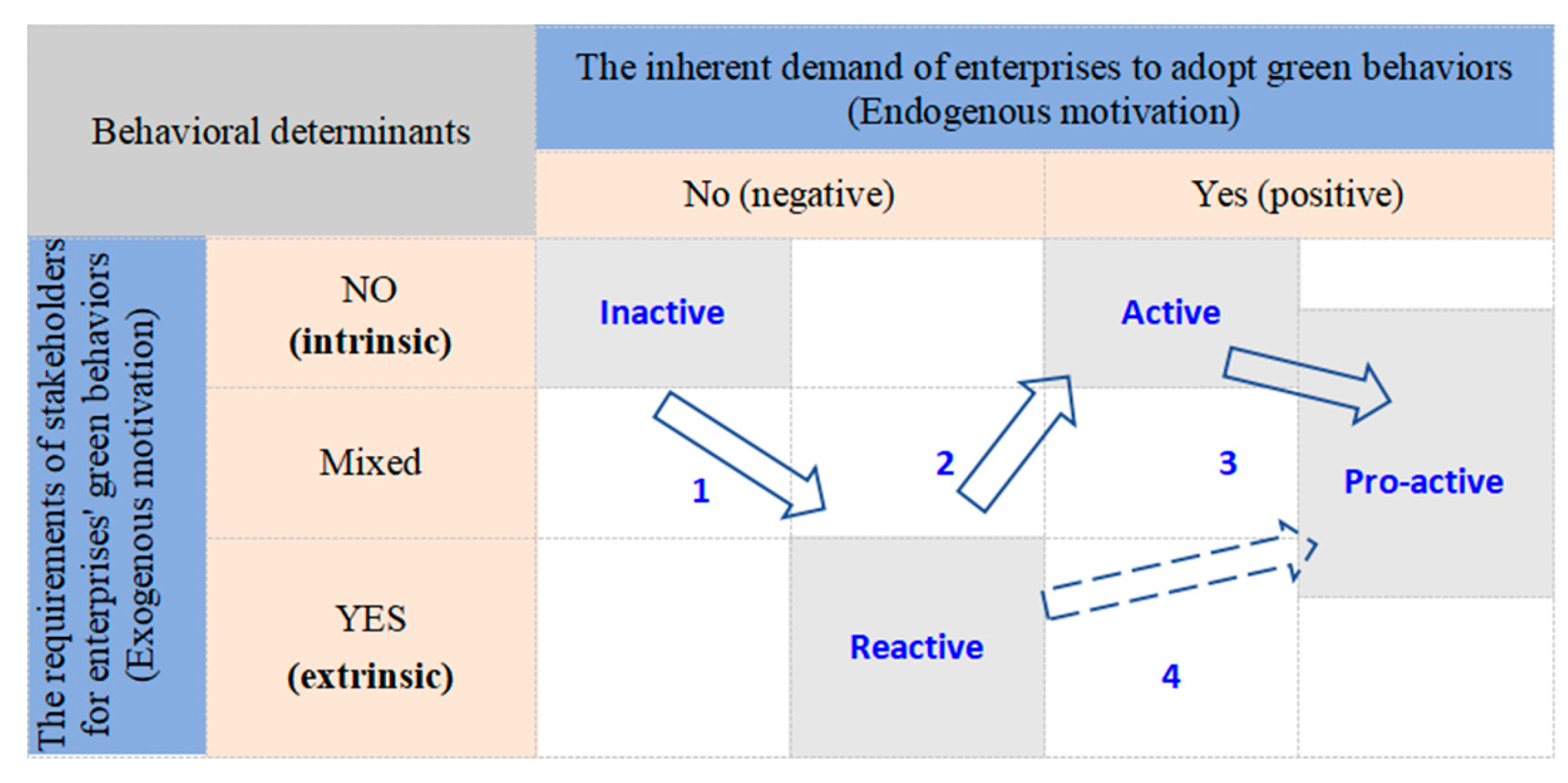
Figure 8.
Motivations and evolution paths for corporate green behaviors.
Note:
①Paths 1-2-3 represent the conventional evolutionary trajectory of corporate responses to environmental issues, while Path 4 denotes the behavioral transition pathway under reputation mechanisms;
② Source: Extended from Van Tulder et al.’s (2018) research framework.
5.2. Contributions to Policy Making and Implementation
From a dynamic, intertemporal perspective, public participation emerges as the primary driver of green behavioral transitions among logistics enterprises. On the one hand, active public engagement lowers the effective costs of corporate green behavior while generating a green premium; on the other hand, market-based mechanisms convert corporate reputation into tradable value, thereby strengthening market feedback–based reputational effects. Moreover, even under weak regulatory enforcement, high levels of public participation significantly amplify the effectiveness of institutional incentive–based reputation mechanisms.
Drawing on existing studies, public participation capacity can be assessed across five dimensions: awareness and willingness, knowledge and information, participatory channels and skills, organizational capacity, and actual influence (Yuan & Fan, 2020). Accordingly, a critical first step is to lower barriers to public participation by reframing full life-cycle environmental data platforms from purely technical disclosure tools into comprehensive multi-stakeholder engagement frameworks. Within such systems, logistics enterprises should disclose standardized key performance indicators—such as packaging recycling rates, carbon emission intensity per unit of transport, and green warehousing utilization rates—through public data platforms, thereby ensuring transparent, consistent, and sustainable data disclosure across the entire logistics value chain.
Second, the substantive influence of public participation should be strengthened by establishing co-creation platforms that incorporate evaluations from consumers, community organizations, and environmental groups, and by integrating these assessments into corporate ESG rating systems as a key input for green finance instruments.
Third, a diversified supervision mechanism should be established by transitioning green procurement whitelists from expert-centric certification models to more inclusive decision-making processes, increasing public representation on green logistics governance committees, and instituting public notice-and-comment procedures for candidate firms. Together, these measures can foster market- and society-oriented green innovation among logistics enterprises while improving the accessibility and usability of green logistics products and services for the public.
When public participation is constrained by limited awareness, willingness, or resources and is unlikely to improve substantially in the short term, the government should strengthen its regulatory role in the logistics sector. This can be achieved by establishing a public environmental performance ranking system based on standardized indicators, implementing a reputational “blacklist” mechanism for non-compliant enterprises, and developing clear and operational reputation-conversion mechanisms to enhance regulatory effectiveness. Such mechanisms may include tax credits for firms with high environmental ratings, priority access to government procurement programs, subsidies for green technological innovation, and the provision of environmental performance–linked financing. Together, these measures form an integrated regulatory framework encompassing monitoring, evaluation, and incentive alignment.
A key finding of this study is that when high levels of public participation and stringent government regulation operate synergistically, governments should strategically reduce direct market interventions. In such contexts, market feedback–based reputation mechanisms become sufficient to motivate logistics enterprises toward sustainable practices, while strict regulation serves to establish a baseline for compliance. Elevated public participation generates strong market pressure through consumer choice and stakeholder expectations. Accordingly, governments should focus on reinforcing bottom-line regulatory standards while limiting discretionary economic intervention, thereby allowing market-driven incentives to guide corporate behavior toward sustainability.
5.3. Research Prospects
The three reputation mechanisms jointly established by government and public actors provide logistics enterprises with stable intertemporal payoff expectations, enabling reactive firms to directly enter multi-stakeholder collaborative governance arrangements. Relative to classical collaboration models that presuppose intrinsic motivation, this framework represents a novel mode of multi-stakeholder governance for addressing wicked problems and lowers participation barriers for small and medium-sized logistics enterprises in environmental governance. Moreover, the effectiveness of each reputation mechanism in shaping corporate green behavior varies significantly across different levels of government regulation and public participation. Accordingly, enhancing public participation and strengthening governmental governance capacity are essential to fully realizing the potential of reputation-based governance mechanisms.
This study treats corporate reputation as an exogenous and fixed parameter; however, in practice, reputation evolves dynamically in response to government policy incentives and public participation. Capturing this endogeneity requires more refined theoretical modeling and validation using richer empirical data. In addition, while the present analysis focuses on the logistics sector, future research could extend the framework to high-pollution industries—such as chemicals and construction—to compare how reputation mechanisms operate under different regulatory intensities. Such comparative analysis would help identify industry-specific moderating factors shaping corporate green behavior and assess the broader generalizability of reputation-based governance mechanisms.
Declaration of competing interest
The authors declare that they have no known competing financial interests or personal relationships that could have appeared to influence the work reported in this paper.
Appendix
| Para-meter | Meaning | Proxy indicators | Data source | |
| C1 and C2 | Administrative costs under government supervision | Cost of air pollution prevention and control | The “Guidelines for the Application of Ecological and Environmental Funds Projects”- Air Pollution Prevention and Control subject | |
| C3 | The cost for logistics enterprises to adopt green environmental behaviors | The cost of new energy penetration per unit of freight volume | VAT invoice records in the Golden Tax System | |
| C4 | The cover-up costs of opportunistic behaviors adopted by logistics enterprises | The deviation between the quality of environmental information disclosure and the actual environmental penalty behavior | ESG report texts and the database of environmental administrative penalties for Chinese enterprises | |
| C5 | The additional costs for logistics enterprises to adopt green behaviors to meet public demands | Expenditure on green marketing and environmental certification per unit of freight volume | Green logistics assessment indicators for logistics enterprises | |
| Ra | the rewards received for the government’s strict regulation | Environmental protection special fund rewards from the superior government | The performance report of the Department of Finance on the funds for air pollution prevention and control | |
| Z | Rent-seeking costs for logistics enterprises | The legally prescribed minimum penalty amount | The “Benchmark for Discretionary Environmental Administrative Penalties” of the Ecological Environment Department | |
| S | The initial reputation value of logistics enterprises | The market credit-based reputation of enterprises in 2020 | National Enterprise Credit Information Publicity System | |
| α | The probability of logistics enterprises seeking rent to evade environmental responsibility | The proportion of the penalty amount equal to the legally prescribed minimum value | “Database of Environmental Administrative Penalties for Chinese Enterprises” and “Benchmarks for Administrative Penalty Discretion | |
| Rh | The additional benefits that logistics enterprises obtain by adopting green behaviors and gaining recognition and cooperation from the public | The proportion of recyclable packaging usage | Special Report on Green Logistics for Enterprises | |
| Rb | The loss of profits caused by the opportunistic behavior of logistics enterprises being discovered by the public | Comprehensive index of enterprise’s appeal handling work | Notice on Consumer Complaints issued by the State Post Bureau | |
| Rf | Logistics enterprises obtain additional long-term income | Green service premium rate | Internal pricing tables of enterprises and the industry report “Sustainable Consumption Research” | |
| F1 | The fine that logistics enterprises have to pay when their opportunistic behavior is discovered by the government | The amount of environmental administrative penalties per unit of freight volume | Environmental administrative penalty information on the website of the ecological environment department | |
| F2 | The government’s lax supervision was discovered by the public and punished | The loss rate of administrative litigation related to environmental supervision | China Judgments Online | |
| Rd | The additional benefits gained from the public for the government’s strict supervision | The sales proportion of green products among similar goods | Classified data on residents’ consumption expenditure from the National Bureau of Statistics |
References
- Ackoff R. L. 1974. Redesigning the future: A systems approach to societal problems, New York: Wiley.
- AhmedA.H., G. Tim and M. Ani. 2022. Assessing the impact of sustainable logistics service quality on relationship quality: Survey-based evidence in Egypt,Cleaner Logistics and Supply Chain, 4.
- Ameknassi L., D.AÏT-Kadi & RezgN. 2016. Integration of logistics outsourcing decisions in a green supply chain design: a stochastic multi-objective multi-period multi-product programming mode. International Journal of Production Economics, 182,pp.165-184. [CrossRef]
- Baah C., Z.Jin and L.Tang. 2020. Organizational and regulatory stakeholder pressures friends or foes to green logistics practices and financial performance: investigating corporate reputation as a missing link.Journal of Cleaner Production,247,pp.119-125.
- Cao R., Ji X., Chen F., et al. 2025. Theoretical Framework and Research Progress of Green Logistics at Home and Abroad. Logistics Research, (2): 7-16.
- Chen, J., T. Hu, and Van Tulder R.2019.Is the environmental Kuznets curve still valid:A perspective of wicked problem. Sustainability, 11,4747. [CrossRef]
- Chen, X.,Yi, N., Zhang L., et al. 2018.Does institutional pressure foster corporate green innovation? Evidence from China’s top 100 companies.Journal of cleaner production, 188,pp.304-311. [CrossRef]
- Cramer,J. 1998. Environmental management: from ‘fit’ to ‘stretch’. Business Strategy and the Environment,7(3),pp.162-172.
- George G., L. Dahlander, Graffin S. et al. 2016. Reputation and status: Expanding the role of social evaluations in management research. The Academy of Management Journal, 59(1),pp.1–13. [CrossRef]
- Huang, X., Z. Hu, Liu C. et al. 2016.The relationships between regulatory and customer pressure, green organizational responses, and green innovation performance. Journal of Cleaner Production,112,pp.3423-3433. [CrossRef]
- Jazairy A. 2020. Aligning the purchase of green logistics practices between shippers and logistics service providers. Transportation Research Part D: Transport and Environment, 82,102305. [CrossRef]
- IEA. 2024. CO2 Emissions from Fuel Combustion Highlights. Paris, France: International Energy Agency.
- Levin K., B. Cashore , S. Bernstein,et al. 2012. Overcoming the tragedy of super wicked problems: Constraining our future selves to ameliorate global climate change. Policy Sciences, 45(2),pp.123-152. [CrossRef]
- Lian G.,A. Xu & ZhuY. 2022. Substantive green innovation or symbolic green innovation? The impact of ER on enterprise green innovation based on the dual moderation effects. Journal of Innovation & Knowledge, 7,100203.
- Naini S., A. Aliahnadi & Jafari-Eskandarim. 2011. Designing a mixed performance measurement system for environmental supply chain management using evolutionary game theory and balanced scorecard: a case study of an auto industry supply chain. Resources, Conservation and Recycling, 55(6),pp.593-603.
- Pan C., Yang B., Feng H., et al. 2023. Selection of Different Cost-Sharing Contracts in Green Supply Chain Under Carbon Trading System. Journal of Systems Engineering, 38(4): 555-576.
- Pan W. 2010. Analysis of the Regional Green Logistics Development Evaluation System Based on Circular Economy Theory. Journal of Beijing Jiaotong University (Social Sciences Edition), 9(3): 42-46.
- Rittel H. W.&WebberM. M.1973. Dilemmas in a general theory of planning. Policy Sciences,4(2),pp.155–169.
- Van Tulder, R., R.Van Tilburg, M. Francken, et al. 2014. Managing the transition to a sustainable enterprise,London: Routledge,pp.82.
- Van Tulder, R.,A. Verbeke & Strange R. 2013. Taking stock of complexity: In search of new pathways to sustainable development”. In R. van Tulder, A. Verbeke, & R. Strange (Eds.), International business and sustainable development (Vol. 8, pp. 1–20). Emerald Group Publishing Limited.
- Wang F., X. Lai, Shi N. 2011. A multi-objective optimization for green supply chain network design. Decision Support Systems,51,pp.262-269.
- Waltho C., S. Ehhedhli & Gzara F. 2019. Green supply chain network design:A review focused on policy adoption and emission quanlification. International Journal of Production Economics, 208,pp.305-318. [CrossRef]
- Wang D., A.Tarasov &Zhan H. 2023. Environmental regulation, innovation capability, and green total factor productivity of the logistics industry.Kybernetes, 52(2),pp.688-707.
- Wang Y., Li Y., Ma Z., et al. 2017. Media Attention, Environmental Regulation and Corporate Environmental Investment. Nankai Business Review, 20(06): 83-94.
- Wu X.and S. Zhao. 2025. Research on green development strategy of logistics packaging based on corporate social responsibility: an evolutionary game analysis. Environment, Development and Sustainability,27,pp.11369–11390.
- Wu X., E. Shu, D. Ye, et al. 2025. Study on green packaging diffusion in logistics enterprise clusters based on complex network evolutionary game. Journal of Cleaner Production,499, pN.PAG-N.PAG. 1p. [CrossRef]
- Yew W.L.& Zhu Z. 2019. Innovative autocrats? Environmental innovation in public participation in China and Malaysia. Journal of Environmental Management, 234: p.28-35.
- Yu H., Wang Y., Sun X., et al. 2019. Research on the Impact of Government Regulation and Environmental NGOs on Pollution Reduction. Soft Science, 33(06): 79-83.
- Yuan H. &Fan S.i. 2020. Research on the Phased Evolution and Evaluation Index System of Social Participation in China: A Case Study of Citizen Participation in Community Governance. Chongqing: Chongqing University Press, 2020.
- Zhang W., M. Zhang,W. Zhang, et al. 2020. What influences the effectiveness of green logistics policies? A grounded theory analysis. Science of the Total Environment 714 (2020), 136731.
- Zhang et al. 2024. A tripartite evolutionary game for the regional green logistics: the roles of government subsidy and platform’s cost-sharing”,Kybernetes,53(1),pp.216-237.
Figure 1.
Tripartite game model of logistics enterprises’ green behavior considering reputation.
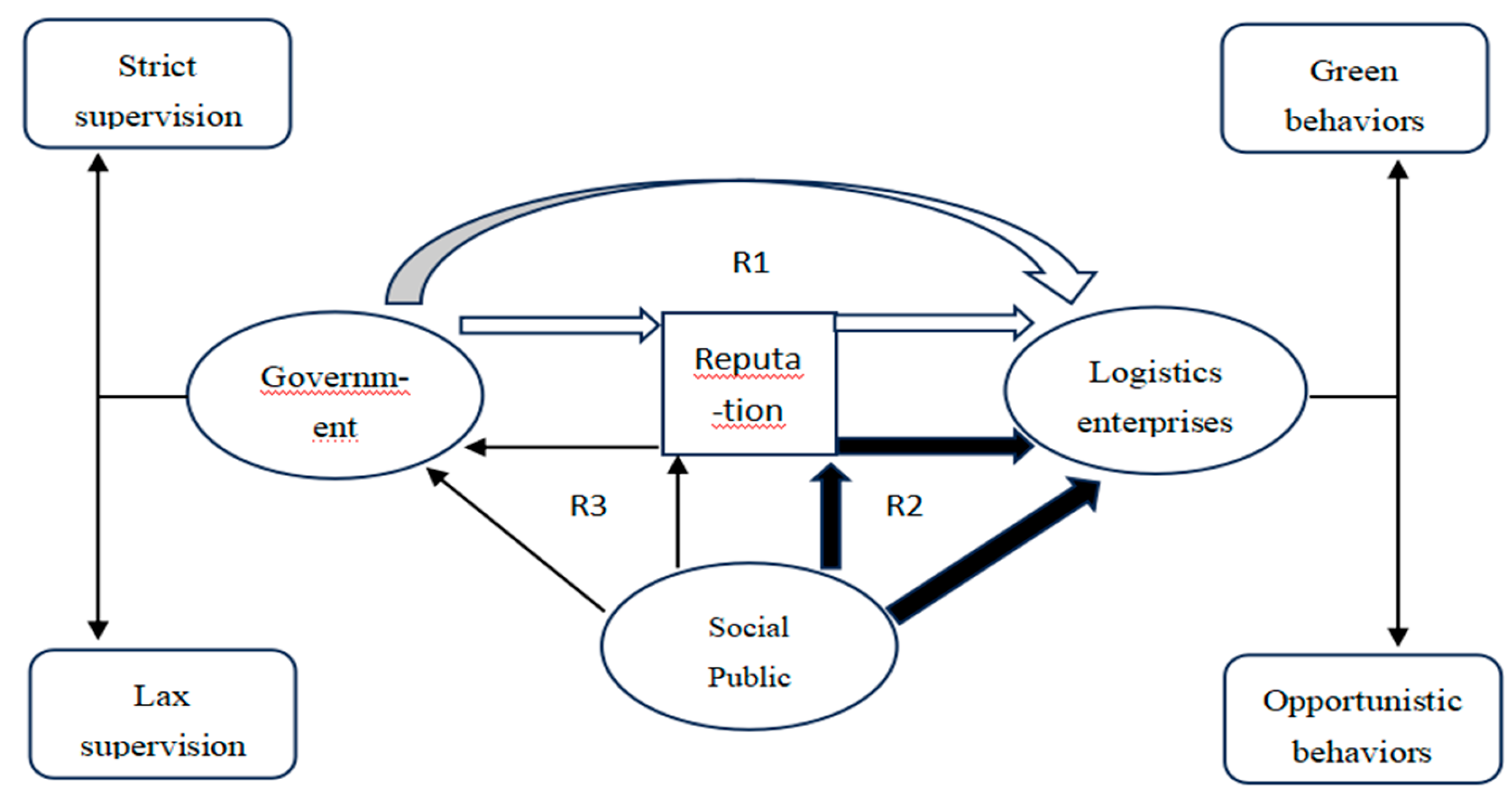
Figure 2.
Sensitivity analysis of Corporate Green Behaviors to Public Participation Level λ.
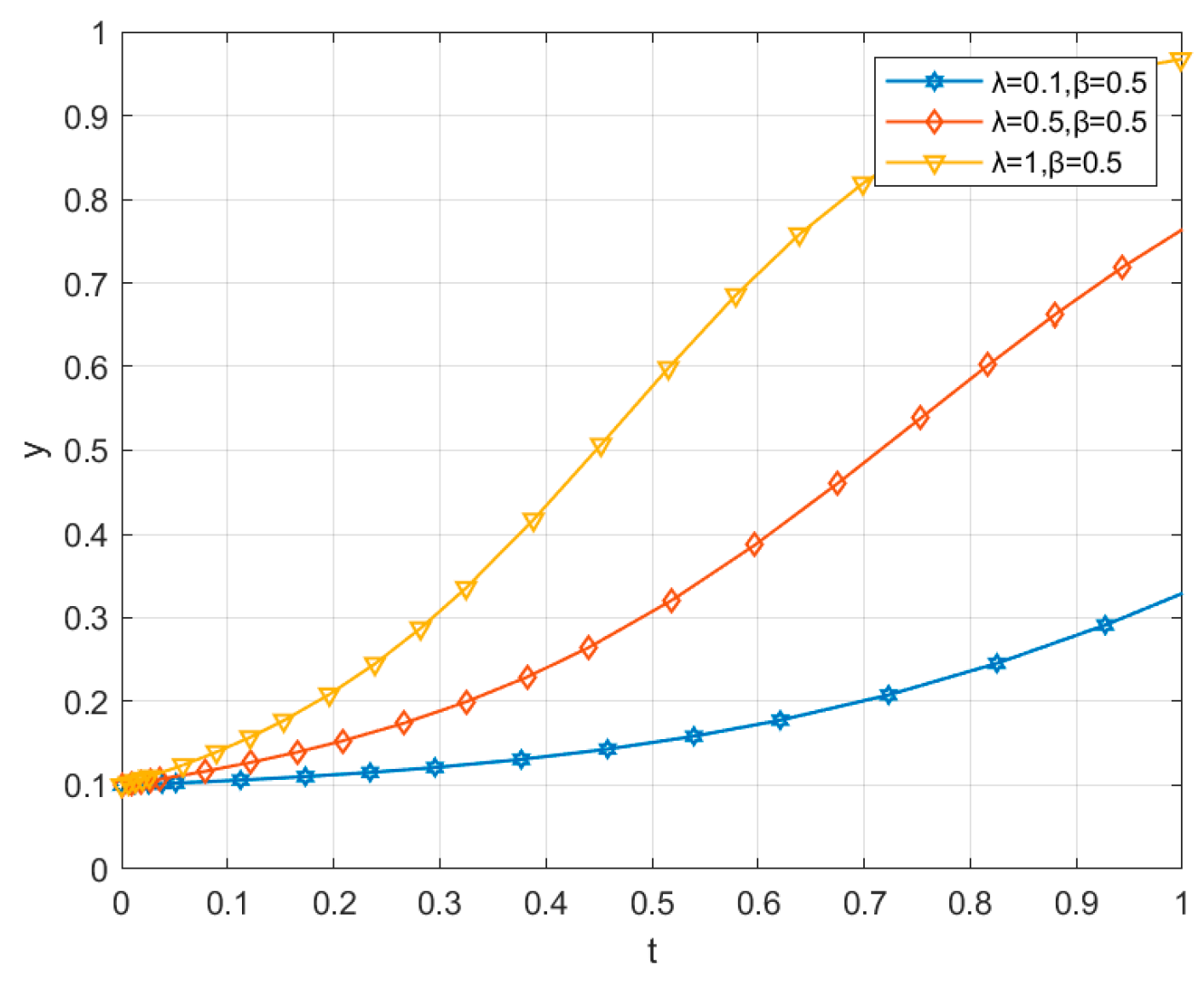
Figure 3.
Sensitivity analysis of corporate green behavior to β under the different situations.
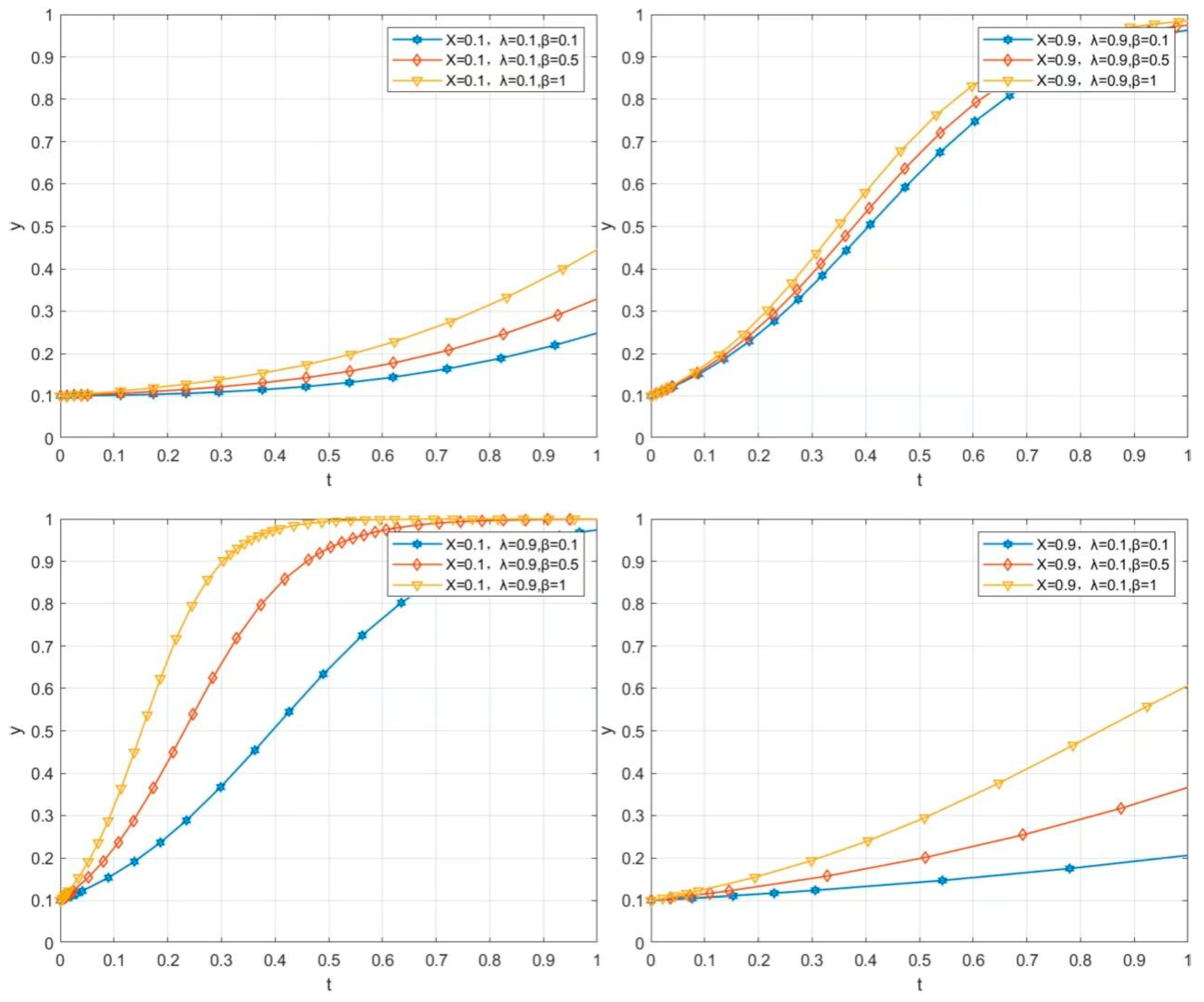
Figure 4.
Institutional incentives under the “double low” and the “G low and P high”scenario.
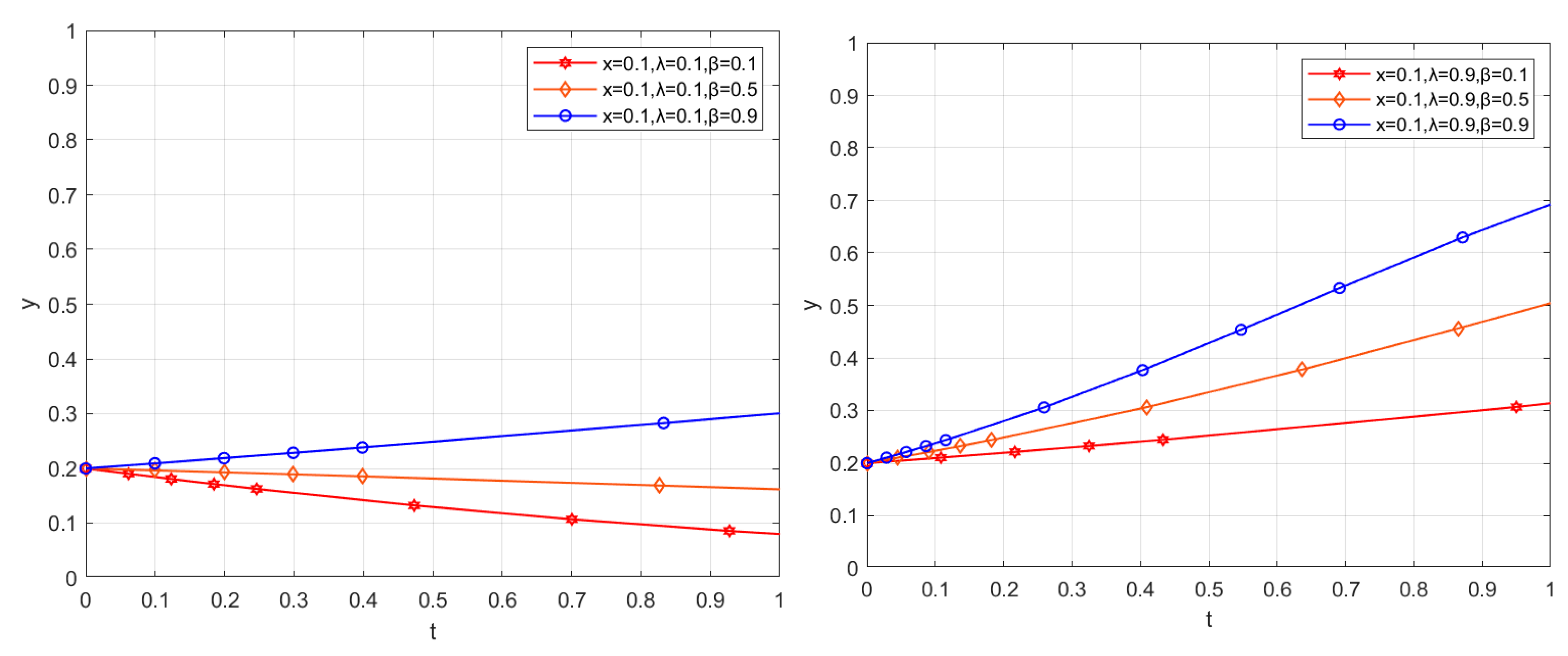
Figure 5.
Market feedback reputation mechanism effect under the lax government supervision.
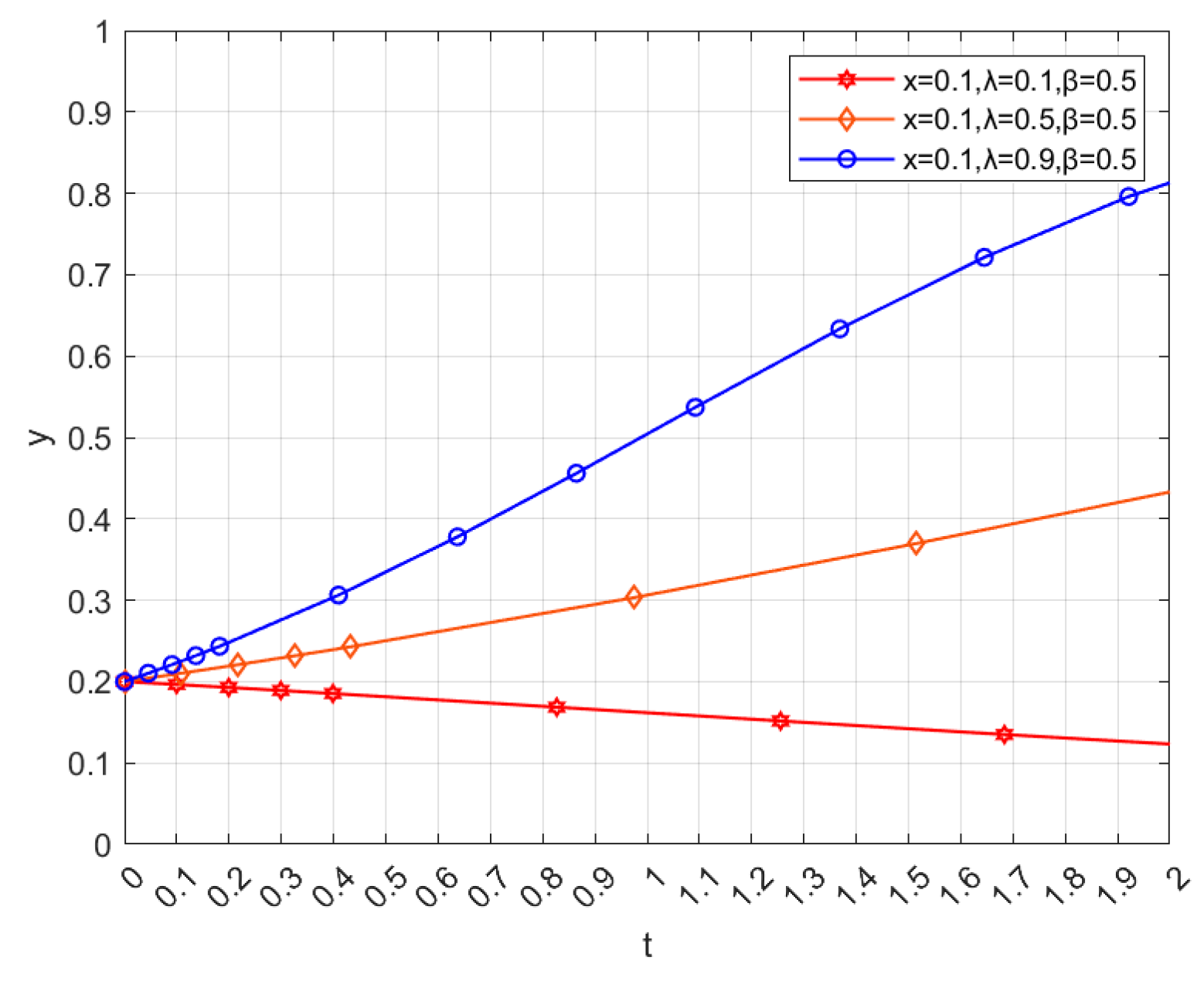
Figure 6.
Social supervisory reputation mechanism under the lax government supervision.
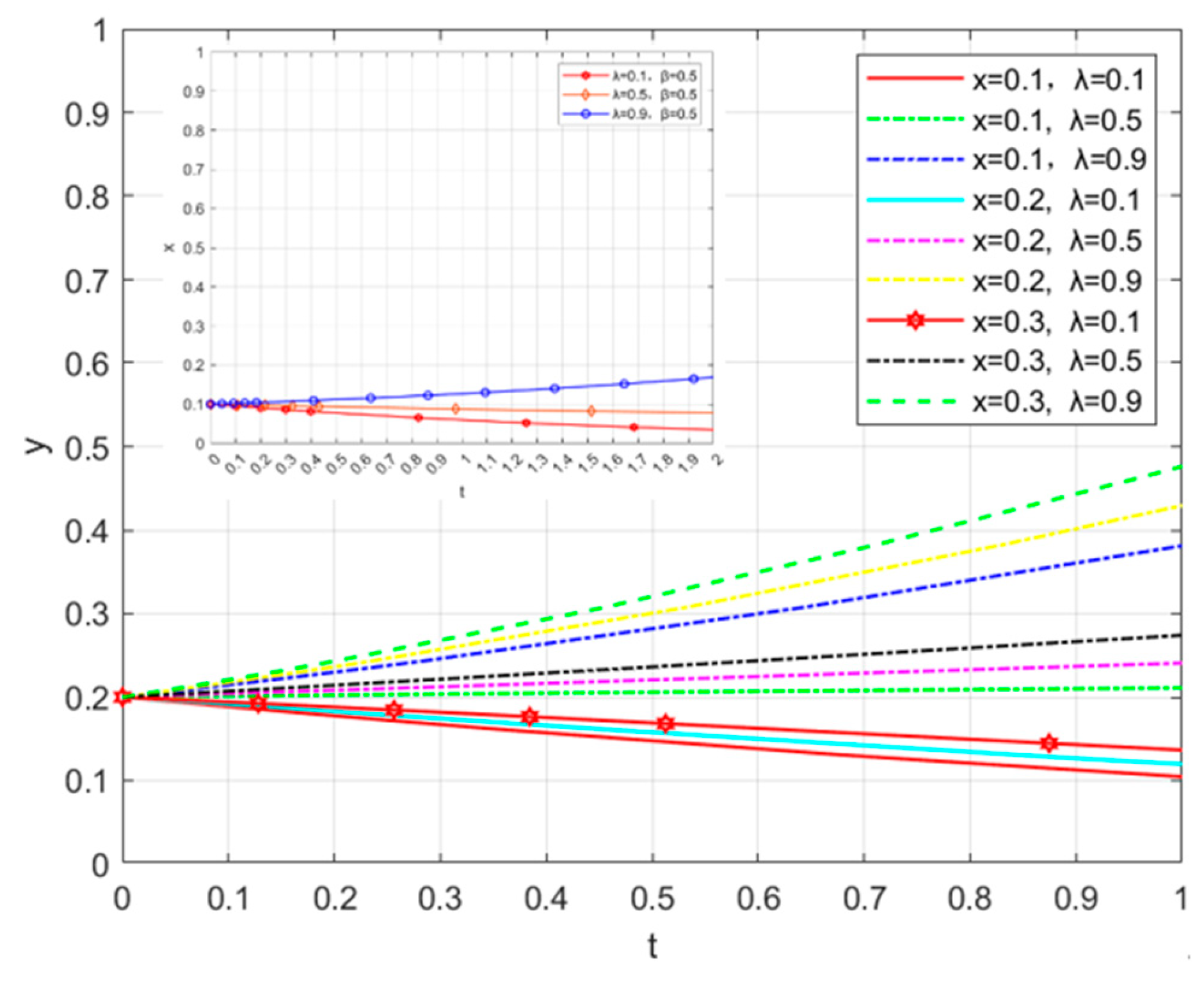
Figure 7.
Institutional incentives in the “G high and P low” and “double high”scenario.
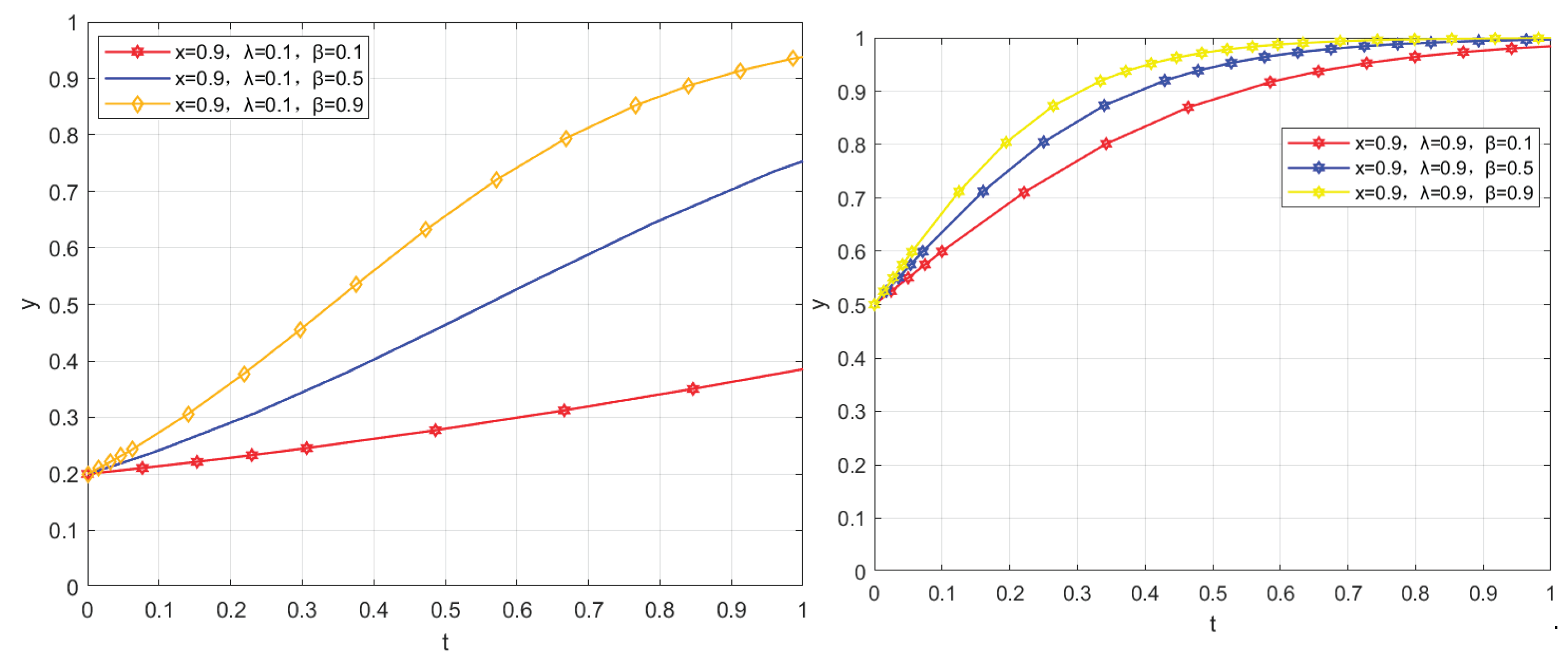

Table 1.
Payoff Matrix of the Game between Government and Logistics Enterprises in Public Participation.
Table 1.
Payoff Matrix of the Game between Government and Logistics Enterprises in Public Participation.
| Strategy | logistics enterprises | ||
| Green behaviors (y) | Opportunistic behavior (1-y) | ||
| government | strict supervision (x) | Rz+Ra+λRd–C1 | Rz+Ra+ F1–αZ–C1 |
| Re+βS +λRh+Rf–C3–C5 | Re +α(F1–Z) –(1–α)F1–λRb–C4 | ||
| Lax supervision (1-x) | Rz–C2 | Rz+αZ–C2–λF2 | |
| Re+βS +λRh+Rf–C5–C3 | Re +α(F1–Z)– C4 –λRb | ||
Table 2.
The system eigenvalues.
| Equilibrium points | Eigenvalue 1 | Eigenvalue 2 |
| P1(0,0) | Ra +C2–C1+F1+λF2–2αZ | βS+λ(Rh+Rb)+Rf-α(F1–Z)+C4-C3-C5 |
| P2(1,0) | -(Ra +C2–C1+F1+λF2–2αZ) | βS+λ(Rh+Rb)+Rf-α(F1–Z)+C4-C3-C5+ (1-α)F1 |
| P3(0,1) | Ra +C2–C1+λRd | -(βS+λ(Rh+Rb)+Rf-α(F1–Z)+C4-C3-C5) |
| P4(1,1) | -(Ra +C2–C1+λRd) | -(βS+λ(Rh+Rb)+Rf-α(F1-Z)+C4-C3-C5+(1-α)F1) |
Table 3.
Stability analysis of Situation 1.
| equilibrium points | Eigenvalue 1 | Eigenvalue 2 | Symbol | Stability |
| P1(0,0) | Ra+C2–C1+F1+λF2–2αZ | βS+λ(Rh+Rb)+Rf-α(F1–Z)+C4-C3-C5 | (-, -) | Stable point |
| P2(0,1) | Ra +C2–C1+λRd | -(βS+λ(Rh+Rb)+Rf-α(F1–Z)+C4-C3-C5) | (±, +) | Instability point |
| P3(1,0) | -(Ra +C2–C1+F1+λF2–2αZ) | βS+λ(Rh+Rb)+Rf-α(F1–Z)+C4-C3-C5+ (1-α)F1 | (+, ±) | Instability point |
| P4(1,1) | -(Ra +C2–C1+λRd) | -(βS+λ(Rh+Rb)+Rf-α(F1-Z)+C4-C3-C5+(1-α)F1) | (±, ±) | Instability point |
Table 4.
Stability analysis of Situation 2.
| Local equilibrium points | Eigenvalue 1 | Eigenvalue 2 | Symbol | Stability |
| P1(0,0) | Ra+C2–C1+F1+λF2–2αZ | βS+λ(Rh+Rb)+Rf-α(F1–Z)+C4-C3-C5 | (+, -) | Unstable points |
| P2(0,1) | Ra +C2–C1+λRd | -(βS+λ(Rh+Rb)+Rf-α(F1–Z)+C4-C3-C5) | (±, +) | Unstable points |
| P3(1,0) | -(Ra+C2–C1+F1+λF2–2αZ) | βS+λ(Rh+Rb)+Rf-α(F1–Z)+C4-C3-C5+ (1-α)F1 | (-, -) | Stable points |
| P4(1,1) | -(Ra +C2–C1+λRd) | -(βS+λ(Rh+Rb)+Rf-α(F1-Z)+C4-C3-C5+(1-α)F1) | (±, +) | Unstable points |
Table 5.
Stability analysis of Situation 3.
| equilibrium points | Eigenvalue 1 | Eigenvalue 2 | Symbol | Stability |
| P1(0,0) | Ra+C2–C1+F1+λF2–2αZ | βS+λ(Rh+Rb)+Rf-α(F1–Z)+C4-C3-C5 | (±, +) | Unstable points |
| P2(0,1) | Ra +C2–C1+λRd | -(βS+λ(Rh+Rb)+Rf-α(F1–Z)+C4-C3-C5) | (-, -) | Stable points |
| P3(1,0) | -(Ra+C2–C1+F1+λF2–2αZ) | βS+λ(Rh+Rb)+Rf-α(F1–Z)+C4-C3-C5+ (1-α)F1 | (±, +) | Unstable points |
| P4(1,1) | -(Ra +C2–C1+λRd) | -(βS+λ(Rh+Rb)+Rf-α(F1-Z)+C4-C3-C5+(1-α)F1) | (+, -) | Unstable points |
Disclaimer/Publisher’s Note: The statements, opinions and data contained in all publications are solely those of the individual author(s) and contributor(s) and not of MDPI and/or the editor(s). MDPI and/or the editor(s) disclaim responsibility for any injury to people or property resulting from any ideas, methods, instructions or products referred to in the content. |
© 2026 by the authors. Licensee MDPI, Basel, Switzerland. This article is an open access article distributed under the terms and conditions of the Creative Commons Attribution (CC BY) license (http://creativecommons.org/licenses/by/4.0/).
Copyright: This open access article is published under a Creative Commons CC BY 4.0 license, which permit the free download, distribution, and reuse, provided that the author and preprint are cited in any reuse.


