

Submitted:
05 May 2026
Posted:
05 May 2026
You are already at the latest version
Abstract
Background: Adipose tissue expansion in obesity is accompanied by extracellular matrix (ECM) remodelling, regulated by matrix metalloproteinases (MMPs). Visceral adipose tissue (VAT) is metabolically more active than subcutaneous adipose tissue (SAT). However, depot-specific differences in proteolytic activity and protein glycooxi-dation remain incompletely characterized.
Methods: In this case-control study, we assessed the activity of six matrix metallo-proteinases (MMP-1, -2, -7, -9, -11, -13) using a fluorescence resonance energy transfer (FRET) assay and quantified advanced glycation and glycooxidation-related markers in paired VAT, SAT and plasma samples obtained from 40 patients with obesity and 21 non-obese controls.
Results: The activities of all assessed MMPs were greater in patients with obesity than in the control group (p < 0.01 for all MMPs). Direct tissue-compartment comparisons showed that MMP activity and glycooxidation-related markers were most pronounced in VAT, with markedly higher values in obese individuals compared with controls. In VAT of obese individuals, median MMP activity was approximately 50–60% higher compared with controls. Amyloid cross-β-structure, vesperlysine and pentosidine were significantly elevated in VAT in obesity, whereas plasma levels were markedly lower and showed limited group differences. No significant differences were observed between obese par-ticipants with and without metabolic syndrome.
Conclusions: Obesity is associated with a depot-specific molecular profile charac-terized by enhanced proteolytic and glycooxidative activity predominantly within vis-ceral adipose tissue. These findings highlight the importance of tissue-compartment–specific assessment in obesity.
Keywords:
obesity
; visceral adipose tissue
; subcutaneous adipose tissue
; matrix metalloproteinases
; MMP activity
; extracellular matrix remodeling
; advanced glycation end-products
; glycooxidation
; oxidative stress
; plasma biomarkers
Study Highlights — What is New
- This study simultaneously quantified matrix metalloproteinase (MMP) activity and glycooxidation-related protein modification in visceral and subcutaneous adipose tissue, as well as in plasma, from individuals with and without obesity.
- Across all examined MMP isoforms and AGE-related markers (i.e., indicators of advanced glycation end-products—non-enzymatic protein modifications formed under conditions of oxidative and carbonyl stress), molecular alterations were most pronounced in visceral adipose tissue.
- In the context of existing literature, the observed pattern is consistent with visceral adipose tissue representing a key site of tissue-level molecular alterations in obesity.
- The results highlight the importance of considering tissue-compartment–specific biology when investigating metabolic risk in obesity.
1. Introduction
Obesity is a complex, chronic disorder characterized not only by excess adiposity but also by profound alterations in adipose tissue biology [1,2]. Accumulating evidence indicates that qualitative changes within adipose tissue—rather than total fat mass alone—play a key role in the development of metabolic and cardiovascular complications [3,4]. Among different fat depots, visceral adipose tissue (VAT) is consistently associated with a higher risk of insulin resistance, type 2 diabetes, non-alcoholic fatty liver disease and cardiovascular disease compared with subcutaneous adipose tissue (SAT) [5,6,7,8,9]. This suggests that depot-specific molecular and structural differences may contribute to the heterogeneous metabolic impact of adipose tissue distribution [5,7,8].
Adipose tissue expansion in obesity is accompanied by extracellular matrix (ECM) remodeling, altered proteolytic activity, immune cell infiltration and oxidative stress [4,10,11]. ECM turnover is tightly regulated and essential for maintaining tissue architecture and mechanical properties [10,11,12]. Dysregulated ECM remodeling may influence adipocyte expandability, local inflammation and tissue stiffness [4,11,12]. Matrix metalloproteinases (MMPs) constitute a family of zinc-dependent endopeptidases that regulate ECM degradation and remodeling [13,14]. Several MMPs, including MMP-1, -2, -7, -9, -11 and -13, have been implicated in adipose tissue remodeling, angiogenesis and inflammatory signaling [10,15,16].
However, most human studies have focused on circulating concentrations of selected MMPs rather than direct assessment of their enzymatic activity within specific adipose depots [16,17,18]. Importantly, circulating levels may not accurately reflect local proteolytic processes within adipose tissue, where ECM remodeling occurs in a spatially and functionally heterogeneous manner. Moreover, available studies typically investigate individual MMPs or single tissue compartments, which limits the ability to capture coordinated proteolytic activity across different fat depots.
Therefore, a comprehensive, depot-specific evaluation of MMP activity directly within human adipose tissue remains limited. In particular, studies simultaneously assessing multiple MMP isoforms and comparing their enzymatic activity between visceral and subcutaneous adipose tissue within the same individuals are scarce. Addressing this gap may provide a more integrated understanding of tissue-specific remodeling processes and their potential contribution to metabolic dysfunction in obesity.
In parallel, obesity is associated with increased oxidative stress and enhanced non-enzymatic protein modification [19,20]. AGEs and related glycooxidative structures accumulate as a result of chronic exposure to reactive carbonyl and oxygen species [21,22]. These modifications may alter protein structure, cross-link extracellular matrix components and influence cellular signaling pathways [21,23,24]. Although circulating AGE levels and AGE–RAGE signaling in adipose tissue have been investigated in the context of obesity and diabetes, data on depot-specific accumulation of glycooxidative modifications within human adipose tissue remain limited and incompletely characterized [24,25,26,27]. In particular, direct comparative analyses of visceral and subcutaneous adipose tissue are scarce, which highlights an important gap in current knowledge [8,10,11].
Importantly, VAT and SAT differ in vascularization, inflammatory cell composition, endocrine activity and metabolic responsiveness [6,7,8,9,28]. Nevertheless, although individual aspects of adipose tissue remodeling, proteolytic activity and AGE–RAGE signaling have been investigated, comprehensive comparative analyses integrating proteolytic activity and glycooxidation-related protein modification across paired VAT, SAT and plasma samples in individuals with and without obesity remain limited [10,16,25]. In particular, studies combining these pathways within the same experimental framework and directly comparing tissue compartments are scarce, highlighting a relevant gap in current knowledge [10,25].
A more detailed characterization of depot-specific molecular patterns may improve understanding of adipose tissue heterogeneity in obesity and clarify to what extent circulating biomarkers reflect tissue-level alterations [7,17,18]. Therefore, the aim of the present case-control study was to compare matrix metalloproteinase activity and glycooxidation-related markers in visceral and subcutaneous adipose tissue and plasma obtained from individuals with and without obesity.
2. Results
2.1. Study Population
The study included 40 patients with morbid obesity undergoing bariatric surgery and 21 non-obese control participants. Patients with obesity presented significantly higher body weight and body mass index (BMI) compared with controls (both p < 0.0001) [1,2]. Systolic and diastolic blood pressure were also significantly elevated in the obesity group (p = 0.0008 and p < 0.0001, respectively) [3]. White blood cell (WBC) count was higher in participants with obesity [3,28]. Hematological parameters such as hemoglobin and hematocrit were lower in the obesity group, whereas most electrolyte and coagulation parameters were comparable between groups.
Detailed anthropometric, biochemical and hematological characteristics are presented in Table 1.
2.2. Matrix Metalloproteinase Activity
Direct comparisons between obese and control participants within each tissue compartment showed significantly higher activity of all analyzed MMPs in VAT of obese individuals. In VAT, median MMP activity in obese participants was higher by 54.7% for MMP-1, 54.5% for MMP-2, 56.6% for MMP-7, 53.1% for MMP-9, 58.2% for MMP-11 and 57.6% for MMP-13 compared with controls. This consistent increase across all analyzed MMPs indicates enhanced proteolytic activity predominantly within VAT.
Complementary two-way ANOVA confirmed significant effects of tissue compartment and obesity status, as well as obesity × tissue interactions for all analyzed MMPs. These results are presented in Supplementary Table S4.
In SAT, obesity-related differences were smaller than in VAT and did not remain statistically significant after correction for multiple comparisons for any of the analyzed MMPs.
In plasma, absolute MMP activity was markedly lower than in adipose tissue compartments. Although median values tended to be higher in obese individuals, group differences were modest and did not remain statistically significant after correction for multiple comparisons for any of the analyzed MMPs.
The distribution of MMP activity across tissue compartments and study groups is presented in Supplementary Figure S1. Direct pairwise comparisons within each tissue compartment are shown in Figure 1.
2.3. Protein Modification and Glycooxidation Markers
Direct comparisons within each tissue compartment showed that selected glycooxidation-related markers were significantly elevated in VAT of obese individuals compared with controls. In VAT, amyloid cross-β-structure levels were 61.9% higher, vesperlysine levels were 69.8% higher and pentosidine levels were 72.8% higher in obese participants. These findings indicate that obesity-related glycooxidative protein modifications are most pronounced in visceral adipose tissue.
Differences in SAT and plasma were smaller and were not consistently significant. Dityrosine and total AGEs showed no significant obesity-related differences within individual compartments, although their levels differed between tissue compartments. Overall, glycooxidation-related markers demonstrated a pattern similar to MMP activity, with the most pronounced alterations observed in VAT.
Complementary two-way ANOVA confirmed a significant tissue-compartment effect for all analyzed fluorescence-based markers and significant obesity-related effects for selected markers. These results are presented in Supplementary Table S5.
For clarity, the overall distribution across tissue compartments is presented in Supplementary Figure S2, whereas direct obese-versus-control comparisons within individual tissue compartments are shown in Figure 2.
2.4. Comparison Between Obese Participants with and Without Metabolic Syndrome
Subgroup analysis within the obesity cohort revealed no statistically significant differences between individuals with and without metabolic syndrome for any analyzed MMPs or AGE-related marker in plasma, SAT or VAT (all p > 0.30).
Median values and interquartile ranges were comparable between subgroups across all compartments. Detailed results are provided in Supplementary Tables S1–S3. The lack of significant differences between MetS subgroups was consistent across all tissue compartments and markers.
2.5. Correlation Analyses
Spearman correlation analyses were performed to explore associations between VAT molecular markers and selected anthropometric and laboratory parameters.
No significant correlations were observed between VAT MMP activity or AGE-related markers and BMI, body weight or blood pressure (all p > 0.05). No consistent associations were detected with CRP or fibrinogen.
Moderate correlations were identified between selected VAT glycooxidation markers and serum amylase (r = 0.41–0.48; p < 0.05). Dityrosine and vesperlysine levels in VAT were inversely correlated with white blood cell count (r ≈ −0.37; p < 0.05).
MMP-11 activity in VAT correlated positively with serum amylase (r = 0.403; p = 0.046) and negatively with WBC (r = −0.382; p = 0.024). MMP-1 showed a modest inverse association with WBC (r = −0.356; p = 0.036).
Other correlations did not reach statistical significance.
3. Discussion
Obesity is associated with complex alterations in adipose tissue structure and function that extend beyond quantitative fat accumulation [1,2,4]. In the present case-control study, we demonstrate that both matrix metalloproteinase activity and glycooxidation-related protein modifications are markedly higher in adipose tissue than in plasma, with the most pronounced alterations consistently observed in VAT.
Direct tissue-compartment comparisons revealed a consistent pattern of increased MMP activity and selected glycooxidation-related markers predominantly in VAT of obese individuals. Complementary two-way ANOVA supported the presence of significant compartment-specific effects, indicating that obesity-related molecular alterations were not uniformly distributed across VAT, SAT and plasma. Together, these findings indicate a consistent depot-specific pattern in obesity [5,7,8].
A consistent observation across all analyzed metalloproteinases was the approximately 50–60% increase in enzymatic activity in VAT of obese individuals compared with controls. This uniform pattern across multiple MMPs suggests coordinated alterations in proteolytic activity within visceral fat [10,16]. Previous experimental and clinical studies have implicated selected MMPs, particularly MMP-2 and MMP-9, in adipose tissue remodeling and cardiometabolic risk [17,29,30]. However, most available human data rely on circulating concentrations rather than direct assessment of enzymatic activity in adipose depots [16,18]. Our findings extend these observations by demonstrating that active proteolytic signaling is predominantly localized within VAT rather than in plasma levels [15].
The markedly lower MMP activity observed in plasma, together with modest or absent group differences in circulation, supports the concept that circulating markers may incompletely represent tissue-level remodeling processes [17,18]. This discrepancy may be explained by several factors, including limited release of active enzymes from the tissue into the circulation, rapid inhibition by circulating tissue inhibitors of metalloproteinases (TIMPs), or temporal differences between local enzymatic activity and its systemic reflection [14]. In addition, dilution effects and the complex dynamics of protein clearance from plasma may further attenuate detectable differences at the systemic level [14]. This compartmental discrepancy underscores the importance of direct tissue assessment when investigating alterations associated with obesity [4,10]. From a clinical perspective, this finding may help explain why circulating biomarkers often show limited sensitivity in reflecting early or localized adipose tissue dysfunction, despite the presence of metabolically relevant alterations within visceral fat.
In parallel, markers of protein glycation and glycooxidation were significantly higher in adipose tissue than in plasma. Among these markers, amyloid cross-β-structure, vesperlysine and pentosidine demonstrated significant obesity-related increases, particularly within VAT. In contrast, dityrosine and total AGE exhibited strong tissue effects. These results indicate that glycooxidative modifications preferentially accumulate within adipose tissue rather than being reflected in circulation [23,25].
The observed increase in proteolytic activity and glycooxidative modifications within VAT may also have implications for ECM organization and mechanical properties [10,11,12]. Accumulation of AGEs can promote cross-linking of matrix proteins, potentially contributing to increased tissue stiffness and altered adipose tissue expandability [11,21,23]. Such structural changes have been linked to impaired adipocyte function and may limit the capacity of adipose tissue to store excess energy in a metabolically safe manner [4,11,12].
In this context, enhanced ECM remodeling and glycooxidative stress within VAT may also be indirectly related to the development of insulin resistance, as both processes have been associated with adipose tissue dysfunction and altered metabolic signaling, which are key features of obesity-related metabolic complications, including type 2 diabetes and cardiovascular disease [7,26,27,28]. Although the present study was not designed to assess insulin sensitivity directly, the observed molecular pattern is consistent with mechanisms previously implicated in metabolic dysregulation [9,25,26].
Furthermore, potential interactions between AGE accumulation and proteolytic activity should be considered [23,25]. Activation of the AGE–RAGE signaling pathway has been shown to promote inflammatory and oxidative responses, which may influence MMP expression and activity [14,24,25,26,27]. This suggests a possible link between glycooxidative stress and ECM remodeling; however, this relationship cannot be established based on the current data and warrants further investigation [10,23].
VAT is characterized by distinct vascularization, immune cell composition and endocrine activity compared with subcutaneous fat [6,7,8,28]. Numerous studies have shown that VAT exhibits stronger inflammatory activation and a closer association with metabolic risk factors [5,6,7,9]. The present data add to this body of evidence by demonstrating that VAT is characterized by enhanced proteolytic and glycooxidative activity [10,25]. Given the well-established association between visceral adiposity and cardiometabolic risk, these molecular alterations may represent tissue-level mechanisms contributing to the development of obesity-related complications. However, these findings do not establish causal mechanisms linking these alterations to clinical outcomes and should therefore be interpreted as descriptive rather than mechanistic. This further supports the concept of VAT as a key site of obesity-related molecular alterations [4,8,12].
Subgroup analysis revealed no significant differences in MMP activity or AGE-related markers between obese individuals with and without metabolic syndrome. This observation suggests that the VAT depot here is primarily associated with obesity itself rather than with the clinical diagnosis of metabolic syndrome [19,31,32]. Alternatively, the absence of subgroup differences may reflect limited statistical power. Larger studies incorporating detailed metabolic phenotyping would be required to clarify whether these molecular alterations relate to specific metabolic traits [7,33]. It is also possible that the molecular alterations observed in VAT represent early or fundamental changes associated with obesity itself, which are not further differentiated by the clinical classification of metabolic syndrome [4,33,34].
An important aspect of the present findings is the discrepancy between tissue-level alterations and circulating markers. Despite pronounced changes in VAT, plasma levels of MMP activity and glycooxidation-related markers showed only modest or non-significant differences between obese and control individuals. This suggests that circulating biomarkers may underestimate the extent of local adipose tissue remodeling. Clinically, this may contribute to the limited ability of standard blood-based markers to fully capture early or tissue-specific pathological processes associated with obesity. Therefore, the observed tissue-specific molecular alterations may precede detectable systemic changes and could be more directly linked to the development of metabolic complications.
Several limitations should be considered when interpreting these results. The case-control design precludes causal inference and does not allow for the assessment of temporal relationships between obesity and the observed molecular alterations. The sample size, particularly in subgroup analyses, may limit statistical power to detect small-to-moderate differences. In addition, although enzymatic activity and glycooxidative markers provide functional information, we did not directly assess extracellular matrix composition, tissue biomechanics, receptor signaling or longitudinal metabolic outcomes [11,25,35]. Therefore, the biological consequences of the observed molecular pattern remain to be established.
Despite these limitations, the study provides a comprehensive comparative assessment of multiple MMPs and glycooxidation markers across paired visceral and subcutaneous adipose tissue samples and plasma. The consistent depot-specific pattern observed across independent molecular pathways strengthens the robustness of the findings.
In summary, our results demonstrate that obesity is associated with proteolytic and glycooxidative activity predominantly within visceral adipose tissue [5,7]. These findings highlight the heterogeneity of adipose tissue biology and suggest that circulating biomarkers may incompletely reflect local molecular alterations in obesity [4,17,18]. Further studies integrating molecular profiling with structural and longitudinal clinical data are warranted to clarify the biological and clinical relevance of these compartment-specific differences [34,35].
4. Materials and Methods
4.1. Study Population and Clinical Data Collection
This case-control study included 40 patients with severe obesity who qualified for bariatric surgery according to institutional eligibility criteria. All participants had a body mass index (BMI) > 32 kg/m2. Exclusion criteria included active malignancy, acute inflammatory disease, autoimmune disorders, chronic infectious diseases, significant alcohol abuse and active nicotine dependence.
The control group consisted of 21 non-obese individuals (BMI < 26 kg/m2) without clinically diagnosed metabolic disorders who were scheduled for elective non-metabolic surgical procedures (hernia repair or laparoscopic cholecystectomy). None of the control participants had a history of bariatric or metabolic surgery. Control participants had no documented history of diabetes, chronic inflammatory disease, or metabolic pharmacotherapy based on medical records.
Anthropometric parameters (body weight, height and BMI) were recorded prior to surgery. Venous blood samples were obtained after an overnight fast for routine biochemical and hematological analyses, including CRP, fibrinogen, liver enzymes, renal function parameters, glucose and complete blood count.
Metabolic syndrome was diagnosed according to the International Diabetes Federation (IDF) criteria, requiring central obesity plus at least two of the following: elevated triglycerides, reduced HDL cholesterol, elevated blood pressure or previously diagnosed hypertension, and impaired fasting glucose or type 2 diabetes [33].
4.2. Adipose Tissue and Plasma Sample Collection
Visceral adipose tissue (VAT) samples were obtained intraoperatively from the greater omentum during abdominal cavity access. Subcutaneous adipose tissue (SAT) samples were collected from the abdominal wall incision site at the beginning of the procedure.
All tissue samples were collected prior to any major tissue manipulation. Immediately after excision, samples were rinsed in sterile saline, snap-frozen in liquid nitrogen and stored at −80 °C until further analysis.
Blood samples were centrifuged at 4 °C within 30 minutes of collection, and plasma was aliquoted and stored at −80 °C. All samples were processed under identical pre-analytical conditions.
Laboratory analyses were performed in technical duplicates. Investigators performing biochemical measurements were blinded to clinical group allocation.
4.3. Ethical Approval and Informed Consent
The study was conducted in accordance with the Declaration of Helsinki and approved by the Bioethics Committee of the Medical University of Bialystok (resolution No. APK.002.98.2023 of 16 February 2023). Additional approval was granted by resolution No. R-I-002/475/2019 of 19 September 2024, authorizing the Humana Medica Omeda center as an additional site for biological sample collection and permitting continuation of the medical experiment at this location. Written informed consent was obtained from all participants prior to inclusion in the study.
4.4. Assessment of Matrix Metalloproteinase Activity
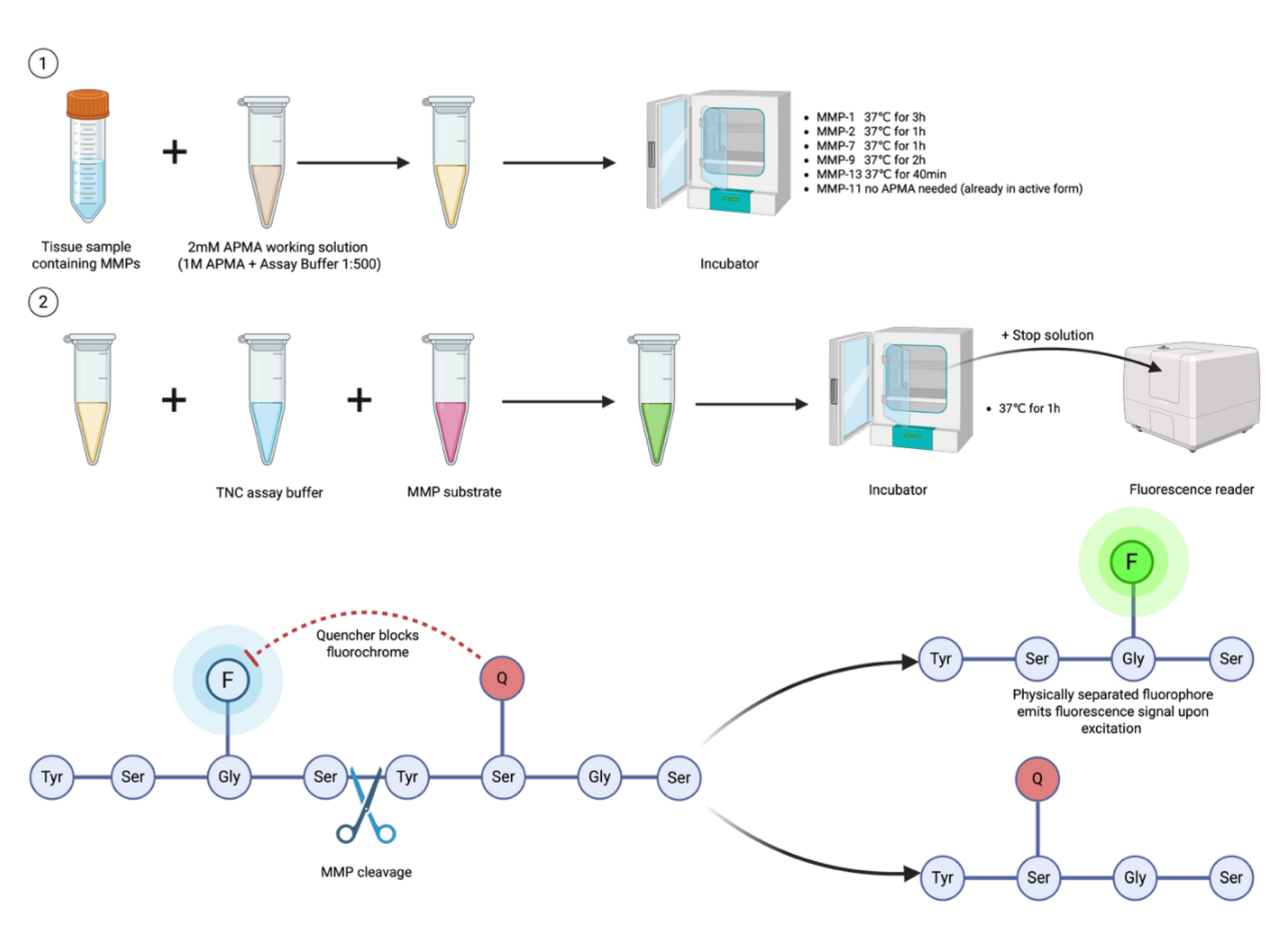
Matrix metalloproteinase (MMP) activity in VAT, SAT and plasma was assessed using a fluorescence resonance energy transfer (FRET)-based assay as previously described [36].
Tissue samples were homogenized in ice-cold buffer and centrifuged to obtain supernatants. Total protein concentration was determined using the Pierce BCA Protein Assay Kit (Thermo Fisher Scientific, Rockford, USA), and MMP activity was normalized to total protein content [37].
Prior to the assay, samples were pre-incubated at 37 °C with 2 mM 4-aminophenylmercuric acetate (APMA) to activate latent pro-MMPs and assess total potential enzymatic activity. Incubation times were isoform-specific (3 h for MMP-1; 1 h for MMP-2 and MMP-7; 2 h for MMP-9; 40 min for MMP-13). MMP-11 did not require pre-incubation due to its predominantly active form.
After activation, samples were incubated with Tris-HCl/NaCl/CaCl2 assay buffer and 3 µM fluorogenic substrate (MCA-Pro-Leu-Gly∼Leu-Dpa(Dnp)-Ala-Arg-NH2; Sigma-Aldrich). Cleavage of the substrate by active MMPs resulted in fluorescence emission proportional to enzymatic activity. Fluorescence was measured after 1 h incubation at 37 °C.
All measurements were performed in duplicate under identical instrumental settings. Background fluorescence was subtracted for each sample. Inter-assay coefficient of variation did not exceed 10%.
Figure 3.
Schematic representation of the fluorescence resonance energy transfer (FRET)–based assay used to quantify matrix metalloproteinase (MMP) activity in adipose tissue and plasma samples. APMA – 4-Aminophenylmercuric acetate; MMPs – metalloproteinases; TNC - Tris-HCl/NaCl/CaCl2. Created with BioRender.com.
Figure 3.
Schematic representation of the fluorescence resonance energy transfer (FRET)–based assay used to quantify matrix metalloproteinase (MMP) activity in adipose tissue and plasma samples. APMA – 4-Aminophenylmercuric acetate; MMPs – metalloproteinases; TNC - Tris-HCl/NaCl/CaCl2. Created with BioRender.com.
4.5. Determination of Advanced Glycation End-Products and Glycooxidation Markers
Total advanced glycation end-products (AGEs) and specific AGE-related structures (vesperlysine, pentosidine and amyloid cross-β-structure) were quantified fluorimetrically [20,21]. In addition, dityrosine (DT), a marker of oxidative protein modification, was measured [20].
Samples were diluted in 0.1 M H2SO4 and analyzed using an Infinite M200 PRO multi-mode reader (Tecan Group Ltd., Männedorf, Switzerland). Excitation/emission wavelength pairs were as follows:
350/440 nm for total AGEs
350/405 nm for vesperlysine
335/385 nm for pentosidine
365/480 nm for dityrosine
435/485 nm for amyloid cross-β-structure
Fluorescence intensity was standardized to quinine sulfate solution (0.1 mg/mL in 0.1 M H2SO4). All measurements were performed in duplicate and normalized to total protein content [37].
Background fluorescence was subtracted for each sample, and all measurements were conducted using identical instrument parameters to minimize inter-assay variability.
4.6. Statistical Analysis
Statistical analyses were performed using GraphPad Prism 9.0 (GraphPad Software, San Diego, CA, USA).
Distribution of continuous variables was assessed using the Shapiro–Wilk test. Because several variables deviated from normality, data are presented as median, interquartile range and full range. Violin plots illustrate distribution together with median and interquartile range.
Group comparisons between obese and control participants within each tissue compartment were performed using the Mann–Whitney U test. This analysis was used as the primary approach for direct between-group comparisons in VAT, SAT and plasma.
As a complementary analysis, two-way analysis of variance (ANOVA) followed by Sidak’s multiple-comparison test was used to evaluate the effects of obesity status, tissue compartment and their interaction on biochemical parameters. The results of this complementary analysis are presented in the Supplementary Materials. Normality of residuals was assessed prior to ANOVA, and homogeneity of variances was verified using Levene’s test.
Correlations between biochemical variables and anthropometric or laboratory parameters were analyzed using Spearman’s rank correlation coefficients.
Given the exploratory nature of correlation analyses and the number of comparisons performed, no formal correction for multiple testing was applied to correlation results; findings were interpreted cautiously.
No a priori sample size calculation was performed due to the exploratory character of the study. Statistical significance was set at p < 0.05.
5. Limitations
This study has several limitations that should be acknowledged when interpreting the findings.
First, the cross-sectional design precludes any inference regarding causality or temporal relationships between obesity and the observed molecular alterations. The results describe associations and compartment-specific patterns but do not establish mechanistic pathways.
Second, the sample size was moderate, particularly in subgroup analyses comparing obese individuals with and without metabolic syndrome. The absence of significant differences in these analyses may reflect limited statistical power to detect small-to-moderate effects.
Third, although we assessed enzymatic activity of multiple MMPs and quantified several glycooxidation markers, we did not directly evaluate extracellular matrix composition, collagen cross-linking, tissue stiffness, receptor signaling (e.g., RAGE activation), or inflammatory cytokine profiles [11,25,35]. Therefore, the functional and structural consequences of the observed molecular alterations cannot be determined from the present dataset.
Fourth, fluorescence-based detection of AGE-related structures provides semi-quantitative information and may be influenced by intrinsic tissue autofluorescence or spectral overlap [20,21]. Although background subtraction and standardized instrumental settings were applied to minimize analytical variability, these methodological characteristics should be considered when interpreting the results.
Fifth, the control group consisted of individuals undergoing elective surgery rather than metabolically characterized healthy volunteers from the general population, which may limit generalizability. Additionally, residual confounding related to diet, medication use, physical activity, or other unmeasured factors cannot be excluded.
Finally, no a priori sample size calculation was performed, and the study was exploratory in nature. Replication in larger, independent cohorts and longitudinal designs would be necessary to confirm the obtained results.
6. Conclusion
In this case-control study, we demonstrate that obesity is associated with increased matrix metalloproteinase activity and enhanced glycooxidative protein modification predominantly within visceral adipose tissue. These alterations were consistently more pronounced in visceral fat compared with subcutaneous adipose tissue and were only partially reflected in plasma.
Further studies integrating molecular profiling with structural, functional and longitudinal clinical data are warranted to clarify the biological and clinical implications of these compartment-specific differences.
Supplementary Materials
The following supporting information can be downloaded at the website of this paper posted on Preprints.org.
Author Contributions
Conceptualization, K.W., B.C., M.M., P.M.; methodology, K.W., M.M., M.Ż-P.; formal analysis, K.W., M.M., B.C.; investigation, K.W. B.C. M.M., A.T., A.K..; writing—original draft preparation, K.W., R.C.; writing—review and editing, B.C., M.M., J.D., A.Z. and P.M.; supervision, P.M. All authors have read and agreed to the published version of the manuscript.
Funding
This research received no external funding. The APC was funded by the Medical University of Bialystok.
Institutional Review Board Statement
The study was conducted in accordance with the Declaration of Helsinki and approved by the Bioethics Committee of the Medical University of Bialystok (resolution No. APK.002.98.2023 of 16 February 2023) and by resolution No. R-I-002/475/2019 of 19 September 2024, which authorized the Humana Medica Omeda center as an additional site for biological sample collection and permitted the continuation of the medical experiment.
Informed Consent Statement
Informed consent was obtained from all subjects involved in the study. Each participant signed the Patient Information Form describing the study procedures and risks, as well as the Consent Form for participation in scientific research and Annex No. 1 and Annex No. 2 to the Personal Data Protection Rules for Research at the Medical University of Bialystok.
Data Availability Statement
The data that support the findings of this study are available from the corresponding author upon reasonable request. Data are not publicly available due to personal data protection regulations.
Acknowledgments
The authors thank the staff of the 1st Department of General and Endocrine Surgery, Medical University of Bialystok, Department of Hygiene, Epidemiology and Ergonomics, Medical University of Bialystok and Humana Medica OMEDA, Białystok for their support and collaboration during manuscript preparation.
Conflicts of Interest
The authors declare no conflicts of interest. The funders had no role in the design of the study; in the collection, analyses, or interpretation of data; in the writing of the manuscript; or in the decision to publish the results.
Abbreviations
AFU – arbitrary fluorescence units
AGEs – advanced glycation end-products
APMA – 4-aminophenylmercuric acetate
BMI – body mass index
CRP – C-reactive protein
DT – dityrosine
ECM – extracellular matrix
FRET – fluorescence resonance energy transfer
HDL – high-density lipoprotein
IDF – International Diabetes Federation
INR – international normalized ratio
MCH – mean corpuscular hemoglobin
MCHC – mean corpuscular hemoglobin concentration
MCV – mean corpuscular volume
MetS – metabolic syndrome
MMPs – matrix metalloproteinases
RAGE – receptor for advanced glycation end-products
RBC – red blood cells
SAT – subcutaneous adipose tissue
TIMPs – tissue inhibitors of metalloproteinases
VAT – visceral adipose tissue
WBC – white blood cells
References
- Elmaleh-Sachs, A.; Schwartz, J.; Bramante, C.; Nicklas, J.; Gudzune, K.; Jay, M. Obesity Management in Adults: A Review. JAMA 2023, 330, 2000–2015. [Google Scholar] [CrossRef] [PubMed]
- Rubino, F.; Batterham, R.L.; Koch, M.; Mingrone, G.; le Roux, C.W.; Farooqi, I.S.; Farpour-Lambert, N.; Gregg, E.W.; Cummings, D.E. Lancet Diabetes &. Lancet Diabetes Endocrinol. 2023, 11, 226–228. [Google Scholar] [CrossRef]
- Henning, R. Obesity and Obesity-Induced Inflammatory Disease Contribute to Atherosclerosis: A Review of the Pathophysiology and Treatment of Obesity. Am. J. Cardiovasc. Dis. 2021, 11, 504–529. [Google Scholar] [PubMed]
- Sun, K.; Kusminski, C.M.; Scherer, P.E. Adipose Tissue Remodeling and Obesity. J. Clin. Investig. 2011, 121, 2094–2101. [Google Scholar] [CrossRef]
- Kaess, B.M.; Pedley, A.; Massaro, J.M.; Murabito, J.; Hoffmann, U.; Fox, C.S. The Ratio of Visceral to Subcutaneous Fat, a Metric of Body Fat Distribution, Is a Unique Correlate of Cardiometabolic Risk. Diabetologia 2012, 55, 2622–2630. [Google Scholar] [CrossRef]
- Oka, R.; Miura, K.; Sakurai, M.; Nakamura, K.; Yagi, K.; Miyamoto, S.; Moriuchi, T.; Mabuchi, H.; Koizumi, J.; Nomura, H.; et al. Impacts of Visceral Adipose Tissue and Subcutaneous Adipose Tissue on Metabolic Risk Factors in Middle--aged Japanese. Obesity 2010, 18, 153–160. [Google Scholar] [CrossRef] [PubMed]
- Neeland, I.J.; Ayers, C.R.; Rohatgi, A.K.; Turer, A.T.; Berry, J.D.; Das, S.R.; Vega, G.L.; Khera, A.; McGuire, D.K.; Grundy, S.M.; et al. Associations of Visceral and Abdominal Subcutaneous Adipose Tissue with Markers of Cardiac and Metabolic Risk in Obese Adults. Obesity 2013, 21. [Google Scholar] [CrossRef]
- Ibrahim, M.M. Subcutaneous and Visceral Adipose Tissue: Structural and Functional Differences. Obes. Rev. 2010, 11, 11–18. [Google Scholar] [CrossRef]
- Wajchenberg, B.L. Subcutaneous and Visceral Adipose Tissue: Their Relation to the Metabolic Syndrome. Endocr. Rev. 2000, 21, 697–738. [Google Scholar] [CrossRef]
- Ruiz-Ojeda, F.J.; Méndez-Gutiérrez, A.; Aguilera, C.M.; Plaza-Díaz, J. Extracellular Matrix Remodeling of Adipose Tissue in Obesity and Metabolic Diseases. Int. J. Mol. Sci. 2019, 20. [Google Scholar] [CrossRef]
- DeBari, M.K.; Abbott, R.D. Adipose Tissue Fibrosis: Mechanisms, Models, and Importance. Int. J. Mol. Sci. 2020, 21, 6030. [Google Scholar] [CrossRef]
- Gliniak, C.M.; Pedersen, L.; Scherer, P.E. Adipose Tissue Fibrosis: The Unwanted Houseguest Invited by Obesity. J. Endocrinol. 2023, 259. [Google Scholar] [CrossRef]
- Zitka, O.; Kukacka, J.; Krizkova, S.; Huska, D.; Adam, V.; Masarik, M.; Prusa, R.; Kizek, R. Matrix Metalloproteinases. Curr. Med. Chem. 2010, 17, 3751–3768. [Google Scholar] [CrossRef]
- Cabral-Pacheco, G.A.; Garza-Veloz, I.; Castruita-De la Rosa, C.; Ramirez-Acuña, J.M.; Perez-Romero, B.A.; Guerrero-Rodriguez, J.F.; Martinez-Avila, N.; Martinez-Fierro, M.L. The Roles of Matrix Metalloproteinases and Their Inhibitors in Human Diseases. Int. J. Mol. Sci. 2020, 21, 9739. [Google Scholar] [CrossRef]
- Li, X.; Zhao, Y.; Chen, C.; Yang, L.; Lee, H.; Wang, Z.; Zhang, N.; Kolonin, M.G.; An, Z.; Ge, X.; et al. Critical Role of Matrix Metalloproteinase 14 in Adipose Tissue Remodeling during Obesity. Mol. Cell. Biol. 2020, 40, e00564-19. [Google Scholar] [CrossRef] [PubMed]
- Mirica, R.M.; Ionescu, M.; Mırıca, A.; Gınghına, O.; Iosıfescu, R.; Vacarasu, A.-B.; Cıotarla, D.-C.; Rosca, A.; Zagrean, L.; Iordache, N. Pathophysiology of Metalloproteinase Matrix in Relation to Morbid Obesity and Associated Pathologies. Eur. Res. J. 2022, 8, 411–419. [Google Scholar] [CrossRef]
- García-Prieto, C.F.; Gil-Ortega, M.; Vega-Martín, E.; Ramiro-Cortijo, D.; Martín-Ramos, M.; Bordiú, E.; Sanchez-Pernaute, A.; Torres, A.; Aránguez, I.; Fernández-Alfonso, M.; et al. Beneficial Effect of Bariatric Surgery on Abnormal MMP-9 and AMPK Activities: Potential Markers of Obesity-Related CV Risk. Front. Physiol. 2019, 10–2019. [Google Scholar] [CrossRef] [PubMed]
- Liberale, L.; Bonaventura, A.; Carbone, F.; Bertolotto, M.; Contini, P.; Scopinaro, N.; Camerini, G.B.; Papadia, F.S.; Cordera, R.; Camici, G.G.; et al. Early Reduction of Matrix Metalloproteinase-8 Serum Levels Is Associated with Leptin Drop and Predicts Diabetes Remission after Bariatric Surgery. Int. J. Cardiol. 2017, 245, 257–262. [Google Scholar] [CrossRef]
- Choromańska, B.; Myśliwiec, P.; Łuba, M.; Wojskowicz, P.; Dadan, J.; Myśliwiec, H.; Choromańska, K.; Zalewska, A.; Maciejczyk, M. A Longitudinal Study of the Antioxidant Barrier and Oxidative Stress in Morbidly Obese Patients after Bariatric Surgery. Does the Metabolic Syndrome Affect the Redox Homeostasis of Obese People? J. Clin. Med. 2020, 9. [Google Scholar] [CrossRef] [PubMed]
- Hawkins, C.L.; Morgan, P.E.; Davies, M.J. Quantification of Protein Modification by Oxidants. Free Radic. Biol. Med. 2009, 46, 965–988. [Google Scholar] [CrossRef]
- Peyroux, J.; Sternberg, M. Advanced Glycation Endproducts (AGEs): Pharmacological Inhibition in Diabetes. Pathol. Biol. 2006, 54, 405–419. [Google Scholar] [CrossRef] [PubMed]
- Lauko, K.K.; Nesterowicz, M.; Trocka, D.; Dańkowska, K.; Żendzian-Piotrowska, M.; Zalewska, A.; Maciejczyk, M. Novel Properties of Old Propranolol─Assessment of Antiglycation Activity through In Vitro and In Silico Approaches. ACS Omega 2024, 9, 27559–27577. [Google Scholar] [CrossRef] [PubMed]
- Strieder-Barboza, C.; Baker, N.A.; Flesher, C.G.; Karmakar, M.; Neeley, C.K.; Polsinelli, D.; Dimick, J.B.; Finks, J.F.; Ghaferi, A.A.; Varban, O.A.; et al. Advanced Glycation End-Products Regulate Extracellular Matrix-Adipocyte Metabolic Crosstalk in Diabetes. Sci. Rep. 2019, 9, 19748. [Google Scholar] [CrossRef] [PubMed]
- Schmidt, A.M.; Stern, D.M. RAGE: A New Target for the Prevention and Treatment of the Vascular and Inflammatory Complications of Diabetes. Trends Endocrinol. Metab. 2000, 11, 368–375. [Google Scholar] [CrossRef]
- Gutowska, K.; Czajkowski, K.; Kuryłowicz, A. Receptor for the Advanced Glycation End Products (RAGE) Pathway in Adipose Tissue Metabolism. Int. J. Mol. Sci. 2023, 24, 10982. [Google Scholar] [CrossRef]
- Feng, Z.; Du, Z.; Shu, X.; Zhu, L.; Wu, J.; Gao, Q.; Wang, L.; Chen, N.; Li, Y.; Luo, M.; et al. Role of RAGE in Obesity-Induced Adipose Tissue Inflammation and Insulin Resistance. Cell Death Discov. 2021, 7, 305. [Google Scholar] [CrossRef]
- Song, F.; Hurtado del Pozo, C.; Rosario, R.; Zou, Y.S.; Ananthakrishnan, R.; Xu, X.; Patel, P.R.; Benoit, V.M.; Yan, S.F.; Li, H.; et al. RAGE Regulates the Metabolic and Inflammatory Response to High-Fat Feeding in Mice. Diabetes 2014, 63, 1948–1965. [Google Scholar] [CrossRef]
- Ouchi, N.; Parker, J.L.; Lugus, J.J.; Walsh, K. Adipokines in Inflammation and Metabolic Disease. Nat. Rev. Immunol. 2011, 11, 85–97. [Google Scholar] [CrossRef]
- Aksoyer Sezgin, S.; Bayoğlu, B.; Ersoz, F.; Sarici, M.; Niyazoğlu, M.; Dirican, A.; Cengiz, M. Downregulation of MMP-2 and MMP-9 Genes in Obesity Patients and Their Relation with Obesity-Related Phenotypes. Turk. J. Biochem. 2022, 47. [Google Scholar] [CrossRef]
- Mazor, R.; Friedmann-Morvinski, D.; Alsaigh, T.; Kleifeld, O.; Kistler, E.B.; Rousso-Noori, L.; Huang, C.; Li, J.B.; Verma, I.M.; Schmid-Schönbein, G.W. Cleavage of the Leptin Receptor by Matrix Metalloproteinase–2 Promotes Leptin Resistance and Obesity in Mice. Sci. Transl. Med. 2018, 10, eaah6324. [Google Scholar] [CrossRef]
- Choromańska, B.; Myśliwiec, P.; Łuba, M.; Wojskowicz, P.; Myśliwiec, H.; Choromańska, K.; Żendzian-Piotrowska, M.; Dadan, J.; Zalewska, A.; Maciejczyk, M. Impact of Weight Loss on the Total Antioxidant/Oxidant Potential in Patients with Morbid Obesity-A Longitudinal Study. Antioxidants 2020, 9. [Google Scholar] [CrossRef]
- Choromańska, B.; Myśliwiec, P.; Łuba, M.; Wojskowicz, P.; Myśliwiec, H.; Choromańska, K.; Dadan, J.; Żendzian-Piotrowska, M.; Zalewska, A.; Maciejczyk, M. Bariatric Surgery Normalizes Protein Glycoxidation and Nitrosative Stress in Morbidly Obese Patients. Antioxidants 2020, 9. [Google Scholar] [CrossRef]
- Alberti, K.G.M.M.; Zimmet, P.; Shaw, J. The Metabolic Syndrome—a New Worldwide Definition. The Lancet 2005, 366, 1059–1062. [Google Scholar] [CrossRef] [PubMed]
- Hinte, L.C.; Castellano-Castillo, D.; Ghosh, A.; Melrose, K.; Gasser, E.; Noé, F.; Massier, L.; Dong, H.; Sun, W.; Hoffmann, A.; et al. Adipose Tissue Retains an Epigenetic Memory of Obesity after Weight Loss. Nature 2024, 636, 457–465. [Google Scholar] [CrossRef]
- Bel Lassen, P.; Charlotte, F.; Liu, Y.; Bedossa, P.; Le Naour, G.; Tordjman, J.; Poitou, C.; Bouillot, J.-L.; Genser, L.; Zucker, J.-D.; et al. The FAT Score, a Fibrosis Score of Adipose Tissue: Predicting Weight-Loss Outcome After Gastric Bypass. J. Clin. Endocrinol. Metab. 2017, 102, 2443–2453. [Google Scholar] [CrossRef]
- Troeberg, L.; Nagase, H. Monitoring Metalloproteinase Activity Using Synthetic Fluorogenic Substrates. Curr. Protoc. Protein Sci. 2003, 33, 21.16.1–21.16.9. [Google Scholar] [CrossRef] [PubMed]
- Walker, J.M. The Bicinchoninic Acid (BCA) Assay for Protein Quantitation. In Basic Protein and Peptide Protocols; Humana Press: New Jersey; pp. 5–8.
Figure 1.
Pairwise comparison of matrix metalloproteinase activity (MMP-1, -2, -7, -9, -11 and -13) between obese and control participants within each tissue compartment (VAT, SAT and plasma). Data are presented as violin plots with median and interquartile range. MMP activity is expressed as arbitrary fluorescence units normalized to protein content (AFU/mg protein). Statistical significance was assessed using Mann–Whitney U tests. Asterisks indicate significance levels (*p < 0.05, **p < 0.01, ***p < 0.001, ****p < 0.0001; ns – not significant).
Figure 1.
Pairwise comparison of matrix metalloproteinase activity (MMP-1, -2, -7, -9, -11 and -13) between obese and control participants within each tissue compartment (VAT, SAT and plasma). Data are presented as violin plots with median and interquartile range. MMP activity is expressed as arbitrary fluorescence units normalized to protein content (AFU/mg protein). Statistical significance was assessed using Mann–Whitney U tests. Asterisks indicate significance levels (*p < 0.05, **p < 0.01, ***p < 0.001, ****p < 0.0001; ns – not significant).
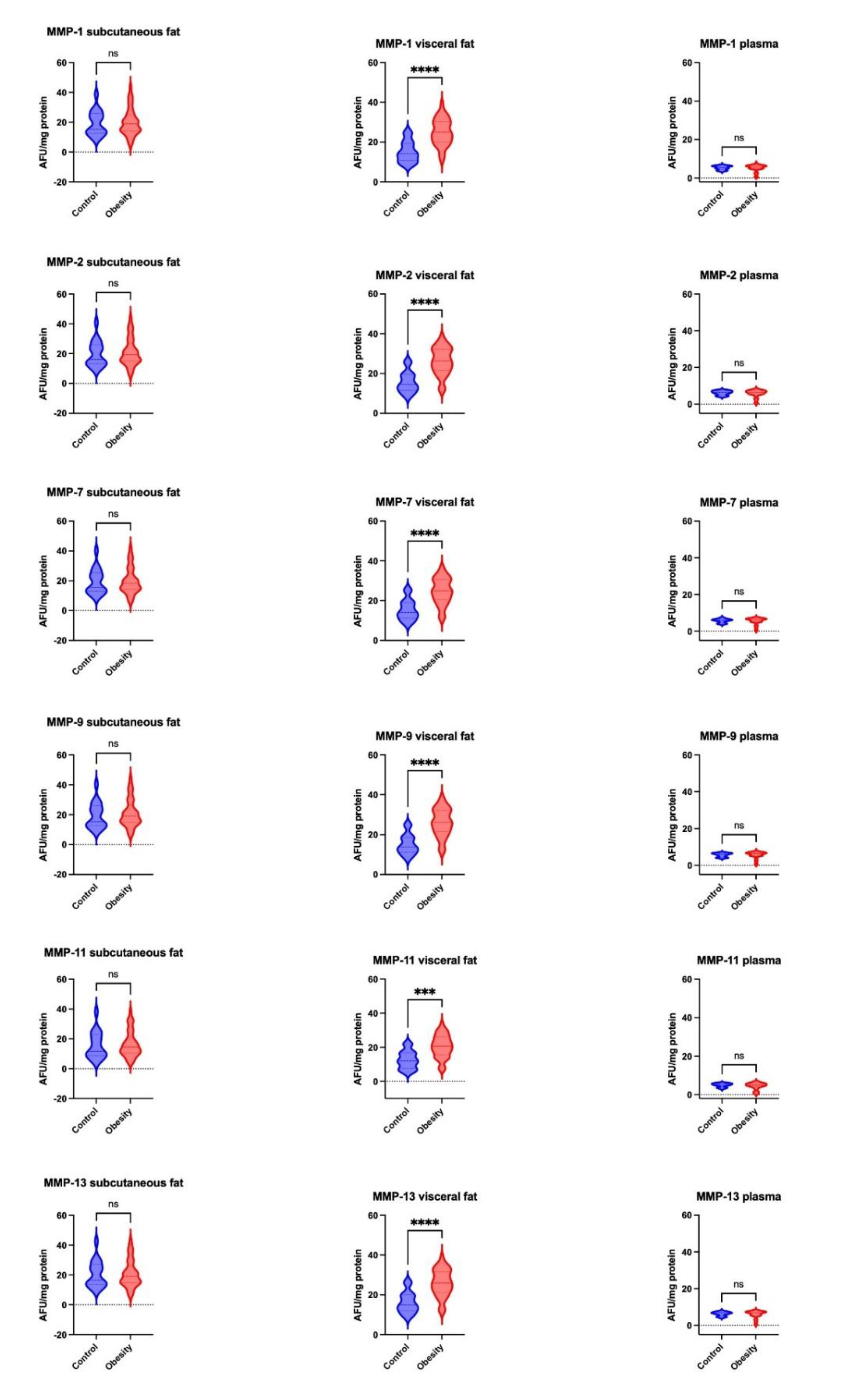
Figure 2.
Pairwise comparison of AGE-related markers between obese and control participants within each tissue compartment (VAT, SAT and plasma). Data are presented as violin plots with median and interquartile range. Fluorescence intensity is expressed as arbitrary fluorescence units normalized to protein content (AFU/mg protein). Statistical significance was assessed using Mann–Whitney U tests. Asterisks indicate significance levels (*p < 0.05, **p < 0.01, ***p < 0.001; ns – not significant).
Figure 2.
Pairwise comparison of AGE-related markers between obese and control participants within each tissue compartment (VAT, SAT and plasma). Data are presented as violin plots with median and interquartile range. Fluorescence intensity is expressed as arbitrary fluorescence units normalized to protein content (AFU/mg protein). Statistical significance was assessed using Mann–Whitney U tests. Asterisks indicate significance levels (*p < 0.05, **p < 0.01, ***p < 0.001; ns – not significant).
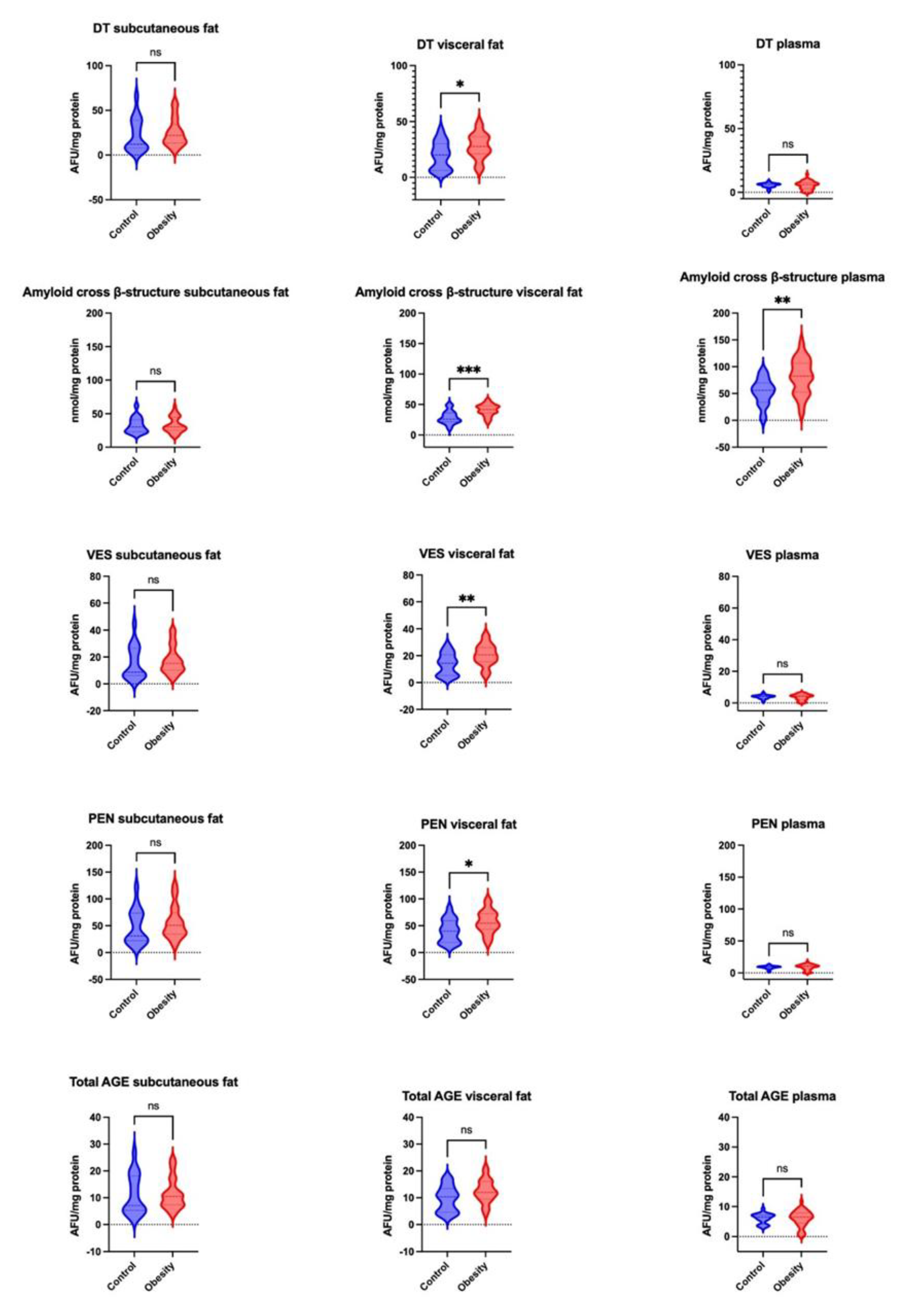

Table 1.
Baseline anthropometric, hematological and biochemical characteristics of control and obese participants. Data are presented as median (minimum–maximum). BMI – body mass index; INR – international normalized ratio; MCH – mean corpuscular hemoglobin; MCHC – mean corpuscular hemoglobin concentration; MCV – mean corpuscular volume; RBC – red blood cells; WBC – white blood cells.
Table 1.
Baseline anthropometric, hematological and biochemical characteristics of control and obese participants. Data are presented as median (minimum–maximum). BMI – body mass index; INR – international normalized ratio; MCH – mean corpuscular hemoglobin; MCHC – mean corpuscular hemoglobin concentration; MCV – mean corpuscular volume; RBC – red blood cells; WBC – white blood cells.
| Parameter | Control (median [min–max]) | Obesity (median [min–max]) | p-value |
| Body weight (kg) | 80.0 (69.0–87.0) | 113.0 (82.0–185.0) | <0.0001 |
| BMI (kg/m2) | 24.51 (20.05–25.96) | 39.24 (32.37–51.79) | <0.0001 |
| Creatinine (mg/dL) | 0.90 (0.68–1.06) | 0.74 (0.52–1.24) | 0.0783 |
| Potassium (mmol/L) | 4.3 (4.0–4.8) | 4.3 (3.7–5.2) | 0.7628 |
| Sodium (mmol/L) | 140 (137–143) | 139 (136–146) | 0.0612 |
| WBC (×103/µL) | 5.67 (4.38–8.40) | 11.19 (5.73–17.92) | <0.0001 |
| RBC (×106/µL) | 4.72 (4.15–6.10) | 4.43 (3.52–5.55) | 0.0016 |
| Hemoglobin (g/dL) | 14.6 (12.6–16.1) | 13.1 (10.4–14.9) | <0.0001 |
| Hematocrit (%) | 43.1 (37.3–47.3) | 39.2 (31.6–46.1) | 0.0009 |
| MCV (fL) | 88.5 (85.0–92.0) | 88.4 (82.0–93.4) | 0.8427 |
| MCH (pg) | 31.2 (30.7–31.7) | 29.4 (25.3–32.6) | 0.1159 |
| MCHC (g/dL) | 34.5 (25.2–47.3) | 33.4 (30.0–35.9) | 0.0094 |
| Platelets (×103/µL) | 261 (87–419) | 243 (123–353) | 0.8991 |
| INR | 1.09 (0.99–1.27) | 1.05 (0.93–1.41) | 0.3611 |
| Systolic blood pressure (mmHg) | 127 (106–142) | 141 (100–168) | 0.0008 |
| Diastolic blood pressure (mmHg) | 76 (65–88) | 95 (78–109) | <0.0001 |
Disclaimer/Publisher’s Note: The statements, opinions and data contained in all publications are solely those of the individual author(s) and contributor(s) and not of MDPI and/or the editor(s). MDPI and/or the editor(s) disclaim responsibility for any injury to people or property resulting from any ideas, methods, instructions or products referred to in the content. |
© 2026 by the authors. Licensee MDPI, Basel, Switzerland. This article is an open access article distributed under the terms and conditions of the Creative Commons Attribution (CC BY) license.
Copyright: This open access article is published under a Creative Commons CC BY 4.0 license, which permit the free download, distribution, and reuse, provided that the author and preprint are cited in any reuse.


