

Submitted:
04 May 2026
Posted:
05 May 2026
You are already at the latest version
Abstract
Background/Objectives: Wearable technology is increasingly used to provide biofeedback in physical rehabilitation; however, there is no consensus on which biofeedback parameter is most clinically useful, as most studies evaluate only one arbitrarily selected parameter. This study presents a wearable multimodal biofeedback system integrating multiple parameters selected based on prior literature and evaluates its feasibility and explores potential changes in motor performance in rehabilitation context through a longitudinal post-stroke case study. Methods: The system integrates inertial and electromyographic sensors to monitor centre of mass (CoM-B), joint angle (ANG-B), and muscle activity (EMG-B), delivering real-time sensory cues (through augmented-reality glasses and an elastic vibrotactile band) based on the monitored parameters. Feasibility was assessed in a post-stroke participant (male, 32 years, 29 months post-stroke, left hemiparesis, Fugl–Meyer Lower Extremity Score = 27) across 15 sessions involving stand-to-sit, split-stance weight shifting, and walking tasks. Each task was practiced with all three biofeedback parameters, with five sessions per parameter. Results: The motor performance varied across biofeedback parameters and tasks. CoM-B was associated with favourable trends in motor performance during stand-to-sit, showing improvements in medio-lateral displacement (0.03/session); ANG-B during walking, increasing ankle dorsiflexion (1 deg/session); and EMG-B during weight shifting, increasing tibialis activation (5 µV/session). Conclusions: The findings highlight task-dependent variability in the ability of biofeedback to elicit favourable motor performance, suggesting that the choice of biofeedback parameters may need to be adapted to task demands. The system demonstrated high usability and feasibility, supporting its potential for post-stroke rehabilitation. Further studies are needed in larger populations.
Keywords:
augmented reality
; center of mass
; feasibility
; joint angle
; muscle activity
1. Introduction
Integrating wearable technology, such as sensors and augmented reality devices, in physical rehabilitation to provide biofeedback on motor behavior is a recent approach which complements conventional physiotherapy [1]. Wearable sensors can monitor conscious and unconscious motor behavior in real-time and inform the user through visual, auditory, or haptic cues delivered by augmented reality devices, increasing behavior awareness and encouraging self-control training [1]. These biofeedback cues can contribute to accelerate the recovery process with repetitive physical training [2]. This repetitive training is fostered by wearable technology, allowing it to occur beyond specialized facilities and without the postural constrains imposed by traditional non-wearable screens [3,4].
Multiple wearable sensors has been used to monitor parameters describing motor behavior [4], namely, pressure sensors [5], force sensors [6], and inertial measurement units [7], monitoring biomechanical parameters; and electromyographic (EMG) and electroencephalographic sensors [8,9,10], monitoring physiological parameters. However, there is currently no consensus on which biofeedback parameter is most useful for clinical practice, and most studies rely on the feasibility of a single, arbitrarily selected parameter [4]. To address this limitation, we developed a novel wearable multimodal system, combining inertial and EMG sensors withs augmented reality glasses, to provide biofeedback on center of mass (CoM-B), joint angle (ANG-B), or muscle activity (EMG-B) parameters. This multimodal approach was selected to provide complementary information about both global movement patterns, local joint mechanics, as well as physiological activity, allowing for more comprehensive feedback during rehabilitation. We aim to present the design of a wearable multimodal biofeedback system and evaluate its feasibility and explores potential changes in motor performance in physical rehabilitation through a longitudinal post-stroke case study.
Stroke is a leading cause of long-term disability worldwide, often resulting in decreased dynamic balance control, weight-shifting, dorsiflexion, and muscle strength in comparison with healthy [3,11]. Rehabilitation is essential to restore function and prevent complications, and emerging technologies such as biofeedback provide patients with real-time information to guide movement training [12]. Recent research supports the effectiveness of biofeedback for post-stroke rehabilitation. Our scoping review on biofeedback systems designed for post-stroke gait rehabilitation found evidence indicating improvements in walking speed, step length, muscle activation, and standardized clinical tests [10]. Systematic reviews report that virtual/augmented reality biofeedback approaches can yield functional gains in gait and balance when used alongside conventional physiotherapy, with some evidence of superior outcomes compared to conventional physiotherapy alone [13]. Based on this evidence, we selected a post-stroke participant as a suitable case study to investigate the feasibility of our biofeedback system and to examine how each parameter (CoM-B, ANG-B, EMG-B) influences motor performance during physical rehabilitation tasks. A single-case longitudinal design was adopted to enable an in-depth, within-subject evaluation of adaptive responses to multimodal biofeedback, which we believe is appropriate for early-stage feasibility assessment in highly heterogeneous post-stroke populations.
2. Materials and Methods
2.1. Wearable Multimodal Technology
The wearable multimodal technology used to provide biofeedback (Figure 1a) integrated multiple sensing modalities. Multimodality in this context refers to the use of different sensor types based on literature to capture complementary aspects of motor behavior, including inertial measurement units (Awinda system, Xsens, Netherlands) to quantify biomechanical parameters—joint angle and medio-lateral center of mass position —and electromyographic sensors (Trigno system, Delsys, USA) to measure physiological parameters, specifically muscle activity. The joint angle and muscle activity are biomechanical and physiological matching single-joint biofeedback parameters, respectively, as they primarily reflect the mechanical and muscular response of one joint in isolation, while the medio-lateral center of mass position works as multi-joint biofeedback parameter, as it represents the global outcome of coordinated movements across multiple joints, including the ankle, knee, hip, and trunk, reflecting overall balance and weight distribution [14].
The system delivered multiple sensory cues so that patients with varying sensory deficits could benefit from the biofeedback. Namely, it included visual cues via augmented reality glasses (HoloLens 2, Microsoft Corporation, USA), and auditory and vibrotactile cues via an instrumented textile band. The sensory cues were controlled in real-time according to the measured parameters.
2.2. Biofeedback
The biofeedback was continuously provided as a virtual circle/bar that moves/increases in proportion to the measured parameter (Figure 1b). In addition, the colour of the virtual circle/bar changed from white to green if the participant reaches a virtual threshold line, indicating favourable motor response (positive reinforcement). Vibrotactile cues in the paretic lower-limb and auditory cues were provided simultaneously with the green cues.
The threshold line was automatically updated (Figure S1), increasing or decreasing the level of difficulty according to the patient's imminent performance. This means that the threshold was adapted in real-time based on the participant’s immediately preceding executions, allowing the system to maintain a level of challenge that was tailored to the user’s current motor performance. In addition, the visual cues from the augmented reality glasses were deactivated (negative reinforcement) to challenge the patient, when the threshold was reached for consecutive periods; and reactivated to avoid frustration, when the threshold was not consecutively reached. In this way, biofeedback was personalized according to the patient's imminent performance, allowing for challenging but not frustrating physical training. Visual cues were chosen to be deactivated during negative reinforcement conditions to increase task difficulty by removing the most informative feedback, leaving vibrotactile and auditory cues [18].
Operability tests were conducted before this study to verify the system's performance. The actuator CPU operated at a frame rate of 50-60 Hz, and the sensor packet drop rate remained below 0.02%. The mean inter-packet delay was 24 milliseconds with a maximum observed delay of 979 milliseconds. Prior work has demonstrated the successful validation of the proposed multimodal biofeedback in a cohort of healthy participants [14].
2.3. Post-Stroke Participant
Experimental protocol was conducted at the University of Minho following the Declaration of Helsinki and approval by the Ethics Committee CEICVS 006/2020. A post-stroke participant gave informed consent for inclusion before participating in this study. He was a 32-year-old male participant (body mass: 68 kg, height: 1.70 m) who owned a higher education level, daily used technology, and practiced exercise every day before stroke occurrence. An ischemic stroke occurred 29 months before inclusion in this study, affecting his left body’s side (Fugl-Meyer lower-limb motor subscale=27). He was able to understand and follow the experimental instructions, to complete the 10 m walk test without the use of a walking aid, did not present other neurological condition or diseases that interfere with the ability to walk or receive biofeedback, untreated medical conditions, neither spasticity not been adequately treated.
2.4. Biofeedback Parameters and Favourable Motor Performance
Post-stroke motor impairments in the present participant included reduced ankle dorsiflexion, likely associated with diminished tibialis anterior activation and relative overactivity of the plantar flexor muscles [15,16,17]. These deficits informed the selection of biofeedback parameters used throughout the intervention, as follows.
Three biofeedback parasmeters were specified to capture complementary aspects of the participant’s motor behaviour. The sagittal ankle angle (ANG-B) and tibialis anterior muscle activity (EMG-B) were included as biomechanical and physiological single-joint parameters, respectively, providing localized information on ankle range of motion and tibialis anterior muscular strength. These parameters were specifically targeted to address the participant’s impaired dorsiflexion control. In contrast, the medio-lateral centre of mass position (CoM-B) was selected as a multi-joint parameter, reflecting whole-body coordination and dynamic balance.
Favourable motor performance was defined in a task-specific manner for this participant. During non-locomotor tasks, favourable motor performance was characterized by increased tibialis anterior activation and ankle dorsiflexion, together with reduced medio-lateral CoM displacement, indicating enhanced balance control. During locomotor tasks, favourable performance included increased medio-lateral CoM displacement, reflecting improved weight transfer.
2.5. Physical Rehabilitation Complemented by Biofeedback
A longitudinal protocol including 18 sessions was implemented to evaluate the feasibility of the system in physical rehabilitation (Figure S2). It comprised a pre-biofeedback session, 15 biofeedback sessions (2 sessions per week for 8 weeks), a post-biofeedback session, and a follow-up session (1 month after the last biofeedback session). During the biofeedback sessions, the participant was instructed to perform conventional lower-limb motor tasks in physiotherapy guided by the CoM-B, ANG-B, or EMG-B biofeedback. He underwent 5 consecutive sessions with each biofeedback parameter. The order of the parameters was randomly assigned to limit the order effect on the results (resulting random order: CoM-B -> ANG-B -> EMG-B). During this study, the participant maintained his usual daily conventional physiotherapy, encompassing 13 hours per week, which didn’t involve biofeedback. As such, the observed changes cannot be attributed solely to the biofeedback intervention and should be interpreted as occurring within the context of ongoing standard rehabilitation.
Each biofeedback session (20-min total) included the following sequence of motor tasks: 5 minutes of stand-to-sit, 5 minutes of split-stance weight-shifting, and 10 minutes of overground walking at a comfortable speed (Figure 1a). These motor tasks were discussed with clinicians and chosen by following clinical practice guidelines for inclusion of multiple dynamic tasks with progressive challenge [19]. A familiarization period was carried out for a maximum of 10 min during the first session with a biofeedback parameter. The patient made sure that he could be guided by the biofeedback to proceed.
The participant was instructed to achieve the threshold line during a particular phase of each motor task so he could cognitively relax during the remaining phases of the movement. The selected phases were defined based on their functional relevance to post-stroke motor impairments. Specifically, feedback was provided: (1) during the sitting phase of the stand-to-sit task, which requires controlled lowering of the body and dynamic balance regulation; (2) during attempted dorsiflexion of the paretic limb in split-stance weight-shifting with ANG-B and EMG-B, targeting ankle control deficits, and during plantar flexion of the non-paretic limb with CoM-B to promote effective weight transfer; and (3) during the paretic swing phase in walking with ANG-B and EMG-B, as this phase is critical for foot clearance and is primarily governed by ankle dorsiflexion, and during medio-lateral displacement toward the paretic limb with CoM-B to promote effective weight transfer. In this study, a researcher with expertise in biomedical engineering supervised the sessions and provided verbal guidance.
2.6. Outcomes
The outcomes were organized into three domains. First, sensor-based outcomes including sagittal ankle angle, tibialis anterior muscle activity, and medio-lateral CoM displacement. Second, user-reported measures, including the NASA Task Load Index (NASA-TLX) and the System Usability Scale (SUS), to assess the participant’s perceived workload, performance, and overall usability of the multimodal biofeedback system. Finally, clinical outcomes including the 10-Meter Walk Test, Timed Up and Go, and the lower-limb motor and sensory subscales of the Fugl-Meyer Assessment to contextualize functional ability.
For the biofeedback sessions, sensor-based data were acquired in the beginning of each session by performing 1 minute of each motor task. Data were time-normalized to the task cycle (0–100%). Mean and standard deviation curves across the task cycle were computed for sagittal ankle angle (deg), medio-lateral CoM displacement (normalized between 0 and 1 by feet distance), and tibialis anterior muscle activity (uV). For each session and motor task, average profiles of these variables were calculated, and the maximum averaged value was extracted during the specific phase in which the participant was instructed to reach the biofeedback threshold. Given the single-case design, regression analyses were used for descriptive trend characterization rather than inferential statistical testing. A linear regression was applied to each sensor-based outcome across sessions, separately for each motor task and biofeedback parameter. The slope of the regression quantified the direction and rate of change across sessions with the same biofeedback parameter and within the same motor task. The coefficient of determination (R²) was used to assess the consistency of the performance across sessions, with higher values indicating more linear motor performance. Then, we compared the rate of change and linear consistency of motor performance between biofeedback parameters and motor tasks.
Favourable changes in motor performance were defined according to task demands. In stand-to-sit, favourable changes were characterized by reduced medio-lateral CoM displacement (suggesting enhanced balance control), alongside increased ankle dorsiflexion and tibialis anterior activation, supporting controlled forward tibial progression. In split-stance weight-shifting and walking tasks, favourable changes were characterized by increased medio-lateral CoM displacement (reflecting improved weight transfer), as well as increased dorsiflexion and muscle activation.
NASA-TLX scores were averaged across sessions with the same biofeedback parameter to compare perceived workload. The SUS was administered during the final training session to evaluate overall system usability.
Clinical outcomes were assessed at pre-biofeedback, post-biofeedback, and follow-up sessions. For the 10-Meter Walk Test and Timed Up and Go, mean and standard deviation of execution times were calculated across three trials. For the Fugl-Meyer Assessment, total scores for the lower-limb motor and sensory subscales were determined.
3. Results
Table 1 demonstrates the rate of change and linear consistency of motor performance (regression along sessions in Figure S3 of supplementary material) along biofeedback sessions.
Assessments with CoM-B revealed a positive trend consistent with the intended direction in medio-lateral displacement (-0.03/session) and in tibialis contraction (11 uV/session) during stand-to-sit; a trend consistent with the intended direction in tibialis contraction (3 uV/session) during split-stance weight shifting; a trend opposite to the intended direction in tibialis activity (-6 uV/session) during walking. Assessments with ANG-B showed a positive trend consistent with the intended direction in ankle dorsiflexion (1 deg/session) during stand-to-sit, in medio-lateral displacement (0.05/session) during split-stance weight shifting, and in ankle dorsiflexion (1 deg/session) during walking. Assessments with EMG-B illustrated a positive trend consistent with the intended direction in medio-lateral displacement (-0.02/session) during stand-to-sit task and in tibialis contraction (5 uV/session) during split-stance weight shifting. No linear change during walking.
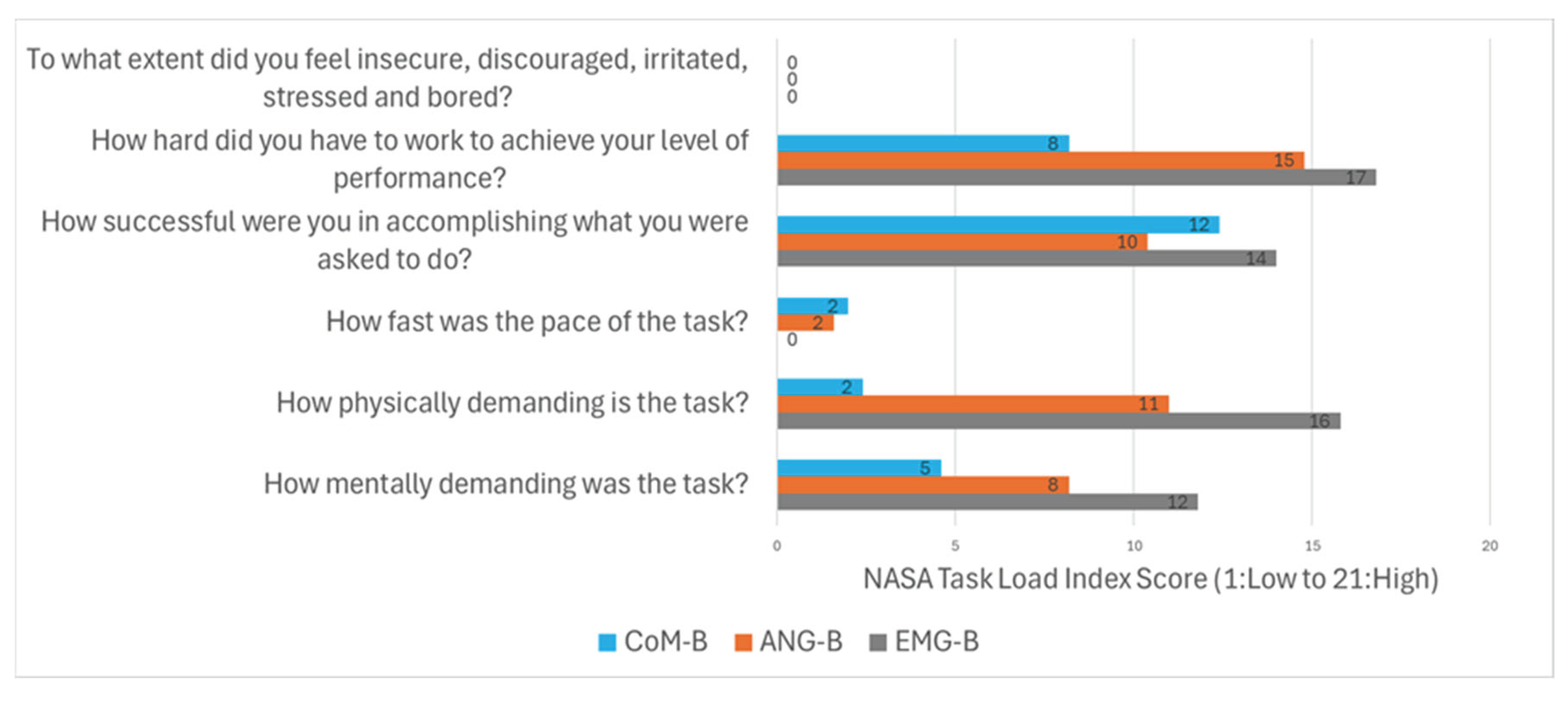
Figure 3 shows the answers to the NASA Task Load Index regarding the training with each biofeedback parameter. None of the sessions were rated with fast rhythm and none delivered feelings of insecurity, boredom, and stress. The participant reported a higher mental and physical effort with EMG-B (12 mental, 16 physical), then ANG-B (8 mental, 11 physical), and later with CoM-B (5 mental, 2 physical). Although with high effort, both mental and physical, EMG-B exceeded the feeling of success than the remaining biofeedback parameters. The participant reported the challenge of understanding how to recruit the tibialis anterior muscle with EMG-B. On the other hand, the feeling of success provided by CoM-B was achieved without so much physical effort. The participant commented that stand-to-sit was the most challenging task with CoM-B.
Figure 3.
Mean and standard deviation (std) of clinical outcomes (10-m Walk Test, Timed Up and Go, Fugl-Meyer subscales for lower-limb motor function and sensation) at pre-, post-biofeedback, and follow-up sessions.
Figure 3.
Mean and standard deviation (std) of clinical outcomes (10-m Walk Test, Timed Up and Go, Fugl-Meyer subscales for lower-limb motor function and sensation) at pre-, post-biofeedback, and follow-up sessions.
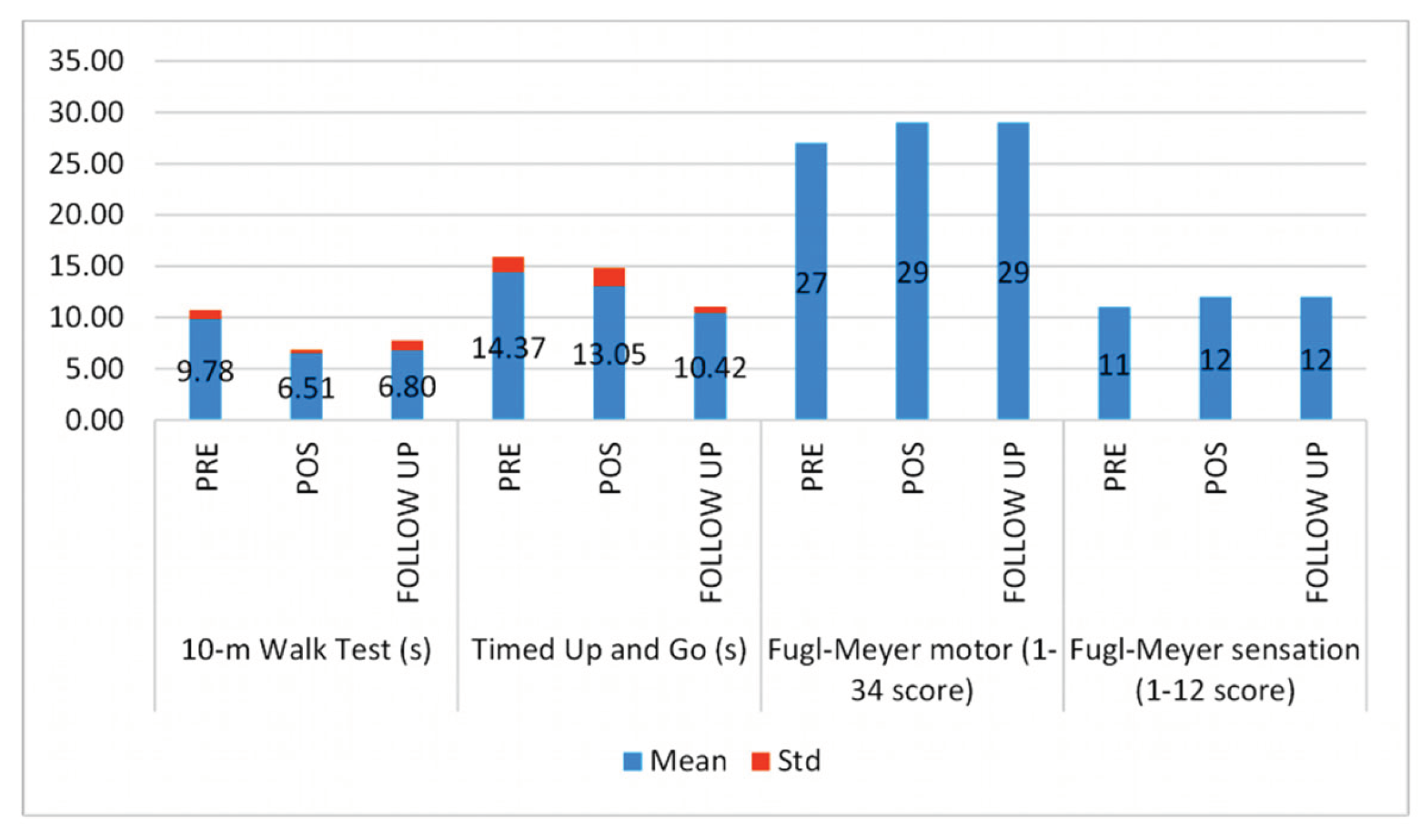
Figure 4.
Averaged NASA Task Load Index scores considering the five sessions with CoM-B, ANG-B, and EMG-B.
Figure 4.
Averaged NASA Task Load Index scores considering the five sessions with CoM-B, ANG-B, and EMG-B.
Usability SUS score of 87 (excellent) was obtained (Figure S4 from supplementary material) following [22]. The lowest-rated answers were related to the doubt of people with limited educational or cognitive backgrounds not being able to benefit from biofeedback. Despite this, the participant showed willingness to use the system, was confident of using it on his own, and considered it easy to use. Moreover, the participant commented that visual cues from the augmented reality glasses were very important because they helped him to achieve the threshold most of the time when the cues appeared. Also, the glasses did not produce any discomfort. Although the participant already felt very aware of his body, he reported that the biofeedback helped him gain even more functional awareness, especially regarding the tibialis muscle. No adverse events were reported by the participant nor noted by researchers. However, the split-stance weight-shifting task was modified during ANG-B training by elevating the foot off the ground, allowing modulation of the ankle joint angle.
Figure 3 displays the 10-m Walk Test, Timed Up and Go, and Fugl-Meyer clinical scores at pre-, post-biofeedback, and follow-up sessions. There was a decrease in timing for 10-m Walk Test (-3s) and Timed Up and Go test (-1s). The Fugl-Meyer motor (+2 score) and sensation scores increased (+1 score) after intervention and were retained in follow-up. The improvement in Fugl-Meyer motor score occurred regarding dorsiflexion of the ankle while lying down (subscale EII) and standing (subscale EIV) procedures.
4. Discussion
This work presents a wearable multimodal biofeedback system integrating inertial and EMG sensors to monitor CoM, joint angles, and muscle activity, combined with augmented reality glasses and an instrumented textile band to deliver synchronized visual, auditory, and vibrotactile feedback in real-time. Its feasibility for physical rehabilitation was assessed through a longitudinal post-stroke case study, evaluating motor performance, clinical outcomes, workload, and usability across 15 training sessions.
Distinct effects were observed depending on the biofeedback parameter and motor task. CoM-B led to the expected reduction in medio-lateral displacement, indicating improved balance, with indirect increase in tibialis anterior activity during stand-to-sit. In contrast, CoM-B produced minimal changes during split-stance weight shifting, likely due to the participant already exhibiting near-optimal balance in this task (values close to the maximum in Figure S3). In this manner, opposite to stand-to-sit, CoM-B during weight shifting was not challenging enough for the participant’s level of disability (Fugl-Meyer lower-limbs motor score = 27), as commented by the participant. During walking, CoM-B increased medio-lateral displacement as expected but did not induce improvements in dorsiflexion nor muscle activity.
ANG-B revealed improvements in ankle dorsiflexion during stand-to-sit and walking, consistent with its intended goal of enhancing range of motion. However, these improvements were not accompanied by changes in muscle activity nor medio-lateral displacement during stand-to-sit. During split-stance weight shifting, dorsiflexion did not improve, likely due to the need to adapt the task for training. This suggests that the split-stance weight shifting task may be more appropriate for individuals with lower levels of impairment (Fugl–Meyer Lower Extremity motor score > 27), in whom the generated muscular activity is sufficient to produce changes in dorsiflexion [8].
EMG-B increased tibialis anterior activity during split-stance weight shifting and walking, aligning with its objective of improving muscle activity. However, it did not translate into improved dorsiflexion, which may be influenced by factors such as antagonist muscle activity or joint stiffness [23], although these were not directly measured in this study. During stand-to-sit, muscle activation decreased unexpectedly, which may reflect the reduced intuitiveness of controlling the tibialis anterior during closed-chain dorsiflexion (tibia moves toward the foot) in contrast with open-chain dorsiflexion (foot moves towards the tibia).
Decreased dynamic balance control, weight-bearing, dorsiflexion, and muscle strength is verified in stroke survivors in comparison with healthy[3,11]. Therefore, trends toward improved motor performance were observed during biofeedback intervention: CoM-B was most successful during stand-to-sit, decreasing medio-lateral displacement; EMG-B during weight shifting, increasing tibialis muscle activity; and ANG-B during walking, increasing ankle dorsiflexion. These findings demonstrate that the feasibility of each biofeedback parameter is task dependent, supporting the need to tailor biofeedback parameter to the motor task. This task-dependent variability suggests that the interaction between biofeedback parameter and motor task may play a role in shaping motor outcomes. As a result, more comprehensive studies are needed to systematically investigate how different biofeedback parameters perform across tasks and to establish guidelines for selecting the most appropriate parameter based on task demands.
All biofeedback modalities were well tolerated by the participant, with no reported discomfort, insecurity, or stress. The participant reported that visual feedback was particularly helpful for achieving task goals, while multimodal feedback enhanced body awareness, notably for muscle activation.
Functional improvements were also observed[3,11], with reductions of 3 s in the 10-m Walk Test and 1 s in the Timed Up and Go test. These changes are within the range reported in the literature (0.4-5s for 10-m Walk Test and 0.2-2s for Timed Up and Go) [6,8,24,25], although variability across studies was influenced by differences in feedback modality and training dose. Improvements in the Fugl–Meyer lower-limb motor score were observed in ankle dorsiflexion tasks but did not exceed the minimally clinically important difference [26], suggesting that greater training intensity or duration may be required to achieve clinically meaningful changes.
This study is limited by the single-participant design and training dose. Additionally, results may have been influenced by daily living variations such as fatigue, sleep, or medication. Future work should include controlled studies with larger and more diverse populations to evaluate the feasibility of multimodal biofeedback and to recommend optimal parameter selection.
5. Conclusions
This study presented a wearable multimodal biofeedback system and evaluated its feasibility for post-stroke physical rehabilitation through a longitudinal case study. The system demonstrated high usability and was well tolerated, supporting its potential for integration into rehabilitation settings.
The results highlight that changes in motor performance were task-dependent, with different biofeedback parameters producing distinct motor responses across stand-to-sit, split-stance weight shifting, and walking tasks. This variability suggests that biofeedback parameter should be chosen to the specific motor tasks needed by the patient.
Although functional improvements were observed, the findings should be interpreted with caution due to the single-participant design. Further studies with larger samples are needed to systematically investigate task-dependent motor changes and to establish guidelines for the selection and application of multimodal biofeedback in clinical practice.
Supplementary Materials
The following supporting information can be downloaded at: https://www.mdpi.com/article/doi/s1, Figure S1: Schematic of threshold automatic updating; Figure S2: Workflow of the experimental protocol with related tasks and outcomes; Figure S3: System Usability Scale (SUS) scores after using the biofeedback; Figure S4: Maximum average per biofeedback session and related regression.
Author Contributions
Conceptualization, CP, JF, CS, TP, CC, and CS; methodology, CP, JF, CS, TP, CC, and CS; software, CP; validation, CP and JF; formal analysis, CP and JF; investigation, CP, JF, and CS; resources, CS; data curation, CP, JF, and CS; writing—original draft preparation, CP; writing—review and editing, JF, CS, and JC; visualization, CP; supervision, JF, CS, and JC; project administration, CS; funding acquisition, CS. All authors have read and agreed to the published version of the manuscript.
Funding
This research was funded by the Fundação para a Ciência e Tecnologia under the scholarship reference 2020.05709.BD, under the Stimulus of Scientific Employment with the grant 2020.03393.CEECIND, and under the national support to R&D units grant, through the reference project UID/04436: Centro de Microssistemas Eletromecânicos da Universidade do Minho (CMEMS-Uminho).
Institutional Review Board Statement
The study was conducted in accordance with the Declaration of Helsinki, and approved by the Institutional Review Board (or Ethics Committee) of University of Minho (protocol code CEICVS 006/2020).
Informed Consent Statement
Informed consent was obtained from the subject involved in the study. Written informed consent has been obtained from the patient to publish this paper.
Data Availability Statement
Data is unavailable due to privacy and ethical restrictions.
Conflicts of Interest
The authors declare no conflicts of interest. The funders had no role in the design of the study; in the collection, analyses, or interpretation of data; in the writing of the manuscript; or in the decision to publish the results.
Abbreviations
The following abbreviations are used in this manuscript:
| ANG | Angle |
| CoM | Center of mass |
| EMG | Electromyographic |
References
- Huang, H.; Wolf, S. L.; He, J. Recent developments in biofeedback for neuromotor rehabilitation. J. Neuroeng. Rehabil. 2006, vol. 3, 11. [Google Scholar] [CrossRef]
- Wolf, S. L. Electromyographic Biofeedback Applications to Stroke Patients. Phys. Ther. 1983, vol. 63(no. 9), 1448–1459. [Google Scholar] [CrossRef]
- Dost Sürücü, G.; Tezen, Ö. The effect of EMG biofeedback on lower extremity functions in hemiplegic patients. Acta Neurol. Belg. 2021, vol. 121(no. 1), 113–118. [Google Scholar] [CrossRef]
- Bowman, T.; et al. Wearable Devices for Biofeedback Rehabilitation: A Systematic Review and Meta-Analysis to Design Application Rules and Estimate the Effectiveness on Balance and Gait Outcomes in Neurological Diseases. Sensors 2021, vol. 21(no. 10), 3444. [Google Scholar] [CrossRef]
- Jung, K.-S.; Bang, H.; In, T.-S.; Cho, H.-Y. Gait training with auditory feedback improves trunk control, muscle activation and dynamic balance in patients with hemiparetic stroke: A randomized controlled pilot study. J. Back. Musculoskelet. Rehabil. 2020, vol. 33(no. 1), 1–6. [Google Scholar] [CrossRef]
- Byl, N.; Zhang, W.; Coo, S.; Tomizuka, M. Clinical impact of gait training enhanced with visual kinematic biofeedback: Patients with Parkinson’s disease and patients stable post stroke. Neuropsychologia 2015, vol. 79, 332–343. [Google Scholar] [CrossRef] [PubMed]
- Hankinson, K.; Shaykevich, A.; Vallence, A.-M.; Rodger, J.; Rosenberg, M.; Etherton-Beer, C. A Tailored Music-Motor Therapy and Real-Time Biofeedback Mobile Phone App (‘GotRhythm’) to Promote Rehabilitation Following Stroke: A Pilot Study. Neurosci. Insights 2022, vol. 17, 263310552211005. [Google Scholar] [CrossRef] [PubMed]
- Arpa, S.; Ozcakir, S. Does electromyographic biofeedback improve exercise effects in hemiplegic patients? A pilot randomized controlled trial. J. Rehabil. Med. 2019, vol. 51(no. 2), 109–112. [Google Scholar] [CrossRef]
- Mottaz, et al. Modulating functional connectivity after stroke with neurofeedback: Effect on motor deficits in a controlled cross-over study. NeuroImage Clin. 2018, vol. 20, no. July, 336–346. [Google Scholar] [CrossRef]
- Pinheiro; Figueiredo, J.; Cerqueira, J.; Santos, C. P. Robotic Biofeedback for Post-Stroke Gait Rehabilitation: A Scoping Review. Sensors 2022, vol. 22(no. 19), 7197. [Google Scholar] [CrossRef] [PubMed]
- Walker, E. R.; Hyngstrom, A. S.; Schmit, B. D. Influence of visual feedback on dynamic balance control in chronic stroke survivors. J. Biomech. 2016, vol. 49(no. 5), 698–703. [Google Scholar] [CrossRef]
- Held, J. P. O.; et al. Augmented Reality–Based Rehabilitation of Gait Impairments: Case Report. JMIR mHealth uHealth 2020, vol. 8(no. 5), e17804. [Google Scholar] [CrossRef] [PubMed]
- Phan, H. L.; Le, T. H.; Lim, J. M.; Hwang, C. H.; Koo, K. Effectiveness of Augmented Reality in Stroke Rehabilitation: A Meta-Analysis. Appl. Sci. 2022, vol. 12(no. 4), 1848. [Google Scholar] [CrossRef]
- Pinheiro, C.; Figueiredo, J.; Pereira, T.; Santos, C. P. Design and Usability Assessment of Multimodal Augmented Reality System for Gait Training. in Robot 2023: Sixth Iberian Robotics Conference, 2024; pp. 437–449. [Google Scholar]
- Kinsella, S.; Moran, K. Gait pattern categorization of stroke participants with equinus deformity of the foot. Gait Posture 2008, vol. 27(no. 1), 144–151. [Google Scholar] [CrossRef] [PubMed]
- Balaban, B.; Tok, F. Gait Disturbances in Patients With Stroke. PM R 2014, vol. 6(no. 7), 635–642. [Google Scholar] [CrossRef] [PubMed]
- Daly, J. J.; Roenigk, K.; Cheng, R.; Ruff, R. L. Abnormal Leg Muscle Latencies and Relationship to Dyscoordination and Walking Disability after Stroke. Rehabil. Res. Pract. 2011, vol. 2011, 1–8. [Google Scholar] [CrossRef]
- Chan, H. S.; Ng, A. W. Y. Finger response times to visual, auditory and tactile modality stimuli. Lect. Notes Eng. Comput. Sci. 2012, vol. 2196, 1449–1454. [Google Scholar]
- Hribernik, M.; Umek, A.; Tomažič, S.; Kos, A. Review of Real-Time Biomechanical Feedback Systems in Sport and Rehabilitation. Sensors 2022, vol. 22(no. 8), 3006. [Google Scholar] [CrossRef]
- Moreira, L.; et al. Study of Gait Cycle Using a Five-Link Inverted Pendulum Model: First Developments. in 2019 IEEE 6th Portuguese Meeting on Bioengineering (ENBENG), Feb. 2019; pp. 1–4. [Google Scholar] [CrossRef]
- Pinheiro, C. Kinematic and kinetic study of sit-to-stand and stand-to-sit movements towards a human-like skeletal model. in 2019 IEEE 6th Portuguese Meeting on Bioengineering (ENBENG), Feb. 2019; pp. 1–4. [Google Scholar] [CrossRef]
- Brooke, J. SUS: A ‘Quick and Dirty’ Usability Scale. Usability Eval. Ind. 1995, 207–212. [Google Scholar] [CrossRef]
- Li, S.; Francisco, G. E.; Zhou, P. Post-stroke Hemiplegic Gait: New Perspective and Insights. Front. Physiol. 2018, vol. 9, no. AUG, 1–8. [Google Scholar] [CrossRef]
- Nan, W.; Dias, A. P. B.; Rosa, A. C. Neurofeedback Training for Cognitive and Motor Function Rehabilitation in Chronic Stroke: Two Case Reports. Front. Neurol. 2019, vol. 10, no. JUL, 1–6. [Google Scholar] [CrossRef]
- Bae, S.; Lee, J.; Lee, B.-H. Effect of an EMG–FES Interface on Ankle Joint Training Combined with Real-Time Feedback on Balance and Gait in Patients with Stroke Hemiparesis. Healthcare 2020, vol. 8(no. 3), 292. [Google Scholar] [CrossRef]
- Pandian, S.; Arya, K. N.; Kumar, D. Minimal clinically important difference of the lower-extremity fugl–meyer assessment in chronic-stroke. Top. Stroke Rehabil. 2016, vol. 23(no. 4), 233–239. [Google Scholar] [CrossRef]
Figure 1.
(a) Participant performing stand-to-sit, split-stance weight shifting, and walking tasks guided by the wearable multimodal biofeedback and (b) visual cues overview for CoM-B, ANG-B, and EMG-B parameters.
Figure 1.
(a) Participant performing stand-to-sit, split-stance weight shifting, and walking tasks guided by the wearable multimodal biofeedback and (b) visual cues overview for CoM-B, ANG-B, and EMG-B parameters.
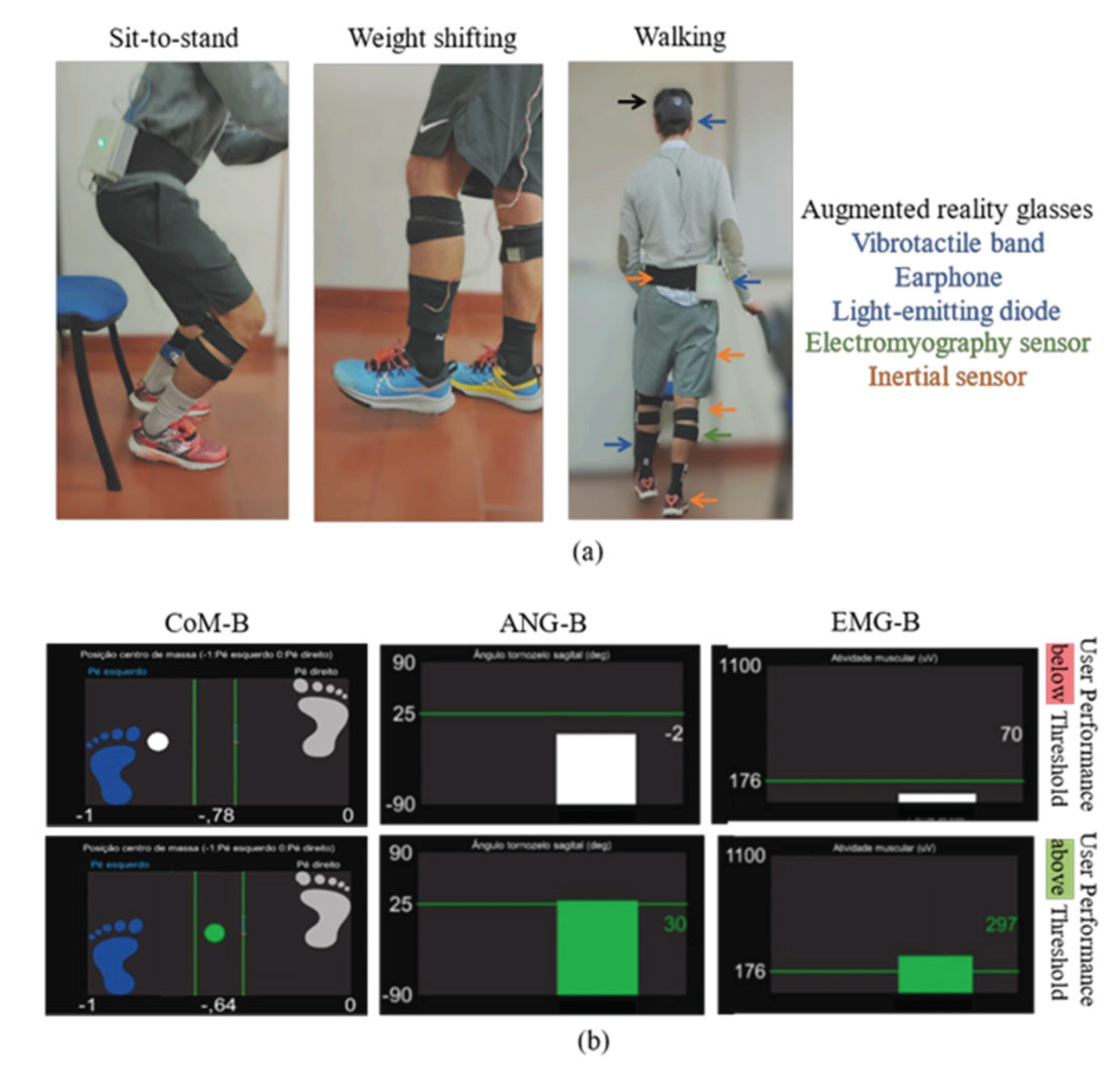

Table 1.
Rate of change (and linear consistency, R2) of motor performance (sagittal ankle joint angle, tibialis anterior muscle activity, and medio-lateral CoM displacement) along biofeedback sessions with the same biofeedback parameter (CoM-B, ANG-B, or EMG-B) and motor task (STS, WS, or W). Values according/opposite to favourable change were coloured in green/red. Consistent linear changes in motor performance (R2≥0.5) were highlighted in bold.
Table 1.
Rate of change (and linear consistency, R2) of motor performance (sagittal ankle joint angle, tibialis anterior muscle activity, and medio-lateral CoM displacement) along biofeedback sessions with the same biofeedback parameter (CoM-B, ANG-B, or EMG-B) and motor task (STS, WS, or W). Values according/opposite to favourable change were coloured in green/red. Consistent linear changes in motor performance (R2≥0.5) were highlighted in bold.
| Sensor-based outcome | Motor task | Biofeedback parameter | Favourable change | ||
| CoM-B | ANG-B | EMG-B | |||
| Medio-lateral CoM displacement (0-1) | STS | -0.03 (0.75) | 0.02 (0.09) | -0.02 (0.63) | < 0 |
| WS | 0.00 (0.01) | 0.05 (0.88) | 0.00 (0.04) | > 0 | |
| W | 0.06 (0.47) | 0.05 (0.07) | -0.03 (0.35) | ||
| Sagittal ankle angle (deg) | STS | 1 (0.20) | 1 (0.54) | 0 (0.01) | > 0 |
| WS | 2 (0.40) | 0 (0.11) | -2 (0.49) | ||
| W | 0 (0.02) | 1 (0.74) | 0 (0.00) | ||
| Tibialis anterior muscle activity (uV) | STS | 11 (0.93) | -1 (0.04) | -2 (0.06) | > 0 |
| WS | 3 (0.50) | -1 (0.24) | 5 (0.82) | ||
| W | -6 (0.91) | 3 (0.45) | 2 (0.29) | ||
| STS: stand-to-sit, WS: split-stance weight shifting, W: walking | |||||
Disclaimer/Publisher’s Note: The statements, opinions and data contained in all publications are solely those of the individual author(s) and contributor(s) and not of MDPI and/or the editor(s). MDPI and/or the editor(s) disclaim responsibility for any injury to people or property resulting from any ideas, methods, instructions or products referred to in the content. |
© 2026 by the authors. Licensee MDPI, Basel, Switzerland. This article is an open access article distributed under the terms and conditions of the Creative Commons Attribution (CC BY) license.
Copyright: This open access article is published under a Creative Commons CC BY 4.0 license, which permit the free download, distribution, and reuse, provided that the author and preprint are cited in any reuse.


