

Submitted:
05 May 2026
Posted:
05 May 2026
You are already at the latest version
Abstract
This study explores how a sustainability induction module for staff and students can meaningfully operationalise multiple Sustainability Development Goals (SDGs) across a higher education institution (HEI). The paper examines tensions between comprehensive SDG integration and efforts to cultivate whole-institution sustainability culture. Using Sterling’s transformational framework, we analyse how staff and students engaged with module content spanning diverse SDGs, including Indigenous land management (SDG 15), ethical consumption (SDG 12), modern slavery (SDG 8), governance (SDG 16) and community engagement (SDG 17). Findings reveal how staff and students experience the parallels between working across SDGs and learning about sustainable actions within personal, organisational, and community contexts of HEIs. While participants appreciated the interconnectedness of sustainability challenges, they also highlighted difficulties associated with the breadth and complexity of addressing multiple SDGs within a single induction experience. This research advances understanding of how transition-oriented learning spaces that are situated between individual and institutional development and those involving affective, cognitive, and intentional dimensions of change, can support HEIs in progressing the 2030 Agenda. At the same time, it identifies key pedagogical challenges in designing induction modules that integrate multiple SDGs in practice.
Keywords:
sustainability education
; SDG 4
; sustainable development goals
; higher education
; online learning
; transformational learning
; organisational learning
; systems thinking
1. Introduction
The global push for sustainability in higher education extends well beyond adopting greener practices; it involves reimagining the very purpose, culture, and societal role of higher education itself. Internationally, higher-education institutions (HEIs) are increasingly recognised as pivotal actors in advancing sustainable development through teaching, research, operations, and community partnerships. In 2022, UNESCO urged higher-education institutions (HEIs) to take “knowledge-driven actions” and lead institutional transformations to meet the UN 2030 Agenda and the 17 Sustainable Development Goals [1]. This call positions sustainability education as central to SDG 4 (Quality Education), while acknowledging HEIs role in advancing the interconnected goals addressing poverty (SDG 1), climate action (SDG 13), and responsible consumption (SDG 12).
Despite growing global commitments, research shows that many HEIs struggle to shift from partial SDG integration to deep structural or cultural transformation [2,3]. Positioned as both drivers of change and stewards of knowledge, HEIs hold the power to reshape higher education at scale, however, are often limited through their systemic and institutional normative cultures [4,5]. These tensions are not unique to any one country; they reflect broader international patterns in the higher-education sector, where sustainability agendas compete with entrenched systems, disciplinary silos, and competing institutional priorities.
Even among institutions with a strong sustainability ethos, challenges remain in ensuring that every member of the HEI network feels empowered to act sustainably within their roles. Beyond institutional commitments and broad declarations, meaningful transformation requires engaging entire communities in practical, inclusive action.
The University of Tasmania (UTAS) provides a useful case through which to examine these international challenges. As part of its mission to become the world’s most sustainable university [6], UTAS piloted an online induction module, An Introduction to Sustainability at UTAS, designed to introduce sustainability concepts and institutional commitments to all staff and students. While situated in an Australian context, the module embodies a challenge faced globally: how to leverage induction processes to cultivate sustainability literacy, shared responsibility, and a deeper sense of belonging to a sustainability-oriented institutional culture.
In this paper, we use the induction module as a case study to explore how inclusive narratives within institutional induction can drive deeper engagement than traditional informational content. By examining staff and student experiences in the 2021–2022 pilot, we investigate the module’s effectiveness in fostering both individual and collective transformation.
Central to this discussion is the question: How can a sustainability induction module for staff and students contribute to whole-institution sustainability culture transformation?
2. Literature Review
2.1. Online Induction in Higher Education
Across higher education systems, online induction has shifted from a peripheral orientation add-on to a strategic touchpoint for socialization, learning and culture building at scale. Traditionally, induction serves as an onboarding process into a new corporate or institutional culture, involving participation, knowledge acquisition, activities, and reflection [7,8].
Higher education induction pathways vary by organisational context, such as administration, research, or academic roles. Online induction modules for staff typically focus on policies and procedures, while student modules address essential preparatory skills, including academic integrity, cybersecurity, and research literacy. Induction is often compulsory, linked to institutional belonging, probationary periods, and increasingly, credentialing frameworks for professional and workplace learning [9]. HEIs are also using induction as a transition tool to embed organisational values and operational norms.
Online sustainability induction modules occupy a liminal space within HEI structures [10], blending elements of student orientation, employee induction, and educational study. By introducing sustainability literacy as a threshold concept [11] the module encourages individuals to actively commit to sustainability values and behaviors. Given the complex, decentralised nature of HEIs—described as “loosely coupled networks of semi-autonomous centres of influence and decision-making” [12] —designing a single induction module that resonates with diverse personal and organisational perspectives is a formidable challenge
2.2. The Effectiveness of Online Induction Modules
While induction is a standard practice in higher education institutions (HEIs), there is limited research on its effectiveness in driving measurable change [13]. Since induction modules are typically housed within closed learning management systems (LMS), their visibility outside institutional networks is restricted, posing challenges for evaluating and comparing sustainability-focused approaches. Moreover, connections between induction modules and broader models of personal behavior change, organisational paradigm shifts [14], or systemic transformation in HEIs [1] remain underexplored.
Despite these gaps, literature on organisational change suggests that induction activities function as distinct “change spaces” with transformational learning potential [8]. Within the scholarship of organisational learning, the challenges of intergenerational learning are acknowledged, coupled with tension between understanding learning as a change as shifting of thinking or a change of behaviour, and the dynamic between individual and collective learning [11]. Given their accessibility, online sustainability induction modules could foster a collective sense of purpose and “response-ability” [3], encouraging staff, students, and stakeholders to embrace systemic thinking and collaborative action.
2.3. Online Learning for Sustainability
Online sustainability learning involves using digital technologies to access interdisciplinary knowledge that integrates ecological, social, and economic concepts of sustainability. This type of learning aims to promote sustainability through introductory exposure, to support deep personal change and competency development, community impact, and to meet organisational HEI goals towards sustainability education [15]. Such cross-purposes suggest a tension about what online sustainability learning can achieve which can include online learning not considered as a legitimate approach for experiential sustainability education [16]. Some researchers suggest that online sustainability can be “richer and more meaningful” [17] learning experiences when pedagogically designed for the distinctive attributes of both online learning and sustainability education. The question then is, does this pedagogically designed online sustainability education realise transformational learning?
The transformational potential for online sustainability learning is the perceived ability to support deep personal learning and shift worldviews. This relates to the characteristics of online learning as reflective and self-paced. However, a case study of universities in Finland, USA and Columbia found that although institutions designed their online sustainability learning intentionally for change and transformation, such transformational outcomes were not measurable through evaluation [15]. This suggests that a clear purpose, process, pedagogical intent, and evaluation are not a simple cornerstone for realising individual and collective transformation within online sustainability learning.
Another aspect to consider for transformation are the platforms of online learning. Digital platforms that invite reflection and dialogue are often positioned as learning spaces that can bridge the gap between purpose, process pedagogy and evaluation to support transformational online learning experiences [18]. Learning management systems (LMS) offer a range of digital tools to build interactive online learning communities, including completion reporting and engagement data. However, the implementation of social and interactive aspects is often shaped by organisational culture and overall attitudes towards the LMS [19].
Attempts to utilise digital learning environments may be hindered by inconsistent understandings of how technical function interacts with pedagogical intent [20]. While emerging technologies such as virtual/extended reality, simulation, artificial intelligence and learning analytics [21,22] are similarly promoted as solutions to enhance the personal and emotional engagement in online learning, this cannot be realised without intentional pedagogical design.
To understand the UTAS pilot module in the context of transformational online learning for sustainability in higher education, it is helpful to contextualise it within global online sustainability learning. Since the 1990s, online education for sustainability, interconnected with the 17 SGDs has been championed by UNESCO and others as a way of broadening access and equity to education for sustainable development [23]. Throughout the 2000s, many universities began developing online sustainability learning through different models. The models include credit-bearing, non-credit-bearing and free online learning offerings. The post-COVID diversification of online learning [24] and changing preferences of learners [25,26] has resulted in a wide variety of online sustainability learning from introductory MOOCs to specialised degree programs and short courses, all catering to different learning needs.
For example, some HEIs developed their own Massive Open Online Courses (MOOCs) to support learning about the SDGs [27]. Other HEIs partnered with sustainability organisations and digital platforms to offer free MOOCs, such as UNESCO’s ESD Learning Cities initiative [28] and the SDG Academy [29]. Alongside the rise in MOOCs, HEIs also developed credentialed fully online sustainability degrees, certificates and even pre-undergraduate qualifications, such as the Diploma of Sustainable Living at UTAS. More recently, the focus has shifted to short courses and micro-credentials [30] offering flexible pathways, such as UK’s Open University Climate Change: Transforming your organisation for sustainability micro-credential.
The research evaluating online sustainability learning focuses on two main areas, content (what sustainability content is taught), and pedagogy (how to teach sustainability) [31]. Other evaluation case studies include digital solutions aimed at supporting students to access practical sustainability experiences as extra-curricular learning, such as an online repository of community-based sustainability projects [32]. Experiential online pedagogy emphasises practical and fieldwork components for “immersion in real world experiences” [16]. For example, practical hands-on tasks may take place in homes, workplaces or communities, rather than classrooms.
As detailed in the following case study, the approach taken with the piloted UTAS online sustainability induction module positions it conceptually somewhere between being an online training module (to prepare staff and students for the university) and an online education unit (for students to learn and act in their broader communities for sustainability). This reflects the global development of online learning for sustainability from ESD that sees education of individuals as the precursor to cultural change for sustainability in communities and organisations.
3. Methodology
3.1. The UTAS Online Sustainability Induction Module and SDG Integration
While the UTAS sustainability induction module directly addresses SDG 4 (Quality Education), and specifically Target 4.7: ensure that all learners acquire the knowledge and skills needed to promote sustainable development, the module’s whole-institution approach also contributes to:
- SDG 12 (Responsible Consumption and Production) through operational sustainability and personal action planning
- SDG 17 (Partnership for the Goals) through collaborative co-design involving staff, students and Indigenous perspectives
- SDG10 (Reduced Inequalities) through examining multiple voices in sustainability
Rather than seeing these SDGs in isolation, the module attempts to embody the integrated nature of the 2030 Agenda and as our findings reveal, this integration creates its own pedagogical and institutional attention.
3.2. Case Study: UTAS Online Sustainability Induction Module
The UTAS online sustainability induction module was developed to complement existing sustainability initiatives and foster institution-wide engagement. Designed as a pilot project within the University’s learning management system, MyLO (Brightspace), the module aligned with UTAS’s commitment to “support the transition to a culture of sustainability” [33]. It was informed by UTAS’s sustainability mission statement, strategy, policies, and research institutes, which focus on environmental, social, and economic sustainability [34]. Structured into eight sequential chapters, the module guided participants through sustainability in the UTAS context. Beginning with an introductory chapter that established the strategic framework (SDG 17, 4), the module covered key focus areas, that can be aligned to SDGs, as suggested in Table 1.
To enhance engagement, the pilot version integrated video case studies, a personal action plan (downloadable document), a reflective responses journal (downloadable document), and an end-of-module completion quiz. These interactive elements were designed to provide participants with both institutional and personal insights, supporting a whole-institution approach to sustainability transformation.
The module’s co-design process, involving multi-disciplinary collaboration between UTAS staff and students, ensured that it was developed beyond traditional disciplinary boundaries. Managed through the UTAS Sustainability Team, the initiative reflects a strategic effort to embed sustainability literacy within the broader university culture. As described in the module introduction, the purpose of the module is “to provide all staff and students with a shared approach to integrating sustainability into everyday decisions and practices on campus.” [34].
This structured approach to sustainability induction reflects a broader need for systemic transformation within higher education institutions. Beyond introducing sustainability principles, the module aims to foster cultural and behavioral shifts, encouraging individuals to rethink their engagement with sustainability at both personal and institutional levels. To analyze the depth of this transformation, we draw on Sterling’s Triadic Thought Model [3] which offers a valuable framework for examining how participants perceive, conceptualize, and enact sustainability through the induction process.
3.3. Theoretical Framework
Sterling’s Triadic Thought Model [3] presents a framework for understanding transformational paradigm shifts within higher education institutions (HEIs), particularly in relation to sustainability and systemic change. The model consists of three interconnected domains:
- Seeing (Concern/Purpose) – The perception and awareness of sustainability challenges, reflecting the values and ethos that shape institutional and individual understanding.
- Knowing (Conception/Operation) – The cognitive processes and frameworks through which sustainability is conceptualized and embedded within organisational structures and learning paradigms.
- Doing (Consequence/Effect/Impact) – The practical application of sustainability principles, encompassing behavioral changes, institutional policies, and measurable impact.
These domains reflect the affective, cognitive, and intentional dimensions of learning and change, supporting a holistic approach to sustainability education within HEIs. Sterling argues that meaningful transformation in higher education must move beyond conventional curriculum adjustments and policy implementation, requiring deep systemic shifts in ethos, epistemology, and institutional identity [3].
3.4. Levels of Manifestation in Transformational Change
Beyond these three domains, Sterling identifies four levels of transformation that determine how sustainability is operationalized within HEIs:
1. Paradigm – The foundational worldview guiding institutional priorities.
2. Purpose – The explicit articulation of sustainability as an institutional mission.
3. Policy – The governance structures that formalize sustainability commitments.
4. Practice – The implementation of sustainability within everyday educational and operational activities.
A key insight from Sterling’s framework is the recognition that paradigm and purpose are often assumed rather than consciously examined, leading institutions to focus on policy and practice without addressing the deeper cultural and epistemological shifts necessary for long-term transformation [3].
Below we describe the methodology used to guide our study that examined perspectives from the UTAS pilot module to determine whether—and how—an online induction can provide evidence of the link between personal and organisational transformation for sustainability in an HEI.
3.5. Research Design
This study uses a qualitative design to examine the impact of the UTAS online sustainability induction module, using descriptive statistics to characterize the sample and summarize demographic information. Participants were recruited through purposive and convenience sampling of academic staff, professional staff, and students via institutional communication channels. Twenty-four participants completed the module and pre- and post-module surveys, which collected both quantitative descriptive data through Likert-scale responses and qualitative insights through open-ended questions. The project was granted ethical approval H0024841 by UTAS Human Research Ethics Committee.
Qualitative data was further enriched through focus groups involving module participants and contributors, providing a broad institutional perspective on sustainability induction. Planned focus groups in 2021 were postponed due to the COVID-19 pandemic and reconvened in 2022 with additional participant recruitment. Small online focus groups (3–4 participants) were conducted via Zoom due to geographical distribution and multi-campus locations.
Due to the small sample size, quantitative data was used solely for descriptive analysis, ensuring it reflected the organisational landscape. Pseudonyms have been used to de-identify participants. Open-ended qualitative responses were preserved to avoid reductionist quantification [35].
3.6. Qualitative Data Analysis
To explore the relationship between individual and organisational transformation, Sterling’s Triadic Thought Model guided thematic coding of surveys and focus groups [36]. This framework categorizes transformation into three interrelated domains and provided an analytic model for mapping participants’ perceptions, conceptions, and practical applications of sustainability induction (Table 2).
Data was further coded based on Sterling’s four levels of transformation within HEI structures, paradigm, purpose, policy and practice. Given Sterling’s observation that purpose is often assumed rather than critically examined, qualitative coding emphasized paradigm and purpose as key indicators of transformational change [3]. This aligns with systems thinking principles, which prioritize deeper insights beyond quantifiable data [37].
4. Results
4.1. Participant Composition
Students comprised 38% (12) of respondents, while 48% (15) were staff, and 9% (3) identified as both staff and students. In terms of organisational representation, the College of Sciences and Engineering (COSE) accounted for the largest proportion (35% / 11 respondents), with students making up 70% (8) of its cohort. This high engagement from COSE may be attributed to a greater focus on environment-related learning and teaching.
The next most represented category was non-College participants (29% / 9 respondents), consisting solely of staff from centralised teams and administrative units. This participation pattern likely reflects the module’s development and promotion as a centralised sustainability initiative. The College of Health and Medicine (COHM) was the only college with no student representatives in survey responses.
4.2. Gender, Age and Organisational Representation
Of the 29 participants who provided gender data, 58% (18) identified as female, while 35% (11) identified as male. Age distribution showed that 61% of respondents were between 30–59 years old, with 32% (10) falling within the 30–44 age group and 29% (9) in the 45–59 age group.
Figure 1 below illustrates the breakdown of participants across academic and administrative units.
4.3. Quantitative Pre- and Post-Module Survey Analysis
The limitations of comparing pre- and post-module survey responses for analysis have already been noted. Figure 2 presents a comparative summary of three post-module Likert-scale questions that align with the Triadic Thought Model used in this research. Respondents were asked to assess their sense of responsibility, knowledge, and ability in relation to sustainability, corresponding to Sterling’s transformation framework:
Responsibility (Concern/Seeing) – Awareness and sense of duty toward sustainability
Knowledge (Conception/Knowing) – Understanding and conceptual engagement
Ability (Consequence/Doing) – Capacity to enact sustainability practices
The data shows that no respondents disagreed or strongly disagreed with the statements regarding responsibility, knowledge, and ability to act sustainably. Participants exhibited high levels of responsibility (Seeing) and knowledge (Knowing), reinforcing engagement with sustainability concepts in their professional roles. However, confidence in Consequence/Doing—the practical application of sustainability—was slightly lower among those who strongly agreed with responsibility and knowledge.
This finding suggests that while participants recognize their role in sustainability, they may also perceive barriers to implementing sustainable practices within their institutional contexts. Given that the study primarily engaged individuals already interested in sustainability, responses suggest that structural or procedural challenges may hinder broader action at UTAS.
Qualitative responses were thematically analysed using Sterling’s transformation framework, as follows.
4.4. Seeing
Participants’ emotional and ethical engagement with sustainability was reflected in their commentary about the induction module—how they perceive the issues and locate themselves within them. Qualitative responses indicated that for several participants, the module initiated a reorientation of awareness, especially in relation to Indigenous knowledges and their foundational relevance to sustainability in the Australian context. Charlie, a student, reflected on this shift in perspective:
“This is kind of embarrassing because I didn’t know this, but I didn’t sort of put two and two together that obviously we should be consulting Aboriginal people with sustainability because they have looked after this country for 60,000 years sustainably…”
Others questioned the purpose and intentions of the module, pointing to a need for greater transparency around its goals:
“My concern would be though, taking a little bit closer look at what you’re expecting as the outcome for the module… What’s the underlying purpose of it?” [Frances, student]
There was a shared desire across staff and students to “see themselves” [Lee, staff] reflected in the module and to understand how it related directly to their role or identity: “To see the immediate link to themselves.” [Frances, student]. Yet, this was juxtaposed with confusion and overload, as some participants found the breadth of the content disorienting: “Even as a person who’s been doing sustainability stuff for ages… some of the things kind of felt a little bit random… why is this in the sustainability module?” [Charlie, student]; and, “There was almost so much information that I was overwhelmed” [Alex, staff].
Unexpected content—such as modern slavery—prompted moments of cognitive dissonance but also opened new avenues for critical reflection: “Surprise at not having really thought about the modern slavery piece… it feels like it’s a different way of thinking about teaching sustainability” [Ari, staff].
The tension between clarity and complexity in how sustainability was presented points to the challenge of cultivating both relevance and critical awareness in induction contexts. These reflections also reveal challenges in SDG 4 goal of education for sustainable development regarding whose knowledge systems are validated and how Indigenous perspectives are integrated, toward reducing inequalities in education.
4.5. Knowing
Participants shared their conceptualisations of sustainability and the knowledge systems they brought to, or developed through, the module in survey and focus group responses. Conflicting worldviews and the politics of sustainability were highlighted, with several participants noting how assumptions embedded in the content may unintentionally alienate or exclude:
“It’d be good at the start to have a page about what sustainability is… I think that would help more people feel included, especially people from different ethnic backgrounds/religions or that are not politically left-wing aligned.” [Sasha, survey]
Staff reflected on the importance of engaging with these epistemic tensions, not avoiding them. For example, Billie suggested “There’s these competing ideas around what sustainability is… from that, you develop a greater self-awareness about okay, well, this is my worldview”.
Student commentary related specifically to the module’s structure. The compulsory nature of knowledge-checking quizzes provoked discomfort among students who lacked confidence in their prior knowledge. In trying to address this, Pat suggested that “maybe if it’s more simple or more like the terminology… maybe they will feel stressed before they start to do the module”.
A common reflection among both staff and students related to a need for the format of the induction to be more customisable and exploratory. Frances, a student, suggested “Like a library... you can browse the catalogue and go into a deep dive at any point.” While Jamie, a staff member, suggested the learning journey itself should be curatable by the learner: “Take a different path… depending on your specific interests”.
Collectively, these reflections highlight a desire for an induction experience that acknowledges different learning journeys and offers space for critical, contextualised meaning-making rather than passive knowledge acquisition as well as careful consideration about how ‘tests’ are embedded in the material - their purpose and connection to ‘successful completion’ as well in their content. Participant calls for multiple definitions and entry points align with SDG 4 and inclusive approaches, yet highlight tensions in how sustainability competencies are assessed, which is important in the context of whether standardized knowledge checks can support a transformational intent.
4.6. Doing
Findings revealed that learning about activities that support sustainability and implications for action were of particular interest to participants. Many emphasised the value of real-world case studies in anchoring sustainability in relatable, everyday contexts. For example, in reference to a story shared in the induction module about worm farming, they noted that this “...was the first point at which I felt a sort of shared journey... I would start this story there” [Sam, staff].
Several staff participants noted the importance of embedding reflection and personal engagement into the module’s design. For instance, Billie acknowledged that “knowledge itself is not enough… aspects that encourage active interaction… those really need to have a key place”. Despite this, barriers to action were also mentioned. Some feared that only those with a prior interest in sustainability would engage with the module, while others pointed to institutional culture as a limiting factor. Charles, a student, believed that “If it’s not compulsory, the only people that will do it are people that kind of already know a reasonable amount about it”. Others perceived a lack of authority to act by the institution: “So much is resting on the idea that people get it… but we then don’t have the permissions to actually enact.” [Billie, staff]
Data also revealed interest from staff and students in extending their reach for sustainability impact beyond the university, and into community and as well as future careers. A student, Frances said: “How are they going to embed this into their future career or their local community?” From the staff perspective, Frankie expressed their interest in understanding “...how it’s going to help me within my own community”.
These statements suggest that while the module may successfully seed ideas and reflections, structural and cultural conditions need to be in place to support sustained, meaningful action. The question then becomes as to the role of, and capacity for an institutional-specific HE induction module to expand possibilities into spheres outside the institutional context. The desire to simultaneously extend sustainability induction and learning into workplaces, homes and communities reflects the spectrum of the SDGs, where education (SDG 4) is seen as leveraging action across other SDGs including SDG 12 (responsible consumption) and SDG 13 (climate action) and SDG 11 (sustainable communities).
5. Discussion
The findings highlight both the promise and the limitations of induction as a vehicle for sustainability education interlinked with the SGDs in HEIs. As Sterling [3] proposes, sustainability transformation is multi-layered, involving shifts in paradigm, purpose, policy, and practice. Each of these levels is evident—if unevenly—in participants’ experiences of the UTAS sustainability induction module. Across all levels, we see a tension between institutional aims and individual sense-making, revealing the complex terrain of embedding sustainability across all SDGs in online induction contexts. This links to [38] findings in transitioning business organisations from induction, suggesting that impactful cultural sustainability-oriented transition within organisations require ‘clusters’ of collective actors at micro, meso and macro levels of organisations, to connect individual and smaller collectives to policy shifts that help transition a whole organisation towards sustainability.
5.1. Paradigm: Sustainability as a Worldview-in-the-Making
Sterling [3] describes paradigm as the deepest level of transformation, where institutions reveal their guiding worldviews and assumptions. In the context of the UTAS module, this layer remained largely implicit. The absence of an explicit discussion about what sustainability or the SDGs mean—or could mean—left some participants unsure of the underpinning ethos of the module. Sash for example, commented on the need to offer multiple definitions and contextual entry points, especially for people who might not identify with dominant political or cultural framings of sustainability.
This aligns with critiques by Gourlay [10] and Irving et al. [11], who describe induction spaces in HE as ‘liminal’—where identity, culture, and belonging are negotiated rather than imposed. Without an explicit invitation to explore competing worldviews, the module risked reinforcing sustainability as a predetermined, normative agenda rather than a shared and evolving commitment. As Billie observed, self-awareness arises from engaging with competing ideas, not from being handed a single version of sustainability.
This raises questions about whose paradigms are prioritised, and how educational spaces can open rather than foreclose possibilities for paradigm-level reflection. The need for explicit engagement with worldview further echoes Daskalaki’s [8] argument that transformative learning requires exposure to difference and dissonance—not just the transmission of assumed norms.
5.2. Purpose: Induction or Invitation?
While many institutions use induction to communicate institutional values [39], this study suggests that the purpose of the sustainability module was unclear to some participants. Frances asked directly: “What’s the underlying purpose of it?” This ambiguity is significant. When institutional purpose is assumed but not communicated, or worse, is interpreted as a box-ticking exercise, it becomes difficult for learners to locate their own motivations within the experience.
Yet, there is also evidence that participants hoped for a broader and more expansive purpose—one that extended beyond compliance and toward shared meaning-making. The module, positioned between compliance and capacity-building, seemed to straddle this divide, but not always comfortably.
Additionally, Pat raising feeling ‘stressed’ at the ambiguity of knowledge-checking quizzes alongside personal sustainability goal planning, which illustrates the blurring of purpose between institutional and student perspectives. On the one hand, the institution is utilising the tools of a learning management platform to more easily track an organisational induction process, while for students, the use of the same learning spaces associated with formal unit assessments and grading creates an almost fearful online experience because of “traversing the unknown”[18] in a formal online learning environment.
The module’s location at the intersection of education, professional development, and institutional onboarding [38] creates a unique complexity. Its liminal status—as both training and education—echoes the literature’s framing of online sustainability learning as flexible, contextual, and evolving [16,25]. Yet this very hybridity also invites confusion. Are participants being trained in a competency, or inducted into a values-based community of practice? The answer seems to be: both. And therein lies the challenge.
5.3. Policy: The Constraints of Compliance
Induction, onboarding or transition into higher education is increasingly digital and aligned with institutional mechanisms—completion tied to probation, contracts, access, or organisational status [39,40]. In this context, the module’s compulsory nature loomed large. While some saw this as a necessary signal of institutional commitment, others viewed it as a source of anxiety or disengagement. The assessment components, in particular, were perceived by some as arbitrary or disconnected from learning goals.
This reflects broader tensions in higher education policy, where risk, audit, and compliance frameworks have become dominant [12]. While policy instruments can formalise commitments, they do not, on their own, foster trust, empowerment, or critical engagement. For sustainability induction to be more than procedural, it must allow learners to encounter complexity, engage affectively, and be invited—not mandated—into reflexive practice.
The literature on online sustainability learning [31,32] emphasises the importance of experiential and values-based approaches. Yet, when assessments privilege recall over relationality, or completion over contemplation, induction becomes a missed opportunity. The danger, as Sterling [3] notes, is that institutions remain fixated on policy and practice without ever interrogating the paradigms and purposes that make those policies meaningful.
5.4. Practice: Connecting to Everyday and Elsewhere
The most positively received aspects of the module were those that felt grounded, real, and relational. Stories like the Burnie worm farm offered a tangible link between institutional messaging and personal or community practice. These stories supported the kind of “response-ability” that Sterling [3] advocates—where knowledge is not only acquired but situated in everyday lives and potential futures.
Participants expressed a clear desire to extend their learning into broader contexts—into workplaces, homes, and communities. As Frances and Frankie both articulated, sustainability learning needed to be more than about ‘here’ (the university), but also about ‘there’ (beyond). This reflects an important trend in global sustainability education, where experiential learning—often online—connects personal reflection with systemic action [16,23].
Yet again, institutional structures appeared to lag behind participant aspiration. A lack of clarity around permission, capacity, and support for sustainability action—both within and beyond the university—created friction. The message seemed to be: “you are responsible,” but not necessarily, “you are resourced.” As Billie put it, the missing piece is “very clear articulation across the institution—the permissions to engage.”
5.5 SDG Integration
The UTAS module illustrates the potential and challenges of a holistic approach to operationalising sustainability through the SDGs using a single online induction/educational intervention. While the special issue calls for understanding how the 17 SDGs can be operationalised, our findings suggest caution over attempting to provide comprehensive SDG coverage as an induction, which may be an overwhelming experience like some participants described. Given that some participants were confused about why topics like modern slavery were sub-chapters in the module, deciding on the purpose of the module between broad literacy across all SDGs and deeper interconnections of the detail of each of the 17 SDGs, and whether to make the complexity of the interconnections explicit rather than assumed seems essential.
6. Conclusions
The UTAS online sustainability induction module is both a product and a provocation. It reflects efforts to align institutional onboarding with global sustainability imperatives, while also revealing the contradictions inherent in trying to standardise what is, at its core, a deeply contextual and values-driven journey.
Through the lens of Sterling’s Levels of Manifestation, we see that while the module succeeded in engaging learners at the level of practice, it did not consistently support paradigm exploration or purpose-driven connection. The experience of participants suggests that for sustainability framed as an induction or transition to contribute to genuine transformation, it must do more than inform. It must invite. It must not just orient learners to institutional culture and the SDGs but acknowledge a mutual transformation to help shape an emergent culture and identity from within.
As HEIs continue to explore how best to support sustainability literacies in staff and students, induction must be reframed not as a neutral top-down process but as a cultural one. And cultural work, as we know, is slow, relational, and resistant to checklists.
Additionally, as HEIs aim to embed the SDGs across organisations and curricula, this study shows that sustainability induction is a critical yet underexamined intervention point related to SDG 4 (Quality Education) and whole-institution change. Our findings suggest that approaches like induction modules that advance multiple SDGs simultaneously navigate some fundamental tensions between:
- Breadth and depth of SDG coverage and meaningful engagement with specific goals
- Institutional and personal accountability, such as completing induction compared to self-directed exploration
- Standardisation to ensure all community members receive sustainability education, but contextualised, to honour diverse roles and worldviews
These tensions are not design or implementation flaws of content scope and coverage but features of attempting transformational induction at institutional scale.
Author Contributions
Conceptualization, A.B. and K.B.; methodology, A.B.; software, A.B.; validation, A.B., K.B. and P.B.; formal analysis, A.B.; investigation, A.B.; resources, A. B and C.E.; data curation, C.E.; writing—original draft preparation, A.B.; writing—review and editing, K.B., P.B. and C.E ; visualization, A.B.; supervision, K.B and P. B.; project administration, C.E.; funding acquisition, C.E. All authors have read and agreed to the published version of the manuscript.
Funding
This research received no external funding.
Institutional Review Board Statement
The study was conducted in accordance with the Declaration of Helsinki and approved by the Human Research Ethics Committee of University of Tasmania (H0024841, November 2020) for studies involving humans.
Informed Consent Statement
Informed consent was obtained from all subjects involved in the study.
Data Availability Statement
The data presented in this study are available on request from the corresponding author due to privacy restrictions.
Conflicts of Interest
The authors declare no conflicts of interest.
Abbreviations
The following abbreviations are used in this manuscript:
| UTAS | University of Tasmania |
| HEI | Higher Education Institution |
References
- UNESCO Knowledge-Driven Actions: Transforming Higher Education for Global Sustainability; United Nations Educational, Scientific and Cultural Organization, 2022.
- Kohl, K.; Hopkins, C.; Barth, M.; Michelsen; Dlouhá, G.; Jana; Razak, Dzulkifli Abdul; Bin Sanusi, Zainal Abidin; Toman, Isabel. A Whole-Institution Approach towards Sustainability: A Crucial Aspect of Higher Education’s Individual and Collective Engagement with the SDGs and beyond. Int. J. Sustain. High. Educ. 2021, 23, 218–236. [Google Scholar] [CrossRef]
- Sterling, S. Concern, Conception, and Consequence: Re-Thinking the Paradigm of Higher Education in Dangerous Times. Front. Sustain. 2021, 2. [Google Scholar] [CrossRef]
- Kemp, N.; Bainbridge, A. Good (Higher) Education in a Fragile World. In Good Education in a Fragile World; Routledge, 2023; ISBN 978-1-003-28651-6. [Google Scholar]
- Kioupi, V.; Giannopoulos, G. Higher Education Learning for Sustainability in the Anthropocene; a Matter of a Transforming Self-Identity? Int. J. Sustain. High. Educ. 2025, ahead-of-print. [Google Scholar] [CrossRef]
- University of Tasmania Sustainability at the University. Available online: https://www.utas.edu.au/about/sustainability (accessed on 2 April 2026).
- Becker, K.; Bish, A. A Framework for Understanding the Role of Unlearning in Onboarding. Hum. Resour. Manag. Rev. 2021, 31, 100730. [Google Scholar] [CrossRef]
- Daskalaki, M. Recontextualizing New Employee Induction: Organizational Entry as a Change Space. J. Appl. Behav. Sci. 2012, 48, 93–114. [Google Scholar] [CrossRef]
- Oliver, B. UNESCO Towards a Common Definition of Micro-Credentials; UNESCO, 2022. [Google Scholar]
- Gourlay, L. Threshold Practices: Becoming a Student through Academic Literacies. Lond. Rev. Educ. 2009, 7, 181–192. [Google Scholar] [CrossRef]
- Irving, G.; Wright, A.; Hibbert, P. Threshold Concept Learning: Emotions and Liminal Space Transitions. Manag. Learn. 2019, 50, 355–373. [Google Scholar] [CrossRef]
- Gale, F.; Davison, A.; Wood, G.; Williams, S.; Towle, N. Four Impediments to Embedding Education for Sustainability in Higher Education. Aust. J. Environ. Educ. 2015, 31, 248–263. [Google Scholar] [CrossRef]
- Hendricks, K.; Louw-Potgieter, J. A Theory Evaluation of an Induction Programme. SA J. Hum. Resour. Manag. 2012, 10, 1–9. [Google Scholar] [CrossRef]
- Rupčić, N. Challenges of Organizational Learning. In Managing Learning Enterprises: Challenges, Controversies and Opportunities; Rupčić, N., Ed.; Springer Nature Switzerland: Cham, 2024; pp. 137–156. ISBN 978-3-031-57704-8. [Google Scholar]
- Hakkarainen, V.; King, J.; Brundiers, K.; Redman, A.; Anderson, C.B.; Goodall, C.N.; Pate, A.; Raymond, C.M. Online Sustainability Education: Purpose, Process and Implementation for Transformative Universities. Int. J. Sustain. High. Educ. 2024, 25, 333–357. [Google Scholar] [CrossRef]
- Douglas, F.; Beasy, K.; Sollis, K.; Flies, E.J. Online, Experiential Sustainability Education Can Improve Students’ Self-Reported Environmental Attitudes, Behaviours and Wellbeing. Sustainability 2024, 16, 2258. [Google Scholar] [CrossRef]
- Davidson, J.; Prahalad, V.; Harwood, A. Design Precepts for Online Experiential Learning Programs to Address Wicked Sustainability Problems. J. Geogr. High. Educ. 2021, 45, 319–341. [Google Scholar] [CrossRef]
- Vallis, C.; Casey, A.; Nash, J.; Menner, R.; Cram, A.; Zeivots, S. Traversing Changing Higher Education Learning Spaces: What We Bring and What Is Missing. High. Educ. Res. Dev. 2025, 44, 83–97. [Google Scholar] [CrossRef]
- Ali, M.; Wood-Harper, T.; Wood, B. Understanding the Technical and Social Paradoxes of Learning Management Systems Usage in Higher Education: A Sociotechnical Perspective. Syst. Res. Behav. Sci. 2024, 41, 134–152. [Google Scholar] [CrossRef]
- Elkington, S.; Dickinson, J. Reimagining Higher Education Learning Spaces: Assembling Theory, Methods, and Practice. High. Educ. Res. Dev. 2025, 44, 8–19. [Google Scholar] [CrossRef]
- Ma, S. Online Learning Issues, Challenges, and Trends in Higher Education: An Instructional Design Perspective Beyond the Pandemic. J. Appl. Instr. Des. 2024, 13(2). [Google Scholar] [CrossRef]
- Saxena, N.; Agrawal, N.; Taneja, M. Investigating the Factors Influencing Online Learning for Sustainability in Higher Education. SN Comput. Sci. 2024, 5, 1047. [Google Scholar] [CrossRef]
- Buckler, C.; Creech, H. Shaping the Future We Want: UN Decade of Education for Sustainable Development; Final Report - UNESCO Digital Library; 2014. [Google Scholar]
- TEQSA Forward Impact of COVID-19 on Australian Higher Education; TEQSA, 2021.
- Stone, C. Online Learning in Australian Higher Education: Opportunities, Challenges and Transformations. Stud. Success 2019, 10, 1–11. [Google Scholar] [CrossRef]
- O’Neill, D.K.; Reinhardt, S.; Jayasundera, K. What Undergraduates Say about Choosing an Online or In-Person Course: Qualitative Results from a Large-Sample, Multi-Discipline Survey. High. Educ. Res. Dev. 2022, 41, 1199–1214. [Google Scholar] [CrossRef]
- Zhan, Z.; Fong, P.S.W.; Mei, H.; Chang, X.; Liang, T.; Ma, Z. Sustainability Education in Massive Open Online Courses: A Content Analysis Approach. Sustainability 2015, 7, 2274–2300. [Google Scholar] [CrossRef]
- UNESCO Institute for Lifelong Learning Education for Sustainable Development Courses, Institute for Lifelong Learning. Available online: https://www.uil.unesco.org/en/education-sustainable-development-courses (accessed on 6 June 2025).
- Sustainable Development Solutions Network SDG Academy - Free Education for Sustainable Development. Available online: https://sdgacademy.org/ (accessed on 6 June 2025).
- van der Hijden, P.; Martin, M. Short Courses, Micro-Credentials, and Flexible Learning Pathways: A Blueprint for Policy Development and Action. In Policy Paper. Flexible Learning Pathways in Higher Education; UNESCO International Institute for Educational Planning, 2023. [Google Scholar]
- Sivapalan, S.; Clifford, Michael J.; Speight, S. Engineering Education for Sustainable Development: Using Online Learning to Support the New Paradigms. Australas. J. Eng. Educ. 2016, 21, 61–73. [Google Scholar] [CrossRef]
- Browne, G.R.; Bender, H.; Bradley, J.; Pang, A. Evaluation of a Tertiary Sustainability Experiential Learning Program. Int. J. Sustain. High. Educ. 2020, 21, 699–715. [Google Scholar] [CrossRef]
- University of Tasmania Pilot and Evaluation of a University of Tasmania Sustainability Induction Module - Research Project Description 2020.
- University of Tasmania An Introduction to Sustainability at UTAS [Pilot of Online MyLO Module] 2022.
- O’Leary, Z. Chapter 16: Analysing Qualitative Data. In The essential guide to doing your research project; SAGE, 2021; pp. 344–368. [Google Scholar]
- Braun, V.; Clarke, V.; Hayfield, N.; Terry, G. Thematic Analysis. In Handbook of Research Methods in Health Social Sciences; Liamputtong, P., Ed.; Springer Singapore: Singapore, 2019; pp. 843–860. ISBN 978-981-10-5251-4. [Google Scholar]
- Meadows, D.H. Dancing With Systems. Available online: https://donellameadows.org/archives/dancing-with-systems/ (accessed on 11 April 2025).
- Zen, A.C.; Bittencourt, B.A.; Hervas-Oliver, J.-L.; Rojas-Alvarado, R. Sustainability-Oriented Transition in Clusters: A Multilevel Framework from Induction. Sustainability 2022, 14, 4265. [Google Scholar] [CrossRef]
- Pinco, O.; Salanta, I.I.; Beleiu, I.N.; Crisan, E.L. The Onboarding Process: A Review. Vilakshan-XIMB J. Manag. 2024, 22, 2–13. [Google Scholar] [CrossRef]
- Brouwer, H.J.; Griffiths, Semra; Jacob, Alycia; Ricks, Thomas Aaron; Schulz, Paula; Lavell, Sharni; Lam, Louisa; Jacob, E. What Are the Facilitators and Barriers Experienced by Sessional Academics during the Process of Onboarding: A Scoping Review. J. High. Educ. Policy Manag. 2024, 46, 585–602. [Google Scholar] [CrossRef]
Figure 1.
Organisational context and role of pre-module survey respondents. Triadic Thought Model: Seeing, Knowing, Doing.
Figure 1.
Organisational context and role of pre-module survey respondents. Triadic Thought Model: Seeing, Knowing, Doing.
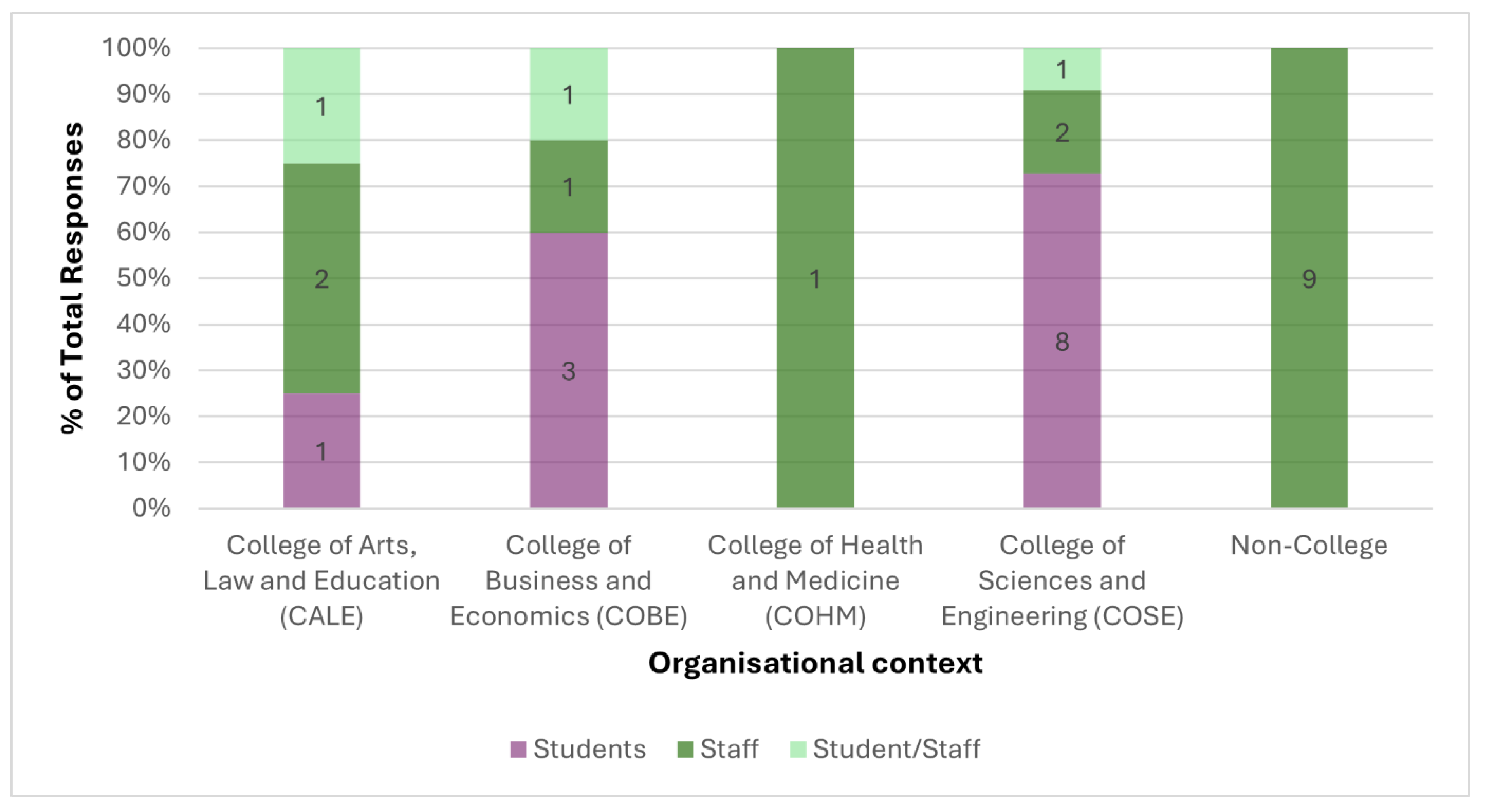
Figure 2.
Summary of selected post-module survey Likert responses.
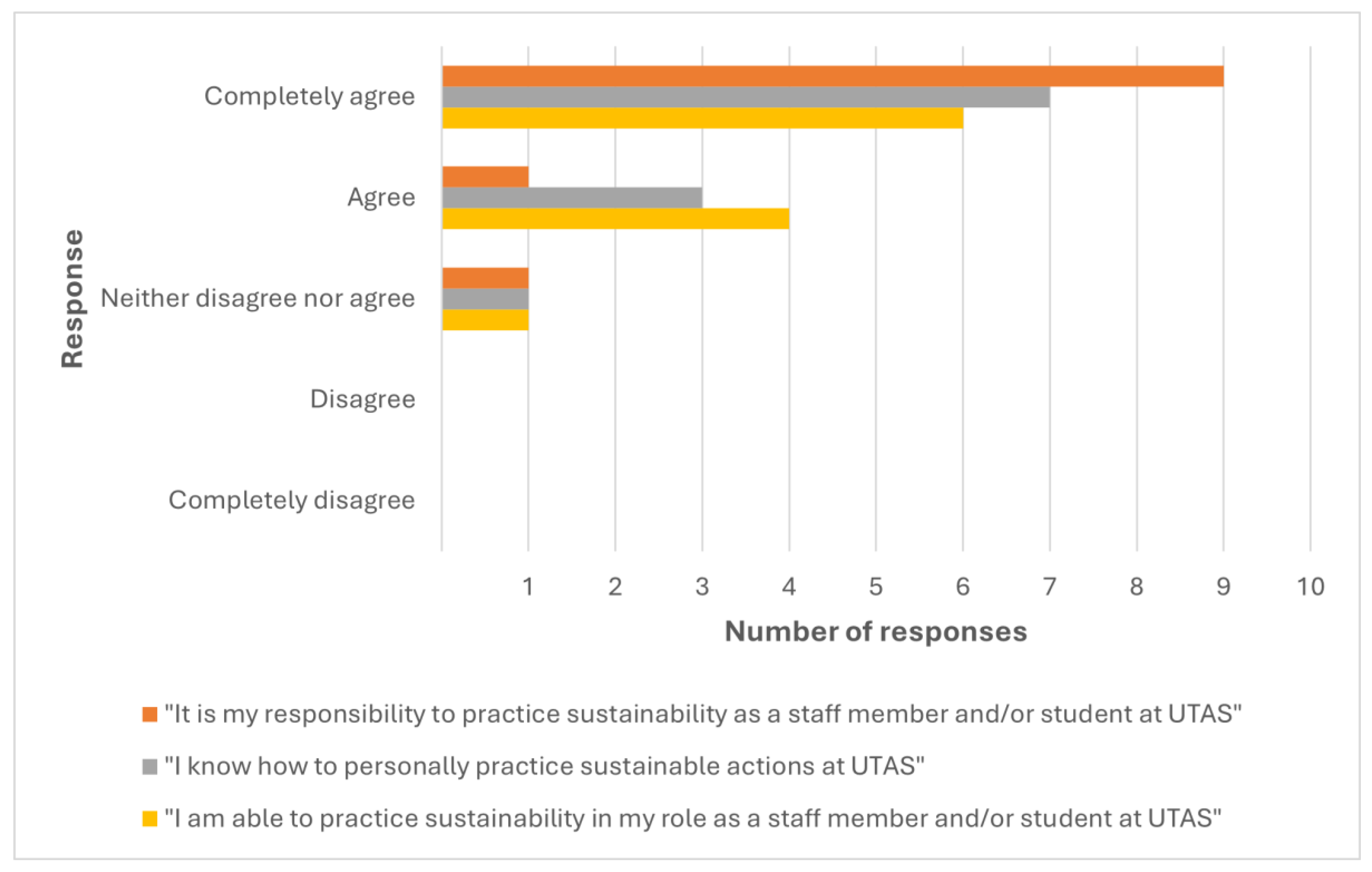

Table 1.
SDG Integration across UTAS online induction module chapters.
| Module Chapter | Primary SDGs | Key Focus |
| Introductory chapter: Strategic framework | 17, 4 | Institutional partners and educational approach |
| Aboriginal perspectives on sustainability at UTAS | 15, 10 | Indigenous knowledge and land stewardship |
| Operational sustainability | 12, 13 | Consumption, production, climate action |
| Engagement and partnership | 17, 11 | Community collaboration |
| Governance & leadership | 16, 17 | Institutional accountability |
| Barriers, enablers & opportunities | 17, 4 | Systemic transformation |
| Personal sustainability commitments | 12, 3 | Individual action and wellbeing |
Note: This mapping to the SDGs is broadly indicative at chapter level only as all SDGs are interconnected. For example, modern slavery was a chapter subtopic that links to multiple SDGs. The whole-institution approach aims for holistic SDG coverage.
Table 2.
Triang Model: Dimensions and interpretations of paradigm.
| Seeing (Concern/Purpose) | Knowing (Conception/Operation) | Doing (Consequence/Effect/Impact) |
| Perception | Conception | Practice |
| Affective dimension | Cognitive dimension | Intentional (design) dimension |
| Epistemology (+axiology) | Ontology | Methodology |
| Ethos | Eidos | Praxis |
| Concern (purpose) | Conception (operation) | Consequences (effect/impact) |
| Participant perceptions before, during, and after the module | Cognitive interpretation and conceptualization of the module | Impact on participants’ actions and institutional engagement |
Disclaimer/Publisher’s Note: The statements, opinions and data contained in all publications are solely those of the individual author(s) and contributor(s) and not of MDPI and/or the editor(s). MDPI and/or the editor(s) disclaim responsibility for any injury to people or property resulting from any ideas, methods, instructions or products referred to in the content. |
© 2026 by the authors. Licensee MDPI, Basel, Switzerland. This article is an open access article distributed under the terms and conditions of the Creative Commons Attribution (CC BY) license.
Copyright: This open access article is published under a Creative Commons CC BY 4.0 license, which permit the free download, distribution, and reuse, provided that the author and preprint are cited in any reuse.


