

Submitted:
02 May 2026
Posted:
05 May 2026
You are already at the latest version
Abstract
Pancreatic ductal adenocarcinoma (PDAC) remains highly lethal and is largely refractory to immune checkpoint inhibition, reflecting limited antigen-specific priming, dominant myeloid suppression, dense desmoplasia, and abnormal vasculature that together enforce immune exclusion. CD40 is a central costimulatory receptor that links CD4⁺ T cell help (via CD40L/CD154) to antigen-presenting cell (APC) licensing and effective CD8⁺ T cell priming, positioning CD40 agonism as a rational strategy to enhance antitumor immunity in PDAC. In addition to robust expression on APC populations (DCs, macrophages, and B cells), CD40 has been reported on subsets of PDAC tumor cells and stromal compartments (including fibroblasts and endothelial cells), implying that CD40-directed therapies may engage multiple cellular nodes and influence both immune activation and microenvironmental remodeling. Mechanistically, CD40 signaling integrates TRAF-dependent pathways (canonical/non-canonical NF-κB, MAPK, and PI3K/AKT) that can promote APC maturation, IL-12-associated Th1 programming, macrophage repolarization, and matrix remodeling that may reduce physical barriers to immune infiltration; however, tumor-intrinsic CD40 signaling can be context-dependent and has been linked to divergent survival or apoptotic outcomes in different settings. Clinically, multiple CD40 agonists are in development, predominantly in combination regimens with chemotherapy, checkpoint blockade, and/or vaccine platforms, with evidence of pharmacodynamic immune engagement but variable efficacy and incomplete randomized validation. Baseline CD40 expression has not consistently predicted benefit, underscoring the need for spatially resolved profiling and on-treatment pharmacodynamic biomarkers to guide patient selection, sequencing, and regimen optimization. Ongoing studies and next-generation, tumor-localized agonist formats will define whether CD40 agonism can deliver consistent, durable clinical benefit in PDAC.
Keywords:
pancreatic cancer (PDAC) CD40-agonists
; tumor microenvironment
; immunotherapy
1. Introduction
Pancreatic ductal adenocarcinoma (PDAC) is the predominant subtype of pancreatic cancer and is the sixth leading cause of cancer mortality worldwide [1]. Its incidence is rising, and projections suggest that it will become the second leading cause of cancer-related death by 2030 [2]. Standard combination chemotherapy regimens (e.g., FOLFIRINOX or gemcitabine/nab-paclitaxel) provide limited long-term benefit [3,4], with 5-year survival remaining around 13% [5], reinforcing the need for new therapeutic strategies.
Immune checkpoint inhibitors (ICIs) alone have transformed care in several solid tumors [6,7,8,9,10,11,12,13,14], but have shown limited activity in biomarker-unselected PDAC [15,16,17]. This refractoriness is largely attributed to an immunosuppressive tumor microenvironment (TME) enriched for tumor-associated macrophages, myeloid-derived suppressor cells, and regulatory T cells, combined with a dense desmoplastic stroma and abnormal, poorly perfused vasculature that restricts immune trafficking and drug delivery. Together with low tumor mutational burden and sparse tumor-specific effector T cells and DCs, these features contribute to an immunologically “cold” phenotype [18,19,20,21,22]. Therapeutic strategies in PDAC, therefore, likely require both improved antigen presentation and T cell priming, as well as relief of stromal-myeloid constraints on effector function.
CD40, a member of the tumor necrosis factor receptor (TNFR) superfamily, is a central co-stimulatory receptor in adaptive immunity that links CD4⁺ T cell help to antigen-presenting cell (APC) licensing and downstream CD8⁺ T cell priming [23,24]. Its physiological ligand, CD40L (CD154), is transiently upregulated on activated CD4⁺ T cells and can also be provided in soluble form, including from platelets, enabling CD40 signaling in both immune and vascular compartments [25,26]. CD40 is primarily expressed by APCs, including dendritic cells (DCs), macrophages, and B cells [25,26,27]. Engagement by CD40L delivers a potent activation signal that promotes APC maturation, cytokine production, and enhanced cross-presentation, thereby strengthening T cell priming and downstream effector functions [23,24,25,26,27,28]. CD40 expression has also been reported on subsets of PDAC tumor cells, with heterogeneity across tumors and disease stages, suggesting context-dependent roles in tumor biology and immune interactions [29,30]. Additionally, CD40 has been detected in stromal compartments, including cancer-associated fibroblasts (CAFs) and select endothelial populations, supporting the concept that CD40-directed therapies may exert effects beyond classical APC activation [24,30,31,32,33].
Consistent with this biology, CD40 agonism in preclinical PDAC models can induce immune activation and stromal remodeling [31,32]. Several CD40 agonists are currently in clinical trials, showing signs of immune activation and generally acceptable safety profiles across various solid tumors, including PDAC. [34,35,36]. However, CD40 signaling is context-dependent: while APC-directed activation is typically immunostimulatory, tumor-intrinsic CD40 signaling has been associated with pro-survival or pro-growth programs in some settings, with potential implications for therapeutic design and patient selection [37,38,39].
In this review, we summarize CD40 expression patterns and measurement considerations, explore CD40 signaling and cell-specific roles in PDAC, and evaluate the clinical and translational progress of CD40-directed strategies. We emphasize how combination regimens and appropriate sequencing may be required to overcome PDAC immune resistance and enable more consistent therapeutic responses.
2. CD40 Expression Landscape in PDAC
In PDAC, CD40 expression is most prominently detected on immune cells but is also reported on tumor cells and stromal elements, with variable levels across compartments and disease settings. This pattern aligns with CD40’s roles in immune activation, stromal remodeling, and tumor biology.
2.1. CD40 Expression on Non-Immune PDAC Compartments
Beyond immune cells, CD40 is present across multiple non-immune compartments in PDAC, including tumor cells and stromal elements. A substantial subset of PDAC tumor cells expresses CD40 (reported at around 68% across cohorts) [29,30], but expression is markedly heterogeneous within tumors and is often higher in advanced or metastatic disease [29]. Functionally, tumor-intrinsic CD40 signaling can yield divergent outcomes, ranging from apoptosis to enhanced proliferation and survival, depending on cellular context, with NF-κB and MAPK pathways implicated as key downstream effectors [37,38,39]. Tumor-cell CD40 expression has also been reported to impair T cell activation by reducing T cell CD154 (CD40L) expression and suppressing cytokine production and proliferation, consistent with a potential contribution to immune escape [40]. This heterogeneity likely reflects differences in oncogenic programs, local cytokine milieus, and spatiotemporal variation between primary tumors and metastatic sites, where immune and stromal architecture can differ and may influence responsiveness to CD40 agonism [41,42]. In the stroma, CD40 expression on subsets of cancer-associated fibroblasts (CAFs) and endothelial cells links CD40 signaling to extracellular matrix (ECM) remodeling and vascular regulation. CAF CD40 activation can trigger cytokine and growth factor production that influence matrix metalloproteinase (MMP) activity, leading to ECM remodeling and effects on invasion that depend on CAF subtype and context [33,43,44,45]. Additionally, CD40-expressing endothelial cells participate in inflammatory vascular remodeling and angiogenic processes [25,26,39,46,47]. Crosstalk between CAFs and endothelial cells, mediated by factors like vascular endothelial growth factor (VEGF) and hepatocyte growth factor (HGF), can result in hypovascularity, reduced drug delivery, and immune exclusion [48,49,50,51]. Consistent with these compartmental effects, studies show that agonistic CD40 activation can induce stromalysis via proteases produced by activated myeloid cells, degrading dense ECM and facilitating infiltration of DCs and effector T cells into tumor tissue [31,32,43]. Collectively, these observations support the concept that CD40-directed therapies may act not only through APC activation but also via tumor-intrinsic and stromal/vascular programs that shape PDAC immune resistance and treatment sensitivity.
2.2. CD40 Expression on Immune Cells Within the PDAC Tumor Microenvironment
The most robust expression of CD40 in PDAC is observed on APC populations, including DCs, macrophages (especially TAMs), monocytes, and B cells [25,26,27]. DC subsets implicated in cross-priming, including cDC1 and cDC2 populations (including CD141⁺ DCs) and LAMP3⁺ mature/regulatory DC states, depend on CD40 engagement for functional maturation and for efficient priming of cytotoxic CD8⁺ T cells [23,26,52]. However, their function in PDAC is frequently inhibited by tumor-derived cytokines and suppressive signals from myeloid populations [53,54].
TAMs, often skewed toward an M2-like phenotype, express variable levels of CD40 [55]. Engagement of CD40 has been shown to promote M1-like inflammatory reprogramming with increased antigen presentation, pro-inflammatory cytokine production (e.g., IL-12, TNF-α), and induction of matrix-degrading programs that can facilitate immune cell infiltration [43]. Within tertiary lymphoid structures (TLS), CD40⁺ B cells may contribute to local antigen presentation and support T cell priming, and, in mature TLS, can undergo antigen-driven maturation and plasma cell differentiation with local antibody production[56]. Importantly, T cells are key providers of the CD40 signal: activated CD4⁺ T cells upregulate CD40 ligand (CD40L/CD154), which licenses CD40⁺ APCs and supports broader lymphocyte activation [24,25,28]. CD40 expression has also been described on subsets of MDSCs, where CD40 engagement may modulate suppressive or effector functions in a context-dependent manner [57,58,59]. NK cells, on the other hand, express CD40 ligand and not the CD40 receptor itself. CD40L engagement on NK cells activates them, enabling them to recognize and kill CD40-expressing target T cells, including tumor cells, and is regulated by IL-12 and IFNγ [60,61]. This activates the NF-κB signaling, resulting in cytotoxic activity [62,63].
3. Biological Functions and Signaling Pathways of CD40 in PDAC
The biological consequences of CD40 engagement are compartment-dependent, shaped by the cellular source of CD40 and the local availability and form of its ligand. The key cellular and molecular mechanisms engaged by CD40 agonists in PDAC are summarized in Figure 1.
3.1. Core CD40 Signaling Pathways Shaping Immune Activation
CD40 is a TNFR family receptor that lacks intrinsic enzymatic activity and signals by recruiting TNF receptor-associated factor (TRAF) adaptor proteins after ligand-induced receptor clustering. The composition and stoichiometry of TRAFs bias downstream pathway engagement and functional output [64,65,66]. A principal consequence of CD40 ligation is activation of canonical NF-κB signaling, inducing transcriptional programs that support APC maturation and T cell priming, including cytokines (e.g., IL-6, TNF-α), adhesion molecules (e.g., ICAM-1), and costimulatory regulators within the B7 family [66,67].
Among the latter, CD40 engagement upregulates the co-stimulatory molecules CD80 (B7-1) and CD86 (B7-2) on DCs and B cells, and enhances T cell activation [23,28,68,69]. Interestingly, CD40 activation has also been shown to upregulate B7-H3 (CD276) expression on DCs, and this upregulation was functionally required for an enhanced antitumor immune response induced by CD40-activated, tumor antigen-pulsed DCs [66,70,71]. The B7-H3 checkpoint molecule is a member of the B7 family and is overexpressed in various solid malignancies, including PDAC, where it promotes tumor growth, metastasis, and treatment resistance [72,73,74]. Therefore, it has emerged as a potential target in cancer immunotherapy. Recent advances in B7-H3-targeting antibody-drug conjugates (ADCs), such as YL201 and HS-20093 (GSK5764227), provide a promising approach for antitumor therapy in early-phase clinical trials [75,76]. Whether CD40 agonist-mediated upregulation of B7-H3 on myeloid cells within the TME could enhance the efficacy of B7-H3-directed ADCs, or, conversely, serve as an immune evasion mechanism that warrants therapeutic targeting, remains an open question with important implications for rational combination strategies that have not yet been addressed.
CD40 can also engage the non-canonical NF-κB axis, contributing to more sustained programs relevant to APC function and lymphoid organization [77]. In parallel, CD40 activates mitogen-activated protein kinase (MAPK) cascades, including extracellular signal-regulated kinase (ERK), c-Jun N-terminal kinase (JNK), and p38, which shape cytokine production, differentiation, and survival programs across myeloid and stromal cells [66,70,71]. CD40 engagement additionally activates the phosphoinositide 3-kinase (PI3K)/AKT pathway, supporting cellular metabolism and antigen-processing capacity in APCs and modulating survival signaling in a context-dependent manner [78]. JAK3-STAT5 signaling is generally not a primary, direct CD40 pathway but can be engaged indirectly via autocrine/paracrine cytokines induced downstream of CD40 activation, thereby tuning inflammatory polarization and preventing tolerogenic programming in APCs [79,80,81,82]. Collectively, these signaling modules determine the magnitude, durability, and qualitative balance of CD40-driven immunity, and they provide a mechanistic basis for why CD40 agonism can have distinct effects across PDAC cellular compartments.
Targeting the JAK/STAT pathway has emerged as a potential therapeutic strategy in cancer, as it is involved in inflammatory responses and progression, particularly STAT3 in pancreatic cancer [83,84,85,86,87,88,89,90]. In a randomized, double-blind, phase II trial in patients with metastatic pancreatic cancer, a subgroup with increased systemic inflammation demonstrated signs of clinical benefit after treatment with ruxolitinib, a JAK1/JAK2 inhibitor, plus capecitabine chemotherapy [91]. Encouraged by these findings, two phase III randomized, placebo-controlled trials, JANUS 1 (NCT02117479) and JANUS 2 (NCT02119663), were initiated to evaluate the efficacy of this combination therapy [92]. Patients with advanced or metastatic pancreatic cancer and increased systemic inflammation, with one prior chemotherapy regimen, received ruxolitinib plus capecitabine or a placebo plus capecitabine. Unfortunately, both trials were terminated prematurely due to futility after interim analysis of JANUS 1, as the combination therapy failed to improve survival compared to placebo. Further investigation into JAK/STAT inhibition was pursued in another phase Ib/II study, in which itacitibin, a selective JAK1 inhibitor, was combined with gemcitabine and nab-paclitaxel in patients with treatment-naïve advanced metastatic solid tumors, including PDAC [93]. Despite demonstrating some clinical activity with an overall response rate of 24%, this trial was also terminated following the disappointing results from JANUS 1 and 2.
Given that CD40 agonism can indirectly engage JAK3-STAT5 signaling [79,80,81,82], combining CD40 agonists with JAK/STAT pathway inhibitors could offer a novel therapeutic approach to further enhance the antitumor response in PDAC. While CD40 engagement promotes APC maturation and enhanced cross-presentation for T cell priming and activation, simultaneously inhibiting the JAK/STAT pathway in the tumor might reduce progression and increase chemotherapy sensitivity, thereby enhancing antitumor efficacy and increasing survival. However, JAK/STAT pathway inhibitors may also have immunosuppressive effects [94,95,96]. Therefore, a comprehensive understanding of how JAK/STAT signaling interacts with CD40-driven immune activation and the overall effect on the immune system and TME could provide valuable insights into this combination strategy. Whether JAK/STAT pathway inhibitors would enhance or impair the efficacy of CD40 agonists, and whether the toxicity profile would be acceptable when combining these two regimens, remains an open question that warrants further preclinical investigation.
3.2. The CD40-CD40L Axis In Vivo: Ligand Sources and Signaling Context
Physiologic CD40 activation is mediated by CD40L (CD154), which is transiently upregulated on activated CD4⁺ T cells and provides the canonical help signal required for APC licensing and effective cytotoxic T cell priming [23,25,26,28]. CD40L can also be supplied by other activated immune cells and is present in soluble form, most prominently derived from platelets, supporting CD40 signaling in vascular and inflammatory contexts and contributing to endothelial activation programs [25,26,39,46,47]. The biologic outcome of CD40 engagement is therefore shaped not only by CD40 expression but also by where, when, and in what form CD40L is available (cell-bound vs soluble), as well as by the inflammatory milieu that determines pathway integration (e.g., NF-κB/MAPK tone) [71,97]. In PDAC, where productive CD4⁺ T cell help is often limited and myeloid suppression is prominent, therapeutic CD40 agonism aims to bypass inadequate endogenous CD40L delivery and restore licensing signals needed for effective priming and intratumoral immune activation [23,26,69].
3.3. CD40-Driven Activation of Antigen-Presenting Cells
CD40 engagement on DCs, macrophages, and B cells induces maturation and functional activation, thereby bridging innate and adaptive immunity. Upon CD40 ligation via CD40L or agonistic antibodies, DCs upregulate MHC class I/II and enhance cross-presentation, thereby enabling priming of both CD4⁺ and CD8⁺ T cells [23,26]. CD40 activation also increases CD80/CD86 expression on DCs, ensuring delivery of the necessary secondary signals to naive T cells, promoting their proliferation and differentiation into cytotoxic and helper subsets [23,69]. In addition, CD40 activation promotes IL-12 production, supporting Th1 polarization, CD8⁺ T cell expansion, and IFN-γ-associated effector programming, all of which are critical for antitumor responses [23,26,43,98]. These changes promote robust cross-priming of CD8⁺ T cells, a process profoundly deficient in untreated PDAC [21,99,100,101]. Therapeutic CD40 agonists could restore this critical antitumor axis.
3.4. Reprogramming of Tumor-Associated Macrophages
The PDAC TME favors immunosuppressive TAM states driven by chronic inflammation, hypoxia, and stromal cues [55,102,103,104]. CD40 signaling can reprogram M2-like macrophages toward a more inflammatory, antigen-presenting phenotype, associated with increased IL-12/TNF-α production, enhanced antigen presentation, induction of matrix-degrading programs, and improved immune cell recruitment [31,32,43,105]. In preclinical PDAC models, macrophage reprogramming is a major contributor to CD40 agonist activity and is mechanistically linked to improved T cell infiltration and intratumoral activation [31,106,107].
3.5. Stromal and Vascular Remodeling Downstream of CD40 Activation
CD40 agonism can modify PDAC stromal barriers through myeloid-driven remodeling programs [32]. CD40 activation increases expression of multiple matrix metalloproteinases (MMPs) in inflammatory macrophages and can suppress profibrotic CAF activity through paracrine and contact-dependent signaling, reducing ECM deposition and facilitating immune trafficking and drug penetration [31,32,43]. Endothelial cells express CD40, whose expression is notably upregulated by pro-inflammatory stimuli such as TNF-α and IFN-γ [46,108]. The interaction between endothelial CD40 and its ligand (CD40L), derived from activated T cells, monocytes, or platelets, triggers a potent pro-inflammatory response in the endothelium [46,47,109,110]. This activation leads to the expression of adhesion molecules (e.g., E-selectin, ICAM-1, VCAM-1), the production of inflammatory cytokines (IL-1, IL-6, IL-8), chemokines, MMPs, and increased procoagulant activity [46,109,111,112,113]. In PDAC models, inflammatory remodeling and stromal loosening have been linked to increased DC and T cell infiltration, supporting a mechanistic role for CD40 in overcoming physical and cellular barriers to immunity [24,31,43,105,114]. Furthermore, CD40-CD40L interactions can induce the production of angiogenic factors, including VEGF and fibroblast growth factor, with soluble CD40L promoting endothelial cell growth [115,116,117]. However, the function of CD40 in tumor angiogenesis is complex. Some studies indicate that CD40 activation may enhance tumor neoangiogenesis by increasing VEGF levels [118,119], whereas others show reduced tumor blood vessels and slower tumor growth due to inflammatory remodeling [39,120].
3.5. Tumor-Intrinsic CD40 Signaling in PDAC
In subsets of PDAC, CD40 is expressed by malignant epithelial cells and can transmit tumor-intrinsic signals upon ligation [29,30,121]. Downstream activation of NF-κB and MAPK pathways has been linked to divergent phenotypes, ranging from apoptosis [29,122,123] to enhanced proliferation and survival [121,124,125,126], depending on cellular state and microenvironmental context [125,127,128]. Beyond effects on tumor cell fitness, tumor-cell CD40 signaling has also been reported to modulate antitumor immunity, including attenuating T cell activation through reduced T cell CD154 (CD40L) expression and impairing cytokine production and proliferation in some settings [40,121,129]. These context-dependent tumor-intrinsic programs are relevant to therapeutic CD40 agonism because the net biologic effect may reflect the balance between APC licensing and myeloid reprogramming on one hand and tumor-cell-associated signaling on the other hand [27,33,130]. Accordingly, interpretation of CD40-targeted strategies in PDAC should consider not only immune compartment engagement but also tumor-cell CD40 expression and downstream signaling competence.
4. Therapeutic Targeting of CD40 in PDAC
CD40 agonism is being pursued in PDAC to compensate for insufficient endogenous CD40L-driven APC licensing and to induce coordinated programs that are typically deficient in this disease: improved antigen presentation and T cell priming, myeloid reprogramming, and remodeling of stromal/vascular barriers that limit immune trafficking and drug delivery. Because CD40 pathway engagement can be pharmacodynamically robust yet clinically variable as monotherapy, most development has focused on rational combinations and on defining the settings and biomarkers that best capture effective pathway engagement.
4.1. CD40 Agonistic Modalities and Design Principles
Productive CD40 signaling requires receptor clustering; therefore, in vivo agonism depends on the efficiency with which an agent promotes CD40 multimerization. This is influenced by the targeted CD40 epitope, effective valency, and, particularly for agonistic monoclonal antibodies (mAbs), Fcγ receptor (FcγR)-mediated crosslinking on accessory cells [131]. These parameters (isotype/Fc engineering, FcγR engagement profile, and binding geometry) shape the magnitude and tissue distribution of immune activation and contribute to inter-agent differences in tolerability and optimal dosing schedules. Accordingly, CD40 agonists should not be treated as a uniform class: selicrelumab (RG7876/CP-870,893), SEA-CD40, mitazalimab (JNJ-64457107/ADC-1013), sotigalimab (APX005M), CDX-1140, ChiLob 7/4, and LVGN7409 are all under clinical investigation in pancreatic cancer (Table 1). While each aims to mimic CD40L-driven activation, they differ in molecular properties that can alter clustering requirements and downstream biology. Across agents, monotherapy activity in PDAC has generally been modest, reinforcing the rationale for combination strategies that provide antigen release and/or relieve downstream suppression.
4.2. Combination Approaches with Chemotherapy
Chemotherapy establishes a mechanistic foundation for CD40 activation in PDAC by boosting antigen availability through tumor cell death and antigen release, promoting immunogenic cell death signals, and altering myeloid cell composition. Additionally, CD40-induced remodeling of myeloid and stromal components may enhance stromal and vascular permeability, facilitating better access for immune cells and drugs to the tumor tissue [32,106,132]. A key goal of chemo-CD40 therapy is to reprogram TAMs, including CD163⁺ myeloid cells, to adopt inflammatory, antigen-presenting, and matrix-remodeling phenotypes, shifting the tumor microenvironment from immunosuppressive to one more supportive of effector functions. This is important because high CD163⁺ macrophage levels correlate with poorer outcomes across various cancers [99,133,134,135]. Preclinical data support a synergistic effect between chemotherapy and CD40 activation, showing improved T cell priming and longer survival in experimental models [32,106,132].
Clinically, combinations of chemotherapy and CD40 in PDAC have been examined, including gemcitabine, gemcitabine combined with nab-paclitaxel, and mFOLFIRINOX (Table 2). In a phase I trial, patients with chemotherapy-naïve advanced PDAC received selicrelumab (CP-870893) in combination with gemcitabine, resulting in an ORR of 19% (4 of 22 patients). The median PFS was 5.2 months (95% CI: 1.9-7.4), and the median OS was 8.4 months (95% CI: 5.3-11.8), with a 1-year OS rate of 28.6%. Immune activation was observed through increased inflammatory cytokines and B cell expression of costimulatory molecules [136].
In a separate phase I study, sixteen patients with resectable PDAC received neoadjuvant selicrelumab, with or without gemcitabine/nab-paclitaxel, followed by adjuvant gemcitabine/nab-paclitaxel and selicrelumab. The median DFS and OS for the neoadjuvant selicrelumab group (n=11) were 9.8 months (95% CI: 0.4-19.2) and 23.4 months (95% CI: 9.1-37.6), respectively. For the group receiving both selicrelumab and gemcitabine/nab-paclitaxel (n=5), median DFS and OS were not reached. When combining both groups, median DFS was 13.9 months (95% CI: 2.9-24.8), and median OS was 23.4 months (95% CI: 18.0-28.8). Patients treated with selicrelumab showed a T cell-enriched tumor microenvironment (82% vs. 37% in untreated tumors, P=0.004), featuring more active and proliferative T cells and reduced fibrosis. Additionally, there were fewer M2-like macrophages and an increase in mature DCs [43].
In the phase Ib/II PRINCE trial, sotigalimab (APX005M) was combined with gemcitabine plus nab-paclitaxel in patients with untreated metastatic PDAC. In the phase 1b portion, responses were observed in 14 of 24 (58%) DLT-evaluable patients [137]. In the randomized phase 2 portion (n=105), the primary endpoint of 1-year OS was met for the nivolumab/chemotherapy arm (57.7%, P=0.006 vs. 35% historical rate) but was not met for the sotigalimab/chemotherapy arm (48.1%, P=0.062) or the triple combination arm (41.3%, P=0.223). Multi-omic biomarker analyses identified distinct treatment-specific immune signature correlates. Survival was correlated with greater intratumoral CD4+ T cell infiltration, increased circulating differentiated CD4+ T cells, and increased APC numbers after sotigalimab/chemotherapy [138].
In OPTIMIZE-1, also a phase Ib/II study, CD40 agonist mitazalimab was combined with mFOLFIRINOX in previously untreated metastatic PDAC achieved a confirmed ORR of 40% (23/57 patients; updated confirmed ORR 42.1% ), with a median PFS of 7.7 (95% CI: 5.8-11.3), median OS of 14.3 months (95% CI: 10.0-21.6), and a notably long median duration of response of 12.6 months. The 1-year PFS and OS rates were 34% (95% CI: 20.8-47.7) and 59% (95% CI: 44.2-71.1), respectively [136,139]. Here, objective responders displayed intratumoral myeloid and T cell activation, and mitazalimab-induced immune activation, including the expansion of effector CD4+ T cells after the priming dose, correlated with improved outcomes. Furthermore, no cytokine release syndrome was reported with mitazalimab, in contrast to earlier-generation CD40 agonists, and the safety profile was consistent with mFOLFIRINOX alone, with no hepatotoxicity-related treatment discontinuations [136].
Across these early-phase studies, chemotherapy-CD40 combination strategies have demonstrated feasibility and acceptable safety, with no unexpected immune-related toxicities [136,137,140]. Observed cytokine release syndrome (grade 1-2 with selicrelumab and sotigalimab) and liver function test elevations were transient, dose-dependent, and clinically manageable. The most common grade ≥3 adverse events have been hematologic (neutropenia, anemia, thrombocytopenia), consistent with the chemotherapy backbone. These data collectively support the continued evaluation of chemotherapy and CD40 combination strategies in both metastatic disease and neoadjuvant settings, while underscoring that the chemotherapy choice, treatment sequencing, and timing of CD40 agonist administration relative to chemotherapy are likely key determinants of both efficacy and tolerability. The planned randomized, controlled, international phase III trial of mitazalimab with mFOLFIRINOX will be critical to establish whether the encouraging results from OPTIMIZE-1 translate into a survival benefit over standard chemotherapy alone [136,139].
4.3. CD40 Agonism Combined with Immune Checkpoint Inhibition
PD-1/PD-L1 and CTLA-4 blockade have limited efficacy in PDAC, in part due to inadequate baseline priming and dominant myeloid-driven suppression. CD40 agonism provides a mechanistic rationale to improve checkpoint responsiveness by licensing APCs, expanding tumor-specific T cell priming, and shifting macrophage programs away from suppressive phenotypes, thereby creating a microenvironment more permissive to checkpoint blockade [24,141,142]. Preclinical models support durable control and immune memory with CD40-ICI combinations [105,141,142]. CD40 agonist with immune checkpoint inhibition resulted in complete tumor regression in a therapy-resistant pancreatic cancer model [142]. This effect was not obtained with checkpoint inhibition alone. In another pancreatic cancer murine model, the combination of CD40 agonism and a checkpoint inhibitor has cured 63% of tumor-bearing animals and increased tumor-specific T cells in the pancreas [143]. These findings were confirmed in an orthotopic Kras/Trp53-mutant model, demonstrating that ICI and CD40 agonism combination significantly reduced the tumor burden and shifted the TME from a suppressive to an activated state, accompanied by enhanced DC migration and decreased immunosuppressive TAMs [105].
The phase 1b PRINCE trial clinically assessed sotigalimab (APX005M), a CD40 agonist, combined with gemcitabine and nab-paclitaxel, with or without the PD-1 inhibitor nivolumab, in patients with untreated metastatic PDAC. [137]. The treatment demonstrated feasibility with manageable safety and encouraging response activity (n=30; 24 DLT-evaluable). The observed cumulative ORR was 58% (14/24 DLT-evaluable patients), with a median PFS of 11.7 months (95% CI: 7.1-17.8), and median OS 20.1 months (95% CI: 10.5-not estimable). The cumulative 1-year PFS and OS rates were 44% (95% CI: 22.2-63.4) and 70% (95% CI: 46.9-84.3), respectively [137].
However, the subsequent randomized phase II portion of the trial (n=105) did not demonstrate a survival benefit for the CD40 treatment arms compared with chemotherapy alone [138]. The primary endpoint of 1-year OS was only met for patients receiving nivolumab plus chemotherapy (57.7% vs 35% historical rate, P = 0.006, n = 34), while the sotigalimab plus chemotherapy arm showed a modest but non-significant increase in the 1-year OS (48.1%, P = 0.062, n = 36). The triple combination arm with sotigalimab plus nivolumab plus chemotherapy did not meet the endpoint (41.3%, P = 0.223, n = 35). Despite no clear clinical benefit, survival after sotigalimab plus chemotherapy was correlated with greater CD4+ T cell infiltration in the tumor and circulating differentiated CD4+ T cells and APCs. Survival after nivolumab plus chemotherapy was correlated with a less immunosuppressive TME at baseline and a higher number of activated, antigen-experienced circulating T cells. Notably, no patient subset was identified for which the triple combination was more beneficial. The lack of survival benefit in this arm could potentially be explained by the observed signs of immune exhaustion [138].
CDX-1140, a fully human IgG2 CD40 agonist antibody designed to activate CD40 without requiring FcγR cross-linking, has also been utilized in combination strategies. A phase I trial (NCT03329950) evaluated CDX-1140 as monotherapy or in combination with CDX-301 (a recombinant human Fms-like tyrosine kinase 3 ligand (Flt3L)), pembrolizumab (anti-PD1), or gemcitabine/nab-paclitaxel in patients with advanced malignancies, including PDAC, and has been completed. Preliminary data were presented at conferences and indicated that CDX-1140 was well-tolerated with evidence of immune activation [144,145].
A separate randomized, open-label phase II trial (NCT04536077) evaluating CDX-1140 with or without CDX-301 in PDAC was terminated before completion. Although no peer-reviewed publication has been issued, some preliminary results have been shared [146]. In PDAC, low tissue levels of Flt3L partly contribute to the deficits in conventional DCs (cDCs). Combining systemic Flt3L with a CD40 agonist restored cDC numbers and function in both mouse models and samples from PDAC patients in clinical trials. However, when combined with Flt3L, dual therapy triggered a cDC-driven type I immune response characterized by T cell infiltration, IL-12 production, and reciprocal IFN-γ responses. cDC1s were responsible for CD8⁺ T cell expansion, and T cell-derived IFN-γ enhanced cDC1 survival. However, the combination also increased regulatory T cells via cDC2 activation, thereby dampening immunity, highlighting the complexity of DC-centered approaches and the challenges of this combinatorial strategy.
A currently active phase I study (NCT04635995) is evaluating LVGN7409, a humanized monoclonal agonistic CD40 antibody, as monotherapy and in combination with anti-PD-1 and/or a CD137 agonist in patients with advanced or metastatic solid tumors, including potentially PDAC. Preliminary monotherapy data in 12 heavily pretreated patients did not show dose-limiting toxicities, and the treatment was well-tolerated. Among 9 evaluable patients, 44% achieved stable disease [147]. The combination arms incorporating checkpoint inhibition and CD137 agonism are of mechanistic interest, since CD137 (4-1BB) co-stimulation can amplify T cell effector function and survival downstream of CD40-licensed priming [148]. Results of this trial may inform whether this approach can overcome the immune suppression and limited T cell priming characteristics of PDAC.
Another phase Ib/II trial (NCT05419479) assessed a triple therapy of sotigalimab, domvanalimab (anti-TIGIT), and zimberelimab (anti-PD-1) in metastatic PDAC, even without checkpoint blockade. However, the trial is presently suspended, and no results have been published, underscoring the difficulties and complexity involved in multi-agent immunotherapy approaches for PDAC.
Collectively, these clinical trials demonstrate that overcoming PDACs’ resistance to checkpoint blockade with CD40 agonism is more complex. Combining checkpoint blockade with CD40 agonism and chemotherapy or other regimens may be insufficient in unselected patients. Furthermore, layering the treatment regimen may paradoxically induce immune exhaustion rather than an additive benefit [138]. Understanding the drivers of immune exhaustion and finding ways to mitigate it [149] and biomarker-driven patient selection are significant determinants of treatment efficacy and improved survival outcomes.
4.4. Integration with Cancer Vaccines and Neoantigen-Directed Therapies
Vaccine strategies in PDAC, including personalized neoantigen approaches and KRAS-targeted vaccines, aim to generate de novo tumor-specific T cell responses against epitopes less constrained by tolerance [150,151,152]. CD40 agonism is central to DC maturation and antigen cross-presentation, and IL-12-associated Th1 programming, and may increase the magnitude and functional quality of vaccine-induced responses by enhancing antigen uptake, processing, and presentation [107,153]. This rationale was confirmed in a preclinical model, where CD40 and CD80/86 signaling in cDC1s was found to play a critical role in the effective antitumor immunity of a neoantigen-based therapeutic vaccine [154]. In a murine pancreatic cancer model, DC vaccination in combination with a CD40 agonist was necessary to improve survival in an advanced PDAC setting, whereas CD40 agonism alone was ineffective [107].
The phase I REACtiVe-2 evaluated DC vaccination with MesoPher (monocyte-derived DCs pulsed with an allogeneic tumor lysate) combined with CD40 agonist mitazalimab in patients with metastatic PDAC after completion of (m)FOLFIRINOX (n=16) [155]. A systemic increase in activated and vaccine-specific T cell responses was observed. In post-therapy tumor biopsies from metastatic sites, increased T cell infiltration and decreased collagen deposition were seen. Despite these immune changes, no objective radiological responses were recorded, and half of the patients (50%) had stable disease after three administrations. Notably, half of the patients in the study (50%) had progressive disease at baseline, indicating that halting the advancing tumor biology is challenging and suggesting that this treatment may not be effective for patients already experiencing disease progression at the time of study initiation. This underscores once more the importance of patient selection to ensure an optimal therapeutic response.
Another vaccination trial (NCT02600949) is exploring a personalized neoantigen peptide-based vaccine, administered alone or combined with imiquimod, pembrolizumab, and/or sotigalimab, in patients with advanced pancreatic and colorectal cancers. Although it is not a traditional vaccine, irreversible electroporation (IRE) serves as an in-situ antigen-release platform. As a non-thermal ablation method, IRE induces immunogenic cell death and releases tumor antigens [156]. A phase I trial (NCT06205849) is currently assessing the combination of surgical IRE with intratumoral mitazalimab injections in patients with locally advanced pancreatic cancer. This approach leverages the synergy between IRE-induced antigen release and CD40-driven APC licensing in a targeted manner and could inform future locoregional immunotherapy strategies for LAPC.
Overall, this data supports the idea that vaccine strategies and CD40 agonism address different bottlenecks in PDAC immunity. Vaccines supply specific antigen targets, while CD40 activation enhances APC licensing and activates costimulatory pathways necessary for effective T cell priming. Further research is needed to determine if combining these methods can overcome immune and stromal barriers, ultimately producing durable benefits across biomarker-defined patient groups.
4.5. Neoadjuvant and Window-of-Opportunity Experience
Window-of-opportunity and neoadjuvant studies offer a direct means to interrogate intratumoral pharmacodynamics and to test whether CD40 agonism can remodel the PDAC TME when immune trafficking and lymphatic drainage may be relatively more intact than in widely metastatic disease. Neoadjuvant selicrelumab has been reported to induce measurable immune activation and TME remodeling, supporting proof-of-mechanism in human PDAC, while the linkage between these pharmacodynamic effects and long-term clinical outcomes remains under active investigation [43]. These settings are also well-suited to optimize sequencing (e.g., relative timing to chemotherapy) and to validate tissue-based pharmacodynamic endpoints for subsequent trials.
4.6. Biomarkers: Prognostic Context and Predictors of Benefit
While pan-cancer analyses have linked higher CD40 expression to improved survival in some settings, this relationship is not uniform across tumor types, and the prognostic value appears limited in PDAC [30,157,158,159,160,161]. In PDAC transcriptomic analyses, CD40 mRNA does not consistently function as an independent predictor of OS, and tumor-cell CD40 expression has not shown robust prognostic value in larger cohorts [30,162].
In a large multi-cohort study using spatial characterization of tumor samples from nine different solid tumors, CD40 expression was present in 68% of pancreatic adenocarcinomas [30]. However, CD40 expression on these tumor cells was not prognostic for OS. Similarly, in a pan-cancer transcriptomic analysis, high CD40 RNA expression was observed in 42% of pancreatic cancers and was correlated with improved OS in patients treated with immune checkpoint inhibitors, but not in multivariable analysis, suggesting that CD40 may not be an independent predictive biomarker [162]. In contrast to CD40 expression on tumor cells, serum levels of both soluble CD40 (sCD40) and CD40 ligand (sCD40L) were found to have some prognostic value. High sCD40 was associated with reduced OS, particularly in patients with neoadjuvant chemotherapy, and the combination with the tumor marker Carbohydrate Antigen 19.9 (CA19-9) increased its diagnostic value [163]. Similar to sCD40, soluble CD40 ligand (sCD40L) levels were also prognostic, with high levels associated with poor survival and correlated with unresectability and distant metastasis [117]. The predictive value of sCD40L was superior to that of the tumor markers CA19-9 and Carcinoembryonic Antigen (CEA).
Instead of CD40 expression, outcome associations in PDAC more strongly track with immune composition and functional state, particularly DC infiltration and macrophage polarization [43,138,139]. Neoadjuvant and adjuvant treatment with selicrelumab increased circulating CD4+ and CD8+ T cells and elevated inflammatory cytokine levels [43]. In the tumor, reduced fibrosis and decreased M2-like macrophages were observed, while an increase in mature DCs and enrichment of T cells were observed. Furthermore, systemic inflammatory cytokine levels were elevated after treatment. In the PRINCE trial, biomarker analysis revealed that higher baseline frequencies of circulating DCs, B cells, and experienced Th1 cells were associated with improved survival in patients treated with sotigalimab and gemcitabine plus nab-paclitaxel [138]. Within the tumor, Th1, Th2, and IFN-γ response signatures, and higher frequencies of tumor-infiltrating non-proliferating conventional and regulatory CD4+ T cells, were associated with improved survival outcomes. In OPTIMIZE-1, baseline tumor-intrinsic gene signatures related to fibrosis and ECM remodeling were associated with improved survival after treatment with mitazalimab and mFOLFIRINOX [139]. In peripheral blood, increased activation and proliferation of circulating T cells and NK cells were observed.
Collectively, these data support prioritizing on-treatment pharmacodynamic biomarkers, such as APC activation, shifts in myeloid polarization, T cell activation and recruitment, and immune infiltration and stromal remodeling in the TME, as more plausible indicators of effective pathway engagement over baseline CD40 abundance alone.
4.7. Safety Considerations and Toxicity Management
CD40 agonists can induce systemic immune activation with cytokine-associated symptoms, transient cytopenias, and liver enzyme elevations; cytokine release syndrome is typically moderate and transient, consistent with activation of immune and vascular compartments [24,36,43,98,164,165]. Transient transaminase elevations are often detected within around 24 hours of dosing and may persist for weeks before resolving, emphasizing the need for laboratory monitoring and dosing strategies that balance potency with tolerability [36,43,98,164,165]. Safety profiles vary among agents, plausibly reflecting differences in FcγR engagement, clustering requirements, and schedule, and intravenous administration has generally been feasible in early-phase studies, while optimal regimens continue to be refined. In PDAC combination studies, including DC vaccination plus CD40 agonism in the REACtiVe-2 trial, overall tolerability has been reported as manageable, supporting further development while underscoring the need to mitigate toxicity and optimize regimens to realize therapeutic benefit [43,136,137,138,140,155].
5. Challenges and Future Directions
5.1. Limitation to Consistent Clinical Benefit
Despite compelling biology, translating CD40 agonism into durable efficacy in PDAC remains difficult. First, PDAC imposes strong baseline constraints, marked myeloid dominance, limited endogenous priming, dense desmoplasia, and abnormal vasculature, which can blunt effector trafficking and function even when APC activation is achieved [4,104]. Second, CD40 agonists are not interchangeable: differences in clustering requirements, FcγR dependence, and exposure profiles likely contribute to heterogeneous pharmacodynamics and safety across agents [131,166]. Third, antitumor activity appears highly context dependent, with outcomes shaped by disease setting (metastatic vs neoadjuvant), tumor burden, immune composition, and treatment sequencing [43,82,136,137,138]. Finally, adaptive counter-regulation, including re-emergence of suppressive myeloid programs, regulatory T cell expansion, compensatory inhibitory pathways, and stromal reconstitution, may limit durability and argue for longitudinal tissue-based interrogation in trials [130,143,146,167].
5.1. Biomarkers and Patient Selection: Beyond Baseline CD40 Abundance
Available data do not support baseline CD40 expression as a reliable prognostic or predictive biomarker in PDAC [30,162]. Future stratification is more likely to benefit from biomarkers that capture the functional state and spatial organization of the microenvironment, such as DC subset abundance and activation [143,146,168], macrophage polarization states [130], TLS features [169,170], and stromal programs [139], rather than single-marker expression. Integrating high-dimensional profiling (single-cell approaches, multiplex tissue imaging, spatial transcriptomics/proteomics, and longitudinal immune monitoring) should help define tumor-immune states permissive to CD40-driven priming and identify early pharmacodynamic signals associated with benefit [171,172,173]. In parallel, emphasis should shift toward on-treatment pharmacodynamic endpoints (APC activation signatures, myeloid reprogramming, chemokine programs linked to trafficking, and quantitative immune infiltration/stromal remodeling readouts) as practical markers of effective pathway engagement [43,82,139].
5.2. Optimization of Dosing, Scheduling, and Delivery
The therapeutic window of CD40 agonists remains a central development constraint, requiring dosing strategies that maximize intratumoral pharmacodynamics while limiting systemic inflammatory toxicity [174]. Step-up dosing, intermittent schedules, and combination-dependent dose modulation warrant systematic evaluation, ideally linked to mechanistic readouts (e.g., APC activation and cytokine programs) that can define an exposure-response relationship [136,165]. Alternative delivery approaches, including locoregional or intratumoral administration, may improve spatial specificity and reduce systemic exposure [35,175], but will require careful feasibility evaluation in PDAC and validation that local activity translates into systemic antitumor immunity [58,176].
5.3. Context-Dependent Tumor-Intrinsic CD40 Signaling
An unresolved translational issue is tumor-intrinsic CD40 signaling, which can produce divergent outcomes depending on tumor state and microenvironmental cues, with NF-κB/MAPK programs linked to either apoptosis or pro-survival/proliferative effects in different settings [29,124,125]. Given that CD40-targeted therapies may engage tumor-cell CD40 in a subset of PDACs [30,162], future work should clarify how genomic alterations, epigenetic states, and extrinsic cytokine signals shape tumor-intrinsic CD40 responses [103,177,178], and whether tumor-cell CD40 status should inform patient selection or combination strategy to avoid unintended protumor signaling [33,40].
5.4. Next-Generation CD40 Agonists and Rational Combinations
Next-generation formats, including Fc-engineered antibodies [179,180], multivalent ligand-mimetic constructs [181], bispecific/conditional agonists [33,176,182,183], and nanoparticle or other tumor-localizing delivery strategies [58,175,184], aim to enhance productive receptor clustering in the relevant immune niche while minimizing systemic activation. Mechanistically, CD40 agonism is unlikely to provide durable benefit as monotherapy and is best developed within multidimensional regimens that coordinate antigen supply with APC licensing and relieve downstream suppression [43,107,136,146]. Chemotherapy and radiotherapy remain important partners for antigen release and microenvironmental modulation [136,137,185], checkpoint blockade may be most effective when paired with demonstrable priming [105,138,142,186], and vaccine/DC/neoantigen strategies provide a direct route to increase antigen-focused T cell responses [107,155]; collectively, these combinations are likely to be particularly informative in neoadjuvant or minimal residual disease settings where tumor burden is lower and immune trafficking may be less constrained [43,107].
5.5. Standardization of CD40 Measurement and Reporting
To enable meaningful comparison across studies and support biomarker development, CD40 measurement requires greater standardization. Bulk transcriptomic readouts quantify CD40 mRNA in mixed tissue and are sensitive to immune/stromal admixture [162,187,188], while spatial profiling confirms multicellular heterogeneity and indicates that treatment exposure can shift compartmental states, altering bulk signals independent of true cell-intrinsic changes [172,189]. Protein-level assays (IHC, multiplex IF, quantitative immunofluorescence) improve compartment attribution but vary by antibody clone, platform, and scoring method and remain sensitive to sampling and intratumoral heterogeneity [121,190]. Accordingly, studies should explicitly report assay modality, scored compartment(s), scoring thresholds, specimen type and disease site, and treatment context, and where feasible, integrate bulk and spatially resolved approaches to support reproducible interpretation [172,173,189,191,192].
6. Conclusion
CD40 is a multicompartment immunotherapeutic target in PDAC, with the capacity to license antigen-presenting cells, reprogram suppressive myeloid states, and contribute to stromal and vascular remodeling, which may help relieve immune exclusion. Early clinical studies have shown clear pharmacodynamic immune engagement, but clinical benefit has remained inconsistent, and baseline CD40 expression alone appears insufficient to guide prognosis or therapeutic selection. Further progress will likely depend on selecting CD40 agonist modalities with appropriate clustering and FcγR-dependent properties, optimizing treatment sequencing to align tumor antigen availability with APC licensing and effector T-cell support, prioritizing on-treatment pharmacodynamic and spatial biomarkers over static expression measures, and improving safety through refined dosing, scheduling, and potentially tumor-localized or conditionally active agonist designs.
A particularly interesting direction is the combination of CD40 agonism with next-generation cancer vaccines, including mRNA-based, KRAS-targeted, neoantigen-directed, and dendritic cell–based platforms. In this setting, CD40 activation may provide the APC licensing and myeloid reprogramming required to convert vaccine-induced antigen recognition into more effective and durable T-cell priming within the hostile PDAC microenvironment. Although early preclinical and clinical data support this rationale, dedicated studies are needed to define optimal timing, combination partners, biomarker strategies, and patient selection. With continued refinement, CD40-directed approaches remain a biologically plausible strategy to increase the proportion of patients with PDAC who achieve meaningful and durable immune-mediated tumor control.
Author Contributions
All authors read and met the ICMJE criteria for authorship. Conceptualization was performed by S.K., A.v.D, and C.W.F.v.E.; methodology and data curation were carried out by S.K., A.v.D, and C.W.F.v.E.; writing original draft preparation was done by S.K., A.v.D, and C.W.F.v.E; review writing and editing were done by J. de V.-G., C.H.J. v. E., and N. v. Supervision was by C.W.F. v. E. All authors have read and agreed to the published version of the manuscript.
Funding
This research received no external funding.
Data Availability Statement
No new data were created or analyzed in this study.
Conflicts of Interest
The authors declare no conflicts of interest.
References
- Bray, F.; Laversanne, M.; Sung, H.; et al. Global cancer statistics 2022: GLOBOCAN estimates of incidence and mortality worldwide for 36 cancers in 185 countries. CA Cancer J. Clin. 2024, 74(3), 229–263. [Google Scholar] [CrossRef]
- Rahib, L.; Smith, B.D.; Aizenberg, R.; Rosenzweig, A.B.; Fleshman, J.M.; Matrisian, L.M. Projecting cancer incidence and deaths to 2030: the unexpected burden of thyroid, liver, and pancreas cancers in the United States. Cancer Res. 2014, 74(11), 2913–21. [Google Scholar] [CrossRef] [PubMed]
- 10.1158/0008-5472.CAN-14-0155.
- Stoop, T.F.; Javed, A.A.; Oba, A.; et al. Pancreatic cancer. Lancet 2025, 405(10485), 1182–1202. [Google Scholar] [CrossRef]
- Park, W.; Chawla, A.; O'Reilly, E.M. Pancreatic Cancer: A Review. Jama 2021, 326(9), 851–862. [Google Scholar] [CrossRef] [PubMed]
- Siegel, R.L.; Kratzer, T.B.; Wagle, N.S.; Sung, H.; Jemal, A. Cancer statistics, 2026. CA Cancer J. Clin. 2026, 76(1), e70043. [Google Scholar] [CrossRef]
- André, T.; Elez, E.; Lenz, H.J.; et al. Nivolumab plus ipilimumab versus nivolumab in microsatellite instability-high metastatic colorectal cancer (CheckMate 8HW): a randomised, open-label, phase 3 trial. Lancet 2025, 405(10476), 383–395. [Google Scholar] [CrossRef]
- Chalabi, M.; Fanchi, L.F.; Dijkstra, K.K.; et al. Neoadjuvant immunotherapy leads to pathological responses in MMR-proficient and MMR-deficient early-stage colon cancers. Nat. Med. 2020, 26(4), 566–576. [Google Scholar] [CrossRef] [PubMed]
- Mok, T.S.K.; Wu, Y.L.; Kudaba, I.; et al. Pembrolizumab versus chemotherapy for previously untreated, PD-L1-expressing, locally advanced or metastatic non-small-cell lung cancer (KEYNOTE-042): a randomised, open-label, controlled, phase 3 trial. Lancet 2019, 393(10183), 1819–1830. [Google Scholar] [CrossRef]
- Spicer, J.D.; Garassino, M.C.; Wakelee, H.; et al. Neoadjuvant pembrolizumab plus chemotherapy followed by adjuvant pembrolizumab compared with neoadjuvant chemotherapy alone in patients with early-stage non-small-cell lung cancer (KEYNOTE-671): a randomised, double-blind, placebo-controlled, phase 3 trial. Lancet 2024, 404(10459), 1240–1252. [Google Scholar] [CrossRef]
- Wolchok, J.D.; Chiarion-Sileni, V.; Rutkowski, P.; et al. Final, 10-Year Outcomes with Nivolumab plus Ipilimumab in Advanced Melanoma. N Engl. J. Med. 2025, 392(1), 11–22. [Google Scholar] [CrossRef]
- Janjigian, Y.Y.; Shitara, K.; Moehler, M.; et al. First-line nivolumab plus chemotherapy versus chemotherapy alone for advanced gastric, gastro-oesophageal junction, and oesophageal adenocarcinoma (CheckMate 649): a randomised, open-label, phase 3 trial. Lancet 2021, 398(10294), 27–40. [Google Scholar] [CrossRef]
- Tannir, N.M.; Albigès, L.; McDermott, D.F.; et al. Nivolumab plus ipilimumab versus sunitinib for first-line treatment of advanced renal cell carcinoma: extended 8-year follow-up results of efficacy and safety from the phase III CheckMate 214 trial. Ann. Oncol. 2024, 35(11), 1026–1038. [Google Scholar] [CrossRef]
- Abou-Alfa, G.K.; Lau, G.; Kudo, M.; et al. Tremelimumab plus Durvalumab in Unresectable Hepatocellular Carcinoma. NEJM Evid. 2022, 1(8), EVIDoa2100070. [Google Scholar] [CrossRef] [PubMed]
- Powles, T.; Valderrama, B.P.; Gupta, S.; et al. Enfortumab Vedotin and Pembrolizumab in Untreated Advanced Urothelial Cancer. N Engl. J. Med. 2024, 390(10), 875–888. [Google Scholar] [CrossRef] [PubMed]
- Brahmer, J.R.; Tykodi, S.S.; Chow, L.Q.; et al. Safety and activity of anti-PD-L1 antibody in patients with advanced cancer. N Engl. J. Med. 2012, 366(26), 2455–65. [Google Scholar] [CrossRef]
- Renouf, D.J.; Loree, J.M.; Knox, J.J.; et al. The CCTG PA.7 phase II trial of gemcitabine and nab-paclitaxel with or without durvalumab and tremelimumab as initial therapy in metastatic pancreatic ductal adenocarcinoma. Nat. Commun. 2022, 13(1), 5020. [Google Scholar] [CrossRef] [PubMed]
- O'Reilly, E.M.; Oh, D.Y.; Dhani, N.; et al. Durvalumab With or Without Tremelimumab for Patients With Metastatic Pancreatic Ductal Adenocarcinoma: A Phase 2 Randomized Clinical Trial. JAMA Oncol. 2019, 5(10), 1431–1438. [Google Scholar] [CrossRef]
- Ho, W.J.; Jaffee, E.M.; Zheng, L. The tumour microenvironment in pancreatic cancer - clinical challenges and opportunities. Nat. Rev. Clin. Oncol. 2020, 17(9), 527–540. [Google Scholar] [CrossRef]
- Murakami, T.; Hiroshima, Y.; Matsuyama, R.; Homma, Y.; Hoffman, R.M.; Endo, I. Role of the tumor microenvironment in pancreatic cancer. Ann. Gastroenterol. Surg. 2019, 3(2), 130–137. [Google Scholar] [CrossRef]
- Dallal, R.M.; Christakos, P.; Lee, K.; Egawa, S.; Son, Y.I.; Lotze, M.T. Paucity of dendritic cells in pancreatic cancer. Surgery 2002, 131(2), 135–8. [Google Scholar] [CrossRef]
- Hegde, S.; Krisnawan, V.E.; Herzog, B.H.; et al. Dendritic Cell Paucity Leads to Dysfunctional Immune Surveillance in Pancreatic Cancer. Cancer Cell 2020, 37(3), 289–307 e9. [Google Scholar] [CrossRef]
- Orhan, A.; Vogelsang, R.P.; Andersen, M.B.; et al. The prognostic value of tumour-infiltrating lymphocytes in pancreatic cancer: a systematic review and meta-analysis. Eur. J. Cancer 2020, 132, 71–84. [Google Scholar] [CrossRef]
- Schoenberger, S.P.; Toes, R.E.; van der Voort, E.I.; Offringa, R.; Melief, C.J. T-cell help for cytotoxic T lymphocytes is mediated by CD40-CD40L interactions. Nature 1998, 393(6684), 480–3. [Google Scholar] [CrossRef] [PubMed]
- Vonderheide, R.H. CD40 Agonist Antibodies in Cancer Immunotherapy. Annu Rev. Med. 2020, 71, 47–58. [Google Scholar] [CrossRef] [PubMed]
- Grewal, I.S.; Flavell, R.A. CD40 and CD154 in cell-mediated immunity. Annu Rev. Immunol. 1998, 16, 111–35. [Google Scholar] [CrossRef]
- van Kooten, C.; Banchereau, J. CD40-CD40 ligand. J. Leukoc. Biol. 2000, 67(1), 2–17. [Google Scholar] [CrossRef] [PubMed]
- Vonderheide, R.H. Prospect of targeting the CD40 pathway for cancer therapy. Clin. Cancer Res. 2007, 13(4), 1083–8. [Google Scholar] [CrossRef]
- Caux, C.; Massacrier, C.; Vanbervliet, B.; et al. Activation of human dendritic cells through CD40 cross-linking. J. Exp. Med. 1994, 180(4), 1263–72. [Google Scholar] [CrossRef]
- He, S.; Zhao, H.; Fei, M.; et al. Expression of the co-signaling molecules CD40-CD40L and their growth inhibitory effect on pancreatic cancer in vitro. Oncol. Rep. 2012, 28(1), 262–8. [Google Scholar]
- Bates, K.M.; Vathiotis, I.; MacNeil, T.; et al. Spatial characterization and quantification of CD40 expression across cancer types. BMC Cancer 2023, 23(1), 220. [Google Scholar] [CrossRef]
- Beatty, G.L.; Chiorean, E.G.; Fishman, M.P.; et al. CD40 agonists alter tumor stroma and show efficacy against pancreatic carcinoma in mice and humans. Science 2011, 331(6024), 1612–6. [Google Scholar] [CrossRef]
- Long, K.B.; Gladney, W.L.; Tooker, G.M.; Graham, K.; Fraietta, J.A.; Beatty, G.L. IFNγ and CCL2 Cooperate to Redirect Tumor-Infiltrating Monocytes to Degrade Fibrosis and Enhance Chemotherapy Efficacy in Pancreatic Carcinoma. Cancer Discov. 2016, 6(4), 400–413. [Google Scholar] [CrossRef]
- McVey, J.C.; Beatty, G.L. Facts and Hopes of CD40 Agonists in Cancer Immunotherapy. Clin. Cancer Res. 2025, 31(11), 2079–2087. [Google Scholar] [CrossRef]
- Mangsbo, S.M.; Broos, S.; Fletcher, E.; et al. The human agonistic CD40 antibody ADC-1013 eradicates bladder tumors and generates T-cell-dependent tumor immunity. Clin. Cancer Res. 2015, 21(5), 1115–26. [Google Scholar] [CrossRef] [PubMed]
- Irenaeus, S.M.M.; Nielsen, D.; Ellmark, P.; et al. First-in-human study with intratumoral administration of a CD40 agonistic antibody, ADC-1013, in advanced solid malignancies. Int. J. Cancer 2019, 145(5), 1189–1199. [Google Scholar] [CrossRef] [PubMed]
- Moreno, V.; Perets, R.; Peretz-Yablonski, T.; et al. A phase 1 study of intravenous mitazalimab, a CD40 agonistic monoclonal antibody, in patients with advanced solid tumors. Invest New Drugs 2023, 41(1), 93–104. [Google Scholar] [CrossRef]
- Baxendale, A.J.; Dawson, C.W.; Stewart, S.E.; et al. Constitutive activation of the CD40 pathway promotes cell transformation and neoplastic growth. Oncogene 2005, 24(53), 7913–23. [Google Scholar] [CrossRef] [PubMed]
- Murugaiyan, G.; Martin, S.; Saha, B. CD40-induced countercurrent conduits for tumor escape or elimination? Trends Immunol. 2007, 28(11), 467–73. [Google Scholar] [CrossRef]
- Korniluk, A.; Kemona, H.; Dymicka-Piekarska, V. Multifunctional CD40L: pro- and anti-neoplastic activity. Tumour Biol. 2014, 35(10), 9447–57. [Google Scholar] [CrossRef]
- Batrla, R.; Linnebacher, M.; Rudy, W.; Stumm, S.; Wallwiener, D.; Gückel, B. CD40-expressing carcinoma cells induce down-regulation of CD40 ligand (CD154) and impair T-cell functions. Cancer Res. 2002, 62(7), 2052–7. [Google Scholar]
- Khaliq, A.M.; Rajamohan, M.; Saeed, O.; et al. Spatial transcriptomic analysis of primary and metastatic pancreatic cancers highlights tumor microenvironmental heterogeneity. Nat. Genet. 2024, 56(11), 2455–2465. [Google Scholar] [CrossRef]
- Gong, R.; Chen, Y.; Li, C.; Zhang, H.; Liu, Z.; Yu, Q. Targeting myeloid cells in pancreatic ductal adenocarcinoma: from primary tumors to liver metastasis. Front Immunol. 2025, 16, 1555036. [Google Scholar] [CrossRef] [PubMed]
- Byrne, K.T.; Betts, C.B.; Mick, R.; et al. Neoadjuvant Selicrelumab, an Agonist CD40 Antibody, Induces Changes in the Tumor Microenvironment in Patients with Resectable Pancreatic Cancer. Clin. Cancer Res. 2021, 27(16), 4574–4586. [Google Scholar] [CrossRef] [PubMed]
- Ohlund, D.; Handly-Santana, A.; Biffi, G.; et al. Distinct populations of inflammatory fibroblasts and myofibroblasts in pancreatic cancer. J. Exp. Med. 2017, 214(3), 579–596. [Google Scholar] [CrossRef]
- 20162024 [pii].
- 10.1084/jem.20162024.
- Rebelo, R.; Xavier, C.P.R.; Giovannetti, E.; Vasconcelos, M.H. Fibroblasts in pancreatic cancer: molecular and clinical perspectives. Trends Mol. Med. 2023, 29(6), 439–453. [Google Scholar] [CrossRef] [PubMed]
- Karmann, K.; Hughes, C.C.; Schechner, J.; Fanslow, W.C.; Pober, J.S. CD40 on human endothelial cells: inducibility by cytokines and functional regulation of adhesion molecule expression. Proc. Natl. Acad. Sci. U S A 1995, 92(10), 4342–6. [Google Scholar] [CrossRef]
- Urban, D.; Thanabalasingam, U.; Stibenz, D.; et al. CD40/CD40L interaction induces E-selectin dependent leukocyte adhesion to human endothelial cells and inhibits endothelial cell migration. Biochem Biophys. Res. Commun. 2011, 404(1), 448–52. [Google Scholar] [CrossRef]
- Shintani, Y.; Fujiwara, A.; Kimura, T.; et al. IL-6 Secreted from Cancer-Associated Fibroblasts Mediates Chemoresistance in NSCLC by Increasing Epithelial-Mesenchymal Transition Signaling. J. Thorac. Oncol. 2016, 11(9), 1482–92. [Google Scholar] [CrossRef]
- Richards, K.E.; Zeleniak, A.E.; Fishel, M.L.; Wu, J.; Littlepage, L.E.; Hill, R. Cancer-associated fibroblast exosomes regulate survival and proliferation of pancreatic cancer cells. Oncogene 2017, 36(13), 1770–1778. [Google Scholar] [CrossRef]
- Chakravarthy, A.; Khan, L.; Bensler, N.P.; Bose, P.; De Carvalho, D.D. TGF-β-associated extracellular matrix genes link cancer-associated fibroblasts to immune evasion and immunotherapy failure. Nat. Commun. 2018, 9(1), 4692. [Google Scholar] [CrossRef]
- Grout, J.A.; Sirven, P.; Leader, A.M.; et al. Spatial Positioning and Matrix Programs of Cancer-Associated Fibroblasts Promote T-cell Exclusion in Human Lung Tumors. Cancer Discov. 2022, 12(11), 2606–2625. [Google Scholar] [CrossRef]
- Andersson, H.; Nyesiga, B.; Hermodsson, T.; et al. Next-generation CD40 agonists for cancer immunotherapy. Expert Opin. Biol. Ther. 2024, 24(5), 351–363. [Google Scholar] [CrossRef]
- Bellone, G.; Carbone, A.; Smirne, C.; et al. Cooperative induction of a tolerogenic dendritic cell phenotype by cytokines secreted by pancreatic carcinoma cells. J. Immunol. 2006, 177(5), 3448–60. [Google Scholar] [CrossRef]
- Xie, Z.; Fang, Y.; Zhang, X.; et al. The emerging role of dendritic cells in the tumor microenvironment: from antigen presentation to targeted immunotherapy. Cell Death Dis. 2025, 16(1), 900. [Google Scholar] [CrossRef]
- Zuo, C.; Baer, J.M.; Knolhoff, B.L.; et al. Stromal and therapy-induced macrophage proliferation promotes PDAC progression and susceptibility to innate immunotherapy. J. Exp. Med. 2023, 220(6). [Google Scholar] [CrossRef]
- jem.20212062 [pii].
- 10.1084/jem.20212062.
- Lehmann, J.; Thelen, M.; Kreer, C.; et al. Tertiary Lymphoid Structures in Pancreatic Cancer are Structurally Homologous, Share Gene Expression Patterns and B-cell Clones with Secondary Lymphoid Organs, but Show Increased T-cell Activation. Cancer Immunol. Res. 2025, 13(3), 323–336. [Google Scholar] [CrossRef]
- Pan, P.Y.; Ma, G.; Weber, K.J.; et al. Immune stimulatory receptor CD40 is required for T-cell suppression and T regulatory cell activation mediated by myeloid-derived suppressor cells in cancer. Cancer Res. 2010, 70(1), 99–108. [Google Scholar] [CrossRef] [PubMed]
- Minaei, E.; Wade, S.J.; Penney, C.; et al. Localized Delivery of Anti-CD40/PD-1 Immunotherapy via a Polymeric Implant is Efficacious, Remodels the Tumor Immune Microenvironment and Improves Safety in a PDAC Mouse Model. Adv. Healthc. Mater. 2026, 15(6), e03780. [Google Scholar] [CrossRef] [PubMed]
- Baumann, D.; Hägele, T.; Mochayedi, J.; et al. Proimmunogenic impact of MEK inhibition synergizes with agonist anti-CD40 immunostimulatory antibodies in tumor therapy. Nat. Commun. 2020, 11(1), 2176. [Google Scholar] [CrossRef]
- Carbone, E.; Ruggiero, G.; Terrazzano, G.; et al. A new mechanism of NK cell cytotoxicity activation: the CD40-CD40 ligand interaction. J. Exp. Med. 1997, 185(12), 2053–60. [Google Scholar] [CrossRef] [PubMed]
- Terrazzano, G.; Pisanti, S.; Grimaldi, S.; et al. Interaction between natural killer and dendritic cells: the role of CD40, CD80 and major histocompatibility complex class i molecules in cytotoxicity induction and interferon-gamma production. Scand. J. Immunol. 2004, 59(4), 356–62. [Google Scholar] [CrossRef] [PubMed]
- Jyothi, M.D.; Khar, A. Regulation of CD40L expression on natural killer cells by interleukin-12 and interferon gamma: its role in the elicitation of an effective antitumor immune response. Cancer Immunol. Immunother. 2000, 49(10), 563–72. [Google Scholar] [CrossRef]
- Turner, J.G.; Rakhmilevich, A.L.; Burdelya, L.; et al. Anti-CD40 antibody induces antitumor and antimetastatic effects: the role of NK cells. J. Immunol. 2001, 166(1), 89–94. [Google Scholar] [CrossRef] [PubMed]
- Tsukamoto, N.; Kobayashi, N.; Azuma, S.; Yamamoto, T.; Inoue, J. Two differently regulated nuclear factor kappaB activation pathways triggered by the cytoplasmic tail of CD40. Proc. Natl. Acad. Sci. U S A 1999, 96(4), 1234–9. [Google Scholar] [CrossRef] [PubMed]
- Foight, G.W.; Keating, A.E. Comparison of the peptide binding preferences of three closely related TRAF paralogs: TRAF2, TRAF3, and TRAF5. Protein Sci. 2016, 25(7), 1273–89. [Google Scholar] [CrossRef]
- Ma, Y.; Ding, J.; Chen, Y. The effect of CD40 agonist antibody therapy on the pancreatic cancer microenvironment. Naunyn Schmiedebergs Arch. Pharmacol. 2026, 399(2), 1897–1915. [Google Scholar] [CrossRef]
- Sun, S.C. Non-canonical NF-κB signaling pathway. Cell Res. 2011, 21(1), 71–85. [Google Scholar] [CrossRef]
- Clatza, A.; Bonifaz, L.C.; Vignali, D.A.; Moreno, J. CD40-induced aggregation of MHC class II and CD80 on the cell surface leads to an early enhancement in antigen presentation. J. Immunol. 2003, 171(12), 6478–87. [Google Scholar] [CrossRef]
- Cella, M.; Scheidegger, D.; Palmer-Lehmann, K.; Lane, P.; Lanzavecchia, A.; Alber, G. Ligation of CD40 on dendritic cells triggers production of high levels of interleukin-12 and enhances T cell stimulatory capacity: T-T help via APC activation. J. Exp. Med. 1996, 184(2), 747–52. [Google Scholar] [CrossRef]
- Gallagher, E.; Enzler, T.; Matsuzawa, A.; et al. Kinase MEKK1 is required for CD40-dependent activation of the kinases Jnk and p38, germinal center formation, B cell proliferation and antibody production. Nat. Immunol. 2007, 8(1), 57–63. [Google Scholar] [CrossRef]
- Tang, T.; Cheng, X.; Truong, B.; Sun, L.; Yang, X.; Wang, H. Molecular basis and therapeutic implications of CD40/CD40L immune checkpoint. Pharmacol. Ther. 2021, 219, 107709. [Google Scholar] [CrossRef]
- Yamato, I.; Sho, M.; Nomi, T.; et al. Clinical importance of B7-H3 expression in human pancreatic cancer. Br. J. Cancer 2009, 101(10), 1709–16. [Google Scholar] [CrossRef]
- Zhao, X.; Li, D.C.; Zhu, X.G.; et al. B7-H3 overexpression in pancreatic cancer promotes tumor progression. Int. J. Mol. Med. 2013, 31(2), 283–91. [Google Scholar] [CrossRef]
- Inamura, K.; Takazawa, Y.; Inoue, Y.; et al. Tumor B7-H3 (CD276) Expression and Survival in Pancreatic Cancer. J. Clin. Med. 2018, 7(7). [Google Scholar] [CrossRef] [PubMed]
- Ma, Y.; Yang, Y.; Huang, Y.; et al. A B7H3-targeting antibody-drug conjugate in advanced solid tumors: a phase 1/1b trial. Nat. Med. 2025, 31(6), 1949–1957. [Google Scholar] [CrossRef] [PubMed]
- Duan, J.; Sun, Y.; Wang, Q.; et al. HS-20093, a B7-H3-targeted antibody-drug conjugate in lung cancer: Results from the ARTEMIS-001 phase 1a/b trial. Cancer Cell. 2026, 44(4), 846–857 e3. [Google Scholar] [CrossRef] [PubMed]
- Hostager, B.S.; Bishop, G.A. CD40-Mediated Activation of the NF-κB2 Pathway. Front Immunol. 2013, 4, 376. [Google Scholar] [CrossRef]
- Zhou, Y.; Richmond, A.; Yan, C. Harnessing the potential of CD40 agonism in cancer therapy. Cytokine Growth Factor Rev. 2024, 75, 40–56. [Google Scholar] [CrossRef]
- Hanissian, S.H.; Geha, R.S. Jak3 is associated with CD40 and is critical for CD40 induction of gene expression in B cells. Immunity 1997, 6(4), 379–87. [Google Scholar] [CrossRef]
- Revy, P.; Hivroz, C.; Andreu, G.; et al. Activation of the Janus kinase 3-STAT5a pathway after CD40 triggering of human monocytes but not of resting B cells. J. Immunol. 1999, 163(2), 787–93. [Google Scholar] [CrossRef]
- Säemann, M.D.; Diakos, C.; Kelemen, P.; et al. Prevention of CD40-triggered dendritic cell maturation and induction of T-cell hyporeactivity by targeting of Janus kinase 3. Am. J. Transplant. 2003, 3(11), 1341–9. [Google Scholar] [CrossRef]
- Wattenberg, M.M.; Herrera, V.M.; Giannone, M.A.; Gladney, W.L.; Carpenter, E.L.; Beatty, G.L. Systemic inflammation is a determinant of outcomes of CD40 agonist-based therapy in pancreatic cancer patients. JCI Insight 2021, 6(5). [Google Scholar] [CrossRef] [PubMed]
- Yu, H.; Pardoll, D.; Jove, R. STATs in cancer inflammation and immunity: a leading role for STAT3. Nat. Rev. Cancer 2009, 9(11), 798–809. [Google Scholar] [CrossRef] [PubMed]
- Lesina, M.; Kurkowski, M.U.; Ludes, K.; et al. Stat3/Socs3 activation by IL-6 transsignaling promotes progression of pancreatic intraepithelial neoplasia and development of pancreatic cancer. Cancer Cell. 2011, 19(4), 456–69. [Google Scholar] [CrossRef] [PubMed]
- Corcoran, R.B.; Contino, G.; Deshpande, V.; et al. STAT3 plays a critical role in KRAS-induced pancreatic tumorigenesis. Cancer Res. 2011, 71(14), 5020–9. [Google Scholar] [CrossRef]
- Fukuda, A.; Wang, S.C.; Morris JPt et, a.l. Stat3 and MMP7 contribute to pancreatic ductal adenocarcinoma initiation and progression. Cancer Cell. 2011, 19(4), 441–55. [Google Scholar] [CrossRef]
- Li, H.; Huang, C.; Huang, K.; et al. STAT3 knockdown reduces pancreatic cancer cell invasiveness and matrix metalloproteinase-7 expression in nude mice. PLoS ONE 2011, 6(10), e25941. [Google Scholar] [CrossRef]
- Chang, Q.; Bournazou, E.; Sansone, P.; et al. The IL-6/JAK/Stat3 feed-forward loop drives tumorigenesis and metastasis. Neoplasia 2013, 15(7), 848–62. [Google Scholar] [CrossRef]
- Scholz, A.; Heinze, S.; Detjen, K.M.; et al. Activated signal transducer and activator of transcription 3 (STAT3) supports the malignant phenotype of human pancreatic cancer. Gastroenterology 2003, 125(3), 891–905. [Google Scholar] [CrossRef]
- Wei, D.; Le, X.; Zheng, L.; et al. Stat3 activation regulates the expression of vascular endothelial growth factor and human pancreatic cancer angiogenesis and metastasis. Oncogene 2003, 22(3), 319–29. [Google Scholar] [CrossRef]
- Hurwitz, H.I.; Uppal, N.; Wagner, S.A.; et al. Randomized, Double-Blind, Phase II Study of Ruxolitinib or Placebo in Combination With Capecitabine in Patients With Metastatic Pancreatic Cancer for Whom Therapy With Gemcitabine Has Failed. J. Clin. Oncol. 2015, 33(34), 4039–47. [Google Scholar] [CrossRef]
- Hurwitz, H.; Van Cutsem, E.; Bendell, J.; et al. Ruxolitinib + capecitabine in advanced/metastatic pancreatic cancer after disease progression/intolerance to first-line therapy: JANUS 1 and 2 randomized phase III studies. Invest New Drugs 2018, 36(4), 683–695. [Google Scholar] [CrossRef]
- Beatty, G.L.; Shahda, S.; Beck, T.; et al. A Phase Ib/II Study of the JAK1 Inhibitor, Itacitinib, plus nab-Paclitaxel and Gemcitabine in Advanced Solid Tumors. Oncologist 2019, 24(1), 14–e10. [Google Scholar] [CrossRef]
- Parampalli Yajnanarayana, S.; Stübig, T.; Cornez, I.; et al. JAK1/2 inhibition impairs T cell function in vitro and in patients with myeloproliferative neoplasms. Br. J. Haematol. 2015, 169(6), 824–33. [Google Scholar] [CrossRef]
- Klein, K.; Stoiber, D.; Sexl, V.; Witalisz-Siepracka, A. Untwining Anti-Tumor and Immunosuppressive Effects of JAK Inhibitors-A Strategy for Hematological Malignancies? Cancers 2021, 13(11). [Google Scholar] [CrossRef]
- Kubo, S.; Yamaoka, K.; Kondo, M.; et al. The JAK inhibitor, tofacitinib, reduces the T cell stimulatory capacity of human monocyte-derived dendritic cells. Ann. Rheum. Dis. 2014, 73(12), 2192–8. [Google Scholar] [CrossRef]
- Chand Dakal, T.; Dhabhai, B.; Agarwal, D.; et al. Mechanistic basis of co-stimulatory CD40-CD40L ligation mediated regulation of immune responses in cancer and autoimmune disorders. Immunobiology 2020, 225(2), 151899. [Google Scholar] [CrossRef]
- Johnson, P.; Challis, R.; Chowdhury, F.; et al. Clinical and biological effects of an agonist anti-CD40 antibody: a Cancer Research UK phase I study. Clin. Cancer Res. 2015, 21(6), 1321–8. [Google Scholar] [CrossRef]
- Ino, Y.; Yamazaki-Itoh, R.; Shimada, K.; et al. Immune cell infiltration as an indicator of the immune microenvironment of pancreatic cancer. Br. J. Cancer 2013, 108(4), 914–23. [Google Scholar] [CrossRef]
- Hou, Y.C.; Chao, Y.J.; Hsieh, M.H.; Tung, H.L.; Wang, H.C.; Shan, Y.S. Low CD8⁺ T Cell Infiltration and High PD-L1 Expression Are Associated with Level of CD44⁺/CD133⁺ Cancer Stem Cells and Predict an Unfavorable Prognosis in Pancreatic Cancer. Cancers 2019, 11(4). [Google Scholar] [CrossRef]
- Fukunaga, A.; Miyamoto, M.; Cho, Y.; et al. CD8+ tumor-infiltrating lymphocytes together with CD4+ tumor-infiltrating lymphocytes and dendritic cells improve the prognosis of patients with pancreatic adenocarcinoma. Pancreas 2004, 28(1), e26-31. [Google Scholar]
- Garcia Garcia, C.J.; Huang, Y.; Fuentes, N.R.; et al. Stromal HIF2 Regulates Immune Suppression in the Pancreatic Cancer Microenvironment. Gastroenterology 2022, 162(7), 2018–2031. [Google Scholar] [CrossRef]
- Caronni, N.; La Terza, F.; Vittoria, F.M.; et al. IL-1β(+) macrophages fuel pathogenic inflammation in pancreatic cancer. Nature 2023, 623(7986), 415–422. [Google Scholar] [CrossRef]
- Shakiba, M.; Tuveson, D.A. Macrophages and fibroblasts as regulators of the immune response in pancreatic cancer. Nat. Immunol. 2025, 26(5), 678–691. [Google Scholar] [CrossRef]
- Ichikawa, J.; Okuda, H.; Kawano, K.; et al. A Combinatorial Effect of Immune Checkpoint Inhibitors and CD40 Agonistic Antibody in Murine Pancreatic Cancer Model. Cancer Sci. 2026, 117(1), 8–18. [Google Scholar]
- Byrne, K.T.; Vonderheide, R.H. CD40 Stimulation Obviates Innate Sensors and Drives T Cell Immunity in Cancer. Cell Rep. 2016, 15(12), 2719–32. [Google Scholar] [CrossRef]
- Lau, S.P.; van Montfoort, N.; Kinderman, P.; et al. Dendritic cell vaccination and CD40-agonist combination therapy licenses T cell-dependent antitumor immunity in a pancreatic carcinoma murine model. J. Immunother. Cancer 2020, 8(2). [Google Scholar] [CrossRef]
- 10.1136/jitc-2020-000772.
- Wagner, A.H.; Gebauer, M.; Pollok-Kopp, B.; Hecker, M. Cytokine-inducible CD40 expression in human endothelial cells is mediated by interferon regulatory factor-1. Blood 2002, 99(2), 520–5. [Google Scholar] [CrossRef]
- Antoniades, C.; Bakogiannis, C.; Tousoulis, D.; Antonopoulos, A.S.; Stefanadis, C. The CD40/CD40 ligand system: linking inflammation with atherothrombosis. J. Am. Coll. Cardiol. 2009, 54(8), 669–77. [Google Scholar] [CrossRef] [PubMed]
- Vuong, J.T.; Stein-Merlob, A.F.; Nayeri, A.; Sallam, T.; Neilan, T.G.; Yang, E.H. Immune Checkpoint Therapies and Atherosclerosis: Mechanisms and Clinical Implications: JACC State-of-the-Art Review. J. Am. Coll. Cardiol. 2022, 79(6), 577–593. [Google Scholar] [CrossRef] [PubMed]
- Prontera, C.; Martelli, N.; Evangelista, V.; et al. Homocysteine modulates the CD40/CD40L system. J. Am. Coll. Cardiol. 2007, 49(22), 2182–90. [Google Scholar] [CrossRef] [PubMed]
- Mach, F.; Schönbeck, U.; Fabunmi, R.P.; et al. T lymphocytes induce endothelial cell matrix metalloproteinase expression by a CD40L-dependent mechanism: implications for tubule formation. Am. J. Pathol. 1999, 154(1), 229–38. [Google Scholar] [CrossRef] [PubMed]
- Eriksson, E.; Moreno, R.; Milenova, I.; et al. Activation of myeloid and endothelial cells by CD40L gene therapy supports T-cell expansion and migration into the tumor microenvironment. Gene Ther. 2017, 24(2), 92–103. [Google Scholar] [CrossRef]
- Luheshi, N.M.; Coates-Ulrichsen, J.; Harper, J.; et al. Transformation of the tumour microenvironment by a CD40 agonist antibody correlates with improved responses to PD-L1 blockade in a mouse orthotopic pancreatic tumour model. Oncotarget 2016, 7(14), 18508–20. [Google Scholar] [CrossRef] [PubMed]
- Melter, M.; Reinders, M.E.; Sho, M.; et al. Ligation of CD40 induces the expression of vascular endothelial growth factor by endothelial cells and monocytes and promotes angiogenesis in vivo. Blood 2000, 96(12), 3801–8. [Google Scholar] [CrossRef]
- Reinders, M.E.; Sho, M.; Robertson, S.W.; Geehan, C.S.; Briscoe, D.M. Proangiogenic function of CD40 ligand-CD40 interactions. J. Immunol. 2003, 171(3), 1534–41. [Google Scholar] [CrossRef]
- Chung, H.W.; Lim, J.B. Clinical significance of elevated serum soluble CD40 ligand levels as a diagnostic and prognostic tumor marker for pancreatic ductal adenocarcinoma. J. Transl. Med. 2014, 12, 102. [Google Scholar] [CrossRef] [PubMed]
- Flaxenburg, J.A.; Melter, M.; Lapchak, P.H.; Briscoe, D.M.; Pal, S. The CD40-induced signaling pathway in endothelial cells resulting in the overexpression of vascular endothelial growth factor involves Ras and phosphatidylinositol 3-kinase. J. Immunol. 2004, 172(12), 7503–9. [Google Scholar] [CrossRef] [PubMed]
- Selvaraj, S.; Raundhal, M.; Patidar, A.; Saha, B. Anti-VEGF antibody enhances the antitumor effect of CD40. Int. J. Cancer 2014, 135(8), 1983–8. [Google Scholar] [CrossRef]
- Kashyap, A.S.; Schmittnaegel, M.; Rigamonti, N.; et al. Optimized antiangiogenic reprogramming of the tumor microenvironment potentiates CD40 immunotherapy. Proc. Natl. Acad. Sci. U S A 2020, 117(1), 541–551. [Google Scholar] [CrossRef]
- Shoji, Y.; Miyamoto, M.; Ishikawa, K.; et al. The CD40-CD154 interaction would correlate with proliferation and immune escape in pancreatic ductal adenocarcinoma. J. Surg. Oncol. 2011, 103(3), 230–8. [Google Scholar] [CrossRef] [PubMed]
- Alexandroff, A.B.; Jackson, A.M.; Paterson, T.; et al. Role for CD40-CD40 ligand interactions in the immune response to solid tumours. Mol. Immunol. 2000, 37(9), 515–26. [Google Scholar] [CrossRef] [PubMed]
- Schiele, P.; Japp, A.S.; Stark, R.; et al. CD8(+) T cell-derived CD40L mediates noncanonical cytotoxicity in CD40-expressing cancer cells. Sci. Adv. 2025, 11(21), eadr9331. [Google Scholar] [CrossRef]
- Davies, C.C.; Mason, J.; Wakelam, M.J.; Young, L.S.; Eliopoulos, A.G. Inhibition of phosphatidylinositol 3-kinase- and ERK MAPK-regulated protein synthesis reveals the pro-apoptotic properties of CD40 ligation in carcinoma cells. J. Biol. Chem. 2004, 279(2), 1010–9. [Google Scholar] [CrossRef]
- Elmetwali, T.; Young, L.S.; Palmer, D.H. CD40 ligand-induced carcinoma cell death: a balance between activation of TNFR-associated factor (TRAF) 3-dependent death signals and suppression of TRAF6-dependent survival signals. J. Immunol. 2010, 184(2), 1111–20. [Google Scholar] [CrossRef]
- Li, D.; Zhong, Y.; Zhou, Y.; et al. Autocrine TNF-α-mediated NF-κB activation is a determinant for evasion of CD40-induced cytotoxicity in cancer cells. Biochem Biophys. Res. Commun. 2013, 436(3), 467–72. [Google Scholar] [CrossRef]
- Ahmed-Choudhury, J.; Russell, C.L.; Randhawa, S.; Young, L.S.; Adams, D.H.; Afford, S.C. Differential induction of nuclear factor-kappaB and activator protein-1 activity after CD40 ligation is associated with primary human hepatocyte apoptosis or intrahepatic endothelial cell proliferation. Mol. Biol. Cell. 2003, 14(4), 1334–45. [Google Scholar]
- Fonsatti, E.; Maio, M.; Altomonte, M.; Hersey, P. Biology and clinical applications of CD40 in cancer treatment. Semin Oncol. 2010, 37(5), 517–23. [Google Scholar]
- Murugaiyan, G.; Agrawal, R.; Mishra, G.C.; Mitra, D.; Saha, B. Differential CD40/CD40L expression results in counteracting antitumor immune responses. J. Immunol. 2007, 178(4), 2047–55. [Google Scholar]
- Murgaski, A.; Kiss, M.; Van Damme, H.; et al. Efficacy of CD40 Agonists Is Mediated by Distinct cDC Subsets and Subverted by Suppressive Macrophages. Cancer Res. 2022, 82(20), 3785–3801. [Google Scholar] [CrossRef]
- Dahan, R.; Barnhart, B.C.; Li, F.; Yamniuk, A.P.; Korman, A.J.; Ravetch, J.V. Therapeutic Activity of Agonistic, Human Anti-CD40 Monoclonal Antibodies Requires Selective FcγR Engagement. Cancer Cell 2016, 29(6), 820–831. [Google Scholar] [CrossRef] [PubMed]
- Beatty, G.L.; Winograd, R.; Evans, R.A.; et al. Exclusion of T Cells From Pancreatic Carcinomas in Mice Is Regulated by Ly6C(low) F4/80(+) Extratumoral Macrophages. Gastroenterology 2015, 149(1), 201–10. [Google Scholar]
- Troiano, G.; Caponio, V.C.A.; Adipietro, I.; et al. Prognostic significance of CD68(+) and CD163(+) tumor associated macrophages in head and neck squamous cell carcinoma: A systematic review and meta-analysis. Oral. Oncol. 2019, 93, 66–75. [Google Scholar] [PubMed]
- López-Janeiro, Á.; Padilla-Ansala, C.; de Andrea, C.E.; Hardisson, D.; Melero, I. Prognostic value of macrophage polarization markers in epithelial neoplasms and melanoma. A systematic review and meta-analysis. Mod. Pathol. 2020, 33(8), 1458–1465. [Google Scholar] [CrossRef] [PubMed]
- Wang, C.; Lin, Y.; Zhu, H.; et al. The Prognostic and Clinical Value of Tumor-Associated Macrophages in Patients With Breast Cancer: A Systematic Review and Meta-Analysis. Front Oncol. 2022, 12, 905846. [Google Scholar]
- Van Laethem, J.L.; Borbath, I.; Prenen, H.; et al. Combining CD40 agonist mitazalimab with mFOLFIRINOX in previously untreated metastatic pancreatic ductal adenocarcinoma (OPTIMIZE-1): a single-arm, multicentre phase 1b/2 study. Lancet Oncol. 2024, 25(7), 853–864. [Google Scholar]
- O'Hara, M.H.; O'Reilly, E.M.; Varadhachary, G.; et al. CD40 agonistic monoclonal antibody APX005M (sotigalimab) and chemotherapy, with or without nivolumab, for the treatment of metastatic pancreatic adenocarcinoma: an open-label, multicentre, phase 1b study. Lancet Oncol. 2021, 22(1), 118–131. [Google Scholar] [CrossRef]
- Padrón, L.J.; Maurer, D.M.; O'Hara, M.H.; et al. Sotigalimab and/or nivolumab with chemotherapy in first-line metastatic pancreatic cancer: clinical and immunologic analyses from the randomized phase 2 PRINCE trial. Nat. Med. 2022, 28(6), 1167–1177. [Google Scholar] [CrossRef]
- Van Laethem, J.L.; Geboes, K.; Borbath, I.; et al. CD40 agonist mitazalimab with mFOLFIRINOX in untreated metastatic pancreatic cancer: Biomarkers associated with outcomes from OPTIMIZE-1. Cell Rep. Med. 2025, 6(10), 102407. [Google Scholar] [CrossRef] [PubMed]
- Beatty, G.L.; Torigian, D.A.; Chiorean, E.G.; et al. A phase I study of an agonist CD40 monoclonal antibody (CP-870,893) in combination with gemcitabine in patients with advanced pancreatic ductal adenocarcinoma. Clin. Cancer Res. 2013, 19(22), 6286–95. [Google Scholar] [CrossRef]
- Winograd, R.; Byrne, K.T.; Evans, R.A.; et al. Induction of T-cell Immunity Overcomes Complete Resistance to PD-1 and CTLA-4 Blockade and Improves Survival in Pancreatic Carcinoma. Cancer Immunol. Res. 2015, 3(4), 399–411. [Google Scholar] [CrossRef] [PubMed]
- Morrison, A.H.; Diamond, M.S.; Hay, C.A.; Byrne, K.T.; Vonderheide, R.H. Sufficiency of CD40 activation and immune checkpoint blockade for T cell priming and tumor immunity. Proc. Natl. Acad. Sci. U S A 2020, 117(14), 8022–8031. [Google Scholar] [CrossRef] [PubMed]
- Burrack, A.L.; Rollins, M.R.; Spartz, E.J.; et al. CD40 Agonist Overcomes T Cell Exhaustion Induced by Chronic Myeloid Cell IL-27 Production in a Pancreatic Cancer Preclinical Model. J. Immunol. 2021, 206(6), 1372–1384. [Google Scholar] [CrossRef]
- Sanborn, R.; Gabrail, N.; Carneiro, B.; et al. Abstract 596: Results from a phase 1 study of CDX-1140, a fully human anti-CD40 agonist monoclonal antibody (mAb), in combination with pembrolizumab. J. Immunother. Cancer 2022, 10 (Suppl 2). [Google Scholar] [CrossRef]
- Sanborn, R.E.; Gabrail, N.Y.; Bhardwaj, N.; et al. Abstract LB-194: First-in-human Phase I study of the CD40 agonist mAb CDX-1140 and in combination with CDX-301 (rhFLT3L) in patients with advanced cancers: Interim results. Cancer Res. 2019, 79 13_Supplement, LB-194-LB-194. [Google Scholar] [CrossRef]
- Hogg, G.D.; Weinstein, A.G.; Kingston, N.L.; et al. Combined Flt3L and CD40 agonism restores dendritic cell-driven T cell immunity in pancreatic cancer. Sci. Immunol. 2025, 10(110), eadp3978. [Google Scholar] [CrossRef]
- Fu, S. Abstract e14501: Early safety and efficacy from a phase I open-label clinical study of LVGN7409 (CD40 agonist antibody) in patients with advanced or metastatic malignancies. presented at: ASCO Annual Meeting; 2022; Session Developmental Therapeutics—Immunotherapy. Accessed 4/28/2026.
- Sanchez-Paulete, A.R.; Labiano, S.; Rodriguez-Ruiz, M.E.; et al. Deciphering CD137 (4-1BB) signaling in T-cell costimulation for translation into successful cancer immunotherapy. Eur. J. Immunol. 2016, 46(3), 513–22. [Google Scholar] [CrossRef] [PubMed]
- Schmiechen, Z.C.; Nanda, H.A.; Burrack, A.L.; et al. IL-15 Complex Enhances Agonistic Anti-CD40 + Anti-PDL1 by Correcting the T-bet to Tox Ratio in CD8+ T cells Infiltrating Pancreatic Ductal Adenocarcinoma. Cancer Immunol. Res. 2025, 13(6), 847–866. [Google Scholar] [CrossRef]
- Rojas, L.A.; Sethna, Z.; Soares, K.C.; et al. Personalized RNA neoantigen vaccines stimulate T cells in pancreatic cancer. Nature 2023, 618(7963), 144–150. [Google Scholar] [CrossRef] [PubMed]
- Pant, S.; Wainberg, Z.A.; Weekes, C.D.; et al. Lymph-node-targeted, mKRAS-specific amphiphile vaccine in pancreatic and colorectal cancer: the phase 1 AMPLIFY-201 trial. Nat. Med. 2024, 30(2), 531–542. [Google Scholar] [CrossRef]
- Sethna, Z.; Guasp, P.; Reiche, C.; et al. RNA neoantigen vaccines prime long-lived CD8(+) T cells in pancreatic cancer. Nature 2025, 639(8056), 1042–1051. [Google Scholar] [CrossRef]
- Vonderheide, R.H. The Immune Revolution: A Case for Priming, Not Checkpoint. Cancer Cell 2018, 33(4), 563–569. [Google Scholar] [CrossRef]
- Yamauchi, T.; Hoki, T.; Oba, T.; et al. CD40 and CD80/86 signaling in cDC1s mediate effective neoantigen vaccination and generation of antigen-specific CX3CR1(+) CD8(+) T cells. Cancer Immunol. Immunother. 2022, 71(1), 137–151. [Google Scholar] [CrossRef]
- Kucukcelebi, S.; van 't Land, F.R.; van der Burg, S.H.; et al. REACtiVe-2: phase I evaluation of dendritic cell vaccination and agonistic CD40 therapy following (m)FOLFIRINOX in metastatic pancreatic cancer. Nat. Commun. 2025, 16(1), 10609. [Google Scholar] [CrossRef] [PubMed]
- Zhao, J.; Wen, X.; Tian, L.; et al. Irreversible electroporation reverses resistance to immune checkpoint blockade in pancreatic cancer. Nat. Commun. 2019, 10(1), 899. [Google Scholar] [CrossRef] [PubMed]
- Sabel, M.S.; Yamada, M.; Kawaguchi, Y.; Chen, F.A.; Takita, H.; Bankert, R.B. CD40 expression on human lung cancer correlates with metastatic spread. Cancer Immunol. Immunother. 2000, 49(2), 101–8. [Google Scholar] [CrossRef]
- Ishikawa, K.; Miyamoto, M.; Yoshioka, T.; et al. Up-regulation of CD40 with juxtacrine activity in human nonsmall lung cancer cells correlates with poor prognosis. Cancer 2008, 113(3), 530–41. [Google Scholar] [CrossRef]
- Guo, J.; Xiao, J.J.; Zhang, X.; Fan, K.X. CD40 expression and its prognostic significance in human gastric carcinoma. Med. Oncol. 2015, 32(3), 63. [Google Scholar] [CrossRef] [PubMed]
- Werner, J.M.; Kuhl, S.; Ulrich, K.; et al. Expression of CD40 Correlates Negatively with Overall and Progression-Free Survival of Low- and High-Grade Gliomas. World Neurosurg. 2019, 130, e17–e25. [Google Scholar] [CrossRef]
- Grazia, G.A.; Bastos, D.R.; Villa, L.L. CD40/CD40L expression and its prognostic value in cervical cancer. Braz. J. Med. Biol. Res. 2023, 56, e13047. [Google Scholar] [CrossRef]
- Uehara, Y.; Nishizaki, D.; Fujiwara, Y.; et al. CD40 transcriptomic expression patterns across malignancies: implications for clinical trials of CD40 agonists. Cancer Immunol. Immunother. 2025, 74(12), 359. [Google Scholar] [CrossRef]
- Digomann, D.; Heiduk, M.; Reiche, C.; et al. Serum immune checkpoint profiling identifies soluble CD40 as a biomarker for pancreatic cancer. npj Precis Oncol. 2023, 7(1), 104. [Google Scholar] [CrossRef] [PubMed]
- Vonderheide, R.H.; Flaherty, K.T.; Khalil, M.; et al. Clinical activity and immune modulation in cancer patients treated with CP-870,893, a novel CD40 agonist monoclonal antibody. J. Clin. Oncol. 2007, 25(7), 876–83. [Google Scholar] [CrossRef]
- Rüter, J.; Antonia, S.J.; Burris, H.A.; Huhn, R.D.; Vonderheide, R.H. Immune modulation with weekly dosing of an agonist CD40 antibody in a phase I study of patients with advanced solid tumors. Cancer Biol. Ther. 2010, 10(10), 983–93. [Google Scholar] [CrossRef]
- Richman, L.P.; Vonderheide, R.H. Role of crosslinking for agonistic CD40 monoclonal antibodies as immune therapy of cancer. Cancer Immunol. Res. 2014, 2(1), 19–26. [Google Scholar] [CrossRef]
- Eriksson, E.; Milenova, I.; Wenthe, J.; Moreno, R.; Alemany, R.; Loskog, A. IL-6 Signaling Blockade during CD40-Mediated Immune Activation Favors Antitumor Factors by Reducing TGF-β, Collagen Type I, and PD-L1/PD-1. J. Immunol. 2019, 202(3), 787–798. [Google Scholar] [CrossRef]
- Plesca, I.; Benešová, I.; Beer, C.; et al. Clinical Significance of Tumor-Infiltrating Conventional and Plasmacytoid Dendritic Cells in Pancreatic Ductal Adenocarcinoma. Cancers 2022, 14(5). [Google Scholar] [CrossRef] [PubMed]
- Tanaka, T.; Masuda, A.; Inoue, J.; et al. Integrated analysis of tertiary lymphoid structures in relation to tumor-infiltrating lymphocytes and patient survival in pancreatic ductal adenocarcinoma. J. Gastroenterol. 2023, 58(3), 277–291. [Google Scholar] [CrossRef]
- Kinker, G.S.; Vitiello, G.A.F.; Diniz, A.B.; et al. Mature tertiary lymphoid structures are key niches of tumour-specific immune responses in pancreatic ductal adenocarcinomas. Gut 2023, 72(10), 1927–1941. [Google Scholar] [CrossRef]
- Yousuf, S.; Qiu, M.; Voith von Voithenberg, L.; et al. Spatially Resolved Multi-Omics Single-Cell Analyses Inform Mechanisms of Immune Dysfunction in Pancreatic Cancer. Gastroenterology 2023, 165(4), 891–908 e14. [Google Scholar] [CrossRef]
- Hwang, W.L.; Jagadeesh, K.A.; Guo, J.A.; et al. Single-nucleus and spatial transcriptome profiling of pancreatic cancer identifies multicellular dynamics associated with neoadjuvant treatment. Nat. Genet. 2022, 54(8), 1178–1191. [Google Scholar] [CrossRef]
- Mi, H.; Sivagnanam, S.; Betts, C.B.; et al. Quantitative Spatial Profiling of Immune Populations in Pancreatic Ductal Adenocarcinoma Reveals Tumor Microenvironment Heterogeneity and Prognostic Biomarkers. Cancer Res. 2022, 82(23), 4359–4372. [Google Scholar] [CrossRef]
- Vonderheide, R.H.; Glennie, M.J. Agonistic CD40 antibodies and cancer therapy. Clin. Cancer Res. 2013, 19(5), 1035–43. [Google Scholar] [CrossRef]
- Liu, H.C.; Davila Gonzalez, D.; Viswanath, D.I.; et al. Sustained Intratumoral Administration of Agonist CD40 Antibody Overcomes Immunosuppressive Tumor Microenvironment in Pancreatic Cancer. Adv. Sci. (Weinh) 2023, 10(9), e2206873. [Google Scholar] [CrossRef]
- Chen, S.; Lin, Y.; Li, D.; et al. Development of a Tumor-Specific Multivalent CD40 Agonist Antibody FAPxCD40 for Cancer Therapy: Balancing Efficacy and Toxicity. Mol. Cancer Ther. 2025, 24(7), 1063–1074. [Google Scholar] [CrossRef]
- McIntyre, C.A.; Grimont, A.; Park, J.; et al. Distinct clinical outcomes and biological features of specific KRAS mutants in human pancreatic cancer. Cancer Cell 2024, 42(9), 1614–1629 e5. [Google Scholar] [CrossRef]
- Chen, Y.; Shen, X.; Tang, Y.; et al. The diverse pancreatic tumor cell-intrinsic response to IFNγ is determined by epigenetic heterogeneity. Cancer Lett. 2023, 562, 216153. [Google Scholar] [CrossRef]
- Osorio, J.C.; Knorr, D.A.; Weitzenfeld, P.; et al. Fc-optimized CD40 agonistic antibody elicits tertiary lymphoid structure formation and systemic antitumor immunity in metastatic cancer. Cancer Cell 2025, 43(10), 1902–1916 e9. [Google Scholar] [CrossRef]
- Wang, L.M.; Yang, C.; Sun, X.; et al. SHR-2005, an FcγR-Dependent CD40 Agonistic Antibody with Potent Antitumor Activities and Favorable Safety Profile. Mol. Cancer Ther. 2025, 24(11), 1671–1684. [Google Scholar] [CrossRef]
- Ceglia, V.; Zurawski, S.; Montes, M.; et al. Anti-CD40 Antibodies Fused to CD40 Ligand Have Superagonist Properties. J. Immunol. 2021, 207(8), 2060–2076. [Google Scholar] [CrossRef]
- Salomon, R.; Dahan, R. Next Generation CD40 Agonistic Antibodies for Cancer Immunotherapy. Front Immunol. 2022, 13, 940674. [Google Scholar] [CrossRef] [PubMed]
- Sum, E.; Rapp, M.; Fröbel, P.; et al. Fibroblast Activation Protein α-Targeted CD40 Agonism Abrogates Systemic Toxicity and Enables Administration of High Doses to Induce Effective Antitumor Immunity. Clin. Cancer Res. 2021, 27(14), 4036–4053. [Google Scholar] [CrossRef]
- Althobaiti, S.; Parajuli, P.; Luong, D.; et al. Enhanced safety and efficacy profile of CD40 antibody upon encapsulation in pHe-triggered membrane-adhesive nanoliposomes. Nanomedicine (Lond) 2025, 20(2), 155–166. [Google Scholar] [CrossRef]
- Rech, A.J.; Dada, H.; Kotzin, J.J.; et al. Radiotherapy and CD40 Activation Separately Augment Immunity to Checkpoint Blockade in Cancer. Cancer Res. 2018, 78(15), 4282–4291. [Google Scholar] [CrossRef]
- Maltez, V.I.; Arora, C.; Gribbin, K.P.; et al. Agonistic anti-CD40 antibody treatment converts resident regulatory T cells into activated type 1 effectors within the tumor microenvironment. Immunity 2026, 59(4), 1058–1074 e7. [Google Scholar] [CrossRef]
- Wartenberg, M.; Cibin, S.; Zlobec, I.; et al. Integrated Genomic and Immunophenotypic Classification of Pancreatic Cancer Reveals Three Distinct Subtypes with Prognostic/Predictive Significance. Clin. Cancer Res. 2018, 24(18), 4444–4454. [Google Scholar] [CrossRef] [PubMed]
- Guo, J.A.; Hoffman, H.I.; Weekes, C.D.; Zheng, L.; Ting, D.T.; Hwang, W.L. Refining the Molecular Framework for Pancreatic Cancer with Single-cell and Spatial Technologies. Clin. Cancer Res. 2021, 27(14), 3825–3833. [Google Scholar] [CrossRef] [PubMed]
- Steele, N.G.; Carpenter, E.S.; Kemp, S.B.; et al. Multimodal Mapping of the Tumor and Peripheral Blood Immune Landscape in Human Pancreatic Cancer. Nat. Cancer 2020, 1(11), 1097–1112. [Google Scholar] [CrossRef]
- Karamitopoulou, E. Tumour microenvironment of pancreatic cancer: immune landscape is dictated by molecular and histopathological features. Br. J. Cancer 2019, 121(1), 5–14. [Google Scholar] [CrossRef] [PubMed]
- Kim, H.; Choi, J.H.; Lim, Y.; et al. Artificial Intelligence-Powered Spatial Analysis of Immune Phenotypes in Resected Pancreatic Cancer. JAMA Surg. 2025, 160(8), 884–892. [Google Scholar] [CrossRef] [PubMed]
- Cao, L.; Huang, C.; Cui Zhou, D.; et al. Proteogenomic characterization of pancreatic ductal adenocarcinoma. Cell 2021, 184(19), 5031–5052 e26. [Google Scholar] [CrossRef]
- Coveler, A.L.; Smith, D.C.; Phillips, T.; et al. Phase 1 dose-escalation study of SEA-CD40: a non-fucosylated CD40 agonist, in advanced solid tumors and lymphomas. J. Immunother. Cancer 2023, 11(6). [Google Scholar] [CrossRef] [PubMed]
Figure 1.
Expression of CD40 and effect of agonistic CD40 antibodies in pancreatic cancer.
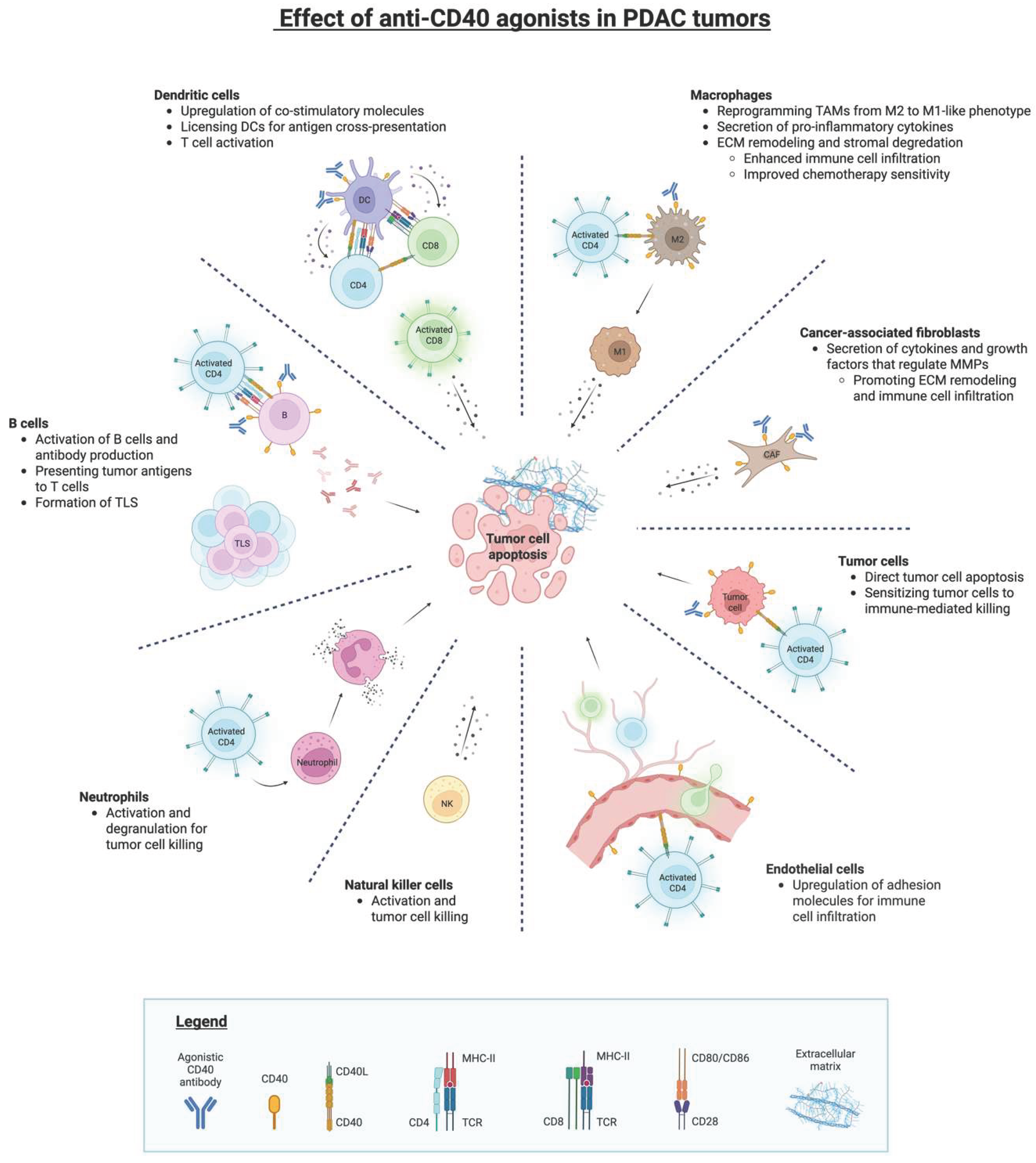

Table 1.
Monoclonal CD40 agonists utilized in clinical trials with pancreatic cancer.
| Agent | Other names | Developer | Antibody class | Fc engineering |
|---|---|---|---|---|
| Sotigalimab | APX005M | Apexigen / Pyxis Oncology | IgG1 | Enhanced FcγRIIB binding |
| Mitazalimab | JNJ-64457107/ADC-1013 | Alligator Bioscience | IgG1 | FcγR crosslinking-dependent; no specific Fc engineering reported |
| Selicrelumab | RG7876/CP-870,893 | Pfizer / Genentech / Roche | IgG2 | None |
| CDX-1140 | - | Celldex Therapeutics | IgG2 | None |
| ChiLob 7/4 | - | University of Southampton | IgG1 | None |
| SEA-CD40 | - | Seagen | IgG1 | Non-fucosylated Fc; Enhanced FcγRIIIa binding |
| LVGN7409 | - | Lyvgen Biopharma | IgG1 | Selective FcγRIIB binding |
Table 2.
Completed clinical trials using monoclonal CD40 agonists in pancreatic cancer.
| Regimen | Design | Tumor type | Treatment scheme | Clinical outcomes | Immunological outcomes | Toxicity | Clinical trial/ reference |
|---|---|---|---|---|---|---|---|
| ChiLob 7/4 | Phase I | CD-40 expressing solid tumors and diffuse large B cell lymphoma (DLBCL), including 2 pancreatic cancer patients (total n=28) | ChiLob7/4 weekly for 4 doses | No objective responses. Disease stabilization in 15/29 treatments (52%), with median duration of 6 months. | Signs for immune activation and effector cell trafficking. | Well-tolerated. One DLT. Infusion reactions could be prevented with single-dose corticosteroid premedication. | NCT01561911 [98] |
| SEA-CD40 | Phase I | Advanced solid tumors (n=56) and lymphoma (n=11), including 3 pancreatic cancer patients (total n=67) |
SEA-CD40 monotherapy in 21-day cycle. | One CR and three SD in seven lymphoma patients. | Cytokine induction and activation of T cells and NK cells in the peripheral blood | Acceptable safety profile. Infusion/hypersensitivity reactions (IHRs) in 73% of the patients, primarily grade 1-2. | NCT02376699 [193] |
| CP-870,893 (=selicrelumab) + gemcitabine | Open-label, dose-escalation, phase I |
Chemotherapy-naive patients with advanced PDAC (n=22). | Gemcitabine once weekly for three weeks with CP-870893 48 hours after gemcitabine on day three of each 28-day cycle. | Median PFS 5.2 months (95% CI: 1.9-7.4). Median OS 8.4 months (95% CI: 5.3-11.8). 1-year OS 28.6%. ORR 19% (4/22 patients). |
Increase in inflammatory cytokines. Increase in B cell expression of costimulatory molecules. Transient depletion of B cells. | Well-tolerated. One DLT. Most common AE was CRS (grade 1 to 2). | NCT00711191 [140] |
| Selicrelumab +/- Gem/Nab | Open-label, phase I |
Resectable PDAC (n=16). |
Arm I (n=16): neoadjuvant selicrelumab two weeks prior to surgery. Arm II (n=11): neoadjuvant Gem/Nab followed by selicrelumab two days later, prior to surgery. Adjuvant Gem/Nab followed by selicrelumab two days later, up to four 28-day cycles, in both arms. |
Both arms (n=16): Median OS 23.4 months (95% CI: 18.0-28.8). Median DFS 13.9 months (95% CI: 2.9-24.8). Arm I: Median OS 23.4 months (95% CI: 9.1-37.6). Median DFS 9.8 months (95% CI: 0.4-19.2). 1-year DFS 49.9%. 1-year OS 81.8%. Arm II: Median OS and DFS are not reached. 1-year DFS 75.0%. 1-year OS 100%. |
82% of the treated tumors were T cell enriched. More active and proliferative T cells in both TME and circulation. Reduced tumor fibrosis. Less M2-like macrophages. More mature intratumoral DCs. Systemically increased inflammatory cytokines. | Acceptable toxicity profile. Selicrelumab related AEs were mostly mild; 5 patients with grade 3 AEs, and one patient with grade 4 AE. Three SAEs observed in two patients. | NCT02588443 [43] |
|
Mitazalimab + mFOLFIRINOX (OPTIMIZE-1) |
Single-arm, phase Ib/II |
Chemotherapy-naive patients with metastasized PDAC (n=70) |
During the first 21 day treatment cycle, mitazalimab on day 1 (priming dose) and on day 10, and mFOLFIRINOX on day 8. During subsequent 14-day treatment cycles, mFOLFIRINOX on day 1 and mitazalimab on day 3. | Median PFS 7.7 months (95% CI: 5.8-11.3). Median OS 14.3 months (95% CI: 10.0-21.6). 1-year PFS 34%. 1-year OS 59%. ORR 40% (23/57 patients). |
Mitazalimab-induced increases in activated circulating myeloid, B cell, and T cell frequencies correlate with better outcomes. Intratumoral myeloid and T cell activation in objective responders. |
Manageable safety. One DLT observed. Most common grade 3 or worse AEs: neutropenia 26%, hypokalaemia 16%, anaemia and thrombocytopenia 11%. SAEs in 41%, none considered related to mitazalimab. No treatment-related deaths. |
NCT04888312 [136,139] |
|
Sotigalimab (APX005M) + Gem/nab +/- nivolumab (PRINCE) |
Non-randomized, open-label, four cohort, phase Ib |
First line treatment for metastasized PDAC (n=30) |
1) Nivolumab + Gem/Nab, 2) Sotigalimab + Gem/Nab, 3) Sotigalimab + nivolumab + Gem/Nab. Nivolumab on days 1 and 15. Sotigalimab on day 3 (=2 days after chemotherapy), or on day 10 if patients received chemotherapy on day 8. |
Median PFS 11.7 months (95% CI: 7.1-17.8). Median OS 20.1 months (95% CI: 10.5-not estimable). ORR 58% (14/24 DLT-evaluable patients). |
Decrease of naïve B cells and increase of plasmablasts. Increased frequency of CD141-negative myeloid DCs and pDCs. Increased proportions of activated CD8+ and CD4+ T cells. Increased proportions of CD4+ naïve, central memory, and regulatory T cells. Decreased KRAS VAF (in 12/14 patients who had detectable KRAS mutations in plasma). |
Treatment is tolerable. Two DLTs (grade 3 and 4 febrile neutropenia), however deemed unrelated to either sotigalimab or nivolumab. 14 (47%) patients with treatment-related SAE. Most common were pyrexia, sepsis, haemolytic uraemic syndrome, and nausea. Overall, grade 3 or 4 treatment-related adverse events occurred in 28 (93%) of 30 patients and were clinically manageable. Most common grade 3-4 treatment-related AEs were haematological and generally transient (lymphocyte count decrease, neutrophil count decrease, and anaemia). No grade 3-4 CRS and infusion reactions. Two deaths due to AEs related to Gem/Nab (sepsis and septic shock in the setting of neutropenia). One death from an unknown cause occurring 4 months after the last study intervention. |
NCT03214250 [137] |
|
Sotigalimab (APX005M) + Gem/Nab +/- nivolumab (PRINCE) |
Randomized, open-label, phase II |
First line treatment for metastasized PDAC (n=105) |
1) Nivolumab + Gem/Nab, 2) Sotigalimab + Gem/Nab, 3) Sotigalimab + nivolumab + Gem/Nab. Nivolumab on days 1 and 15. Sotigalimab on day 3 (=2 days after chemotherapy), or on day 10 if patients received chemotherapy on day 8. |
1) Nivo/chemo (n=34): Median PFS 6.4 months (95% CI: 5.2-8.8). Median OS 16.7 months (95% CI: 9.8-18.4). 1-year OS 57.7% ORR 50% (95% CI: 32-68). 2) Sotiga/chemo (n=36): Median PFS 7.3 months (95% CI: 5.4-9.2). Median OS 11.4 months (95% CI: 7.2-20.1) 1-year OS 48.1% ORR 33% 3) Sotiga/nivo/chemo (n=35): Median PFS 6.7 months (95% CI: 4.2-9.8). Median OS 10.1 months (95% CI: 7.9-13.2). 1-year OS 41.3% ORR 31%. |
98% of the patients had at least one treatment related AE. Most common grade 3-4 treatment related AEs were hematologic and generally transient. Two patients died due to an AE. One from acute hepatic failure possibly related to sotiga/chemo. One from intracranial haemorrhage possibly related sotiga/nivo/chemo. |
NCT03214250 [138] |
|
|
Mitazalimab + autologous DC vaccine (REACtiVe-2) |
Open-label, dose-escalation, phase I |
Metastasized PDAC (n=16) |
Biweekly 25 × 10[6] DCs (1/3 i.d. and 2/3 i.v.) co-administered with mitazalimab for the first three administrations, followed by a fourth and fifth administration if no disease progression. | In patients without PD at baseline: Median PFS 2.76 months (IQR: 2.40-6.86), and median OS 12.1 months (IQR: 5.74-21.77). 1-year PFS rate 13% 1-year OS rate 50%. No objective radiological response. 8/16 patients (50%) with SD after 3x administrations. | Systemic increase in activated and vaccine-specific T cell responses. Increased T cell infiltration and decreased collagen deposition in post-treatment biopsies. | Safe and well-tolerated. One transient DLT (grade 3 fever). | NCT05650918 [155] |
Disclaimer/Publisher’s Note: The statements, opinions and data contained in all publications are solely those of the individual author(s) and contributor(s) and not of MDPI and/or the editor(s). MDPI and/or the editor(s) disclaim responsibility for any injury to people or property resulting from any ideas, methods, instructions or products referred to in the content. |
© 2026 by the authors. Licensee MDPI, Basel, Switzerland. This article is an open access article distributed under the terms and conditions of the Creative Commons Attribution (CC BY) license (http://creativecommons.org/licenses/by/4.0/).
Copyright: This open access article is published under a Creative Commons CC BY 4.0 license, which permit the free download, distribution, and reuse, provided that the author and preprint are cited in any reuse.


