

Submitted:
03 May 2026
Posted:
05 May 2026
You are already at the latest version
Abstract
Environmental RNA (eRNA) has been increasingly used to move beyond “who is there” toward “who is active” and “what is happening” in ecosystems. Yet, most workflows have been optimized for laboratory sequencing, and decision-grade field use has remained sporadic. In this article, field-ready eRNA panels are defined as curated sets of transcripts paired with process controls and a transparent scoring rule, and a build–test pathway is described from marker discovery to deployment. Candidate markers are prioritized with field constraints in mind (abundance, specificity, persistence, and confounding seasonality), and RNA class choice (mRNA, rRNA, small and other non-coding RNAs) is treated as a design lever for robustness. Pre-analytics are discussed as panel engineering, with emphasis placed on capture, rapid stabilization, and inhibitor management to preserve multi-marker relationships. Field readout options are then compared, including isothermal amplification, CRISPR-assisted detection, portable qPCR, and portable nanopore sequencing for on-site verification and panel refresh. Finally, minimum controls and staged validation levels are proposed to support defensible ecological claims. Deliberate attention is directed toward shared terminology and testable standards so that discussion within and between ecology, diagnostics, and conservation practice is stimulated and priorities for future investigations are sharpened.
Keywords:
field-ready eRNA panels
; environmental RNA
; isothermal amplification
; CRISPR-based detection
; portable nanopore sequencing
; conservation monitoring
; biomarker validation
1. Introduction
Biodiversity monitoring has been increasingly shaped by environmental nucleic acids because species detection has been enabled without capture, handling, or direct observation, and because broad taxonomic coverage has been obtained from water, soil, sediments, and air-associated matrices (Bohmann et al., 2014; Çevik & Çevik, 2025). In conservation practice, eDNA-based approaches are increasingly positioned as highly sensitive, efficient, and largely non-invasive complements (rather than replacements) to traditional surveys, particularly for improving detection of rare, invasive, or otherwise elusive taxa (Bohmann et al., 2014; Çevik & Çevik, 2025). At the same time, inference on current local occupancy has often been complicated by transport and persistence of DNA, with temporal mismatch being introduced between biological presence and molecular detection (Çevik & Çevik, 2025).
Interest has therefore been directed toward environmental RNA (eRNA), where shorter persistence and closer linkage to transcriptional activity have been emphasized as potential advantages for time-sensitive ecological questions (Kagzi, Hechler, Fussmann, & Cristescu, 2022; Yates, Derry, & Cristescu, 2021; Zou et al., 2025). In recent syntheses, eRNA has been described as spanning (i) RNA-templated metabarcoding for biodiversity inference, (ii) metatranscriptomics for community function, and (iii) targeted transcript assays for organismal state, exposure, or life-history events (Rishan, Kline, & Rahman, 2024; Zou et al., 2025). Proof-of-concept demonstrations have also been reported in which tissue-biased transcripts in water have been leveraged to infer fish reproductive activity, illustrating how narrowly defined markers can be moved toward field-relevant ecological endpoints (Aminaka, Wong, Yada, & Hyodo, 2025). In parallel, a broader RNA biology has been argued to be underused in environmental monitoring, and panel design has been expanded conceptually beyond mRNA to include structural and non-coding RNAs that can be informative for stress, development, and adaptation (Ahi & Schenekar, 2025).
Despite this momentum, most eRNA workflows have remained centered on laboratory sequencing pipelines, and field deployment has been constrained by sensitivity to pre-analytical handling, mixed-origin templates, and matrix-specific inhibition (Rishan et al., 2024; Yates et al., 2021; Zou et al., 2025). Faster decay of eRNA relative to eDNA has been quantified under controlled conditions, reinforcing that time-to-stabilization and physicochemical context can shift detectability and interpretation (Kagzi et al., 2022). Method development has further shown that capture media, preservation choices, and short-term storage conditions can materially alter recovered eRNA and therefore can alter downstream conclusions unless controlled and reported explicitly (T. S. Jo, 2023; T. Jo, Tsuri, Hirohara, & Yamanaka, 2023).
Translation to decision-grade applications has also been limited by uneven reporting and validation practices across studies and ecosystems (Rishan et al., 2024; Zou et al., 2025). Minimum-information guidance has recently been extended to workflows that include eRNA, including the MIEM checklist for environmental metabarcoding reporting and archiving (Klymus et al., 2024). For eRNA specifically, a minimum-information standard (eRNA-Min) has been proposed to reduce overstatement of biomarker claims and to improve traceability of pre-analytical context, controls, and analytical provenance (Ahi, 2025). In parallel, assay-centric reporting standards have been updated for quantitative workflows, including MIQE 2.0 for qPCR and dMIQE2020 for dPCR, and these standards have been considered directly relevant where targeted eRNA panels are intended for management decisions rather than exploratory discovery (Bustin et al., 2025; Whale et al., 2020).
Meanwhile, a mature technology landscape has been assembled for field molecular readout, including isothermal amplification, CRISPR-assisted detection, and portable sequencing, and these methods have already been adapted to environmental nucleic acids in biosecurity and conservation contexts (Durán-Vinet et al., 2025; Gygax et al., 2025; Leugger, Lüthi, Schmidlin, Kontarakis, & Pellissier, 2025; Varzandi, Reska, Urban, Zanet, & Ferroglio, 2025). CRISPR-based environmental biosurveillance (CRISPR-eBx) has been synthesized as a route to portable and highly specific detection across water, soil, and air, including applications to invasive and endangered species (Durán-Vinet et al., 2025). Field CRISPR-Dx protocols have further been demonstrated for rapid on-site eDNA detection of a threatened mammal, highlighting how sample-to-answer workflows can be compressed to support immediate field decisions even when sensitivity tradeoffs remain (Leugger et al., 2025). Portable nanopore sequencing has also been shown to support mobile, in situ environmental workflows and rapid screening, offering a practical route for on-site verification and panel refresh when reference gaps or unexpected taxa are encountered (Gygax et al., 2025; Varzandi et al., 2025).
In this article, field-ready eRNA panels are defined as curated sets of transcript targets paired with process controls and an explicit scoring rule, and a build–test pathway is outlined from marker discovery to deployable readout (Ahi, 2025; Ahi & Schenekar, 2025; Yates et al., 2021). Discussion within and between ecology, diagnostics, and conservation practice is intended to be stimulated by shared terminology and testable expectations, so that future investigations can be directed toward reproducible panel engineering rather than repeated reinvention of end-to-end workflows (Bustin et al., 2025; Durán-Vinet et al., 2025; Klymus et al., 2024). The build–test pathway from context definition to deployment is summarized as a stage-gated workflow (Figure 1).
| Box 1 | Panel readiness levels (PRL) for field-ready eRNA panels |
|
PRL0: Concept and context fixed - Context of use, target taxa/community, matrix, and decision consequence are stated. - Claim type is pre-registered (presence; recent activity; phenology; condition). PRL1: Candidate markers and assay blueprint - Candidate targets are justified from discovery data or prior biology. - In-silico specificity is documented against local/non-target references where available. - Assay blueprint is drafted (targets, controls, scoring rule concept). PRL2: Analytical validation on reference material - Assay performance is established on reference templates (LOD/LOQ as relevant, repeatability). - RNA/DNA discrimination is demonstrated where needed (RT(–) and DNase logic). - Core negative/positive controls are defined and shown to behave as intended. PRL3: Matrix resilience and pre-analytics locked - Performance is demonstrated in real extracts or matrix spikes (inhibition frequency, mitigation rule). - Capture, stabilization, and extraction steps are fixed as an SOP (with time-to-stabilization limits). - Contamination-resilience measures are implemented (closed-tube preference; carryover prevention plan). PRL4: Field pilot with independent confirmation - Field detections are replicated across sites/days and compared to an independent line of evidence (survey data, lab confirmatory assay, or orthogonal molecular method). - The scoring rule is finalized (thresholds, replicate concordance rule, “indeterminate” category). PRL5: Transferability and operational QA - Reproducibility is demonstrated across operators (and ideally labs) using the same SOP. - Run-level acceptance criteria are enforced (blank behavior, IAC pass/fail, replicate rules). - Reporting package is complete (metadata + controls + analysis provenance). PRL6: Program integration and lifecycle management - Decision triggers and escalation pathway are codified (screen → confirm → action). - Drift is monitored (seasonal confounders; reagent lots; instrument checks). - “Panel refresh” is scheduled (sequence verification / local variant checks when needed). |
2. What is a Field-Ready eRNA Panel?
Environmental RNA (eRNA) has been positioned as a next-step environmental nucleic acid readout because temporal proximity to biological activity and richer ecological interpretation have been sought beyond presence–absence inference (Yates et al., 2021; Zou et al., 2025). In parallel, the breadth of environmental RNA biology has been highlighted as underused, with non-coding and structural RNA classes having been argued to hold ecological signal that is not captured by mRNA-centric approaches (Ahi & Schenekar, 2025).
In this article, a field-ready eRNA panel is defined as a curated set of eRNA targets, paired with explicit process or analytical controls and an interpretation rule, that can be executed within a realistic field workflow (Ahi, 2025; Ahi & Schenekar, 2025; Yates et al., 2021; Zou et al., 2025). The “panel” concept has been treated as technology-agnostic: readout can be performed by parallel singleplex assays, small multiplex sets, or staged screening or confirmation, provided that the same claim and evidence standard are maintained (Ahi, 2025; Macher et al., 2024). Field readiness is best framed by constraints that are imposed by conservation operations—time-to-result, portability, tolerance to inhibitors, and interpretability by non-specialists—rather than by the analytical platform alone (Ahi, 2025; Zou et al., 2025).
Panel purpose has been clarified when the claim has been stated explicitly (Ahi, 2025; Yates et al., 2021; Zou et al., 2025). Four claim types have been repeatedly invoked in the eRNA ecology literature and can be used as a practical taxonomy for panel design (Ahi, 2025; Ahi & Schenekar, 2025; Yates et al., 2021; Zou et al., 2025).First, occupancy or presence claims have been supported when stable targets that maximize detectability have been prioritized, with rRNA-derived targets often being treated as high-copy candidates (Yates et al., 2021) (Marshall, Vanderploeg, & Chaganti, 2021). Second, recent activity or “live” signal claims have been advanced where RNA-based measurements have been expected to reduce legacy signal relative to DNA, and this has been supported by empirical comparisons in which eRNA detections have been shown to be more localized or to show lower false-positive tendencies in contexts where dead material is likely to accumulate (Macher et al., 2024; Z. Xue et al., 2024). For example, eRNA and eDNA metabarcoding have been compared in a lowland stream, and greater localization of eRNA detections has been reported despite broadly comparable taxonomic recovery(Macher et al., 2024). In ballast-water monitoring, eRNA metabarcoding has been used to reduce apparent false positives after disinfection, consistent with the interpretation that extracellular or dead-derived DNA can inflate eDNA-based diversity estimates (Z. Xue et al., 2024). Differences between eRNA and eDNA community signals have also been demonstrated in estuarine mesocosms, reinforcing that template choice can shift ecological conclusions even when sampling and marker loci are held constant (Giroux, Reichman, Langknecht, Burgess, & Ho, 2022).
Third, demography or phenology claims have been enabled when tissue- or stage-biased transcripts have been targeted (Aminaka et al., 2025; Parsley & Goldberg, 2024; Yates et al., 2021). Life-stage discrimination has been demonstrated in amphibian pond systems by targeting larval-associated transcripts, where larvae-specific eRNA has been detected only when larvae have been present despite persistent eDNA detections (Parsley & Goldberg, 2024). Reproductive phenology has similarly been approached through targeted markers, with a gonad-associated transcript having been linked to spawning behavior in fish through concurrent behavioral observation and water-sample quantification (Aminaka et al., 2025). Fourth, condition, stress or functional-state claims have been motivated by metatranscriptomic and targeted-expression applications, and recent reviews have emphasized that translation of those signals will depend on careful marker selection and rigorous claim discipline (Ahi, 2025; Ahi & Schenekar, 2025; Zou et al., 2025) (Figure 2).
A panel architecture has been favored over single-marker assays because environmental RNA signal is rarely shaped by a single process (Ahi, 2025; Yates et al., 2021; Zou et al., 2025). Rapid and target-specific decay has been repeatedly shown, with mRNA and rRNA components being lost on different timescales, and with the eRNA:eDNA ratio having been proposed as a way to estimate the “age” of shed material in controlled settings (Marshall et al., 2021). In a more recent decay experiment spanning multiple eNA components, differential persistence of mitochondrial eDNA of different lengths, ribosomal eRNA, and messenger eRNA has been quantified, underscoring that inference can be shifted substantially by target choice even before sampling design is considered (Brandão-Dias et al., 2025). For these reasons, multi-target designs (e.g., “structural anchor + functional marker” or “presence marker + state marker”) have been treated as a practical route to internal consistency checks and more defensible interpretation (Ahi, 2025; Ahi & Schenekar, 2025; Brandão-Dias et al., 2025; Marshall et al., 2021).
To avoid ambiguity, a panel specification is best documented in advance by stating (i) the context of use, (ii) the exact claim type, (iii) likely confounders, and (iv) minimum performance evidence. A recent minimum-information proposal (eRNA-Min) has provided a structured “biomarker claim card” concept for this purpose, and it has been designed to make evidence tiers and assumptions explicit from single-species assays through community-scale profiles (Ahi, 2025). In the following section, marker selection and RNA-layer choice are therefore treated as the first engineering step in building panels that can survive the transition from sequencing discovery to field decisions.
3. From Discovery to Markers: Choosing Targets and RNA Types
Marker selection has been constrained first by the ecological claim that is intended to be supported, because the same transcript can be informative for one context (e.g., phenology) yet misleading for another (e.g., occupancy) (Stevens & Parsley, 2023). Candidate targets have therefore been recommended to be chosen only after the likely biological source of shed RNA has been specified (mucus or epithelia, gametes, sloughed cells, or tissue fragments) and after the expected direction of change has been stated (constitutive presence versus conditional upregulation) (Stevens & Parsley, 2023). Marker triage is positioned as an early stage gate in the overall panel workflow (Figure 1).
In practice, discovery has been built from three main inputs: (i) organismal transcriptomes and gene-expression resources, (ii) controlled exposure or life-stage contrasts, and (iii) environmental transcriptomics (Aminaka et al., 2025; Stevens & Parsley, 2023). A concrete “shortlist” workflow has been illustrated for spawning inference, where literature- and transcriptome-based candidates were filtered by tissue specificity, detectability in water, and assay behavior under genomic DNA carryover, before a final marker was retained (Aminaka et al., 2025). Comparable logic has been applied for demographic inference in amphibians, where stage-associated transcripts were targeted so that larval presence could be distinguished from adult-only conditions under laboratory validation and field sampling (Parsley & Goldberg, 2024).
For stress and exposure endpoints, discovery has been strengthened when extra-organismal eRNA profiles have been explicitly compared against organismal RNA from the same individuals or communities (Gou et al., 2025; Hechler, Yates, Chain, & Cristescu, 2023; Hiki, Yamagishi, & Yamamoto, 2023; Miyata, Inoue, Yamane, & Honda, 2025). In a proof-of-concept toxicology study, hundreds to thousands of fish genes were detected from water eRNA, correlation with tissue read counts was reported, and differentially expressed genes were recovered under sublethal exposure despite strong non-target read dominance (Hiki et al., 2023). Improved gene recovery and pathway-level interpretation have been reported when short, well-timed sampling and optimized processing were applied in aquarium settings, where gene ontology analysis and larger sets of differentially expressed genes were obtained from fish eRNA (Miyata et al., 2025). Dose-resolved transcriptional responses have also been demonstrated from water eRNA in fish, supporting the view that discovery datasets can be used to identify markers that behave monotonically with stress intensity rather than only in binary contrasts (Gou et al., 2025). At the community scale, environmental transcriptomics under heat stress has shown that extra-organismal eRNA can recover both species-specific responses (e.g., Daphnia differentially expressed genes) and multi-taxon functional shifts across trophic levels (Hechler et al., 2023). Extension to complex freshwater mesocosms has further shown that eRNA-based metatranscriptomics can detect pollutant-associated functional pathways across diverse eukaryotes, while highlighting annotation and compositional confounding as dominant analytical constraints during discovery (He et al., 2025).
A triage funnel has been needed because discovery lists are typically too long and too context-dependent to be deployed directly (He et al., 2025; Hiki et al., 2023; Stevens & Parsley, 2023). As a first filter, markers have been preferred when expression is concentrated in tissues plausibly shed into the sampled matrix and when contrast is large enough to be interpreted against dilution (for instance, strong tissue specificity for reproductive markers, or robust induction for stress markers) (Aminaka et al., 2025; Parsley & Goldberg, 2024; Stevens & Parsley, 2023). As a second filter, targets have been down-selected when detectability is retained in environmental extracts rather than only in tissues, because several candidates that amplify cleanly from pooled tissue can fail in water due to low abundance or instability (Aminaka et al., 2025). As a third filter, sequence “assayability” has been treated as non-negotiable, because false positives can be introduced by genomic DNA carryover and because exon–intron structure can be exploited to reduce that risk through exon–exon spanning designs and systematic no–reverse-transcriptase testing (Aminaka et al., 2025). In spawning-marker development, routine RT(–) screening and redesign or exclusion criteria have been emphasized as essential, particularly when sperm-rich samples are involved and DNA carryover is expected to be high (Aminaka et al., 2025).
Cross-species portability has been treated as a deliberate choice rather than a default, because conservation monitoring alternates between needs for broad transfer (multi-site programs) and strict specificity (rare taxa in mixed communities) (Aminaka et al., 2025; Stevens & Parsley, 2023). When portability has been sought, conserved functional genes have been favored as “core” targets, while non-coding or highly variable regions have been suggested as levers to maintain specificity among closely related taxa when required (Aminaka et al., 2025). When portability has not been feasible, marker design has been constrained by available reference sequences, and gaps in eukaryotic genome resources have been identified as a practical ceiling on how far community-wide discovery can be converted into validated panels (He et al., 2025).
RNA-type choice has been positioned as part of marker engineering, because temporal sensitivity and robustness have been shown to differ strongly between RNA classes (Brandão-Dias et al., 2025; Z. Xu & Asakawa, 2025). In a controlled decay experiment spanning multiple eNA components, mitochondrial messenger eRNA was reported to disappear within hours, whereas ribosomal eRNA persisted longer and decayed on a timescale closer to (but still faster than) an rDNA counterpart, reinforcing that “eRNA” should not be treated as a single persistence class (Brandão-Dias et al., 2025). Dissolved environmental RNA has also been shown to pass through 0.45 μm filtration and to remain partly detectable for extended periods in non-sterile water under tube storage, while being modeled to reach low ambient levels that challenge current detection in realistic waters, indicating that persistence can be prolonged in some contexts even as detectability remains limiting (Z. Xu & Asakawa, 2025).
Broader RNA layers have therefore been recommended to be considered during panel building, because functional inference does not have to be restricted to mRNA abundance alone (Ahi & Schenekar, 2025). Regulatory and structural RNAs have been highlighted as potential markers for stress, development, and adaptation, and the dependence of interpretability on RNA biology (biogenesis, compartmentalization, turnover) has been emphasized as an underused advantage rather than an added complication (Ahi & Schenekar, 2025). MicroRNAs have been particularly notable because extracellular stability has been linked to protein association and vesicle packaging, and because stress-associated shifts have been detected not only in blood and mucus but also in surrounding water after acute stress in fish (Ikert et al., 2021). Epitranscriptomic RNA modifications (e.g., m⁶A, pseudouridine, and m⁵C) can reshape RNA structure, stability, and turnover, suggesting that modification state could be treated as an additional environmental marker-design axis rather than as background chemistry. RNA aptamers, highlighted as programmable and antibody-free binders, could in principle be engineered for modification-aware capture or sensing of target RNAs if adapted to environmental matrices, potentially improving selectivity in complex mixtures (Khorshid & Ahi, 2026). The broader conceptual case for exploiting multiple RNA types (including surprisingly stable classes) has also been made in the foundational eRNA literature, which has argued that functional information can be retrieved from environmental RNA if the correct layer and scale of inference are chosen (Cristescu, 2019).
4. Field Sampling for eRNA: Capture, Stabilization, and Inhibitors
Field performance of eRNA panels has been shaped disproportionately by pre-analytics, because RNA has been altered rapidly by capture materials, handling time, storage conditions, inhibitors, and contamination risk (Ahi, 2025; T. S. Jo, 2023). In recent minimum-information guidance, these pre-analytical variables have been treated as core metadata rather than optional details, because panel interpretation can be shifted even when downstream assays are unchanged (Ahi, 2025). In aquatic applications, filtration has been used most often to concentrate eRNA, but no universal “best” filter has been established because trade-offs have been imposed by particle size distributions, clogging, and available field time (Bowers et al., 2021). In aquarium validation, similar target eRNA concentrations were recovered on GF/F and GF/A glass-fiber filters, while improved throughput was suggested for GF/A because larger volumes were passed within practical filtration times (T. S. Jo, 2023). Extraction yield has also been shown to be sensitive to lysis chemistry and volume, with a modest increase in lysis buffer volume producing a large increase in recovered target eRNA in controlled tests (T. S. Jo, 2023). These observations have supported an operational view in which capture efficiency and extraction efficiency must be treated as a coupled system during method optimization, rather than as separable steps (Bowers et al., 2021)(T. S. Jo, 2023).
A second design choice has been created by partitioning of eRNA between particulate-associated and dissolved fractions (Z. Xu & Asakawa, 2025). In controlled experiments, most RNA extracted from zebrafish cells has been reported to pass through 0.45 μm filters, indicating that a dissolved or subcellular fraction can dominate depending on the source and physical state of RNA (Z. Xu & Asakawa, 2025). Because dissolved RNA has been predicted to reach low ambient concentrations under plausible natural-water scenarios, filtration decisions have been encouraged to be aligned with the intended claim (e.g., cell-associated transcripts for state inference versus short fragments for presence screening) (Z. Xu & Asakawa, 2025).
Stabilization has been treated as the critical choke point for field deployment because delays between sampling and stabilization have been shown to translate directly into false negatives (Wang, Xiong, Huang, & Zhan, 2025). In a coastal case study, marked declines in fish taxon richness were reported after short storage periods, with no taxa detected after 72 h under any tested temperature and with measurable losses observed even after 1 h (Wang et al., 2025). These findings have reinforced the practice of immediate on-site filtration when possible, while also highlighting that “time-to-filtration” should be recorded explicitly because it can dominate variability across replicates and sites (Wang et al., 2025). Practical alternatives to deep-freezing have been demonstrated, including on-filter preservation using RNAlater, where stable preservation of target eRNA on filters was reported at −20 °C and even at 4 °C for at least six days (T. S. Jo, 2023).
Preservation constraints have been intensified in sediments and saline envirnments, where ionic strength and co-extracted inhibitors can shift RNA integrity and downstream behavior (Keneally, Gaget, Kidd, & Brookes, 2024). Across an estuarine salinity gradient, snap freezing was reported to improve eDNA yield in low-salinity sediments but to reduce eRNA integrity in marine and hypersaline conditions, whereas a preservation solution (LifeGuard) improved eDNA and eRNA recovery across all salinities (Keneally et al., 2024). These results have supported a general recommendation that preservation strategy should be matched to matrix chemistry rather than adopted wholesale from eDNA workflows (Keneally et al., 2024).
Environmental context has further been shown to alter eRNA persistence and therefore the window in which sampling remains interpretable (T. Jo et al., 2023; Kagzi et al., 2022). In factorial aquarium experiments, faster eRNA degradation was reported at higher temperatures and under alkaline conditions, and the eRNA:eDNA ratio was observed to decrease over time, consistent with use of paired molecules as a “freshness” axis under controlled conditions (T. Jo et al., 2023). Across a broad pH gradient, faster decay of eRNA than eDNA was quantified in microcosms, with detectability of eRNA predicted for up to ~57 h under neutral pH in the tested system (Kagzi et al., 2022). Differential decay among eNA components has also been documented in a multi-target experiment, where ribosomal eRNA and messenger eRNA were reported to persist on different timescales, implying that multi-marker panel ratios can drift even when sampling and extraction are held constant (Brandão-Dias et al., 2025). For this reason, field sampling for panels has been framed most defensibly when environmental covariates (temperature, pH, salinity, turbidity) and handling times are recorded as potential modifiers of marker relationships rather than as background context (Brandão-Dias et al., 2025; T. Jo et al., 2023; Kagzi et al., 2022).
Matrix-derived inhibitors remain a major barrier because inhibition can be imposed on reverse transcription, polymerase activity, or both, and can vary among targets within the same extract (Alm, Zheng, & Raskin, 2000; Lim, Roco, & Frostegård, 2016; Linzner et al., 2024). RNA extracts from environmental samples have been shown to be frequently contaminated with humic substances and co-extracted DNA, and reduced hybridization response has been demonstrated as humic and DNA loads increase, illustrating the general susceptibility of RNA workflows to co-extracted material (Alm et al., 2000). For inhibitor-rich soils, co-extraction and purification have been shown to require extensive cleanup prior to enzymatic steps, because enzymatic inhibition and inconsistent DNase performance can persist even when commercial kits are used (Lim et al., 2016). In wastewater matrices, humic acid has been highlighted as a prevalent inhibitor that can impair reverse transcription, and improved sensitivity has been reported when inhibitor-removal steps are incorporated into total nucleic acid workflows (Linzner et al., 2024). Chemical strategies for inhibitor mitigation have also been demonstrated in difficult soils, where inhibitor adsorption (e.g., PVP) and targeted removal (e.g., aluminum sulfate) enabled recovery of dsRNA suitable for qRT-PCR from clayed and sandy matrices (Zarrabian & Sherif, 2025).
Taken together, field sampling has been treated most usefully as “panel engineering,” where capture and preservation are designed to keep multi-marker relationships intact and where inhibition is anticipated and measured rather than discovered post hoc (T. S. Jo, 2023; Lim et al., 2016; Linzner et al., 2024). In the next section, these stabilized extracts are connected to field readout options, where amplification, detection chemistry, and multiplexing are selected to match the claims that panels are intended to support.
5. Field Readout Methods: Amplification, Detection, and Multiplexing
Field-ready eRNA panels have been limited less by marker availability than by the practicality of converting stabilized extracts into defensible results under field constraints (time, power, contamination control, and interpretability) (Durán-Vinet et al., 2025). In recent ecological deployments, rapid readout has been pursued through three complementary routes: portable PCR or qPCR, isothermal amplification, and CRISPR-assisted detection, with portable sequencing being used as a verification and “panel refresh” layer when unexpected targets are encountered (Doi et al., 2021; Durán-Vinet et al., 2025; Seimon et al., 2024). A practical comparison of field readout options, including typical constraints and best-fit roles in screening–confirmation designs, is provided in Table 1.
Portable PCR and qPCR have been used when quantification, multiplexing capacity, and established quality-control logic have been prioritized (Doi et al., 2021; Seimon et al., 2024). An ultra-rapid mobile PCR workflow has been demonstrated for on-site eDNA detection in ~30 minutes, illustrating that centralized thermocyclers are not strictly required when targeted detection is the primary goal (Doi et al., 2021). A point-of-detection qPCR platform has also been developed and validated for rapid, onsite detection of a critically endangered freshwater turtle, indicating that conservation workflows can be compressed into field-operable protocols while retaining assay familiarity for practitioners (Seimon et al., 2024). For eRNA panels, the same pathway has been extended by reverse transcription (one-step or two-step), although reagent cold-chain and RNase control have generally been more demanding than for DNA-only assays (Durán-Vinet et al., 2025; Seimon et al., 2024).
Isothermal amplification has been favored when minimal instrumentation has been needed and when “screening speed” has been valued over absolute quantification (Durán-Vinet et al., 2025; Hartle-Mougiou et al., 2024; Hayes, Gouthro, & Gagnon, 2025; Kageyama et al., 2022). In ecology-facing applications, quantitative colorimetric LAMP has been coupled to a portable device for rapid detection and quantification of invasive lionfish eDNA, and qualitative detection has been shown to be feasible directly from the collection filter without a separate extraction step (Hartle-Mougiou et al., 2024). A portable LAMP-based kit has similarly been validated for invasive carp eDNA, reinforcing that field-ready workflows can be built around simple incubation and endpoint readouts when a limited number of high-priority targets are monitored (Kageyama et al., 2022). For eRNA panels, these designs have been translated through RT-LAMP, and environmental virus surveillance has provided the clearest demonstration of the approach: RT-LAMP has been applied to wastewater and surface-water samplers with semi-quantitative spectrophotometric readout, internal controls, and defined positivity thresholds, while agreement with RT-qPCR has been reported primarily above low-template ranges where stochasticity and inhibitors dominate (Hayes et al., 2025). Such results have underscored two practical design implications for panels: replication per sample has been required near the detection limit, and internal amplification controls have been needed to separate inhibition from true absence (Hayes et al., 2025).
Multiplexing under isothermal conditions has remained feasible but constrained (Hartle-Mougiou et al., 2024; Hayes et al., 2025). LAMP multiplexing has been complicated by primer–primer interactions and by an increased risk of spurious amplification, such that “small multiplex” or parallel singleplex strategies have often been preferred in field kits (Hartle-Mougiou et al., 2024; Hayes et al., 2025; Kageyama et al., 2022). Higher-throughput handling has therefore been approached operationally (multiwell formats, repeated replicates, staged screening or confirmation) rather than through high-order multiplex reactions that are fragile outside controlled laboratory conditions (Hayes et al., 2025).
CRISPR-assisted detection has been treated as a specificity upgrade for both DNA and RNA targets, particularly where false positives carry management costs (e.g., rare species, regulated invasives, or pathogen early warning) (Durán-Vinet et al., 2025; Kim et al., 2025; Leugger et al., 2025; Williams et al., 2025; J. Yang, Matsushita, Xia, Yoshizawa, & Iwasaki, 2024). Within ecological monitoring, CRISPR-based environmental biosurveillance (CRISPR-eBx) has been synthesized as a growing toolkit spanning water, soil, and air, with deployments reported for invasive and endangered species as well as pathogens, using Cas12 and Cas13 systems coupled to environmental nucleic acids (Durán-Vinet et al., 2025). A Cas13-based field method has been reported for rapid, low-cost, on-site detection of environmental DNA and RNA, using RPA followed by Cas13 cleavage to detect mitochondrial DNA or RNA targets from fish, thereby demonstrating that eRNA-compatible logic can be implemented in an ecology-oriented format (J. Yang et al., 2024). Field-based CRISPR-Dx has also been demonstrated for an elusive threatened mammal, where lateral flow readout enabled on-site eDNA detection across multiple locations and where subsequent laboratory confirmation clarified the sensitivity gap that can arise when extraction and amplification are simplified for speed (Leugger et al., 2025). In a separate on-site biosurveillance design, an RPA–CRISPR/Cas12a assay has been validated for chironomid larvae, with both fluorescence and lateral-flow formats and with field sampling and microscopy used for comparative validation; a low detection limit and simple deployment were emphasized as the main operational advantages (Kim et al., 2025).
Hardware simplification has been a decisive step for CRISPR field use, because fluorescence readout has often been the limiting component rather than nuclease activity (Durán-Vinet et al., 2025; Williams et al., 2025). A portable incubating fluorometer (SensEDNA) has been custom-built to run incubation and fluorescence detection for an RPA–CRISPR-Cas workflow and has been used for catchment-scale detection of Atlantic salmon eDNA, illustrating how compact optics can convert CRISPR assays into repeatable, triplicate-capable field measurements (Williams et al., 2025). In many conservation contexts, however, lateral-flow strips have remained the most robust endpoint readout because interpretability has been high and specialized optics have been avoided (Kim et al., 2025; Leugger et al., 2025).
Cross-contamination and workflow zoning have been recurring constraints for field amplification, especially when high-yield amplicons are produced (Feng et al., 2021; Hayes et al., 2025; C. Shi et al., 2025; Y. Yang, Wang, Xue, & Zhou, 2023). one-tube designs have therefore been pursued to reduce aerosol contamination and manual transfers (Y. Yang et al., 2023). A one-tube assay coupling CRISPR-Cas13a with RT-RPA has been reported for wastewater SARS-CoV-2 detection, with matrix resistance and reduced contamination risk emphasized and with performance validated in environmental water matrices (Y. Yang et al., 2023). More generally, technical integration challenges in combining reverse transcription, isothermal amplification, and CRISPR readout have been mapped in analytical method studies, and practical solutions (reaction compartmentalization, timing control, buffer compatibility) have been described as prerequisites for reliable one-pot or near-one-pot workflows (Feng et al., 2021). A recent comparative review of one-pot CRISPR-based isothermal amplification has further summarized integration strategies and failure modes, providing a useful design space for future eRNA panel deployments where transfers must be minimized (C. Shi et al., 2025). Portable nanopore sequencing is included in Table 1 as a complementary layer for verification and panel refresh rather than routine panel readout. Beyond amplification-centric workflows, RNA biosensors—spanning fluorogenic RNA aptamers, CRISPR-Cas sensors, riboswitches, and catalytic RNA sensors—have been reviewed as highly sensitive platforms for reporting RNA presence and regulatory state (including RNA modification state) and for tracking physiological responses to extrinsic stressors, suggesting a plausible future route to deployable multi-marker sensing if adapted and validated for inhibitor-rich environmental matrices (Ahi & Khorshid, 2025).
Portable nanopore sequencing has occupied a different niche within field-ready panels: routine panel readout has not been replaced, but on-site sequencing has been used for verification, for rapid updating of assay targets, and for extending detection beyond a predefined marker list when needed (Gygax et al., 2025; Maggini et al., 2024; Varzandi et al., 2025). A fully mobile nanopore eDNA workflow has been implemented in remote field conditions and has been used to complete sample-to-analysis metabarcoding on site, with nanopore performance compared directly against Illumina sequencing and with feasibility for in situ biodiversity assessment emphasized (Gygax et al., 2025). In applied marine monitoring, nanopore sequencing of “catch water” has been used onboard or near fisheries operations to estimate catch and bycatch composition, including threatened and vulnerable species, illustrating how portable sequencing can generate actionable biodiversity information without disrupting routine activities (Maggini et al., 2024). For wildlife health surveillance, PCR-free nanopore native sequencing has been used to screen environmental water for pathogens and has enabled early detection (later confirmed by ddPCR), indicating that sequencing can add an exploratory and confirmatory layer when the relevant threat is not limited to one or two predefined targets (Varzandi et al., 2025). For eRNA panels, these sequencing use cases have supported two pragmatic roles: (i) confirmation of assay targets and variants when false positives must be ruled out rapidly, and (ii) “panel refresh” when local populations, pathogens, or environmental communities differ from the reference sequences on which primers and guides were designed (Durán-Vinet et al., 2025; Gygax et al., 2025; Maggini et al., 2024; Varzandi et al., 2025).
Best biosensing platforms to be integrated for field-ready eRNA panels detection: Field-ready eRNA panels require not only robust molecular biology techniques (e.g., reverse transcription, amplification, and CRISPR-based recognition) (Y. Zhang et al., 2024; Zou et al., 2025), but also practical signal-transduction platforms that convert target recognition into measurable readouts under complex field constraints such as limited power, variable environmental conditions (e.g., pH, temperature, and salinity), non-specialist operators, contamination risk, and inhibitor-rich matrices. Accordingly, biosensor platforms including paper-based, microfluidic, electrochemical, transistor-based, acoustic and microbalances, as well as optical platforms, represent best possible choices that can improve the determination of eRNA panel outputs in real-world applications.
Paper-based biosensors and lateral flow assay (LFA) platforms remain among the most widely deployed formats for field molecular testing due to their low cost, simplicity, robustness, and low infrastructure requirements (Koczula & Gallotta, 2016). In the context of eRNA panels, LFAs are most commonly coupled to upstream reverse transcription, isothermal amplification, or CRISPR-based recognition, while the interpretability and decision value of the assay increasingly depend on the use of portable LFA readers rather than visual inspection alone (Farrell, Whitmore, & Duffy, 2021; M. Xue, Gonzalez, Osikpa, Gao, & Lillehoj, 2024). Reader-assisted LFAs enable objective signal quantification, reduce operator subjectivity, and support replicate concordance and threshold-based scoring rules that are required for decision-grade applications. LFA readers range from compact optical scanners and smartphone-assisted devices to dedicated handheld instruments designed for standardized illumination and signal capture. Their use facilitates semi-quantitative interpretation, longitudinal comparison across samplings, and integration of internal controls, thereby improving reproducibility under field conditions (Kinyua, Memeu, Mugo Mwenda, Ventura, & Velotta, 2025). Within a panel-engineering framework, the choice to deploy LFA readers should be treated as a platform-level design decision that directly affects quality assurance, data comparability, and progression toward higher panel readiness levels, particularly where non-specialist operators and multi-site deployments are anticipated.
Fully automated microfluidic devices provide another pathway to operational readiness by integrating (i) sample processing steps, (ii) reverse transcription and amplification (e.g., RT-qPCR or RT-LAMP), and (iii) sealed detection into compact cartridges or chips (Sayad et al., 2016). Such integration reduces manual transfers which in turn lowers the contamination risk, improves procedural standardization, and enables staged workflows (from screening to confirmation) that align naturally with decision-grade panel scoring (Sayad et al., 2016; X. Xu et al., 2024). Recent portable microfluidic platforms integrating RT-qPCR and RT-LAMP illustrate how dual-mode architectures can deliver both speed and confirmatory capability in a unified device format (Donia et al., 2022; B. Zhang et al., 2026).
Electrochemical biosensors (e.g., impedimetric, amperometric, and voltammetric) are real-time, label-free methodologies, which converts receptor-target biological interactions into measurable electrical signals. These platforms offer a compact, low-power signal transduction that can reduce reliance on fluorescence optics, with extensive development for multiplexed mobile molecular diagnostics (Khan et al., 2025; Suhag, 2025) Hybrid approaches that couple amplification and high-specificity recognition (including CRISPR) to electrochemical readout demonstrate a route to sensitive detection in portable formats (Jiang et al., 2025; Zakiyyah et al., 2025) However, as with other direct-sensing approaches, environmental deployment requires careful validation against matrix effects (such as inhibitors, particulates, ionic strength, and temperature changes) and signal drift considerations that should be explicitly captured during validation (J. Wu, Liu, Chen, Ma, & Ju, 2023)
Moreover, field-effect transistor (FET) biosensors, represent a promising real-time, label-free electrical readout platform for nucleic acids and small RNAs, with ongoing progress toward portable implementations. So far, FET performance is strongly influenced by solution electrostatics (e.g., Debye screening), surface fouling, and sample ionic strength, making rigorous validation on real environmental matrices essential before these platforms can be treated as decision-grade field tools (Hwang et al., 2020; Tian et al., 2020)
Acoustic and microbalance biosensors, such as quartz crystal microbalance (QCM), surface acoustic wave (SAW) devices, provide label-free detection of nucleic acids by measuring very small mass and viscoelastic changes associated with the probe (e.g., DNA or RNA sequences) hybridization at a functionalized surface of a piezoelectric crystal such as a gold-coated quartz (Hur, Han, Seon, Pak, & Roh, 2005; Mannelli, Minunni, Tombelli, & Mascini, 2003; Zhu, Gao, Shen, Yang, & Yuan, 2005). These platforms have been widely used to characterize nucleic-acid binding kinetics, probe performance, and surface chemistry under controlled conditions, and can operate in real time without fluorescent or enzymatic labels (Mannelli et al. 2003; Hur et al. 2005). Miniaturized and chip-scale acoustic resonators are increasingly being explored as portable biosensor components, although their deployment in inhibitor-rich environmental matrices remains limited by surface fouling, non-specific adsorption, and the need for stable fluid handling (Delica, Nazarov, De La Franier, & Thompson, 2025; Nair, Teo, & Li, 2022). Within a panel-engineering framework, microbalance biosensors are therefore best viewed as high-resolution transduction platforms for assay development and emerging compact devices, rather than as standalone field-ready detectors of eRNA.
Optical and photonic biosensing platforms provide highly sensitive and often label-free detection of nucleic acid hybridization and are widely used as analytical benchmarks in biosensor development (Jain, Chauhan, & Saxena, 2023). Surface plasmon resonance (SPR) and related refractive-index–based methods enable real-time monitoring of RNA- or DNA-probe interactions and are valuable for characterizing binding kinetics, specificity, and assay performance under controlled laboratory conditions (Carrascosa, Huertas, & Lechuga, 2016; Y. Wu et al., 2024). However, these platforms typically require stable optics, precise temperature control, and low-turbidity samples, which currently limits their applicability in field-deployable eRNA workflows (Ramirez-Priego, Mauriz, Giarola, & Lechuga, 2024). As a result, optical biosensors are best viewed as validation and development tools rather than primary field readouts for decision-grade eRNA panels.
Emerging optical approaches, including photonic crystal sensors and nanomaterial-enhanced fluorescence platforms, show promise for increased sensitivity and miniaturization, but their robustness in inhibitor-rich environmental matrices and under variable field conditions remains insufficiently validated (Zhong et al., 2016). Within a panel-engineering framework, optical biosensing therefore occupies an important role in assay benchmarking and platform comparison, while field deployment is more realistically achieved through compact optics integrated into CRISPR or isothermal amplification devices rather than through standalone photonic sensors.
In the next section, these readout options are linked to decision-grade panel design through controls, scoring rules, and staged validation expectations, so that speed is not purchased at the cost of ambiguous ecological claims.
6. Decision-Grade Panels: Controls, Scoring, and Validation
Decision-grade conclusions from field-ready eRNA panels have been made only when quality assurance has been treated as part of assay design rather than as an add-on (Ahi, 2025; Goldberg et al., 2016; Klymus et al., 2024; Shu, Ludwig, & Peng, 2020). For environmental nucleic acids, false positives have been most often introduced through contamination and assay cross-reactivity, whereas false negatives have been most often introduced through low template abundance, inhibition, and RNA loss during pre-analytics (Ahi, 2025; Buxton, Matechou, Griffin, Diana, & Griffiths, 2021; Goldberg et al., 2016; Klymus et al., 2024; Sepulveda, Hutchins, Forstchen, Mckeefry, & Swigris, 2020; Shu et al., 2020). Because eRNA panels can be interpreted as evidence for presence, recent activity, phenology, or condition, a conservative claim-and-evidence match has been recommended, with explicit documentation of what has been measured and what has been inferred (Pochon, Bowers, Zaiko, & Wood, 2025).
Controls across the full workflow: Negative controls have been required at each stage so that contamination sources can be localized (Goldberg et al., 2016; Klymus et al., 2024; Sepulveda et al., 2020; Shu et al., 2020). Field blanks, filtration blanks, extraction blanks, and no-template amplification controls have been repeatedly recommended for targeted and metabarcoding workflows, and amplification in any of these blanks has been treated as a trigger for troubleshooting rather than as background noise (Klymus et al., 2024; Sepulveda et al., 2020; Shu et al., 2020). For eRNA panels, no–reverse-transcriptase controls have been required when DNA carryover can plausibly mimic RNA signal, particularly for high-copy loci and for samples expected to contain cellular debris (Bustin et al., 2025; Pochon et al., 2025). In metabarcoding-style panels, the control taxonomy described in minimum-reporting guidance has been used to standardize what must be run and what must be reported, including positive controls that reveal tag-jumping, index hopping, or cross-run carryover (Klymus et al., 2024).
Positive controls have been used for two distinct purposes: process recovery and analytical performance (Ahi, 2025; Klymus et al., 2024; Shu et al., 2020). For analytical performance, quantified standards and dilution series have been used to establish amplification efficiency, linear range, and limit of detection, with reporting expectations having been formalized in MIQE 2.0 for qPCR and in dMIQE2020 for digital PCR (Bustin et al., 2025; Whale et al., 2020). For process recovery, exogenous nucleic acids have been spiked at known copy numbers to monitor extraction and reverse transcription losses, particularly when panels are intended to be interpreted quantitatively or semi-quantitatively (Baker et al., 2005; Bustin et al., 2025; Pine et al., 2016; Whale et al., 2020). Where sequencing-based discovery and targeted panel deployment are combined, ERCC-style RNA spike-ins have been used widely in transcriptomics as measurement assurance tools and can be repurposed as external recovery checks for panel development when their limitations are stated clearly (Baker et al., 2005; Pine et al., 2016).
Inhibition and matrix resilience: Inhibition has been treated as unavoidable in many environmental matrices and has been monitored rather than assumed absent (Buxton et al., 2021; Schrader, Schielke, Ellerbroek, & Johne, 2012). Matrix-specific inhibitors and their mechanisms have been summarized in a major synthesis, and the need for internal quality controls has been emphasized because inhibition can otherwise be indistinguishable from true absence (Schrader et al., 2012). Internal amplification controls have therefore been recommended for field panels, either as an exogenous co-amplified target or as a split-sample spike-in strategy, with calibration across a range of target concentrations having been shown to improve interpretability under partial inhibition (Diana, Matechou, Griffin, Buxton, & Griffiths, 2021; King, Debruyne, Kuch, Schwarz, & Poinar, 2009; Van Doorn et al., 2009). For monitoring programs, inhibitor assessment has been expected to be documented alongside any dilution, cleanup, or additive approach used to alleviate inhibition, because such interventions can shift detection probability and quantification bias (Bustin et al., 2025; Schrader et al., 2012).
Carryover prevention and contamination resilience: Carryover contamination has been a recurring failure mode for high-yield amplification in low-template workflows, and it has been highlighted as a systematic issue in eDNA studies as well as in isothermal assays (Hsieh, Mage, Csordas, Eisenstein, & Soh, 2014; Longo, Berninger, & Hartley, 1990; Sepulveda et al., 2020). Enzymatic carryover prevention using dUTP incorporation and uracil-DNA glycosylase treatment has been established in PCR and has been adapted to LAMP and related isothermal workflows, including closed-vessel or one-pot formats designed to reduce aerosol transfer (Hsieh et al., 2014; Rohatensky et al., 2018; Y. Shi et al., 2021). For field-ready panels, contamination resilience has been increased by procedural zoning (pre- and post-amplification separation), sealed reaction formats, and run-level decision rules that account for blank behavior rather than ignoring it (Bustin et al., 2025; Sepulveda et al., 2020; Shu et al., 2020).
Panel scoring and interpretation rules: Because field-ready panels are multi-target by design, interpretation has been strengthened when an explicit scoring rule has been pre-specified (Ahi, 2025; Pochon et al., 2025). For presence-style panels, conservative thresholds (replicate concordance, minimum copy number, or model-based detection probability) have been favored when management costs of false positives are high (Buxton et al., 2021; Thalinger et al., 2021; Tingley, Coleman, Gecse, van Rooyen, & R. Weeks, 2021). For state or phenology panels, ratio- or anchor-based designs have been recommended so that shifts in a functional marker can be interpreted against a structural or constitutive marker that tracks sample recovery and general template availability (Bustin et al., 2025; Pochon et al., 2025). For expression-informed panels, normalization choices have been treated as critical design decisions, with MIQE 2.0 providing reporting expectations for reference genes, amplification efficiencies, and data processing steps when relative quantification is used (Bustin et al., 2025). Where spike-ins are employed, their role has been described as measurement assurance rather than as a substitute for ecological replication, because variability in shedding, transport, and decay cannot be “controlled away” analytically (Baker et al., 2005; Pine et al., 2016; Schrader et al., 2012).
Validation and “panel readiness” levels: Validation has been treated as staged, because different failure modes emerge as assays move from clean templates to complex field matrices (Ahi, 2025; Buxton et al., 2021; Thalinger et al., 2021). For targeted eDNA assays, a widely adopted readiness scale has been proposed and has been used to communicate how far validation has progressed from in silico specificity through field confirmation and routine monitoring (Thalinger et al., 2021). For eRNA panels, an analogous panel readiness concept can be used to require evidence at progressively realistic steps: (i) in silico specificity and assay design, (ii) analytical sensitivity and specificity on reference material, (iii) matrix-spike and inhibition characterization, (iv) field pilot with independent confirmation, and (v) transferability checks across operators or laboratories (Ahi, 2025; Bustin et al., 2025; Thalinger et al., 2021; Whale et al., 2020). When repeated field sampling is feasible, imperfect detection has been addressed by hierarchical occupancy or detection models that incorporate replication and can account for false positive processes, thereby converting replicate patterns into probabilities that are easier to defend in conservation decisions (Buxton et al., 2021; Thalinger et al., 2021; Tingley et al., 2021). Finally, reporting has been treated as part of validation, because comparability and reuse depend on traceable metadata, control outcomes, and transparent analysis (Ahi, 2025; Bustin et al., 2025; Klymus et al., 2024; Whale et al., 2020). Minimum-information guidance for metabarcoding (MIEM), for eRNA claim discipline (Ahi, 2025), and for quantitative assays (MIQE 2.0 and dMIQE2020) can therefore be viewed as complementary: reproducible pre-analytics and metadata, defensible inference claims, and assay-level performance evidence can be required simultaneously rather than sequentially (Ahi, 2025; Bustin et al., 2025; Klymus et al., 2024; Whale et al., 2020).
These requirements are operationalized in Box 1 so that readiness claims can be stated consistently across platforms and studies.
7. Conclusions
Field-ready eRNA panels are best viewed as engineered measurement systems rather than as simplified versions of sequencing workflows. If this framing is adopted, progress is expected to be accelerated by aligning each panel with a clearly bounded claim (presence, recent activity, phenology, condition) and by treating “panel success” as the ability to reproduce an interpretation rule under realistic field constraints. In that setting, the most fragile steps are likely to remain upstream of the instrument: capture choices, time-to-stabilization, and matrix inhibition are expected to dominate variability unless they are designed and recorded as first-order variables. Near-term advances are likely to be unlocked by three practical shifts. First, marker development will be strengthened when discovery datasets are routinely converted into shortlists using explicit triage criteria (field detectability, persistence class, confounder sensitivity, and assayability), rather than by selecting markers primarily for biological interest. Second, panel robustness is expected to improve when RNA class choice is treated as a design lever—particularly when more stable RNA layers are paired with temporally sensitive markers so that internal consistency checks can be built into interpretation. Third, adoption in conservation programs will be facilitated when controls and validation are standardized across platforms, so that the same panel can be executed as portable qPCR in one setting and as isothermal or CRISPR-assisted screening in another without changing the evidentiary meaning of a positive result (Figure 3). A deliberate convergence on shared reporting expectations is therefore suggested, where claim discipline for eRNA, quantitative assay transparency, and staged readiness testing are applied together rather than sequentially. If these expectations are used as common ground, discussion within and between ecology, diagnostics, and conservation practice can be sharpened toward testable standards, and future investigations can be directed toward transferable, decision-grade workflows rather than one-off.
Author Contributions
MK and EPA conceived the idea for this manuscript. MK and EPA conducted the literature review and drafted the initial version, ZA made the figures and added furssther literature review, all authors collaboratively revised and finalized the manuscript.
Data Availability Statement
No data has been produced during the preparation of this manuscript.
Acknowledgments
Not applicable.
References
- Ahi, E. P. (2025). eRNA-Min: Minimum Information Standard for Environmental RNA Reporting. [CrossRef]
- Ahi, E.P.; Khorshid, M. Potentials of RNA biosensors in developmental biology. Dev. Biol. 2025, 526, 173–188. [CrossRef]
- Ahi, E.P.; Schenekar, T. The Promise of Environmental RNA Research Beyond mRNA. Mol. Ecol. 2025, 34, e17787. [CrossRef]
- Alm, E.W.; Zheng, D.; Raskin, L. The Presence of Humic Substances and DNA in RNA Extracts Affects Hybridization Results. Appl. Environ. Microbiol. 2000, 66, 4547–4554. [CrossRef]
- Aminaka, Y.; Wong, M.K.-S.; Yada, T.; Hyodo, S. The use of environmental RNA for inferring fish spawning behavior. Sci. Rep. 2025, 15, 1–14. [CrossRef]
- The External RNA Controls Consortium The External RNA Controls Consortium: a progress report. Nat. Methods 2005, 2, 731–734. [CrossRef]
- Bohmann, K.; Evans, A.; Gilbert, M.T.P.; Carvalho, G.R.; Creer, S.; Knapp, M.; Yu, D.W.; de Bruyn, M. Environmental DNA for wildlife biology and biodiversity monitoring. Trends Ecol. Evol. 2014, 29, 358–367. [CrossRef]
- Bowers, H.A.; Pochon, X.; von Ammon, U.; Gemmell, N.; Stanton, J.-A.L.; Jeunen, G.-J.; Sherman, C.D.H.; Zaiko, A. Towards the Optimization of eDNA/eRNA Sampling Technologies for Marine Biosecurity Surveillance. Water 2021, 13, 1113. [CrossRef]
- Brandão-Dias, P.F.; Shaffer, M.; Guri, G.; Parsons, K.M.; Kelly, R.P.; Allan, E.A. Differential decay of multiple environmental nucleic acid components. Sci. Rep. 2025, 15, 1–13. [CrossRef]
- A Bustin, S.; Ruijter, J.M.; Hoff, M.J.B.v.D.; Kubista, M.; Pfaffl, M.W.; Shipley, G.L.; Tran, N.; Rödiger, S.; Untergasser, A.; Mueller, R.; et al. MIQE 2.0: Revision of the Minimum Information for Publication of Quantitative Real-Time PCR Experiments Guidelines. Clin. Chem. 2025, 71, 634–651. [CrossRef]
- Buxton, A.; Matechou, E.; Griffin, J.; Diana, A.; Griffiths, R.A. Optimising sampling and analysis protocols in environmental DNA studies. Sci. Rep. 2021, 11, 1–10. [CrossRef]
- Carrascosa, L.G.; Huertas, C.S.; Lechuga, L.M. Prospects of optical biosensors for emerging label-free RNA analysis. TrAC Trends Anal. Chem. 2016, 80, 177–189. [CrossRef]
- Çevik, T.; Çevik, N. Environmental DNA (eDNA): A review of ecosystem biodiversity detection and applications. Biodivers. Conserv. 2025, 34, 2999–3035. [CrossRef]
- Cristescu, M.E. Can Environmental RNA Revolutionize Biodiversity Science?. Trends Ecol. Evol. 2019, 34, 694–697. [CrossRef]
- Delica, A.; Nazarov, M.A.; De La Franier, B.; Thompson, M. Antifouling Modification of Gold Surfaces for Acoustic Wave Sensor Applications. Biosensors 2025, 15, 343. [CrossRef]
- Diana, A.; Matechou, E.; Griffin, J.E.; Buxton, A.S.; Griffiths, R.A. An RShiny app for modelling environmental DNA data: accounting for false positive and false negative observation error. Ecography 2021, 44, 1838–1844. [CrossRef]
- Doi, H.; Watanabe, T.; Nishizawa, N.; Saito, T.; Nagata, H.; Kameda, Y.; Maki, N.; Ikeda, K.; Fukuzawa, T. On-site environmental DNA detection of species using ultrarapid mobile PCR. Mol. Ecol. Resour. 2021, 21, 2364–2368. [CrossRef]
- Donia, A.; Shahid, M.F.; Hassan, S.-U.; Shahid, R.; Ahmad, A.; Javed, A.; Nawaz, M.; Yaqub, T.; Bokhari, H. Integration of RT-LAMP and Microfluidic Technology for Detection of SARS-CoV-2 in Wastewater as an Advanced Point-of-Care Platform. Food Environ. Virol. 2022, 14, 364–373. [CrossRef]
- Durán-Vinet, B.; Stanton, J.-A.L.; Jeunen, G.-J.; Pochon, X.; Zaiko, A.; Gemmell, N.J. CRISPR as a next-generation environmental biosurveillance tool for air, land, and water. Trends Biotechnol. 2025. [CrossRef]
- A Farrell, J.; Whitmore, L.; Duffy, D.J. The Promise and Pitfalls of Environmental DNA and RNA Approaches for the Monitoring of Human and Animal Pathogens from Aquatic Sources. BioScience 2021, 71, 609–625. [CrossRef]
- Feng, W.; Peng, H.; Xu, J.; Liu, Y.; Pabbaraju, K.; Tipples, G.; Joyce, M.A.; Saffran, H.A.; Tyrrell, D.L.; Babiuk, S.; et al. Integrating Reverse Transcription Recombinase Polymerase Amplification with CRISPR Technology for the One-Tube Assay of RNA. Anal. Chem. 2021, 93, 12808–12816. [CrossRef]
- Giroux, M.S.; Reichman, J.R.; Langknecht, T.; Burgess, R.M.; Ho, K.T. Environmental RNA as a Tool for Marine Community Biodiversity Assessments. Sci. Rep. 2022, 12, 1–13. [CrossRef]
- Goldberg, C.S.; Turner, C.R.; Deiner, K.; Klymus, K.E.; Thomsen, P.F.; Murphy, M.A.; Spear, S.F.; McKee, A.; Oyler-McCance, S.J.; Cornman, R.S.; et al. Critical considerations for the application of environmental DNA methods to detect aquatic species. Methods Ecol. Evol. 2016, 7, 1299–1307. [CrossRef]
- Gou, X.; Liu, X.; Su, X.; Ji, H.; Wang, Q.; Zhang, X. Water Environmental RNA Reveals Dose-Dependent Toxicant Responses in Fish. Environ. Sci. Technol. 2025, 59, 24717–24727. [CrossRef]
- Gygax, D.; Ramirez, S.; Chibesa, M.; Simpamba, T.; Riffel, M.; Riffel, T.; Srivathsan, A.; Nijland, R.; Urban, L. Evaluation of nanopore sequencing for increasing accessibility of eDNA studies in biodiverse countries. PLOS ONE 2025, 20, e0333994. [CrossRef]
- Hartle-Mougiou, K.; Gubili, C.; Xanthopoulou, P.; Kasapidis, P.; Valiadi, M.; Gizeli, E. Development of a quantitative colorimetric LAMP assay for fast and targeted molecular detection of the invasive lionfish Pterois miles from environmental DNA. Front. Mar. Sci. 2024, 11, 1358793. [CrossRef]
- Hayes, E.K.; Gouthro, M.T.; Gagnon, G.A. Isothermal amplification as a water safety tool: rapid detection of viruses in surface water and wastewater. Environ. Sci. Water Res. Technol. 2025, 11, 2141–2151. [CrossRef]
- He, X.; Maruki, T.; Morgado-Gamero, W.B.; Barrett, R.D.H.; Fugère, V.; Fussmann, G.F.; Gonzalez, A.; Shapiro, B.J.; Cristescu, M.E. Environmental RNA -Based Metatranscriptomics as a Novel Biomonitoring Tool: A Case Study of Glyphosate-Based Herbicide Effects on Freshwater Eukaryotic Communities. Mol. Ecol. 2025, 34, e70164. [CrossRef]
- Hechler, R.M.; Yates, M.C.; Chain, F.J.J.; Cristescu, M.E. Environmental transcriptomics under heat stress: Can environmental RNA reveal changes in gene expression of aquatic organisms?. Mol. Ecol. 2023, 34. [CrossRef]
- Hiki, K.; Yamagishi, T.; Yamamoto, H. Environmental RNA as a Noninvasive Tool for Assessing Toxic Effects in Fish: A Proof-of-concept Study Using Japanese Medaka Exposed to Pyrene. Environ. Sci. Technol. 2023, 57, 12654–12662. [CrossRef]
- Hsieh, K.; Mage, P.L.; Csordas, A.T.; Eisenstein, M.; Soh, H.T. Simultaneous elimination of carryover contamination and detection of DNA with uracil-DNA-glycosylase-supplemented loop-mediated isothermal amplification (UDG-LAMP). Chem. Commun. 2014, 50, 3747–3749. [CrossRef]
- Hur, Y.; Han, J.; Seon, J.; Pak, Y.E.; Roh, Y. Development of an SH-SAW sensor for the detection of DNA hybridization. Sensors Actuators A: Phys. 2005, 120, 462–467. [CrossRef]
- Hwang, M.T.; Heiranian, M.; Kim, Y.; You, S.; Leem, J.; Taqieddin, A.; Faramarzi, V.; Jing, Y.; Park, I.; van der Zande, A.M.; et al. Ultrasensitive detection of nucleic acids using deformed graphene channel field effect biosensors. Nat. Commun. 2020, 11, 1–11. [CrossRef]
- Ikert, H.; Lynch, M.D.J.; Doxey, A.C.; Giesy, J.P.; Servos, M.R.; Katzenback, B.A.; Craig, P.M. High Throughput Sequencing of MicroRNA in Rainbow Trout Plasma, Mucus, and Surrounding Water Following Acute Stress. Front. Physiol. 2021, 11. [CrossRef]
- Jain, U.; Chauhan, N.; Saxena, K. (2023). Fundamentals of sensors and biosensors: An overview. Multifaceted Bio-Sensing Technology: Bioelectrochemical Systems: The Way Forward: Volume IV, 4, 31–44. [CrossRef]
- Jiang, W.; Zhu, T.; Zhou, S.; Pan, L.; Qiao, Z.; Wang, M.; Yang, D. Recent advances in electrochemical-based CRISPR/Cas biosensing for nucleic acid and non-nucleic acid pathogenic microorganism detection. Food Res. Int. 2025, 221, 117213. [CrossRef]
- Jo, T.S. Methodological considerations for aqueous environmental RNA collection, preservation, and extraction. Anal. Sci. 2023, 39, 1711–1718. [CrossRef]
- Jo, T.; Tsuri, K.; Hirohara, T.; Yamanaka, H. Warm temperature and alkaline conditions accelerate environmental RNA degradation. Environ. DNA 2022, 5, 836–848. [CrossRef]
- Kageyama, S.A.; Hoogland, M.R.; Tajjioui, T.; Schreier, T.M.; Erickson, R.A.; Merkes, C.M. Validation of a Portable eDNA Detection Kit for Invasive Carps. Fishes 2022, 7, 363. [CrossRef]
- Kagzi, K.; Hechler, R.M.; Fussmann, G.F.; Cristescu, M.E. Environmental RNA degrades more rapidly than environmental DNA across a broad range of pH conditions. Mol. Ecol. Resour. 2022, 22, 2640–2650. [CrossRef]
- Keneally, C.; Gaget, V.; Kidd, S.P.; Brookes, J.D. Sample Preservation Solution Increases Nucleic Acid Yield and Environmental RNA Quality in Sediments Across an Estuarine Salinity Gradient. Environ. DNA 2024, 6. [CrossRef]
- Khan, M.U.; Rahman, M.; Zahan, N.; Masud, M.K.; Sarker, S.; Haque, H. Electrochemical Biosensing for Antibiotic-Resistant Bacteria: Advances, Challenges, and Future Directions. Micromachines 2025, 16, 986. [CrossRef]
- Khorshid, M.; Ahi, E.P. RNA Aptamers and Epitranscriptomics: Charting Unexplored Territories in RNA Biology. Mol. Diagn. Ther. 2026, 1–20. [CrossRef]
- Kim, K.; Kachiprath, B.; Yeo, I.; Shim, K.; Kwak, I.; Jeong, C. Environmental DNA -based RPA - CRISPR /Cas12a assay for on-site detection of chironomid larvae in aquatic environments. Pest Manag. Sci. 2025, 82, 2458–2467. [CrossRef]
- King, C.E.; Debruyne, R.; Kuch, M.; Schwarz, C.; Poinar, H.N. A Quantitative Approach to Detect and Overcome PCR Inhibition in Ancient DNA Extracts. BioTechniques 2009, 47, 941–949. [CrossRef]
- Kinyua, D.M.; Memeu, D.M.; Mwenda, C.N.M.; Della Ventura, B.; Velotta, R. Advancements and Applications of Lateral Flow Assays (LFAs): A Comprehensive Review. Sensors 2025, 25, 5414. [CrossRef]
- Klymus, K.E.; Baker, J.D.; Abbott, C.L.; Brown, R.J.; Craine, J.M.; Gold, Z.; Hunter, M.E.; Johnson, M.D.; Jones, D.N.; Jungbluth, M.J.; et al. The MIEM guidelines: Minimum information for reporting of environmental metabarcoding data. Metabarcoding Metagenomics 2024, 8, e128689–518. [CrossRef]
- Koczula, K.M.; Gallotta, A. Lateral flow assays. Essays Biochem. 2016, 60, 111–120. [CrossRef]
- Leugger, F.; Lüthi, M.; Schmidlin, M.; Kontarakis, Z.; Pellissier, L. Rapid field-based detection of a threatened and elusive species with environmental DNA and CRISPR-Dx. Glob. Ecol. Conserv. 2025, 59. [CrossRef]
- Lim, N.Y.N.; Roco, C.A.; Frostegård, Å. Transparent DNA/RNA Co-extraction Workflow Protocol Suitable for Inhibitor-Rich Environmental Samples That Focuses on Complete DNA Removal for Transcriptomic Analyses. Front. Microbiol. 2016, 7, 1588. [CrossRef]
- Linzner, N.; Bartel, A.; Schumacher, V.; Grau, J.H.; Wyler, E.; Preuß, H.; Garske, S.; Bitzegeio, J.; Kirst, E.B.; Liere, K.; et al. Effective Inhibitor Removal from Wastewater Samples Increases Sensitivity of RT-dPCR and Sequencing Analyses and Enhances the Stability of Wastewater-Based Surveillance. Microorganisms 2024, 12, 2475. [CrossRef]
- Lobato, I.M.; O'SUllivan, C.K. Recombinase polymerase amplification: Basics, applications and recent advances. TrAC Trends Anal. Chem. 2018, 98, 19–35. [CrossRef]
- Longo, M.C.; Berninger, M.S.; Hartley, J.L. Use of uracil DNA glycosylase to control carry-over contamination in polymerase chain reactions. Gene 1990, 93, 125–128. [CrossRef]
- Macher, T.-H.; Arle, J.; Beermann, A.J.; Frank, L.; Hupało, K.; Koschorreck, J.; Schütz, R.; Leese, F. Is it worth the extra mile? Comparing environmental DNA and RNA metabarcoding for vertebrate and invertebrate biodiversity surveys in a lowland stream. PeerJ 2024, 12, e18016. [CrossRef]
- Maggini, S.; Jacobsen, M.W.; Urban, P.; Hansen, B.K.; Kielgast, J.; Bekkevold, D.; Jardim, E.; Martinsohn, J.T.; Carvalho, G.R.; Nielsen, E.E.; et al. Nanopore environmental DNA sequencing of catch water for estimating species composition in demersal bottom trawl fisheries. Environ. DNA 2024, 6. [CrossRef]
- Mannelli, I.; Minunni, M.; Tombelli, S.; Mascini, M. Quartz crystal microbalance (QCM) affinity biosensor for genetically modified organisms (GMOs) detection. Biosens. Bioelectron. 2003, 18, 129–140. [CrossRef]
- Marshall, N.T.; Vanderploeg, H.A.; Chaganti, S.R. Environmental (e)RNA advances the reliability of eDNA by predicting its age. Sci. Rep. 2021, 11, 1–11. [CrossRef]
- Miyata, K.; Inoue, Y.; Yamane, M.; Honda, H. Fish environmental RNA sequencing sensitively captures accumulative stress responses through short-term aquarium sampling. Sci. Total. Environ. 2024, 959, 178182. [CrossRef]
- Nair, M.P.; Teo, A.J.T.; Li, K.H.H. Acoustic Biosensors and Microfluidic Devices in the Decennium: Principles and Applications. Micromachines 2021, 13, 24. [CrossRef]
- Parsley, M.B.; Goldberg, C.S. Environmental RNA can distinguish life stages in amphibian populations. Mol. Ecol. Resour. 2023, 24. [CrossRef]
- Pine, P.S.; Munro, S.A.; Parsons, J.R.; McDaniel, J.; Lucas, A.B.; Lozach, J.; Myers, T.G.; Su, Q.; Jacobs-Helber, S.M.; Salit, M. Evaluation of the External RNA Controls Consortium (ERCC) reference material using a modified Latin square design. BMC Biotechnol. 2016, 16, 1–15. [CrossRef]
- Pochon, X.; Bowers, H.A.; Zaiko, A.; Wood, S.A. Advancing the environmental DNA and RNA toolkit for aquatic ecosystem monitoring and management. PeerJ 2025, 13, e19119. [CrossRef]
- Ramirez-Priego, P.; Mauriz, E.; Giarola, J.F.; Lechuga, L.M. Overcoming challenges in plasmonic biosensors deployment for clinical and biomedical applications: A systematic review and meta-analysis. Sens. Bio-Sensing Res. 2024, 46. [CrossRef]
- Rishan, S.T.; Kline, R.J.; Rahman, S. New prospects of environmental RNA metabarcoding research in biological diversity, ecotoxicological monitoring, and detection of COVID-19: a critical review. Environ. Sci. Pollut. Res. 2024, 31, 11406–11427. [CrossRef]
- Rohatensky, M.G.; Livingstone, D.M.; Mintchev, P.; Barnes, H.K.; Nakoneshny, S.C.; Demetrick, D.J.; Dort, J.C.; van Marle, G. Assessing the performance of a Loop Mediated Isothermal Amplification (LAMP) assay for the detection and subtyping of high-risk suptypes of Human Papilloma Virus (HPV) for Oropharyngeal Squamous Cell Carcinoma (OPSCC) without DNA purification. BMC Cancer 2018, 18, 166. [CrossRef]
- Sayad, A.A.; Ibrahim, F.; Uddin, S.M.; Pei, K.X.; Mohktar, M.S.; Madou, M.; Thong, K.L. A microfluidic lab-on-a-disc integrated loop mediated isothermal amplification for foodborne pathogen detection. Sensors Actuators B: Chem. 2016, 227, 600–609. [CrossRef]
- Schrader, C.; Schielke, A.; Ellerbroek, L.; Johne, R. PCR inhibitors - occurrence, properties and removal. J. Appl. Microbiol. 2012, 113, 1014–1026. [CrossRef]
- Seimon, T.A.; Van Long, N.; Le, M.; McCormack, T.E.M.; Nguyen, T.T.; Ngo, H.; Thang, N.T.; Hoang, T.; Platt, S.G.; Van Ha, H.; et al. Development and Application of a Portable Environmental DNA Test for the Detection of Rafetus swinhoei in Viet Nam. Environ. DNA 2024, 6. [CrossRef]
- Sepulveda, A.J.; Hutchins, P.R.; Forstchen, M.; Mckeefry, M.N.; Swigris, A.M. The Elephant in the Lab (and Field): Contamination in Aquatic Environmental DNA Studies. Front. Ecol. Evol. 2020, 8. [CrossRef]
- Shi, C.; Yu, Z.; Tan, H.; Li, W.; Wang, Y.; Wang, Y.; Zhang, Q.; Man, Y. One-Pot CRISPR-Based Isothermal Amplification for Nucleic Acid Detection: A Comparative Review of Different Strategies. ACS Sensors 2025, 10, 9108–9134. [CrossRef]
- Shi, Y.; Xu, M.; Duan, X.; Li, S.; Ding, J.-W.; Chen, L. WarmStart colorimetric loop-mediated isothermal amplification for the one-tube, contamination-free and visualization detection of Shigella flexneri. Int. J. Infect. Dis. 2021, 112, 55–62. [CrossRef]
- Shu, L.; Ludwig, A.; Peng, Z. Standards for Methods Utilizing Environmental DNA for Detection of Fish Species. Genes 2020, 11, 296. [CrossRef]
- Stevens, J.D.; Parsley, M.B. Environmental RNA applications and their associated gene targets for management and conservation. Environ. DNA 2022, 5, 227–239. [CrossRef]
- Suhag, D. (2025). Electrochemical Biosensors: Principles and Mechanisms. In Biomimetic Sensor Technologies (pp. 79–103). Springer, Singapore. [CrossRef]
- Thalinger, B.; Deiner, K.; Harper, L.R.; Rees, H.C.; Blackman, R.C.; Sint, D.; Traugott, M.; Goldberg, C.S.; Bruce, K. A validation scale to determine the readiness of environmental DNA assays for routine species monitoring. Environ. DNA 2021, 3, 823–836. [CrossRef]
- Tian, M.; Qiao, M.; Shen, C.; Meng, F.; Frank, L.A.; Krasitskaya, V.V.; Wang, T.; Zhang, X.; Song, R.; Li, Y.; et al. Highly-sensitive graphene field effect transistor biosensor using PNA and DNA probes for RNA detection. Appl. Surf. Sci. 2020, 527. [CrossRef]
- Tingley, R.; Coleman, R.; Gecse, N.; van Rooyen, A.; Weeks, A.R. Accounting for false positive detections in occupancy studies based on environmental DNA: A case study of a threatened freshwater fish (Galaxiella pusilla). Environ. DNA 2020, 3, 388–397. [CrossRef]
- van Doorn, R.; Klerks, M.M.; van Gent-Pelzer, M.P.E.; Speksnijder, A.G.C.L.; Kowalchuk, G.A.; Schoen, C.D. Accurate Quantification of Microorganisms in PCR-Inhibiting Environmental DNA Extracts by a Novel Internal Amplification Control Approach Using Biotrove OpenArrays. Appl. Environ. Microbiol. 2009, 75, 7253–7260. [CrossRef]
- Varzandi, A.R.; Reska, T.; Urban, L.; Zanet, S.; Ferroglio, E. Environmental screening through nanopore native sequencing leads to the detection of Batrachochytrium dendrobatidis in La Mandria Regional Park, Italy. Glob. Ecol. Conserv. 2025, 59. [CrossRef]
- Wang, F.; Xiong, W.; Huang, X.; Zhan, A. Influence of short-term water sample storage on environmental RNA metabarcoding-based biodiversity assessment. J. Environ. Sci. 2025. [CrossRef]
- The dMIQE Group; Huggett, J.F. The Digital MIQE Guidelines Update: Minimum Information for Publication of Quantitative Digital PCR Experiments for 2020. Clin. Chem. 2020, 66, 1012–1029. [CrossRef]
- Williams, M.A.; Briciu-Burghina, C.; Power, S.; O’gRady, J.; de Eyto, E.; Kent, N.; Parle-McDermott, A.; Regan, F. SensEDNA: An innovative optical CRISPR platform for rapid environmental DNA monitoring. Talanta Open 2025, 12. [CrossRef]
- Wu, J.; Liu, H.; Chen, W.; Ma, B.; Ju, H. Device integration of electrochemical biosensors. Nat. Rev. Bioeng. 2023, 1, 346–360. [CrossRef]
- Wu, Y.; Wang, G.; Yu, X.; Fan, Y.; Chen, X.; Liu, S. Label-Free DNA Hybridization Detection Using a Highly Sensitive Fiber Microcavity Biosensor. Sensors 2024, 24, 278. [CrossRef]
- Xu, X.; Li, G.; Xue, L.; Dong, S.; Luo, J.; Cao, Z. Microfluidic devices integrated with plasmonic nanostructures for sensitive fluorescent immunoassays. Biomicrofluidics 2024, 18, 011303. [CrossRef]
- Xu, Z.; Asakawa, S. Release and degradation of dissolved environmental RNAs from zebrafish cells. RNA Biol. 2025, 22, 1–12. [CrossRef]
- Xue, M.; Gonzalez, D.H.; Osikpa, E.; Gao, X.; Lillehoj, P.B. Rapid and automated interpretation of CRISPR-Cas13-based lateral flow assay test results using machine learning. Sensors Diagn. 2024, 4, 171–181. [CrossRef]
- Xue, Z.; Tian, W.; Han, Y.; Li, S.; Guo, J.; He, H.; Yu, P.; Zhang, W. Environmental RNA metabarcoding for ballast water microbial diversity: Minimizing false positives. Sci. Total. Environ. 2024, 955, 176902. [CrossRef]
- Yang, J.; Matsushita, S.; Xia, F.; Yoshizawa, S.; Iwasaki, W. Rapid, easy, sensitive, low-cost and on-site detection of environmental DNA and RNA using CRISPR-Cas13. Methods Ecol. Evol. 2024, 15, 1408–1421. [CrossRef]
- Yang, Y.; Wang, F.; Xue, B.; Zhou, X. Field-deployable assay based on CRISPR-Cas13a coupled with RT-RPA in one tube for the detection of SARS-CoV-2 in wastewater. J. Hazard. Mater. 2023, 459, 132077. [CrossRef]
- Yates, M.C.; Derry, A.M.; Cristescu, M.E. Environmental RNA: A Revolution in Ecological Resolution?. Trends Ecol. Evol. 2021, 36, 601–609. [CrossRef]
- Zakiyyah, S.N.; Irkham; Sima, K.S.P.; Kharismasari, C.Y.; Xi, M.; Gaffar, S.; Ozsoz, M.; Paolucci, F.; Valenti, G.; Hartati, Y.W. CRISPR-Cas13a-powered electrochemical biosensors for RNA-based disease diagnostic and monitoring. Sensors Actuators Rep. 2025, 10. [CrossRef]
- Zarrabian, M.; Sherif, S.M. Overcoming soil matrix interference for reliable environmental monitoring of dsRNA. Environ. Technol. Innov. 2025, 40. [CrossRef]
- Zhang, B.; Li, X.; Huang, M.; Jiang, M.; Du, L.; Yin, P.; Fang, X.; Jiang, X.; Qi, F.; Lin, Y.; et al. A Portable Dual-Mode Microfluidic Device Integrating RT-qPCR and RT-LAMP for Rapid Nucleic Acid Detection in Point-of-Care Testing. Biosensors 2026, 16, 51. [CrossRef]
- Zhang, Y.; Qiu, Y.; Liu, K.; Zhong, W.; Yang, J.; Altermatt, F.; Zhang, X. Evaluating eDNA and eRNA metabarcoding for aquatic biodiversity assessment: From bacteria to vertebrates. Environ. Sci. Ecotechnology 2024, 21, 100441. [CrossRef]
- Zhong, K.; Khorshid, M.; Li, J.; Markey, K.; Wagner, P.H.; Song, K.; Van Cleuvenbergen, S.; Clays, K. Fabrication of optomicrofluidics for real-time bioassays based on hollow sphere colloidal photonic crystals with wettability patterns. J. Mater. Chem. C 2016, 4, 7853–7858. [CrossRef]
- Zhu, L.; Gao, Y.; Shen, H.; Yang, Y.; Yuan, L. A Quartz Crystal Microbalance (QCM) Study of Single-Strand DNA Hybridization and Hydrolytic Cleavage. J. Anal. Chem. 2005, 60, 780–783. [CrossRef]
- Zou, N.; Wang, S.; Qiu, W.; Kong, W.; Wang, G.; Wang, S. Environmental RNA as a transformative tool for aquatic ecosystem health assessment: progress and challenges. Ecol. Indic. 2025, 180. [CrossRef]
Figure 1.
Build–test workflow for field-ready eRNA panels. A stepwise pipeline is shown from defining the context of use to validation and deployment, with stage gates marking points where key commitments should be locked (claim, marker shortlist, pre-analytics, readout stack, and interpretation rule). Two feedback loops are included to reflect iterative refinement: panel refresh from new sites or sequence variants and workflow adjustments driven by field logistics and inhibition patterns. Table 1 and Box 1 are referenced within the schematic to link method selection and readiness-level evidence requirements without duplicating their content.
Figure 1.
Build–test workflow for field-ready eRNA panels. A stepwise pipeline is shown from defining the context of use to validation and deployment, with stage gates marking points where key commitments should be locked (claim, marker shortlist, pre-analytics, readout stack, and interpretation rule). Two feedback loops are included to reflect iterative refinement: panel refresh from new sites or sequence variants and workflow adjustments driven by field logistics and inhibition patterns. Table 1 and Box 1 are referenced within the schematic to link method selection and readiness-level evidence requirements without duplicating their content.
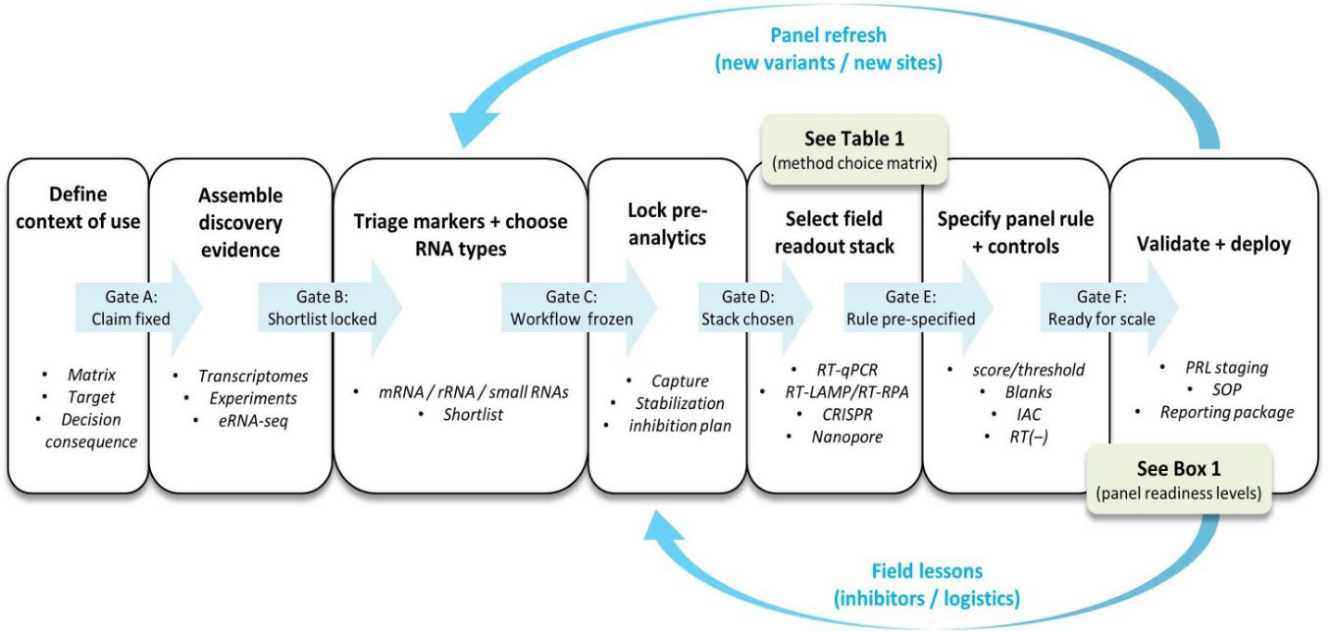
Figure 2.
A practical taxonomy of eRNA panel claims for targeted panel design. Circular schematic summarizing four recurring inference types invoked in the eRNA ecology literature; presence/occupancy, recent activity (“live”) signal (interpreted cautiously), demography/phenology, and condition/stress/functional state, that can guide marker selection and reporting. In practice, stronger claims require stronger supporting evidence and should be presented using explicit claim discipline aligned with QC controls and study context.
Figure 2.
A practical taxonomy of eRNA panel claims for targeted panel design. Circular schematic summarizing four recurring inference types invoked in the eRNA ecology literature; presence/occupancy, recent activity (“live”) signal (interpreted cautiously), demography/phenology, and condition/stress/functional state, that can guide marker selection and reporting. In practice, stronger claims require stronger supporting evidence and should be presented using explicit claim discipline aligned with QC controls and study context.
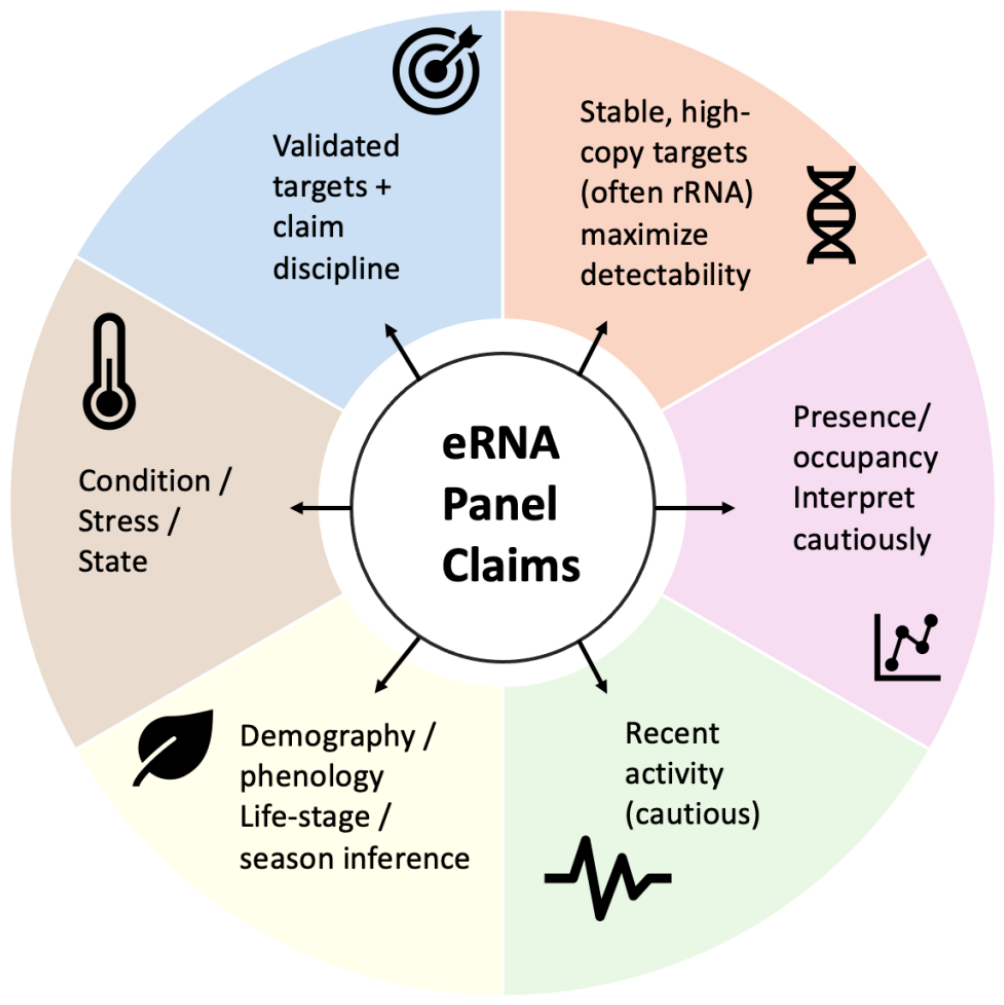
Figure 3.
A conceptual framework for field-ready eRNA panels as engineered measurement systems. Panels are aligned to a bounded claim and evaluated by the ability to reproduce an interpretation rule under field constraints, with key sources of variability often arising from pre-analytical steps (capture, stabilization delay, inhibition). The figure highlights triage-based marker shortlisting, RNA-class design choices, and standardized controls/validation across platforms as practical levers for robust deployment.
Figure 3.
A conceptual framework for field-ready eRNA panels as engineered measurement systems. Panels are aligned to a bounded claim and evaluated by the ability to reproduce an interpretation rule under field constraints, with key sources of variability often arising from pre-analytical steps (capture, stabilization delay, inhibition). The figure highlights triage-based marker shortlisting, RNA-class design choices, and standardized controls/validation across platforms as practical levers for robust deployment.
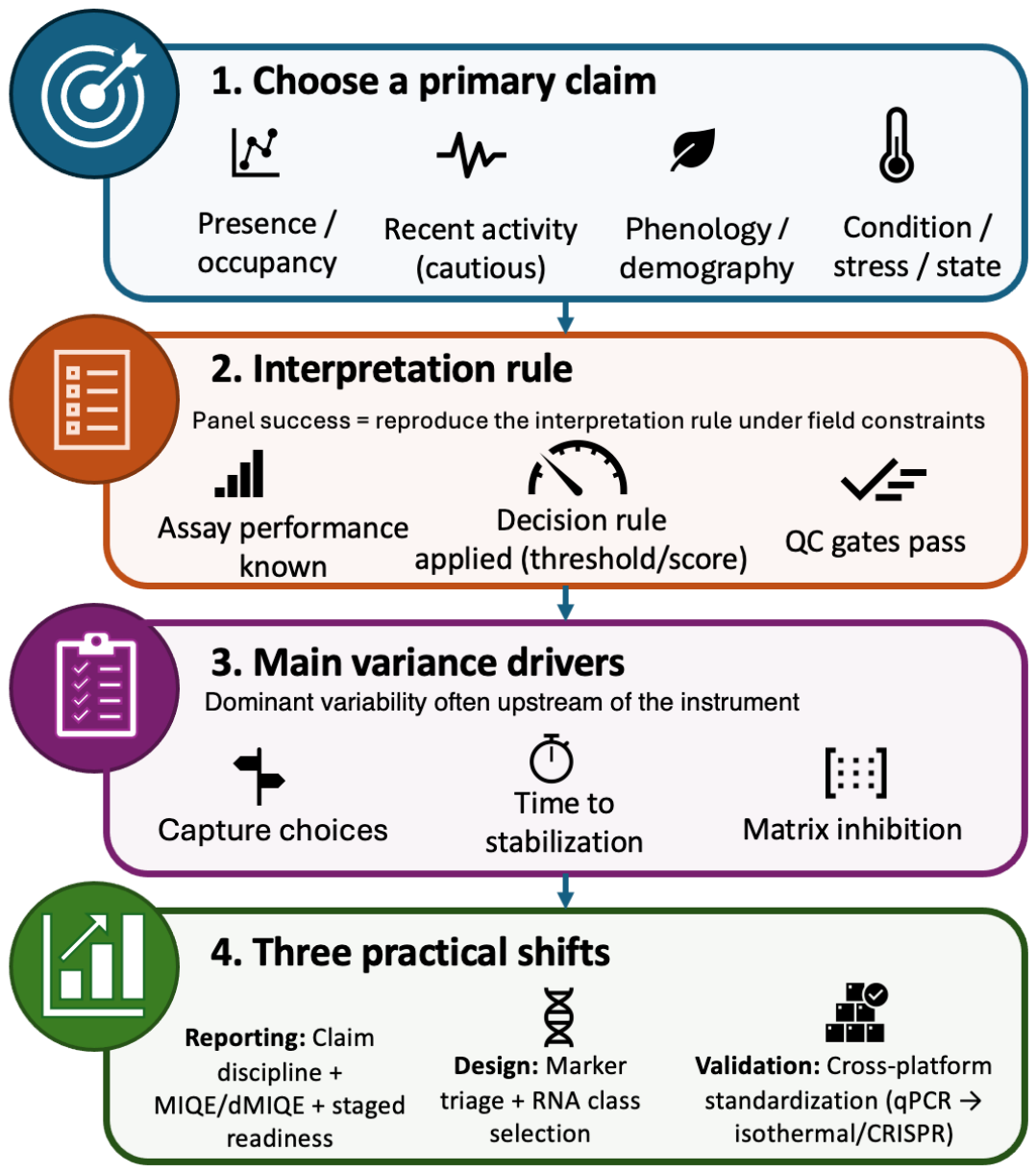

Table 1.
Field-compatible readout options for eRNA panels following sample stabilization and extraction. For each method class, typical time-to-result, minimum equipment needs, practical panel scale, primary output type, and best-fit role within a screening–confirmation workflow are summarized, together with the main limitations that should be anticipated during deployment. Abbreviations: POD, point-of-detection; qual, qualitative; semi-quant, semi-quantitative; LOD, limit of detection.
Table 1.
Field-compatible readout options for eRNA panels following sample stabilization and extraction. For each method class, typical time-to-result, minimum equipment needs, practical panel scale, primary output type, and best-fit role within a screening–confirmation workflow are summarized, together with the main limitations that should be anticipated during deployment. Abbreviations: POD, point-of-detection; qual, qualitative; semi-quant, semi-quantitative; LOD, limit of detection.
| Readout option (typical stack) | Typical time | Minimum field setup | Realistic panel scale | Output | Best fit in workflow | Key constraints to plan for | Ref. |
| portable RT-qPCR / POD qPCR (one-step RT-qPCR) | 45–120 min | portable qPCR + pipettes; cold chain or lyophilized reagents | small multiplex (≈4–6) or parallel singleplex | quantitative / semi-quant | confirmatory testing; decision thresholds | inhibition; RT(–)/blank discipline; RNase control; logistics | (Bustin et al., 2025; Doi et al., 2021; Seimon et al., 2024) |
| lab RT-dPCR / ddPCR | same day (near-lab) | benchtop dPCR system | singleplex to modest multiplex | high-confidence quant | adjudicate borderline results; enforcement-grade confirmation | not field-portable; transport/turnaround | (Whale et al., 2020) |
| RT-LAMP (colorimetric/ fluor) |
20–45 min | heat block; closed tubes; optional simple reader | parallel singleplex; very small multiplex | qualitative / semi-quant | rapid screen; low-instrument settings | spurious amp/primer crosstalk; carryover risk; inhibitors; replicate rules | (Hartle-Mougiou et al., 2024; Hayes et al., 2025) |
| RT-RPA / RT-RAA (+ lateral flow/fluor) | 15–30 min | 37–42 °C incubator; strips or small reader | parallel singleplex; small multiplex (fragile) | qualitative / semi-quant | rapid screen; battery-friendly workflows | design-sensitive; nonspecific amp if poorly optimized; reagent ecosystem varies | (Feng et al., 2021; Lobato & O’Sullivan, 2018) |
| isothermal + CRISPR (RT-RPA/LAMP → Cas12/13; one-tube when possible) | 30–75 min | incubator; lateral flow or compact optics | low-plex; staged testing works well | high-specificity qual / semi-quant | specificity upgrade where false positives are costly | integration complexity; inhibition near LOD; contamination control still needed | (Leugger et al., 2025; Williams et al., 2025; J. Yang et al., 2024) |
| portable nanopore sequencing (amplicon or native) | 6–24 h | nanopore + laptop + power; basic wet lab | broad (sequence-based) | sequence confirmation / discovery | on-site verification; panel refresh; unexpected taxa/variants | operator skill; bioinformatics; sensitivity may lag targeted assays at very low template | (Gygax et al., 2025; Maggini et al., 2024; Varzandi et al., 2025) |
Disclaimer/Publisher’s Note: The statements, opinions and data contained in all publications are solely those of the individual author(s) and contributor(s) and not of MDPI and/or the editor(s). MDPI and/or the editor(s) disclaim responsibility for any injury to people or property resulting from any ideas, methods, instructions or products referred to in the content. |
© 2026 by the authors. Licensee MDPI, Basel, Switzerland. This article is an open access article distributed under the terms and conditions of the Creative Commons Attribution (CC BY) license (http://creativecommons.org/licenses/by/4.0/).
Copyright: This open access article is published under a Creative Commons CC BY 4.0 license, which permit the free download, distribution, and reuse, provided that the author and preprint are cited in any reuse.


