

Submitted:
01 May 2026
Posted:
05 May 2026
You are already at the latest version
Abstract
In recent decades, the evolution of optogenetic engineering has revolutionised biomedical (neuroscience) research and synthetic biology. It also opens exciting opportunities in the biomanufacturing sector, paving the way for opto-biotechnology, a light-driven system for scalable production of valuable products. This review consolidates the evolution of optogenetics into opto-biotechnology across pharmaceuticals, nutraceuticals, lipids, antibodies and biofuels. Here, we highlight conceptual designs for opto-biotechnology in scalable biomanufacturing as the next frontier beyond optogenetics and as a clue to the synthesis of light-driven biosynthetic gene clusters mediated bioactives. It will also discuss how opto-biotechnology intersects with synthetic biology, systems biology, and bioprocess engineering to push the frontiers of programmable biomanufacturing without genetic interventions. Moreover, moving forward to translational application, as future strategists, we will discuss the integration of machine learning, computational modelling and artificial intelligence for crafting the precise light exposure tactics and factors, increasing the yield and efficiency of opto-modulated systems, thereby reshaping the landscape of optobiomanufacturing.
Keywords:
opto-biomaufacturing
; optogenetics
; photoreceptor
; value-added products
; systems biology
1. Introduction
In recent decades, biotechnology has revolutionised synthetic biology and biomanufacturing. Its intersection with light-driven processes has provided groundbreaking transformation in the field of biomedical, offering unprecedented control over biological systems with spatiotemporal precision. The foundation principle of opto-biotechnology is optogenetics, which combines genetics with optics, a light-mediated process. Initially, it was mainly developed as a neuroscience tool for controlling neural activity. This interdisciplinary method extends to opto-biotechnology, precisely controlling light-responsive cellular processes across a wide range of organisms, including bacteria, microalgae, yeast, and plants. This allows for dynamic changes in gene expression, metabolic fluxes, and cellular behavior. Light has gained momentum as a regulatory input for next-generation biomanufacturing systems, unlike conventional chemical inducers, because of its non-invasive, reversible, cheap, and tunable parameters like intensities, wavelength, pattern, duration and their synchronisation.
Light controls the metabolic processes in the photosynthetic organisms including cynobacteria, alage and plants. Alteration in light quality, quantity, duration and pattern is evidenced to have effect on algal lipid metabolism (Takeshita et al., 2014; Iasimone et al., 2018). High light intensity can cause rearrangement of thylakoid thus, reducing membrane lipid. In Chlamydomonas reinhardtii, blue light regulates starch metabolism (Yuan et al. 2025). In plants, light-environment engineering and optogenetic for spatiotemporal control of growth, photosynthesis and biosynthetic pathway is harnessed for bioproduction of valuable compounds (Konard et al., 2023). Studies have shown that improving light conditions can increase biomass yield and help make certain valuable compounds like carotenoids, polyphenols, and essential oils (Chen et al., 2020). Artificial lighting technologies, including LEDs, have been utilized in controlled environments to optimize the production of specific biomolecules in microalgae and cyanobacteria (Takeshita et al., 2014; Iasimone et al., 2018; Ghedifa et al., 2021; Sforza et al., 2012).
Recent progress in opto-biotechnology has enabled the creation of advanced light-sensitive genetic circuits, photoreceptors, and optogenetic switches that precisely modulate biosynthetic pathways. These new technologies have made it possible to make more high-value compounds, like carotenoids, biofuels, medicines, and specialty chemicals, especially on microbial platforms that do and do not photosynthesize. Combining optogenetic modules with metabolic engineering and computational modeling has made it even easier to optimize pathways in real time, which lowers the metabolic burden and increases yield efficiency. Also, the combination of opto-biotechnology with new fields like quantum biology and nano-optics is creating new ways to control biological systems with never-before-seen clarity. Thus, opto-biotechnology is revolutionizing the production of high-value bioproducts by leveraging the unique metabolic capacities of different organisms by their photosynthetic efficiency, extensive metabolic diversity, and sustainability profile.
Recent advancement in genetic engineering, particularly in biosynthetic gene clusters (BGCs), has created new possibilities for creating custom algal strains that can make complex natural products (Singh et al., 2025; Manisha et al., 2025). BGCs, which are groups of genes that are located next to each other and code for entire biosynthetic pathways, make it possible to edit, add, or fine-tune metabolic routes in a modular way to make specific products. The field is also moving quickly because synthetic biology, optogenetics, artificial intelligence (AI), and photobioreactor engineering are all coming together. This makes opto biomanufacturing platforms even more productive, scalable, and economically appealing. Thus, this review talk about how opto-biotechnology can advance programmable biomanufacturing without genetic manipulations by combining with systems biology, synthetic biology, and bioprocess engineering. This review will also examine the influence of light across various processes, encompassing photosynthesis-driven bioproduct formation, photobioreactors for microbial production, and the photochemical synthesis of bio-based compounds.
2. Optogenetics: From Evolution to Current Status
Optogenetics originated with the discovery of bacteriorhodopsin, a retinal-bound proton pump in archaea that enables light-driven ion movement in 1971 (Oesterhelt, D. and Stoeckenius 1973). This led to the field's foundation in 2005, when Karl Deisseroth demonstrated that channelrhodopsin-2 (ChR2) from Chlamydomonas reinhardtii could evoke action potentials in mammalian neurons with blue light (Boyden et al., 2005; Boyden et al., 2011; Deisseroth et al., 2006). The term optogenetics was first coined in this work. This work won the 2010 Brain Prize and changed the way we think about causal neuroscience by replacing crude electrical stimulation with genetic spatiotemporal precision (Boyden et al., 2011; Deisseroth 2011). Over the course of more than twenty years, the toolkit grew to include inhibitory halorhodopsins like NpHR in 2007 for hyperpolarisation, bistable step-function opsins in 2010 that keep activation going without constant light, red-shifted ChrimsonR in 2014 that goes deeper into tissues, and non-opsin innovations like CRY2-CIB1 cryptochrome heterodimers and LOV-domain actuators for reversible protein recruitment, cAMP modulation, and promoter control (Boyden et al., 2011; Duan and Gao 2025). This advancement has caused a huge shift in optobiotechnology, moving optogenetics from the brain to microbial cell factories, where light replaces chemical inducers for orthogonal, non-toxic dynamic control (Chen et al., 2018, Zhao et al., 2018). It sets the stage for scalable, sustainable biomanufacturing and improves real-time metabolomics through multi-omics integration. This marks the beginning of an era of light-controlled green production that is as efficient as petrochemicals but uses less energy and produces less waste (Reshetnikov et al., 2022).
3. Opto-Biotechnology: Core Principle
Opto-biotechnology relies on the principle of exploiting photoreceptor and genetic circuits (synthetic or native) to accurately regulate or check the expression of specific gene and cellular. It exploits light as tunable and programmable non-invasive tool for modulating metabolic pathways, in turn, improvising the scalability and selectivity of important bioactives and metabolites. Various light-sensing proteins (photoreceptors) are the key factor converting illumination as fined tuned stimulus altering gene expression.
3.1. Photoreceptor Network and Light Responsiveness Modules
The fundamentals of opto-biotechnology lies on photoreceptors. These are the specialized proteins that undergo conformational changes upon absorbing light of specific wavelengths. They are coupled to biological effectors which modulates the downstream signalling, ultimately modulates cellular functions. The prominent photoreceptors are LOV (light, oxygen, or voltage) domains, cryptochromes, and phytochromes, which have been engineered into modular optogenetic systems to activate or repress gene expression, alter protein interactions, and control enzymatic activities. These photoreceptors affect photosynthesis by interacting with the photosynthetic apparatus and also control various metabolic processes in the organism. For Blue light photoreceptor, phototropin, influences the overall fitness of photosynthetic machinery (Petroutsos et al., 2016). These photoreceptors detect specific wavelengths, and their responses depend on the signalling states of their photocycles. Additionally, the activities of multiple photoreceptors could be interconnected, potentially influencing the metabolic pathways and the efficiencies of photosynthesis. In C. reinhardtii, phototropin modulates the carotenoid metabolism and the study also suggested that this modulation might be achieved via coordinating with other red light photoreceptor (Im et al., 2006). It has been observed that light-based activation of downstream molecules that contribute to the bio-manufacture of carotenoids and chlorophyll (Toledo-Ortizhas et al. 2010) the potential to improve growth and metabolic accumulations in algae by controlling photoreceptor activity.
3.2. Light and Metabolic Regulation
Different wavelengths of light (light quality) have a significant effect on the amounts of metabolites and proteins microalgae produce, making it a powerful, non-invasive tool for metabolic engineering (Table 1). For example, low-intensity light and short residence times in continuous batch cultures can increase the overall protein content. This is probably because they make photosynthesis more efficient and reduce photoinhibition (Borella et al., 2021). Green light (520–550 nm) strongly boosts the biosynthesis of R-phycoerythrin, a key phycobiliprotein, and soluble proteins. UV light (280–400 nm) works with MAAs, which are natural UV protectants with antioxidant properties (Ghedifa et al., 2021). Blue light (400–500 nm), on the other hand, is mostly sensed by phototropin kinases. It increases the levels of antioxidants, phenolic compounds, and secondary metabolites in red algae like Gracilaria gracilis. This starts a chain of events that leads to the upregulation of phenylpropanoid pathways.
Strategic manipulation of LED-based spectral quality further enhances bioactivity. A blue-light shift greatly increases the antimicrobial activity of polar functional fractions in Prymnesium sp. DMGCW_41 and cf. Chlorococcum sp. DMGCW_43. White and blue LED combinations work best for Micractinium sp. LACW_01, which is linked to higher terpenoid and polyketide production (McGee et al., 2020). Additional research supports this: in Chlamydomonas reinhardtii, blue light pulses through channelrhodopsin-2 (ChR2) optogenetic constructs quickly phosphorylate kinases such as Aurora A, which speeds up ciliogenesis and lipid accumulation for example, triacylglycerols for biofuels (Gao et al., 2020). Phototropin-mediated blue light signaling in green algae increases carotenoid levels by 2-3 fold, as shown by HPLC (Das et al., 2019). Nonetheless, extensive light-based algal research has traditionally focused on illumination parameters—spectrum quality, intensity, photoperiod, and pulsing—to enhance biomass productivity and bulk metabolites in various taxa such as Chlorella and Nannochloropsis (Liu et al., 2012; Sforza et al., 2012; Van Wagenen et al., 2012; George et al., 2014). Emerging gaps encompass the integration of multi-omics (e.g., metabolomics and phosphoproteomics) for predictive models in biomanufacturing and crop resilience.
3.3. Mechanisms for Opto-Modulated Circuits and Biomanufacturing
Opto-modulated circuits use light-sensitive proteins to precisely control gene expression and metabolic pathways in cells, enabling dynamic biomanufacturing of biofuels, chemicals, and biomaterials. These mechanisms leverage photoreceptors like EL222, CRY2-CIB1, and PhyB-PIF for applications in microbes, algae, and plants (Table 2). Common modules include EL222 (blue light-induced DNA binding via LOV domain), CRY2-CIB1 (heterodimerization), and CcaSR (green/red light phosphorylation). For example EL222-based systems like OptoEXP and OptoINVRT enable light-inducible or darkness-inducible expression by controlling VP16 activation or GAL80 repression. Amplification circuits (OptoAMP) boost signals 23-fold using GAL regulons, achieving activation at 1% light duty cycles via EL222^A79Q^ mutants and photosensitive degrons. Clustering tools like optoCluster (CRY2 oligomerization) or PixELL (PixD/PixE) create synthetic organelles for flux control (Zhao et al., 2020; Zhao et al., 2021). In microbes, OTs decouple growth from production in two/three-phase fermentations, enhancing titers via metabolic switches. OptoAMP in S. cerevisiae yields 6 g/L lactic acid (12-fold over dark), 830 mg/L isobutanol (2-fold over full light growth), and >30 mg/L naringenin via pulsed light (Zhao et al., 2021; Reshetnikov).
4. Opto tools and Technologies in Opto-Bimanufacturing
4.1. Optogenetic and Light-Controlled Biomanufacturing
Optogenetics is a transformative approach where light-responsive proteins and synthetic promoters are engineered to provide precisely timed and tunable control over gene expression and metabolic pathways. Optogenetic tools (OTs) consist of photosensitive modules fused to effectors that undergo conformational changes upon light exposure, modulating transcription, protein clustering, or ion flux. For example the photoreceptor or synthetic light-activated systems such as modular LOV (Light, Oxygen, Voltage) domain proteins and blue-light responsive CRY2CIB1 dimerizers are incorporated in algae to drive or repress specific steps in BGC-derived product synthesis depending on illumination protocols (Chen et al., 2018). A novel optogenetic circuits developed allowed regulation of fermentation via light by switching cells from a light-induced growth phase to a darkness-induced production phase. The study demonstrated how periodic light pulses can increase yields by adjusting the expression of enzymes during the production phase by using optogenetics in metabolic engineering for the production of valuable compounds (Zhao et al., 2018). They engineered the mitochondrial isobutanol pathway to produce up to 8.49 ± 0.31 g l⁻¹ isobutanol and 2.38 ± 0.06 g l⁻¹ 2 methyl 1 butanol microaerobically from glucose.
Synthetic biology has expanded these tools into light-switchable promoters, opto-CRISPR systems, and protein degradation modules, allowing rapid, reversible, and inducible control over metabolic fluxes without chemical additives. The versatility and orthogonality of optogenetics provide a robust toolkit to overcome challenges associated with conventional biomanufacturing processes. Recently, opto tools are now employed for agrobiotechnology, smart biomaterials synthesis having unique properties, and green biofuels in bioreactors (Reshetnikov et al., 2022)
4.2. Optobioreactor Technologies
Advanced bioreactors with programmable LED arrays can deliver tailored light spectra, intensities, and rhythms to synchronize metabolic flux with demand—allowing on-demand biosynthesis and improved resource efficiency. VODORASLO and similar startups are already commercializing compact, domestic, and industrial-scale optobioreactors for flexible algal cultivation and by-product capture.
4.2.1. An Introduction to Light-Based Bioreactors
The advent of optogenetics has revolutionized the bioprocess industry for the development of light-mediated bioreactors. Optogenetics refers to the application of genetically encoded light-responsive proteins, also known as photoreceptors that upon light activation mediate cellular functions (Seong et al., 2021). Therefore, it is inferred that, in a similar manner, light can replace chemical inducers, temperature fluctuations, or nutrient modifications and instead serve as a non-invasive signal that enables the manufacturing of several commercially relevant products. The precision and spacio-temporal control conferred by light as a signaling tool provides specific control over gene expression and protein production (Emiliani et al., 2022).
The use of light for culturing microorganisms is not a new process. Since time immemorial, microorganisms, particularly algae, have been cultured in photobioreactors (PBRs) by providing optimal illumination conditions. The intensity, duration, and pattern is extremely crucial for the growth of microalgal cultures and in turn is linked to their photosynthetic efficiency. A colossal amount of light leads to photo-oxidation and photo-inhibition. However, limited light availability reduces microbial growth and biomass (Carvalho et al., 21).
4.2.2. Effect of Artificial Light on Algal Cultivation
Several parameters affect the growth and quality of algal cells. The generation of microalgal biomass and their metabolites majorly depends on the wavelength and intensity of light as well as the temperature and structure of the growth vessels. Other variables such as growth medium composition, pH, and carbon dioxide availability also determine the algal growth rate (Metsoviti et al., 2019). The light energy is a crucial factor microalgal cultivation as it affects its rate of photosynthesis. Microalgae demands a light/dark phase configuration as the light energy is used to adenosine triphosphate (ATP) and nicotinamide adenine dinucleotide phosphate-oxidase (NAPDH) and the dark phase is employed for the metabolites synthesis (Al-Qasmi et al., 2012). Light energy for algal cell cultivation is provided either directly via sunlight or artificial lights (AL). Sunlight exploitation is a cost-effective strategy as it is surplus and is freely available. However, its utilization as a dependable light source is compromised due to changes in day/night cycles and seasonal/weather variations. Moreover, sunlight availability changes with a change in geographical location. Therefore, these hindrances propel the development of a more stable and reliable artificial lighting (AL) systems. The integration of AL in photobioreactor system results into an uninterrupted and measured illumination with an improved control over wavelength and light intensity. The diverse type of light sources includes fluorescent tubes, high-intensity discharge lamps, incandescent bulbs and light-emitting diodes (LEDs). Amongst all, LEDs are preferable choice for illumination in photobioreactors (PBRs) due to their size, narrow wavelength emission, less heat generation, and electronically dimmable. However, indulgence over AL raises the electricity and microalgal cultivation costs, a debate that still needs to be addressed (Blanken et al., 2013; Singh and Mishra, 2023). The entire spectrum of light does not facilitate microalgal photosynthesis. The visible light ranging from 400 to 700 nm is demarcated as photosynthetically-active radiation (PAR) that is harnessed to form biomass (Nwoba et al., 2019).
4.2.3. Conventional Methods of Artificial Illumination
The traditional source of illumination is based on the usage of fluorescent bulbs, high pressure sodium lamps, metal halide lamps, and incandescent lamps that demand high power, electricity and temperature. Due to high thermal emission, tissue cultures are not placed in close association with the light source as it may lead to photo-stress (Gupta and Jatothu, 2013; Hyeon-Lee et al., 2023). An excess or inadequate light exposure imparts a negative effect towards algal cultivation. Hence it is extremely crucial that the light is optimally distributed to the algal biomass. Different studies have reported appropriate photon flux density value ranging from 50-200 µmol/m2/s. Therefore, a compatible photobioreactor is designed where irrespective of the distance from the light source, the entire algal biomass receives equivalent amount of radiation. The increase in the cell density of algae may demand a surge in the light intensity to maintain their growth rate. However, a continuous rise in light intensity leads to photoinhibition that exposes the biomass to higher quantities of light (Brzychczyk et al., 2020). The fluorescent lamps demonstrate a PAR efficiency of 1.25 μmol-ph s−1 W−1 (μmol PAR photons per second per watt of energy), that is commonly employed in laboratories and plant growth chambers. The high intensity discharge (HID) lamps are majorly exploited in horticulture and possess a PAR efficiency of 1.87 1.25 μmol-ph s−1 W−1. A comparative study based on PAR efficiency exhibited that HID and LED lighting are most suitable for microalgal cultivation. The heat production is similar for LED and HID lamps, possessing a comparable wall plug efficiency (WPE). The LED does not display emission in the infrared zone. As infrared radiation heats surfaces, therefore, using LED in photobioreactors does not require an additional step of cooling (Blanken et al., 2013).
4.2.3. Light-Emitting Diodes (LEDs)
Fluorescent lamps and LEDs serve as superior AL systems for algal biomass production. LEDs are extensively employed for microalgal cultivation as they are customized for narrow range emission to correlate with the algal photosynthetic spectrum. An ideal AL system should convert electricity to light with high efficiency without wasting energy in the form of heat. As compared to other AL systems, LEDs possess a long lifespan, and exhibit less heat generation. With ease in use in photobioreactors, LEDs improves controllability of the geometry, orientation and temperature of the photobioreactors (Nwoba et al., 2019). LEDs are semiconductors that emit light of a narrow emission width. As a result, separate parts of the PAR can be detailed, thereby monitoring an organism’s photosynthetic response. The absorption peaks of the PAR directly correlate with the organism’s chlorophyll and carotenoid content (Schulze et al., 2014).
There are several advantages conferred by the LED-based approaches over the conventional systems. The emission peak of LEDs is narrow, falling within a range of 10-30 nm. They are solid-state semi-conductors and allow for the detailed study of different parts of photosynthetically active region (PAR). This aids in extensive analysis of an organism’s photosynthetic response. The narrow peak of LEDs enables flexibility in the design of photobioreactors (Glemser et al., 2016). The effect of mixed and green LED was studied on the growth and lipid accumulation in the microalgae, Phaeodactylum tricornutum, Isochrysis galbana, Nannochloropsis salina, and Nannochloropsis oceanica, where the mixed light wavelength fostered higher biomass than the single wavelength LED (Ra et al., 2018). Teo and co-workers also showed that different light wavelengths control the growth and lipid accumulation in microalgae, Tetraselmis sp. and Nannochloropsis sp. where an enhanced growth was observed when the algal cells were propagated under blue light (Teo et al., 2014). A similar study was conducted by Baidya and co-workers, showed that different light wavelengths (white, green, blue and red) control the chlorophyll and β-carotenoid content in the freshwater algae, Chlorella ellipsoidea. Further, in accordance to the previous studies, the protein and lipid quantities were superior in the blue light in comparison to other wavelengths of LEDs (Baidya et al., 2021).
The development of light-based bioreactors is a sustainable approach to biomanufacturing, as it limits the use of harmful chemicals and inducers. Further, when optimized at appropriate intensities, it is safe to the microbial biomass and does not cause cell toxicity. Hence, the integration of light-based systems into bioreactors for microbial cultures other than algae, provides a new leap into the green manufacturing of value-added products.
4.3. Systems Biology, Artificial Intelligence and Machine Learning Approaches in Opto-Biomanufacturing
By simulating intricate light-responsive networks and refining dynamic control techniques, systems biology, artificial intelligence, and machine learning are transforming opto-biomanufacturing in algae, microorganisms, and higher plants. Systems techniques use multi-omics data to recreate metabolic models and light-signaling pathways (Fu et al., 2025; Long et al., 2022). Optogenetic perturbations, such as CRY2-CIB1-mediated PSII suppression in Chlamydomonas reinhardtii, which reroute electrons to HYDA1 for 2-3x H2 yields under sulfur shortage, are simulated by flux balance analysis (FBA) and dynamic FBA (dFBA) (Wang et al., 2017). Interactome mapping finds UVR8-COP1 nodes for PULSE-inducible terpenoids in higher plants, such as Nicotiana benthamiana, and predicts 3–5x flow redirection. Two-phase crop development and production are made possible by kinetic models (ODEs for LOV photocycles) that quantify τ_on/off (~1-30 min) for EL222 circuits (Polstein et al., 2012).
Process control and circuit design are accelerated by machine learning. Random Forest/CNN Growth Rate Models (GRMs) optimize pulsed blue light (1–5% duty) for twofold productivity in Chlorella PBRs by predicting algal biomass under spectral gradients (R²>0.95) (Sumanasekara et al., 2025). In C. reinhardtii ML maximizes red pre-growth + blue induction; Opto-CRY2/CIB1-GAL4 drives amiR-D1 suppression (psbA ~50%), tripling H2 via systems-validated O2-sensitive flux (GEM-iSynCYC). In Nicotiana and Arabidopsis: RL adjusts EL222-VP64 agroinfiltration (10-50 mg/L amorpha-4,11-diene); AI deconvolutes PULSE (UVR8-degron) networks for taxadiene (3x) (Long et al., 2022).
4.4. Biosynthetic Gene Clusters in Opto Biomanufacturing
Opto-biomanufacturing harnesses the power of light to regulate and enhance the production of valuable biomolecules in photosynthetic organisms, particularly those of the green lineage such as microalgae and plants. Fundamentally, this approach is the interplay between light-sensing photoreceptors and biosynthetic gene clusters (BGCs), which orchestrate the synthesis of specialised metabolites. Understanding and leveraging this relationship is opening new avenues for sustainable bioproduction. In the green lineage, light is a key regulator that affects the manufacture of valuable metabolites as well as the buildup of biomass. Proteins called photoreceptors, which detect and react to particular wavelengths, alter photosynthetic efficiency and set off signaling cascades that impact metabolic pathways. The direct effect of light on metabolic output is highlighted by recent research showing that certain illumination conditions, like blue light, can greatly increase the production of compounds like astaxanthin in Chlamydomonas reinhardtii even without genetic modification (Singh et al. 2025). In the green lineage, BGCs are responsible for the production of terpenoids, carotenoids, and other secondary metabolites with pharmaceutical, nutritional, and industrial value. These clusters ensure coordinated gene expression and efficient pathway operation, often responding to environmental cues such as light. Recent studies have identified BGCs in microalgae and plants whose activity is modulated by light via photoreceptor networks. Systems biology and molecular analyses revealed that fine-tuning illumination conditions can upregulate or downregulate these clusters, thereby controlling the yield and spectrum of valuable metabolites produced. For example, blue light not only enhances pigment production but also induces crosstalk between photoreceptors, carotenoid biosynthetic proteins, cell signalling networks, and BGCs, resulting in a coordinated metabolic response (Singh et al. 2025). Further, Manisha et al. 2025 using data-driven analytics, showed that crosstalk of BGC components with photoreceptors, glycan processing, fatty acid metabolisms and energy metabolism in C. reinhardtii. Thus, systems biology approaches are being used to map the regulatory networks connecting photoreceptors and BGCs, allowing for rational design of illumination regimes to maximize product yields. Both direct light modulation (Singh et al. 2025) and optogenetic engineering (the introduction of synthetic light-responsive elements) are being explored to control BGC activity. The ability to modulate BGC activity through illumination, without or with minimal genetic modification, offers a promising route for green biotechnology and industrial bioprocessing. Continued advances in systems biology, photobioreactor design, and synthetic biology will further unlock the potential of this approach for producing a broad array of high-value products.
5. Scope in Different Sectors
Opto-modulation, the strategic use of light to influence cellular metabolism and biochemical pathways, presents significant opportunities for enhancing the accumulation of value-added bioproducts. This approach can be applied to the production of pharmaceuticals and biofuels by controlling light parameters such as wavelength, intensity, and photoperiod (Figure 1). In pharmaceutical production, opto-modulated strategies have been employed to enhance the biosynthesis of secondary metabolites, including alkaloids, flavonoids, and terpenoids, which serve as active pharmaceutical ingredients (Zhao et al., 2018). Several studies have demonstrated that different light wavelengths, such as blue and red light, upregulates biosynthetic pathways in microbes and medicinal plants, enhancing beneficial bioactive chemicals bioaccumulation. Opto-modulation has improved the synthesis of medicinal chemicals and recombinant proteins in genetically modified microorganisms. Moreover, it has enabled precise control of gene expression in response to light by integrating optogenetic systems, resulting in better controlled pharmaceutical product biosynthesis (Jin et al., 2023).
Moreover, opto-modulation has been investigated in the biofuel industry to enhance lipid accumulation in cyanobacteria and microalgae, which are important feedstocks for the manufacturing of biodiesel. Specific spectral compositions and pulsed light exposure can maximize photosynthetic efficiency and improve lipid production (Chen et al., 2022). Furthermore, metabolic fluxes have been dynamically regulated by creating light-responsive regulatory circuits allocating carbon for the synthesis of biofuels like hydrogen, butanol, and ethanol. As oxidative stress causes lipid buildup and the synthesis of secondary metabolites, light-induced regulation of stress responses can also lead to increased biofuel generation (Park et al., 2020).
Additionally, in pharmaceuticals and biofuels, optomodulation strategies are exploited to produce high-value nutraceuticals, pigments, and bio-based polymers. Light-induced metabolic pathway change can lead to the accumulation of antioxidants, polyphenols, and vitamins, which are used in the food and cosmetics industries. Furthermore, opto-modulation allows for the exact regulation of enzyme activity in synthetic biology applications, allowing for the customized synthesis of bio-based products with reduced environmental impact and increased efficiency (Gao et al., 2023). Light distribution and usage in bioprocessing systems could be enhanced by developments in photonic technologies, such as fiber optics, nanophotonic structures, and artificial intelligence-driven light delivery systems. By integrating adaptive light control and real-time monitoring, researchers can dynamically enhance production conditions, boosting the effectiveness of opto-modulated bioproduct accumulation.
6. Challenges and Future Directions
Despite benefits, optomodulation has certain limitations. Light penetration in dense cultures, expenses for artificial lighting systems might provide obstacles for light-driven bioproduction of high-value added bioactives and molecules. Future research in the direction of enhancing light delivery methods, modelling light-responsive metabolic engineering techniques, with integration of renewable energy sources is warranted for sustainable production. Opto-biotechnology in biofilm, hydrogels and drug delivery emerges as platform for precision medicine for opto pharmaceuticals. Furthermore, developments in machine learning and computational modeling can help with the creation of optimal light exposure tactics, increasing the yield and efficiency of opto-modulated systems. Additionally, implementation of newly emerging concept of digital twin systems will revolutionize opto-biomanufacturing by effortlessly integrating Computational fluid dynamics, metabolomics models, photoreceptor kinetics, and multiomics data to create a precise virtual replicas of microbes, algal and higher plants for real-time predictive control.
7. Conclusions
Optomodulated strategies provide a significant paradigm platform in microbial biomanufacturing, shifting from static fermentation processes to dynamically regulated, light-driven programmable production systems. Metabolic engineers can fine-tune pathways with an unprecedented level of accuracy and strength by using light to spatio-temporally control gene expression, metabolic flux, and growth-production transitions (Figure 2). Even though there are still problems with light penetration, scalability, and long-term genetic stability, new developments in LED-based lighting systems, synthetic optogenetic circuits, bioreactor-level integration and AI/ML-driven optimization for strain, metabolic pathways, and process design are about to change the face of industrial biotechnology. In the long run, connecting real-time sensors, feedback-controlled light patterns, and machine-learning-guided strain engineering will make it possible to build fully programmable cellular factories for sustainable, high-value bioproduction.
Author Contributions
S.K. and R.S. conceptualise the manuscript. R.S. drafted the manuscript with the help of S.K. and S.M. All authors reviewed and approved the final manuscript.
Author’s approval
All authors have seen and approved the manuscript. This is original and not under consideration or published anywhere.
Declaration of interest
The authors declare no competing interests.
Acknowledgements
S.K is highly thankful to the DBT (BT/PR53866/BSA/33/107/2024) and ANRF/SERB for (EEQ/2023/000398) for providing financial assistance. RS acknowledge DBT-RA program (DBT-RA/2022/July/N/2560). S.M. acknowledge DBT (BT/PR53866/BSA/33/107/2024) for financial assistance.
References
- Al-Qasmi, M.; Raut, N.; Talebi, S.; Al-Rajhi, S.; Al-Barwani, T. A review of effect of light on microalgae growth. Proc. World Congr. Eng. 2012, Vol. 1(No. 2), 1–7. [Google Scholar]
- Arnlund, D.; Johansson, L.C.; Wickstrand, C.; Barty, A.; Williams, G.J.; Malmerberg, E.; Davidsson, J.; Milathianaki, D.; DePonte, D.P.; Shoeman, R.L.; Wang, D. Visualizing a protein quake with time-resolved X-ray scattering at a free-electron laser. Nat. Methods 2014, 11(9), 923–926. [Google Scholar] [CrossRef]
- Baidya, A.; Akter, T.; Islam, M. R.; Shah, A. A.; Hossain, M. A.; Salam, M. A.; Paul, S. I. Effect of different wavelengths of LED light on the growth, chlorophyll, β-carotene content and proximate composition of Chlorella ellipsoidea. Heliyon 2021, 7(12). [Google Scholar] [CrossRef]
- Beel, B.; Prager, K.; Spexard, M.; Sasso, S.; Weiss, D.; Müller, N.; Heinnickel, M.; Dewez, D.; Ikoma, D.; Grossman, A.R.; Kottke, T. A flavin binding cryptochrome photoreceptor responds to both blue and red light in Chlamydomonas reinhardtii. Plant Cell 2012, 24(7), 2992–3008. [Google Scholar] [CrossRef]
- Blanken, W.; Cuaresma, M.; Wijffels, R. H.; Janssen, M. Cultivation of microalgae on artificial light comes at a cost. Algal Res. 2013, 2(4), 333–340. [Google Scholar] [CrossRef]
- Borella, L.; Sforza, E.; Bertucco, A. Effect of residence time in continuous photobioreactor on mass and energy balance of microalgal protein production. N Biotechnol. 2021, 64, 46–53. [Google Scholar] [CrossRef] [PubMed]
- Boyden, E.S.; Zhang, F.; Bamberg, E.; Nagel, G.; Deisseroth, K. Millisecond-timescale, genetically targeted optical control of neural activity. Nat. Neurosci. 2005, 8(9), 1263–1268. [Google Scholar] [CrossRef]
- Boyden, E.S. A history of optogenetics: the development of tools for controlling brain circuits with light. F1000 Biol. Rep. 2011, 3, 11. [Google Scholar] [CrossRef]
- Brzychczyk, B.; Hebda, T.; Pedryc, N. The influence of artificial lighting systems on the cultivation of algae: The example of chlorella vulgaris. Energies 2020, 13(22), 5994. [Google Scholar] [CrossRef]
- Carvalho, A. P.; Silva, S. O.; Baptista, J. M.; Malcata, F. X. Light requirements in microalgal photobioreactors: an overview of biophotonic aspects. Appl. Microbiol. Biotechnol. 2011, 89(5), 1275–1288. [Google Scholar] [CrossRef]
- Chen, I.W.; Papagiakoumou, E.; Emiliani, V. Towards circuit optogenetics. Curr. Opin. Neurobiol. 2018, 50, 179–189. [Google Scholar] [CrossRef]
- Deisseroth, K.; Feng, G.; Majewska, A.K.; Miesenböck, G.; Ting, A.; Schnitzer, M.J. Next-generation optical technologies for illuminating genetically targeted brain circuits. J. Neurosci. 2006, 26(41), 10380–10386. [Google Scholar] [CrossRef]
- Deisseroth, K. Optogenetics. Nat. Methods 2011, 8(1), 26–29. [Google Scholar] [CrossRef]
- Duan, X.; Zhu, M.; Gao, S. Two decades of optogenetic tools: a retrospective and a look ahead. Adv. Genet. 2025, 6(3), e00021. [Google Scholar] [CrossRef] [PubMed]
- Dutta Gupta, S.; Jatothu, B. Fundamentals and applications of light-emitting diodes (LEDs) in in vitro plant growth and morphogenesis. Plant Biotechnol. Rep. 2013, 7(3), 211–220. [Google Scholar] [CrossRef]
- Emiliani, V.; Entcheva, E.; Hedrich, R.; Hegemann, P.; Konrad, K. R.; Lüscher, C.; Yizhar, O. Optogenetics for light control of biological systems. Nat. Rev. Methods Prim. 2022, 2(1), 55. [Google Scholar] [CrossRef] [PubMed]
- Fernandes, B. D.; Mota, A.; Teixeira, J. A.; Vicente, A. A. Continuous cultivation of photosynthetic microorganisms: approaches, applications and future trends. Biotechnol. Adv. 2015, 33(6), 1228–1245. [Google Scholar] [CrossRef]
- Fu, R.; Chen, Z.; Tian, H.; Hu, J.; Bu, F.; Zheng, P.; Chi, L.; Xue, L.; Jiang, Q.; Li, L.; Zhu, L. A review on the applications of machine learning in biomaterials, biomechanics, and biomanufacturing for tissue engineering. Smart Mater. Med. 2025, 6(2), 171–204. [Google Scholar] [CrossRef]
- Gao, L.; et al. Nanophotonic Approaches for Enhancing Light Utilization in Bioprocesses. Adv. Mater. 2023, 35(12), 2301045. [Google Scholar]
- García-Plazaola, J.I.; Esteban, R.; Fernández-Marín, B.; Kranner, I.; Porcar-Castell, A. Thermal energy dissipation and xanthophyll cycles beyond the Arabidopsis model. Photosynth. Res. 2012, 113(1), 89–103. [Google Scholar] [CrossRef]
- George, B.; Pancha, I.; Desai, C.; Chokshi, K.; Paliwal, C.; Ghosh, T.; Mishra, S. Effects of different media composition, light intensity and photoperiod on morphology and physiology of freshwater microalgae Ankistrodesmus falcatus–A potential strain for bio-fuel production. Bioresour. Technol. 2014, 171, 367–374. [Google Scholar] [CrossRef]
- Ghedifa, A. B.; Vega, J.; Korbee, N.; Mensi, F.; Figueroa, F. L.; Sadok, S. Effects of light quality on the photosynthetic activity and biochemical composition of Gracilaria gracilis (Rhodophyta). J. Appl. Phycol. 2021, 33, 3413–3425. [Google Scholar] [CrossRef]
- Glemser, M.; Heining, M.; Schmidt, J.; Becker, A.; Garbe, D.; Buchholz, R.; Brück, T. Application of light-emitting diodes (LEDs) in cultivation of phototrophic microalgae: current state and perspectives. Appl. Microbiol. Biotechnol. 2016, 100(3), 1077–1088. [Google Scholar] [CrossRef]
- Hifney, A.F.; Issa, A.A.; Fawzy, M.A. Abiotic stress induced production of ß-carotene, allophycocya-nin and total lipids in Spirulina sp. J. Biol. Earth Sci. 2013, 3, B54–B64. [Google Scholar]
- Im, C. S.; Eberhard, S.; Huang, K.; Beck, C. F.; Grossman, A. R. Phototropin involvement in the expression of genes encoding chlorophyll and carotenoid biosynthesis enzymes and LHC apoproteins in Chlamydomonas reinhardtii. Plant J. 2006, 48(1), 1–16. [Google Scholar] [CrossRef]
- Iasimone, F.; Panico, A.; De Felice, V.; Fantasma, F.; Iorizzi, M.; Pirozzi, F. Effect of light intensity and nutrients supply on microalgae cultivated in urban wastewater: Biomass production, lipids accumulation and settleability characteristics. J. Environ. Manag. 2018, 223, 1078–1085. [Google Scholar] [CrossRef]
- Konrad, K.R.; Gao, S.; Zurbriggen, M.D.; Nagel, G. Optogenetic methods in plant biology. Annu. Rev. Plant Biol. 2023, 74(1), 313–339. [Google Scholar] [CrossRef]
- Kumari, A.; Kumar, A.; Sharma, K.; Pati, S.R.; Mohanty, S.; Kateriya, S. Molecular characterization of unique multi-domain harbouring fungal rhodopsin for establishing their novel opto-synthetic biological usages. bioRxiv 2025, 2025–06. [Google Scholar]
- Lee, H. H.; Xing, Q.; Park, J. S.; Lee, H.; Yarish, C.; Kim, J. K. Effects of different artificial photosynthetically active radiation (PAR) sources and intensity on the growth and nutrient uptake in Ulva prolifera and Neopyropia yezoensis. Algal Res. 2023, 72, 103151. [Google Scholar] [CrossRef]
- Liu, J.; Yuan, C.; Hu, G.; Li, F. Effects of light intensity on the growth and lipid accumulation of microalga Scenedesmus sp. 11-1 under nitrogen limitation. Appl. Biochem. Biotechnol. 2012, 166(8), 2127–2137. [Google Scholar] [CrossRef]
- Long, B.; Fischer, B.; Zeng, Y.; Amerigian, Z.; Li, Q.; Bryant, H.; Li, M.; Dai, S.Y.; Yuan, J.S. Machine learning-informed and synthetic biology-enabled semi-continuous algal cultivation to unleash renewable fuel productivity. Nat. Commun. 2022, 13(1), 541. [Google Scholar] [CrossRef]
- Möglich, A.; Moffat, K. Structural basis for light-dependent signaling in the dimeric LOV domain of the photosensor YtvA. J. Mol. Biol. 2007, 373(1), 112–126. [Google Scholar] [CrossRef]
- Mc Gee, D.; Archer, L.; Smyth, T. J.; Fleming, G. T.; Touzet, N. Bioprospecting and LED-based spectral enhancement of antimicrobial activity of microalgae isolated from the west of Ireland. Algal Res. 2020, 45, 101704. [Google Scholar] [CrossRef]
- Oesterhelt, D.; Stoeckenius, W. Functions of a new photoreceptor membrane. Proc. Natl. Acad. Sci. 1973, 70(10), 2853–2857. [Google Scholar] [CrossRef]
- Park, S.; et al. Light-Induced Oxidative Stress and Its Role in High-Value Bioproduct Formation. Biochem. Eng. J. 2020, 156, 107634. [Google Scholar]
- Petroutsos, D.; Tokutsu, R.; Maruyama, S.; Flori, S.; Greiner, A.; Magneschi, L.; Cusant, L.; Kottke, T.; Mittag, M.; Hegemann, P.; Finazzi, G. A blue-light photoreceptor mediates the feedback regulation of photosynthesis. Nature 2016, 537(7621), 563–566. [Google Scholar] [CrossRef]
- Polstein, L.R.; Gersbach, C.A. Light-inducible spatiotemporal control of gene activation by customizable zinc finger transcription factors. J. Am. Chem. Soc. 2012, 134(40), 16480–16483. [Google Scholar] [CrossRef]
- Metsoviti, M. N.; Papapolymerou, G.; Karapanagiotidis, I. T.; Katsoulas, N. Effect of light intensity and quality on growth rate and composition of Chlorella vulgaris. Plants 2019, 9(1), 31. [Google Scholar] [CrossRef]
- Nwoba, E. G.; Parlevliet, D. A.; Laird, D. W.; Alameh, K.; Moheimani, N. R. Light management technologies for increasing algal photobioreactor efficiency. Algal Res. 2019, 39, 101433. [Google Scholar] [CrossRef]
- Ra, C. H.; Sirisuk, P.; Jung, J. H.; Jeong, G. T.; Kim, S. K. Effects of light-emitting diode (LED) with a mixture of wavelengths on the growth and lipid content of microalgae. Bioprocess Biosyst. Eng. 2018, 41(4), 457–465. [Google Scholar] [CrossRef]
- Reshetnikov, V.V.; Smolskaya, S.V.; Feoktistova, S.G.; Verkhusha, V.V. Optogenetic approaches in biotechnology and biomaterials. Trends Biotechnol. 2022, 40(7), 858–874. [Google Scholar] [CrossRef]
- Sandgruber, F.; Gielsdorf, A.; Baur, A.C.; Schenz, B.; Müller, S.M.; Schwerdtle, T.; Stang, G.I.; Grieh, C.; Lorkowski, S.; Dawczynski, C. Variability in Macro- and Micronutrients of 15 Commercially Available Microalgae Powders. Mar. Drugs. 2021, 19, 310. [Google Scholar] [CrossRef] [PubMed]
- Schulze, P.S.; Guerra, R.; Pereira, H.; Schüler, L.M.; Varela, J.C. Flashing LEDs for microalgal production. Trends Biotechnol. 2017, 35(11), 1088–1101. [Google Scholar] [CrossRef]
- Seong, J.; Lin, M. Z. Optobiochemistry: Genetically encoded control of protein activity by light. Annu. Rev. Biochem. 2021, 90(1), 475–501. [Google Scholar] [CrossRef] [PubMed]
- Sforza, E.; Simionato, D.; Giacometti, G.M.; Bertucco, A.; Morosinotto, T. Adjusted light and dark cycles can optimize photosynthetic efficiency in algae growing in photobioreactors. PLoS ONE 2012, 7(6), e38975. [Google Scholar] [CrossRef]
- Singh, V.; Mishra, V. A review on the current application of light-emitting diodes for microalgae cultivation and its fiscal analysis. Crit. Rev. Biotechnol. 2023, 43(5), 665–679. [Google Scholar] [CrossRef] [PubMed]
- Silva-Stenico, M.E.; Silva, C.S.P.; Lorenzi, A.S.; Shishido, T.K.; Etchegaray, A.; Lira, S.P.; Moraes, L.A.B.; Fiore, M.F. Non-ribosomal peptides produced by Brazilian cyanobacterial isolates with antimicrobial activity. Microbiol. Res. 2011, 166(3), 161–175. [Google Scholar] [CrossRef]
- Süssmuth, R.; Müller, J.; von Döhren, H.; Molnár, I. Fungal cyclooligomer depsipeptides: from classical biochemistry to combinatorial biosynthesis. Nat. Prod. Rep. 2011, 28, 99–124. [Google Scholar] [CrossRef]
- Sumanasekara, H.; Jayasingha, H.; Amarasooriya, G.; Dayarathne, N.; Mainali, B.; Senevirathna, L.; Gamage, A.; Merah, O. Hybrid machine learning models for predicting the impact of light wavelengths on algal growth in freshwater ecosystems. Phycology 2025, 5(2), 23. [Google Scholar] [CrossRef]
- Takala, H.; Björling, A.; Berntsson, O.; Lehtivuori, H.; Niebling, S.; Hoernke, M.; Kosheleva, I.; Henning, R.; Menzel, A.; Ihalainen, J.A.; Westenhoff, S. Signal amplification and transduction in phytochrome photosensors. Nature 2014, 509(7499), 245–248. [Google Scholar] [CrossRef]
- Takeshita, T.; Ota, S.; Yamazaki, T.; Hirata, A.; Zachleder, V.; Kawano, S. Starch and lipid accumulation in eight strains of six Chlorella species under comparatively high light intensity and aeration culture conditions. Bioresour. Technol. 2014, 158, 127–134. [Google Scholar] [CrossRef]
- Teo, C. L.; Atta, M.; Bukhari, A.; Taisir, M.; Yusuf, A. M.; Idris, A. Enhancing growth and lipid production of marine microalgae for biodiesel production via the use of different LED wavelengths. Bioresour. Technol. 2014, 162, 38–44. [Google Scholar] [CrossRef]
- Toledo-Ortiz, G.; Huq, E.; Rodríguez-Concepción, M. Direct regulation of phytoene synthase gene expression and carotenoid biosynthesis by phytochrome-interacting factors. Proc. Natl. Acad. Sci. 2010, 107(25), 11626–11631. [Google Scholar] [CrossRef]
- Trippens, J.; Greiner, A.; Schellwat, J.; Neukam, M.; Rottmann, T.; Lu, Y.; Kateriya, S.; Hegemann, P.; Kreimer, G. Phototropin influence on eyespot development and regulation of phototactic behavior in Chlamydomonas reinhardtii. Plant Cell 2012, 24(11), 4687–4702. [Google Scholar] [CrossRef]
- Wang, Y.; Jiang, X.; Hu, C.; Sun, T.; Zeng, Z.; Cai, X.; Li, H.; Hu, Z. Optogenetic regulation of artificial microRNA improves H. 2017. [Google Scholar]
- Yuan, Y.; Iannetta, A.A.; Kim, M.; Sadecki, W.; Arend, M.; Tsichla, A.; Águila Ruiz-Sola, M.; Kepesidis, G.; Falconet, D.; Thevenon, E.; Tardif, M. Phototropin connects blue light perception to starch metabolism in green algae. Nat. Commun. 2025, 16(1), 2545. [Google Scholar] [CrossRef] [PubMed]
- Ziegler, T.; Möglich, A. Photoreceptor engineering. Front. Mol. Biosci. 2015, 2, 30. [Google Scholar] [CrossRef]
- Zhao, E.M.; Zhang, Y.; Mehl, J.; Park, H.; Lalwani, M.A.; Toettcher, J.E.; Avalos, J.L. Optogenetic regulation of engineered cellular metabolism for microbial chemical production. Nature 2018, 555(7698), 683–687. [Google Scholar] [CrossRef] [PubMed]
- Zhao, E.M.; Lalwani, M.A.; Lovelett, R.J.; García-Echauri, S.A.; Hoffman, S.M.; Gonzalez, C.L.; Toettcher, J.E.; Kevrekidis, I.G.; Avalos, J.L. Design and Characterization of Rapid Optogenetic Circuits for Dynamic Control in Yeast Metabolic Engineering. ACS Synth. Biol. 2020, 9(12), 3254–3266. [Google Scholar] [CrossRef] [PubMed Central]
- Zhao, E.M.; Lalwani, M.A.; Chen, J.M.; Orillac, P.; Toettcher, J.E.; Avalos, J.L. Optogenetic Amplification Circuits for Light-Induced Metabolic Control. ACS Synth. Biol. 2021, 10(5), 1143–1154. [Google Scholar] [CrossRef] [PubMed]
Figure 1.
Schematic representation of opto-biomanufacturing from prokaryotes, algae and green plants. The figure represents the potential applications and benefits due to light-assisted green manufacturing of flavonoids, pigments, biodiesel, and nutraceuticals.
Figure 1.
Schematic representation of opto-biomanufacturing from prokaryotes, algae and green plants. The figure represents the potential applications and benefits due to light-assisted green manufacturing of flavonoids, pigments, biodiesel, and nutraceuticals.
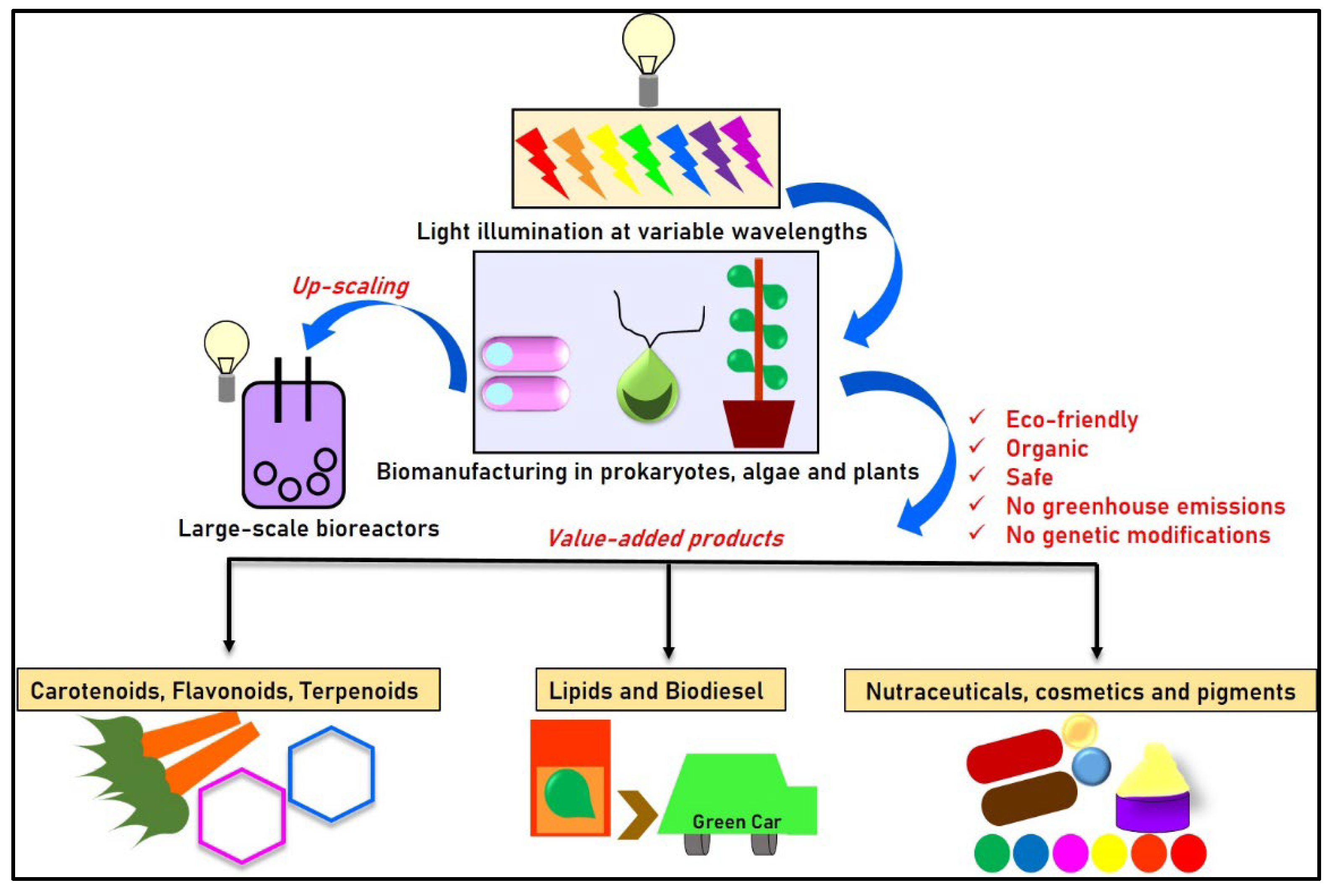
Figure 2.
Overview of AI-assisted opto-biotechnology in different sector. The framework emphasizes light-responsive techniques to control cellular processes, enhance crop resilience and yield, and facilitate the development of recombinant antibody, high-value goods from microorganisms, macroalgae, medicinal plants, and bioenergy crops.
Figure 2.
Overview of AI-assisted opto-biotechnology in different sector. The framework emphasizes light-responsive techniques to control cellular processes, enhance crop resilience and yield, and facilitate the development of recombinant antibody, high-value goods from microorganisms, macroalgae, medicinal plants, and bioenergy crops.
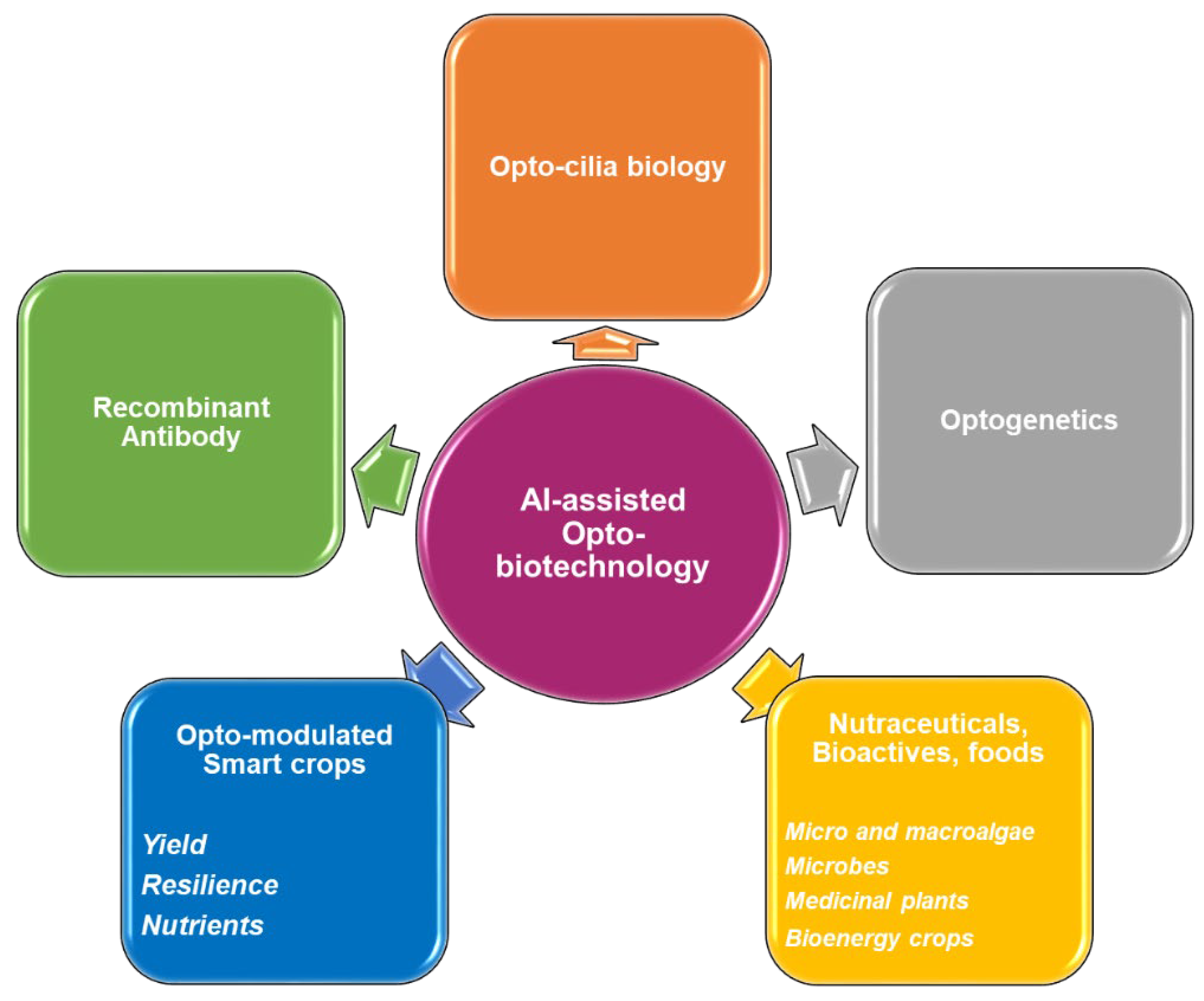

Table 1.
Optomodulation in different algal for enhanced valuable bioproducts.
| Light Quality | Algal Strain/Group | Key Metabolites/Proteins Affected | Mechanism/Notes | Reference | ||
| Low intensity + short residence (continuous batch) | Microalgae (general) | Increased total protein content | Optimizes photosynthesis, reduces photoinhibition | Borella et al., 2021 | ||
| Green (520-550 nm) | Red algae (Gracilaria gracilis) | R-phycoerythrin, soluble proteins | Phycobiliprotein biosynthesis | Ghedifa et al., 2021 | ||
| UV (280-400 nm) | Red algae (Gracilaria gracilis) | Mycosporine-like amino acids (MAAs) | UV protectants, antioxidants (synergistic with green) | Ghedifa et al., 2021 | ||
| Blue (400-500 nm) | Gracilaria gracilis | Antioxidants, phenolic compounds | Phototropin kinase signaling, phenylpropanoids | Ghedifa et al., 2021 | ||
| Blue shift | Prymnesium sp. DMGCW_41 | Polar fractions (antimicrobial) | Terpenoids/polyketides upregulated | McGee et al., 2020 | ||
| Blue shift | cf. Chlorococcum sp. DMGCW_43 | Polar fractions (antimicrobial) | Terpenoids/polyketides upregulated | McGee et al., 2020 | ||
| Blue (phototropin) | Green algae (C. reinhardtii) | Carotenoids (2-3x increase) | Kinase cascades, HPLC-detectable | Das et al., 2019 | ||
| White/Red (growth phase) + Blue/Green shift | General microalgae | Biomass → high-value (astaxanthin, MAAs) | Two-phase: growth then accumulation | Liu et al., 2012; Sforza et al., 2012; etc. |
||
Table 2.
Optogenetic circuit and biomanufacturing in different organisms.
| Pathway/Product | Host | OT Circuit/Module | Yield Improvement | Light Dose/Condition |
References |
|
| Lactic acid | S. cerevisiae | OptoAMP4/OptoINVRT7 | 12.8-fold vs dark | 1.3% pulses (blue) | ||
| Isobutanol | S. cerevisiae | OptoAMP/EXP | 8.49 g/L (2-fold) | 1.7% production phase |
Zhao et al., 2020; Zhao et al., 2021 Reshetnikov et al., 2022 |
|
| Naringenin | S. cerevisiae | OptoAMP4 | >20-fold vs plant | Variable two-phase | ||
| Lycopene | E. coli | PhyB-PIF3 | ~2-fold vs IPTG | Red light pulses | ||
| Hydrogen | C. reinhardtii |
CRY2-CIB1 (PSII repression) |
2.7-fold vs WT | Blue light (continuous) | ||
| Astaxanthin | Phaffia rhodozyma (yeast-like) | CRY2 clustering | 2.5-fold | Blue pulses | ||
| Isoprenoids/ sesquiterpenes |
Nicotiana benthamiana (higher plant) | EL222-VP64 (leaf agroinfiltration) | 10-50-fold transient | Blue light (450 nm) | ||
| Carotenoids | Arabidopsis | PULSE (UVR8-COP1 degron) | 3-fold flux redirection | UV-B pulses |
Disclaimer/Publisher’s Note: The statements, opinions and data contained in all publications are solely those of the individual author(s) and contributor(s) and not of MDPI and/or the editor(s). MDPI and/or the editor(s) disclaim responsibility for any injury to people or property resulting from any ideas, methods, instructions or products referred to in the content. |
© 2026 by the authors. Licensee MDPI, Basel, Switzerland. This article is an open access article distributed under the terms and conditions of the Creative Commons Attribution (CC BY) license (http://creativecommons.org/licenses/by/4.0/).
Copyright: This open access article is published under a Creative Commons CC BY 4.0 license, which permit the free download, distribution, and reuse, provided that the author and preprint are cited in any reuse.


