

Submitted:
30 April 2026
Posted:
05 May 2026
You are already at the latest version
Abstract
MicroRNAs (miRNAs) have been associated with the initiation, development, and progression of various cancers, including cervical cancer. Their involvement in cervical cancer is extensively documented, as they influence critical biological pathways, including apoptosis, cell cycle progression, immune evasion, and metastasis. In cervical cancer, deregulated miRNA expression contributes to tumor aggressiveness by interfering with key molecular pathways, many of which are also influenced by high-risk human papillomavirus (HPV) oncoproteins. In this review, we highlight key signaling pathways regulated by miRNAs linked to cancer hallmarks, particularly sustained proliferative signaling, which was the most frequently affected pathway across the studies reviewed. Furthermore, the interplay among HPV oncoproteins, dysregulated miRNA expression, and altered signaling pathways drives key oncogenic processes, including uncontrolled proliferation, evasion of apoptosis, and metastasis.
Keywords:
cervical cancer
; microRNAs
; HPV
; signaling pathways
; hallmarks of cancer
1. Introduction
Cervical cancer (CC) is the fourth most common cancer and has the highest mortality rate among women worldwide [1]. In Brazil, it is estimated that 17,000 new cases will be diagnosed in the 2023-2025 triennium, with an estimated incidence rate of 15.38 cases per 100,000 women, making it the third most common cancer among women in the country [2]. Human Papillomavirus (HPV) infection is the leading etiological factor for CC [3]. HPV can be classified by oncogenic potential into low-risk (lr-HPV) and high-risk (hr-HPV) types. Lr-HPV types cause genital warts, while hr-HPV types are carcinogenic [4,5]. Persistent HPV infection can lead to the development of cervical intraepithelial neoplasia (CIN), which may progress to CC [6].
During the progression of CC, the HPV oncoproteins E6 and E7 degrade the tumor suppressor proteins p53 and retinoblastoma protein (pRb), respectively, leading to cell cycle dysregulation and uncontrolled cell proliferation, which promote cancer development [3]. These oncoproteins can also induce epigenetic mechanisms, such as DNA methylation and histone modification, contributing to tumor progression [3,6]. Epigenetic modifications and gene expression regulation are further modulated by microRNAs (miRNAs), which play a critical role in this process.
miRNAs are small, non-coding RNAs, typically 18–24 nucleotides in length, that play a crucial role in regulating gene expression. They are involved in various biological processes, including development, cell division, differentiation, apoptosis, and disease progression, including cancer [7,8]. The biogenesis, function, and regulation of miRNAs are complex and tightly controlled, as even minor disruptions in miRNA pathways can lead to significant pathological conditions, such as cancer, cardiovascular diseases, and neurodegenerative disorders [9]. In carcinogenesis, miRNAs are classified into oncogenic miRNAs (oncomiRs) or tumor-suppressor genes (ts-miRs) [9,10,11].
miRNAs are highly selective and can regulate a broad spectrum of genes, often targeting multiple mRNAs simultaneously. This ability enables miRNAs to fine-tune gene expression and modulate various biological processes, including development and differentiation, cell cycle and apoptosis, and immune response [12]. The expression of miRNAs is precisely regulated at several stages to ensure proper cellular function and to prevent pathological states [13]. Key mechanisms involved in miRNA regulation include transcriptional regulation [14], epigenetic modifications [15,16], post-transcriptional regulation [17], regulation by other RNAs [18], as well as environmental and physiological factors [14,19], and feedback loops [20].
miRNAs play a crucial role in regulating and modulating the hallmarks of cancer, including sustaining proliferative signaling, evading growth suppressors, resisting cell death, enabling replicative immortality, and activating invasion and metastasis. In CC, miRNAs influence biological pathways involved in development and progression, acting as key factors in carcinogenesis [22]. Given the significant role that miRNAs play in cancer progression, identifying the specific miRNA regulatory pathways in CC is crucial for understanding its molecular mechanisms. These pathways may provide valuable insights into novel biomarkers for early detection, prognosis, and therapeutic targets for CC. Moreover, understanding how miRNAs regulate key signaling pathways in cervical carcinogenesis could lead to the development of more effective, targeted therapies that improve patient outcomes. Therefore, the findings of this review aim to make a significant contribution to future research on CC and to support the development of more effective approaches for early diagnosis and treatment of the disease.
2. Association of microRNA Expression in the Development and Progression of Cervical Cancer
Numerous miRNAs exhibit dual roles in different tumors, acting as suppressors in some cancers and activators in others, highlighting the importance of regulatory mechanisms and the complex, multitarget interactions between miRNAs and their regulators [23]. In this context, dysregulated miRNA expression contributes significantly to the evolution of precursor lesions and plays a critical role in the development of precursor lesions and the development of CC, a complex mainly instigated by hr-HPV infection [24]. Persistent hr-HPV infection is a key initiating factor in the pathogenesis of CC. However, while necessary, it is not sufficient for malignant transformation, since additional genetic and epigenetic alterations, including changes in miRNA expression, contribute to tumor progression [25]. Several studies have demonstrated that miRNAs are key regulators of critical cellular processes, including apoptosis, cell cycle progression, and metastasis, all of which are vital to cancer development and progression.
A prominent example of miRNA involvement in CC is miRNA-10a-5p [28]. Its upregulation is linked to enhanced cell growth and migration, along with the inhibition of ubiquitin-conjugating enzyme E2I (UBE2I), which serves as a critical regulator of apoptosis and cell differentiation. Thus, a better understanding of the molecular bases for the functioning of miRNA-10a-5p could translate into new useful avenues in clinical practice. On the other hand, modulation of the miRNA-10a-5p/UBE2I axis might be an encouraging approach to hinder the tumor spread and improve patients' outcomes; it needs to be investigated further and clinically validated [28].
A systematic review published in 2021 offered a broader perspective by examining the results of 27 studies, which identified 26 miRNAs associated with key aspects of CC progression, such as cellular proliferation, migration, and apoptosis [22]. Some specific downregulated miRNAs, such as miR-1284, miR-573, miR-433, miR-424-5p, and miR-361-5p show different expressions across various stages of CC. Their dysregulation influences hallmarks of cancer processes such as evasion of growth suppressors and induction of replicative immortality. These findings emphasize the clinical potential of miRNAs as biomarkers for disease classification, prognosis, and therapeutic intervention.
Incorporating mRNAs as molecular markers into screening protocols can enhance the accuracy of patient stratification by considering their risk profiles. This enables the adoption of personalized therapeutic approaches that not only improve clinical outcomes but also help reduce the overall impact of CC [29]. Beyond refining the predictive capacity of screening programs, understanding these relationships opens new pathways for developing more targeted therapies within precision medicine.
3. The Regulation of miRNA Expression by High-Risk HPV Viral Oncoproteins
The oncogenic potential of hr-HPV is mediated by the viral oncoproteins E5, E6, and E7, which disrupt key cellular pathways and regulate the expression of miRNAs ‘crucial molecules that control processes such as proliferation, migration, apoptosis, and immune evasion’ [25,30]. These oncoproteins work synergistically to promote hallmarks of cancer, including uncontrolled growth, resistance to cell death, and immune escape [30].
The E5 oncoprotein promotes immune evasion and cell transformation by interacting with major histocompatibility complex class I (MHC I) to impair immune detection. It enhances epidermal growth factor receptor (EGFR) activation, drives cell proliferation, and helps cells evade apoptosis by disrupting the Fas receptor and the Death-Inducing Signaling Complex (DISC) [31,32]. These effects enable HPV-infected cells to survive and proliferate, contributing to cancer development [33]. E6 and E7 complement E5 by disrupting key pathways. E6 targets p53, altering miRNA expression and degrading tumor-suppressive factors [34], while E7 inactivates pRb, driving uncontrolled cell division [35]. Together, these oncoproteins promote tumor progression and therapy resistance. Understanding their effects on miRNAs offers insights into CC mechanisms and potential targeted therapies [36].
The E5 oncoprotein can alter miRNA expression to influence cell adhesion, migration, and proliferation, contributing to CC progression [33]. Greco et al. demonstrated that HPV16-positive keratinocytes expressing E5 can downregulate miR-203 and miR-324-5, while upregulating miR-146a. The upregulation of miR-146a promotes cell adhesion and cycle progression by targeting zinc finger protein (ZNF813). In contrast, the downregulation of miR-203 affects cell junctions, migration, and motility through the regulation of p63, contributing to cellular transformation and tumor progression [37].
The E6 oncoprotein modulates miRNAs that regulate key pathways involved in cell proliferation, migration, and immune evasion in CC. For instance, Sommerova et al. identified several miRNAs associated with cervical carcinogenesis, highlighting the downregulation of miR-409-3p and its inverse correlation with E6 mRNA levels. E6 suppresses miR-409-3p, activating the phosphoinositide-3 kinase (PI3K)/AKT pathway, which enhances cell proliferation and migration, suggesting a potential tumor-suppressor role for miR-409-3p [38]. Another study found that knocking out E6 in CC cells resulted in increased miR-143 expression and decreased hypoxia-inducible factor 1-alpha (HIF-1α) and programmed death-ligand 1 (PD-L1) levels, suggesting that E6 promotes immune evasion via the miR-143/HIF-1α axis [39].
The E7 oncoprotein can regulate miRNAs involved in CC progression by promoting cell proliferation, invasion, and resistance to therapy. Liu et al. showed that the E7 upregulates miR-27b via DiGeorge critical region 8 (DGCR8), leading to polo-like kinase2 (PLK2) downregulation, which promotes CC cell proliferation and invasion while reducing paclitaxel-induced apoptosis. This E7/miR-27b/PLK2 pathway presents a potential target for CC therapy [40]. Kong et al. described that the E7 oncoprotein upregulates miR-21, enhancing CC cell growth, proliferation, and invasion. Inhibiting miR-21 in E7-overexpressing cells reduces these effects without significantly affecting apoptosis, highlighting miR-21 as a key mediator of E7-driven CC progression [41].
The E6/E7 oncoproteins together can regulate various miRNAs that influence key processes such as proliferation, apoptosis, and immune evasion in CC. For example, Honegger et al. demonstrated that E6/E7 oncoproteins regulate intracellular and exosomal miRNAs in HPV-positive cancer cells, impacting key processes such as proliferation and apoptosis. Silencing E6/E7 in HeLa and SiHa cells downregulated miR-17-5p, miR-186-5p, miR-378a-3p, miR-378f, miR-629-5p, and miR-7-5p, while upregulating miR-143-3p, miR-23a-3p, miR-23b-3p, and miR-27b-3p. Additionally, in exosomes, E6/E7 downregulated let-7d-5p, miR-20a-5p, miR-378a-3p, miR-423-3p, miR-7-5p, and miR-92a-3p, while upregulating miR-21-5p, which targets p21 to promote cell proliferation and inhibit apoptosis. These findings highlight the role of E6/E7 in miRNA-mediated regulation of HPV-driven cancer growth [42]. Ling et al. showed that HPV16 E6/E7 downregulates miR-142-5p, leading to increased PD-L1 expression and promoting immune evasion in CC. Restoring miR-142-5p inhibits tumor growth by targeting PD-L1, suggesting its potential as a therapeutic target for immunotherapy [43]. Furthermore, another study has described that HPV16 E6/E7 upregulates miR-331-3p, which targets neuropilin 2 (NRP2), influencing cell proliferation, cycle progression, and apoptosis. NRP2 also regulates E6/E7 expression and keratinocyte differentiation markers. These findings suggest that miR-331-3p and NRP2 play key roles in CC progression and could be potential targets for therapeutic interventions [44].
The oncoproteins E5, E6, and E7 can cooperatively regulate miRNAs involved in cell proliferation and tumor growth, highlighting their potential as biomarkers for CC. Han et al. demonstrated that HPV16 oncoproteins E5, E6, and E7 collectively downregulate miR-148a-3p, which regulates cell proliferation and may contribute to tumor growth. Additionally, E6/E7 suppress miR-199b-5p and miR-190a-5p, further promoting CC progression. Silencing these oncoproteins restores the expression of these miRNAs, highlighting their potential as diagnostic biomarkers for HPV16-positive CC [45]. These data are summarized in Table 1.
The regulation of miRNAs by hr-HPV oncoproteins highlights their role in CC progression. These miRNAs offer potential biomarkers for diagnosis, prognosis, and therapeutic targets. Strategies to restore tumor-suppressive miRNAs or inhibit oncogenic miRNAs could pave the way for novel treatments against HPV-driven malignancies [25].
4. MicroRNAs Associated with Signaling Pathways in HPV Infection
Several miRNAs have been found to exhibit aberrant expression in key signaling pathways involved in HPV infection, including the E6-p53, E7-pRb, PI3K/AKT, FAK/AKT/ERK, Wnt/β-catenin, Notch, Hedgehog, JAK/STAT, EGFR [46,47,48,49]. This aberrant expression is a consequence of HPV infection, which triggers a series of cellular events that may ultimately lead to cancer, with cell growth and uncontrolled differentiation being prominent features (Figure 1 and Figure 2) [47,50].
In the E6-p53 signaling pathway, miR-34a is downregulated in CC due to the degradation of p53 by the HPV E6 oncoprotein. This negative regulation results in the increased expression of p18 inhibitor of cyclin-dependent kinase 4c (P18INK4c), a cyclin-dependent kinase inhibitor, which is associated with CC progression [51,52]. The E6 oncoprotein, in concert with p53, negatively regulates miR-23b, leading to increased expression of Urokinase-type plasminogen activator (uPA), which promotes cell migration [53].
miR-375 functions as a tumor suppressor by negatively regulating the HPV E6 and E7 oncogenes, which are crucial for the degradation of p53 and pRb, respectively [54]. Suppression of E6 and E7 by miR-375 stabilizes p53, inducing cell cycle arrest and apoptosis in HPV-positive CC cells [55]. miR-129-5p negatively regulates specificity protein 1 (SP1), a transcription factor that promotes the expression of HPV E6 and E7, thereby reducing the oncogenic potential of HPV in CC cells [56].
The E6 oncoprotein of HPV16 upregulates miR-92, which in turn downregulates the expression of the phosphatase and tensin homolog (PTEN), thus activating the PI3K/AKT pathway [57]. The cluster miR-302 and miR-367 downregulated cyclin D1 and AKT1 through 3’-UTR interactions, indirectly, upregulating p27 and p21, which inhibit cell proliferation [58]. A study by Hou et al. showed that miR-196a downregulates forkhead box O1 (FOXO1) and p27, contributing to cancer cell proliferation [59].
The catalytic subunit phosphoinositide 3-kinase delta (PIK3CD) is negatively regulated by miR-125b, which suppresses tumor growth and promotes apoptosis in cancer cells. PIK3CD regulates the PI3K pathway [60]. Overexpression of miR-133b activates the AKT1 and extracellular signal-regulated kinase (ERK) pathway, promoting cell proliferation through the degradation of its targets mammalian sterile 20-like kinase 2 (MST2), cell division control protein 42 homolog (CDC42) and ras homolog gene family member A (RHOA) [61]. Li et at. demonstrated that overexpression of miR-218 in HeLa cells promotes apoptosis through targeting the AKT/mTOR signaling pathway, while also reducing cell proliferation [62].
miR-23b-3p acts as a tumor suppressor by targeting c-mesenchymal-epithelial transition factor (c-MET), promoting epithelial-mesenchymal transition (EMT), cell migration, and cancer cells invasion. Overexpression of miR-23b-3p reduces focal adhesion kinase (FAK) activation, a downstream effector of c-MET [63]. miR-21 inhibits PTEN, thus activating the AKT pathway [64].
miR-7 targets FAK, leading to decreased FAK protein levels and suppression of cell proliferation, migration, and invasion [65]. Lu et al. demonstrated that miR-497-5p act as a tumor suppressor by negatively regulating mitogen-activated protein kinase 1 (MAPK1), hence decreasing ERK activation [66]. miR-454-3p targets tripartite motif-containing 3 (TRIM3), activating P38 MAPK through downregulation by P53 and cleaved caspase-3 [67].
miR-135a regulates the Wnt/ β-catenin signaling pathway via seven in absentia homolog 1 (SIAH1), promoting β-catenin degradation [68]. miR-205-5p negatively regulates axis inhibition protein 2 (AXIN2), so activating the Wnt/β-catenin signaling pathway, inhibiting apoptosis, and increasing cell proliferation [69]. miR-146a inhibits catenin beta 1 (CTNNB1), an intermediary gene in the Wnt pathway, impairing proliferation, migration, and invasion [70]. miR-4524b-5p downregulates Wilms tumor gene on the X chromosome (WTX), also known as APC membrane recruitment protein 1 (AMER1), which promotes the ubiquitination and degradation of β-catenin, thus negatively regulating the Wnt signaling pathway [71].
Overexpression of miR-424-5p inhibits the lysine demethylase 5B (KDM5B) expression, which suppresses Notch1 and Notch2 expression, thereby reducing the activation of the Notch pathway and decreasing cell proliferation [72]. miR-34a reduces the expression of Notch1 and Jagged1, inhibiting cervical cell invasion [73]. Additionally, miR-628-5p regulates Jagged1, activating the Notch signaling pathway [74].
miR-130a-3p targets delta-like notch 1 ligand (DLL1), a Notch ligand, leading to its downregulation in CC tissues. Inhibition of miR-130a-3p reduces proliferation, migration, and invasion of CC cells, suggesting its role in promoting cancer cell aggressiveness through DLL1 modulation [75]. Furthermore, a study by Causin et al. demonstrated that Wnt family member 10a (WNT10A), a member of the Wnt signaling pathway, is a target of miR-130a-3p, with reduced WNT10A expression observed upon overexpression of miR-130a-3p [75].
miR-506 suppresses CC cell growth by targeting GLI family zinc finger 3 (Gli3), a transcription factor in the Hedgehog signaling pathway [76]. miR-9, a tumor suppressor, targets interleukin-6 (IL-6) in the JAK/STAT3 signaling pathway, leading to autophosphorylation and activation of JAK [77]. miR-126 inhibits the expression. of matrix metalloproteinase-2 (MMP2), matrix Metalloproteinase-9 (MMP9), and the JAK2/STAT3 pathway through its target, zinc finger E-box binding homeobox 1 (ZEB1) [78]. Additionally, ZEB1 is also a target of miR-211, and these two miRNAs inhibit proliferation, migration, and invasion through their regulation of ZEB1 [79].
The epidermal growth factor receptor (EGFR) is downregulated by miR-875-5p, which suppresses growth and metastasis in CC [80]. Moreover, the epidermal growth factor (EGF), induces EMT, which can be downregulated by miR-155. Lei et al.demonstrated that the negative regulation of miR-155 inhibits proliferation, migration, and enhances chemosensitivity in CC cells [81]. These data are summarized in Table 2.
Despite the well-established roles of these signaling pathways in CC progression, the complexity of their interactions necessitates further studies to fully elucidate their implications for therapeutic strategies. Understanding these mechanisms could lead to more effective cancer treatments by targeting specific nodes within these signaling networks.
5. Clinical Significance of Deregulation of microRNA Expression in Cervical Cancer
In CC, miRNAs can act as tumor suppressors or oncogenic factors, regulating gene expression, cell proliferation, apoptosis, and other cell processes. Furthermore, the dysregulation of miRNA expression is associated with diagnosis, progression, and response to treatments [82,83].
The majority of dysregulated miRNAs in CC are downregulated (e.g., miR-34a, miR-23b, miR-125b, miR-218, miR-497-5p, miR-146a, miR-126, miR-875-5p and miR-155). This reduced expression has been linked to poorer overall survival outcomes. For instance, Chen et al. identified that the downregulation of miR-34a is associated with progression and metastasis in CC through the targeting of Bcl2 and c-Met [84]. Additionally, one study reported that the downregulation of miR-125b correlates with advanced tumor stage, lymph node metastasis, and shorter survival in CC patients [85].
In contrast, five miRNAs were found to be upregulated (e.g., miR-133b, miR-205-5p, miR-196a, miR-21 and miR-9). The upregulation of miR-9 has been linked to oncogenic effects and is associated with higher tumor staging based on the FIGO system, lymph node metastasis, and vascular invasion [86]. Increased expression of miR-196a is correlated with shorter overall survival, and positive regulation is associated with advanced tumor stage [59]. These data are summarized in Table 3.
These findings underscore the potential of miRNAs as biomarkers in CC, offering insights into prognosis and potential therapeutic targets. The downregulation of tumor suppressor miRNAs is associated with poorer survival and increased tumor aggressiveness, while the overexpression of oncogenic miRNAs contributes to disease progression. Therefore, the dysregulation of miRNAs expression may represent a promising avenue for the development of novel diagnostic and therapeutic strategies for CC.
6. Computational Strategies for the Identification of Differentially Expressed microRNAs in Cervical Cancer
Recent studies have demonstrated that miRNAs play a crucial role in the regulation of gene expression and are frequently dysregulated in this type of tumor [94]. The identification of differentially expressed miRNAs (DE-miRNAs) can provide promising biomarkers for diagnosis, prognosis, and therapeutic targets [95]. In this context, computational approaches have become fundamental for analyzing large transcriptomic datasets, enabling the precise identification of gene expression patterns associated with the development and progression of CC [96].
6.1. Computational Approaches for the Identification of de-miRNAs
6.1.1. Differential Expression Analysis
The identification of differentially expressed miRNAs is typically performed using robust statistical analyses of data obtained from RNA sequencing (RNA-seq) or microarrays. The main tools employed include:
DESeq2: In recent years, bioinformatics and computational biology, combined with omics and transcriptomics techniques, have played an essential role in biomedicine, particularly in the identification of biomarkers for precision medicine and drug discovery. Differential gene expression (DGE) analysis is widely used to process RNA-seq data, enabling the identification of differentially expressed genes under various experimental conditions. This approach facilitates functional enrichment analyses, providing biological insights into identified genes and aiding in the discovery of new therapeutic targets. DESeq2 is a statistical tool based on negative binomial count models, widely used for analyzing RNA-seq data by estimating dispersions and variations with high precision. This method applies shrinkage techniques for fold changes and dispersion, enhancing the robustness of results, especially in studies with small sample sizes [97].
edgeR: is a Bioconductor software package designed for differential expression analysis of RNA-seq and other count-based genomic data. It employs statistical methods based on the negative binomial distribution to model count variability, making it suitable for datasets with biological replication [98].
limma: Based on Bayesian linear models, applied for the analysis of microarray and RNA-seq data, allowing efficient normalization and control of confounding variables [99].
6.1.2. Integration of Multi-Omics Data
The integration of multi-omics data has significantly contributed to the identification of DE-miRNAs involved in the pathogenesis of CC. By combining transcriptomic, proteomic, and genomic data, researchers can improve the accuracy of miRNA biomarker discovery, providing valuable insights into the molecular mechanisms underlying tumor progression and treatment response.
miRTarBase and TargetScan: These databases provide experimentally validated and predicted miRNA-mRNA interactions, enabling the functional annotation of DE-miRNAs. miRTarBase compiles validated interactions through literature curation, whereas TargetScan predicts miRNA binding sites based on sequence complementarity and evolutionary conservation [100]. In CC research, these tools assist in identifying key miRNA targets implicated in oncogenic pathways, such as PI3K/AKT and TGF-β signaling [101,102].
The Cancer Genome Atlas (TCGA) and Gene Expression Omnibus (GEO): These public genomic repositories offer large-scale datasets containing transcriptomic profiles from CC and normal tissue samples. TCGA provides integrated molecular characterization, including miRNA-seq, mRNA-seq, and DNA methylation data, allowing for comprehensive cross-validation of candidate biomarkers. GEO, on the other hand, hosts microarray and sequencing datasets that enable meta-analyses across different patient cohorts, improving the reproducibility of miRNA expression studies [103].
By leveraging these multi-omics resources, researchers can enhance the identification of clinically relevant miRNAs and gain a more holistic view of their functional roles in CC progression and therapeutic resistance.
6.1.3. Application of Machine Learning Algorithms
Machine learning (ML) techniques have emerged as powerful tools for analyzing transcriptomic data and uncovering hidden patterns that contribute to CC diagnosis, prognosis, and treatment stratification. ML approaches facilitate the classification of miRNA expression profiles and improve the predictive power of biomarker discovery models.
Random Forest and Support Vector Machines (SVM): These supervised learning algorithms are widely applied in cancer bioinformatics to differentiate between normal and malignant cervical tissue samples based on miRNA expression patterns. Random Forest constructs multiple decision trees and integrates their predictions to improve classification accuracy, while SVM maps expression data into a high-dimensional space to identify optimal decision boundaries for distinguishing cancerous from non-cancerous samples [104]. Studies utilizing these techniques have successfully identified miRNA signatures predictive of CC stage and patient survival [105].
Artificial Neural Networks (ANNs): Deep learning models, such as convolutional and recurrent neural networks, have demonstrated remarkable efficiency in analyzing large-scale miRNA expression datasets. ANNs can recognize non-linear relationships between miRNAs and their target genes, thereby improving the accuracy of biomarker prediction [106]. Recent studies have applied ANN models to integrate multi-omics data, achieving higher specificity and sensitivity in identifying miRNA-based prognostic markers for CC [107].
By incorporating machine learning into miRNA research, computational methods can enhance biomarker discovery, optimize patient stratification, and ultimately contribute to the development of personalized therapeutic strategies for CC treatment.
The application of computational strategies for the identification of DE-miRNAs has led to substantial advances in understanding the molecular biology of CC. The use of statistical tools for differential expression analysis, the integration of multi-omics data, and the application of machine learning have enabled the discovery of biomarkers with significant clinical potential. Future studies should focus on the functional validation of these miRNAs and the refinement of predictive approaches to enhance their clinical applicability.
7. Conclusions
In conclusion, miRNAs play a pivotal role in the regulation of key oncogenic processes in HPV-driven cervical cancer, including cell proliferation, apoptosis, immune evasion, and metastatic spread. This review highlights the intricate interactions between HPV oncoproteins and miRNA-mediated modulation of critical signaling pathways. However, despite significant advances in our understanding of these mechanisms, several important questions remain unanswered. Notably, most available data are derived from in vitro studies or small clinical cohorts, and there is a need for large-scale, integrative studies to validate miRNAs as robust diagnostic or prognostic biomarkers. Moreover, the therapeutic modulation of miRNAs—either through mimic or inhibitor strategies—has shown promise in preclinical models but requires further translational research and clinical trial validation. Future investigations should focus on standardizing miRNA profiling techniques, clarifying their role in treatment resistance, and exploring.
Author Contributions
G.M.P developed the overall study, conducted the data reviews and prepared the manuscript. S.C participated in designing and developing the study and critically read the manuscript. P.R.d.S. participated in designing and developing the study and critically read the manuscript. A.J.A.d.F. participated in designing and developing the study and critically read the manuscript. S.M.J.B. participated in designing and developing the study and critically read the manuscript. R.M.R. participated in designing and developing the study and critically read the manuscript. M.M.C.M. participated in designing and developing the study, critically read the manuscript and financial support. R.L.C. Conceived and supervised the study development, contributed to manuscript preparation, and critically read the manuscript.
Funding
This research was funded by São Paulo Research Foundation (FAPESP) (grant #2024/16601-8), and the present study was partially supported by DECIT “Aplicação de um painel de biomarcadores como ferramenta para a estratificação de risco do câncer de colo de útero no contexto do Sistema Único de Saúde (SUS)” (process nº 444011/2023-4). Rhafaela Lima Causin received a fellowship from São Paulo Research Foundation (FAPESP, grant: #2022/16187-1).
Institutional Review Board Statement
Not applicable.
Informed Consent Statement
Not applicable.
Data Availability Statement
No new data were created or analyzed in this study. Data sharing is not applicable to this article.
Conflicts of Interest
The authors declare no conflicts of interest.
Abbreviations
The following abbreviations are used in this manuscript:
| AKT | Protein kinase B |
| AMER1 | APC membrane recruitment protein 1 |
| ANNs | Artificial Neural Networks |
| AXIN2 | Axis Inhibition Protein 2 |
| CC | Cervical Cancer |
| CDC42 | Cell division control protein 42 homolog |
| CIN | Cervical intraepithelial neoplasia |
| c-MET | C-Mesenchymal-Epithelial Transition Factor |
| CTNNB1 | Catenin beta 1 |
| DE-miRNAs | Differentially expressed miRNAs |
| DGCR8 | DiGeorge Critical Region 8 |
| DGE | Differential gene expression |
| DISC | Death-Inducing Signaling Complex |
| DLL1 | Delta-like notch 1 ligand |
| EGF | Epidermal Growth Factor |
| EGFR | Epidermal Growth Factor Receptor |
| EMT | Epithelial-mesenchymal transition |
| ERK | Extracellular signal-regulated kinase |
| FAK | Focal Adhesion Kinase |
| GEO | Gene Expression Omnibus |
| GLI3 | GLI family zinc finger 3 |
| HIF-1α | Hypoxia-Inducible Factor 1-alpha |
| HPV | Human Papillomavirus |
| hr-HPV | High-risk Human Papillomavirus |
| IL-6 | Interleukin-6 |
| KDM5B | Lysine demethylase 5B |
| lr-HPV | Low-risk Human Papillomavirus |
| MAPK1 | Mitogen-Activated Protein Kinase 1 |
| MHC I | Major Histocompatibility Complex class I |
| miRNAs | MicroRNAs |
| ML | Machine learning |
| MMP2 | Matrix Metalloproteinase-2 |
| MMP9 | Matrix Metalloproteinase-9 |
| MST2 | Mammalian sterile 20-like kinase 2 |
| NRP2 | Neuropilin 2 |
| OncomiRs | Oncogenic miRNAs |
| P18INK4c | p18 inhibitor of cyclin-dependent kinase 4c |
| PD-L1 | Programmed Death-Ligand 1 |
| PI3K | Phosphoinositide-3 kinase |
| PIK3CD | Phosphoinositide-3 kinase delta |
| PLK2 | Polo-like kinase2 |
| pRb | Retinoblastoma protein |
| PTEN | Phosphatase and Tensin Homolog |
| RHOA | Ras homolog gene family member A |
| RNA | Ribonucleic acid |
| RNA-seq | RNA sequencing |
| SP1 | Specificity Protein 1 |
| SVM | Random Forest and Support Vector Machines |
| TCGA | The Cancer Genome Atlas |
| TRIM3 | Tripartite motif-containing 3 |
| ts-miRs | Tumor-suppressor genes |
| UBE2I | Ubiquitin-conjugating enzyme E2I |
| uPA | Urokinase-type plasminogen activator |
| WNT10A | Wnt family member 10a |
| WTX | Wilms tumor gene on the X chromosome |
| ZEB1 | Zinc finger E-box binding homeobox 1 |
| ZNF813 | Zinc finger protein |
References
- Bray, F.; Laversanne, M.; Sung, H.; Ferlay, J.; Siegel, R.L.; Soerjomataram, I.; Jemal, A. Global Cancer Statistics 2022: GLOBOCAN Estimates of Incidence and Mortality Worldwide for 36 Cancers in 185 Countries. CA A Cancer J. Clin. 2024, 74, 229–263. [Google Scholar] [CrossRef]
- Lima, F.; Oliveira, J.; Costa, L.; Martins, L.; Santos, M.; de Camargo Cancela, M.; Migowski, A.; Schilithz, A.; Corrêa, F.; Oliveira, I.; et al. Estimativa 2023 : Incidência de Câncer No Brasil; 2023; ISBN 978-65-88517-09-3. [Google Scholar]
- Pulliero, A.; Cassatella, G.; Astuni, P.; Khalid, Z.; Fiordoro, S.; Izzotti, A. The Role of microRNA Expression and DNA Methylation in HPV-Related Cervical Cancer: A Systematic Review. Int. J. Mol. Sci. 2024, 25, 12714. [Google Scholar] [CrossRef] [PubMed]
- Burd, E.M. Human Papillomavirus and Cervical Cancer. Clin. Microbiol. Rev. 2003, 16, 1–17. [Google Scholar] [CrossRef] [PubMed]
- Mlynarczyk-Bonikowska, B.; Rudnicka, L. HPV Infections—Classification, Pathogenesis, and Potential New Therapies. Int. J. Mol. Sci. 2024, 25, 7616. [Google Scholar] [CrossRef] [PubMed]
- Xu, M.; Cao, C.; Wu, P.; Huang, X.; Ma, D. Advances in Cervical Cancer: Current Insights and Future Directions. Cancer Commun. 2025, 45, 77–109. [Google Scholar] [CrossRef] [PubMed]
- Shang, R.; Lee, S.; Senavirathne, G.; Lai, E.C. microRNAs in Action: Biogenesis, Function and Regulation. Nat. Rev. Genet 2023, 24, 816–833. [Google Scholar] [CrossRef]
- Pietrykowska, H.; Sierocka, I.; Zielezinski, A.; Alisha, A.; Carrasco-Sanchez, J.C.; Jarmolowski, A.; Karlowski, W.M.; Szweykowska-Kulinska, Z. Biogenesis, Conservation, and Function of miRNA in Liverworts. J. Exp. Bot. 2022, 73, 4528–4545. [Google Scholar] [CrossRef]
- Vishnoi, A.; Rani, S. MiRNA Biogenesis and Regulation of Diseases: An Overview. Methods Mol. Biol. 2017, 1509, 1–10. [Google Scholar] [CrossRef]
- Banno, K.; Iida, M.; Yanokura, M.; Kisu, I.; Iwata, T.; Tominaga, E.; Tanaka, K.; Aoki, D. MicroRNA in Cervical Cancer: OncomiRs and Tumor Suppressor miRs in Diagnosis and Treatment. ScientificWorldJournal 2014, 2014, 178075. [Google Scholar] [CrossRef]
- Esquela-Kerscher, A.; Slack, F.J. Oncomirs - microRNAs with a Role in Cancer. Nat. Rev. Cancer 2006, 6, 259–269. [Google Scholar] [CrossRef]
- Ratti, M.; Lampis, A.; Ghidini, M.; Salati, M.; Mirchev, M.B.; Valeri, N.; Hahne, J.C. MicroRNAs (miRNAs) and Long Non-Coding RNAs (lncRNAs) as New Tools for Cancer Therapy: First Steps from Bench to Bedside. Targ. Oncol. 2020, 15, 261–278. [Google Scholar] [CrossRef] [PubMed]
- Ali Syeda, Z.; Langden, S.S.S.; Munkhzul, C.; Lee, M.; Song, S.J. Regulatory Mechanism of MicroRNA Expression in Cancer. Int. J. Mol. Sci. 2020, 21, 1723. [Google Scholar] [CrossRef]
- Samad, A.F.A.; Sajad, M.; Nazaruddin, N.; Fauzi, I.A.; Murad, A.M.A.; Zainal, Z.; Ismail, I. MicroRNA and Transcription Factor: Key Players in Plant Regulatory Network. Front Plant Sci. 2017, 8, 565. [Google Scholar] [CrossRef] [PubMed]
- Pajares, M.J.; Alemany-Cosme, E.; Goñi, S.; Bandres, E.; Palanca-Ballester, C.; Sandoval, J. Epigenetic Regulation of microRNAs in Cancer: Shortening the Distance from Bench to Bedside. Int. J. Mol. Sci. 2021, 22, 7350. [Google Scholar] [CrossRef]
- Arif, K.M.T.; Elliott, E.K.; Haupt, L.M.; Griffiths, L.R. Regulatory Mechanisms of Epigenetic miRNA Relationships in Human Cancer and Potential as Therapeutic Targets. Cancers 2020, 12, 2922. [Google Scholar] [CrossRef]
- Remenyi, J.; Bajan, S.; Fuller-Pace, F.V.; Arthur, J.S.C.; Hutvagner, G. The Loop Structure and the RNA Helicase P72/DDX17 Influence the Processing Efficiency of the Mice miR-132. Sci. Rep. 2016, 6, 22848. [Google Scholar] [CrossRef]
- Hashemi, M.; Khosroshahi, E.M.; Daneii, P.; Hassanpoor, A.; Eslami, M.; Koohpar, Z.K.; Asadi, S.; Zabihi, A.; Jamali, B.; Ghorbani, A.; et al. Emerging Roles of CircRNA-miRNA Networks in Cancer Development and Therapeutic Response. Non-Coding RNA Res. 2025, 10, 98–115. [Google Scholar] [CrossRef]
- Ross, S.A.; Davis, C.D. MicroRNA, Nutrition, and Cancer Prevention1. Adv. Nutr. 2011, 2, 472–485. [Google Scholar] [CrossRef]
- Tsang, J.; Zhu, J.; van Oudenaarden, A. MicroRNA-Mediated Feedback and Feedforward Loops Are Recurrent Network Motifs in Mammals. Mol. Cell 2007, 26, 753–767. [Google Scholar] [CrossRef] [PubMed]
- Hanahan, D. Hallmarks of Cancer: New Dimensions. Cancer Discov. 2022, 12, 31–46. [Google Scholar] [CrossRef]
- Causin, R.L.; de Freitas, A.J.A.; Trovo Hidalgo Filho, C.M.; dos Reis, R.; Reis, R.M.; Marques, M.M.C. A Systematic Review of MicroRNAs Involved in Cervical Cancer Progression. Cells 2021, 10, 668. [Google Scholar] [CrossRef]
- Otmani, K.; Rouas, R.; Berehab, M.; Lewalle, P. The Regulatory Mechanisms of oncomiRs in Cancer. Biomed. Pharmacother. 2024, 171, 116165. [Google Scholar] [CrossRef] [PubMed]
- Amin, F.A.S.; Un Naher, Z.; Ali, P.S.S. Molecular Markers Predicting the Progression and Prognosis of Human Papillomavirus-Induced Cervical Lesions to Cervical Cancer. J. Cancer Res. Clin. Oncol. 2023, 149, 8077–8086. [Google Scholar] [CrossRef] [PubMed]
- Pedroza-Torres, A.; López-Urrutia, E.; García-Castillo, V.; Jacobo-Herrera, N.; Herrera, L.A.; Peralta-Zaragoza, O.; López-Camarillo, C.; De Leon, D.C.; Fernández-Retana, J.; Cerna-Cortés, J.F.; et al. MicroRNAs in Cervical Cancer: Evidences for a miRNA Profile Deregulated by HPV and Its Impact on Radio-Resistance. Molecules 2014, 19, 6263–6281. [Google Scholar] [CrossRef] [PubMed]
- Abolfathi, H.; Arabi, M.; Sheikhpour, M. A Literature Review of microRNA and Gene Signaling Pathways Involved in the Apoptosis Pathway of Lung Cancer. Respir. Res. 2023, 24, 55. [Google Scholar] [CrossRef]
- Wang, J.; Chen, L. The Role of miRNAs in the Invasion and Metastasis of Cervical Cancer. Biosci. Rep. 2019, 39, BSR20181377. [Google Scholar] [CrossRef]
- Gu, Y.; Feng, X.; Jin, Y.; Liu, Y.; Zeng, L.; Zhou, D.; Feng, Y. Upregulation of miRNA-10a-5p Promotes Tumor Progression in Cervical Cancer by Suppressing UBE2I Signaling. J. Obstet. Gynaecol. 2023, 43, 2171283. [Google Scholar] [CrossRef]
- Passaro, A.; Al Bakir, M.; Hamilton, E.G.; Diehn, M.; André, F.; Roy-Chowdhuri, S.; Mountzios, G.; Wistuba, I.I.; Swanton, C.; Peters, S. Cancer Biomarkers: Emerging Trends and Clinical Implications for Personalized Treatment. Cell 2024, 187, 1617–1635. [Google Scholar] [CrossRef]
- Tommasino, M. The Human Papillomavirus Family and Its Role in Carcinogenesis. Semin. Cancer Biol. 2014, 26, 13–21. [Google Scholar] [CrossRef]
- Kabsch, K.; Alonso, A. The Human Papillomavirus Type 16 E5 Protein Impairs TRAIL- and FasL-Mediated Apoptosis in HaCaT Cells by Different Mechanisms. J. Virol. 2002, 76, 12162–12172. [Google Scholar] [CrossRef]
- Cortese, M.S.; Ashrafi, G.H.; Campo, M.S. All 4 Di-Leucine Motifs in the First Hydrophobic Domain of the E5 Oncoprotein of Human Papillomavirus Type 16 Are Essential for Surface MHC Class I Downregulation Activity and E5 Endomembrane Localization. Int. J. Cancer 2010, 126, 1675–1682. [Google Scholar] [CrossRef]
- DiMaio, D.; Petti, L.M. The E5 Proteins. Virology 2013, 445, 99–114. [Google Scholar] [CrossRef]
- Mantovani, F.; Banks, L. The Human Papillomavirus E6 Protein and Its Contribution to Malignant Progression. Oncogene 2001, 20, 7874–7887. [Google Scholar] [CrossRef] [PubMed]
- Gonzalez, S.L.; Stremlau, M.; He, X.; Basile, J.R.; Münger, K. Degradation of the Retinoblastoma Tumor Suppressor by the Human Papillomavirus Type 16 E7 Oncoprotein Is Important for Functional Inactivation and Is Separable from Proteasomal Degradation of E7. J. Virol. 2001, 75, 7583–7591. [Google Scholar] [CrossRef]
- Zheng, Z.-M.; Wang, X. Regulation of Cellular miRNA Expression by Human Papillomaviruses. Biochim Biophys. Acta 2011, 1809, 668–677. [Google Scholar] [CrossRef]
- Greco, D.; Kivi, N.; Qian, K.; Leivonen, S.-K.; Auvinen, P.; Auvinen, E. Human Papillomavirus 16 E5 Modulates the Expression of Host microRNAs. PLoS ONE 2011, 6, e21646. [Google Scholar] [CrossRef]
- Sommerova, L.; Anton, M.; Bouchalova, P.; Jasickova, H.; Rak, V.; Jandakova, E.; Selingerova, I.; Bartosik, M.; Vojtesek, B.; Hrstka, R. The Role of miR-409-3p in Regulation of HPV16/18-E6 mRNA in Human Cervical High-Grade Squamous Intraepithelial Lesions. Antivir. Res. 2019, 163, 185–192. [Google Scholar] [CrossRef] [PubMed]
- Konstantopoulos, G.; Leventakou, D.; Saltiel, D.-R.; Zervoudi, E.; Logotheti, E.; Pettas, S.; Karagianni, K.; Daiou, A.; Hatzistergos, K.E.; Dafou, D.; et al. HPV16 E6 Oncogene Contributes to Cancer Immune Evasion by Regulating PD-L1 Expression through a miR-143/HIF-1a Pathway. Viruses 2024, 16, 113. [Google Scholar] [CrossRef] [PubMed]
- Liu, F.; Zhang, S.; Zhao, Z.; Mao, X.; Huang, J.; Wu, Z.; Zheng, L.; Wang, Q. MicroRNA-27b up-Regulated by Human Papillomavirus 16 E7 Promotes Proliferation and Suppresses Apoptosis by Targeting Polo-like Kinase2 in Cervical Cancer. Oncotarget 2016, 7, 19666–19679. [Google Scholar] [CrossRef]
- Kong, Q.; Wang, W.; Li, P. Regulator Role of HPV E7 Protein on miR-21 Expression in Cervical Carcinoma Cells and Its Functional Implication. Int. J. Clin. Exp. Pathol. 2015, 8, 15808–15813. [Google Scholar]
- Honegger, A.; Schilling, D.; Bastian, S.; Sponagel, J.; Kuryshev, V.; Sültmann, H.; Scheffner, M.; Hoppe-Seyler, K.; Hoppe-Seyler, F. Dependence of Intracellular and Exosomal microRNAs on Viral E6/E7 Oncogene Expression in HPV-Positive Tumor Cells. PLoS Pathog. 2015, 11, e1004712. [Google Scholar] [CrossRef]
- Ling, J.; Sun, Q.; Tian, Q.; Shi, H.; Yang, H.; Ren, J. Human Papillomavirus 16 E6/E7 Contributes to Immune Escape and Progression of Cervical Cancer by Regulating miR-142-5p/PD-L1 Axis. Arch. Biochem Biophys. 2022, 731, 109449. [Google Scholar] [CrossRef]
- Fujii, T.; Shimada, K.; Asano, A.; Tatsumi, Y.; Yamaguchi, N.; Yamazaki, M.; Konishi, N. MicroRNA-331-3p Suppresses Cervical Cancer Cell Proliferation and E6/E7 Expression by Targeting NRP2. Int. J. Mol. Sci. 2016, 17, 1351. [Google Scholar] [CrossRef]
- Han, M.-S.; Lee, J.M.; Kim, S.-N.; Kim, J.-H.; Kim, H.-S. Human Papillomavirus 16 Oncoproteins Downregulate the Expression of miR-148a-3p, miR-190a-5p, and miR-199b-5p in Cervical Cancer. BioMed Res. Int. 2018, 2018, 1942867. [Google Scholar] [CrossRef]
- Wang, F.; Li, B.; Xie, X. The Roles and Clinical Significance of microRNAs in Cervical Cancer. Histol. Histopathol. 2016, 131–139. [Google Scholar] [CrossRef]
- Gupta, S.; Kumar, P.; Das, B.C. HPV: Molecular Pathways and Targets. Curr. Probl. Cancer 2018, 42, 161–174. [Google Scholar] [CrossRef] [PubMed]
- Doghish, A.S.; Ali, M.A.; Elyan, S.S.; Elrebehy, M.A.; Mohamed, H.H.; Mansour, R.M.; Elgohary, A.; Ghanem, A.; Faraag, A.H.I.; Abdelmaksoud, N.M.; et al. miRNAs Role in Cervical Cancer Pathogenesis and Targeted Therapy: Signaling Pathways Interplay. Pathol.-Res. Pract. 2023, 244, 154386. [Google Scholar] [CrossRef]
- Hazazi, A.; Khan, F.R.; Albloui, F.; Arif, S.; Abdulaziz, O.; Alhomrani, M.; Sindi, A.A.A.; Abu-Alghayth, M.H.; Abalkhail, A.; Nassar, S.A.; et al. Signaling Pathways in HPV-Induced Cervical Cancer: Exploring the Therapeutic Promise of RNA Modulation. Pathol.-Res. Pract. 2024, 263, 155612. [Google Scholar] [CrossRef]
- Pal, A.; Kundu, R. Human Papillomavirus E6 and E7: The Cervical Cancer Hallmarks and Targets for Therapy. Front Microbiol. 2019, 10, 3116. [Google Scholar] [CrossRef]
- Wang, X.; Meyers, C.; Guo, M.; Zheng, Z.-M. Up-Regulation of p18Ink4c Expression by Oncogenic HPV E6 via P53-miR-34a Pathway. Int. J. Cancer 2011, 129, 1362–1372. [Google Scholar] [CrossRef] [PubMed]
- Wang, X.; Wang, H.-K.; McCoy, J.P.; Banerjee, N.S.; Rader, J.S.; Broker, T.R.; Meyers, C.; Chow, L.T.; Zheng, Z.-M. Oncogenic HPV Infection Interrupts the Expression of Tumor-Suppressive miR-34a through Viral Oncoprotein E6. RNA 2009, 15, 637–647. [Google Scholar] [CrossRef]
- Au Yeung, C.L.; Tsang, T.Y.; Yau, P.L.; Kwok, T.T. Human Papillomavirus Type 16 E6 Induces Cervical Cancer Cell Migration through the P53/microRNA-23b/Urokinase-Type Plasminogen Activator Pathway. Oncogene 2011, 30, 2401–2410. [Google Scholar] [CrossRef]
- Jung, H.M.; Phillips, B.L.; Chan, E.K. miR-375 Activates P21 and Suppresses Telomerase Activity by Coordinately Regulating HPV E6/E7, E6AP, CIP2A, and 14-3-3ζ. Mol. Cancer 2014, 13, 80. [Google Scholar] [CrossRef]
- Song, L.; Liu, S.; Zeng, S.; Zhang, L.; Li, X. miR-375 Modulates Radiosensitivity of HR-HPV-Positive Cervical Cancer Cells by Targeting UBE3A through the P53 Pathway. Med. Sci. Monit. 2015, 21, 2210–2217. [Google Scholar] [CrossRef] [PubMed]
- Zhang, J.; Li, S.; Yan, Q.; Chen, X.; Yang, Y.; Liu, X.; Wan, X. Interferon-β Induced microRNA-129-5p Down-Regulates HPV-18 E6 and E7 Viral Gene Expression by Targeting SP1 in Cervical Cancer Cells. PLoS ONE 2013, 8, e81366. [Google Scholar] [CrossRef] [PubMed]
- Yu, Y.; Zhang, Y.; Zhang, S. MicroRNA-92 Regulates Cervical Tumorigenesis and Its Expression Is Upregulated by Human Papillomavirus-16 E6 in Cervical Cancer Cells. Oncol. Lett. 2013, 6, 468–474. [Google Scholar] [CrossRef] [PubMed]
- Cai, N.; Wang, Y.-D.; Zheng, P.-S. The microRNA-302-367 Cluster Suppresses the Proliferation of Cervical Carcinoma Cells through the Novel Target AKT1. RNA 2013, 19, 85–95. [Google Scholar] [CrossRef]
- Hou, T.; Ou, J.; Zhao, X.; Huang, X.; Huang, Y.; Zhang, Y. MicroRNA-196a Promotes Cervical Cancer Proliferation through the Regulation of FOXO1 and p27Kip1. Br. J. Cancer 2014, 110, 1260–1268. [Google Scholar] [CrossRef]
- Cui, F.; Li, X.; Zhu, X.; Huang, L.; Huang, Y.; Mao, C.; Yan, Q.; Zhu, J.; Zhao, W.; Shi, H. MiR-125b Inhibits Tumor Growth and Promotes Apoptosis of Cervical Cancer Cells by Targeting Phosphoinositide 3-Kinase Catalytic Subunit Delta. Cell Physiol. Biochem 2012, 30, 1310–1318. [Google Scholar] [CrossRef]
- Qin, W.; Dong, P.; Ma, C.; Mitchelson, K.; Deng, T.; Zhang, L.; Sun, Y.; Feng, X.; Ding, Y.; Lu, X.; et al. MicroRNA-133b Is a Key Promoter of Cervical Carcinoma Development through the Activation of the ERK and AKT1 Pathways. Oncogene 2012, 31, 4067–4075. [Google Scholar] [CrossRef]
- Li, J.; Ping, Z.; Ning, H. MiR-218 Impairs Tumor Growth and Increases Chemo-Sensitivity to Cisplatin in Cervical Cancer. Int. J. Mol. Sci. 2012, 13, 16053–16064. [Google Scholar] [CrossRef]
- Campos-Viguri, G.E.; Peralta-Zaragoza, O.; Jiménez-Wences, H.; Longinos-González, A.E.; Castañón-Sánchez, C.A.; Ramírez-Carrillo, M.; Camarillo, C.L.; Castañeda-Saucedo, E.; Jiménez-López, M.A.; Martínez-Carrillo, D.N.; et al. MiR-23b-3p Reduces the Proliferation, Migration and Invasion of Cervical Cancer Cell Lines via the Reduction of c-Met Expression. Sci. Rep. 2020, 10, 3256. [Google Scholar] [CrossRef]
- Xu, J.; Zhang, W.; Lv, Q.; Zhu, D. Overexpression of miR-21 Promotes the Proliferation and Migration of Cervical Cancer Cells via the Inhibition of PTEN. Oncol. Rep. 2015, 33, 3108–3116. [Google Scholar] [CrossRef]
- Hao, Z.; Yang, J.; Wang, C.; Li, Y.; Zhang, Y.; Dong, X.; Zhou, L.; Liu, J.; Zhang, Y.; Qian, J. MicroRNA-7 Inhibits Metastasis and Invasion through Targeting Focal Adhesion Kinase in Cervical Cancer. Int. J. Clin. Exp. Med. 2015, 8, 480–487. [Google Scholar] [PubMed]
- Lu, M.; Gao, Q.; Wang, Y.; Ren, J.; Zhang, T. LINC00511 Promotes Cervical Cancer Progression by Regulating the miR-497-5p/MAPK1 Axis. Apoptosis 2022, 27, 800–811. [Google Scholar] [CrossRef] [PubMed]
- Song, Y.; Guo, Q.; Gao, S.; Hua, K. miR-454-3p Promotes Proliferation and Induces Apoptosis in Human Cervical Cancer Cells by Targeting TRIM3. Biochem. Biophys. Res. Commun. 2019, 516, 872–879. [Google Scholar] [CrossRef]
- Leung, C.O.N.; Deng, W.; Ye, T.-M.; Ngan, H.Y.S.; Tsao, S.W.; Cheung, A.N.Y.; Pang, R.T.K.; Yeung, W.S.B. miR-135a Leads to Cervical Cancer Cell Transformation through Regulation of β-Catenin via a SIAH1-Dependent Ubiquitin Proteosomal Pathway. Carcinogenesis 2014, 35, 1931–1940. [Google Scholar] [CrossRef] [PubMed]
- Niu, Z.; Wang, F.; Lv, S.; Lv, Y.; Liu, M.; Fu, L.; Yao, Y.; Wang, L.; Lin, W.; Yuan, F. HNRNPU-AS1 Regulates Cell Proliferation and Apoptosis via the MicroRNA 205-5p/AXIN2 Axis and Wnt/β-Catenin Signaling Pathway in Cervical Cancer. Mol. Cell. Biol. 2021, 41, e00115-21. [Google Scholar] [CrossRef]
- Sathyanarayanan, A.; Chandrasekaran, K.S.; Karunagaran, D. microRNA-146a Inhibits Proliferation, Migration and Invasion of Human Cervical and Colorectal Cancer Cells. Biochem. Biophys. Res. Commun. 2016, 480, 528–533. [Google Scholar] [CrossRef]
- Li, T.; Zhou, W.; Li, Y.; Gan, Y.; Peng, Y.; Xiao, Q.; Ouyang, C.; Wu, A.; Zhang, S.; Liu, J.; et al. MiR-4524b-5p/WTX/β-Catenin Axis Functions as a Regulator of Metastasis in Cervical Cancer. PLoS ONE 2019, 14, e0214822. [Google Scholar] [CrossRef]
- Zhou, Y.; An, Q.; Guo, R.; Qiao, Y.; Li, L.; Zhang, X.; Zhao, X. miR424-5p Functions as an Anti-Oncogene in Cervical Cancer Cell Growth by Targeting KDM5B via the Notch Signaling Pathway. Life Sci. 2017, 171, 9–15. [Google Scholar] [CrossRef] [PubMed]
- Pang, R.T.K.; Leung, C.O.N.; Ye, T.-M.; Liu, W.; Chiu, P.C.N.; Lam, K.K.W.; Lee, K.-F.; Yeung, W.S.B. MicroRNA-34a Suppresses Invasion through Downregulation of Notch1 and Jagged1 in Cervical Carcinoma and Choriocarcinoma Cells. Carcinogenesis 2010, 31, 1037–1044. [Google Scholar] [CrossRef]
- Chen, Y.; Wu, Q.; Lin, J.; Wei, J. DARS-AS1 Accelerates the Proliferation of Cervical Cancer Cells via miR-628-5p/JAG1 Axis to Activate Notch Pathway. Cancer Cell Int. 2020, 20, 535. [Google Scholar] [CrossRef] [PubMed]
- Causin, R.L.; Van Helvoort Lengert, A.; Gomes, I.N.F.; De Freitas, A.J.A.; Rosa, M.N.; Dos Reis, R.; Reis, R.M.; Marques, M.M.C. MicroRNA-130a-3p Inhibition Suppresses Cervical Cancer Cell Progression. Oncol. Rep. 2023, 49, 109. [Google Scholar] [CrossRef]
- Wen, S.-Y.; Lin, Y.; Yu, Y.-Q.; Cao, S.-J.; Zhang, R.; Yang, X.-M.; Li, J.; Zhang, Y.-L.; Wang, Y.-H.; Ma, M.-Z.; et al. miR-506 Acts as a Tumor Suppressor by Directly Targeting the Hedgehog Pathway Transcription Factor Gli3 in Human Cervical Cancer. Oncogene 2015, 34, 717–725. [Google Scholar] [CrossRef] [PubMed]
- Zhang, J.; Jia, J.; Zhao, L.; Li, X.; Xie, Q.; Chen, X.; Wang, J.; Lu, F. Down-Regulation of microRNA-9 Leads to Activation of IL-6/Jak/STAT3 Pathway through Directly Targeting IL-6 in HeLa Cell. Mol. Carcinog. 2016, 55, 732–742. [Google Scholar] [CrossRef]
- Xu, J.; Wang, H.; Wang, H.; Chen, Q.; Zhang, L.; Song, C.; Zhou, Q.; Hong, Y. The Inhibition of miR-126 in Cell Migration and Invasion of Cervical Cancer through Regulating ZEB1. Hereditas 2019, 156, 11. [Google Scholar] [CrossRef]
- Chen, G.; Huang, P.; Xie, J.; Li, R. microRNA-211 Suppresses the Growth and Metastasis of Cervical Cancer by Directly Targeting ZEB1. Mol. Med. Rep. 2018, 17, 1275–1282. [Google Scholar] [CrossRef]
- Liang, H.; Zhao, Y.; Pi, J.; Luo, R. MiR-875-5p Suppresses Cervical Cancer Cell Proliferation and Metastasis via Negative Regulation of EGFR. Trop. J. Pharm. Res. 2021, 20, 939–946. [Google Scholar] [CrossRef]
- Lei, C.; Wang, Y.; Huang, Y.; Yu, H.; Huang, Y.; Wu, L.; Huang, L. Up-Regulated miR155 Reverses the Epithelial-Mesenchymal Transition Induced by EGF and Increases Chemo-Sensitivity to Cisplatin in Human Caski Cervical Cancer Cells. PLoS ONE 2012, 7, e52310. [Google Scholar] [CrossRef]
- Abbas, M.; Mehdi, A.; Khan, F.H.; Verma, S.; Ahmad, A.; Khatoon, F.; Raza, S.T.; Afreen, S.; Glynn, S.A.; Mahdi, F. Role of miRNAs in Cervical Cancer: A Comprehensive Novel Approach from Pathogenesis to Therapy. J. Gynecol. Obstet. Hum. Reprod. 2021, 50, 102159. [Google Scholar] [CrossRef]
- Chauhan, P.; Pramodh, S.; Hussain, A.; Elsori, D.; Lakhanpal, S.; Kumar, R.; Alsaweed, M.; Iqbal, D.; Pandey, P.; Al Othaim, A.; et al. Understanding the Role of miRNAs in Cervical Cancer Pathogenesis and Therapeutic Responses. Front Cell Dev. Biol. 2024, 12, 1397945. [Google Scholar] [CrossRef] [PubMed]
- Chen, A.-H.; Qin, Y.-E.; Tang, W.-F.; Tao, J.; Song, H.; Zuo, M. MiR-34a and miR-206 Act as Novel Prognostic and Therapy Biomarkers in Cervical Cancer. Cancer Cell Int. 2017, 17, 63. [Google Scholar] [CrossRef]
- Huang, L.; Lin, J.-X.; Yu, Y.-H.; Zhang, M.-Y.; Wang, H.-Y.; Zheng, M. Downregulation of Six MicroRNAs Is Associated with Advanced Stage, Lymph Node Metastasis and Poor Prognosis in Small Cell Carcinoma of the Cervix. PLoS ONE 2012, 7, e33762. [Google Scholar] [CrossRef]
- Azizmohammadi, S.; Safari, A.; Azizmohammadi, S.; Kaghazian, M.; Sadrkhanlo, M.; Yahaghi, E.; Farshgar, R.; Seifoleslami, M. Molecular Identification of miR-145 and miR-9 Expression Level as Prognostic Biomarkers for Early-Stage Cervical Cancer Detection. QJM An. Int. J. Med. 2017, 110, 11–15. [Google Scholar] [CrossRef] [PubMed]
- Romero-López, M.J.; Jiménez-Wences, H.; Cruz-De la Rosa, M.I.; Román-Fernández, I.V.; Fernández-Tilapa, G. miR-23b-3p, miR-124-3p and miR-218-5p Synergistic or Additive Effects on Cellular Processes That Modulate Cervical Cancer Progression? A Molecular Balance That Needs Attention. Int. J. Mol. Sci. 2022, 23, 13551. [Google Scholar] [CrossRef] [PubMed]
- Dong, C.; Dong, R.; Song, J.; Yu, C.; Zhuang, Y.; Guo, Q. Knockdown of lncRNA EGFR-AS1 Promotes Autophagy-Mediated Ferroptosis in Cervical Cancer via Regulating EGFR Expression through miR-133b. Mol. Cell. Toxicol. 2024, 20, 139–147. [Google Scholar] [CrossRef]
- Kogo, R.; How, C.; Chaudary, N.; Bruce, J.; Shi, W.; Hill, R.P.; Zahedi, P.; Yip, K.W.; Liu, F.-F. The microRNA-218~Survivin Axis Regulates Migration, Invasion, and Lymph Node Metastasis in Cervical Cancer. Oncotarget 2014, 6, 1090–1100. [Google Scholar] [CrossRef]
- Karunakara, S.H.; Eswaran, S.; Mallya, S.; Suresh, P.S.; Chakrabarty, S.; Kabekkodu, S.P. Analysis of miR-497/195 Cluster Identifies New Therapeutic Targets in Cervical Cancer. BMC Res. Notes 2024, 17, 217. [Google Scholar] [CrossRef]
- Santos, J.M.O.; Tavares, V.; Gil da Costa, R.M.; Medeiros, R. MiR-150 and miR-155 Expression Predicts Survival of Cervical Cancer Patients: A Translational Approach to Novel Prognostic Biomarkers. Biomarkers 2023, 28, 617–627. [Google Scholar] [CrossRef]
- Xu, J.; Li, Y.; Wang, F.; Wang, X.; Cheng, B.; Ye, F.; Xie, X.; Zhou, C.; Lu, W. Suppressed miR-424 Expression via Upregulation of Target Gene Chk1 Contributes to the Progression of Cervical Cancer. Oncogene 2013, 32, 976–987. [Google Scholar] [CrossRef]
- Yang, Y.; Song, K.; Chang, H.; Chen, L. Decreased Expression of microRNA-126 Is Associated with Poor Prognosis in Patients with Cervical Cancer. Diagn. Pathol. 2014, 9, 220. [Google Scholar] [CrossRef]
- Calin, G.A.; Croce, C.M. MicroRNA Signatures in Human Cancers. Nat. Rev. Cancer 2006, 6, 857–866. [Google Scholar] [CrossRef]
- Chakrabortty, A.; Patton, D.J.; Smith, B.F.; Agarwal, P. miRNAs: Potential as Biomarkers and Therapeutic Targets for Cancer. Genes 2023, 14, 1375. [Google Scholar] [CrossRef] [PubMed]
- Yang, X.; Zhou, M.; Luan, Y.; Li, K.; Wang, Y.; Yang, X. Identification of Key Genes Associated with Cervical Cancer Based on Bioinformatics Analysis. BMC Cancer 2024, 24, 897. [Google Scholar] [CrossRef] [PubMed]
- Rosati, D.; Palmieri, M.; Brunelli, G.; Morrione, A.; Iannelli, F.; Frullanti, E.; Giordano, A. Differential Gene Expression Analysis Pipelines and Bioinformatic Tools for the Identification of Specific Biomarkers: A Review. Comput Struct. Biotechnol. J. 2024, 23, 1154–1168. [Google Scholar] [CrossRef] [PubMed]
- Terra Machado, D.; Bernardes Brustolini, O.J.; Côrtes Martins, Y.; Grivet Mattoso Maia, M.A.; Ribeiro de Vasconcelos, A.T. Inference of Differentially Expressed Genes Using Generalized Linear Mixed Models in a Pairwise Fashion. PeerJ 2023, 11, e15145. [Google Scholar] [CrossRef]
- Ritchie, M.E.; Phipson, B.; Wu, D.; Hu, Y.; Law, C.W.; Shi, W.; Smyth, G.K. Limma Powers Differential Expression Analyses for RNA-Sequencing and Microarray Studies. Nucleic Acids Res. 2015, 43, e47. [Google Scholar] [CrossRef]
- Hsu, S.-D.; Lin, F.-M.; Wu, W.-Y.; Liang, C.; Huang, W.-C.; Chan, W.-L.; Tsai, W.-T.; Chen, G.-Z.; Lee, C.-J.; Chiu, C.-M.; et al. miRTarBase: A Database Curates Experimentally Validated microRNA-Target Interactions. Nucleic Acids Res. 2011, 39, D163–169. [Google Scholar] [CrossRef]
- Yi, Y.; Liu, Y.; Wu, W.; Wu, K.; Zhang, W. The Role of miR-106p-5p in Cervical Cancer: From Expression to Molecular Mechanism. Cell Death Discov. 2018, 4, 1–15. [Google Scholar] [CrossRef]
- Xu, M.; Huseinovic, A.; Jaspers, A.; Yuan, L.; Steenbergen, R.D.M. Downregulation of miR-193a/b-3p during HPV-Induced Cervical Carcinogenesis Contributes to Anchorage-Independent Growth through PI3K-AKT Pathway Regulators. J. Med. Virol. 2023, 95, e28589. [Google Scholar] [CrossRef] [PubMed]
- Burk, R.D.; Chen, Z.; Saller, C.; Tarvin, K.; Carvalho, A.L.; Scapulatempo-Neto, C.; Silveira, H.C.; Fregnani, J.H.; Creighton, C.J.; Anderson, M.L.; et al. Integrated Genomic and Molecular Characterization of Cervical Cancer. Nature 2017, 543, 378–384. [Google Scholar] [CrossRef] [PubMed]
- Biswas, N.; Chakrabarti, S. Artificial Intelligence (AI)-Based Systems Biology Approaches in Multi-Omics Data Analysis of Cancer. Front Oncol. 2020, 10, 588221. [Google Scholar] [CrossRef] [PubMed]
- Liu, B.; Ding, J.; Luo, J.; Lu, L.; Yang, F.; Tan, X. Seven Protective miRNA Signatures for Prognosis of Cervical Cancer. Oncotarget 2016, 7, 56690–56698. [Google Scholar] [CrossRef]
- Afshar, S.; Afshar, S.; Warden, E.; Manochehri, H.; Saidijam, M. Application of Artificial Neural Network in miRNA Biomarker Selection and Precise Diagnosis of Colorectal Cancer. Iran. BioMed J. 2019, 23, 175–183. [Google Scholar] [CrossRef]
- Ozaki, Y.; Broughton, P.; Abdollahi, H.; Valafar, H.; Blenda, A.V. Integrating Omics Data and AI for Cancer Diagnosis and Prognosis. Cancers 2024, 16, 2448. [Google Scholar] [CrossRef]
Figure 1.
miRNAs associated with signaling pathways and hallmarks of cancer. Red subheadings correspond to the miRNAs upregulated and green subheadings correspond to the miRNAs downregulated.
Figure 1.
miRNAs associated with signaling pathways and hallmarks of cancer. Red subheadings correspond to the miRNAs upregulated and green subheadings correspond to the miRNAs downregulated.
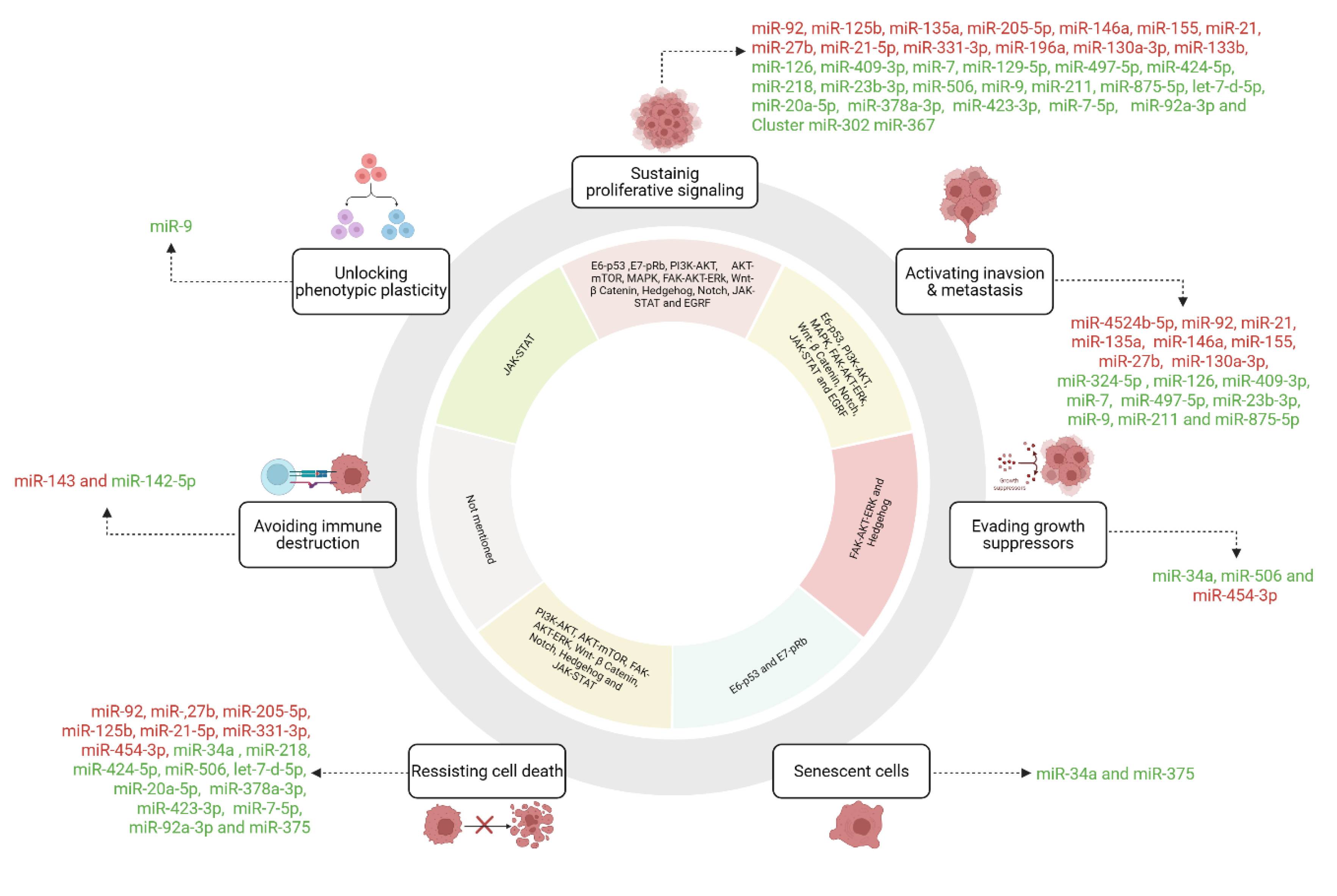
Figure 2.
miRNAs involved in cervical cancer. The miRNAs upregulated and downregulated associated with various hallmarks of cervical cancer are listed under the red and green subheadings, respectively. The symbol ┤ indicates that miRNA negatively regulates the target.
Figure 2.
miRNAs involved in cervical cancer. The miRNAs upregulated and downregulated associated with various hallmarks of cervical cancer are listed under the red and green subheadings, respectively. The symbol ┤ indicates that miRNA negatively regulates the target.
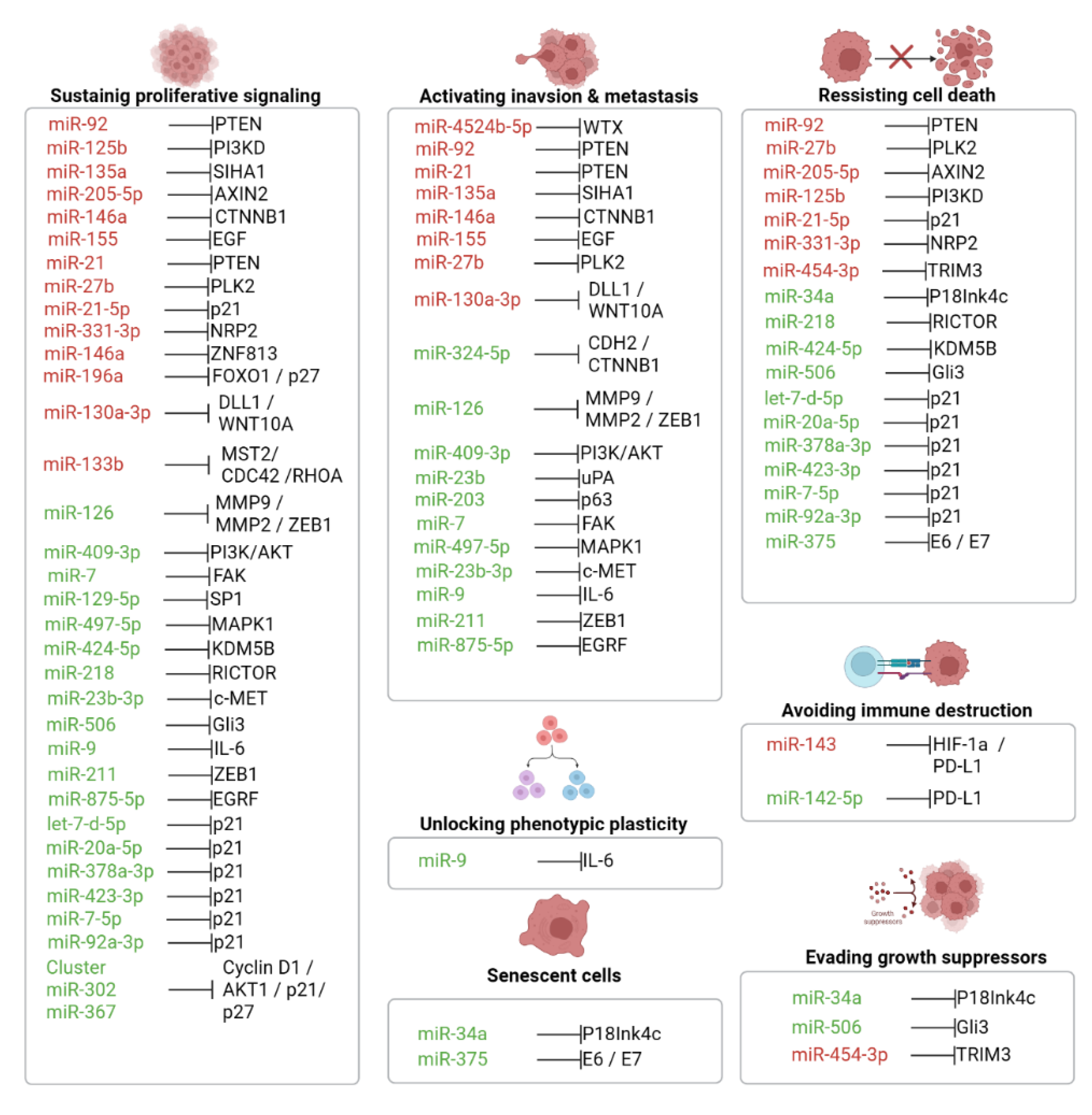

Table 1.
Summary of HPV Oncoproteins (E5, E6, and E7) and Their Regulation of miRNAs in cervical cancer.
Table 1.
Summary of HPV Oncoproteins (E5, E6, and E7) and Their Regulation of miRNAs in cervical cancer.
| Protein | miRNAs | Expression | Target | Cell Process | Ref. |
| E5 | miR-146a | Up | ZNF813 | Cell adhesion and cell cycle | [37] |
| E5 | miR-203 | Down | p63 | Cell junction, cell migration, and cell motility | [37] |
| E5 | miR-324-5p | Down | CDH2, CTNNB1 | Transendothelial migration | [37] |
| E6 | miR-409-3p | Down | PI3K/AKT | Proliferation and migration | [38] |
| E6 | miR-143 | Up | HIF-1a, PD-L1 | Immune system | [39] |
| E7 | miR-27b | Up | PLK2 | Cell proliferation, invasion and apoptosis | [40] |
| E7 | miR-21 | Up | No identified | Cell growth, proliferation and invasion | [41] |
| E6/E7 | miR-17-5p, miR-186-5p, miR-378a-3p, miR-378f, miR-629-5p, and miR-7-5p (intracellular) | Down | No identified | Cell proliferation and apoptosis | [42] |
| E6/E7 | miR-143-3p, miR-23a-3p, miR-23b-3p, and miR-27b-3p (intracellular) | Up | No identified | Cell proliferation and apoptosis | [42] |
| E6/E7 | let-7d-5p, miR-20a-5p, miR-378a-3p, miR-423-3p, miR-7-5p, miR-92a-3p (exosomal) | Down | p21 | Cell proliferation and apoptosis | [42] |
| E6/E7 | miR-21-5p (exosomal) | Up | p21 | Cell proliferation and apoptosis | [42] |
| E6/E7 | miR-142-5p | Down | PD-L1 | Immune system | [43] |
| E6/E7 | miR-331-3p | Up | NRP2 | Cell proliferation, cell cycle, apoptosis | [44] |
| E6/E7 | miR-199b-5p and miR-190a-5p | Down | No identified | Cell proliferation | [45] |
| E5/E6/E7 | miR-148a-3p | Down | No identified | Cell proliferation | [45] |
| This table summarizes the role of HPV oncoproteins (E5, E6, and E7) in regulating microRNAs (miRNAs) involved in cervical cancer progression. The "Protein" column lists the HPV oncoproteins responsible for miRNA regulation. The "miRNAs" column shows the specific miRNAs affected by these oncoproteins. The "Regulation" column indicates whether the miRNA is upregulated (increased) or downregulated (decreased). The "Target" column identifies the key molecular targets of the regulated miRNAs. The "Cell Process" column describes the biological processes influenced, such as cell proliferation, migration, apoptosis, and immune evasion. The "Ref." column references the studies that reported these interactions. | |||||
Table 2.
Overview of miRNAs, their Targets, associated signaling pathways, and hallmarks of cancer.
| miRNA | Target | Signaling pathways | Hallmarks of cancer | Ref. | ||||
| miR-34a | p18Ink4c | E6/p53 | Senescent cells, evading growth suppressors and resisting cell death | [51,52] | ||||
| miR-23b | uPA | E6/p53 | Activating invasion & metastasis | [53] | ||||
| miR-375 | E6 and E7 | E6/p53 and E7/pRb | senescent cells and resisting cell death | [54] | ||||
| miR-129-5p | SP1 | E6/p53 and E7/pRb | Sustaining proliferative signaling | [56] | ||||
| miR-92 | PTEN | PI3K/AKT | Sustaining proliferative signaling, activating invasion & metastasis and resisting cell death | [57] | ||||
| Cluster miR-302 and miR-367 | Cyclin D1, AKT1, and p27 | PI3K/AKT | Sustaining proliferative signaling | [58] | ||||
| miR-196a | FOXO1 and p27 | PI3K/AKT | Sustaining proliferative signaling | [59] | ||||
| miR-125b | PIK3CD | PI3K/AKT/mTOR | Sustaining proliferative signaling and resisting cell death | [60] | ||||
| miR-133b | MST2, CDC42 and RHOA | AKT/ERK | Sustaining proliferative signaling | [61] | ||||
| miR-218 | RICTOR | AKT/mTOR | Sustaining proliferative signaling and resisting cell death | [62] | ||||
| miR-23b-3p | c-Met | FAK/AKT/ERK | Sustaining proliferative signaling and activating invasion & metastasis | [63] | ||||
| miR-21 | PTEN | FAK/AKT/ERK | Sustaining proliferative signaling and activating invasion & metastasis | [64] | ||||
| miR-7 | FAK | FAK/AKT/ERK | Sustaining proliferative signaling and activating invasion & metastasis | [65] | ||||
| miR-497-5p | MAPK1 | MAPK | Sustaining proliferative signaling and activating invasion & metastasis | [66] | ||||
| miR-454-3p | TRIM3 | MAPK | Evading growth suppressors and resisting cell death | [67] | ||||
| miR-135a | SIAH1 | Wnt/β-catenin | Activating invasion & metastasis and sustaining proliferative signaling | [68] | ||||
| miR-205-5p | AXIN2 | Wnt/β-catenin | Resisting cell death and sustaining proliferative signaling | [69] | ||||
| miR-146a | CTNNB1 | Wnt | Activating invasion & metastasis and sustaining proliferative signaling | [70] | ||||
| miR-4524b-5p | WTX | Wnt/β-catenin | Activating invasion & metastasis | [71] | ||||
| miR-424-5p | KDM5B | Notch | Sustaining proliferative signaling and resisting cell death | [72] | ||||
| miR-34a | Notch1 and Jagged1 | Notch | Activating invasion & metastasis | [73] | ||||
| miR-628-5p | Jagged1 | Notch | Sustaining proliferative signaling and resisting cell death | [74] | ||||
| miR-130a-3p | DLL1 e WNT10A | Notch/Wnt | Activating invasion & metastasis and sustaining proliferative signaling | [75] | ||||
| miR-506 | Gli3 | Hedgehog | Sustaining proliferative signaling, evading growth suppressors and resisting cell death | [76] | ||||
| miR-9 | IL-6 | JAK/STAT | Sustaining proliferative signaling, activating invasion & metastasis and unlocking phenotypic plasticity | [77] | ||||
| miR-126 | MMP2, MMP9 and ZEB1 | JAK/STAT | Sustaining proliferative signaling and activating invasion & metastasis | [78] | ||||
| miR-211 | ZEB1 | JAK/STAT | Sustaining proliferative signaling and activating invasion & metastasis | [79] | ||||
| miR-875-5p | EGFR | EGFR | Sustaining proliferative signaling and activating invasion & metastasis | [80] | ||||
| miR-155 | EGF | EGFR | Sustaining proliferative signaling, activating invasion & metastasis | [81] | ||||
This table provides an overview of miRNAs involved in cervical cancer. The ‘miRNAs’ column lists miRNAs associated with cervical cancer. The ’Target’ column identifies the primary molecular targets regulated by these miRNAs. The ’Signaling pathways’ column describes the signaling pathways in which each miRNA is involved. The ’Hallmarks of Cancer’ column indicates the specific hallmarks of cancer associated with each miRNA. The ’Ref’ column cites the studies that reported these interactions.
Table 3.
miRNAs involved in cervical cancer’s clinical outcome.
| miRNAs | Expression | Outcome | Ref. |
| miR-34a | Downregulated | Shorter overall survival | [84] |
| miR-23b | Downregulated | Shorter overall survival | [87] |
| miR-125b | Downregulated | Shorter overall survival | [85] |
| miR-133b | Upregulated | Shorter overall survival | [88] |
| miR-218 | Downregulated | Shorter overall survival | [89] |
| miR-196a | Upregulated | Shorter overall survival | [59] |
| miR-497-5p | Downregulated | Poor survival | [90] |
| miR-21 | Upregulated | Shorter overall survival | [91] |
| miR-205-5p | Upregulated | Poor survival | [69] |
| miR-146a | Downregulated | Shorter overall survival | [91] |
| miR-424-5p | Downregulated | Poor prognosis | [92] |
| miR-9 | Upregulated | Shorter overall survival | [86] |
| miR-126 | Downregulated | Shorter overall survival | [93] |
| miR-875-5p | Downregulated | Shorter overall survival | [80] |
| miR-155 | Downregulated | Shorter overall survival | [91] |
This table summarizes the role of miRNAs in clinical outcome of cervical cancer. The ’miRNAs’ column lists miRNAs associated with clinical outcomes. The ’Status’ column indicates whether the regulation of each miRNA is upregulated or downregulated. The ’Outcome’ column describes the clinical outcome associated with miRNA. The ’Ref’ column cites the studies that reported these interactions.
Disclaimer/Publisher’s Note: The statements, opinions and data contained in all publications are solely those of the individual author(s) and contributor(s) and not of MDPI and/or the editor(s). MDPI and/or the editor(s) disclaim responsibility for any injury to people or property resulting from any ideas, methods, instructions or products referred to in the content. |
© 2026 by the authors. Licensee MDPI, Basel, Switzerland. This article is an open access article distributed under the terms and conditions of the Creative Commons Attribution (CC BY) license.
Copyright: This open access article is published under a Creative Commons CC BY 4.0 license, which permit the free download, distribution, and reuse, provided that the author and preprint are cited in any reuse.


