

Submitted:
02 May 2026
Posted:
05 May 2026
You are already at the latest version
Abstract
Plastics pyrolysis is increasingly pursued as a pathway for producing circular hydrocarbon feedstocks for petrochemical integration. However, non-integrated reactor configurations often exhibit limited heat-transfer control, significant char handling requirements, and variable product distributions. This work presents a system-level interpretation of the MLM-R™ process, an integrated pyrolysis–combustion loop in which a circulating solid heat carrier enables continuous thermal supply through internal oxidation of carbonaceous residues. Material Flow Analysis (MFA) was applied to reconcile mass, elemental carbon, and chemical energy distributions across the defined process boundary. For the representative case study (1,000 kg polyolefin basis), ~81% of feed carbon and ~83% of feed chemical energy (HHV basis) were recovered in the condensed liquid product, while ~7% of feed carbon was internally combusted to sustain autothermal operation. Simulated distillation analysis indicates that removal of a ~15 wt% C34+ heavy fraction enables compliance with refinery-relevant boiling range targets (≥95% below 480°C). The combined MFA and physicochemical interpretation supports the role of integrated solids circulation and heat-transfer control as primary drivers of product selectivity and process scalability in circular feedstock production.
Keywords:
thermochemical recycling
; circular refinery feedstocks
; material flow analysis
1. Introduction
Chemical recycling of plastic waste via thermochemical conversion is increasingly pursued to produce circular hydrocarbon feedstocks for the petrochemical industry. Among available routes, pyrolysis of polyolefin-rich waste can generate liquid and gaseous hydrocarbons that—after suitable conditioning—may substitute fossil-derived refinery and steam-cracking feeds [1,2,3]. However, many non-integrated pyrolysis schemes generate a carbonaceous solid residue (char/coke) that must be separated, transported, and managed externally, increasing operational complexity and potentially degrading overall resource efficiency [4,5]. In addition, limited control of heat transfer and vapor residence time may favor secondary reactions (e.g., cracking–recombination, aromatization, and condensation/polymerization), broadening the boiling range and reducing compatibility with petrochemical specifications [1,6,7].
Beyond feedstock composition and operating temperature, the outcome of plastic pyrolysis is strongly governed by heat and mass transfer phenomena, which directly control reaction kinetics, vapor residence time, and the extent of secondary reactions. Kinetic studies on polyolefin and biomass degradation have consistently shown that primary chain scission reactions compete with secondary cracking, recombination, and aromatization processes, whose relative importance increases with residence time and thermal non-uniformity [6,7,8,9,10].
In many conventional reactor configurations, including batch, rotary kiln, and fixed-bed systems, the scale-up of plastic pyrolysis is intrinsically limited by insufficient heat transfer rates and by diffusion-controlled regimes, which promote temperature gradients, local overheating, and enhanced char formation. Even fluidized-bed concepts, when not embedded in an integrated solids-circulation loop, may suffer from instability in heat supply and from the progressive accumulation of carbonaceous residues that deteriorate long-term operability [11,12,13,14,15,16,17,18,19].
These limitations highlight that the technological challenge in plastic pyrolysis is not solely chemical in nature, but lies at the interface between reaction kinetics and multiphase hydrodynamics. Consequently, reactor concepts that integrate controlled solids circulation, stable fluidization, and internal heat regeneration represent a structurally different approach compared to non-integrated pyrolysis systems.
PRUVIA GmbH publicly describes the MLM-R® process as a continuous loop configuration in which a solid heat carrier circulates between a pyrolysis reactor and a regenerator, while pyrolysis vapors are routed to condensation and fractionation units [20,21]. In this architecture, carbonaceous residues formed during pyrolysis are oxidized in a separate regenerator, providing heat to recondition the circulating solids. Conceptually, this approach integrates reaction chemistry with controlled solids hydrodynamics and internal heat regeneration, aligning with established principles of bubbling fluidized beds and non-mechanical solids circulation systems [15,16,17,18,19].
The present work does not disclose proprietary mechanical details but instead provides a system-level interpretation of the MLM-R™ process through Material Flow Analysis (MFA). By reconciling mass, elemental carbon, and chemical energy distributions within a defined boundary, the study evaluates how integrated reactor architecture influences carbon utilization, energy partitioning, and product quality.
1.1. Scope and System Boundaries
The scope of this work is to: define the system boundary for quantitative MFA of the MLM-R™ loop; report reconciled mass (Goods layer), elemental carbon (Substance layer) and chemical energy (Energy layer) distributions for a representative operating case; and discuss implications for petrochemical integration, with emphasis on product-quality levers linked to heat transfer and residence time. The MFA boundary spans from plastic feeding to the outlets of condensed hydrocarbon products and non-condensable gas on the pyrolysis side, and to the regenerator off-gas outlet on the combustion side. Upstream collection/sorting and downstream upgrading (e.g., hydrotreating) are outside the boundary.
2. Materials and Methods
2.1. Feedstock Description
The investigated feedstock is a polyolefin-rich plastic waste stream representative of post-consumer and post-industrial mixed plastics targeted for chemical recycling. Feed acceptance criteria are defined to limit contaminants that can adversely impact product quality and operability, particularly halogens, inert solids, and excessive moisture. Because feedstock specifications can be commercially sensitive, only aggregated descriptors are reported here (Table 1); detailed specifications are handled within PRUVIA technical documentation and commercial annexes.
2.2. Mlm-R™ Technology Description
According to PRUVIA public disclosures, the MLM-R® process is a continuous pyrolysis loop in which a solid heat carrier circulates between: a pyrolysis reactor, where plastic is thermally cracked in the absence of oxygen to produce a hot pyrolysis vapor stream; and a regenerator, where the carbonaceous residues are combusted and heat carrier is reheated. Pyrolysis vapors are routed to a fractionation section to produce a liquid product with the desired specification, while the regenerator off-gas is discharged after cleaning and the reheated solids are returned to the reactor to provide the thermal duty required for pyrolysis [20,21].
From a process-engineering standpoint, the MLM-R™ loop can be interpreted as an integrated system of thermochemical reactions aimed to recover the entire feedstock energy of the input and address to chemical recycling most of the input plastic mass. Similar architectures are widely employed in fluid catalytic cracking and circulating fluidized-bed combustion, where stable solids circulation is achieved through the balance of pressure drops, aeration flows, and non-mechanical solids valves [18,19].
The circulation of a solid heat carrier allows the decoupling of heat generation from the endothermic pyrolysis reactions, overcoming one of the main scale-up bottlenecks of plastic pyrolysis reactors. Literature on fluidized-bed hydrodynamics and L-valve-controlled solids transport demonstrates that such systems can maintain reproducible solids fluxes and thermal stability over a wide operating window, provided that bubbling regime and particle properties are properly selected [18,19].
For the purpose of system-level MFA, the technology is represented as lumped unit functions (feed introduction/conditioning, pyrolysis reactor, gas–solid separation, solids buffer/conditioning, regenerator/combustion, and condensation/recovery). This representation is sufficient to quantify overall mass and carbon flows while avoiding disclosure of proprietary geometries and internals.
2.3. Material Flow Analysis (Mfa) Tool and Reconciliation Approach
MFA was performed using STAN (subSTance flow ANalysis), a freeware tool developed at TU Wien to construct material/substance flow models and reconcile measured/estimated data using statistical methods (including options for uncertainty handling) [22,23,24]. STAN supports graphical system definition, layering of Goods/Substances, and redundancy-based consistency checking by data reconciliation.Three layers were implemented:
- (i)
- Goods Layer: Total Mass Flows (Kg Per Functional Basis);
- (ii)
- Carbon layer: elemental carbon flows (kg C per functional basis).
- (iii)
- A chemical-energy partitioning (HHV basis) was derived from reconciled mass flows and assigned heating values for the streams. Thermal energy flows (sensible heat, heat exchange across boundaries, and heat losses) were not modeled as STAN “energy flows” because the objective is to report chemical-energy partitioning consistent with the defined process boundary.
In the context of thermochemical conversion systems governed by multiphase transport phenomena, MFA provides a robust framework to translate complex reactor behavior into system-level performance indicators. In particular, the use of an elemental carbon layer allows the quantification of selectivity between recoverable hydrocarbon products and internally combusted residues, independently of the detailed reaction pathway [25,26].
Previous studies have successfully applied MFA to waste management systems to support technology comparison, scale-up decisions, and energy-efficiency assessments [27]. In the present work, MFA is therefore adopted not as a mere accounting exercise, but as a consistency tool linking reactor architecture, solids circulation strategy, and product distribution.
2.4. Framework for Petrochemical Feed Compatibility Discussion
The discussion of petrochemical compatibility is framed around properties commonly used to evaluate pyrolysis oils for refinery/steam-cracker integration: boiling-range distribution, hydrocarbon family distribution (paraffins/olefins/naphthenes/aromatics), trace heteroatoms (notably chlorine and sulfur), and stability behavior. When property values are not directly reported in this manuscript, literature-based context is provided explicitly as comparative background, not as measured MLM-Oil data.
3. Results
3.1. Reconciled Mass Balance
The reconciled MFA results are consistent with operation under conditions that favor distillable hydrocarbon formation and limit solid carbon accumulation. The high fraction of feed carbon recovered in the condensed liquid, combined with the limited share oxidized in the regenerator, indicates that carbon conversion is steered away from char accumulation and toward distillable hydrocarbons.
From a mechanistic viewpoint, this behavior is consistent with a regime dominated by primary chain scission reactions, where rapid and homogeneous heat transfer suppresses prolonged vapor residence and reduces the probability of secondary condensation and aromatization reactions [6,7,8,9,10]. Such an interpretation is in line with kinetic and experimental studies showing that temperature gradients and slow heat transfer are primary drivers for heavy-end formation in plastic pyrolysis.
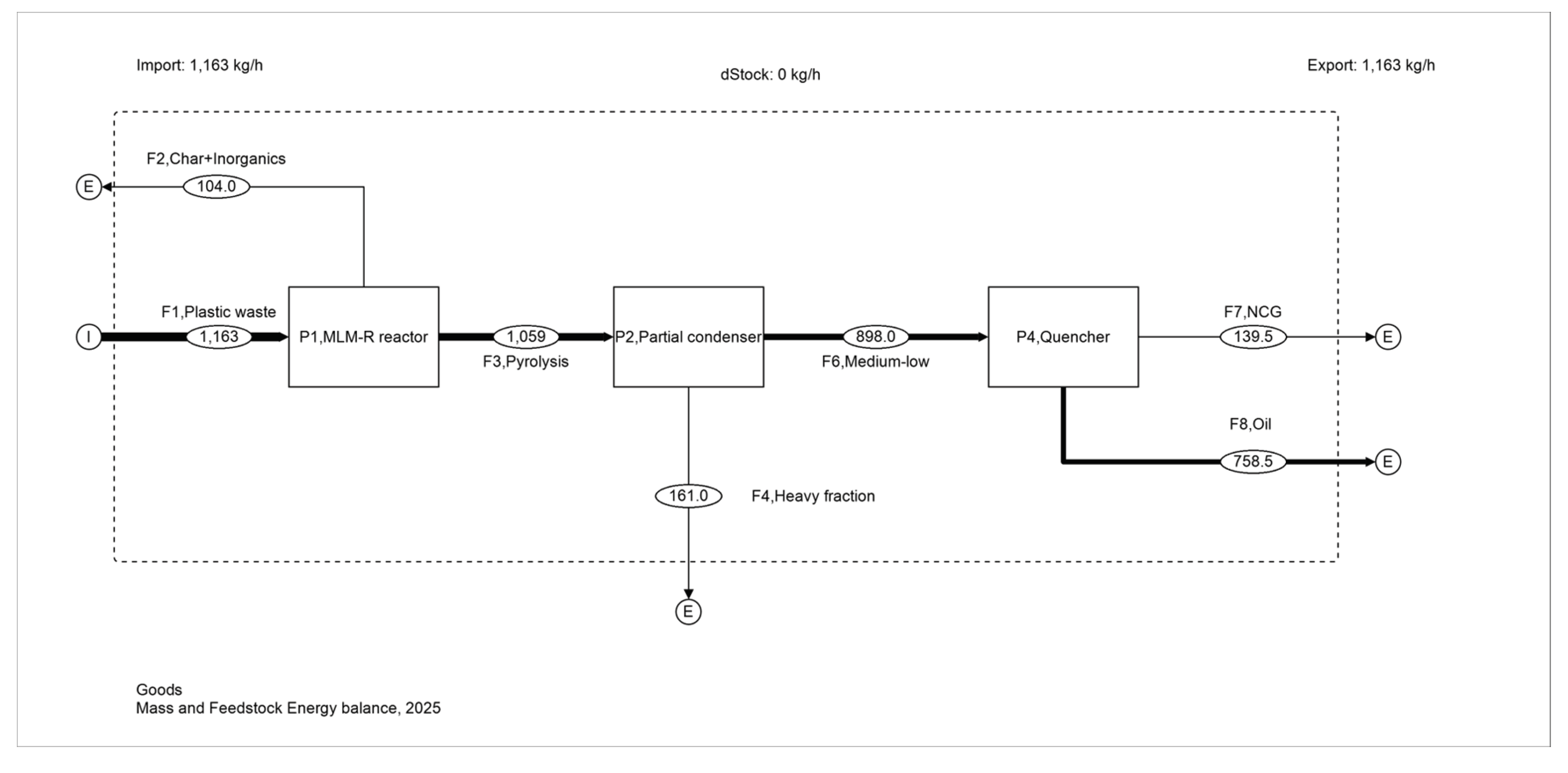
Table 2 summarizes the reconciled mass distribution for a representative operating case corresponding to 1,163 kg as-received plastic feed, equivalent to 1,000 kg dry polyolefin basis after removal of moisture and inert fractions. The dominant outputs are the condensed liquid (MLM-Oil), non-condensable gas (NCG), and regenerator off-gas. Minor solid losses are aggregated within the combustion-side outlet to preserve system-level representation.
The reconciled carbon balance (Table 3) indicates that 81.0% of feed carbon is recovered in the condensed liquid fraction, 11.6% in NCG, and 6.8% is internally oxidized in the regenerator. Carbon closure was within ±0.5%, confirming internal consistency of the reconciliation procedure.
Carbon closure was within ±0.5%, confirming reconciliation robustness.
Figure 1.
Reconciled mass distribution (Goods layer) for basis 1,000 kg plastic feed.
3.2. Chemical-Energy Partitioning
Chemical-energy partitioning was calculated from reconciled mass flows using stream-specific HHV values. Table 4 summarizes the share of feedstock chemical energy recovered as liquid and gaseous hydrocarbon products, and the share converted into process heat through internal combustion of carbonaceous residues in the regenerator.
Heating values were assigned based on representative stream compositions and standard correlations consistent with literature ranges.
All chemical-energy values are reported on a higher heating value (HHV) basis to ensure consistency with elemental carbon accounting.
3.3. Robustness Considerations
Sensitivity checks at system level (e.g., plausible uncertainty on minor losses and feed variability) showed that the reconciled Goods, Carbon and Energy layers remain consistent, supporting that the reported partitioning is primarily determined by the integrated loop architecture rather than boundary artifacts.
4. Physicochemical Considerations for Mlm-Oil Integration
Polyolefin-derived pyrolysis oils typically consist of broad hydrocarbon distributions spanning light naphtha (C5) to vacuum gas oil (C40+) ranges. Their suitability for petrochemical integration depends not only on overall liquid yield, but on boiling-range distribution, hydrocarbon family composition (paraffinic/olefinic/aromatic balance), heteroatom levels, and thermal stability. Secondary reactions promoted by excessive vapor residence time or localized overheating increase aromatic content and heavy-end formation, thereby reducing compatibility with steam-cracker and refinery specifications [6].
Simulated distillation analysis (ASTM D2887) indicates that removal of approximately 15 wt% of the C34+ heavy fraction (corresponding to ~480°C true boiling point equivalent) enables compliance with refinery-relevant specifications requiring ≥95% of the stream to boil below 480°C (Figure 2). This heavy-tail fraction is consistent with secondary condensation products typically associated with prolonged vapor residence or localized heat-transfer limitations in non-integrated systems [6,11]. The ability to control the magnitude of this fraction is therefore directly linked to reactor heat-transfer uniformity and solids circulation stability.
4.1. Linking Mfa Outcomes to Oil-Quality Targets
The MFA-derived carbon distribution provides indirect evidence of reaction selectivity. High carbon recovery in the condensed liquid (81%) suggests suppression of excessive solid carbon formation, which is typically associated with localized overheating and prolonged vapor residence. Literature on polyolefin pyrolysis consistently identifies rapid heat transfer and minimized vapor residence time as key levers to limit secondary condensation and aromatization. The integrated solids-circulation architecture therefore influences product quality not by modifying intrinsic kinetics, but by stabilizing the transport regime under which those kinetics operate.
4.2. Impurity Control
Control of halogens, sulfur, and nitrogen is critical for downstream petrochemical integration due to risks of corrosion and catalyst poisoning [1,2,3,4]. In polyolefin-rich streams meeting defined feed acceptance criteria, heteroatom levels are typically low; however, partitioning behavior during pyrolysis remains relevant. Literature indicates that inorganic species and a significant fraction of halogens preferentially associate with the solid residue [1,2,3,4] when effective gas–solid separation and stable solids circulation are maintained.
In the integrated loop configuration, carbonaceous residues are directed to the regenerator, where oxidation further segregates inorganic species from the condensed hydrocarbon stream. The impurity partitioning reported in Table 5 reflects this system-level segregation mechanism. While detailed speciation analysis is beyond the scope of this study, the integrated architecture reduces inorganic carryover to the liquid product relative to configurations lacking dedicated solids management.
5. Discussion
The reconciled Material Flow Analysis provides a system-level interpretation of the MLM-R™ technology that is consistent with both pyrolysis chemistry and multiphase transport theory. The high fraction of feed carbon recovered in the condensed liquid, combined with the limited share oxidized in the regenerator, indicates that the process architecture effectively suppresses the accumulation of solid carbonaceous residues while sustaining the thermal demand internally. This behavior differentiates the MLM-R™ concept from non-integrated pyrolysis systems, where char extraction and external heat supply represent structural bottlenecks.
From a mechanistic standpoint, the observed carbon distribution is compatible with a reaction regime dominated by primary chain scission, in which rapid and spatially uniform heat transfer minimizes temperature gradients and limits vapor residence time. Kinetic and experimental studies on polyolefin pyrolysis consistently show that prolonged residence times and non-uniform heating promote secondary cracking, condensation, and aromatization, shifting products toward heavier fractions and higher aromatic content. The MFA outcomes reported here therefore support the interpretation that the integrated solids-circulation loop indirectly steers the chemistry toward distillable hydrocarbons by controlling transport phenomena rather than by altering intrinsic reaction pathways.
The internal oxidation of carbonaceous residues in a dedicated regenerator further contributes to process stability by decoupling heat generation from pyrolysis reactions. In contrast to configurations where char is withdrawn and managed externally, the MLM-R™ architecture converts a limited fraction of feed carbon into process heat within the system boundary, reducing operational complexity and improving overall carbon utilization. Importantly, this feature emerges from the system layout itself and does not rely on additional downstream treatment or auxiliary fuel inputs.
From an engineering perspective, the relevance of these results extends beyond mass and carbon efficiency. Fluidized-bed-based loop systems benefit from well-established hydrodynamic principles and industrial precedent, particularly in fluid catalytic cracking and circulating fluidized-bed combustion. By embedding plastic pyrolysis within such a framework, the MLM-R™ technology leverages mature multiphase-flow engineering to address scale-up challenges that are intrinsic to diffusion- and heat-transfer-limited reactors such as rotary kilns and large fixed beds. In this sense, the MFA results should be interpreted not only as performance indicators, but also as evidence of a scalable process logic grounded in coupled reaction–transport control.
Compared to literature-reported liquid carbon recoveries of 60–75% in non-integrated polyolefin pyrolysis systems [1,4], the present case (~81% carbon recovery to liquid) suggests improved carbon selectivity toward condensable hydrocarbons. While direct comparison across technologies requires caution, the results are consistent with the hypothesis that integrated solids circulation and internal heat regeneration reduce conditions conducive to char overproduction and heavy-end growth.
5.1. Industrial Relevance and Outlook
Scale-up of plastic pyrolysis technologies remains challenging due to the combined influence of reaction kinetics, heat transfer, and solids handling. Reactor concepts governed by diffusion-limited heat transfer, such as rotary kilns and large fixed beds, exhibit intrinsic scale-up constraints that are difficult to overcome by geometric enlargement alone [11,12,13].
In contrast, the MLM-R™ technology is based well-established scaling laws and industrial precedent, particularly in FCC and circulating fluidized-bed combustion [15,16,17,18]. By embedding pyrolysis within a solids-circulation loop, the MLM-R™ technology leverages this body of knowledge, positioning itself as a chemically driven process enabled by mature multiphase-flow engineering rather than by empirical reactor scaling.
The combination of liquid recovery, controlled internal thermal supply, and elimination of external char disposal is industrially relevant for continuous operation and scale-up. Publicly available information indicates that the MLM-R™ technology has progressed from pilot validation to operation of an industrial demonstration plant, supporting its relevance beyond laboratory-scale concepts [20,21].
In this context, the present MFA-based analysis provides a transparent and reproducible framework to assess integrated pyrolysis systems without disclosure of proprietary design details. Future peer-reviewed work should focus on publication-grade characterization of the liquid product and on uncertainty-qualified MFA datasets to further consolidate the link between system architecture, product quality, and industrial operability.
6. Conclusions
This work demonstrates how Material Flow Analysis can be used to describe and interpret the MLM-R™ integrated pyrolysis–combustion concept at the system level while respecting confidentiality constraints. For the representative case study, reconciled mass and elemental-carbon balances show that the majority of feed carbon is recovered as liquid and gaseous hydrocarbon products, with only a limited fraction internally oxidized to supply process heat. This configuration intrinsically avoids external char handling and supports stable thermal operation.
Beyond quantitative balances, the analysis highlights a broader implication: in plastic pyrolysis, product selectivity and scalability are governed not only by intrinsic reaction kinetics, but by the integration of those kinetics with solids hydrodynamics and heat-transfer control. By coupling pyrolysis chemistry with a controlled solids-circulation loop, the MLM-R™ technology exemplifies a process architecture in which transport phenomena are deliberately used to steer chemical outcomes. This perspective shifts the design focus from isolated reactor optimization toward system-level integration as a key enabler for refinery-ready circular feedstock production.
Author Contributions
Conceptualization, methodology, formal analysis, investigation, data curation, writing - original draft preparation, writing - review and editing, visualization, supervision, and project administration, M.L.M. The author has read and agreed to the published version of the manuscript.
Funding
This research received no external funding.
Institutional Review Board Statement
Not applicable.
Informed Consent Statement
Not applicable.
Data Availability Statement
The data presented in this study are available on request from the corresponding author. Certain process-specific information is not publicly available due to commercial confidentiality and proprietary restrictions.
Conflicts of Interest
The author is the inventor of patent EP 3 894 516 B1, which is related to the MLM-R technology discussed in this article and is authorized by PRUVIA GmbH to use the data and the information provided for the paper for scientific purposes.
References
- Vollmer, I.; Jenks, M. J. F.; Roelands, M. C. P.; White, R. J.; van Harmelen, T.; de Wild, P.; van der Laan, G. P.; Meirer, F.; Keurentjes, J. T. F.; Weckhuysen, B. M. Beyond Mechanical Recycling: Giving New Life to Plastic Waste. Angew. Chem. Int. Ed. 2020, 59, 15402–15423. [Google Scholar] [CrossRef] [PubMed]
- Aguado, J.; Serrano, D. P.; Escola, J. M. Fuels from Waste Plastics by Thermal and Catalytic Processes: A Review. Ind. Eng. Chem. Res. 2008, 47, 7982–7992. [Google Scholar] [CrossRef]
- Aguado, J.; Serrano, D. P. Feedstock Recycling of Plastic Wastes; Royal Society of Chemistry: Cambridge, U.K., 2007. [Google Scholar] [CrossRef]
- Maqsood, T.; Dai, J.; Zhang, Y.; Guang, M.; Li, B. Pyrolysis of Plastic Species: A Review of Resources and Products. J. Anal. Appl. Pyrolysis 2021, 159, 105295. [Google Scholar] [CrossRef]
- Al-Salem, S. M.; Antelava, A.; Constantinou, A.; Manos, G.; Dutta, A. A Review on Thermal and Catalytic Pyrolysis of Plastic Solid Waste (PSW). J. Environ. Manag. 2017, 197, 177–198. [Google Scholar] [CrossRef] [PubMed]
- Di Blasi, C. Modeling Chemical and Physical Processes of Wood and Biomass Pyrolysis. Prog. Energy Combust. Sci. 2008, 34, 47–90. [Google Scholar] [CrossRef]
- Foster, A. J.; Jae, J.; Cheng, Y.-T.; Huber, G. W.; Lobo, R. F. Optimizing the Aromatic Yield and Distribution from Catalytic Fast Pyrolysis of Biomass over ZSM-5. Appl. Catal. 2012, A 423-424, 154–161. [Google Scholar] [CrossRef]
- Westerhout, R. W. J.; Waanders, J.; Kuipers, J. A. M.; van Swaaij, W. P. M. Kinetics of the Low-Temperature Pyrolysis of Polyethene, Polypropene, and Polystyrene: Modeling, Experimental Determination, and Comparison with Literature Models and Data. Ind. Eng. Chem. Res. 1997, 36, 1955–1964. [Google Scholar] [CrossRef]
- Gracida-Alvarez, U. R.; Mitchell, M. K.; Sacramento-Rivero, J. C.; Shonnard, D. R. Effect of Temperature and Vapor Residence Time on the Micropyrolysis Products of Waste High Density Polyethylene. Ind. Eng. Chem. Res. 2018, 57, 1911–1924. [Google Scholar] [CrossRef]
- Miskolczi, N.; Bartha, L.; Deak, G.; Jover, B.; Kallo, D. Thermal and Thermo-Catalytic Degradation of High-Density Polyethylene Waste. J. Anal. Appl. Pyrolysis 2004, 72, 235–242. [Google Scholar] [CrossRef]
- Glicksman, L. R. Fluidized Bed Scaleup. In Handbook of Fluidization and Fluid-Particle Systems; Yang, W.-C., Ed.; Marcel Dekker: New York, 2003; pp. 343–378. [Google Scholar]
- Werther, J.; Hartge, E.-U. chapter in. In Handbook of Fluidization and Fluid-Particle Systems; Yang, W.-C., Ed.; Marcel Dekker: New York, 2003. [Google Scholar]
- Handbook of Fluidization and Fluid-Particle Systems; Yang, W.-C., Ed.; Marcel Dekker: New York, 2003. [Google Scholar]
- Arena, U. Process and Technological Aspects of Municipal Solid Waste Gasification. A Review. Waste Manag. 2012, 32, 625–639. [Google Scholar] [CrossRef] [PubMed]
- Kunii, D.; Levenspiel, O. Fluidization Engineering, 2nd ed.; Butterworth-Heinemann: Boston, 1991. [Google Scholar]
- Basu, P. Combustion and Gasification in Fluidized Beds; CRC Press/Taylor & Francis: Boca Raton, FL, 2006. [Google Scholar]
- Grace, J. R.; Bi, H. T.; Golriz, M. Circulating Fluidized Beds. Adv. Chem. Eng. 2008, 35, 1–52. [Google Scholar]
- Knowlton, T. M. Standpipes and Nonmechanical Valves. In Handbook of Fluidization and Fluid-Particle Systems; Yang, W.-C., Ed.; Marcel Dekker: New York, 2003; pp. 571–598. [Google Scholar]
- Bi, H. T.; Grace, J. R. Flow Regime Diagrams for Gas-Solid Fluidization and Upward Transport. Int. J. Multiph. Flow 1995, 21, 1229–1236. [Google Scholar] [CrossRef]
- Mastellone, M. L. Plastic-to-Oil Plant for Converting Plastic Waste into Petrochemical Products. Eur. Patent EP 3 894 516 B1, 29 Nov 2023. [Google Scholar]
- PRUVIA GmbH. MLM-R Technology—Integrated Pyrolysis Loop for Plastic Waste Conversion. Available online: https://www.pruvia.com/technology-in-detail/ (accessed on 2026-03-08).
- Brunner, P. H.; Rechberger, H. Practical Handbook of Material Flow Analysis; CRC Press: Boca Raton, FL, 2016. [Google Scholar]
- Cencic, O. Nonlinear Data Reconciliation in Material Flow Analysis with Software STAN. Sustain. Environ. Res. 2016, 26, 291–298. [Google Scholar] [CrossRef]
- Allesch, A.; Brunner, P. H. Material Flow Analysis as a Tool to Improve Waste Management Systems: The Case of Austria. Environ. Sci. Technol. 2017, 51, 540–551. [Google Scholar] [CrossRef] [PubMed]
- Zaccariello, L.; Cremiato, R.; Mastellone, M. L. Evaluation of Municipal Solid Waste Management Performance by Material Flow Analysis: Theoretical Approach and Case Study. Waste Manag. Res. 2015, 33(10), 871–885. [Google Scholar] [CrossRef] [PubMed]
- Mastellone, M. L.; Brunner, P. H.; Arena, U. Scenarios of Waste Management for a Waste Emergency Area: A Substance Flow Analysis. J. Ind. Ecol. 2009, 13(5), 735–757. [Google Scholar] [CrossRef]
- Arena, U.; Di Gregorio, F. A Waste Management Planning Based on Substance Flow Analysis. Resour. Conserv. Recycl. 2014, 85, 54–66. [Google Scholar] [CrossRef]
Figure 2.
Simulated distillation profile of MLM-Oil before and after removal of the C34+ heavy fraction (~15 wt%), illustrating compliance with a 95% boiling point below 480°C.
Figure 2.
Simulated distillation profile of MLM-Oil before and after removal of the C34+ heavy fraction (~15 wt%), illustrating compliance with a 95% boiling point below 480°C.
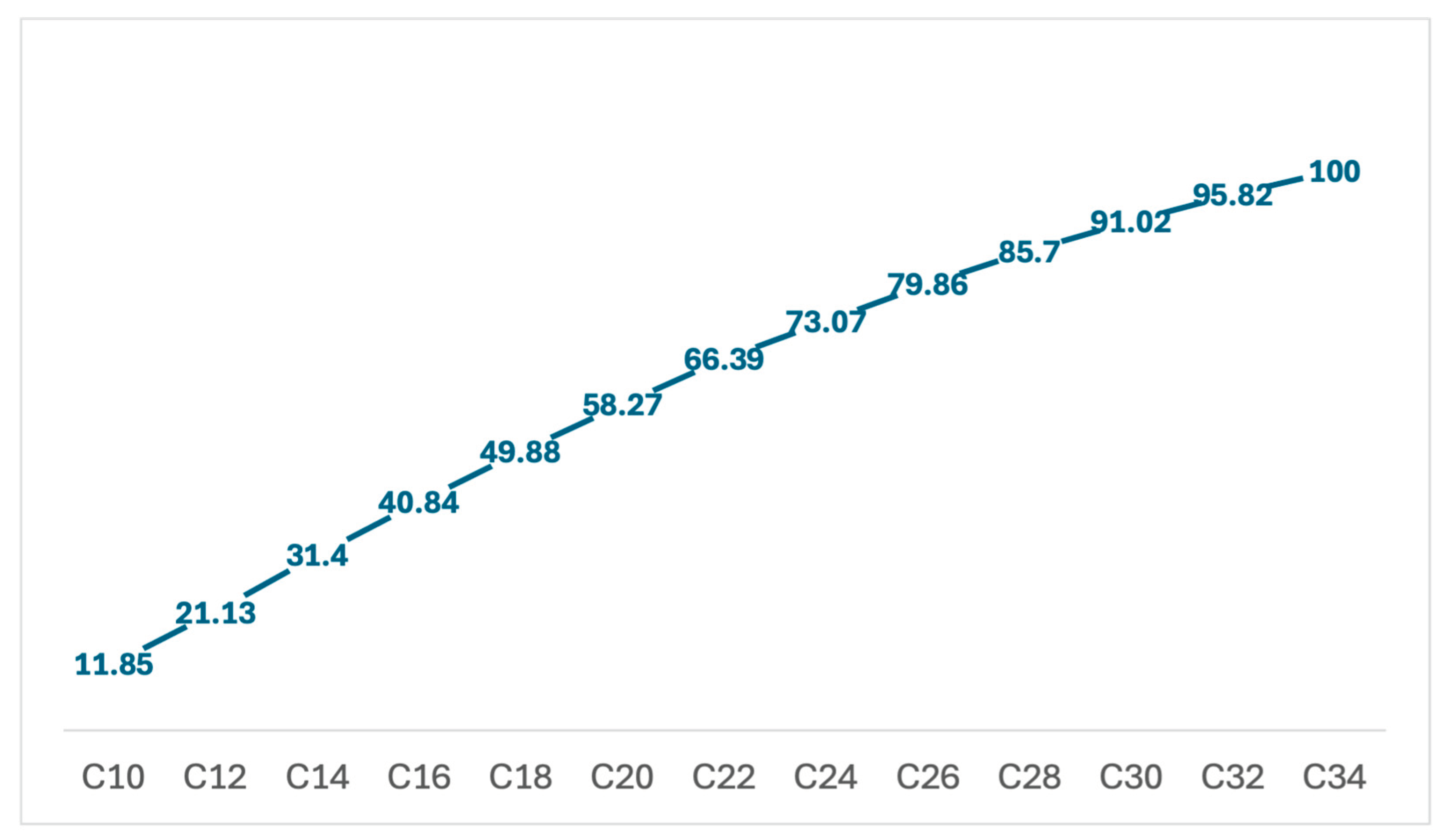

Table 1.
Plastic waste composition.
| Component, % | Carbon*, % | Feedstock Energy, MJ/kg | |
|---|---|---|---|
| Polyolefins fraction | 86.00% | 86.08% | 45.73 |
| Other polymers | 4.00% | 56.85% | 23.25 |
| Inorganics | 2.00% | 0.00% | 0 |
| Biogenic | 3.00% | 50.00% | 20 |
| Moisture | 5.00% | 0.00% | 0 |
* Carbon content values are representative elemental-carbon mass fractions used for MFA modeling.
Table 2.
Reconciled mass distribution (Goods layer) for basis 1,000 kg polyolefins.
| Stream | Mass | Notes |
| Plastic feed | 1163 | System input |
| Condensed liquid | 919.26 | Pyrolysis-side product |
| Non-condensable gas (NCG) | 139.53 | Pyrolysis-side product |
| Char to regenerator off-gas | 80.74 (103.9 incl. inorganics) | Combustion-side outlet |
Table 3.
Elemental carbon balance for basis 1,000 kg polyolefins.
| Stream | Carbon (kg C per basis) | Fraction of feed carbon (%) |
| Feed carbon | 904.9 | 100 |
| Carbon in Oil | 600.9 (Light) +137.6 (Heavy) | 81.0 |
| Carbon in NCG | 105.1 | 11.6 |
| Carbon internally combusted | 61.3 | 6.8 |
Table 4.
Chemical-energy partitioning derived from reconciled MFA (HHV basis).
| Energy term | Energy (MJ per basis) | Share of feed energy (%) |
| Feedstock chemical energy (HHV basis) | 47512 | 100 |
| Recovered in Oil (chemical) | 39618 | 83.3 |
| Recovered in NCG (chemical) | 5093 | 10.7 |
| Converted to heat via internal combustion | 2801 | 5.89 |
Table 5.
Partition of impurities between the pyrolysis-side product and combustion-side product lines*.
Table 5.
Partition of impurities between the pyrolysis-side product and combustion-side product lines*.
| Impurity | In the Oil |
In the Flue Gas (from char oxidation) |
| Chlorine | 13% | 87% |
| Nitrogen | 44% | 56% |
| Sulphur | 5% | 95% |
* Values are measured during test runs and represent normalized partitioning within the defined MFA boundary.
Disclaimer/Publisher’s Note: The statements, opinions and data contained in all publications are solely those of the individual author(s) and contributor(s) and not of MDPI and/or the editor(s). MDPI and/or the editor(s) disclaim responsibility for any injury to people or property resulting from any ideas, methods, instructions or products referred to in the content. |
© 2026 by the author. Licensee MDPI, Basel, Switzerland. This article is an open access article distributed under the terms and conditions of the Creative Commons Attribution (CC BY) license.
Copyright: This open access article is published under a Creative Commons CC BY 4.0 license, which permit the free download, distribution, and reuse, provided that the author and preprint are cited in any reuse.


