

Submitted:
01 May 2026
Posted:
04 May 2026
You are already at the latest version
Abstract
Taste buds are continuously renewed sensory organs in which development, adult maintenance, and repair share overlapping molecular circuitry. During embryogenesis, WNT/β-catenin signaling promotes taste placode formation and placodal Shh expression, whereas SHH refines papilla spacing and restricts neighboring papilla formation. SOX2 functions as a taste-competence and progenitor-maintenance factor. In adults, LGR5/LGR6-RSPO-WNT signaling sustains progenitor activity, and gustatory neurons provide RSPO2 as a niche signal that maintains epithelial renewal. HH signaling from epithelial and neuronal sources further supports SOX2-dependent progenitor homeostasis. Lineage allocation is controlled by transcriptional programs that include POU2F3/SKN-1a for sweet, umami, and bitter type II taste receptor cells and ASCL1 with posterior-field NKX2-2 for type III presynaptic/sour cells. After denervation or irradiation, regeneration depends primarily on LGR5+/KRT14+ progenitors and may be supplemented, in specific injury contexts, by plasticity of a subset of K8-lineage taste receptor cells that acquire KRT14/SOX2/PCNA progenitor-like features. Key unresolved issues include the direct chromatin targets of taste lineage regulators (which remain to be defined by ChIP-seq in native taste progenitors), the identity of the type I cell selector, the contribution of dedifferentiation across injury models, and the extent to which mouse-derived networks are conserved in human taste biology.
Keywords:
Taste bud
; WNT/β‐catenin
; SHH
; SOX2
; LGR5
; R‐spondin
; POU2F3
; organoid
; regeneration
; lineage specification
1. Introduction
Taste allows vertebrates to evaluate the nutritional value and potential toxicity of ingested material. This sensory task is performed by taste buds, compact epithelial sensory organs composed of approximately 50-100 cells embedded in the epithelium of the tongue, palate, pharynx, and larynx [1,2]. A defining feature of taste buds is continuous cellular turnover. In adult mice, differentiated taste receptor cells (TRCs) are replaced over a period of roughly 8–12 days in fungiform papillae and up to 22 days in circumvallate papillae, requiring persistent progenitor activity and lineage allocation throughout life [3]. On the mouse tongue, taste buds reside in three major papilla types. Fungiform papillae (FuP) occupy the anterior tongue and generally contain a single taste bud. The circumvallate papilla (CVP) is posterior midline and harbors hundreds of taste buds. Foliate papillae (FoP) are scattered throughout the posterior-lateral tongue [4]. FuP taste buds receive their innervation mainly from the chorda tympani branch of the facial nerve (CN VII). CVP taste buds are innervated by the glossopharyngeal nerve (CN IX). Foliate papillae taste buds are dually innervated by both CN VII and CN IX. This innervation is required not only for sensory transmission but also for maintenance of the epithelial taste organ. Genetic and organoid studies have shown that pathways used during taste organ development, including WNT/β-catenin, SHH/HH, SOX2, Notch, and BMP signaling, are reused during adult maintenance but with altered functional outputs [3,5]. The identification of gustatory-neuron-derived R-spondins, particularly RSPO2, as WNT-amplifying niche signals that maintain epithelial progenitors and explain the long-recognized dependence of taste buds on gustatory innervation [6]. An additional layer of organization arises from the composite embryonic origin of the tongue. Lineage-tracing studies indicate that anterior tongue epithelium, including FuP, is predominantly ectoderm-derived, whereas posterior CVP/FoP fields are endoderm-derived [7]. This anterior-posterior distinction affects transcription factor usage, progenitor composition, and the interpretation of genetic perturbation experiments [8]. Taste bud biology therefore requires region-specific models rather than a single uniform program. This review integrates evidence for a genetic network that governs taste bud development, homeostasis, and regeneration. The discussion follows the network from embryonic placode patterning to adult progenitor maintenance, lineage specification, injury responses, organoid systems, and comparative vertebrate models. Particular emphasis is placed on distinguishing established mechanisms from plausible but still untested regulatory models.
2. Anatomical and Cellular Framework
2.1. Taste Fields and Their Embryonic Origins
A central principle in taste biology is that the major tongue papilla types do not share a single germ-layer origin (Figure 1). In mice, inducible Cre-based lineage tracing by Rothova et al. demonstrated that the anterior tongue epithelium giving rise to FuP is predominantly ectoderm-derived, whereas the posterior tongue epithelium forming CVP and FoP is endoderm-derived [7]. This anterior-ectoderm/posterior-endoderm organization has implications for transcription factor expression, progenitor identity, and local signaling during taste bud maintenance [8]. The approximate boundary between these territories lies near the foramen cecum/posterior tongue landmark region rather than functioning as a sharply demarcated mature anatomical line in the mouse [4]. The anterior field shows broad SOX2-associated epithelial competence and gives rise to FuP, each usually containing a single taste bud innervated by CN VII. The posterior field forms the CVP and FoP, which contain numerous taste buds and are densely innervated by CN IX [1].
This dual-field organization is important experimentally. Perturbations targeted to one papilla type cannot be assumed to generalize across the entire gustatory system, because phenotypes may differ between anterior FuP and posterior CVP/FoP taste fields.
2.2. Cellular Organization of the Mature Taste Bud
Within the mature taste bud, several cell populations can be distinguished by morphology, molecular markers, and function (Figure 1). Type I cells are glial-like support cells that wrap other cell types and express the ectoenzyme NTPDase2, consistent with roles in extracellular ATP clearance and ionic homeostasis [1]. Type II receptor cells detect sweet, umami, and bitter stimuli through T1R- and T2R-family receptors and the downstream signaling machinery PLCβ2, TRPM5, and α-gustducin [9]. Amiloride-sensitive sodium taste involves ENaC-expressing taste cells, but the lineage relationship of these cells to canonical type II TRCs remains incompletely resolved [1]. Type III presynaptic cells express serotonin, CAR4, synaptic proteins, and the proton channel OTOP1, and are central to sour taste transmission [10]. Basal or precursor cells at and around the base of the bud express markers such as SOX2, p63, KRT5, and KRT14 and include heterogeneous progenitor and post-mitotic precursor states [11]. This cellular diversity requires continuous lineage control rather than a single terminal differentiation event. New TRCs must be specified in appropriate proportions while older cells are removed by apoptosis. The regulatory network must therefore coordinate progenitor maintenance, entry into differentiation, and cell-type allocation under both homeostatic and injury conditions.
2.3. Animal Models and Experimental Systems
The mouse remains the principal model for taste bud biology because of the availability of Cre and CreERT2 driver lines, including K14-Cre, K5-Cre, Shh-Cre, Sox2-CreERT2, Lgr5-CreERT2, and related reporters [11,12]. Tamoxifen-inducible systems permit temporal control of cell labeling and gene deletion, enabling lineage tracing of progenitor populations during homeostasis and after injury. Other vertebrate models address questions that are difficult to study in mice. Zebrafish (Danio rerio) provide optical accessibility and rapid genetic manipulation, although their taste buds are pharyngeal/oral rather than lingual [13]. Cichlid fish provide natural genetic variation in jaw morphology, tooth number, and taste bud density [14]. Elasmobranchs such as the catshark (Scyliorhinus canicula) are informative for evolutionary questions concerning shared oral epithelial progenitors and the relationship between taste and dental regenerative programs [15]. Organoid platforms are now central for mechanistic and translational work (Table 1). Taste organoids can be established from single LGR5+ or LGR6+ progenitors and can generate multiple TRC lineages under defined culture conditions [16]. Subsequent refinements have improved functional maturation, surface accessibility, and region-specific modeling, including anterior tongue organoids [17,18]. Because most current systems lack gustatory neurons, mesenchyme, and vascular/immune inputs, they are best viewed as reductionist models of epithelial competence and differentiation rather than complete replicas of the in vivo taste bud niche.
3. Embryonic Development of Taste Papillae
3.1. Early Placode Formation and Papilla Morphogenesis
Taste bud development begins with thickened epithelial placodes at stereotyped positions on the dorsal tongue and along the developing CVP furrow [19]. In mice, morphological signs of FuP placodes appear around embryonic day (E)12-E13, before the onset of overt TRC differentiation at approximately E17-E18 [3]. These early placodes express Shh, which serves as a spatial marker of emerging gustatory epithelium and contributes to papilla patterning. This tissue-level patterning role should be distinguished from the later cell-level effects of HH signaling on taste cell differentiation before and after birth (Section 3.5). Jung and colleagues mapped expression of Shh, Bmp2, Bmp4, and Fgf8 during early tongue papilla development [20]. Shh expression was strongest in placode cores, Bmp4 was enriched near placode edges, and Fgf8 was detected in interpapillary epithelium. These spatial relationships support a reaction-diffusion-like patterning model in which local placodal signals and surrounding modulatory inputs jointly determine papilla spacing [19,20]. Whether SHH signaling is functionally necessary for this patterning was addressed by subsequent studies. Work from Hall et al. established that it was. They demonstrated that applying exogenous SHH protein or pharmacologically activating the HH pathway completely disrupted the normal array of FuP, leading to papilla loss, fusions, and incorrect positioning [21]. The data confirmed the SHH central role in the papilla-patterning field. Later work from Liu and colleagues complicated this picture by identifying multiple HH signaling centers—including one in the mesenchyme—that work together with epithelial SHH to control not only the initial formation of papillae but also the maintenance of taste buds later on [22]. It is now known that the SHH-expressing cells of the placode are the direct precursors to mature TRCs. Lineage tracing experiments using an Shh-Cre driver have definitively shown that these SHH-positive placode cells give rise to type I and type II taste cells in the developing bud, establishing this embryonic placode as a major developmental origin of taste receptor cells. Whether type III cells also derive from these SHH+ placode progenitors remains unresolved [12].
3.2. WNT–SHH Crosstalk as the Primary Developmental Axis
Fungiform papilla patterning depends on crosstalk between WNT/β-catenin and SHH signaling (Figure 2). Iwatsuki et al. reported that epithelial β-catenin activity is required upstream for Shh expression in developing placodes; loss of β-catenin abolished placodal Shh expression and impaired papilla formation, whereas β-catenin gain-of-function expanded the placode domain [23]. Thus, WNT/β-catenin activity promotes placode formation and placodal Shh expression. SHH signaling then refines papilla number and spacing and restricts papilla formation in adjacent epithelium. This should not be simplified as a high-SHH interpapillary state, because Shh itself is a placodal core marker. The WNT-SHH module is modified by additional pathways. BMP signaling helps limit or refine placodal patterning, and FGF8 expression in interpapillary epithelium marks or modulates nonplacodal regions [20]. Mesenchymal inputs, discussed below, further influence epithelial WNT activity and differentiation competence. Papilla spacing is therefore best described as an integrated field effect involving WNT-driven placode competence, placodal Shh expression, and BMP/FGF-mediated modulation, rather than as a simple one-directional SHH-to-FGF8 cascade.
3.3. SOX2 as a Competence Factor for Taste Fate
The HMG-box transcription factor SOX2 has a central role in taste-lineage competence. Sox2 hypomorphic mice form papillae but fail to generate normal taste bud sensory cells, indicating that SOX2 is not required for initial papilla morphogenesis but is essential for subsequent sensory cell differentiation [24]. This phenotype separates papilla formation, which depends heavily on WNT/SHH patterning, from taste bud cell specification, which requires SOX2-dependent competence. In the adult, high SOX2 protein levels are observed in basal epithelial cells surrounding and underlying taste buds, whereas lower levels occur in differentiating taste cells [25]. Shechtman et al. found that SOX2-high posterior lingual progenitors efficiently generate taste organoids in vitro, whereas SOX2-medium and SOX2-low populations have reduced or absent taste-lineage capacity [26]. Such results support a model in which SOX2 helps maintain a taste-permissive progenitor state. Direct genome-wide SOX2 binding targets in taste progenitors, however, remain incompletely defined; current evidence should not be interpreted as demonstrating direct SOX2 occupancy at Pou2f3, Nkx2-2, or Notch target loci in native taste progenitors.
3.4. Mesenchymal Control of Epithelial Taste Patterning
Taste papilla development is not purely epithelial-autonomous. Liu et al. demonstrated that neural crest-derived mesenchyme contributes to lingual mesenchyme and is required for normal papilla positioning and development [27]. Ishan et al. further demonstrated that conditional deletion of the BMP type I receptor ALK3 in tongue mesenchyme disrupts epithelial WNT/β-catenin activity and taste papilla cell differentiation [28]. These data indicate that mesenchymal ALK3-BMP signaling indirectly supports epithelial WNT activity and papilla differentiation, although the specific downstream secreted factors remain to be fully resolved. The mesenchymal-epithelial axis adds an important interpretive layer. Taste bud formation and maintenance involve communication between neural crest-derived mesenchyme and epithelium, and perturbing one compartment can alter signaling in the other. This distinction is relevant when comparing anterior ectoderm-derived and posterior endoderm-derived taste fields.
3.5. Birth as the Developmental Switch Point
A major transition in taste bud biology occurs around birth. Golden and colleagues demonstrated that taste bud cell renewal begins at or shortly after birth and coincides with a shift in SHH function [29]. Before birth, HH signaling in forming taste bud placodes can repress premature taste cell differentiation, despite its role in patterning taste organs. After birth, SHH becomes pro-differentiation and supports ongoing production of new TRCs from progenitors [29]. The molecular basis for this switch is not fully resolved. One plausible mechanism involves a change in the GLI transcription factor code. The data suggest that the GLI2 activator form, which is dominant pre-natally, may act as a repressor of taste differentiation genes in the embryo. In contrast, GLI1 (a pure activator) becomes dominant in postnatal progenitors and promotes taste cell specification. Golden et al. went on to identify Foxa1 and Foxa2 as candidate downstream targets of the postnatal SHH signal, suggesting that these Forkhead-domain transcription factors relay the pro-taste SHH output in the neonatal progenitor compartment [29]. Whether this involves direct GLI binding to Foxa1/2 enhancers or more indirect mechanisms, however, remains an open question that chromatin-level analysis has yet to answer.
4. Progenitor Cells and Lineage Specification
4.1. KRT14/KRT5 Progenitors and the Extragemmal Origin of New Cells
Lineage tracing by Okubo et al. established that new taste cells arise primarily from basal progenitors located outside the taste bud proper [11]. Pulse-chase experiments using K14-CreERT2 and K5-CreERT2 drivers revealed that KRT14+/KRT5+/p63+/SOX2+ perigemmal or extragemmal basal cells generate both TRCs and surrounding keratinocytes. This work supports an outside-in model of taste bud renewal. These progenitors are heterogeneous and can generate taste and non-taste epithelial progeny. Daughter-cell fate appears to depend on local niche context, including whether cells enter the bud or remain in the surrounding epithelium [11]. WNT, RSPO, HH, and Notch signals from the bud, nerves, and surrounding epithelium likely influence this allocation, but the precise mechanism that recruits or commits daughters to the taste lineage remains unresolved [30].
4.2. LGR5 and LGR6 Stem/Progenitor Compartments
LGR5, a GPCR-family receptor, is a well-known transcriptional target of WNT/β-catenin signaling and also serves as a core component of the RSPO-amplified WNT receptor complex. In tissues like the intestine and stomach, LGR5+ cells are the bona fide stem cells. Researchers have now extended this principle to the posterior tongue. For instance, Yee et al. observed that Lgr5-EGFP reporter-positive cells are located in the perigemmal epithelium around CVP and FoP taste buds [31]. Their lineage tracing demonstrated that these LGR5+ cells could generate type I, II, and III TRCs over several weeks, confirming their multipotency in vivo. Takeda and colleagues not only confirmed this LGR5+ lineage contribution in both developing anterior and posterior taste fields but also demonstrated that LGR5+ progenitors contribute to taste bud regeneration after glossopharyngeal nerve transection [32]. The observation directly links the LGR5 compartment to the canonical stem cell injury response. The related receptor LGR6 appears to mark a distinct, though partially overlapping, progenitor population. This population is more prominent in the anterior tongue, which is consistent with the known ectodermal and endodermal origins of the tongue different geographic regions [16]. Work from Ren et al. using single-cell isolation was particularly revealing. They demonstrated that a single LGR5+ or LGR6+ cell could initiate a taste organoid in vitro, establishing clonogenic capacity and providing a powerful quantitative assay for stemness at the single-cell level [16]. The stark difference in organoid-forming frequency between LGR5+ and LGR5− progenitors—about an order of magnitude—suggests that LGR5 indeed marks a functionally distinct, WNT-high subset of the broader progenitor pool. However, the lineage contributions of LGR5 and LGR6 have been a subject of some debate. Using more refined temporal pulse-chase protocols, Kim et al. have suggested that while LGR5+ cells are genuine contributors to taste bud renewal, they might only be a fraction of the total proliferative progenitor pool [33]. Their work points to a substantial contribution from LGR5-negative KRT5+ progenitors, especially in the anterior tongue. Perhaps the most comprehensive picture comes from a recent lineage study by Verweij et al. [34]. They revealed that LGR5+ cells in the posterior tongue are, in fact, tripotent. These cells generate not only taste bud cells but also non-taste lingual epithelial cells and even salivary gland cells—a much broader stem cell potential for this compartment than had previously been recognized. This tripotency implies that niche signals, particularly RSPO2 from neurons, do more than just maintain the progenitor pool; they likely direct the allocation of LGR5+ progeny among these multiple epithelial lineages. In sum, LGR5+ cells represent a well-characterized but non-exclusive progenitor population; substantial contributions from LGR5-negative KRT5+ progenitors, especially in the anterior tongue, indicate that taste bud renewal relies on multiple, partially overlapping stem cell pools whose relative contributions vary by tongue region [16,33].
4.3. SOX2-High Competence and Progenitor Heterogeneity
Progenitor identity in the taste system is graded rather than binary. SOX2 level predicts taste-lineage competence in vitro: SOX2-high posterior lingual progenitors efficiently generate taste organoids, whereas SOX2-medium and SOX2-low populations show reduced taste-lineage output [26]. SOX2-high status does not fully overlap with LGR5 expression, suggesting that SOX2 level and LGR5/RSPO responsiveness define related but nonidentical aspects of progenitor competence. Such heterogeneity is not unique to the taste system. Similar graded potency is observed in other rapidly renewing tissues like the intestine and skin, where the threshold for stem cell activation is highly context-dependent [3]. What then determines a taste progenitor competence state? It likely arises from an integration of multiple inputs: local WNT signals acting through the LGR5/RSPO/RNF43 axis, Hedgehog pathway activity upstream of SOX2, and the timing of differentiation controlled by Notch. All of these signals fluctuate as cells cycle and interact with their niche. This shift in thinking, from a single binary marker to a more dynamic "competence state" driving lineage potential, is an important one. This concept will likely prove valuable for understanding stem cell dynamics beyond the tongue, extending to many other epithelial tissues.
4.4. Type II Lineage Specification: POU2F3 as the Primary Selector
Commitment to the type II receptor-cell lineage is governed largely by POU2F3, also known as SKN-1a (Figure 3). Mice lacking Pou2f3 lose type II TRCs responsible for sweet, umami, and bitter detection, including cells expressing TRPM5 and PLCβ2 [35]. In Pou2f3-null mice, would-be type II cells are partially redirected toward a
type III-like fate, and glossopharyngeal nerve recordings show loss of sweet, umami, and bitter responses with preserved or enhanced sour responses [35]. POU2F3 is activated in differentiating cells after entry into the taste bud and promotes the type II transcriptional program, including Trpm5, Plcb2, and Gnat3 expression. ETV1, an ETS-family transcription factor, further refines type II subtype programs; Etv1 mutant mice show reduced sweet, umami, and sodium-responsive cell populations [36]. FOXA1 and FOXA2 are candidate postnatal SHH targets expressed in taste lineages, but their direct roles in type II specification remain to be clarified [29].
4.5. Type III Lineage Specification: NKX2-2, ASCL1, and Regional Identity.
Type III presynaptic/sour TRCs are specified through a pathway involving ASCL1 and, in posterior taste fields, NKX2-2. Seta et al. reported that Ascl1-null mice have a selective deficit in AADC-positive type III cells, whereas type II cells are largely preserved [37]. The result links type III taste cell differentiation to proneural transcriptional programs consistent with their synaptic phenotype. Regional identity further modifies this pathway. Qin et al. used inducible lineage tracing to show that NKX2-2-expressing cells in endoderm-derived CVP and FoP taste fields are committed to the type III lineage [8]. Loss of NKX2-2 reduces type III cells in posterior taste buds, indicating that NKX2-2 promotes posterior type III lineage specification rather than marking broad type I/type III populations. NKX2-2 expression is largely absent from the anterior ectoderm-derived taste field, reinforcing the need for region-specific lineage models.
4.6. Notch/HES Signaling as a Timing and Gating Mechanism
Unlike lineage selectors such as POU2F3 and NKX2-2, the Notch-HES axis appears to act primarily as a timing and gating mechanism. Notch pathway components, including Notch1/2, Jagged1, Delta-like ligands, and HES1/5, are expressed in developing and adult taste papillae [38]. Ota et al. combined mathematical modeling with experimental validation and found that HES1 regulates the pace of taste cell differentiation in the developing CVP [39]. Loss of HES1 causes premature differentiation and altered cell-type proportions, supporting a model in which Notch/HES signaling maintains progenitor states and restrains early entry into lineage-specific programs. A lateral-inhibition-like relationship between Notch and ASCL1 is plausible, by analogy with neurogenesis, but it has not been directly imaged at single-cell resolution in the mammalian tongue. Pharmacologic inhibition of Notch signaling in mouse tongue explants shifts differentiation and cell-type ratios in a manner consistent with this model [38]. Therefore, Notch should be described as a regulator of differentiation timing and lineage balance rather than as a fully resolved cell-by-cell fate selector. It should be noted that much of the lateral-inhibition model for taste type III specification is inferred by analogy with intestinal and hair follicle systems. While Hes1 knockout data and Notch component expression patterns in taste buds are consistent with this model, quantitative cell-type ratio measurements after taste-bud-specific Notch pathway manipulation remain limited, and the model awaits full validation through conditional approaches in adult taste tissue.
4.7. Emerging Regulators and Unresolved Lineages
Several lineage questions remain unresolved. The type I cell lineage lacks a validated dedicated transcriptional selector and a CreERT2 driver that specifically marks the transition from progenitor to mature type I cell. This gap is important because type I cells are abundant and perform glial-like support functions [1]. Amiloride-sensitive ENaC+ sodium-responsive taste cells also remain incompletely assigned. Although they have often been discussed in relation to type II cells, current evidence does not fully resolve whether they follow the canonical POU2F3dependent type II program or a distinct specification pathway. At the chromatin level, genome-wide maps of direct binding targets for POU2F3, NKX2-2, ASCL1, SOX2, and GLI factors in native taste progenitors and differentiating TRCs are still limited. Single-cell transcriptomics and emerging organoid-based profiling provide important cell-state information, but direct ChIP-seq, CUT&RUN, or CUT&TAG analyses will be needed to define cis-regulatory logic and co-factor usage in taste lineage decisions.
5. Adult Homeostasis and Signaling Maintenance
5.1. HH/GLI Signaling as a Homeostatic Requirement
SHH signaling illustrates how a developmental pathway is repurposed for adult tissue maintenance. Blocking HH signaling in adult mice, either by conditional HHIP expression or by SMO inhibition, rapidly reduces progenitor proliferation and shrinks taste cell populations [5,25]. Conversely, conditional HH activation can maintain or expand taste bud cell populations [40]. The results establish HH signaling as a continuing requirement for adult taste bud renewal, not merely an embryonic patterning cue. Adult SHH has both epithelial and neuronal sources. SHH protein is produced by basal precursor cells within taste buds and by gustatory neurons [41]. Neuron-specific or epithelium-specific Shh deletion alone produces modest effects on taste bud maintenance, but combined loss of both neuronal and epithelial SHH causes severe taste bud degeneration, demonstrating that SHH from both sources cooperatively maintains the taste epithelium [41]. Shh-expressing basal cells are post-mitotic precursors of functional TRCs, linking Shh expression to the differentiation trajectory of taste cells [42].
5.2. Downstream of HH in Adult Tissue Maintenance
HH activity is linked to SOX2-dependent progenitor maintenance. In adult lingual epithelium, SMO inhibition rapidly reduces SOX2 protein in progenitor populations, and loss of SOX2 disrupts production of differentiated taste cells [25]. Ohmoto et al. further demonstrated that Sox2 deletion in posterior tongue epithelium disrupts both taste bud cells and LGR5+ progenitor identity [43]. These studies support an HH-SOX2-LGR5 regulatory axis, although the direct chromatin intermediates and GLI-dependent enhancers remain to be defined.
5.3. LGR5/RSPO/WNT Axis and the Neural Niche
The WNT/β-catenin pathway is also indispensable for adult taste bud renewal. Conditional deletion of β-catenin in K5+ progenitors causes progressive loss of taste progenitors, collapse of SHH+ precursor populations, and impaired behavioral taste perception [44]. Thus, WNT signaling is required for progenitor maintenance and taste cell renewal. Whether WNT activity directly instructs specific mature TRC subtypes or primarily acts through progenitor competence and survival remains an area requiring further primary evidence [45]. Adult WNT tone is regulated by R-spondin proteins. RSPOs bind LGR4/5/6 co-receptors and antagonize the E3 ubiquitin ligases RNF43 and ZNRF3, which otherwise promote Frizzled receptor turnover [46]. Stabilizing Frizzled receptors increases progenitor responsiveness to available WNT ligands. In the taste epithelium, epithelial deletion of Rnf43/Znrf3 expands the progenitor pool and demonstrates that endogenous RSPO/RNF43/ZNRF3 regulation limits taste tissue size [46]. Lin et al. reported that exogenous RSPO1 can partially substitute for neuronal input after glossopharyngeal nerve transection and can help maintain taste cell generation in denervated animals [30]. In organoid cultures, removal of R-spondin markedly impairs generation of differentiated taste cells, reinforcing the importance of RSPO-amplified WNT signaling for epithelial progenitor function [16,30]. Xu et al. identified RSPO2 as a specific neuronal niche ligand. Conditional deletion of Rspo2 in gustatory neurons caused progressive taste bud loss that phenocopied denervation despite intact nerve fiber anatomy [6]. The evidence demonstrates that gustatory neurons maintain the epithelial taste bud niche by supplying RSPO2 to support WNT-high LGR5/LGR6-responsive progenitors (Figure 4). The directionality is therefore neuron-to-epithelium niche support, not epithelial maintenance of sensory neurons.
6. Injury and Regeneration
6.1. Denervation as the Canonical Regeneration Model
Denervation remains the canonical model for taste bud degeneration and regeneration [32]. After transection of the glossopharyngeal or chorda tympani nerve, taste buds begin to lose cells within several days and may degenerate substantially by 10-14 days. Regeneration depends on reinnervation, which restores trophic signals and can take weeks after nerve crush or transection. Takeda et al. used Lgr5-based lineage tracing to show that labeled LGR5+ progenitors expand after injury and contribute to regenerated taste buds, supporting a canonical stem/progenitor-cell regeneration pathway [32]. The discovery of neuronal RSPO2 provides a molecular explanation for nerve dependence. Loss of neuronal RSPO2 reduces RSPO-amplified WNT signaling in LGR5/LGR6-responsive progenitors, whereas exogenous RSPO1 can partially preserve taste bud integrity in denervated animals [6,30]. A testable implication is that maintaining WNT amplification in epithelial progenitors during denervation may preserve the regenerative substrate, although the timing, dose, and safety of WNT activation require careful evaluation.
6.2. Adult Epithelial Competence Revealed by Shh Misexpression
SHH misexpression experiments reveal latent taste-forming competence in adult lingual epithelium. Castillo and colleagues found that forced SHH expression in adult lingual progenitors outside normal papilla regions can induce ectopic taste buds containing multiple TRC types and attracting gustatory nerve fibers [40]. This indicates that adult lingual epithelium retains a broader competence to initiate taste bud programs than is normally expressed in vivo. The molecular cascade downstream of ectopic SHH remains incompletely resolved. SOX2 upregulation is a plausible component, but direct induction of POU2F3, NKX2-2, or other lineage selectors has not been fully established in this model. The observation that innervation follows ectopic bud formation suggests that epithelial taste bud initiation can precede nerve ingrowth, whereas neuronal signals are essential for subsequent maintenance.
6.3. Radiation-Induced Injury and WNT-Mediated Rescue
Head and neck radiotherapy commonly causes dysgeusia or ageusia, with major consequences for nutrition and quality of life [4]. Nguyen et al. demonstrated that ionizing radiation rapidly induces cell-cycle arrest and apoptosis in taste progenitors, followed by delayed loss of differentiated TRCs [47]. This temporal pattern indicates that progenitor depletion, rather than immediate killing of all differentiated taste cells, is a major mechanism of radiation-induced taste loss. Fractionated irradiation further depletes taste progenitors and differentiated TRCs and is associated with reduced WNT/β-catenin signaling in the lingual epithelium [48]. Zhu et al. found that LiCl, a GSK3β inhibitor that can stabilize β-catenin signaling, promotes recovery of radiation-induced oral mucositis and dysgeusia in mice [49]. Guo et al. reported that SIRT1 inhibition supports LGR5+ taste bud stem cell survival and mitigates radiation-induced oral mucositis in mice [50]. These studies provide preclinical proof of principle for protecting the taste progenitor compartment, but clinical translation and the operative mechanisms of lithium-containing interventions require further validation.
6.4. Injury-Induced Epithelial Plasticity and Dedifferentiation
Injury-induced epithelial plasticity may supplement canonical stem/progenitor-driven repair. Adpaikar et al. used lineage tracing after glossopharyngeal nerve injury and reported that a subset of K8-lineage differentiated taste receptor cells reexpressed KRT14, SOX2, and PCNA, acquiring a progenitor-like molecular profile under specific injury conditions [51]. These lineage-traced cells contributed to regenerated taste buds after nerve supply returned, suggesting that committed K8+ taste receptor cells can participate in repair through a dedifferentiation-associated pathway. This observation expands the potential regenerative cell pool beyond canonical LGR5+/KRT14+ progenitors. However, the extent of dedifferentiation across injury types, papilla regions, and normal homeostasis remains unresolved. It should therefore be framed as an injury-associated, subset-level pathway rather than as the dominant mode of routine taste bud turnover. Importantly, the authors validated Cre specificity by confirming absence of reporter expression in uninduced controls, reducing the likelihood that the observed lineage-traced cells reflect Cre leakiness rather than genuine dedifferentiation. The molecular triggers of dedifferentiation remain unknown. Loss of nerve-derived RSPO2 and SHH may create a permissive environment, but direct causal links have not been demonstrated. Future work should define whether WNT, HH, Notch, inflammatory signals, or mechanical injury cues actively induce lineage reversal or merely allow survival of cells that transiently enter a progenitor-like state.
7. Comparative and Emerging Perspectives
7.1. Zebrafish: Mechanistic Genetics of Taste Bud Ontogeny
Zebrafish lack a tongue, but taste buds in their pharyngeal and oral epithelia share several organizational and molecular features with mammalian taste buds [13]. Work in zebrafish has implicated Hedgehog, Notch, and FGF pathways in taste bud development. Kapsimali et al. reported that FGF signaling controls pharyngeal taste bud formation through miR-200 and Delta-Notch activity, linking growth-factor signaling to Notch regulation in a nonmammalian vertebrate model [52]. Whether this FGF-miR-200-Notch module is conserved in mammalian tongue taste buds remains unresolved. The optical accessibility of zebrafish larvae is valuable for live imaging of taste bud development and turnover. Such approaches can define differentiation kinetics and lineage behaviors that are difficult to observe directly in mammalian tongue tissue. However, because zebrafish taste buds are not lingual organs, comparative conclusions should be limited to conserved cellular and molecular modules rather than one-to-one anatomical equivalence.
7.2. Cichlid Fish: Coevolution of Taste and Dental Structures
The diverse cichlid fish of East Africa offer a natural experiment in the genetics of oral epithelial organization [14]. Across hundreds of species, they display a wide spectrum of jaw morphologies, tooth densities, and taste bud numbers, all driven by distinct ecological pressures. To understand the genetic basis for this, Bloomquist and colleagues used quantitative trait locus (QTL) mapping in cichlid F2 hybrids, uncovering a direct genetic link between tooth number and taste bud density [14]. The data suggest that shared genomic regions control both traits. However, how is this co-regulation achieved? Subsequent functional work revealed that key components of the WNT, BMP, and Hedgehog signaling pathways are co-expressed (or “synexpressed”) in the developing fields for both teeth and taste buds. The data suggest a model in which a common signaling toolkit is deployed across the oral epithelium, governed by a shared set of genomic loci. The implications of this co-evolutionary patterning extend beyond developmental biology and into the clinic. If teeth and taste buds are indeed built from a shared genetic blueprint, then targeting these pathways pharmacologically could have unintended consequences. This concern is clinically relevant. For example, patients treated with Hedgehog pathway inhibitors for basal cell carcinoma often experience altered taste and enamel defects. The cichlid data provides an evolutionary context for these pleiotropic susceptibilities, indicating pathways redeployed for therapeutic purposes were originally optimized by natural selection for development.
7.3. Sharks: Evolutionary Origin of the SOX2+ Oral Progenitor
The catshark Scyliorhinus canicula posed a conundrum. The shark has no tongue, but its oral epithelium contains taste buds, and it regularly sheds and replaces its teeth like other vertebrates. Martin et al. later offered a resolution, reporting the presence of SOX2-expressing progenitor cells in oral epithelium of the shark [15]. These cells, they found, contribute to developing both taste buds and the lifelong replacement of teeth. The finding suggests that a common SOX2+ oral progenitor represents an ancient cell type, probably present even in the last common ancestor of cartilaginous and bony fishes. From an evolutionary standpoint, it appears the taste system may have co-opted the dental regenerative machinery, or perhaps the reverse is true. SOX2 appears to be the molecular key maintaining this shared regenerative program throughout the oral cavity [15]. This evolutionary perspective also aligns with molecular data on SOX2 as a taste competence factor (Section 3.3) and as a gene involved in progenitor homeostasis (Section 4.4). The data indicate that the SOX2 role in taste bud biology is not a recent mammalian invention. Instead, it is a deeply conserved function, one that was established in oral epithelial progenitors long before cartilaginous and bony fishes went their separate ways.
7.4. Organoid Platforms: Bridging Genetics and Physiology
Taste organoids provide a reductionist platform for dissecting epithelial taste bud genetic networks (Table 2). Since the establishment of LGR5/LGR6-derived taste organoids by Ren et al., culture systems have been refined to improve differentiation and functional accessibility [16,17]. For example, suspension and outward-facing organoid formats facilitate calcium imaging and electrophysiological analysis of taste transduction in organoid-derived cells [17]. Region-specific organoids are particularly important. Kim et al. established anterior tongue organoids from LGR6+ and SOX2+ progenitor populations and demonstrated that these cultures preserve anterior, ectoderm-derived transcriptional and chromatin features [18]. This enables direct comparison of anterior FuP and posterior CVP/FoP biology under controlled conditions. Transcriptome analyses of taste organoids have also identified genes and pathways associated with taste versus non-taste epithelial differentiation [53]. These resources should facilitate discovery of lineage markers and regulatory candidates.
7.5. Single-Cell Genomics and Atlas Approaches
Single-cell genomics has provided a high resolution for characterizing cell-state heterogeneity in taste tissues. A recent single-cell atlas of the mouse CVP across multiple ages, generated by Ren et al., uncovered progressive changes in cell abundance and transcriptional states during aging [54]. For example, their data indicated that aging signatures emerge across taste papilla cell populations, including elevated mitochondrial gene expression (e.g., mt-Nd4l) and reduced Tmem59, a membrane protein whose loss impairs taste receptor cell generation and taste sensitivity. Mucosal support cells show increased unfolded protein response and oxidative stress markers in older animals [54]. These molecular signatures may contribute to the well-documented decline in taste sensitivity and gustatory nerve function that occurs with age. A long-standing question in the field has been the precise identity of the taste stem cell. By combining scRNA-seq with inducible lineage tracing, Verweij et al. reported a notable finding [34]. They demonstrated that LGR5+ cells in the posterior tongue are tripotent stem cells. These progenitors generate not only taste bud cells but also non-taste lingual keratinocytes and salivary gland cells, with the final cell fate proportions appearing to depend on local niche signals. The result redefines the LGR5+ cell as a considerably more potent and versatile progenitor than previously appreciated. Several questions remain suitable for single-cell and spatial genomic approaches. Profiling progenitor niches during injury, mapping the neuroepithelial boundary, and integrating scRNA-seq with ATAC-seq, CUT&RUN, or CUT&TAG could distinguish direct regulatory targets from downstream transcriptional consequences and may reveal rare transitional states missed by bulk analysis.
7.6. Metabolic Disease, Viral Infection, and Emerging Modulators of Taste Homeostasis
Metabolic disorders are increasingly recognized contributors to taste dysfunction. Kaufman et al. reported that obesity-associated low-grade inflammation reduces taste bud abundance in mice and linked this effect to TNF-α-mediated suppression of progenitor renewal [55]. GLP-1-related pathways may also influence taste receptor expression, taste sensitivity, and food preference, although direct effects of modern GLP-1 receptor agonists on taste bud lineage networks require further mechanistic study [56]. COVID-19 brought clinical attention to persistent taste dysfunction. Yao et al. reported long-term morphological changes in taste papillae after SARS-CoV-2 infection [57], and Morad et al. identified reduced PLCβ2 and TAS1R3 expression in taste tissues from individuals with long COVID taste dysfunction [58]. The evidence suggests that persistent taste loss may involve impaired maintenance or function of PLCβ2-dependent type II taste pathways. Whether SARS-CoV-2 (whose primary entry receptor ACE2 is expressed predominantly in non-gustatory basal keratinocytes rather than taste cells) or post-infectious inflammation disrupts POU2F3-dependent lineage specification, WNT/Notch signaling, or neuronal RSPO2 support remains speculative.
Complementing single-cell sequencing, spatial transcriptomics now allows resolution of gene expression patterns within the taste organ native environment. Using tomo-seq on the mouse oral mucosa—spanning the tongue, cheeks, and palate—Seubert et al. identified FGF pathway components like FGF1, FGF7, and FGF10 as site-specific niche factors [59]. Organoid assays confirmed their importance. Spatial mapping is crucial for addressing the fundamental question of why taste buds form only in specific locations and how their local signaling microenvironment is established. An unanticipated regulatory layer has emerged from the intersection of chronobiology and single-cell genomics. Matsu-Ura et al. discovered that circadian clock genes are expressed heterogeneously across taste bud cells [60]. Clock-gated cell renewal produces time-of-day-dependent changes in taste sensitivity in mice. Their scRNA-seq data revealed that gene expression in type II taste cells varies diurnally, suggesting the entire output of the taste bud genetic network is temporally modulated. Such observations have immediate implications for experimental design, as time-of-day effects must now be considered. They also provide a potential mechanism explaining how aging, known to disrupt circadian rhythms, might exacerbate the age-related decline in taste progenitor function documented by Ren et al. [54].
8. Translational Implications
8.1. Taste Dysfunction: Clinical Context and Mechanistic Framework
Clinically, taste dysfunction—whether as distorted taste (dysgeusia) or its complete loss (ageusia)—is a significant problem with a wide array of causes. The etiologies range from head and neck radiation therapy and chemotherapy to viral infections like SARS-CoV-2, aging, and zinc deficiency. Many medications also contribute; for instance, the Hedgehog pathway inhibitors used to treat basal cell carcinoma and some leukemias are well-documented causes [4]. The mouse-derived molecular framework suggests mechanisms for several clinical taste disorders. Radiation-induced dysgeusia likely reflects progenitor depletion and reduced WNT/β-catenin signaling [47,48]. Chemotherapy may produce overlapping progenitor and inflammatory effects, though mechanisms likely vary by agent. In COVID-19-associated taste dysfunction, available data support altered taste bud architecture and reduced expression of type II transduction genes in some patients [57,58,61]. A contribution from gustatory neuron dysfunction or reduced RSPO2 niche support is plausible but unproven and should be presented as a hypothesis rather than an established mechanism [6]. Age-related taste decline may involve reduced epithelial renewal, altered WNT target expression, and changes in neural support, but causal relationships remain to be defined [54].
8.2. Pharmacological Targets for Taste Restoration
Several pharmacological targets emerge from this network. WNT amplification is the most developed conceptually: LiCl promotes recovery in irradiated mouse models, and exogenous RSPO can partially maintain taste buds after denervation [30,49]. However, systemic WNT activation has safety limitations, including proliferative and oncogenic risks. This concern is particularly relevant for head and neck cancer patients who have undergone radiation therapy: residual tumor cells in the irradiated field could be stimulated by exogenous WNT activation, potentially promoting cancer recurrence or second primary tumor development. The oral mucosa is already a site of frequent WNT pathway dysregulation in squamous cell carcinoma. Translation will therefore require local rather than systemic delivery, transient rather than sustained activation, stringent tumor surveillance protocols, and exclusion of patients with active or recently treated malignancies until adequate preclinical safety data are available. SIRT1 inhibition represents another preclinical approach for radiation-associated progenitor protection [50]. HH signaling is a double-edged target. Adult HH activity is required for taste bud homeostasis, and cancer-directed HH pathway inhibitors can disrupt taste organs [5,25]. Conversely, uncontrolled HH activation is not a straightforward therapeutic solution. Strategies that preserve gustatory neuronal support may be attractive because neurons supply both RSPO2 and SHH, but neurotrophic-factor approaches require evidence that they maintain relevant ligand secretion and translate safely to humans [41,62].
8.3. Outstanding Questions
A major unresolved issue is the precise difference between the gene regulatory networks governing the anterior, ectoderm-derived taste field versus the posterior, endoderm-derived one. NKX2-2 data [8] and the clear distinction between anterior and posterior organoids [18] indicate that these networks are not identical. However, a direct head-to-head genomic comparison at the chromatin level—a critical experiment—has not yet been performed. This leaves a fundamental gap in the current understanding of taste field patterning.
The identity of the transcriptional selector for type I glial-like taste cells remains unresolved. Candidate transcription factors include GFI1, which specifies secretory versus absorptive fates in intestinal epithelium and is expressed in some taste bud cells, and glia-associated factors such as SOX10 and NFIA, given the glial-like wrapping morphology and NTPDase2 expression of type I cells. However, none of these candidates has been validated by conditional knockout in taste tissue, and the possibility that type I identity arises by default in the absence of POU2F3 or ASCL1 activity—rather than through a dedicated selector—cannot be excluded. The specification of amiloride-sensitive ENaC+ sodium-responsive cells is also uncertain. These cells should not be described as definitively canonical type II cells until lineage, transcriptional, and functional evidence resolves whether they follow the POU2F3 program or a distinct pathway. Although SOX2, GLI factors, β-catenin/TCF, POU2F3, NKX2-2, ASCL1, and HES1 have been implicated in taste bud biology, their direct chromatin targets and co-factor interactions in native taste progenitors and differentiating cells remain poorly defined. CUT&RUN, CUT&TAG, and chromatin-accessibility profiling of sorted cells from fresh tissue and organoids should help address this gap. In a related context, single-cell transcriptomics has shown that a subset of murine esophageal progenitors can differentiate into taste bud-like cells in vivo, consistent with broader plasticity of upper gastrointestinal epithelium and the relevance of single-cell approaches [63]. An additional area worthy of investigation concerns the role of dedifferentiation in taste bud maintenance. The extent to which reversion of mature TRCs to a progenitor-like state contributes to regeneration following various injury types, as well as the molecular signals that enable or inhibit this lineage reversal, remains to be determined. Whether dedifferentiation constitutes a significant component of normal homeostatic turnover or is strictly a stress response remains unclear. Perhaps the most pressing question is whether the mouse-derived networks are conserved in humans. This issue is crucial for translating mechanistic insights into human therapies. However, systematic comparative genomics between mouse and human taste cells, combined with functional validation in human organoids or non-human primate tissue, remains largely incomplete. Specific high-priority experiments include: (i) POU2F3 CUT&RUN in FACS-sorted TRPM5+ type II precursors to define direct versus indirect transcriptional targets; (ii) ATAC-seq comparison of anterior LGR6+ versus posterior LGR5+ progenitors to identify region-specific chromatin accessibility landscapes; and (iii) single-cell multi-omic profiling (scRNA-seq + scATAC-seq) of taste buds during the first 72 hours after denervation to capture the earliest molecular events in progenitor activation and potential dedifferentiation. Current human taste data remain sparse. The GTEx consortium provides bulk RNA-seq from human tongue tissue but lacks taste-bud-specific resolution. No dedicated human taste bud single-cell atlas comparable to the mouse CVP atlas [54] has been published to date. Preliminary evidence from human circumvallate organoids suggests that LGR5 and LGR6 are expressed in human taste progenitors, but whether their relative contributions and regional distributions mirror the mouse pattern is unknown. Human taste bud turnover has been estimated at approximately 10–14 days based on histological observations, broadly similar to mouse FuP kinetics, but systematic measurement using modern pulse-chase approaches has not been performed. Bridging this species gap is essential: generating a Human Cell Atlas-quality single-cell reference for human taste tissue, combined with cross-species computational integration, should be a priority for the field.
9. Conclusions
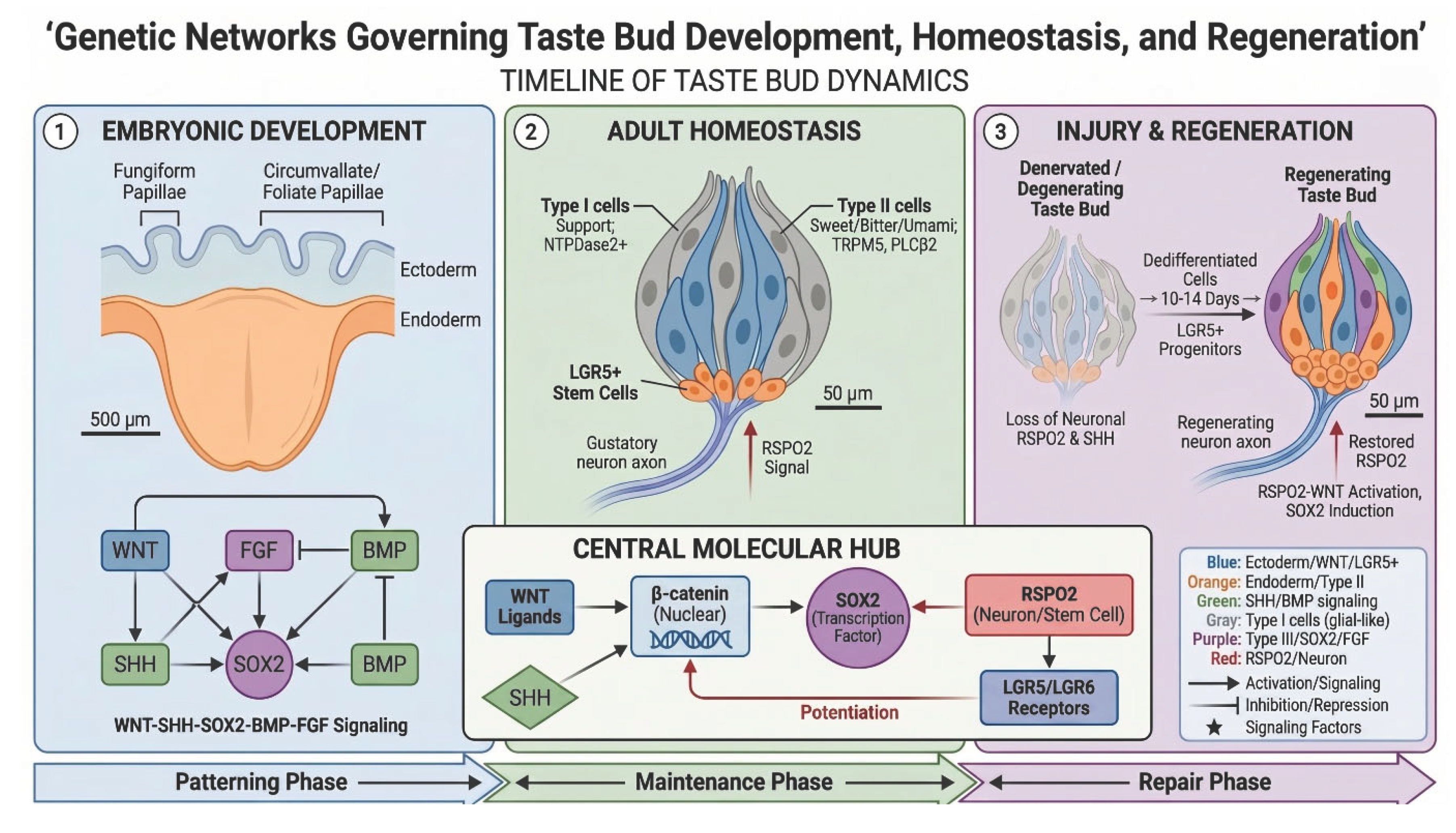
Taste bud development, homeostasis, and regeneration are often considered separate biological processes, but the evidence reviewed here indicates that they are built from overlapping signaling modules (Figure 5). SHH first contributes to embryonic placode patterning, then changes functional output around birth, and later supports adult progenitor maintenance. WNT/β-catenin signaling promotes embryonic placode formation and supports adult epithelial renewal, with RSPO2 from gustatory neurons providing a key WNT-amplifying niche signal. Downstream, POU2F3/SKN-1a and ASCL1/NKX2-2-associated programs specify type II and type III lineages, whereas Notch/HES signaling regulates timing and balance of differentiation. These findings are consistent with a tissue-ecosystem model in which taste bud maintenance depends on epithelial progenitors, neural niche signals, mesenchymal inputs, and lineage-specific transcriptional programs. Regeneration after injury involves canonical LGR5+ progenitor expansion and may also involve dedifferentiation of a subset of committed TRCs under defined injury conditions. The relative contribution of this plasticity in vivo remains to be quantified. Recent findings that c-Kit-expressing sweet taste cells resist nerve injury and support later regeneration [64], and tyrosine kinase inhibitors dysregulate fate selection of specific taste bud cell subtypes through KIT inhibition [65], adding an additional layer of lineage-specific resilience. From a translational perspective, RSPO/WNT potentiation, protection of HH-dependent progenitor maintenance, mitigation of radiation-induced progenitor injury, and controlled modulation of injury-associated plasticity are plausible therapeutic directions. Each requires careful validation because the same pathways that promote epithelial renewal can also drive pathological proliferation if activated broadly or chronically. Figure 5 summarizes this integrated network along a temporal axis, illustrating how embryonic patterning signals transition into adult homeostatic mechanisms and how injury disrupts and reinnervation restores these circuits. Addressing these gaps will require integration of single-cell genomics, spatial profiling, organoid systems, and validation in human or non-human primate tissue.
Author: Contributions:I.-Y.J. and J.-W.K. contributed equally to this work. I.-Y.J. and J.-W.K. performed the literature review and drafted the manuscript. B.S., Y.S. and J.-K. K. performed writing review and editing. J.-O.S. conceptualized the study, supervised the work, and critically revised the manuscript. All authors approved the final version.
Funding
This work was supported by the National Research Foundation of Korea (NRF) grant funded by the Korea government (MSIT) Grants RS-2024-00457696 (to J.O.S.). This research was supported by a grant of the Korea Health Technology R&D Project through the Korea Health Industry Development Institute (KHIDI), funded by the Ministry of Health &Welfare, Republic of Korea (grant number: RS-2025-02223691) (to J.O.S.). This study was funded by the Soonchunhyang University research Fund (to I.Y.J.).
References
- Roper, S.D.; Chaudhari, N. Taste buds: cells, signals and synapses. Nat. Rev. Neurosci. 2017, 18, 485–497. [Google Scholar] [CrossRef]
- Finger, T.E.; Kinnamon, S.C. Taste isn’t just for taste buds anymore. F1000 Biol. Rep. 2011, 3, 20. [Google Scholar] [CrossRef] [PubMed]
- Barlow, L.A. Progress and renewal in gustation: new insights into taste bud development. Development 2015, 142, 3620–3629. [Google Scholar] [CrossRef] [PubMed]
- Witt, M. Anatomy and development of the human taste system. Handb. Clin. Neurol. 2019, 164, 147–171. [Google Scholar] [CrossRef]
- Mistretta, C.M.; Kumari, A. Hedgehog Signaling Regulates Taste Organs and Oral Sensation: Distinctive Roles in the Epithelium, Stroma, and Innervation. Int. J. Mol. Sci. 2019, 20, 1341. [Google Scholar] [CrossRef] [PubMed]
- Xu, J.; de Araujo, A.M.; Xi, R.; Lin, X.; Lu, C.; Zhou, M.; Hankenson, K.; Margolskee, R.F.; Matsumoto, I.; de Lartigue, G.; et al. Gustatory-neuron-supplied R-spondin-2 is required for taste bud replenishment. Stem Cell Rep. 2025, 20, 102542. [Google Scholar] [CrossRef]
- Rothova, M.; Thompson, H.; Lickert, H.; Tucker, A.S. Lineage tracing of the endoderm during oral development. Dev. Dyn. 2012, 241, 1183–1191. [Google Scholar] [CrossRef]
- Qin, Y.; Sukumaran, S.K.; Margolskee, R.F. Nkx2-2 expressing taste cells in endoderm-derived taste papillae are committed to the type III lineage. Dev. Biol. 2021, 477, 232–240. [Google Scholar] [CrossRef]
- Chaudhari, N.; Roper, S.D. The cell biology of taste. J. Cell Biol. 2010, 190, 285–296. [Google Scholar] [CrossRef]
- Huang, A.L.; Chen, X.; Hoon, M.A.; Chandrashekar, J.; Guo, W.; Tränkner, D.; Ryba, N.J.P.; Zuker, C.S. The cells and logic for mammalian sour taste detection. Nature 2006, 442, 934–938. [Google Scholar] [CrossRef]
- Okubo, T.; Clark, C.; Hogan, B.L.M. Cell lineage mapping of taste bud cells and keratinocytes in the mouse tongue and soft palate. Stem Cells 2009, 27, 442–450. [Google Scholar] [CrossRef] [PubMed]
- Thirumangalathu, S.; Harlow, D.E.; Driskell, A.L.; Krimm, R.F.; Barlow, L.A. Fate mapping of mammalian embryonic taste bud progenitors. Development 2009, 136, 1519–1528. [Google Scholar] [CrossRef]
- Hansen, A.; Reutter, K.; Zeiske, E. Taste bud development in the zebrafish, Danio rerio. Dev. Dyn. 2002, 223, 483–496. [Google Scholar] [CrossRef]
- Bloomquist, R.F.; Parnell, N.F.; Phillips, K.A.; Fowler, T.E.; Yu, T.Y.; Sharpe, P.T.; Streelman, J.T. Coevolutionary patterning of teeth and taste buds. Proc. Natl. Acad. Sci. USA 2015, 112, E5954–E5962. [Google Scholar] [CrossRef]
- Martin, K.J.; Rasch, L.J.; Cooper, R.L.; Metscher, B.D.; Johanson, Z.; Fraser, G.J. Sox2+ progenitors in sharks link taste development with the evolution of regenerative teeth from denticles. Proc. Natl. Acad. Sci. USA 2016, 113, 14769–14774. [Google Scholar] [CrossRef]
- Ren, W.; Lewandowski, B.C.; Watson, J.; Aihara, E.; Iwatsuki, K.; Bachmanov, A.A.; Margolskee, R.F.; Jiang, P. Single Lgr5- or Lgr6-expressing taste stem/progenitor cells generate taste bud cells ex vivo. Proc. Natl. Acad. Sci. USA 2014, 111, 16401–16406. [Google Scholar] [CrossRef]
- Adpaikar, A.A.; Zhang, S.; Kim, H.Y.; Kim, K.W.; Moon, S.J.; Lee, J.M.; Jung, H.S. Fine-tuning of epithelial taste bud organoid to promote functional recapitulation of taste reactivity. Cell. Mol. Life Sci. 2022, 79, 211. [Google Scholar] [CrossRef] [PubMed]
- Kim, S.Y.; Verweij, L.H.G.; Lin, L.; van Es, J.H.; Slack, J.; Winkel, C.; et al. Organoid Modeling of Mouse Anterior Tongue Epithelium Reveals Regional and Cellular Identities. Adv. Sci. 2025, 12, e06738. [Google Scholar] [CrossRef] [PubMed]
- Mistretta, C.M.; Liu, H.X. Development of fungiform papillae: patterned lingual gustatory organs. Arch. Histol. Cytol. 2006, 69, 199–208. [Google Scholar] [CrossRef]
- Jung, H.S.; Oropeza, V.; Thesleff, I. Shh, Bmp-2, Bmp-4 and Fgf-8 are associated with initiation and patterning of mouse tongue papillae. Mech. Dev. 1999, 81, 179–182. [Google Scholar] [CrossRef]
- Hall, J.M.H.; Bell, M.L.; Finger, T.E. Disruption of sonic hedgehog signaling alters growth and patterning of lingual taste papillae. Dev. Biol. 2003, 255, 263–277. [Google Scholar] [CrossRef]
- Liu, H.X.; Ermilov, A.; Grachtchouk, M.; Li, L.; Gumucio, D.L.; Dlugosz, A.A.; Mistretta, C.M. Multiple Shh signaling centers participate in fungiform papilla and taste bud formation and maintenance. Dev. Biol. 2013, 382, 82–97. [Google Scholar] [CrossRef] [PubMed]
- Iwatsuki, K.; Liu, H.X.; Gröner, A.; Singer, M.A.; Lane, T.F.; Grosschedl, R.; Mistretta, C.M.; Margolskee, R.F. Wnt signaling interacts with Shh to regulate taste papilla development. Proc. Natl. Acad. Sci. USA 2007, 104, 2253–2258. [Google Scholar] [CrossRef]
- Okubo, T.; Pevny, L.H.; Hogan, B.L.M. Sox2 is required for development of taste bud sensory cells. Genes Dev. 2006, 20, 2654–2659. [Google Scholar] [CrossRef] [PubMed]
- Castillo-Azofeifa, D.; Seidel, K.; Gross, L.; Golden, E.J.; Jacquez, B.; Klein, O.D.; Barlow, L.A. SOX2 regulation by hedgehog signaling controls adult lingual epithelium homeostasis. Development 2018, 145, dev164889. [Google Scholar] [CrossRef]
- Shechtman, L.A.; Scott, J.K.; Larson, E.D.; Isner, T.J.; Johnson, B.J.; Gaillard, D.; Dempsey, P.J.; Barlow, L.A. High Sox2 expression predicts taste lineage competency of lingual progenitors in vitro. Development 2023, 150, dev201375. [Google Scholar] [CrossRef] [PubMed]
- Liu, H.X.; Komatsu, Y.; Mishina, Y.; Mistretta, C.M. Neural crest contribution to lingual mesenchyme, epithelium and developing taste papillae and taste buds. Dev. Biol. 2012, 368, 294–303. [Google Scholar] [CrossRef]
- Ishan, M.; Wang, Z.; Zhao, P.; Yao, Y.; Stice, S.L.; Wells, L.; Mishina, Y.; Liu, H.X. Taste papilla cell differentiation requires the regulation of secretory protein production by ALK3-BMP signaling in the tongue mesenchyme. Development 2023, 150, dev201838. [Google Scholar] [CrossRef]
- Golden, E.J.; Larson, E.D.; Shechtman, L.A.; Trahan, G.D.; Gaillard, D.; et al. Onset of taste bud cell renewal starts at birth and coincides with a shift in SHH function. eLife 2021, 10, e64013. [Google Scholar] [CrossRef]
- Lin, X.; Lu, C.; Ohmoto, M.; Choma, K.; Margolskee, R.F.; Matsumoto, I.; Jiang, P. R-spondin substitutes for neuronal input for taste cell regeneration in adult mice. Proc. Natl. Acad. Sci. USA 2021, 118, e2001833118. [Google Scholar] [CrossRef]
- Yee, K.K.; Li, Y.; Redding, K.M.; Iwatsuki, K.; Margolskee, R.F.; Jiang, P. Lgr5-EGFP marks taste bud stem/progenitor cells in posterior tongue. Stem Cells 2013, 31, 992–1000. [Google Scholar] [CrossRef] [PubMed]
- Takeda, N.; Jain, R.; Li, D.; Li, L.; Lu, M.M.; Epstein, J.A. Lgr5 identifies progenitor cells capable of taste bud regeneration after injury. PLoS ONE 2013, 8, e66314. [Google Scholar] [CrossRef] [PubMed]
- Kim, H.J.; Seo, D.W.; Shim, J.; Lee, J.S.; Choi, S.H.; Kim, D.H.; Moon, S.J.; Jung, H.S.; Jeong, Y.T. Reassessing the genetic lineage tracing of lingual Lgr5+ and Lgr6+ cells in vivo. Anim. Cells Syst. 2024, 28, 353–366. [Google Scholar] [CrossRef]
- Verweij, L.H.G.; Kim, S.Y.; Laskaris, D.; Lin, L.; van Son, G.J.F.; et al. Tripotent Lgr5 stem cells in the posterior tongue generate lingual, taste, and salivary gland lineages. Nat. Commun. 2025, 16, 10266. [Google Scholar] [CrossRef]
- Matsumoto, I.; Ohmoto, M.; Narukawa, M.; Yoshihara, Y.; Abe, K. Skn-1a (Pou2f3) specifies taste receptor cell lineage. Nat. Neurosci. 2011, 14, 685–687. [Google Scholar] [CrossRef] [PubMed]
- Ohmoto, M.; Jyotaki, M.; Yee, K.K.; Matsumoto, I. A Transcription Factor Etv1/Er81 Is Involved in the Differentiation of Sweet, Umami, and Sodium Taste Cells. eNeuro 2023 2023, 10, ENEURO.0236–22. [Google Scholar] [CrossRef]
- Seta, Y.; Oda, M.; Kataoka, S.; Toyono, T.; Toyoshima, K. Mash1 is required for the differentiation of AADC-positive type III cells in mouse taste buds. Dev. Dyn. 2011, 240, 775–784. [Google Scholar] [CrossRef]
- Seta, Y.; Seta, C.; Barlow, L.A. Notch-associated gene expression in embryonic and adult taste papillae and taste buds suggests a role in taste cell lineage decisions. J. Comp. Neurol. 2003, 464, 49–61. [Google Scholar] [CrossRef]
- Ota, M.S.; Kaneko, Y.; Kondo, K.; Ogishima, S.; Tanaka, H.; Eto, K.; Kondo, T. Combined In Silico and In Vivo Analyses Reveal Role of Hes1 in Taste Cell Differentiation. PLoS Genet. 2009, 5, e1000443. [Google Scholar] [CrossRef]
- Castillo, D.; Seidel, K.; Salcedo, E.; Ahn, C.; de Sauvage, F.J.; Klein, O.D.; Barlow, L.A. Induction of ectopic taste buds by SHH reveals the competency and plasticity of adult lingual epithelium. Development 2014, 141, 2993–3002. [Google Scholar] [CrossRef]
- Castillo-Azofeifa, D.; Losacco, J.T.; Salcedo, E.; Golden, E.J.; Finger, T.E.; Barlow, L.A. Sonic hedgehog from both nerves and epithelium is a key trophic factor for taste bud maintenance. Development 2017, 144, 3054–3065. [Google Scholar] [CrossRef]
- Miura, H.; Scott, J.K.; Harada, S.; Barlow, L.A. Sonic hedgehog-expressing basal cells are general post-mitotic precursors of functional taste receptor cells. Dev. Dyn. 2014, 243, 1286–1297. [Google Scholar] [CrossRef]
- Ohmoto, M.; Lei, W.; Yamashita, J.; Hirota, J.; Jiang, P.; Matsumoto, I. SOX2 regulates homeostasis of taste bud cells and lingual epithelial cells in posterior tongue. PLoS ONE 2020, 15, e0240848. [Google Scholar] [CrossRef]
- Gaillard, D.; Bowles, S.G.; Salcedo, E.; Xu, M.; Millar, S.E.; Barlow, L.A. β-catenin is required for taste bud cell renewal and behavioral taste perception in adult mice. PLoS Genet. 2017, 13, e1006990. [Google Scholar] [CrossRef] [PubMed]
- Piarowski, C.M.; Isner, T.J.; Barlow, L.A. Developing and Regenerating a Sense of Taste. Curr. Top. Dev. Biol. 2025, 165, 353–404. [Google Scholar] [CrossRef] [PubMed]
- Lu, C.; Lin, X.; Yamashita, J.; Xi, R.; Zhou, M.; Zhang, Y.V.; et al. RNF43/ZNRF3 negatively regulates taste tissue homeostasis. Stem Cell Rep. 2022, 17, 369–383. [Google Scholar] [CrossRef]
- Nguyen, H.M.; Reyland, M.E.; Barlow, L.A. Mechanisms of taste bud cell loss after head and neck irradiation. J. Neurosci. 2012, 32, 3474–3484. [Google Scholar] [CrossRef]
- Gaillard, D.; Shechtman, L.A.; Millar, S.E.; Barlow, L.A. Fractionated head and neck irradiation impacts taste progenitors, differentiated taste cells, and Wnt/β-catenin signaling in adult mice. Sci. Rep. 2019, 9, 17934. [Google Scholar] [CrossRef] [PubMed]
- Zhu, J.; Zhang, H.; Li, J.; Zheng, X.; Jia, X.; Xie, Q.; et al. LiCl Promotes Recovery of Radiation-Induced Oral Mucositis and Dysgeusia. J. Dent. Res. 2021, 100, 754–763. [Google Scholar] [CrossRef]
- Guo, Q.; Chen, S.; Rao, X.; Li, Y.; Pan, M.; Fu, G.; Yao, Y.; Gao, X.; Tang, P.; Zhou, Y.; et al. Inhibition of SIRT1 promotes taste bud stem cell survival and mitigates radiation-induced oral mucositis in mice. Am. J. Transl. Res. 2019, 11, 4789–4799. [Google Scholar] [PubMed]
- Adpaikar, A.A.; Lee, J.M.; Lee, D.J.; Cho, H.Y.; Ohshima, H.; Moon, S.J.; Jung, H.S. Epithelial plasticity enhances regeneration of committed taste receptor cells following nerve injury. Exp. Mol. Med. 2023, 55, 171–182. [Google Scholar] [CrossRef] [PubMed]
- Kapsimali, M.; Kaushik, A.L.; Gibon, G.; Dirian, L.; Ernest, S.; Rosa, F.M. Fgf signaling controls pharyngeal taste bud formation through miR-200 and Delta-Notch activity. Development 2011, 138, 3473–3484. [Google Scholar] [CrossRef] [PubMed]
- Ren, W.; Aihara, E.; Lei, W.; Gheewala, N.; Uchiyama, H.; Margolskee, R.F.; Iwatsuki, K.; Jiang, P. Transcriptome analyses of taste organoids reveal multiple pathways involved in taste cell generation. Sci. Rep. 2017, 7, 4004. [Google Scholar] [CrossRef]
- Ren, W.; Li, W.; Cha, X.; Wang, S.; Cai, B.; Wang, T.; et al. Single-cell transcriptomic atlas of taste papilla aging. Aging Cell 2024, 23, e14308. [Google Scholar] [CrossRef]
- Kaufman, A.; Choo, E.; Koh, A.; Dando, R. Inflammation arising from obesity reduces taste bud abundance and inhibits renewal. PLoS Biol. 2018, 16, e2001959. [Google Scholar] [CrossRef]
- Doval-Caballero, J.L.E.; Ferreira-Hermosillo, A.; Eugenio-Ponce, G.D.; García-Sáenz, M.R.; Ibarra-Salce, R.; Tenorio-Rojo, A.P.; Luna-Avila, E.S.; Gete-Palacios, P.C.; Pérez-Hernández, F.; Rojas-Milán, E.; et al. Potential role of glucagon-like peptide-1 in taste receptors. Front. Endocrinol. 2026, 16, 1683419. [Google Scholar] [CrossRef]
- Yao, Q.; Doyle, M.E.; Liu, Q.R.; Appleton, A.; O'Connell, J.F.; Weng, N.P.; Egan, J.M. Long-Term Dysfunction of Taste Papillae in SARS-CoV-2. NEJM Evid. 2023, 2, EVIDoa2300046. [Google Scholar] [CrossRef]
- Morad, H.; Vanhala, T.; Kisiel, M.A.; Andreason, A.; Li, M.; Andersson, G.; Laurell, G.; Finger, T.E.; Hellekant, G. Taste dysfunction in long COVID. Chem. Senses 2026, 51, bjaf068. [Google Scholar] [CrossRef] [PubMed]
- Seubert, A.C.; Krafft, M.; Bopp, S.; Helal, M.; Bhandare, P.; Wolf, E.; Alemany, A.; Riedel, A.; Kretzschmar, K. Spatial transcriptomics reveals molecular cues underlying the site specificity of the adult mouse oral mucosa and its stem cell niches. Stem Cell Rep. 2024, 19, 1706–1719. [Google Scholar] [CrossRef]
- Matsu-Ura, T.; Nasu, A.; Lee, S.; Yoshida, N. Circadian clock–gated cell renewal controls time-dependent changes in taste sensitivity. Proc. Natl. Acad. Sci. USA 2025, 122, e2421421122. [Google Scholar] [CrossRef]
- Wang, J.; Liu, R.; Ma, H.; Zhang, W. The Pathogenesis of COVID-19–Related Taste Disorder and Treatments. J. Dent. Res. 2023, 102, 1191–1198. [Google Scholar] [CrossRef]
- Nosrat, C.A.; Blomlöf, J.; ElShamy, W.M.; Ernfors, P.; Olson, L. Lingual deficits in BDNF and NT3 mutant mice leading to gustatory and somatosensory disturbances, respectively. Development 1997, 124, 1333–1342. [Google Scholar] [CrossRef] [PubMed]
- Vercauteren Drubbel, A.; Beck, B. Single-cell transcriptomics uncovers the differentiation of a subset of murine esophageal progenitors into taste buds in vivo. Sci. Adv. 2023, 9, eadd9135. [Google Scholar] [CrossRef] [PubMed]
- Ki, S.Y.; Jang, J.H.; Kim, D.H.; Jeong, Y.T. c-Kit signaling confers damage-resistance to sweet taste cells upon nerve injury. Int. J. Oral. Sci. 2025, 17, 57. [Google Scholar] [CrossRef] [PubMed]
- Piarowski, C.M.; Barlow, L.A. Tyrosine kinase inhibitors affect sweet taste and dysregulate fate selection of specific taste bud cell subtypes via KIT inhibition. Development 2026, 153, dev205259. [Google Scholar] [CrossRef]
Figure 1.
Anatomical and cellular organization of the mouse taste system. (A) Dorsal view of the mouse tongue showing the distribution and developmental origins of taste papillae. Fungiform papillae (FuP, blue dots) are located in the anterior two-thirds of the tongue, are predominantly ectoderm-derived, and receive innervation from the chorda tympani branch of the facial nerve (CN VII). The circumvallate papilla (CVP, red) lies at the posterior midline, is endoderm-derived, and is innervated by the glossopharyngeal nerve (CN IX). Foliate papillae (FoP, orange crescents) are located along the posterior-lateral tongue margins, are endoderm-derived, and receive dual innervation from both CN VII and CN IX. The dashed line indicates the approximate sulcus terminalis boundary between ectoderm- and endoderm-derived territories. (B) Cross-section of a mature taste bud illustrating the four principal cell populations: type I glial-like support cells (gray; NTPDase2+; enwrapping), type II receptor cells (blue; PLCβ2+/TRPM5+; sweet, umami, and bitter), type III presynaptic cells (green; CAR4+/serotonin+; sour), and basal progenitor cells (orange; SOX2+/KRT14+; predominantly extragemmal). Gustatory afferent nerve fibers innervate the taste bud from below. Note: OTOP1, the proton channel essential for sour transduction, is expressed in type III cells but is not separately labeled in the illustration.
Figure 1.
Anatomical and cellular organization of the mouse taste system. (A) Dorsal view of the mouse tongue showing the distribution and developmental origins of taste papillae. Fungiform papillae (FuP, blue dots) are located in the anterior two-thirds of the tongue, are predominantly ectoderm-derived, and receive innervation from the chorda tympani branch of the facial nerve (CN VII). The circumvallate papilla (CVP, red) lies at the posterior midline, is endoderm-derived, and is innervated by the glossopharyngeal nerve (CN IX). Foliate papillae (FoP, orange crescents) are located along the posterior-lateral tongue margins, are endoderm-derived, and receive dual innervation from both CN VII and CN IX. The dashed line indicates the approximate sulcus terminalis boundary between ectoderm- and endoderm-derived territories. (B) Cross-section of a mature taste bud illustrating the four principal cell populations: type I glial-like support cells (gray; NTPDase2+; enwrapping), type II receptor cells (blue; PLCβ2+/TRPM5+; sweet, umami, and bitter), type III presynaptic cells (green; CAR4+/serotonin+; sour), and basal progenitor cells (orange; SOX2+/KRT14+; predominantly extragemmal). Gustatory afferent nerve fibers innervate the taste bud from below. Note: OTOP1, the proton channel essential for sour transduction, is expressed in type III cells but is not separately labeled in the illustration.
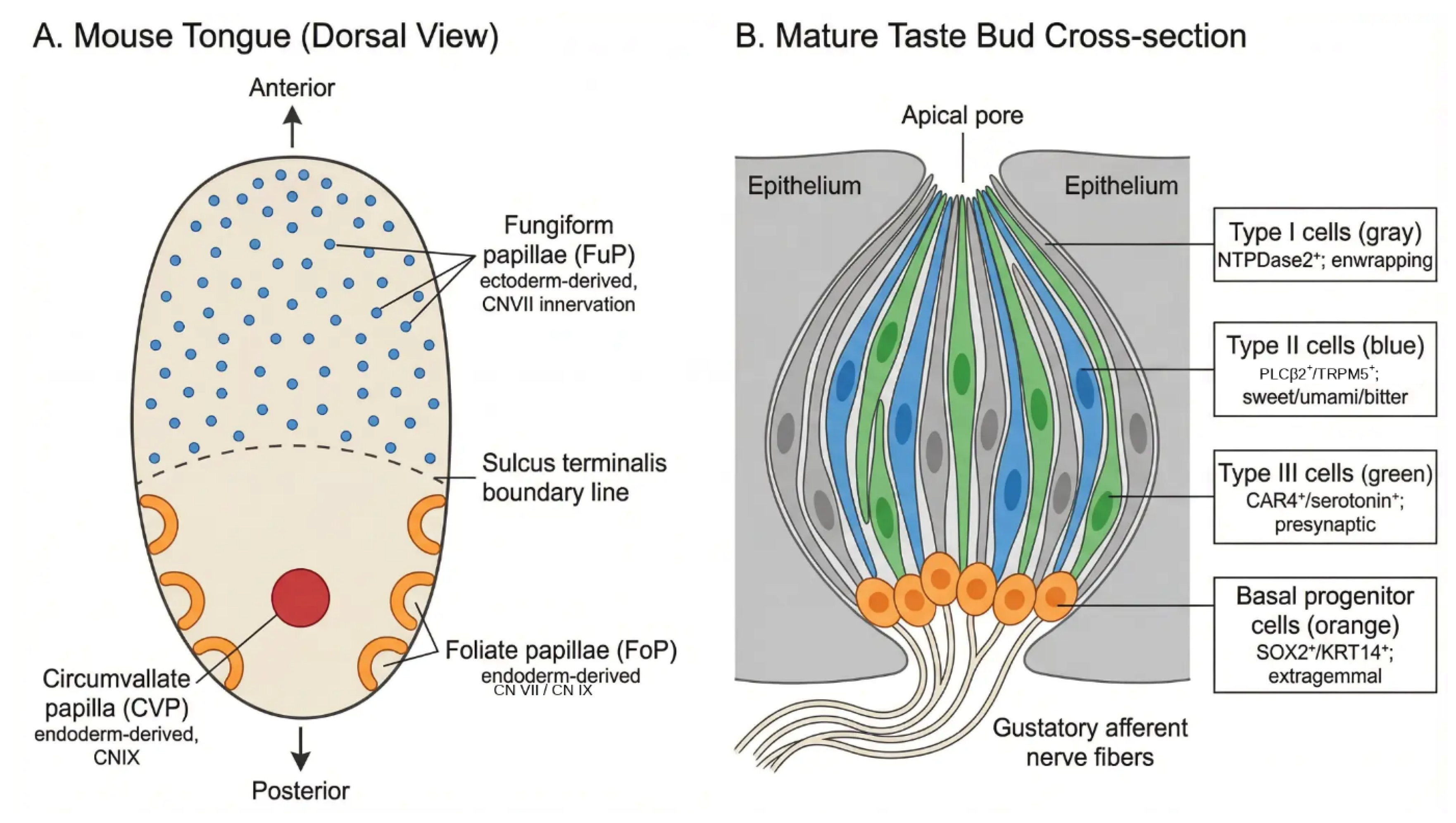
Figure 2.
Core genetic network governing embryonic papilla patterning and adult taste bud homeostasis. (Left) Embryonic Patterning (E12–birth). WNT/β-catenin signaling promotes placode formation and induces Shh expression in placode cores. SHH signaling refines papilla spacing and restricts neighboring papilla formation. In the inter-papilla zone, FGF8 marks non-placodal epithelium. BMP4 at placode edges modulates patterning, and mesenchymal ALK3-BMP signaling (green dashed arrows) indirectly supports epithelial WNT activity. The lower sub-panel illustrates the periodic placode–inter-papilla pattern along the tongue surface. (Right) Adult Homeostasis. Gustatory neurons and epithelial cells provide SHH (orange arrows), which maintains SOX2 expression in progenitors. Neuronal RSPO2 (green arrow) amplifies WNT signaling through LGR5/LGR6 receptors by antagonizing RNF43/ZNRF3-mediated Frizzled receptor turnover. β-catenin/WNT activity drives differentiation of LGR5+ progenitor cells into mature type I, type II, and type III taste receptor cells (TRCs). Arrow legend: Red arrows indicate activation; blue blunt-ended arrows indicate inhibition; green dashed arrows indicate mesenchymal-to-epithelial cross-talk; orange arrows indicate the SHH–SOX2 signaling axis.
Figure 2.
Core genetic network governing embryonic papilla patterning and adult taste bud homeostasis. (Left) Embryonic Patterning (E12–birth). WNT/β-catenin signaling promotes placode formation and induces Shh expression in placode cores. SHH signaling refines papilla spacing and restricts neighboring papilla formation. In the inter-papilla zone, FGF8 marks non-placodal epithelium. BMP4 at placode edges modulates patterning, and mesenchymal ALK3-BMP signaling (green dashed arrows) indirectly supports epithelial WNT activity. The lower sub-panel illustrates the periodic placode–inter-papilla pattern along the tongue surface. (Right) Adult Homeostasis. Gustatory neurons and epithelial cells provide SHH (orange arrows), which maintains SOX2 expression in progenitors. Neuronal RSPO2 (green arrow) amplifies WNT signaling through LGR5/LGR6 receptors by antagonizing RNF43/ZNRF3-mediated Frizzled receptor turnover. β-catenin/WNT activity drives differentiation of LGR5+ progenitor cells into mature type I, type II, and type III taste receptor cells (TRCs). Arrow legend: Red arrows indicate activation; blue blunt-ended arrows indicate inhibition; green dashed arrows indicate mesenchymal-to-epithelial cross-talk; orange arrows indicate the SHH–SOX2 signaling axis.
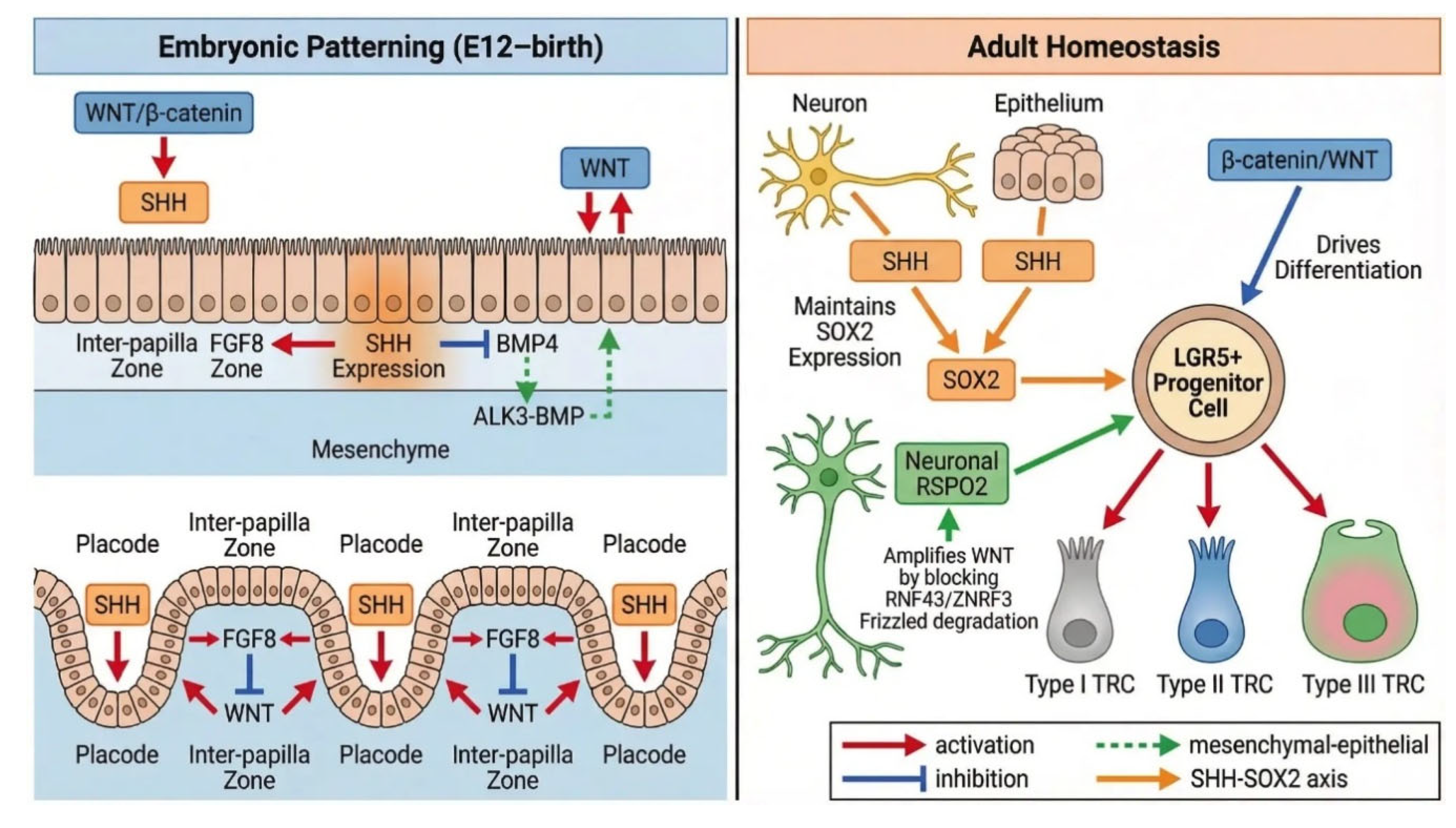
Figure 3.
Lineage specification network within the taste bud. Multipotent progenitor cells (SOX2-high, KRT14+, LGR5+, LGR6+) enter a NOTCH/HES1-associated signaling gate that regulates differentiation timing. When HES1 levels are high, the progenitor state is maintained; when HES1 levels decrease, cells are permitted to differentiate. POU2F3/SKN-1a acts as the primary selector for the type II receptor cell lineage, generating sweet TRCs (T1R2/T1R3), umami TRCs (T1R1/T1R3), and bitter TRCs (T2R). ETV1 further refines type II subtype programs, including sodium-responsive cells. ASCL1 promotes type III presynaptic cell differentiation, gated by Notch-mediated lateral inhibition (blue blunt-ended arrow). NKX2-2 promotes type III lineage specification specifically in posterior endoderm-derived taste fields (CVP and FoP). Type III sour TRCs express OTOP1, CAR4+, and are presynaptic. The transcriptional selector for type I cells (NTPDase2+) remains unresolved (dashed arrow with question mark). Legend: Blue ovals indicate type II fate; gray ovals indicate type I fate; green ovals indicate type III fate. Solid arrows represent established pathways; dashed arrows represent proposed or unresolved connections.
Figure 3.
Lineage specification network within the taste bud. Multipotent progenitor cells (SOX2-high, KRT14+, LGR5+, LGR6+) enter a NOTCH/HES1-associated signaling gate that regulates differentiation timing. When HES1 levels are high, the progenitor state is maintained; when HES1 levels decrease, cells are permitted to differentiate. POU2F3/SKN-1a acts as the primary selector for the type II receptor cell lineage, generating sweet TRCs (T1R2/T1R3), umami TRCs (T1R1/T1R3), and bitter TRCs (T2R). ETV1 further refines type II subtype programs, including sodium-responsive cells. ASCL1 promotes type III presynaptic cell differentiation, gated by Notch-mediated lateral inhibition (blue blunt-ended arrow). NKX2-2 promotes type III lineage specification specifically in posterior endoderm-derived taste fields (CVP and FoP). Type III sour TRCs express OTOP1, CAR4+, and are presynaptic. The transcriptional selector for type I cells (NTPDase2+) remains unresolved (dashed arrow with question mark). Legend: Blue ovals indicate type II fate; gray ovals indicate type I fate; green ovals indicate type III fate. Solid arrows represent established pathways; dashed arrows represent proposed or unresolved connections.
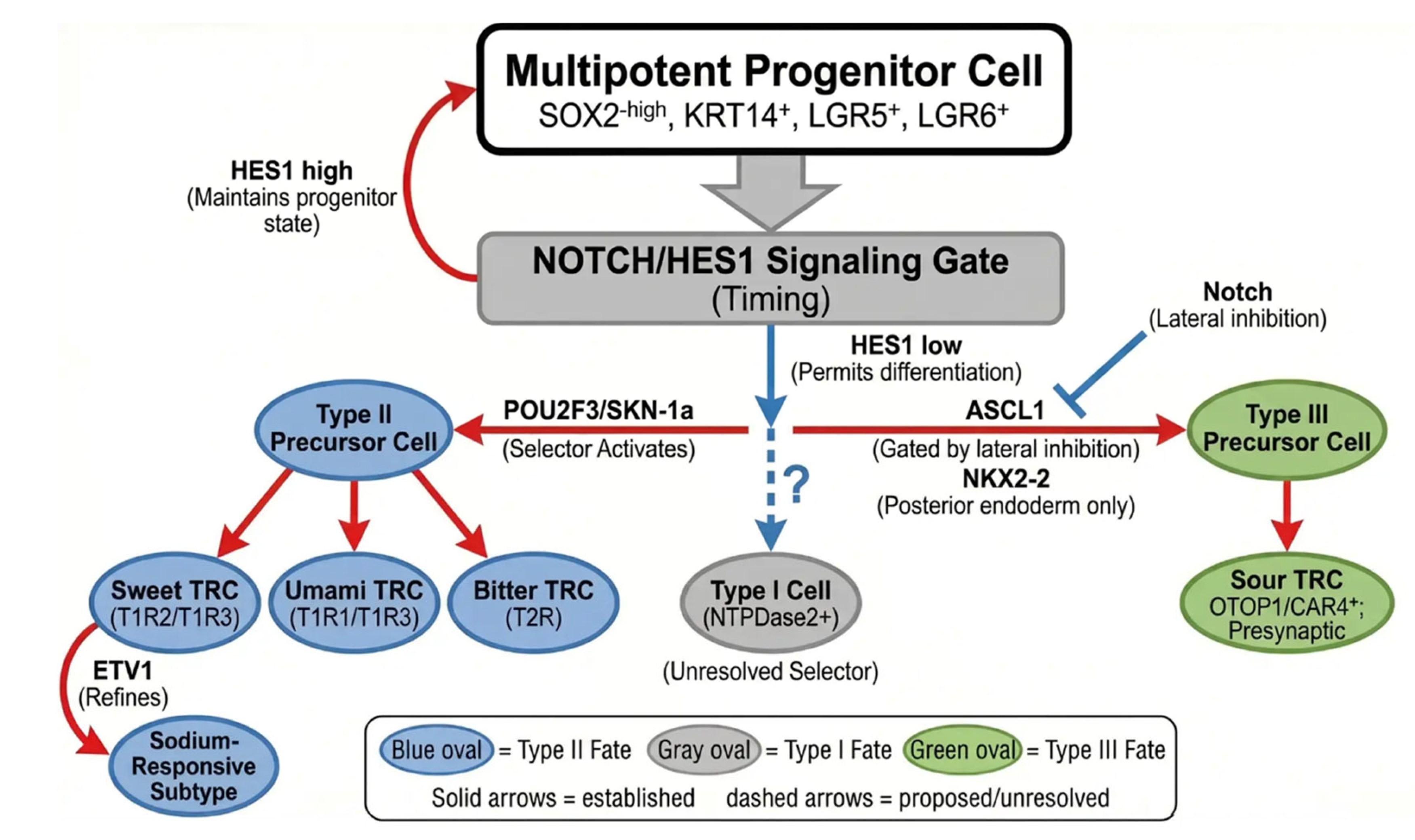
Figure 4.
Neural niche model and regeneration mechanisms. (A) Normal Homeostasis. Gustatory neurons supply RSPO2 (dark green arrow) and SHH (green arrow) to basal and perigemmal progenitors. RSPO2 amplifies WNT signaling through LGR5/LGR6 receptors by antagonizing the E3 ubiquitin ligases RNF43/ZNRF3 (red X), which otherwise promote Frizzled receptor turnover. SHH supports SOX2 expression and progenitor identity. Active WNT signaling (WNT↑) maintains the progenitor pool and drives ongoing differentiation into type I, type II, and type III TRCs. (B) Denervation/Injury. Nerve transection (black X) eliminates neuronal RSPO2 and SHH supply. The grayed-out WNT↑ symbol indicates diminished WNT tone rather than increased signaling. Taste buds degenerate over approximately 10–14 days. Exogenous RSPO (syringe) can partially rescue taste bud integrity by maintaining residual WNT amplification. (C) Regeneration. Reinnervation restores neuronal RSPO2 and SHH support. Regeneration proceeds primarily through canonical LGR5+ progenitor cell expansion (blue arrow). A dashed pathway indicates an injury-associated, subset-level, proposed dedifferentiation mechanism in which K8-lineage differentiated taste receptor cells acquire KRT14+/SOX2+ progenitor-like features (red curved arrow), potentially supplementing canonical stem cell-driven repair.
Figure 4.
Neural niche model and regeneration mechanisms. (A) Normal Homeostasis. Gustatory neurons supply RSPO2 (dark green arrow) and SHH (green arrow) to basal and perigemmal progenitors. RSPO2 amplifies WNT signaling through LGR5/LGR6 receptors by antagonizing the E3 ubiquitin ligases RNF43/ZNRF3 (red X), which otherwise promote Frizzled receptor turnover. SHH supports SOX2 expression and progenitor identity. Active WNT signaling (WNT↑) maintains the progenitor pool and drives ongoing differentiation into type I, type II, and type III TRCs. (B) Denervation/Injury. Nerve transection (black X) eliminates neuronal RSPO2 and SHH supply. The grayed-out WNT↑ symbol indicates diminished WNT tone rather than increased signaling. Taste buds degenerate over approximately 10–14 days. Exogenous RSPO (syringe) can partially rescue taste bud integrity by maintaining residual WNT amplification. (C) Regeneration. Reinnervation restores neuronal RSPO2 and SHH support. Regeneration proceeds primarily through canonical LGR5+ progenitor cell expansion (blue arrow). A dashed pathway indicates an injury-associated, subset-level, proposed dedifferentiation mechanism in which K8-lineage differentiated taste receptor cells acquire KRT14+/SOX2+ progenitor-like features (red curved arrow), potentially supplementing canonical stem cell-driven repair.
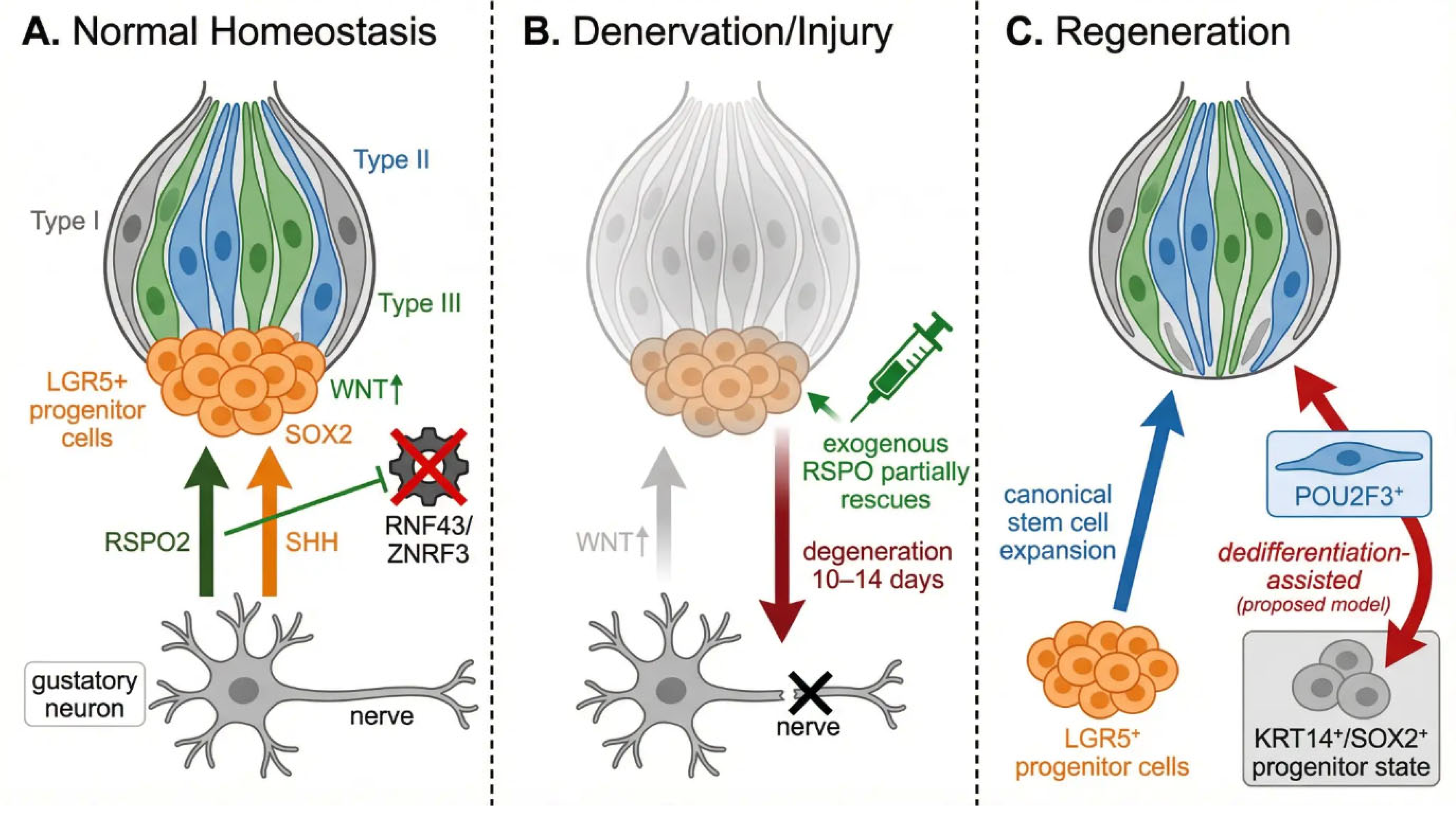
Figure 5.
Overview of the integrated genetic network governing taste bud development, homeostasis, and regeneration. The network operates along a temporal axis encompassing three phases. (1) Embryonic Development: WNT/β-catenin signaling drives placode formation and Shh expression. SHH, BMP, FGF, and SOX2 coordinate papilla patterning and taste-lineage competence. Fungiform papillae (ectoderm-derived) and circumvallate/foliate papillae (endoderm-derived) are established. (2) Adult Homeostasis: Gustatory neurons supply RSPO2 and SHH to support LGR5+/LGR6+-responsive, SOX2-high progenitors. Type I (support; NTPDase2+), type II (sweet/bitter/umami; TRPM5, PLCβ2), and type III cells are continuously renewed. (3) Injury and Regeneration: Loss of neuronal RSPO2 and SHH leads to taste bud degeneration over 10–14 days. Reinnervation restores RSPO2-WNT activation and SOX2 induction, enabling LGR5+ progenitor expansion and taste bud recovery. The Central Molecular Hub (lower panel) illustrates the convergence of WNT ligands, β-catenin, SOX2, RSPO2, LGR5/LGR6 receptors, and SHH into an integrated signaling circuit that is shared across all three phases. Color code: Blue = ectoderm/WNT/LGR5+; Orange = endoderm/type II; Green = type I/SHH/BMP; Purple = type III/SOX2/FGF; Red = RSPO2/neuron; Gray = type I cells (glial-like). Solid arrows indicate activation/signaling; blunt-ended lines indicate inhibition/repression; star symbols indicate signaling factors.
Figure 5.
Overview of the integrated genetic network governing taste bud development, homeostasis, and regeneration. The network operates along a temporal axis encompassing three phases. (1) Embryonic Development: WNT/β-catenin signaling drives placode formation and Shh expression. SHH, BMP, FGF, and SOX2 coordinate papilla patterning and taste-lineage competence. Fungiform papillae (ectoderm-derived) and circumvallate/foliate papillae (endoderm-derived) are established. (2) Adult Homeostasis: Gustatory neurons supply RSPO2 and SHH to support LGR5+/LGR6+-responsive, SOX2-high progenitors. Type I (support; NTPDase2+), type II (sweet/bitter/umami; TRPM5, PLCβ2), and type III cells are continuously renewed. (3) Injury and Regeneration: Loss of neuronal RSPO2 and SHH leads to taste bud degeneration over 10–14 days. Reinnervation restores RSPO2-WNT activation and SOX2 induction, enabling LGR5+ progenitor expansion and taste bud recovery. The Central Molecular Hub (lower panel) illustrates the convergence of WNT ligands, β-catenin, SOX2, RSPO2, LGR5/LGR6 receptors, and SHH into an integrated signaling circuit that is shared across all three phases. Color code: Blue = ectoderm/WNT/LGR5+; Orange = endoderm/type II; Green = type I/SHH/BMP; Purple = type III/SOX2/FGF; Red = RSPO2/neuron; Gray = type I cells (glial-like). Solid arrows indicate activation/signaling; blunt-ended lines indicate inhibition/repression; star symbols indicate signaling factors.
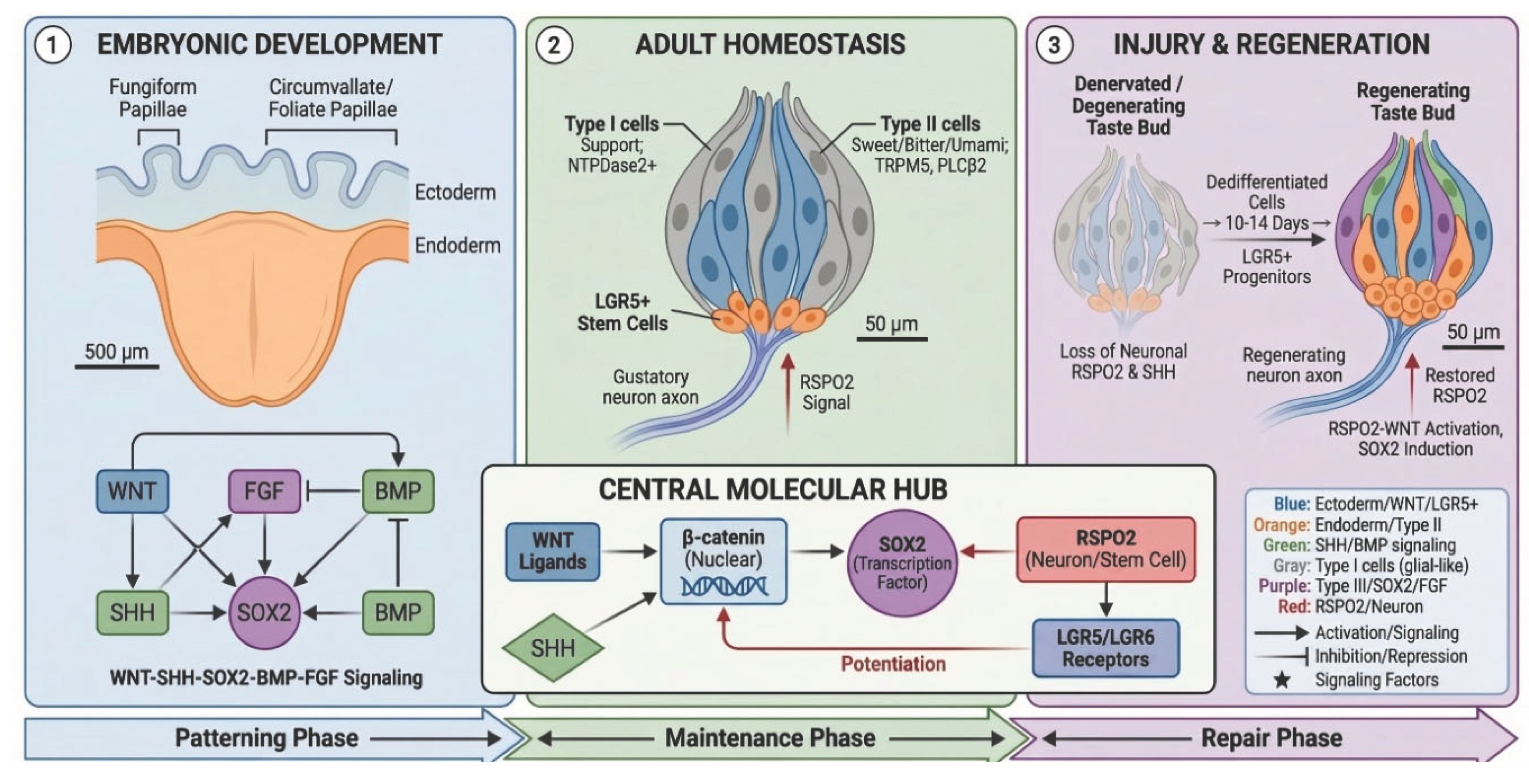

Table 1.
Summary of taste organoid platforms and their key features.
| Organoid System | Starting Cell(s) | Species | Culture Conditions | Key Findings | Ref. |
| LGR5/LGR6-derived taste organoids |
Single LGR5⁺ or LGR6⁺ cells from CVP |
Mouse | Matrigel; WNT3a, RSPO1, Noggin, EGF |
First demonstration that single taste stem cells generate all TRC types ex vivo; established clonal organoid culture | [16] |
| Anterior tongue epithelial organoids |
Anterior tongue epithelium (non-taste) |
Mouse | Modified intestinal organoid protocol |
Revealed regional and cellular identities; anterior tongue epithelium can form organoids distinct from CVP-derived ones | [18] |
| Fine-tuned taste bud organoids |
CVP epithelial cells | Mouse | Optimized with BMP inhibition, FGF10 |
Enhanced functional recapitulation of taste reactivity; improved Type II and Type III cell differentiation | [17] |
| Transcriptome-profiled taste organoids |
LGR5⁺/LGR6⁺ cells | Mouse | Standard taste organoid medium |
RNA-seq revealed multiple pathways (WNT, Notch, SHH) involved in taste cell generation within organoids | [53] |
| SOX2-high progenitor organoids |
SOX2-high lingual progenitors |
Mouse | WNT/RSPO-based medium |
High SOX2 expression predicts taste lineage competency in vitro; SOX2-low cells form non-taste epithelium | [26] |
| Tripotent posterior tongue organoids |
Single LGR5⁺ cells from posterior tongue |
Mouse | WNT/RSPO-enriched medium |
Single LGR5⁺ stem cell generates taste bud, salivary gland, and lingual epithelial lineages | [34] |
Table 2.
Key transcription factors and signaling molecules governing taste bud genetic networks.
| Gene/Molecule | Class | Stage | Function in Taste | Key Ref. |
|---|---|---|---|---|
| SHH | Morphogen | Embryonic → Adult | Placode marker; papilla patterning; postnatal switch to pro-differentiation; adult homeostatic requirement; maintains SOX2 | [21,22,29,41] |
| WNT/β-catenin | Signaling pathway |
Embryonic → Adult | Upstream of placodal Shh expression; embryonic papilla patterning; adult progenitor renewal; β-catenin required for taste cell turnover | [23,44] |
| SOX2 | HMG-box TF | Embryonic → Adult | Required for taste bud sensory cell development; maintained by SHH in adults; SOX2-high state predicts taste competency; regulates posterior tongue homeostasis | [24,25,26] |
| LGR5 | WNT target GPCR |
Postnatal → Adult | Marks taste bud stem/progenitor cells in posterior tongue; capable of taste bud regeneration after injury; tripotent in posterior tongue | [31,32,34] |
| LGR6 | WNT target GPCR |
Postnatal → Adult | Marks taste stem/progenitor cells; generates taste bud cells ex vivo alongside LGR5; anterior tongue organoid formation | [16,18] |
| RSPO2 | WNT amplifier |
Adult | Gustatory-neuron-supplied niche signal; required for taste bud replenishment; substitutes for neuronal input in regeneration | [6,30] |
| RNF43/ZNRF3 | Ub ligases | Adult | Negative regulators of WNT; loss leads to expanded taste tissue; RSPO blocks their Frizzled-degrading activity to amplify WNT | [46] |
| POU2F3/ SKN-1a |
POU TF | Postnatal → Adult | Master selector for Type II (sweet/umami/bitter) taste receptor cell lineage; absence eliminates all Type II cells | [35] |
| NKX2-2 | HD TF | Postnatal → Adult | Expressed in endoderm-derived (CVP/FoP) taste cells; committed to Type III lineage; posterior endoderm only | [8] |
| ASCL1/MASH1 | bHLH TF | Postnatal → Adult | Type III differentiation; proneural; absence reduces AADC⁺ Type III cells; gated by Notch lateral inhibition | [37] |
| HES1 | Notch target | All stages | Timing gate; maintains progenitor state and constrains premature differentiation; may influence POU2F3/ASCL1 balance | [38,39] |
| BMP4/ALK3 | BMP/receptor | Embryonic | Mesenchymal BMP signaling via ALK3 required for taste papilla cell differentiation; regulates secretory protein production | [28] |
| FGF8 | Growth factor | Embryonic | Expressed in inter-papilla zones; inhibited by SHH; contributes to placode spacing pattern | [20] |
| ETV1 | ETS TF | Postnatal → Adult | Refines Type II subtype identity; involved in differentiation of sweet, umami, and sodium taste cells; downstream of POU2F3 | [36] |
| FOXA1/FOXA2 | Forkhead TF | Birth → Adult | Expressed in postmitotic taste precursors at birth; may contribute to early differentiation programs | [29] |
Abbreviations: TF, transcription factor; HMG, high-mobility group; GPCR, G-protein-coupled receptor; HD, homeodomain; bHLH, basic helix-loop-helix; Ub, ubiquitin; CVP, circumvallate papilla; FoP, foliate papillae; AADC, aromatic L-amino acid decarboxylase.
Disclaimer/Publisher’s Note: The statements, opinions and data contained in all publications are solely those of the individual author(s) and contributor(s) and not of MDPI and/or the editor(s). MDPI and/or the editor(s) disclaim responsibility for any injury to people or property resulting from any ideas, methods, instructions or products referred to in the content. |
© 2026 by the authors. Licensee MDPI, Basel, Switzerland. This article is an open access article distributed under the terms and conditions of the Creative Commons Attribution (CC BY) license (http://creativecommons.org/licenses/by/4.0/).
Copyright: This open access article is published under a Creative Commons CC BY 4.0 license, which permit the free download, distribution, and reuse, provided that the author and preprint are cited in any reuse.


