
Submitted:
02 May 2026
Posted:
05 May 2026
You are already at the latest version
Abstract
This study examined the mechanisms linking cognitively activating mathematics instruction to self-efficacy via metacognition. A sequential mediation model was tested whereby cognitive activating instruction measured via mathematical reasoning and mathematical argumentation was specified to predict metacognitive self-regulation, which in turn was estimated to predict mathematics performance and self-efficacy. The data of 6403 adolescents (49.76% females) from the Greek PISA 2022 were utilized. Latent variables were constructed from the student questionnaire items to capture cognitive activation, metacognitive self-regulation, and self-efficacy. Structural equation modelling showed that cognitive activation was positively associated with metacognitive self-regulation, which, in turn, was substantially associated with mathematics self-efficacy. Sequential mediation analysis indicated that cognitive activating instruction was also directly linked to mathematics self-efficacy and indirectly through mathematics performance, supporting the role of performance as a source of mastery experiences. In brief, the findings imply that engaging students with cognitively activating activities could potentially enhance metacognitive self-regulation skills which is a promising pathway for improving adolescents’ mathematics self-efficacy via the formation of mastery experiences in mathematics.
Keywords:
metacognition
; metacognitive self-regulation
; mathematics self-efficacy
; cognitive activation
; mathematics performance
; PISA 2022
1. Introduction
Mathematical competence, that is, the capability to take appropriate actions in response to mathematical challenges (Niss & Højgaard, 2019), is considered essential for both academic achievement and successfully navigating everyday life mathematical problems (OECD, 2023a). Grounded in mathematical knowledge and skills, it provides students with a critical foundation to pursue science, technology, engineering, and mathematics (STEM) careers, which are key to future jobs in a fast-changing world shaped by technology. Beyond domain-specific skills, mathematics competence cultivates also soft skills (Wolf & McCoy, 2019). These are essential for future personal educational and economic success and becoming reflective, constructive, and active citizens in the 21st century (European Commission, 2022; OECD, 2023a).
Despite the importance of mathematical competence, international evidence suggests a decline in mathematics performance in adolescent students, which underscores the need for further studies that examine the processes that can increase adolescent students’ mathematics performance (Granello et al., 2025). Importantly, this decline is situated within the broader developmental context of adolescence. Adolescence represents a developmental stage that involves not only notable physiological changes (Sawyer et al., 2018), but also changes in motivational and metacognitive processes that are associated with learning and performance (dos Santos Kawata et al., 2021; I. Katsantonis, 2024; Veenman et al., 2006). This trend has been discussed in relation to changes in motivation and metacognitive regulation during adolescence, which are known to be linked with academic performance (I. Katsantonis & McLellan, 2023).
Within this developmental context, one key factor that has been consistently associated with mathematics performance is mathematics self-efficacy (Street et al., 2024). Grounded in social-cognitive theory (Bandura, 1997), mathematics self-efficacy is defined as a self-belief in one’s capability to perform well in mathematics tasks (Ferla et al., 2009). Self-efficacy has been shown to predict not only mathematics performance but also learning engagement (Tang et al., 2021). Additionally, mathematics self-efficacy has been linked with the potential to close gender- and ethnicity-based gaps in mathematics performance (Yang et al., 2024). The above suggest that, although the role of self-efficacy in promoting mathematics performance is well-established, less attention has been paid to the instructional and cognitive processes through which such self-efficacy beliefs are developed in classroom contexts.
Despite the fact that mathematics self-efficacy can predict mathematics performance (Street et al., 2024), mathematics performance can also be a source of self-efficacy. According to social-cognitive theory, self-efficacy beliefs are formed primarily through four processes, namely mastery experiences, vicarious experiences, social persuasion, and physiological states (Bandura, 1997; Pajares, 1996; Usher & Pajares, 2009). Mathematics performance constitutes one of the most important sources of mathematics self-efficacy, as it provides students with direct evidence of their competence through mastery experiences. Empirical research consistently shows that successful performance strengthens efficacy beliefs, whereas repeated failure undermines them (Usher & Pajares, 2009). In this sense, achievement is not merely an outcome of self-efficacy but also a formative mechanism through which such self-beliefs are constructed and reinforced (Street et al., 2024).
However, mathematics performance should not only be conceived as a final product but also a process requiring moving beyond motivational processes such as self-efficacy and considering the role of self-regulatory skills. This set of skills which has been linked with mathematics performance is metacognitive (Lingel et al., 2019; Muncer et al., 2022; Xie et al., 2026) and behavioural (Rademacher, 2022; Tee et al., 2021) self-regulatory skills. Since the self-regulatory processes are multicomponent, it is important to differentiate between these separate components in order to gain deeper insights into which process emerges as more salient correlate of mathematics performance and subsequently, mathematics self-efficacy.
While self-efficacy helps explain why students engage with mathematics tasks, understanding how performance is shaped in classroom contexts requires attention to metacognitive self-regulatory processes and the instructional practices that support them. Crucially, metacognitive self-regulation is shaped not only by maturational processes but also by classroom instructional practices (I. G. Katsantonis, 2025; Xie et al., 2026). One teaching strategy that can be potentially linked with self-regulation skills is cognitive activation. Cognitive activation involves engaging teaching that challenges students’ thinking processes and makes students recall prior knowledge, construct arguments, and link content material to real-life practical examples (Baumert et al., 2010; Teig et al., 2019). Cognitive activation teaching strategies have the potential to promote higher-order cognitive skills and deep learning (S. Liu & Yin, 2024). By prompting students to reflect on their reasoning and evaluate alternative solution strategies, cognitively activating instruction may directly stimulate metacognitive regulation processes (Kyriakides et al., 2020). Hence, it is important to examine the potential association of cognitive activation with metacognitive control and monitoring.
Within a social-cognitive framework (Bandura, 1997; Schunk & DiBenedetto, 2020), instructional practices (environment) shape internal regulatory processes (metacognition), which produce performance (behavior), and these performance experiences form self-efficacy beliefs (person). Taken together, this perspective supports a theoretically grounded and testable pathway. Thus, the current study aims to contribute to the literature by testing this specific outlined pathway using the latest available nationally representative Greek data from the Programme for International Student Assessment. By providing concrete and nationally representative evidence on this pathway, the study provides a structured account of how instructional practices, metacognition, mathematics performance and self-efficacy are interlinked.
1.1. Theoretical Framework
1.1.1. Cognitive Activation as an Instructional Antecedent of Metacognition
Cognitive activation is a critical instructional strategy that encompasses a range of techniques such as linking new mathematics concepts with previously acquired knowledge (I. G. Katsantonis, 2025; Li et al., 2021), involving students in cognitively challenging tasks and engaging students in constructive discourse (Zuo et al., 2024). There is ample evidence that cognitive activation can be a factor that positively contributes to mathematics performance (Förtsch et al., 2016; S. Liu & Yin, 2024; Zuo et al., 2024). Yet, based on the social-cognitive theory (Bandura, 2001), directly linking cognitive activating instruction with mathematics performance seems to ignore that mathematics performance is the product of a process rather than simply a behavioural outcome [see also (Szűcs et al., 2014). Therefore, it is important to consider how cognitive activation can be linked with other critical antecedents of mathematics performance, such as metacognitive self-regulation. Although these constructs have been widely studied in a bivariate manner, there is limited evidence on how instructional practices, regulatory processes, and motivational beliefs are structurally interrelated within a single framework, particularly in large-scale adolescent samples.
The empirical literature regarding the associations between cognitive activating instruction and metacognitive self-regulation is particularly sparse in large-scale, adolescent samples and process-oriented models. In a systematic review that synthesised classroom observation studies, it was reported that classroom environments that enabled students to think, plan, and evaluate had the capacity to activate metacognitive processes (Dignath & Veenman, 2021). Another study with older adolescents (aged 17 years old) reported a positive indirect pathway from cognitive activation to metacognitive regulation via self-efficacy and achievement emotions (boredom, enjoyment) (Ekatushabe et al., 2021). Overall, it can be understood that the evidence regarding the association between cognitive activating instruction and metacognitive self-regulation is limited and it remains to be seen whether and how these factors are interrelated and can contribute collectively to mathematics performance and self-efficacy. In this sense, cognitive activating instruction may serve as the trigger for activating metacognitive regulation strategies, which in turn can boost performance. In the next, section the link between metacognitive regulation and performance is discussed.
1.1.2. Metacognitive Self-regulation as a Mechanism Underpinning of Performance
One theoretically relevant set of processes through which mathematics performance is built comprises metacognition. Metacognition in the learning sciences is generally conceptualised as individuals’ capacity to monitor and regulate their cognitive activity whilst solving academic tasks (Efklides, 2008; I. Katsantonis, 2020; I. Katsantonis & McLellan, 2023; Metcalfe & Shimamura, 1996). Recent work emphasises that metacognition is a multicomponent construct that encompasses knowledge, feelings, and control of cognitive processing, which is called metacognitive skills or self-regulation (Efklides, 2006; Rivers, 2021). Metacognition also involves monitoring, which is individuals capability to be aware of one’s knowledge about the task and to estimate the accuracy of one’s cognitive processing (Efklides, 2006). Empirical work generally supports the importance of metacognition for mathematics performance, despite the picture being more nuanced. For instance, the meta-analytic study by Muncer et al. (2022) reported that the relationship between metacognitive processes and mathematics performance was moderately positive in adolescence, which indicates that metacognitive processes are indeed meaningful for performance outcomes. More specifically, studies on metacognitive monitoring report that students’ metacognitive judgements are tied to performance, but often monitoring of students’ processing of the task is imperfect. Another study has also indicated that students’ monitoring skills were inaccurate and students usually were overconfident in their capabilities (Lingel et al., 2019). This raises an important question: if monitoring is often imperfect, what role do broader metacognitive self-regulatory processes play in translating cognitive engagement into performance?
Particularly metacognitive self-regulation is a central component of self-regulated learning and academic adaption (Panadero, 2017; Schunk, 2005). In this sense, students who can accurately regulate the quality of their understanding and work tend to produce stronger mathematics performance, which, in turn, may function as the basis for stronger mathematics self-efficacy. Research studies have revealed that metacognitive self-regulation skills were a good predictor of mathematics performance (Nelson & Fyfe, 2019; Wang et al., 2021). Thus, given the inaccuracies and the overconfidence of students’ monitoring judgments (Oudman et al., 2022), the current study focuses on metacognitive self-regulation skills as an outcome of cognitive activation and as an antecedent of mathematics performance and self-efficacy.
An important conceptual issue that should be discussed is that metacognitive skills can be conceptualised either as domain-general or domain-specific skills. Recent evidence supports a dual account, whereby both general regulating processes and domain-specific processes can contribute to performance. Specifically, Zhao et al. (2019) provided evidence in favour of a bi-factor structure that suggested that domain-specific (mathematics) metacognitive skills co-exist with a domain-general metacognition factor. Additionally, an experimental study showed via an exploratory factor analysis that metacognition becomes more domain-general when children transition to adolescence (ages 10 to 13), with the age range of 10 to 11 being a transitional phase (Geurten et al., 2018). These findings partially support the conceptualisation and operationalisation of metacognitive self-regulation as general regulatory processes that extend beyond the mathematics domain. Accordingly, the present study focuses on the domain-general component of metacognition, capturing students’ broader capacity to evaluate and regulate cognitive activity across contexts.
In sum, metacognitive regulation strategies hold the potential to enhance students’ academic performance, which in turn can serve as a source of mastery experiences that can increase students’ mathematics self-efficacy (Usher, 2009). Thus, in the next section, I discuss mathematics performance as an outcome of mathematics mastery experiences.
1.1.3. Mathematics Self-Efficacy as an Outcome of Mastery Experiences
A substantial body of research has conceptually and empirically positioned mathematics self-efficacy as a predictor of mathematics performance, with consistent evidence coming from large-scale studies and reviews demonstrating robust effects in this direction (Street et al., 2024; Yang et al., 2024). Within this dominant perspective, self-efficacy is treated by researchers as an antecedent of performance, which influences students’ effort, persistence, and learning behaviours (Madrilejos, 2025; Tang et al., 2021). However, Bandura's (1997) social-cognitive theory posits that self-efficacy beliefs are constructed through the interpretation of prior experiences, with mastery experiences—i.e., previous performance—representing the most influential source [see also (Usher, 2009; Usher & Pajares, 2009). From this standpoint, mathematics performance should not be considered only a mere outcome but a key mechanism through which students form and recalibrate their beliefs about their mathematical capabilities.
Despite the strong social-cognitive grounding, the literature reveals contradictory findings regarding the association between mathematics performance and self-efficacy, even in studies employing longitudinal designs. For example, a recent study illustrated that higher mathematics performance was positively associated with higher mathematics self-efficacy beliefs, which is consistent with the social-cognitive idea that that successful performance provides competence-relevant feedback (R. Liu et al., 2024). Similarly, other longitudinal findings indicate that mathematics performance and mathematics self-efficacy are modestly positively linked, sometimes in a mutually reinforcing manner (Du et al., 2021). At the same time, there is longitudinal evidence showing that mathematics performance was not associated with mathematics self-efficacy (Schöber et al., 2018). Taken together, these findings suggest that although mathematics self-efficacy and performance are interlinked constructs, the potential predictive relationship from mathematics performance to mathematics self-efficacy requires further study.
In light of this lack of consensus, a cautious interpretation is warranted. Using cross-sectional PISA 2022 data, the current modelling of mathematics performance as a predictor of self-efficacy reflects a theoretically grounded specification rather than a causal claim. Given the contradictory evidence in the literature, the findings should be interpreted as indicative of associations only, contributing to an ongoing debate about the relationship between achievement and self-efficacy.
1.1.4. The Present Study: An Integrative Framework for Mathematics Self-Efficacy
Building on the above theoretical and empirical considerations, the current study proposes an integrative framework. The purpose of this framework is to link cognitive activation instructional practices, metacognitive processes, mathematics performance and self-efficacy, within the developmental context of adolescence. The proposed framework can be situated within the broader social-cognitive perspective (Bandura, 1991, 2001), where cognitive activating instruction is considered an environmental factor, metacognitive processes and mathematics self-efficacy are internal personal factors, and mathematics performance is a behavioural factor. The conceptual model is presented in Figure 1. The present study contributes to the literature in three important ways. First, it advances prior research by specifying and testing a theoretically grounded process mechanism within the social-cognitive framework, whereby cognitive activating instruction is linked with mathematics self-efficacy indirectly through metacognitive self-regulation and mathematics performance. In doing so, the study moves beyond isolated testing of associations between these factors and directly models how instructional environments are concurrently statistically reflected in behavioural outcomes and subsequently in self-beliefs. Second, the study addresses an existent gap within the literature by integrating instructional, metacognitive, and motivational constructs within a single coherent framework, which has rarely been examined using large-scale adolescent data. Third, by modelling mathematics performance as a precursor of self-efficacy, the study contributes to ongoing debates regarding the possible directionality of this relationship, providing evidence aligned with the mastery experiences mechanism proposed in social-cognitive theory.
The overarching research question that the current study aims to address is the following:
RQ1: How are cognitive activating instruction, metacognitive self-regulation, mathematics performance and self-efficacy linked together?
From this RQ1 several research hypotheses are derived as follows. Ιt is expected that cognitive activating instruction in mathematics will be associated with metacognitive self-regulation (H1). Next, metacognitive self-regulation is hypothesised to associate with mathematics performance (H2), which in turn will be associated with mathematics self-efficacy (H3).
2. Materials and Methods
2.1. Data and Sample
The data of 6403 Greek adolescent students come from the 2022 version of the Programme for International Student Assessment (PISA) that were collected by the Organization for Economic Co-Operation and Development (OECD) (OECD, 2023b). The data collection commenced in Greece on 15 March and ended on 15 April 2022. The sample was comprised by 49.76% female adolescents. Most participants (91.54%) spoke Greek as the main language at home and studied in Grade 10 (98.17%), namely First Grade of Lyceum. The data are accessible upon request from OECD at https://www.oecd.org/en/data/datasets/pisa-2022-database.html.
2.2. Measures
All item wordings are presented in the Tables S1–S3 in the Supplemental Materials, along with the measurement model’s factor loadings.
Mathematics Self-efficacy
Seven items drawn from the student questionnaire module were utilized to measure adolescents’ mathematics self-efficacy. The questions’ prompt was “How confident do you feel about having to do the following mathematics tasks?”. Sample items include “Solving an equation like 2(x+3) = (x + 3) (x - 3)” and “Finding the actual distance between two places on a map with a 1:10,000 scale”. The items were scored using a four-point Likert-type scale ranging from 1 “not at all confident” to 4 “very confident”. Cronbach’s alpha was 0.87 for this scale.
Cognitive Activation: Mathematics Argumentation
The cognitive activation scale, labelled Mathematics Argumentation, reflected teaching practices of explaining, justifying, defending, and generating solutions. This is a modified version of the PISA 2022 cognitive activation: fostering reasoning measure (OECD, 2024b) because the original measure was displaying low validity for the Greek context. The revised scale consisted of six items with the following question prompt “This school year, how often did your teacher do the following things in your mathematics lessons?”. Sample items include “The teacher asked us to explain how we solved a mathematics problem” and “The teacher encouraged us to think about how to solve mathematics problems in different ways than demonstrated in class”. The scoring scale ranged from 1 “never or almost never” to 5 “every lesson or almost every lesson”. Cronbach’s alpha for the mathematics argumentation scale was 0.85, indicated a very good reliability for this scale.
Metacognitive Regulation
Although PISA 2022 does not provide a direct measure of metacognitive regulation, it was possible to construct a brief proxy scale of global metacognitive control/ self-regulation by identifying items that clearly map onto the control component of metacognition (Brown, 1980; Efklides, 2008). Metacognitive self-regulation was measured using four items coming from the student questionnaire. The overall question prompt was “to what extent do you agree or disagree with the following statements?”. Sample items of the metacognitive self-regulation scale include “I like to make sure there are no mistakes” and “I carefully check homework before turning it in”. The four items were scored using a five-point Likert-type scale ranging from 1 “strongly disagree” to 5 “strongly agree”. Cronbach’s alpha index of reliability was 0.72, indicating good reliability.
Mathematics Performance
Adolescents’ mathematics performance is measured using the PISA 2022 standardized assessment outcomes (OECD, 2023b). The PISA 2022 adaptive cognitive assessment included a standardized assessment of adolescent students’ mathematics skills and specifically, tests their ability to reason mathematically and to formulate and apply mathematic concepts, strategies and reasoning in real-world contexts and domains (OECD, 2023b). Mathematics scores were extracted as plausible values from Item Response Theory modelling (OECD, 2023b). The PISA mathematics scores have no theoretical minimum or maximum but the average of the scale is 500 and 100 is the standard deviation across all participating countries (OECD, 2024a).
2.3. statistical Analyses
To evaluate common method bias, the Harman’s single factor approach (Harman, 1967) and the bi-factor modelling (Rodriguez et al., 2016) were utilised. That is, the percent of variance explained by the first unrotated factor in a minimum residual exploratory factor analysis should be less than 50% in order to assume the absence of common method bias. Additionally, the explained common variance coefficient (ECV) in bifactor modelling was computed to estimate the percent of variance explained by a general ‘method’ factor that was uncorrelated with the specific latent factors (i.e., metacognitive self-regulation, mathematics self-efficacy, argumentation and conceptual reasoning). Furthermore, the omega hierarchical (ωH)reliability coefficient was computed to evaluate whether a general ‘method’ factor might be reliable (Rodriguez et al., 2016). The bifactor indices (i.e., ECV and ωH) were calculated using the lavaan package (Rosseel, 2012) and the BifactorIndicesCalculator package (Dueber, 2021) in R (R Core Team, 2023). Reliability of the scales was computed using the semTools package (Jorgensen et al., 2026).
Next, confirmatory factor analysis (CFA) and structural equation modelling (SEM) were implemented in Mplus (Muthén & Muthén, 2017). To account for the complex sampling design of the PISA survey, the command TYPE=COMPLEX was specified to adjust the estimates for the sampling weight and the clustering of the adolescent students within schools. The models were estimated using the robust maximum likelihood estimator (MLR), which is a good choice that addressed non-normality and is suitable for data with 5 and 4 categories (Bandalos, 2014; Rhemtulla et al., 2012). The fit of the hypothesized latent variable models was evaluated using the conventional guidelines for the fit indices. Specifically, CFI and TLI values close to .95 accompanied by RMSEA and SRMR values below 0.06 were taken to indicate a good fitting model (Hu & Bentler, 1999).
3. Results
3.1. Descriptive Statistics and Correlations
Descriptive statistics were computed as mean scores for each variable and are presented in Table 1. As can be seen in Table 1, the adolescents had rather average metacognitive monitoring and perceived cognitive activating instruction and below average mathematics self-efficacy. Metacognitive control was slightly above average, whereas the average mathematics performance in this sample was below the OECD average of 500 (OECD, 2023b). All variables displayed skewness values near zero, indicating approximately normally distributed data.
Based on the latent correlation analyses presented in Figure 2, several statistically significant associations were observed among the study variables. Most notably, mathematics self-efficacy was strongly correlated with mathematics performance (ACHIEV; r = 0.52, p < 0.001). In addition, mathematics self-efficacy demonstrated modest but consistent associations with metacognitive self-regulation (MCOG; r = 0.22, p < 0.001) and cognitive activation in mathematics instruction (MATHARG; r = 0.21, p < 0.001). Mathematics performance was also positively related to both metacognitive self-regulation (r = 0.16, p < 0.001) and cognitive activation (r = 0.20, p < 0.001). Finally, a moderate association was observed between metacognitive self-regulation and cognitive activation (r = 0.21, p < 0.001).
3.2. Preliminary Psychometric Analyses
3.1.1. Assessing Potential Common Method Bias
To ascertain the possibility of common method bias, two analytic approaches were followed, namely exploratory factor analysis and bi-factor modelling. The first unrotated factor from an exploratory factor analysis explained 25% of the variance in the indicators, which is indicating according to some the absence of common method bias (Howard & Henderson, 2023). From the bifactor modelling, the ECV for the general method factor was 0.20 and the omega hierarchical coefficient of reliability for this method factor was ωH= 0.31 The above indicate that the method factor captured only 31% of the variance across all items and exhibited low reliability. This is taken to suggest that there is not a dominant general response factor.
3.1.2. Confirmatory Factor Analysis of the Measurement Model
In the first instance, CFAs were implemented to evaluate the construct validity each measure separately. To evaluate the construct validity, the strength of the factor loadings and the goodness-of-fit indices were inspected. The separate CFAs for each multi-item measure indicated that all measures utilised in the present study exhibit very good construct validity. The goodness-of-fit indices are presented in Table 2 below. The latent factor loadings were all above 0.4 and many in the range of 0.5 to 0.8, indicating strong correspondence between the specified items and the hypothesised constructs. The factor loadings and the item wordings can be found in Tables S1 to S3 in Supplemental Materials.
Next, all the measures were pooled to estimate the pooled CFA of the measurement model with the correlations between the latent factors and the mathematics performance index, exhibited acceptable fit to the data, namely χ2 (130) = 1124.444, p< 0.001, CFI= 0.918, TLI= 0.903, RMSEA= 0.035 90%CI [0.033 – 0.036], SRMR= 0.051. This indicates that the hypothesised underlying measurement structure is sufficient enough to support structural modelling.
3.3. Structural Model of the Process Linking Cognitive Activation to Mathematics Self-Efficacy
The model’s fit to the data was acceptable with χ2 (130) = 1124.444, p< 0.001, CFI= 0.918, TLI= 0.903, RMSEA= 0.035 90%CI [0.033 – 0.036], SRMR= 0.051. The final SEM model is presented in Figure 3, where standardised regression coefficients that reached statistical significance are presented. As can be seen in Figure 3, a coherent pathway can be traced from cognitive activation—mathematics argumentation (MATHARG) to metacognitive self-regulation (MCOG) (β = 0.209, p < .001). In turn, metacognitive self-regulation was positively associated with mathematics achievement (β = 0.126, p < .001) and mathematics self-efficacy (β = 0.126, p < .001). Cognitive activation - mathematics argumentation also exerted a direct effect on mathematics achievement (β = 0.174, p < .001) and mathematics self-efficacy (β = 0.087, p < .001). Furthermore, mathematics performance emerged as the strongest predictor of mathematics self-efficacy (β = 0.484, p < .001), indicating that performance-based experiences constitute a central mechanism in the formation of self-efficacy beliefs. Taken together, these findings support a process model in which cognitively activating instruction contributes to students’ internal regulatory processes, which in turn are linked with both mathematics performance and self-efficacy, while also maintaining direct pathways to these outcomes. Overall, the model explained 30%, 5%, and 4% of the variance in mathematics self-efficacy, performance, and metacognitive self-regulation, respectively.
Indirect effects were computed to examine the mediating pathways within the model. For mathematics achievement, the total effect of cognitive activation—mathematics argumentation (MATHARG) was statistically significant (β = 0.201, p < .001), comprising both a direct effect (β = 0.174, p < .001) and a small but significant indirect effect through metacognitive self-regulation (MCOG) (β = 0.026, p < .001). This indicates that approximately 13% of the total effect of cognitive activation on mathematics achievement is explained via metacognitive self-regulation. For mathematics self-efficacy, the total effect of MATHARG was also significant (β = 0.211, p < .001), with a substantial proportion accounted for by indirect pathways (β = 0.124, p < .001). Specifically, three significant indirect effects were identified: (a) via mathematics achievement (β = 0.084, p < .001), (b) via metacognitive self-regulation (β = 0.027, p < .001), and (c) a sequential pathway through metacognitive self-regulation and mathematics achievement (β = 0.013, p < .001). These findings suggest that approximately 59% of the total effect of cognitive activation on mathematics self-efficacy operates through indirect mechanisms. Taken together, the results highlight mathematics achievement as the primary mediator linking cognitive activation to self-efficacy, while metacognitive self-regulation plays both an independent and a complementary sequential mediating role. Details about the specific indirect pathways are presented in Table 3.
From Table 3 several interesting insights emerge regarding the explanatory pathways from cognitive activation to mathematics achievement and self-efficacy. Regarding mathematics achievement, the indirect association between cognitive activation—mathematics argumentation (MATHARG) and achievement is modest but statistically significant, operating through metacognitive self-regulation (MCOG) (β = 0.026, p < .001). This finding suggests that cognitively activating instructional practices may enhance students’ regulatory processes, which in turn contribute to improved mathematics performance. However, the majority of the total effect remains direct, indicating that cognitive activation primarily influences achievement through more immediate instructional mechanisms, with metacognitive self-regulation playing a secondary, complementary role.
For mathematics self-efficacy, the total indirect effect was substantial (β = 0.124, p < .001), accounting for approximately 59% of the total effect. This indicates that the relationship between cognitive activation and self-efficacy is largely indirect, although a significant direct effect remains. The pattern of specific indirect effects reveals multiple meaningful pathways. First, the strongest indirect pathway operated through mathematics achievement (β = 0.084, p < .001), consistent with the role of mastery experiences as a central source of self-efficacy. This finding indicates that cognitively activating instructional practices may enhance students’ confidence in their mathematical abilities primarily by improving their performance outcomes. Second, a significant indirect pathway emerged through metacognitive self-regulation (β = 0.027, p < .001), suggesting that students’ capacity to regulate their learning processes also contributes independently to the development of self-efficacy beliefs. Finally, a sequential mediation pathway was supported, whereby cognitive activation predicted metacognitive self-regulation, which in turn predicted achievement, and subsequently self-efficacy (β = 0.013, p < .001). This pathway provides evidence for a cascading process in which instructional practices foster internal regulatory processes that enhance performance, ultimately strengthening students’ confidence in their mathematical capabilities. Overall, these findings highlight mathematics achievement as the primary intervening mechanism linking cognitive activation to self-efficacy, while metacognitive self-regulation plays both an independent and a complementary role within a sequential process.
4. Discussion
The present study examined within the social-cognitive perspective the interplay between cognitive activating instruction, metacognitive self-regulation, mathematics performance and mathematics self-efficacy. Drawing on a large, nationally representative dataset from PISA 2022, the study provided several important insights into the underlying psychological processes that contribute to the formulation of mathematics self-efficacy beliefs, while also clarifying the links between cognitive activating instruction and metacognitive regulation. In brief, the results of the structural modelling highlight that stimulating and challenging instructional practices are associated with internal regulatory processes that, in turn, positively associate with mathematics performance and subsequent self-efficacy beliefs. In the following sections, the findings will be unpacked and linked with previous studies.
4.1. Cognitive Activating Instruction as the Trigger for Metacognitive Regulation and Mathematics Performance
The results of the modelling revealed interesting insights into the role of cognitive activating instruction in metacognitive regulation, and mathematics performance. The link between cognitive activating instruction and mathematics performance is well established (Li et al., 2021; Zuo et al., 2024); however, there is scarcely any evidence that explicitly links cognitive activating instruction with metacognitive self-regulation. Cognitive activating instruction has been linked in the past with deep thinking and challenging learning environments that create opportunities for students’ learning (Ekatushabe et al., 2021; Li et al., 2021). However, only a few studies have provided concrete and direct evidence in favour of a positive association between cognitive activating instruction (e.g., questioning, modelling, applying previous knowledge) and metacognition (Ekatushabe et al., 2021; Kyriakides et al., 2020).
As was initially hypothesised, cognitive activation in the form of mathematics argumentation was statistically significantly associated with metacognitive self-regulation with a notable effect size. Hence, hypothesis H1 was confirmed. This finding seems to suggest that being able to self-reflect and check one’s mathematics learning might be a critical metacognitive process that can be boosted by cognitive activating instruction. So far, the social-cognitive logic underpinning the study’s model is confirmed because an instructional strategy, which is an environmental factor, is directly related to internal metacognitive regulatory processes. Overall, the current findings directly underscore the importance of cognitive activating instruction for enhancing adolescent students’ levels of metacognitive self-regulation in mathematics.
Within the broader model, cognitive activation contributed to mathematics performance both directly and indirectly through metacognitive self-regulation. However, the indirect effect was relatively modest, indicating that while metacognitive self-regulation plays a meaningful role, cognitive activation also exerts a substantial direct influence on performance.
4.2. Metacognitive Self-regulation As A Complementary Source of Self-Efficacy
Metacognitive self-regulation is widely recognised as a key process that supports effective learning since it enables students to actively plan, monitor, and control their cognitive and behavioural strategies (Oudman et al., 2022; Rivers, 2021). The present findings provide empirical support for this role within the context of mathematics learning. Hence, hypothesis 2 was confirmed. Within the current social-cognitive framework of self-efficacy, metacognitive self-regulation occupies a dual role. Beyond its well-known role in predicting mathematics performance (Fu & Qi, 2025; Wang et al., 2021), metacognitive self-regulation was found to be a direct statistically significant predictor of mathematics self-efficacy. This finding is theoretically meaningful because it suggests that mathematics self-efficacy beliefs are not only shaped by performance-based mastery experiences, but also via adolescents’ capacity to self-evaluate and control their own learning process.
From a social-cognitive perspective, this direct association may represent the role of internal self-evaluative processes in belief formation. Metacognitive self-regulation encompasses processes such as monitoring, strategy adjustment, and self-evaluation, which together provide learners with internal feedback about their learning progress (Efklides, 2008). Students who actively regulate their learning by planning, adjusting strategies and persisting in mathematics may develop a stronger sense of personal agency and control over their mathematics learning (Schunk & DiBenedetto, 2020; Zimmerman et al., 2017). This, in turn, can foster more positive mathematics self-efficacy beliefs, even beyond the influence of objective performance outcomes (Bandura, 1991; Usher & Pajares, 2009). Importantly, this finding aligns well with a separate strand of research that indicates that students rely on internal judgments about their performance (e.g., confidence judgments, perceived understanding) when forming beliefs about their competence (Dunlosky & Metcalfe, 2009; Rivers, 2021). Whilst mathematics performance provides an objective external evidence of competence that can increase mathematics self-efficacy beliefs, metacognitive self-regulation skills can provide internal feedback about the mathematics learning progress, which students may use when forming judgments about their competence (Schunk & DiBenedetto, 2020).
Thus, the present findings suggest that metacognitive self-regulation operates not only as a mechanism supporting achievement, but also as a process through which students interpret and make sense of their learning experiences, thereby shaping their self-efficacy beliefs. In the next section, I discuss the final part of the model, which connects performance to self-efficacy.
4.3. Performance as a Source for Self-Efficacy
The final and key outcome of the current study is mathematics self-efficacy. Mathematics self-efficacy has long been conceived as an important antecedent of mathematics performance (Street et al., 2024). Yet, social-cognitive theory indicates that mathematics performance can serve as mastery experiences, which increase students’ mathematics self-efficacy beliefs (Usher, 2009; Usher & Pajares, 2009). In fact, mastery experiences are revealed to be the strongest predictor of high mathematics self-efficacy (Peura et al., 2026), a finding which clearly aligns with the current study’s model. Hence, hypothesis 3 was confirmed.
Despite the cross-sectional nature of the data, the current result regarding the association between mathematics performance and self-efficacy contributes tentatively to the wider discussion on the links between these two important factors. Specifically, it shows support for the broader social-cognitive perspective (Bandura, 1991; Schunk & DiBenedetto, 2020), by providing concrete process evidence in favour of going from an external environmental influence (cognitive activation) to internal personal regulatory processes (metacognitive self-regulation) to a behavioural outcome (mathematics performance), which can relate to a personal self-belief formation (mathematics self-efficacy). Moreover, previous empirical research has questioned the extent to which performance can predict self-efficacy (Schöber et al., 2018) and other studies point toward a small association (Du et al., 2021; R. Liu et al., 2024). Yet, the current study, despite its design limitations due to the cross-sectional nature of the data, provided evidence in favour of a moderate effect size.
Overall, the findings emphasise the need to conceptualise mathematics self-efficacy as a construct that can be shaped through mastery experiences in the classroom context. By placing mathematics self-efficacy at the end of the social-cognitive process linking cognitive activating instruction, metacognitive self-regulation, and mathematics performance, the study provides a more dynamic account of how self-efficacy beliefs can be formulated. In fact, the model suggests that mathematics self-efficacy beliefs do not form disconnected from the wider cognitively and instructionally driven processes. Based on the findings, I turn next to the educational implications and the future directions for research.
4.4. Limitations and Future Directions for Research
The present study suffers from several limitations that I aim to outline here. First, it is recognised that the PISA 2022 data, despite being nationally representative and valid, remain cross-sectional and cannot provide causal explanation. Thus, the discussion of the findings should be interpreted in light of this limitation. Second, the self-regulatory measures were operationalised and formally validated within the current study’s design and thus, require further refinement in future studies. Third, the relationship between mathematics performance and self-efficacy is probably best represented as bidirectional. Hence, future research can further examine the directionality of this relationship via longitudinal designs or feedback effects. Finally, although the model explained a significant proportion of the variance in self-efficacy, there is unexplained variance in mathematics performance and metacognitive self-regulation, suggesting that other factors need to be considered in future research.
4.5. Implications for Practice
In terms of educational implications, the study holds the potential to provide several important recommendations for educational practice, especially under light of the consistent declines in academic performance in Greek adolescents over the years (I. Katsantonis et al., 2023). First, the findings suggest that creating instructional environments that prioritise cognitive activation might be helpful for fostering metacognitive self-regulation, mathematics performance and self-efficacy. Second, although the current study does not involve an intervention design, it shows that metacognitive self-regulation is a key factor that links both mathematics performance and self-efficacy. Thus, emphasising the teaching of metacognitive self-regulation strategies can help students evaluate their thinking processes and products, detect errors, improve their performance and critically formulate robust mathematics self-efficacy beliefs. Third, given the positive association between mathematics performance and self-efficacy, it is important to design instructional environments that enable students to build mastery experiences, which can have long-term beneficial effects on learning and achievement (Özcan & Kültür, 2021). Finally, the findings indicate that it might prove useful to rethink the role of metacognitive self-regulation in adolescence, particularly within this specific context. Finally, the findings suggest that strengthening metacognitive self-regulation may help alleviate the consistent declines in academic performance noted in Greece through two complementary pathways: by directly supporting mathematics performance and by indirectly enhancing students’ self-efficacy, which may increase their willingness to engage with challenging mathematical tasks (Tang et al., 2021).
5. Conclusions
In conclusion, the study provided a theoretically grounded testable process model that explains how cognitively activating instruction is linked to adolescents’ mathematics self-efficacy through metacognitive self-regulation and mathematics performance. The key findings highlight the critical role of mathematics performance as the central behavioural mechanism that connects instructional practice to mathematics self-efficacy. Additionally, the study underscores the role of metacognitive self-regulation skills as a complementary source of self-efficacy beliefs that also serve as the bridge between cognitive activating instruction, mathematics performance and self-efficacy. By situating mathematics self-efficacy as an outcome within a broader social-cognitive process, the current study contributes to the literature by providing a more dynamic process-oriented account of self-efficacy beliefs formation. Overall, the results underscore the importance of instructional environments that create the conditions for deep thinking and reasoning and metacognitive self-regulatory processes as key pathways for enhancing mathematics performance and self-efficacy.
Supplementary Materials
The following supporting information can be downloaded at the website of this paper posted on Preprints.org, Table S1: Factor Loadings of the Self-regulation Scale; Table S2: Factor Loadings of the Cognitive Activation Scale: Mathematics Argumentation; Table S3: Factor Loadings of the Mathematics Self-efficacy Scale.
Author Contributions
For research articles with several authors, the following statements should be used “Conceptualization, I.G.K.; methodology, I.G.K.; software, I.G.K.; validation, I.G.K.; formal analysis, I.G.K; investigation, I.G.K.; resources, I.G.K.; data curation, I.G.K.; writing—original draft preparation, I.G.K.; writing—review and editing, I.G.K; visualization, I.G.K.; supervision, I.G.K. All authors have read and agreed to the published version of the manuscript.
Funding
This research received no external funding.
Institutional Review Board Statement
The study was conducted in accordance with the Declaration of Helsinki. The Greek data collection of the Programme for International Student Assessment 2022 has received approval from the Greek Ministry of Education (decision: 2454/ΓΔ4 date: 11-1-2022).
Informed Consent Statement
Written informed consent was obtained from the participating adolescents’ parents/legal guardians. More information available from OECD at https://www.oecd.org/en/data/datasets/pisa-2022-database.html.
Data Availability Statement
Data are available from the Organization for Economic Co-operation and Development at https://www.oecd.org/en/data/datasets/pisa-2022-database.html.
Conflicts of Interest
The author declares no conflicts of interest.
References
- Bandalos, D. L. Relative Performance of Categorical Diagonally Weighted Least Squares and Robust Maximum Likelihood Estimation. Struct. Equ. Model. A Multidiscip. J. 2014, 21(1), 102–116. [Google Scholar] [CrossRef]
- Bandura, A. Social cognitive theory of self-regulation. Organ. Behav. Hum. Decis. Process. Theor. Cogn. Self-Regul. 1991, 50(2), 248–287. [Google Scholar] [CrossRef]
- Bandura, A. Self-efficacy: The exercise of control; W H Freeman, 1997. [Google Scholar]
- Bandura, A. Social cognitive theory: An agentic perspective. Annu. Rev. Psychol. 2001, 52(1), 1–26. [Google Scholar] [CrossRef]
- Baumert, J.; Kunter, M.; Blum, W.; Brunner, M.; Voss, T.; Jordan, A.; Klusmann, U.; Krauss, S.; Neubrand, M.; Tsai, Y.-M. Teachers’ mathematical knowledge, cognitive activation in the classroom, and student progress. Am. Educ. Res. J. 2010, 47(1), 133–180. [Google Scholar] [CrossRef]
- Brown, A. L. Metacognitive development and reading. In Theoretical issues in reading comprehension; Spiro, R. J., Bruce, B. B., Brewer, F. W., Eds.; Lawrence Erlbaum, 1980; pp. 453–481. [Google Scholar]
- Dignath, C.; Veenman, M. V. J. The role of direct strategy instruction and indirect activation of self-regulated learning—Evidence from classroom observation studies. Educ. Psychol. Rev. 2021, 33(2), 489–533. [Google Scholar] [CrossRef]
- dos Santos Kawata, K. H.; Ueno, Y.; Hashimoto, R.; Yoshino, S.; Ohta, K.; Nishida, A.; Ando, S.; Nakatani, H.; Kasai, K.; Koike, S. Development of Metacognition in Adolescence: The Congruency-Based Metacognition Scale. Front. Psychol. 2021, 11. Available online: https://www.frontiersin.org/articles/10.3389/fpsyg.2020.565231. [CrossRef]
- Du, C.; Qin, K.; Wang, Y.; Xin, T. Mathematics interest, anxiety, self-efficacy and achievement: Examining reciprocal relations. Learn. Individ. Differ. 2021, 91, 102060. [Google Scholar] [CrossRef]
- Dueber, D. BifactorIndicesCalculator: Bifactor Indices Calculator. R package (Version 0.2.2) [Computer software]. 2021. Available online: https://CRAN.R-project.org/package=BifactorIndicesCalculator.
- Dunlosky, J.; Metcalfe, J. Metacognition; Sage Publications, Inc, 2009; p. ix, 334. [Google Scholar]
- Efklides, A. Metacognition and affect: What can metacognitive experiences tell us about the learning process? Educ. Res. Rev. 2006, 1(1), 3–14. [Google Scholar] [CrossRef]
- Efklides, A. Metacognition: Defining its facets and levels of functioning in relation to self-regulation and co-regulation. Eur. Psychol. 2008, 13, 277–287. [Google Scholar] [CrossRef]
- Ekatushabe, M.; Nsanganwimana, F.; Muwonge, C. M.; Ssenyonga, J. The relationship between cognitive activation, self-efficacy, achievement emotions and (meta)cognitive learning strategies among ugandan biology learners. Afr. J. Res. Math. Sci. Technol. Educ. 2021, 25(3), 247–258. [Google Scholar] [CrossRef]
- European Commission. Increasing achievement and motivation in mathematics and science learning in schools: Eurydice report; EACEA, 2022. [Google Scholar]
- Ferla, J.; Valcke, M.; Cai, Y. Academic self-efficacy and academic self-concept: Reconsidering structural relationships. Learn. Individ. Differ. 2009, 19(4), 499–505. [Google Scholar] [CrossRef]
- Förtsch, C.; Werner, S.; von Kotzebue, L.; Neuhaus, B. J. Effects of biology teachers’ professional knowledge and cognitive activation on students’ achievement. Int. J. Sci. Educ. 2016, 38(17), 2642–2666. [Google Scholar] [CrossRef]
- Fu, Y.; Qi, C. The relationship between metacognitive skills and mathematics achievement of Chinese eighth-grade students. Curr. Psychol. 2025, 44(5), 3845–3856. [Google Scholar] [CrossRef]
- Geurten, M.; Meulemans, T.; Lemaire, P. From domain-specific to domain-general? The developmental path of metacognition for strategy selection. Cogn. Dev. 2018, 48, 62–81. [Google Scholar] [CrossRef]
- Granello, F.; Cuder, A.; Doz, E.; Pellizzoni, S.; Passolunghi, M. C. Improving math self-efficacy and math self-concept in middle school: A narrative systematic review. Eur. J. Psychol. Educ. 2025, 40(1), 42. [Google Scholar] [CrossRef]
- Harman, D. A single factor test of common method variance. J. Psychol. 1967, 35, 359. [Google Scholar]
- Howard, M. C.; Henderson, J. A review of exploratory factor analysis in tourism and hospitality research: Identifying current practices and avenues for improvement. J. Bus. Res. 2023, 154, 113328. [Google Scholar] [CrossRef]
- Hu, L.; Bentler, P. M. Cutoff criteria for fit indexes in covariance structure analysis: Conventional criteria versus new alternatives. Struct. Equ. Model. 1999, 6(1), 1–55. [Google Scholar] [CrossRef]
- Jorgensen, T. D.; Pornprasertmanit, S.; Schoemann, A. M.; Rosseel, Y. R package version 0.5-8; semTools: Useful tools for structural equation modeling. 2026. Available online: https://cran.r-project.org/package=semTools.
- Katsantonis, I. Self-regulated learning and reading comprehension: The effects of gender, motivation and metacognition. Hell. J. Psychol. 2020, 17(3), 286–307. [Google Scholar] [CrossRef]
- Katsantonis, I. Exploring age-related differences in metacognitive self-regulation: The influence of motivational factors in secondary school students. Front. Psychol. 2024, 15. [Google Scholar] [CrossRef]
- Katsantonis, I. G. Typologies of teaching strategies in classrooms and students’ metacognition and motivation: A latent profile analysis of the Greek PISA 2018 data. Metacognition Learn. 2025, 20(1), 4. [Google Scholar] [CrossRef]
- Katsantonis, I.; McLellan, R. Person-centred study on higher-order interactions between students’ motivational beliefs and metacognitive self-regulation: Links with school language achievement. PLoS ONE 2023, 18(10), e0289367. [Google Scholar] [CrossRef]
- Katsantonis, I.; McLellan, R.; Torres, P. E. Unraveling the complexity of the associations between students’ science achievement, motivation, and teachers’ feedback. Front. Psychol. 2023, 14. [Google Scholar] [CrossRef]
- Kyriakides, L.; Anthimou, M.; Panayiotou, A. Searching for the impact of teacher behavior on promoting students’ cognitive and metacognitive skills. Stud. Educ. Eval. 2020, 64, 100810. [Google Scholar] [CrossRef]
- Li, H.; Liu, J.; Zhang, D.; Liu, H. Examining the relationships between cognitive activation, self-efficacy, socioeconomic status, and achievement in mathematics: A multi-level analysis. Br. J. Educ. Psychol. 2021, 91(1), 101–126. [Google Scholar] [CrossRef]
- Lingel, K.; Lenhart, J.; Schneider, W. Metacognition in mathematics: Do different metacognitive monitoring measures make a difference? ZDM 2019, 51(4), 587–600. [Google Scholar] [CrossRef]
- Liu, R.; Jong, C.; Fan, M. Reciprocal relationship between self-efficacy and achievement in mathematics among high school students. Large-Scale Assess. Educ. 2024, 12(1), 14. [Google Scholar] [CrossRef]
- Liu, S.; Yin, H. Opening the black box: How professional learning communities, collective teacher efficacy, and cognitive activation affect students’ mathematics achievement in schools. Teach. Teach. Educ. 2024, 139, 104443. [Google Scholar] [CrossRef]
- Madrilejos, K. Structural equation model of students’ interest, motivation, self-efficacy, persistence, and perceived teaching quality in mathematics. J. Interdiscip. Perspect. 2025, 3(3), 260–272. [Google Scholar] [CrossRef]
- Metacognition: Knowing about knowing; Metcalfe, J., Shimamura, A. P., Eds.; 1. MIT Press paperback ed). MIT Press, 1996. [Google Scholar]
- Muncer, G.; Higham, P. A.; Gosling, C. J.; Cortese, S.; Wood-Downie, H.; Hadwin, J. A. A meta-analysis investigating the association between metacognition and math performance in adolescence. Educ. Psychol. Rev. 2022, 34(1), 301–334. [Google Scholar] [CrossRef]
- Muthén, L. K.; Muthén, B. O. Mplus user’s guide, 8th edn; Muthén & Muthén, 2017. [Google Scholar]
- Nelson, L. J.; Fyfe, E. R. Metacognitive monitoring and help-seeking decisions on mathematical equivalence problems. Metacognition Learn. 2019, 14(2), 167–187. [Google Scholar] [CrossRef]
- Niss, M.; Højgaard, T. Mathematical competencies revisited. Educ. Stud. Math. 2019, 102(1), 9–28. [Google Scholar] [CrossRef]
- OECD. PISA 2022 Results (Volume I): The State of Learning and Equity in Education; OECD, 2023a. [Google Scholar] [CrossRef]
- OECD. PISA 2022 results (volume i): The state of learning and equity in education; OECD, 2023b. [Google Scholar] [CrossRef]
- OECD. PISA 2022 Results (Volume IV): How Financially Smart Are Students? OECD Publishing, 2024a. [Google Scholar] [CrossRef]
- OECD. PISA 2022 Results (Volume V): Learning Strategies and Attitudes for Life; OECD Publishing, 2024b. [Google Scholar] [CrossRef]
- Oudman, S.; van de Pol, J.; van Gog, T. Effects of self-scoring their math problem solutions on primary school students’ monitoring and regulation. Metacognition Learn. 2022, 17(1), 213–239. [Google Scholar] [CrossRef]
- Özcan, B.; Kültür, Y. Z. The relationship between sources of mathematics self-efficacy and mathematics test and course achievement in high school seniors. Sage Open 2021, 11(3), 21582440211040124. [Google Scholar] [CrossRef]
- Pajares, F. Self-efficacy beliefs in academic settings. Rev. Educ. Res. 1996, 66(4), 543–578. [Google Scholar] [CrossRef]
- Panadero, E. A review of self-regulated learning: Six models and four directions for research. Front. Psychol. 2017, 8. [Google Scholar] [CrossRef]
- Peura, P.; Koponen, T.; Aro, T.; Viholainen, H.; Aro, M. Dynamics of change in math self-efficacy, sources of self-efficacy, and math skills. J. Educ. Psychol. 2026, 118(2), 209–223. [Google Scholar] [CrossRef]
- R Core Team. R: A language and environment for statistical computing. R Foundation for Statistical Computing. 2023. Available online: https://www.R-project.org/.
- Rademacher, A. The Longitudinal Influence of Self-Regulation on School Performance and Behavior Problems From Preschool to Elementary School. J. Res. Child. Educ. 2022, 36(1), 112–125. [Google Scholar] [CrossRef]
- Rhemtulla, M.; Brosseau-Liard, P. É.; Savalei, V. When can categorical variables be treated as continuous? A comparison of robust continuous and categorical SEM estimation methods under suboptimal conditions. Psychol. Methods 2012, 17(3), 354–373. [Google Scholar] [CrossRef]
- Rivers, M. L. Metacognition about practice testing: A review of learners’ beliefs, monitoring, and control of test-enhanced learning. Educ. Psychol. Rev. 2021, 33(3), 823–862. [Google Scholar] [CrossRef]
- Rodriguez, A.; Reise, S. P.; Haviland, M. G. Evaluating bifactor models: Calculating and interpreting statistical indices. Psychol. Methods 2016, 21(2), 137–150. [Google Scholar] [CrossRef]
- Rosseel, Y. lavaan: An R Package for Structural Equation Modeling. J. Stat. Softw. 2012, 48(1), Article 1. [Google Scholar] [CrossRef]
- Sawyer, S. M.; Azzopardi, P. S.; Wickremarathne, D.; Patton, G. C. The age of adolescence. Lancet Child. Adolesc. Health 2018, 2(3), 223–228. [Google Scholar] [CrossRef]
- Schöber, C.; Schütte, K.; Köller, O.; McElvany, N.; Gebauer, M. M. Reciprocal effects between self-efficacy and achievement in mathematics and reading. Learn. Individ. Differ. 2018, 63, 1–11. [Google Scholar] [CrossRef]
- Schunk, D. H. Self-regulated learning: The educational legacy of Paul R. Pintrich. Educ. Psychol. 2005, 40(2), 85–94. [Google Scholar] [CrossRef]
- Schunk, D. H.; DiBenedetto, M. K. Motivation and social cognitive theory. Contemp. Educ. Psychol. 2020, 60, 101832. [Google Scholar] [CrossRef]
- Street, K. E. S.; Malmberg, L.-E.; Schukajlow, S. Students’ mathematics self-efficacy: A scoping review. ZDM – Math. Educ. 2024, 56(2), 265–280. [Google Scholar] [CrossRef]
- Szűcs, D.; Devine, A.; Soltesz, F.; Nobes, A.; Gabriel, F. Cognitive components of a mathematical processing network in 9-year-old children. Dev. Sci. 2014, 17(4), 506–524. [Google Scholar] [CrossRef]
- Tang, D.; Fan, W.; Zou, Y.; George, R. A.; Arbona, C.; Olvera, N. E. Self-efficacy and achievement emotions as mediators between learning climate and learning persistence in college calculus: A sequential mediation analysis. Learn. Individ. Differ. 2021, 92, 102094. [Google Scholar] [CrossRef]
- Tee, K. N.; Leong, K. E.; Abdul Rahim, S. S. A Self-Regulation Model of Mathematics Achievement for Eleventh-Grade Students. Int. J. Sci. Math. Educ. 2021, 19(3), 619–637. [Google Scholar] [CrossRef]
- Teig, N.; Scherer, R.; Nilsen, T. I know I can, but do I have the time? The role of teachers’ self-efficacy and perceived time constraints in implementing cognitive-activation strategies in science. Front. Psychol. 2019, 10. [Google Scholar] [CrossRef]
- Usher, E. L. Sources of Middle School Students’ Self-Efficacy in Mathematics: A Qualitative Investigation. Am. Educ. Res. J. 2009, 46(1), 275–314. [Google Scholar] [CrossRef]
- Usher, E. L.; Pajares, F. Sources of self-efficacy in mathematics: A validation study. Contemp. Educ. Psychol. 2009, 34(1), 89–101. [Google Scholar] [CrossRef]
- Veenman, M. V. J.; Van Hout-Wolters, B. H. A. M.; Afflerbach, P. Metacognition and learning: Conceptual and methodological considerations. Metacognition Learn. 2006, 1(1), 3–14. [Google Scholar] [CrossRef]
- Wang, M.-T.; Binning, K. R.; Del Toro, J.; Qin, X.; Zepeda, C. D. Skill, Thrill, and Will: The Role of Metacognition, Interest, and Self-Control in Predicting Student Engagement in Mathematics Learning Over Time. Child. Dev. 2021, 92(4), 1369–1387. [Google Scholar] [CrossRef]
- Wolf, S.; McCoy, D. C. The role of executive function and social-emotional skills in the development of literacy and numeracy during preschool: A cross-lagged longitudinal study. Dev. Sci. 2019, 22(4), e12800. [Google Scholar] [CrossRef]
- Xie, Y.; Liu, Q.; Lei, T. The development of metacognition and its impact on mathematics academic achievement among junior high school students: A two-and-a-half-year longitudinal study. Metacognition Learn. 2026, 21(1), 5. [Google Scholar] [CrossRef]
- Yang, Y.; Maeda, Y.; Gentry, M. The relationship between mathematics self-efficacy and mathematics achievement: Multilevel analysis with NAEP 2019. Large-Scale Assess. Educ. 2024, 12(1), 16. [Google Scholar] [CrossRef]
- Zhao, N.; Teng, X.; Li, W.; Li, Y.; Wang, S.; Wen, H.; Yi, M. A path model for metacognition and its relation to problem-solving strategies and achievement for different tasks. ZDM 2019, 51(4), 641–653. [Google Scholar] [CrossRef]
- Zimmerman, B. J.; Schunk, D. H.; DiBenedetto, M. K. The role of self-efficacy and related beliefs in self-regulation of learning and performance. In Handbook of competence and motivation, second edition; Elliot, A. J., Dweck, C. S., Yeager, D. S., Eds.; Guilford Press, 2017; pp. 313–333. [Google Scholar]
- Zuo, S.; Huang, Q.; Qi, C. The relationship between cognitive activation and mathematics achievement: Mediating roles of self-efficacy and mathematics anxiety. Curr. Psychol. 2024, 43(39), 30794–30805. [Google Scholar] [CrossRef]
Figure 1.
Social-Cognitive Conceptual Model of the Study.
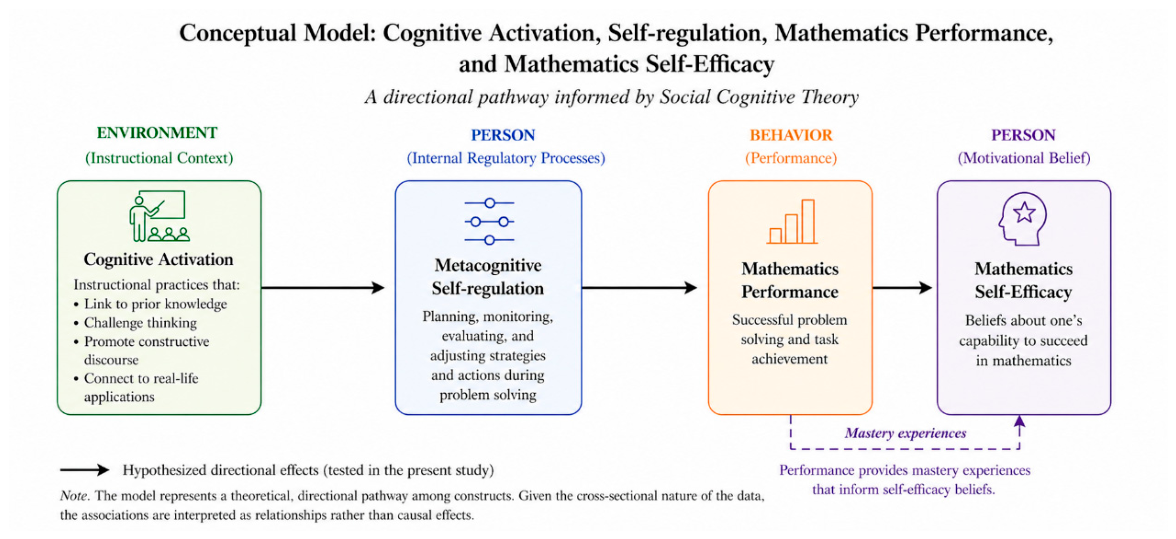
Figure 2.
Heatmap showing the correlations between the study’s measures. Correlations were derived from weighted and cluster-adjusted CFA measurement model. ***p < 0.001.
Figure 2.
Heatmap showing the correlations between the study’s measures. Correlations were derived from weighted and cluster-adjusted CFA measurement model. ***p < 0.001.
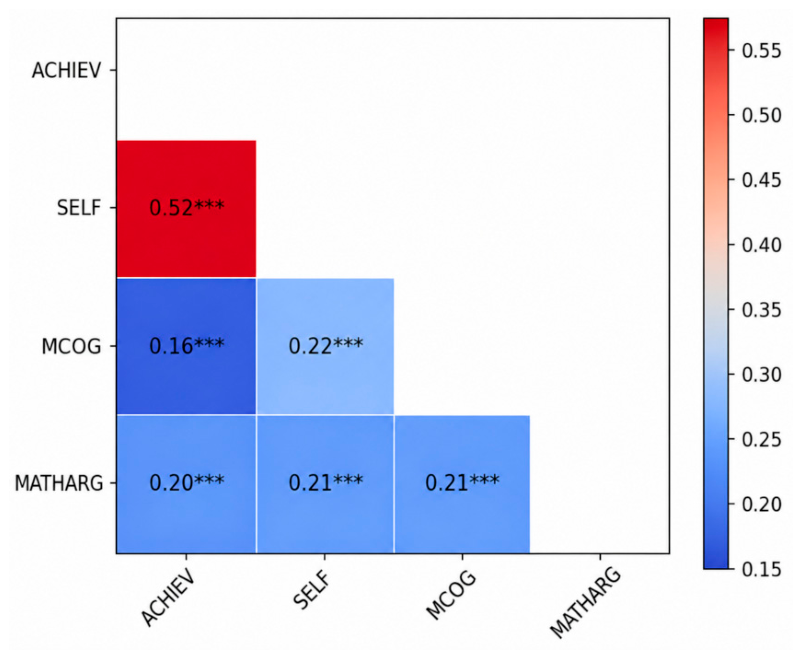
Figure 3.
Full path diagram of the structural equation model. Matharg: Cognitive activation- mathematics argumentation (explaining and justifying); MCOG: Metacognitive self-regulation; Self: Mathematics self-efficacy; ACHIEV: PISA 2022 standardized mathematics achievement; Circles connected to observed variables indicate residual variances; Directed arrows indicate regressions; Bidirectional arrows indicate correlations; Only statistically significant paths are shown (at least p < .05).
Figure 3.
Full path diagram of the structural equation model. Matharg: Cognitive activation- mathematics argumentation (explaining and justifying); MCOG: Metacognitive self-regulation; Self: Mathematics self-efficacy; ACHIEV: PISA 2022 standardized mathematics achievement; Circles connected to observed variables indicate residual variances; Directed arrows indicate regressions; Bidirectional arrows indicate correlations; Only statistically significant paths are shown (at least p < .05).
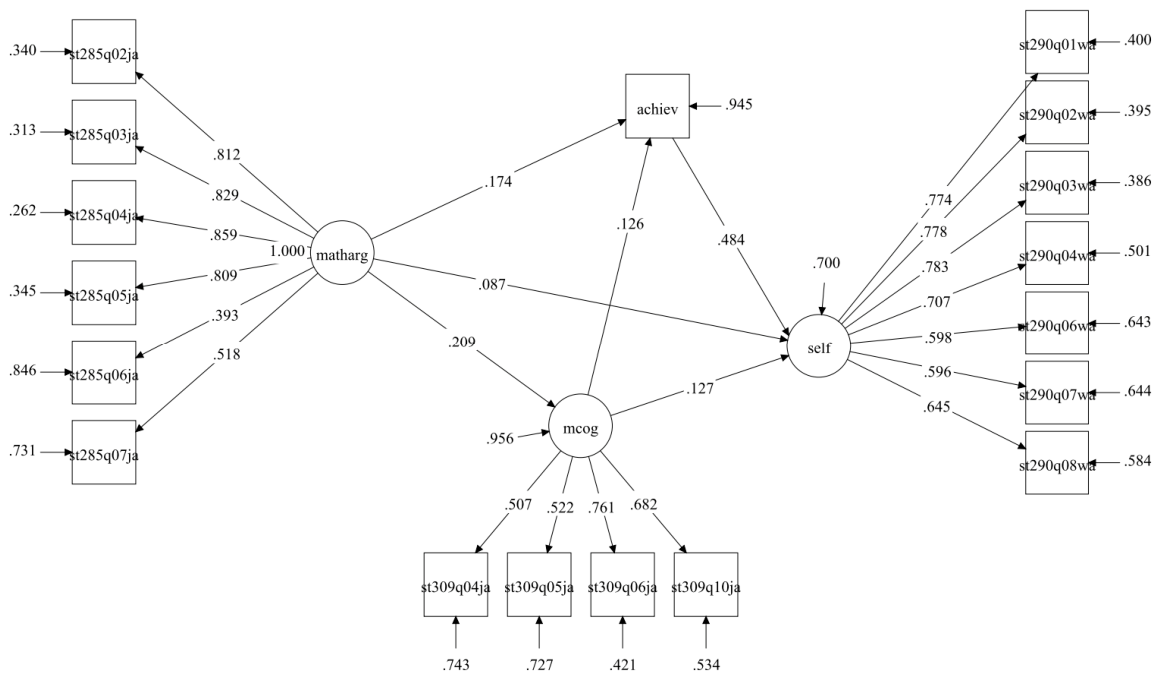

Table 1.
Descriptive statistics for the key variables under study.
| Variable | Mean | SD | Minimum | Maximum | Skewness |
| Mathematics Self-efficacy | 2.48 | 0.76 | 1 | 4 | 0.01 |
| Metacognitive Self-regulation | 3.65 | 0.86 | 1 | 5 | -0.62 |
| Cognitive Activation: Mathematics Argumentation | 3.16 | 1.07 | 1 | 5 | -0.19 |
| Mathematics Performance | 430.14 | 79.23 | 128.1 | 702.44 | 0.24 |
Table 2.
Goodness-of-fit indices of the CFA models per measure.
| Measure | Scaled chi-square (df) | CFI | TLI | RMSEA | SRMR |
| Cognitive activation: Mathematics argumentation | 124.685 (9)*** | 0.968 | 0.946 | 0.047 | 0.049 |
| Metacognitive self-regulation | 49.758 (2)*** | 0.925 | 0.774 | 0.063 | 0.053 |
| Mathematics self-efficacy | 150.415 (14)*** | 0.967 | 0.950 | 0.041 | 0.039 |
Note: *** p< 0.001; CFI: Comparative fit index; TLI: Tucker-Lewis index; RMSEA: Root mean square error of approximation; SRMR: Standardized root mean residual.
Table 3.
Standardised specific indirect paths in the SEM model for the key outcomes.
| Path | Coefficient (S.E.) | P-value |
| Effects on Achievement | ||
| Argumentation → Metacognitive Self-regulation → Achievement | 0.026 (0.006) | 0.000 |
| Effects on Self-efficacy | ||
| Argumentation → Achievement → Self-efficacy | 0.084 (0.011) | 0.000 |
| Argumentation → Metacognitive Self-regulation → Self-efficacy | 0.027 (0.006) | 0.000 |
| Argumentation → Metacognitive Self-regulation → Achievement → Self-efficacy | 0.013 (0.003) | 0.000 |
| Direct Effect | ||
| Argumentation → Self-efficacy | 0.087 (0.018) | 0.000 |
Disclaimer/Publisher’s Note: The statements, opinions and data contained in all publications are solely those of the individual author(s) and contributor(s) and not of MDPI and/or the editor(s). MDPI and/or the editor(s) disclaim responsibility for any injury to people or property resulting from any ideas, methods, instructions or products referred to in the content. |
© 2026 by the authors. Licensee MDPI, Basel, Switzerland. This article is an open access article distributed under the terms and conditions of the Creative Commons Attribution (CC BY) license (http://creativecommons.org/licenses/by/4.0/).
Copyright: This open access article is published under a Creative Commons CC BY 4.0 license, which permit the free download, distribution, and reuse, provided that the author and preprint are cited in any reuse.


