

Submitted:
01 May 2026
Posted:
04 May 2026
You are already at the latest version
Abstract
Mid-stage embryos of different species often look more alike than early embryos or adults. Early and late development diverge, leading to a broad-narrow-broad hourglass pattern. I propose that mid-embryogenesis coincides with protocol waists, narrow interfaces that standardize communication between otherwise distinct processes. For example, continuous spatial geometry is translated into a morphogen gradient protocol readable by gene regulatory networks. This architecture arises because the physical space-time geometry of early development cannot directly instruct late gene regulatory programs. They require a translator. The need for domain translation distinguishes protocols from generic canalization and bottlenecks. Translation protocols explain the hourglass: a protocol screens off upstream inputs, allowing early diversification, and decouples downstream responses, enabling late radiation. A protocol waist often remains evolutionarily frozen as the essential common language that keeps these diverging halves compatible. Perturbations of protocol waists tend to cause widespread system failure, concentrating fragility. Protocol waists provide a framework to interpret domain translators, such as morphogen gradients for geometry-to-molecules, Notch/Delta lateral inhibition for topology-to-fates, the vertebrate segmentation clock for time-to-space, and Hox axial patterning for position-to-identity. Sequential domain translators form a protocol stack, matching the common architecture of robust complex systems in engineering.
Keywords:
evo-devo
; embryogenesis
; protocols
; robustness
; fragility
1. Introduction
Mid-stage embryos of different species look more alike than either early embryos or adults [1]. As development proceeds, disparate trajectories converge to a similar form midway, then diverge again. The broad-narrow-broad pattern traces the developmental hourglass [2,3,4].
The narrow waist often corresponds to setting the basic body plan. For example, most vertebrate species share neural tube, somites, and pharyngeal arches at this mid-embryonic stage [3,5,6].
Recent molecular data reinforce the hourglass pattern in animals. Among related species, gene expression converges in mid-development and diverges early and late [7,8]. Similarly, older genes are preferentially expressed in mid-development, with newer genes more commonly expressed early and late [9,10,11].
Hourglass patterns in gene expression have also been observed in flowering plants [12], fungi [13], and brown algae [14]. Such molecular convergence across kingdoms hints at deep organizational principles underlying complex multicellularity.
The puzzle is why a middle developmental stage should be so conserved, given the observed diversity of starting and ending forms. Classical explanations invoked modularity, canalization, pleiotropy, or developmental constraints [4,15,16,17,18,19]. But none provided a compelling explanation for why the middle should be special.
I propose that mid-embryogenesis is conserved because it is when embryos must translate between different types of biological information. Early development lays down raw materials and axes; late development executes fine-grained organogenesis. In between, embryos must bridge from physical dimensions of geometry, timing, and topology to genetic programs of fates and identities.
The bridging mechanisms are the protocol waists. They form standardized, narrow interfaces that convert one domain into another. Because protocol waists are single points of cross-domain communication, they are both deeply conserved and intrinsically fragile. Fragility concentrates at the waist because there is no alternate path around a broken translator.
This perspective differs from prior accounts in its emphasis on cause. Modularity describes interchangeable parts; bottlenecks describe dimensional compression. Neither places domain translation at the center.
I claim that incompatibility between domains was the primary force that created the interfaces between distinct developmental processes. The need for translation is what makes those interfaces narrow, conserved protocol waists that constrain mid-embryogenesis.
The following sections define protocol waists, describe their consequences, and place them within the wider frame of complex robust systems in engineering and biology. The article also reviews the similarities and differences between protocol waists and other theories of the developmental hourglass, such as regulatory hubs [20,21], bottlenecks [4], modularity [4,16], and canalization [15].
The core of the article reviews four canonical mid-development mechanisms—morphogen gradients, Notch/Delta lateral inhibition, the vertebrate segmentation clock, and Hox gene patterning—and discusses each with respect to the properties of protocol waists.
2. Protocol Waists
Five properties define protocol waists and provide measurable criteria for identifying them. Define symbols X for input domain, Y for output domain, and Z for protocol waist translator between domains, with mapping .
1. Domain bridging. The translator Z mediates between fundamentally incompatible representational systems, for example, spatial geometry to gene expression, temporal oscillations to spatial pattern, or neighbor topology to cell fate. This distinguishing feature separates protocol waists from regulatory hubs. A hub integrates signals within a single domain, such as genes regulating genes. A protocol bridges distinct domains, such as geometry regulating genes.
2. Compression. The translator Z has a far lower dimensionality than the inputs X, yet it carries the essential information to guide Y. Many upstream variables are condensed into a simple code, such as a single concentration value, a binary state, or a combinatorial gene pattern.
3. Screening-off. Given the code Z, the downstream outcome Y becomes largely independent of the specific upstream information X that produced Z. The translator screens off its own history, acting as a sufficient statistic. Formally, we expect the mutual information to be near zero, meaning that once Z is known, further details of X provide little additional predictive power about Y.
4. Invariance. Consequently, diverse upstream routes X that yield the same Z lead to the same Y. The translator generates standardized outcomes despite variability in upstream details. This property underpins the reliability of development, allowing embryos to buffer genetic and environmental noise by channeling it into a robust intermediate code. Upstream processes can vary as long as they remain compatible with the intermediate code, Z. Downstream processes can also vary as long as they continue to read Z in a way that retains functional outcomes.
5. Manipulability. Directly writing or altering Z is sufficient to set or change Y, and supplying Z can rescue Y even if X is compromised. This pattern provides the experimental signature of a causal control point. Classic gain-of-function and rescue experiments in development are powerful precisely because they often target these translator codes, demonstrating that the code is not just correlated with the outcome but causally determines it.
3. Consequences of Protocol Waists
1. Cross-lineage conservation. A domain translator, once established, tends to become frozen. Change to a translator requires simultaneously altering the sender, the receiver, or both, which is difficult by common evolutionary process. Further, the screening-off and invariance properties allow organisms with different upstream machinery to retain the same protocol signal. Thus, mid-developmental stages remain comparable across long evolutionary distances.
This protocol retention explains why we can meaningfully align pharyngula-stage vertebrates or germband-extended arthropods despite their disparate early development [2,5]. The protocol marks the moment at which early and late developmental domains can communicate. The translator is a fundamental solution to a recurring developmental problem.
2. Release of diversity. Screening-off releases evolutionary freedom on both sides of the waist. Upstream processes can vary as long as they produce the correct protocol signal. Downstream processes can change as long as they continue to read the protocol signal and maintain functional outcomes. This evolutionary freedom early and late in development explains the broad-narrow-broad hourglass pattern.
3. Emergent fragility. In a pure protocol waist, there is no redundant path around a broken protocol. Thus, fragility concentrates at waists. Greater developmental disruption or mortality should arise from perturbations that affect conserved vertebrate mid-embryogenesis compared to perturbations that act before or after the waist [17]. Key protocol translators such as the morphogen gradient machinery, Notch/Delta signaling, or Hox cluster regulation should be particularly sensitive.
Fragility is the flip side of robustness [22,26,27]. The system is robust to upstream perturbations but vulnerable to breaking the translator itself. Translator components are often dosage-sensitive, and several central translator genes are haploinsufficient in humans or model organisms, implying the system is finely tuned and cannot tolerate deviation [28,29,30,31,32,33]. This sensitivity is consistent with the conservation of genes expressed in mid-embryogenesis [34,35,36].
Figure 1 shows the structure of protocol waists and their evolutionary consequences.
4. Protocol Waists vs Regulatory Hubs
Like protocol waists, at a regulatory hub, multiple inputs converge and multiple outputs diverge. Hubs cannot change easily because many processes depend on them, leading to evolutionary conservation [20,21].
However, the resemblance to protocol waists is superficial. Protocols are about the nature of the transformation between domains, not the number of connections. A hub can regulate many genes while operating entirely within a single domain, receiving transcriptional inputs and producing transcriptional outputs. By contrast, a protocol waist reads one kind of signal and writes another.
For example, a typical transcription factor that integrates multiple upstream regulators and controls multiple downstream targets is a hub. A morphogen gradient that converts spatial position into gene expression states is a protocol waist. The morphogen speaks two languages, geometry and genetics, providing the translation between them.
Translators may often sit at tissue boundaries or developmental interfaces, where they can sense one representational map and write another. Hubs are expected to lack such clear positioning in relation to different domains.
Some developmental regulators may lie on a continuum between pure hubs and pure protocol waists. The theory here predicts that the degree of cross-domain translation correlates more strongly with mid-embryogenic conservation than does the degree of hub-like connectivity.
5. Relation to Prior Theories
In addition to hubs, several other established theories address the evolutionary conservation of mid-embryonic development. Bottleneck models emphasize dimensional reduction, in which many early trajectories compress to few mid-stage states [4]. Modularity emphasizes interchangeable parts with defined interfaces [4,16]. Canalization focuses on developmental robustness through feedback and redundancy [15]. Deep homology emphasizes the ancient toolkit of conserved genes and pathways [37].
Each theory captures something real. The protocol waist view does not contradict these accounts. Instead, it proposes that domain translation is the underlying cause that partially unifies the other theories and explains many particular attributes of development not specified by them.
Key bottlenecks are narrow because translation requires compression. The bottlenecks do not just compress but also link otherwise incompatible domains. Modules form because translation creates natural interfaces. The interfaces do more than hide internal details; they define a common signaling language between domains.
The hubs that primarily conserve mid-embryogenesis translate rather than merely connect. Canalization concentrates at translation points because protocol signals screen off upstream variation. Deep homology persists because replacing a translator is difficult, requiring rare coordinated changes in both linked domains.
The key prediction that distinguishes the protocol waist framework is that conservation of mid-development should concentrate specifically at points of domain translation, not merely at points of high connectivity, low dimensionality, or functional importance. The empirical examples in the following section illustrate the essential role of domain translation.
6. Four Examples
The entire theory of protocol waists turns on the nature of domain translation. What exactly is that?
In biology, the most useful definitions are often empirical and inductive. To build toward that goal, I now turn to four protocol waists in development. For each, I consider existing observations and potential future studies in relation to the five predicted properties and three consequences of the protocol waist theory.
Much of the following restates common understanding of development. However, by putting protocol waists at the foundation, we can see more clearly the entire architecture of development and how the parts fit together.
Prior concepts described one component or another without connecting all of the parts into a single frame. Those prior concepts did not predict the broad set of specific attributes associated with protocol waists. Instead, prior work often accurately described some of those attributes without fully explaining what to expect and why.
The protocol waist perspective predicts that translating processes between domains will tend to have the full range of special attributes. Other key developmental processes that do not translate between domains will likely have fewer of those special attributes.
6.1. Morphogen Gradients: Geometry to Genes
Embryonic cells must know their spatial position to select appropriate gene expression programs for their emerging fate. Yet they have no direct mechanism to sense location. Morphogen gradients solve this challenge by encoding position as concentration, forming a protocol waist.
For example, the Spemann organizer in amphibians secretes BMP antagonists including Chordin, Noggin, and Follistatin that establish a dorsal-ventral morphogen gradient [38]. Similarly, the Bicoid protein in Drosophila forms an anterior-to-posterior concentration gradient that specifies positional identity [39,40]. Different threshold levels specify the head and thorax.
6.1.1. Protocol Waist Properties
A morphogen gradient exhibits the five defining properties of a protocol waist. First, a gradient bridges distinct domains by translating geometric coordinates into molecular concentrations that cells read through receptors, triggering distinct gene expression programs at different thresholds.
Second, a morphogen gradient dramatically compresses information. The complex geometry of an embryo reduces to the local morphogen concentration.
Third, a gradient screens off upstream history from downstream response. When an early amphibian embryo is bisected, each fragment with organizer tissue can form a complete, proportionate embryo [38]. The BMP gradient re-establishes in each half [41], and cells pattern according to the rescaled concentrations rather than their original coordinates [42]. The morphogen level at each point erases the geometric history that produced it.
Fourth, the screening-off property creates invariance to upstream variation. For example, changes in embryo geometry that do not change the gradient are expected to have little influence on the developmental outcome. For morphogens, the gradients scale with size. The Bicoid gradient adjusts proportionally across closely related dipteran species with different egg sizes [43], and the BMP activity gradient scales with embryo size in Xenopus [42,44]. The protocol signal remains invariant despite variation in absolute embryo dimensions.
Fifth, manipulating the gradient alters the outcome. Implanting a bead soaked in Sonic Hedgehog protein at the anterior margin of a chick limb bud induces mirror-image digit duplications patterned according to the artificial gradient [45]. Adding excess BMP to amphibian embryos causes dorsally positioned cells to adopt ventral fates [46,47,48].
6.1.2. Protocol Waist Consequences
Now consider the three consequences of protocol waists. First, morphogen gradients are deeply conserved across lineages. Vertebrate dorsal-ventral patterning by the BMP gradient also operates in insects, though with inverted orientation. Ventral in Drosophila corresponds to dorsal in vertebrates [49,50].
Cross-species rescue experiments demonstrate functional conservation. Drosophila Sog can dorsalize Xenopus embryos, and Xenopus Chordin can ventralize Drosophila [51]. Across tissues and taxa, different developmental contexts employ different morphogens, such as BMPs, Wnts, FGFs, Hedgehogs. However, the gradient-to-gene-expression translation logic remains similar [52].
Second, developmental process increasingly diversifies with distance from the morphogen gradient protocol waist.
Upstream, the mechanisms that establish morphogen sources vary across lineages. Drosophila relies on maternal deposition of bicoid mRNA, which directly forms a gradient [39,40]. Vertebrates first induce an organizer—the Spemann organizer in amphibians, the node in mammals—which then secretes BMP antagonists to establish the gradient [53,54,55]. These different upstream routes all converge to establish similar gradient profiles.
Downstream, the genes activated in response to morphogen gradients diverge rapidly between lineages. Drosophila interprets the Bicoid gradients through gap genes like Hunchback and Krüppel [56]. Vertebrates activate entirely different transcription factors in response to BMP or Hedgehog gradients [57]. The gene regulatory networks receiving the morphogen signal are sites of evolutionary innovation.
Third, the sufficiency of the gradient independently of upstream cause concentrates fragility at the translation point. Loss of bicoid function in Drosophila results in embryos lacking anterior structures [58]. In humans, mutations in Sonic Hedgehog cause failure of forebrain septation and disruption of facial structures [59].
The translator represents a single point of failure, whereas mutations affecting upstream geometry or downstream tissue-specific genes typically produce more limited defects. In experimental terms, a fragility-mapping test predicts that perturbations to waist variables cause broader, more coordinated defects than equal-strength perturbations upstream or downstream.
Viewing gradients as protocol waists clarifies why they are both robust and fragile [22]. Robustness arises because the low-dimensional gradient at the protocol waist is sufficient, screening off the upstream perturbations associated with the many paths that converge to the same gradient. Fragility arises because so many downstream decisions rely on the low-dimensional signal at the waist.
6.2. Notch/Delta Lateral Inhibition: Topology to Fate
Cells in developing tissues must coordinate fates with their neighbors to create fine-grained patterns of specialized and supporting cells [60,61]. Notch/Delta signaling solves this by translating the local topology of cell-cell contacts into a binary fate code.
A cell expressing Delta activates Notch receptors in adjacent cells. Notch activation represses Delta in the receiving cell, creating a feedback loop that amplifies small initial differences [62].
A cell with slightly more Delta suppresses Delta in its neighbors, which means that neighbors do not inhibit Delta in the original cell. This feedback resolves into alternating high-Delta cells that adopt a primary fate, such as neural precursor, and high-Notch neighbors that adopt a secondary fate, such as epidermal.
This mechanism of direct cell-cell interaction forms a protocol waist between neighborhood connectivity and the cell fate decisions that pattern tissues. Unlike the analog code of a morphogen gradient, lateral inhibition establishes a robust digital code, converting continuous spatial relationships into discrete binary signals.
This juxtacrine mechanism creates a regularly spaced distribution of specialized cells, each surrounded by cells that adopt the alternative fate and can later differentiate into various supporting roles.
6.2.1. Protocol Waist Properties
First, Notch/Delta bridges domains, connecting the physical topology of neighboring cells and the gene regulatory programs of fate [60]. The translator converts neighbor relations into binary molecular signals. Each cell becomes either a sender with high Delta and low Notch activity, or a receiver with the opposite pattern. This bridge between topology and fate enables small-scale patterning over large-scale regions without global positional information.
Second, lateral inhibition compresses the high-dimensional state of cells over a local region into one yes/no bit of information per cell. This extreme compression provides a simple local rule with global consequences.
Third, the binary protocol screens off the downstream fine-grained cellular fate pattern from many upstream perturbations and stochastic fluctuations of state over a local region of cells. In simple Delta-Notch feedback experiments, small inhomogeneities self-amplify and fine-grained patterns arise over a wide range of conditions [61,63]. Drosophila mosaics show that wild-type cells adopt epidermal versus neural fate depending on the relative level of Notch activity in adjacent cells [62]. The binary code, not the path to that code, determines the outcome.
Fourth, invariance of pattern to upstream detail arises from the protocol’s screening-off property. Diverse perturbations that break symmetry all drive neighboring cells toward opposite fates, yielding the same stable “salt-and-pepper” pattern mostly independent of initial conditions [63].
Fifth, manipulating the binary Delta-Notch code produces predictable outcomes. Loss of Notch signaling prevents lateral inhibition, so excess cells adopt the neural fate [60]. Conversely, constitutive Notch activation suppresses neural differentiation. Mosaic experiments confirm cell-autonomous control: cells lacking Notch adopt neural fates even in normally inhibitory neighborhoods, whereas cells with forced Notch activation remain non-neural even where neural fates would normally emerge [62].
6.2.2. Protocol Waist Consequences
First, the Notch/Delta translator is broadly conserved across lineages. The core proteins and their feedback pathways appear throughout metazoa [60,64]. Independently, plants evolved analogous lateral inhibition for stomatal spacing using different molecules [65]. This convergence suggests the binary translation protocol solves a fundamental spatial problem of development.
Second, diversity increases with distance from the translator. Upstream, the symmetry-breaking that triggers neighbor inhibition and pattern varies widely. Stochastic gene expression, mechanical forces, or earlier patterning can all initiate the competition. Downstream, the specific genes activated in high-Delta and high-Notch cells differ widely across lineages.
Third, fragility concentrates at the translation protocol. Alagille syndrome arises from human mutations in the Notch signaling pathway, affecting liver, heart, skeleton, eyes, and kidneys [28]. Multiple organs fail because they use the same translator for different patterning decisions. T-cell acute lymphoblastic leukemia arises from activating NOTCH1 mutations, which drive incorrect fate decisions in blood precursors [66]. Disrupting a single translator cascades widely because there is no alternate path to compensate for a lost or garbled binary protocol.
Different tissues tune this translator for different spacing needs. Some adjust feedback strength to control pattern density. Others extend signaling range through filopodia that carry Delta beyond immediate neighbors [67]. Yet the core protocol remains invariant, converting local competitions into discrete fate decisions.
6.3. Vertebrate Segmentation Clock: Time to Space
Vertebrates establish body segments by translating a temporal rhythm into a spatial pattern [68]. In developing embryos, presomitic mesoderm (PSM) cells synchronize gene expression oscillations [69]. Periods for the segmentation clock vary, roughly 30 minutes in zebrafish, 90 minutes in chick, and 2 hours in mice [70].
The oscillations travel spatially along the embryo’s elongating tail as a moving maturation wavefront. Each time a cycle completes, cells at the wavefront transition from oscillating to fixed states, freezing the temporal signal into space as a new segment boundary. The clock’s phase—a cell’s temporal position in its oscillation cycle—translates time into the spatially periodic series of somites that later form vertebrae and ribs.
The wave’s velocity slows as the tissue shortens, and oscillation period may also change, both affecting the spatial wavelength and thus segment size. Typically, segments shorten as the remaining tissue shortens. The translation of time to space uses oscillation phase modulated by local length scale, screening off most other upstream details from downstream outcomes.
6.3.1. Protocol Waist Properties
The segmentation clock has all five protocol waist properties. It translates time to space. It compresses cell growth, movement, and the expression of many genes in complex cycling loops to the oscillation phase per cell, a single summary variable that captures the information relevant for downstream patterning [70].
The phase screens off upstream detail from downstream outcome. If the clock’s synchrony is disturbed and later restored, periodic segments re-emerge once cells resynchronize [71,72]. Given the local phase field, one can predict boundary timing and position without additional upstream measurements of molecular pathway expression levels, cell lineage, or other historical attributes.
Different routes to the same phase pattern yield the same segmented output. Oscillations entrained by external periodic signals create segments just as endogenous oscillations do [73,74]. So long as the oscillation period and tissue elongation rate maintain their ratio, segment size and number adjust while preserving overall pattern [70].
Manipulability confirms the translator’s causal role. For example, Hes7 mutations in mice disrupt oscillations and produce severe segmentation defects [75,76]. Shifting the wavefront position via FGF signaling manipulation changes segment size [77]. External periodic pulses can entrain the clock to new periods, demonstrating direct control over the translation mechanism [73,74].
6.3.2. Protocol Waist Consequences
The segmentation clock’s core mechanism is conserved across vertebrates [70,78]. The molecular components show homology and functional equivalence. Notch signaling synchronizes oscillations, and opposing FGF–retinoic acid gradients define the wavefront across the phylum with only modest variation. A zebrafish embryo and a mouse embryo deploy the same fundamental algorithm despite a 2-fold difference in segment number and 4-fold difference in clock period [79].
Upstream and downstream processes diverge between lineages. Upstream, different species initiate oscillations through varying molecular networks, yet all funnel into the same oscillatory code. Mechanisms of elongation also vary, and growth rates evolve freely so long as they couple appropriately to the clock’s period. Downstream, the developmental fate and function of segments differ widely. Overall, early and late development explore diverse evolutionary paths while mid-embryonic segmentation remains constrained at the clock’s protocol waist.
The segmentation clock’s central role in development creates fragility. Disrupting the time-to-space translation causes system-wide failure of the segmented body plan. Mutations in core clock genes or wavefront signaling produce catastrophic phenotypes. In humans, spondylocostal dysostosis arises from mutations in several components of the Notch-dependent segmentation machinery, resulting in fused or malformed vertebrae throughout the spine [80]. The benefits of robustness to upstream variation conferred by the protocol waist come with the cost of fragility at the waist.
6.4. Hox Genes: Positional History to Identity
The Hox system compresses spatial and temporal history into a combinatorial protocol code, the on/off states of the various Hox genes [81]. Analog trajectories of development reduce to digital instructions that subsequent gene regulatory networks execute. Those downstream gene networks control what cells and tissues actually do.
In vertebrates, the segmentation clock sets the location of segments. The Hox system determines the fate of cells in those segments. Vertebrates inherited this conserved Hox system, which arose in essentially its modern form in a bilaterian ancestor [82].
Hox genes activate sequentially by a progressive wave of chromatin opening that moves along the cluster of genes in step with developmental time [83,84]. Earlier-activated genes specify anterior structures, while later-activated genes pattern posterior regions. The temporal sequence becomes a spatial pattern along the body axis.
6.4.1. Protocol Waist Properties
The Hox system translates continuous positional and temporal history into a discrete molecular code. It compresses high-dimensional information into a small code set. It screens off downstream outcomes from the variable details that determine a cell’s history.
The screening off is, as always, fundamentally important. Manipulating the Hox code directly resets cellular identity. Shifting Hox expression boundaries produces corresponding shifts in morphology. The code, rather than developmental history or neighbor context, primarily determines type [85,86].
Because of this causal relationship, a particular Hox code produces the same final identity regardless of how that code was established. Different upstream routes to the same Hox state yield equivalent outcomes.
6.4.2. Protocol Waist Consequences
Deep evolutionary conservation occurs in the clustered genomic organization of Hox genes, their sequential collinear activation mechanism, and their role in axial patterning. Hox proteins from very different animals are often functionally interchangeable. For example, vertebrate Hox genes inserted into Drosophila embryos can trigger analogous patterning changes or rescue mutants, resulting in the expected transformations along the body axis [87,88].
The Hox protocol releases broad diversity in earlier and later developmental stages by decoupling what happens on either side of the translator. Upstream, different species use widely varying mechanisms to generate the positional cues and timing that feed into Hox activation.
For example, some embryos rely on maternal morphogen gradients to establish initial axial cues, others deploy iterative segmentation clocks or moving wavefronts of growth and differentiation, and others incorporate signaling gradients like FGF or retinoic acid. Insects lay down segments almost simultaneously along the embryo, whereas vertebrates add segments sequentially from a posterior growth zone.
Downstream, a conserved Hox-based positional code can be interpreted differently in different species, yielding alternative structures in corresponding regions.
The Hox translator also concentrates fragility, creating a single point of failure in the architecture of the embryo. Chromosomal rearrangements that alter the Hox cluster cause widespread mispatterning across multiple body regions. Mutations in individual Hox genes can eliminate or transform entire sections of the body plan [85,89,90].
7. The Developmental Protocol Stack
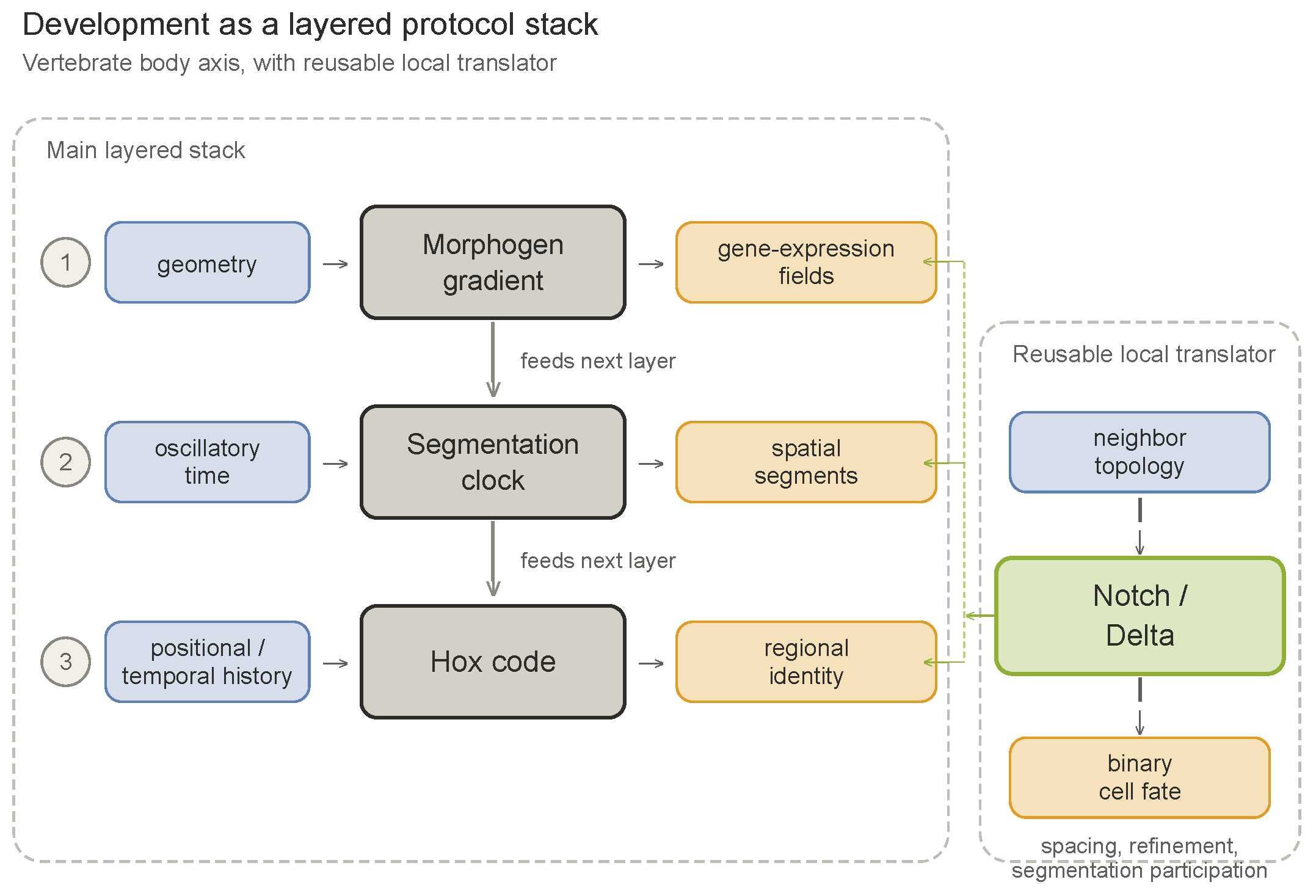
Multiple domain translators often work in series, creating a cascade of conversions. In vertebrates, morphogen gradients map geometry to gene expression patterns, which segmentation clocks translate into periodic segments, which the Hox protocol encodes into regional identities (Figure 2).
The analogy to the internet illuminates this architecture. That communication network flows through layered protocols. Physical signals become data packets, packets traverse networks via multiple layered routing protocols, and applications interpret the resulting streams. Each layer speaks its own internal language but presents a standardized interface to adjacent layers.
This architecture explains both the internet’s remarkable interoperability and its characteristic vulnerabilities. Perturbing the core TCP/IP protocol breaks everything that depends on it [22]. Embryonic development employs a similar architecture of layered communication protocols to achieve reliable integration across domains.
Consider the vertebrate body axis as a canonical example. Morphogen gradients establish the global coordinate systems that translate the embryo’s physical geometry into molecular concentration profiles. Different species may vary the specific morphogens used or their production mechanisms, but the gradient as a coordinate system persists as the base translation layer [91].
In vertebrate somitogenesis, the segmentation clock reads the gradient via a specific protocol: neighboring cells compare their FGF signaling levels and commit to boundary formation when the spatial fold change exceeds a characteristic threshold, approximately 22% in zebrafish [92].
The clock machinery is tuned to this threshold protocol. The result is a translation of temporal oscillations into spatial periodicity, producing discrete, spatially ordered segments whose locations provide the positional cues for the next layer.
The Hox system translates those segment locations into specific tissues and functions. In vertebrates, the temporal oscillations of the segmentation clock define those spatial locations. In some insects, the cascade of gap and pair-rule genes defines the locations [93]. The Hox protocol works in the same way for temporally or spatially determined locations. At comparable axial levels, the Hox code can be interpreted to yield different structures across lineages, for example, wings in the insect thorax, forelimbs in tetrapods, or rib-bearing vertebrae in snakes.
Finally, local refinement mechanisms operate within these Hox-specified domains, specifying the fate of individual cells. Notch/Delta lateral inhibition produces a salt-and-pepper pattern of specialized cells, whether in a thoracic or abdominal segment, in a fly wing or mouse spinal cord.
This idealized developmental stack captures the essential logic. Biological reality adds detail. For example, Notch signaling synchronizes oscillations within the segmentation clock, determines cell fates through lateral inhibition, and mediates boundary formation between compartments [94]. This reuse of a fundamental protocol solves similar domain-translation problems wherever they arise.
8. Robust Complex Systems
My emphasis on protocol waists arises from the general study of robust complex systems [22,23,25,27,95]. Large human-engineered systems center on protocols that translate between domains. Biology’s primary information and energy systems use ancient protocols [26,96].
Computer software talks to computer hardware through a small set of common operating system signals, the kernel protocol. The software does not know how the hardware does its job. The hardware does not know what the software is doing. Each part works in different domains of information storage and transformation. The operating system kernels are relatively stable over time, allowing broad diversification on the hardware and software ends. System fragility concentrates at the kernel protocols, the primary site of attack by computer viruses.
In biology, the oldest and most important systems also use protocols to link upstream and downstream layers. In metabolism, diverse upstream biochemistry breaks down different food sources that feed into evolutionarily ancient and conserved mechanisms to transform ADP to ATP. From those narrow chemical protocols that create the ATP/ADP disequilibrium, the system uses that disequilibrium to drive the broadly diversified downstream biochemical and physical work of life.
Similarly, hereditary information is stored and manipulated in many different ways. Yet essentially all of life runs that information through the same DNA makes RNA makes protein protocol. From that protocol, the proteins run the vastly diverse processes of life.
The point here is that there is a logical and historical inevitability to the architectural design of complex systems. Different layers represent and manipulate information in different ways. The layers communicate through narrow, conserved protocols. The layers themselves diversify widely but retain the ability to communicate through the conserved protocols.
More broadly, essentially all robust complex systems seem to be built on protocols that translate between domains. This article suggests that development likely conforms to that universal architecture [95].
9. Paradox of Robustness
The protocol waist perspective emphasizes the fragility of narrow domain translators. That view helps to understand why, for example, vertebrate segmentation clocks use multiple safeguards to enhance the robustness of the protocol. Temperature alters molecular periodicity but the segmentation pattern remains invariant [97]. Parallel oscillatory circuits, such as Notch, Wnt, and FGF, lock together so that if one pathway drifts, others constrain it [98]. Delayed negative feedback loops create stable limit cycles resisting perturbations [99].
This layering of robustness mechanisms onto an intrinsically fragile process calls to mind the paradox of robustness [95,100]. In the flow of control, an important and easily perturbed point is an attractive location for additional buffering mechanisms.
With each new buffering layer, an error in the protected process matters less because it can be compensated by the new buffering mechanism [100,101,102]. Thus, there is a weakening of the pressure of natural selection acting directly on the original protected process. That weakening of selection predicts a decay in the precision of the protected component when isolated from the new buffering layer, and perhaps an increase in genetic variability. In Herbert Spencer’s evocative phrase [103]: “The ultimate result of shielding men from the effects of folly, is to fill the world with fools.”
As additional protective buffering gets layered on top, the lower layers may relax with the weakening direct pressure. When the system is viewed as a whole, the decayed precision of the lower layers may not be apparent because the higher-level buffering corrects errors. But when the parts are studied in isolation and compared over their evolutionary history, the paradox of robustness predicts that as the system acquires more buffering layers, the components become sloppier in their isolated performance [95,100].
Because protocol waists are important sites of fragility, they become likely sites for this robustness layering and paradox of robustness. That buffering of the protocol mechanism does not change the intrinsic fragility of the protocol waist. If the translator fails, widespread developmental failure typically follows.
The Hox system illustrates this layering of protective buffers on top of a fragile core protocol. In cases where multiple Hox genes are active in the same cell, the gene that is more posterior (5’) along the chromosome represses the expression or overrides the function of more anterior (3’) genes.
This dominance creates a self-correcting hierarchy. If a cell expresses conflicting Hox signals, the posterior-most code wins, ensuring the cell adopts the correct identity for the furthest posterior Hox gene it expresses. Posterior prevalence sharpens the boundaries between Hox domains and preserves the fidelity of the code even when expression patterns overlap or fluctuate.
Multiple molecular mechanisms underlie this posterior prevalence, including direct competition between Hox protein products [104] and microRNA networks that specifically downregulate anterior Hox transcripts [105]. The buffered hierarchy protects against minor errors or noise in Hox gene expression. However, it does not remove the fundamental fragility of the system. If the Hox translation from spatial and temporal history to segment identity fails, no alternative pathway correctly patterns the body axis.
In the developmental hourglass, the paradox of robustness also arises in another way. During the initial evolution of a protocol waist, as the waist evolves to better compensate for variations in its inputs, it increases the probability of choosing the correct protocol code in spite of a decayed input signal. Consequently, the strength of natural selection on the accuracy of the inputs weakens, and evolution becomes more likely to widen the range of those inputs.
On the other side, the more the protocol code screens off outputs from inputs, the more the downstream outputs can diversify. Overall, the increased buffering by the protocol drives the diversification of the upstream inputs, and the enhancement of its screening off properties drives the widening of the downstream outputs. Evolutionary enhancements of the protocol create the evolutionary hourglass.
10. Conclusions
The evolutionary hourglass arises from development’s need to translate between incompatible domains. Early embryonic cells carry information in spatial position, neighbor relationships, and inherited molecular factors. Development must translate these heterogeneous inputs into unified genetic programs for cell fate. The waist of the hourglass is where this translation happens.
Mid-embryogenesis is conserved because it relies on protocol waists to bridge otherwise incommunicable systems. Morphogen gradients translate continuous spatial geometry into molecular signals. Segmentation clocks translate temporal oscillations into spatial boundaries. Hox genes translate positional history into segment identity. These translator mechanisms are relatively frozen in evolution because changing them requires difficult coordinated alterations in both the sending and receiving domains.
This framework unifies several established theories of developmental conservation. Protocol waists occur where inputs compress to necessary translation points, forming bottlenecks. Modules arise because translation creates natural interfaces between domains. Essential hubs in mid-embryogenesis typically bridge distinct domains. Canalization concentrates at translation points because protocol signals screen off upstream variation. Deep homology persists because replacing a translator demands rare coordinated changes on both sides.
The architecture naturally generates the evolutionary hourglass. On the input side, diverse upstream states compress into simple protocol codes. This many-to-few mapping means that various input combinations converge to the same protocol signal. The code’s invariance to upstream changes allows early developmental trajectories to diverge across lineages, widening the input side of the hourglass.
On the output side, the protocol screens off downstream processes from upstream details, liberating late development to diversify into many forms. The waist itself remains fixed because it is the essential bridge that allows these diverging halves to communicate.
More than this, protocol waists actively drive divergence at both ends. As a translator evolves to better compensate for variation in its inputs, selection on input precision weakens, and upstream mechanisms drift. As screening-off strengthens, downstream processes gain freedom to innovate. The hourglass is a dynamic consequence of translation—the protocol waist generates the pattern it marks.
This perspective yields testable predictions that distinguish it from prior theories. Conservation in development should concentrate specifically at points of domain translation, not merely at points of high connectivity, low dimensionality, or functional importance. Disrupting a protocol waist may produce failures that span multiple domains, such as scrambled mappings between space, time, and gene expression. Translation should more strictly screen off inputs from outputs than other connectors.
Ultimately, development operates as a layered protocol stack. Each layer speaks its own language and communicates through conserved translation protocols. Evolution innovates freely at the edges because it is constrained by standardized protocols at the core. The developmental hourglass reflects this deeper architecture. It is the necessary consequence of building complex systems from incompatible parts that must nonetheless communicate.
Acknowledgments
The Donald Bren Foundation and National Science Foundation grant DEB–2325755 support my research.
References
- von Baer, K.E. Über Entwickelungsgeschichte der Thiere: Beobachtung und Reflexion; Gebrüdern Bornträger: Königsberg, 1828. [Google Scholar]
- Sander, K. The evolution of patterning mechanisms: gleanings from insect embryogenesis. In Development and Evolution; Goodwin, B.C., Holder, N., Wylie, C.C., Eds.; The Sixth Symposium of the British Society for Developmental Biology, Cambridge University Press: Cambridge, 1983; pp. 137–159. [Google Scholar]
- Duboule, D. Temporal colinearity and the phylotypic progression: a basis for the stability of a vertebrate Bauplan and the evolution of morphologies through heterochrony. Development 1994, 1994, 135–142. [Google Scholar] [CrossRef]
- Raff, R.A. The Shape of Life: Genes, Development, and the Evolution of Animal Form; University of Chicago Press: Chicago, 1996. [Google Scholar]
- Slack, J.M.W.; Holland, P.W.H.; Graham, C.F. The zootype and the phylotypic stage. Nature 1993, 361, 490–492. [Google Scholar] [CrossRef]
- Hu, H.; Uesaka, M.; Guo, S.; Shimai, K.; Lu, T.M.; Li, F.; Fujimoto, S.; Ishikawa, M.; Liu, S.; Sasagawa, Y.; et al. Constrained vertebrate evolution by pleiotropic genes. Nat. Ecol. Evol. 2017, 1, 1722–1730. [Google Scholar] [CrossRef]
- Irie, N.; Kuratani, S. Comparative transcriptome analysis reveals vertebrate phylotypic period during organogenesis. Nat. Commun. 2011, 2, 248. [Google Scholar] [CrossRef]
- Kalinka, A.T.; Varga, K.M.; Gerrard, D.T.; Preibisch, S.; Corcoran, D.L.; Jarrells, J.; Ohler, U.; Bergman, C.M.; Tomančák, P. Gene expression divergence recapitulates the developmental hourglass model. Nature 2010, 468, 811–814. [Google Scholar] [CrossRef]
- Domazet-Lošo, T.; Tautz, D. A phylogenetically based transcriptome age index mirrors ontogenetic divergence patterns. Nature 2010, 468, 815–818. [Google Scholar] [CrossRef]
- Levin, M.; Anavy, L.; Cole, A.G.; Winter, E.; Mostov, N.; Khair, S.; Senderovich, N.; Kovalev, E.; Silver, D.H.; Feder, M.; et al. The mid-developmental transition and the evolution of animal body plans. Nature 2016, 531, 637–641. [Google Scholar] [CrossRef] [PubMed]
- Ma, F.; Zheng, C. Transcriptome age of individual cell types in Caenorhabditis elegans. Proc. Natl. Acad. Sci. 2023, 120, e2216351120. [Google Scholar] [CrossRef] [PubMed]
- Quint, M.; Drost, H.G.; Gabel, A.; Ullrich, K.K.; Bönn, M.; Grosse, I. A transcriptomic hourglass in plant embryogenesis. Nature 2012, 490, 98–101. [Google Scholar] [CrossRef]
- Cheng, X.; Hui, J.H.L.; Lee, Y.Y.; Law, P.T.W.; Kwan, H.S. A “developmental hourglass” in fungi. Mol. Biol. Evol. 2015, 32, 1556–1566. [Google Scholar] [CrossRef]
- Lotharukpong, J.S.; Zheng, M.; Luthringer, R.; Liesner, D.; Drost, H.G.; Coelho, S.M. A transcriptomic hourglass in brown algae. Nature 2024, 635, 129–135. [Google Scholar] [CrossRef]
- Waddington, C.H. The Strategy of the Genes; George Allen & Unwin: London, 1957. [Google Scholar]
- Wagner, G.P.; Altenberg, L. Complex adaptations and the evolution of evolvability. Evolution 1996, 50, 967–976. [Google Scholar] [CrossRef] [PubMed]
- Galis, F.; Metz, J.A.J. Testing the vulnerability of the phylotypic stage: on modularity and evolutionary conservation. J. Exp. Zool. 2001, 291, 195–204. [Google Scholar] [CrossRef]
- Uchida, Y.; Uesaka, M.; Yamamoto, T.; Takeda, H.; Irie, N. Embryonic lethality is not sufficient to explain hourglass-like conservation of vertebrate embryos. Evodevo 2018, 9, 7. [Google Scholar] [CrossRef] [PubMed]
- Uchida, Y.; Takeda, H.; Furusawa, C.; Irie, N. Stability in gene expression and body-plan development leads to evolutionary conservation. EvoDevo 2023, 14, 4. [Google Scholar] [CrossRef]
- Fraser, H.B.; Hirsh, A.E.; Steinmetz, L.M.; Scharfe, C.; Feldman, M.W. Evolutionary rate in the protein interaction network. Science 2002, 296, 750–752. [Google Scholar] [CrossRef] [PubMed]
- Jeong, H.; Mason, S.P.; Barabási, A.L.; Oltvai, Z.N. Lethality and centrality in protein networks. Nature 2001, 411, 41–42. [Google Scholar] [CrossRef]
- Doyle, J.C.; Alderson, D.L.; Li, L.; Low, S.; Roughan, M.; Shalunov, S.; Tanaka, R.; Willinger, W. The “robust yet fragile” nature of the Internet. Proc. Natl. Acad. Sci. 2005, 102, 14497–14502. [Google Scholar] [CrossRef]
- Doyle, J.C.; Csete, M. Architecture, constraints, and behavior. Proc. Natl. Acad. Sci. 2011, 108, 15624–15630. [Google Scholar] [CrossRef]
- Akhshabi, S.; Dovrolis, C. The evolution of layered protocol stacks leads to an hourglass-shaped architecture. In Proceedings of the Proceedings of the ACM SIGCOMM 2011 Conference, New York, NY, 2011; pp. 206–217. [Google Scholar] [CrossRef]
- Matni, N.; Ames, A.D.; Doyle, J.C. A quantitative framework for layered multirate control: Toward a theory of control architecture. IEEE Control Syst. 2024, 44, 52–94. [Google Scholar] [CrossRef]
- Csete, M.E.; Doyle, J.C. Reverse engineering of biological complexity. Science 2002, 295, 1664–1669. [Google Scholar] [CrossRef]
- Csete, M.; Doyle, J. Bow ties, metabolism and disease. Trends Biotechnol. 2004, 22, 446–450. [Google Scholar] [CrossRef] [PubMed]
- Oda, T.; Elkahloun, A.G.; Pike, B.L.; Okajima, K.; Krantz, I.D.; Genin, A.; Piccoli, D.A.; Meltzer, P.S.; Spinner, N.B.; Collins, F.S.; et al. Mutations in the human Jagged1 gene are responsible for Alagille syndrome. Nat. Genet. 1997, 16, 235–242. [Google Scholar] [CrossRef]
- Li, L.; Krantz, I.D.; Deng, Y.; Genin, A.; Banta, A.B.; Collins, C.C.; Qi, M.; Trask, B.J.; Kuo, W.L.; Cochran, J.; et al. Alagille syndrome is caused by mutations in human Jagged1, which encodes a ligand for Notch1. Nat. Genet. 1997, 16, 243–251. [Google Scholar] [CrossRef]
- Nanni, L.; Ming, J.E.; Bocian, M.; Steinhaus, K.; Bianchi, D.W.; de Die-Smulders, C.; Giannotti, A.; Imaizumi, K.; Jones, K.L.; Del Campo, M.; et al. The mutational spectrum of the Sonic Hedgehog gene in holoprosencephaly: SHH mutations cause a significant proportion of autosomal dominant holoprosencephaly. Hum. Mol. Genet. 1999, 8, 2479–2488. [Google Scholar] [CrossRef] [PubMed]
- Reis, L.M.; Tyler, R.C.; Schilter, K.F.; Abdul-Rahman, O.; Innis, J.W.; Kozel, B.A.; Schneider, A.S.; Bardakjian, T.M.; Lose, E.J.; Martin, D.M.; et al. BMP4 loss-of-function mutations in developmental eye disorders including SHORT syndrome. Hum. Genet. 2011, 130, 495–504. [Google Scholar] [CrossRef]
- Kurban, M.; Wajid, M.; Petukhova, L.; Shimomura, Y.; Christiano, A.M. A nonsense mutation in the HOXD13 gene underlies synpolydactyly with incomplete penetrance. J. Hum. Genet. 2011, 56, 701–706. [Google Scholar] [CrossRef]
- Koenig, S.N.; LaHaye, S.; Feller, J.D.; Rowland, P.; Hor, K.N.; Trask, A.J.; Janssen, P.M.; Radtke, F.; Lilly, B.; Garg, V. Notch1 haploinsufficiency causes ascending aortic aneurysms in mice. JCI Insight 2017, 2, e91353. [Google Scholar] [CrossRef]
- Liu, J.; Viales, R.R.; Khoueiry, P.; Reddington, J.P.; Girardot, C.; Furlong, E.E.M.; Robinson-Rechavi, M. The hourglass model of evolutionary conservation during embryogenesis extends to developmental enhancers with signatures of positive selection. Genome Res. 2021, 31, 1573–1581. [Google Scholar] [CrossRef]
- Zalts, H.; Yanai, I. Developmental constraints shape the evolution of the nematode mid-developmental transition. Nat. Ecol. Evol. 2017, 1, 0113. [Google Scholar] [CrossRef] [PubMed]
- Piasecka, B.; Lichocki, P.; Moretti, S.; Bergmann, S.; Robinson-Rechavi, M. The hourglass and the early conservation models—co-existing patterns of developmental constraints in vertebrates. PLoS Genet. 2013, 9, e1003476. [Google Scholar] [CrossRef] [PubMed]
- Shubin, N.; Tabin, C.; Carroll, S. Fossils, genes and the evolution of animal limbs. Nature 1997, 388, 639–648. [Google Scholar] [CrossRef]
- De Robertis, E.M. Spemann’s organizer and the self-regulation of embryonic fields. Mech. Dev. 2009, 126, 925–941. [Google Scholar] [CrossRef]
- Driever, W.; Nüsslein-Volhard, C. A gradient of bicoid protein in Drosophila embryos. Cell 1988, 54, 83–93. [Google Scholar] [CrossRef]
- Driever, W.; Nüsslein-Volhard, C. The bicoid protein determines position in the Drosophila embryo in a concentration-dependent manner. Cell 1988, 54, 95–104. [Google Scholar] [CrossRef]
- Reversade, B.; De Robertis, E.M. Regulation of ADMP and BMP2/4/7 at opposite embryonic poles generates a self-regulating morphogenetic field. Cell 2005, 123, 1147–1160. [Google Scholar] [CrossRef] [PubMed]
- Ben-Zvi, D.; Shilo, B.Z.; Fainsod, A.; Barkai, N. Scaling of the BMP activation gradient in Xenopus embryos. Nature 2008, 453, 1205–1211. [Google Scholar] [CrossRef]
- Gregor, T.; Bialek, W.; de Ruyter van Steveninck, R.R.; Tank, D.W.; Wieschaus, E.F. Diffusion and scaling during early embryonic pattern formation. Proc. Natl. Acad. Sci. USA 2005, 102, 18403–18407. [Google Scholar] [CrossRef]
- Ben-Zvi, D.; Barkai, N. Scaling of morphogen gradients by an expansion-repression integral feedback control. Proc. Natl. Acad. Sci. USA 2010, 107, 6924–6929. [Google Scholar] [CrossRef]
- Riddle, R.D.; Johnson, R.L.; Laufer, E.; Tabin, C. Sonic hedgehog mediates the polarizing activity of the ZPA. Cell 1993, 75, 1401–1416. [Google Scholar] [CrossRef] [PubMed]
- Dale, L.; Howes, G.; Price, B.M.J.; Smith, J.C. Bone morphogenetic protein 4: a ventralizing factor in early Xenopus development. Development 1992, 115, 573–585. [Google Scholar] [CrossRef]
- Dosch, R.; Gawantka, V.; Delius, H.; Blumenstock, C.; Niehrs, C. Bmp-4 acts as a morphogen in dorsoventral mesoderm patterning in Xenopus. Development 1997, 124, 2325–2334. [Google Scholar] [CrossRef] [PubMed]
- Jones, C.M.; Dale, L.; Hogan, B.L.M.; Wright, C.V.E.; Smith, J.C. Bone morphogenetic protein-4 (BMP-4) acts during gastrula stages to cause ventralization of Xenopus embryos. Development 1996, 122, 1545–1554. [Google Scholar] [CrossRef] [PubMed]
- Arendt, D.; Nübler-Jung, K. Inversion of dorsoventral axis? Nature 1994, 371, 26. [Google Scholar] [CrossRef] [PubMed]
- De Robertis, E.M.; Sasai, Y. A common plan for dorsoventral patterning in Bilateria. Nature 1996, 380, 37–40. [Google Scholar] [CrossRef]
- Holley, S.A.; Jackson, P.D.; Sasai, Y.; Lu, B.; De Robertis, E.M.; Hoffmann, F.M.; Ferguson, E.L. A conserved system for dorsal-ventral patterning in insects and vertebrates involving sog and chordin. Nature 1995, 376, 249–253. [Google Scholar] [CrossRef]
- Briscoe, J.; Small, S. Morphogen rules: design principles of gradient-mediated embryo patterning. Development 2015, 142, 3996–4009. [Google Scholar] [CrossRef]
- Beddington, R.S.P. Induction of a second neural axis by the mouse node. Development 1994, 120, 613–620. [Google Scholar] [CrossRef]
- Bachiller, D.; Klingensmith, J.; Kemp, C.; Belo, J.A.; Anderson, R.M.; May, S.R.; McMahon, J.A.; McMahon, A.P.; Harland, R.M.; Rossant, J.; et al. The organizer factors Chordin and Noggin are required for mouse forebrain development. Nature 2000, 403, 658–661. [Google Scholar] [CrossRef]
- De Robertis, E.M. Spemann’s organizer and self-regulation in amphibian embryos. Nat. Rev. Mol. Cell Biol. 2006, 7, 296–302. [Google Scholar] [CrossRef]
- Struhl, G.; Johnston, P.; Lawrence, P.A. Control of Drosophila body pattern by the hunchback morphogen gradient. Cell 1992, 69, 237–249. [Google Scholar] [CrossRef]
- Dessaud, E.; McMahon, A.P.; Briscoe, J. Pattern formation in the vertebrate neural tube: a sonic hedgehog morphogen-regulated transcriptional network. Development 2008, 135, 2489–2503. [Google Scholar] [CrossRef]
- Frohnhöfer, H.G.; Nüsslein-Volhard, C. Organization of anterior pattern in the Drosophila embryo by the maternal gene bicoid. Nature 1986, 324, 120–125. [Google Scholar] [CrossRef]
- Roessler, E.; Belloni, E.; Gaudenz, K.; Jay, P.; Berta, P.; Scherer, S.W.; Tsui, L.C.; Muenke, M. Mutations in the human Sonic Hedgehog gene cause holoprosencephaly. Nat. Genet. 1996, 14, 357–360. [Google Scholar] [CrossRef] [PubMed]
- Artavanis-Tsakonas, S.; Rand, M.D.; Lake, R.J. Notch signaling: cell fate control and signal integration in development. Science 1999, 284, 770–776. [Google Scholar] [CrossRef] [PubMed]
- Simpson, P. Lateral inhibition and the development of the sensory bristles of the adult peripheral nervous system of Drosophila. Development 1990, 109, 509–519. [Google Scholar] [CrossRef]
- Heitzler, P.; Simpson, P. The choice of cell fate in the epidermis of Drosophila. Cell 1991, 64, 1083–1092. [Google Scholar] [CrossRef]
- Collier, J.R.; Monk, N.A.M.; Maini, P.K.; Lewis, J.H. Pattern formation by lateral inhibition with feedback: a mathematical model of Delta-Notch intercellular signalling. J. Theor. Biol. 1996, 183, 429–446. [Google Scholar] [CrossRef]
- Gazave, E.; Lapébie, P.; Richards, G.S.; Brunet, F.; Ereskovsky, A.V.; Degnan, B.M.; Borchiellini, C.; Vervoort, M.; Renard, E. Origin and evolution of the Notch signalling pathway: an overview from eukaryotic genomes. BMC Evol. Biol. 2009, 9, 249. [Google Scholar] [CrossRef] [PubMed]
- Hara, K.; Kajita, R.; Torii, K.U.; Bergmann, D.C.; Kakimoto, T. The secretory peptide gene EPF1 enforces the stomatal one-cell-spacing rule. Genes Dev. 2007, 21, 1720–1725. [Google Scholar] [CrossRef]
- Weng, A.P.; Ferrando, A.A.; Lee, W.; Morris, IV, J.P.; Silverman, L.B.; Sanchez-Irizarry, C.; Blacklow, S.C.; Look, A.T.; Aster, J.C. Activating mutations of NOTCH1 in human T cell acute lymphoblastic leukemia. Science 2004, 306, 269–271. [Google Scholar] [CrossRef]
- De Joussineau, C.; Soulé, J.; Martin, M.; Anguille, C.; Montcourrier, P.; Alexandre, D. Delta-promoted filopodia mediate long-range lateral inhibition in Drosophila. Nature 2003, 426, 555–559. [Google Scholar] [CrossRef]
- Cooke, J.; Zeeman, E.C. A clock and wavefront model for control of the number of repeated structures during animal morphogenesis. J. Theor. Biol. 1976, 58, 455–476. [Google Scholar] [CrossRef]
- Palmeirim, I.; Henrique, D.; Ish-Horowicz, D.; Pourquié, O. Avian hairy gene expression identifies a molecular clock linked to vertebrate segmentation and somitogenesis. Cell 1997, 91, 639–648. [Google Scholar] [CrossRef] [PubMed]
- Oates, A.C.; Morelli, L.G.; Ares, S. Patterning embryos with oscillations: structure, function and dynamics of the vertebrate segmentation clock. Development 2012, 139, 625–639. [Google Scholar] [CrossRef]
- Riedel-Kruse, I.H.; Müller, C.; Oates, A.C. Synchrony dynamics during initiation, failure, and rescue of the segmentation clock. Science 2007, 317, 1911–1915. [Google Scholar] [CrossRef]
- Uriu, K.; Liao, B.K.; Oates, A.C.; Morelli, L.G. From local resynchronization to global pattern recovery in the zebrafish segmentation clock. eLife 2021, 10, e61358. [Google Scholar] [CrossRef] [PubMed]
- Sonnen, K.F.; Lauschke, V.M.; Uraji, J.; Falk, H.J.; Petersen, Y.; Funk, M.C.; Beaupeux, M.; François, P.; Merten, C.A.; Aulehla, A. Modulation of phase shift between Wnt and Notch signaling oscillations controls mesoderm segmentation. Cell 2018, 172, 1079–1090.e12. [Google Scholar] [CrossRef]
- Sanchez, P.G.L.; Mochulska, V.; Mauffette Denis, C.; Mönke, G.; Tomita, T.; Tsuchida-Straeten, N.; Petersen, Y.; Sonnen, K.; François, P.; Aulehla, A. Arnold tongue entrainment reveals dynamical principles of the embryonic segmentation clock. eLife 2022, 11, e79575. [Google Scholar] [CrossRef] [PubMed]
- Bessho, Y.; Sakata, R.; Komatsu, S.; Shiota, K.; Yamada, S.; Kageyama, R. Dynamic expression and essential functions of Hes7 in somite segmentation. Genes Dev. 2001, 15, 2642–2647. [Google Scholar] [CrossRef]
- Hirata, H.; Bessho, Y.; Kokubu, H.; Masamizu, Y.; Yamada, S.; Lewis, J.; Kageyama, R. Instability of Hes7 protein is crucial for the somite segmentation clock. Nat. Genet. 2004, 36, 750–754. [Google Scholar] [CrossRef] [PubMed]
- Dubrulle, J.; McGrew, M.J.; Pourquié, O. FGF signaling controls somite boundary position and regulates segmentation clock control of spatiotemporal Hox gene activation. Cell 2001, 106, 219–232. [Google Scholar] [CrossRef]
- Krol, A.J.; Roellig, D.; Dequéant, M.L.; Tassy, O.; Glynn, E.; Hattem, G.; Mushegian, A.; Oates, A.C.; Pourquié, O. Evolutionary plasticity of segmentation clock networks. Development 2011, 138, 2783–2792. [Google Scholar] [CrossRef]
- Gomez, C.; Özbudak, E.M.; Wunderlich, J.; Baumann, D.; Lewis, J.; Pourquié, O. Control of segment number in vertebrate embryos. Nature 2008, 454, 335–339. [Google Scholar] [CrossRef]
- Turnpenny, P.D.; Alman, B.; Cornier, A.S.; Giampietro, P.F.; Offiah, A.; Tassy, O.; Pourquié, O.; Kusumi, K.; Dunwoodie, S. Abnormal vertebral segmentation and the notch signaling pathway in man. Dev. Dyn. 2007, 236, 1456–1474. [Google Scholar] [CrossRef]
- McGinnis, W.; Krumlauf, R. Homeobox genes and axial patterning. Cell 1992, 68, 283–302. [Google Scholar] [CrossRef]
- de Rosa, R.; Grenier, J.K.; Andreeva, T.; Cook, C.E.; Adoutte, A.; Akam, M.; Carroll, S.B.; Balavoine, G. Hox genes in brachiopods and priapulids and protostome evolution. Nature 1999, 399, 772–776. [Google Scholar] [CrossRef]
- Deschamps, J.; Duboule, D. Embryonic timing, axial stem cells, chromatin dynamics, and the Hox clock. Genes Dev. 2017, 31, 1406–1416. [Google Scholar] [CrossRef] [PubMed]
- Noordermeer, D.; Leleu, M.; Schorderet, P.; Joye, E.; Chabaud, F.; Duboule, D. Temporal dynamics and developmental memory of 3D chromatin architecture at Hox gene loci. eLife 2014, 3, e02557. [Google Scholar] [CrossRef]
- Lewis, E.B. A gene complex controlling segmentation in Drosophila. Nature 1978, 276, 565–570. [Google Scholar] [CrossRef] [PubMed]
- Kessel, M.; Gruss, P. Homeotic transformations of murine vertebrae and concomitant alteration of Hox codes induced by retinoic acid. Cell 1991, 67, 89–104. [Google Scholar] [CrossRef]
- Malicki, J.; Schughart, K.; McGinnis, W. Mouse Hox-2.2 specifies thoracic segmental identity in Drosophila embryos and larvae. Cell 1990, 63, 961–967. [Google Scholar] [CrossRef]
- Lutz, B.; Lu, H.C.; Eichele, G.; Miller, D.; Kaufman, T.C. Rescue of Drosophila labial null mutant by the chicken ortholog Hoxb-1 demonstrates that the function of Hox genes is phylogenetically conserved. Genes Dev. 1996, 10, 176–184. [Google Scholar] [CrossRef]
- Goodman, F.R. Limb malformations and the human HOX genes. Am. J. Med. Genet. 2002, 112, 256–265. [Google Scholar] [CrossRef]
- Spitz, F.; Herkenne, C.; Morris, M.A.; Duboule, D. Inversion-induced disruption of the Hoxd cluster leads to the partition of regulatory landscapes. Nat. Genet. 2005, 37, 889–893. [Google Scholar] [CrossRef]
- Wolpert, L. Positional information and the spatial pattern of cellular differentiation. J. Theor. Biol. 1969, 25, 1–47. [Google Scholar] [CrossRef]
- Simsek, M.F.; Özbudak, E.M. Spatial fold change of FGF signaling encodes positional information for segmental determination in zebrafish. Cell Rep. 2018, 24, 66–78. [Google Scholar] [CrossRef] [PubMed]
- Nüsslein-Volhard, C.; Wieschaus, E. Mutations affecting segment number and polarity in Drosophila. Nature 1980, 287, 795–801. [Google Scholar] [CrossRef] [PubMed]
- Bray, S.J. Notch signalling: a simple pathway becomes complex. Nat. Rev. Mol. Cell Biol. 2006, 7, 678–689. [Google Scholar] [CrossRef] [PubMed]
- Frank, S.A. Robustness and complexity. Cell Syst. 2023, 14, 1015–1020. [Google Scholar] [CrossRef]
- Friedlander, T.; Mayo, A.E.; Tlusty, T.; Alon, U. Evolution of bow-tie architectures in biology. PLoS Comput. Biol. 2015, 11, e1004055. [Google Scholar] [CrossRef] [PubMed]
- Schröter, C.; Herrgen, L.; Cardona, A.; Brouhard, G.J.; Feldman, B.; Oates, A.C. Dynamics of zebrafish somitogenesis. Dev. Dyn. 2008, 237, 545–553. [Google Scholar] [CrossRef]
- Dequéant, M.L.; Glynn, E.; Gaudenz, K.; Wahl, M.; Chen, J.; Mushegian, A.; Pourquié, O. A complex oscillating network of signaling genes underlies the mouse segmentation clock. Science 2006, 314, 1595–1598. [Google Scholar] [CrossRef]
- Lewis, J. Autoinhibition with transcriptional delay: a simple mechanism for the zebrafish somitogenesis oscillator. Curr. Biol. 2003, 13, 1398–1408. [Google Scholar] [CrossRef] [PubMed]
- Frank, S.A. Maladaptation and the paradox of robustness in evolution. PLoS ONE 2007, 2, e1021. [Google Scholar] [CrossRef] [PubMed]
- Rutherford, S.L.; Lindquist, S. Hsp90 as a capacitor for morphological evolution. Nature 1998, 396, 336–342. [Google Scholar] [CrossRef]
- Stoltzfus, A. On the possibility of constructive neutral evolution. J. Mol. Evol. 1999, 49, 169–181. [Google Scholar] [CrossRef]
- Spencer, H. Essays: Scientific, Political, and Speculative. In D; Appleton: New York, 1907; Vol. 3. [Google Scholar]
- Duboule, D.; Morata, G. Colinearity and functional hierarchy among genes of the homeotic complexes. Trends Genet. 1994, 10, 358–364. [Google Scholar] [CrossRef]
- Yekta, S.; Shih, I.H.; Bartel, D.P. MicroRNA-directed cleavage of HOXB8 mRNA. Science 2004, 304, 594–596. [Google Scholar] [CrossRef]
Figure 1.
Protocol waists and the developmental hourglass. (a) A protocol waist compresses diverse inputs X (blue) through a narrow translator Z (gray) to produce outputs Y (orange). The translator screens off downstream outcomes from upstream details, so different upstream routes yielding the same Z produce the same Y. (b) Each domain translator predicts its own hourglass. Horizontal width at any time point represents the degree of evolutionary divergence between lineages. The waist (black marker) sits at the developmental time when that translator operates. The example here shows vertebrate development time: earliest for morphogen gradients, intermediate for the segmentation clock, latest for the Hox code. Green denotes early development above the waist; red denotes late development below. The composite (right) is the superposition of the three individual hourglasses, producing an extended waist zone rather than a single pinch. Dashed lines show the correspondence between individual waist positions and the composite’s elongated narrow region.
Figure 1.
Protocol waists and the developmental hourglass. (a) A protocol waist compresses diverse inputs X (blue) through a narrow translator Z (gray) to produce outputs Y (orange). The translator screens off downstream outcomes from upstream details, so different upstream routes yielding the same Z produce the same Y. (b) Each domain translator predicts its own hourglass. Horizontal width at any time point represents the degree of evolutionary divergence between lineages. The waist (black marker) sits at the developmental time when that translator operates. The example here shows vertebrate development time: earliest for morphogen gradients, intermediate for the segmentation clock, latest for the Hox code. Green denotes early development above the waist; red denotes late development below. The composite (right) is the superposition of the three individual hourglasses, producing an extended waist zone rather than a single pinch. Dashed lines show the correspondence between individual waist positions and the composite’s elongated narrow region.
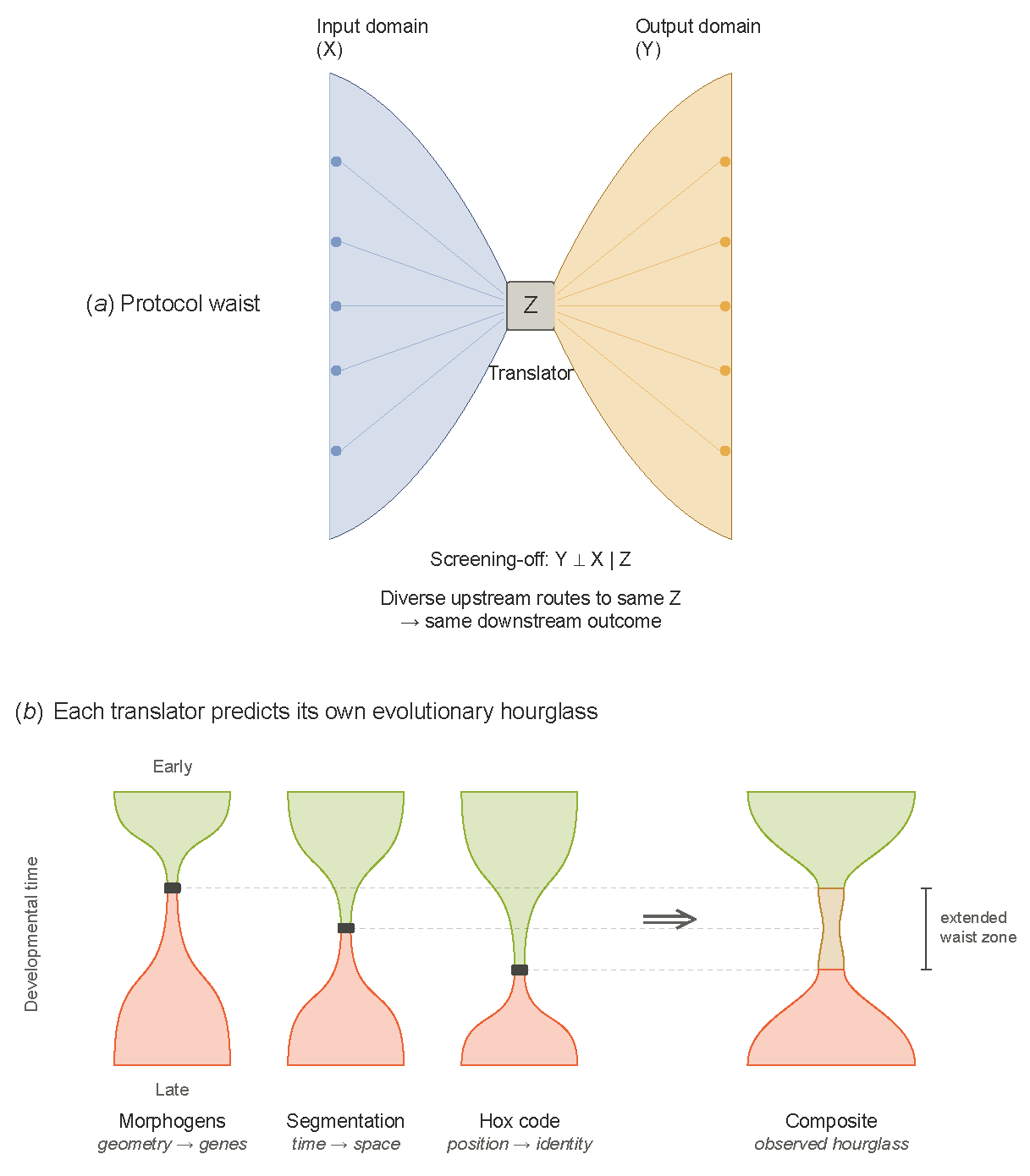
Figure 2.
Development as a layered protocol stack. The vertebrate body axis is patterned by a cascade of domain translators (gray), each reading one kind of information (blue) and writing another (orange). Morphogen gradients translate embryo geometry into gene-expression fields. The segmentation clock translates temporal oscillations into spatial segments. The Hox code translates positional and temporal history into regional identities along the axis. Notch/Delta lateral inhibition (green) is a reusable local translator that can plug into any layer, refining cell spacing and sharpening boundaries. Each translator provides a narrow interface between otherwise incompatible representations. The cascade forms a layered protocol stack analogous to the architecture of robust engineered systems.
Figure 2.
Development as a layered protocol stack. The vertebrate body axis is patterned by a cascade of domain translators (gray), each reading one kind of information (blue) and writing another (orange). Morphogen gradients translate embryo geometry into gene-expression fields. The segmentation clock translates temporal oscillations into spatial segments. The Hox code translates positional and temporal history into regional identities along the axis. Notch/Delta lateral inhibition (green) is a reusable local translator that can plug into any layer, refining cell spacing and sharpening boundaries. Each translator provides a narrow interface between otherwise incompatible representations. The cascade forms a layered protocol stack analogous to the architecture of robust engineered systems.
Disclaimer/Publisher’s Note: The statements, opinions and data contained in all publications are solely those of the individual author(s) and contributor(s) and not of MDPI and/or the editor(s). MDPI and/or the editor(s) disclaim responsibility for any injury to people or property resulting from any ideas, methods, instructions or products referred to in the content. |
© 2026 by the authors. Licensee MDPI, Basel, Switzerland. This article is an open access article distributed under the terms and conditions of the Creative Commons Attribution (CC BY) license (http://creativecommons.org/licenses/by/4.0/).
Copyright: This open access article is published under a Creative Commons CC BY 4.0 license, which permit the free download, distribution, and reuse, provided that the author and preprint are cited in any reuse.


