
Submitted:
02 May 2026
Posted:
04 May 2026
You are already at the latest version
Abstract
Student design competitions connect higher education and professional practice, yet their educational value depends on whether evaluation is transparent, interpretable, and fair. In the context of sustainable design education, opaque and heterogeneous judging practices may weaken the link between competition participation, capability development, and long-term talent cultivation. To address this problem, this study develops a five-dimensional evaluation framework based on design evaluation theory and data-driven modelling. The framework is composed of innovation and creativity, artistic aesthetics, applied technology, work normativity, and practical promotion. A total of 202 award-winning entries from six national competitions in China were re-evaluated by six expert judges under a double-blind procedure, producing 1,212 valid scoring records. Regression modelling was used to identify event-specific weighting patterns and to examine how dimension scores relate to overall evaluation outcomes. The results show clear variation across competitions and experts, indicating that evaluation is not simply the direct application of stated criteria, but a practice shaped by competition-specific priorities and judgement patterns. The framework provides an evidence-based basis for improving transparency and fairness in competition governance and for supporting more sustainable design education through clearer and more actionable evaluation.
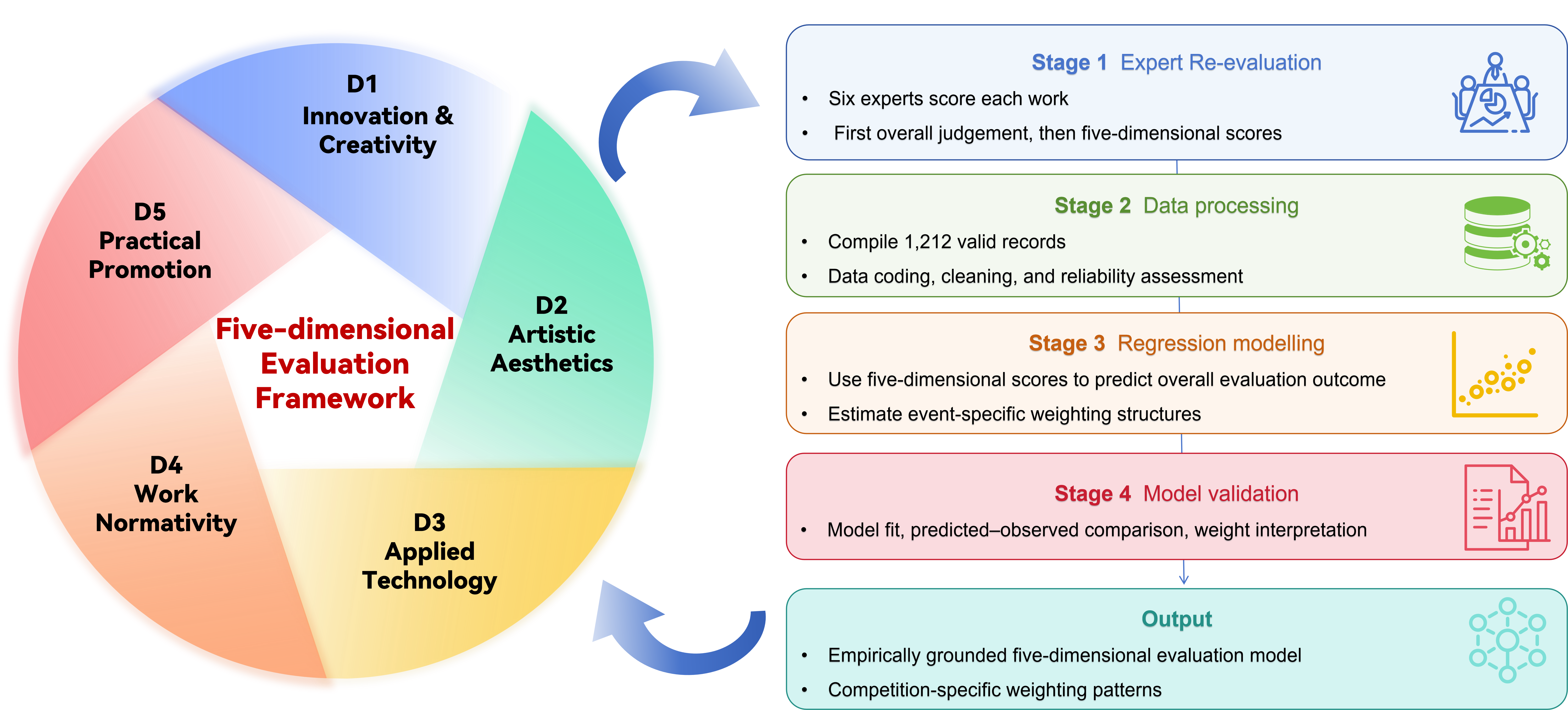
Keywords:
student design competitions
; sustainable design education
; evaluative transparency
; evaluation fairness
; competition governance
; data-driven modelling
1. Introduction
Design education has long served as a bridge between artistic creativity and applied communication. Within higher education, advertising design is not only a professional field but also a pedagogical and cultural practice through which students develop creative inquiry, social awareness, and interdisciplinary collaboration [1,2,3]. Student design competitions extend this function by providing relatively authentic contexts in which learners interpret briefs, articulate ideas, and respond to professional expectations of visual communication [4]. In this sense, competitions are not merely extracurricular showcases; they are also evaluative spaces in which design capability is recognised, rewarded, and translated into educational value. Their educational significance therefore depends not only on participation itself, but also on whether evaluation is transparent, fair, and aligned with long-term capability development.
In China, over the past 20 years, competition-based design education has evolved into a large and highly structured national ecosystem spanning advertising design, digital media, visual communication, interactive innovation, and public-service communication [5,6]. Flagship events such as the National College Student Advertising Art Competition attract very large numbers of submissions and involve a substantial proportion of higher education institutions offering design-related programmes [7]. Many competitions are aligned with broader educational and policy aspirations, including digital transformation, rural revitalisation, sustainable development and cultural renewal [8,9,10]. Given their scale, diversity, and institutional influence, such competitions have become increasingly important in shaping students’ learning trajectories, institutional teaching priorities, and forms of professional preparation [11,12]. This makes the Chinese competition landscape a particularly useful context for examining how student design work is evaluated and how evaluation practices shape the educational value of competition participation.
However, the educational value of competition participation depends partly on how creative work is judged. Creativity assessment in design is inherently challenging because student work is multidimensional, context-sensitive, and only partly reducible to explicit scoring criteria. Unlike assessments centred on standardised problem solving, the evaluation of design outcomes usually involves simultaneous judgements about originality, aesthetic coherence, technical feasibility, communicative effectiveness, and contextual appropriateness [13,14,15]. Existing studies therefore suggest that the assessment of design work is rarely a purely objective or mechanical process; rather, it is shaped by disciplinary conventions, perceptual salience, tacit knowledge, and the situated judgement practices that characterise art and design assessment [13,16,17,18]. This means that the evaluation of student design work cannot be understood simply as the application of fixed criteria, but must also be approached as an interpretive practice in which quality is judged through comparison, professional experience, and context-sensitive judgement [18,19,20].
These challenges become more significant in competition-based learning environments, where formal criteria do not always translate directly or consistently into actual judging practice. Research in higher education assessment has shown that evaluative standards are frequently interpreted rather than simply applied, and that pre-set criteria do not remove indeterminacy from grading practice [19,20,21]. This issue is especially salient in student design competitions, because the same criterion may be understood differently across events or applied differently by different judges [17,18]. In the Chinese competition context, these problems are further intensified by limited procedural transparency. In some cases, organisers do not explicitly specify the relative weighting of criteria; in others, even when indicative proportions are available, judges may still interpret them differently across events. When competition outcomes are communicated only as overall scores or prize levels rather than as dimension-specific feedback, students may find it difficult to translate evaluation results into targeted learning and improvement [22,23]. In large, multi-category systems such as those in China, fragmented criteria, inconsistent operationalisation, and divergent interpretations of creativity, aesthetic quality, and feasibility can therefore weaken transparency, reduce fairness, and limit the formative value of competition feedback for long-term capability development [16,24]. From the perspective of sustainable design education, this raises a significant governance question: whether student competitions function as transparent and development-oriented learning environments, or whether they operate primarily as opaque ranking mechanisms.
Although these issues are increasingly recognised, existing research has mainly relied on qualitative reflection, conceptual discussion, or relatively small-scale case studies[25]. Comparatively little work has systematically examined how evaluative emphases vary across different competitions or how judges allocate value to core dimensions of student design work under comparable conditions. Meanwhile, although data-driven approaches are increasingly used in design ideation, educational assessment, and creative evaluation, their application to competition-based design evaluation remains limited [26,27,28]. As a result, there is still a lack of empirically validated and theoretically grounded analytical frameworks capable of capturing both the explicit criteria and the implicit judgement logics that shape evaluation across diverse competition contexts.
To address this gap, the present study develops and validates a five-dimensional evaluation framework for student design competitions, integrating perspectives from innovation and creativity, artistic aesthetics, applied technology, work normativity, and practical promotion. Using expert re-evaluation data from six major national competitions in China, the study employs regression-based modelling to identify competition-specific weighting patterns and to examine the extent to which these five dimensions explain overall judging outcomes. Rather than treating competition assessment as the uniform application of official rubrics, this study analyses it as a differentiated evaluative practice shaped by event-specific emphases and judging logics. By making these differences more visible and analytically comparable, the proposed framework aims to enhance transparency and fairness in competition governance, while offering implications for sustainable design education and more coherent talent development in higher education.
2. Conceptual Foundations and Competition Criteria Mapping
To support the analytical framework adopted in this study, student design competition evaluation is organised into five dimensions: innovation and creativity, artistic aesthetics, applied technology, work normativity, and practical promotion. This framework did not emerge solely from abstract theorisation. Rather, it was developed through more than a decade of teaching and competition-related judging experience. These dimensions were distilled from recurrent concerns in scholarship on design cognition, aesthetic judgement, technological mediation, design constraints, and human-centred applicability. The purpose of this section is therefore not to derive the dimensions anew, but to clarify their theoretical grounding and conceptual relevance for subsequent mapping and modelling.
2.1. Theoretical Foundations of the Five Dimensions
2.1.1. Innovation and Creativity
Innovation and creativity form a foundational dimension of design evaluation because student work is expected not only to respond to a brief, but also to generate meaningful alternatives through reframing, synthesis, and value creation. Design innovation theory provides a foundational perspective for understanding creativity as a structured yet exploratory process [29]. Classical models such as Lawson’s problem–solution oscillation [13] and Cross’s designer ways of knowing [14] describe creativity as a dynamic interplay between divergent exploration and convergent refinement. From this perspective, creativity in student design competitions should not be understood simply as visual novelty, but as the ability to propose original and meaningful responses grounded in a coherent problem–solution rationale. Design-driven innovation adds a cultural and semantic dimension, framing creativity as the generation of new meanings rather than purely functional novelty [30]. Accordingly, innovation and creativity in this study refers to the originality of ideas, the conceptual strength of the design response, and the extent to which a work proposes meaningful alternatives to existing forms.
2.1.2. Artistic Aesthetics
Artistic aesthetics is a second core dimension because design outcomes are communicated not only through ideas, but also through their visual and expressive organisation. Aesthetic judgement forms a central pillar of design evaluation. Eisner’s arts-based cognition theory conceptualises aesthetic understanding as a form of intelligence that operates through perception, composition, and expressivity [2]. Empirical research further demonstrates that aesthetic literacy enhances emotional engagement and communicative clarity [31,32], while stylistic cohesion and visual readability remain essential to effective design communication. In competition settings, aesthetic quality signals not only visual appeal, but also the designer’s capacity to organise information, establish expressive coherence, and communicate purpose effectively. Artistic aesthetics therefore encompasses composition, stylistic unity, expressive intentionality, and the clarity with which visual decisions support communication.
2.1.3. Applied Technology
Applied technology is included because contemporary design practice is increasingly shaped by technological tools, production processes, and digital workflows. Contemporary design practice is increasingly shaped by technological mediation, from digital fabrication and animation to computational design and AI-augmented workflows. Theories of technological creativity describe how innovation emerges through tool-mediated experimentation, material exploration and iterative prototyping [33,34]. Recent research on AI-supported ideation [32,35] and human–computer co-creation [36] highlights the growing importance of technical fluency in shaping design outcomes. In this study, applied technology refers to the accuracy, sophistication, and appropriateness with which technical tools, platforms, or materials are used in student work.
2.1.4. Work Normativity
Work normativity captures the structured and rule-governed aspect of design evaluation. Design operates within a structured interplay of constraints, including technological limitations, communicative requirements and ethical or cultural considerations. Rather than restricting creativity, constraints often support coherence and clarity, enabling designers to focus conceptual exploration [37]. Contemporary research in systems-oriented design [38] and organisational evaluation [39] reinforces the role of structure and standards in supporting fair and interpretable outcomes. In competition contexts, this dimension refers to adherence to relevant professional and ethical standards, clarity of communication, format compliance, and the disciplined presentation of design intent.
2.1.5. Practical Promotion
Practical promotion reflects the context-oriented and application-related side of design evaluation. Design outcomes are ultimately purposive actions oriented towards human contexts. Theories of human-centred design [40] and recent frameworks for practical innovation [41,42] emphasise usability, contextual fit, and implementation feasibility. Evidence from innovation tournaments further indicates that feasibility and applicability often exert a stronger influence on expert judgement than novelty alone [43]. Accordingly, practical promotion refers to the extent to which student work addresses real needs, engages relevant users or stakeholders, and demonstrates potential for implementation or wider application.
Taken together, these five dimensions reflect the cognitive, aesthetic, technological, normative, and practical aspects of student design work, as shown in Figure 1. The figure further demonstrates that each primary dimension can be specified through three secondary indicators, thereby forming a hierarchical evaluative structure. This layered framework is intended to connect broad conceptual dimensions with more operational aspects of judgement. The dimensions and sub-dimensions are not mutually exclusive criteria, but analytically distinguishable components of a holistic evaluative structure. This conceptual grounding provides the basis for the criteria mapping and regression modelling presented in the following sections.
2.2. Mapping Competition Criteria onto the Five-Dimensional Framework
To examine whether the proposed framework matches existing competition practices, the stated evaluation criteria of six major national student design competitions in China were systematically mapped onto the five-dimensional structure developed in this study. This step serves two functions. First, it tests whether the framework is sufficiently comprehensive to accommodate the criteria used across competitions with different disciplinary orientations. Second, it establishes a common analytical basis for subsequent modelling by translating heterogeneous evaluative language into a comparable dimensional structure. Table 1 presents a condensed comparison of the original criteria for each competition (Events A–F) and their corresponding mappings to the five-dimensional framework.
The six competitions selected for analysis cover advertising design, digital media, visual communication, interactive innovation, and applied technology, and together provide a broad cross-section of current competition-based design education in China. Although the wording of criteria varies across events, the underlying evaluative concerns are highly comparable. Terms such as originality, creativity, and conceptual expression map onto innovation and creativity; criteria related to visual expression, aesthetics, and communicative impact map onto artistic aesthetics; references to technical feasibility, code quality, model optimisation, or production quality map onto applied technology; requirements concerning standardisation, compliance, and presentational clarity map onto work normativity; and criteria addressing application scenarios, practicality, or dissemination potential map onto practical promotion.
Across all events, the key evaluative elements can be accommodated within the five-dimensional framework, indicating an underlying conceptual commonality despite differences in terminology and emphasis. The main distinction lies not in whether a dimension is present, but in how strongly it is foregrounded. Creativity and aesthetics are especially prominent in some competitions, whereas technical feasibility and implementation-oriented criteria are more strongly emphasised in others. Certain competitions adopt a relatively balanced distribution across dimensions, while others display more specialised evaluative profiles. This means that student design competitions do not differ because they assess entirely different forms of quality, but because they assign different levels of importance to shared dimensions.
Representative award-winning works from the six competitions are shown in Appendix A (Figure A1), which helps illustrate the diversity of design forms and competition contexts underlying the present analysis.
3. Data and Methods
This section operationalises the five-dimensional framework by constructing a comparable expert judgement dataset and estimating event-specific weighting structures. As shown in Figure 2, the analysis proceeded in four stages: expert re-evaluation, data processing and reliability assessment, regression modelling, and model validation.
3.1. Expert Re-Evaluation Procedure
A total of 202 award-winning entries from six major national student design competitions in China were selected for re-evaluation. Award-winning works were used because they had already passed the original selection procedures and therefore provided an appropriate basis for examining how recognised student work is valued across competitions. A panel of six expert judges was assembled from relevant professional and academic fields, including visual communication, digital media, brand strategy, and the creative industries. Their role was not to reproduce the original award decisions, but to generate a comparable judgement dataset under standardised conditions.
A double-blind protocol was adopted. All entries were anonymised and uploaded to a secure online platform, and their order was randomised. Judges received a calibration briefing on the operational definitions of the five dimensions but were not informed of the original awards or competition-specific criteria. They assigned scores only at the dimensional level, allowing composite evaluative tendencies to be inferred analytically. This procedure generated 1,212 valid scoring records.
3.2. Data Processing and Reliability Assessment
The five-dimensional scores provided by the expert panel were used as the main explanatory variables. The original competition award levels were converted into a standardised outcome score using three ordered reference points: first prize = 95, second prize = 85, and third prize = 75. This transformation provided a common outcome proxy for comparative weighting analysis across events. As illustrated in Figure 3, first-prize entries clustered strongly at the upper score range, while second prizes concentrated between 80–90 points with occasional anomalies. Third prizes showed wider dispersion, reflecting variability in underlying evaluative standards.
Discrepancy analysis shown in Figure 4a revealed that 14% of first-prize entries and 3% of second-prize entries would be downgraded, while 4% of second-prize entries and 10% of third-prize entries would be upgraded. Figure 4b further shows that 66.34% of the works presented zero discrepancies between original and re-evaluated levels, whereas 33.66% exhibited disagreement. Notably, 7.43% of works displayed deviations of three to four levels, indicating substantial inconsistency in original scoring.
Inter-rater reliability was assessed using intraclass correlation coefficients (ICC), as shown in Figure 5. For the aggregated five dimensions, ICC values ranged between 0.83 and 0.88, indicating high overall agreement. However, notable deviations emerged at the judge level: J5 exhibited significantly lower ICC (0.68) on D1 innovation & creativity, and J6 recorded the lowest ICC (0.83) for total score, reflecting both intra-individual and inter-individual variance in dimensional interpretation.
These results suggest that the dataset is sufficiently reliable for comparative modelling while still retaining meaningful interpretive variation.
3.3. Regression Modelling Strategy
To quantify evaluative tendencies, a set of event-specific linear models was constructed. The dependent variable (y) was defined as the composite evaluation score derived from standardised award levels (95/85/75), while the five-dimension scores served as independent variables (x₁–x₅). Then, the modelling framework is formulated as:
where ki denote the estimated weights, and b is the intercept.
Prior to modelling, all dimension scores were z-standardised to eliminate scale effects and ensure comparability across competitions. Coefficient constraints ensured 0.10 ≤ ki ≤ 0.30 to prevent any single dimension from dominating. Meanwhile, coefficients were constrained to sum to 1, producing interpretable weighting structures consistent with evaluative practice. Original data and Python codes are provided in Supplementary File.
3.3.1. Baseline Equal-Weight Model
An initial benchmark model allocated 0.20 to each dimension. Although this model produced moderately strong fits (R² = 0.721–0.878 across events), prediction accuracy fell below 90%. This suggests that equal weighting does not adequately capture observed judging tendencies.
3.3.2. Event-Specific Models
Ordinary least squares (OLS) regression was used to estimate empirical weighting patterns for each event. Each model outputs a set of coefficients representing the empirical weighting of the five dimensions, alongside a model intercept and R². The estimated coefficients for all events are summarised in Table 2.
Across the six competitions, the resulting parameter matrices revealed distinctive evaluative patterns. While applied technology (D3) receives the highest average weight across competitions, innovation & creativity (D1) is strongly weighted in events A and E. Work normativity (D4) is highly variation-prone, dominant in some events and minimal in others. All final models achieved R² = 0.855–0.896, all exceeding the equal-weight baseline model, demonstrating improved alignment with expert scoring behaviour.
3.4. Model Validation and Comparative Fit
The predictive validity of the regression models was examined by applying the fitted parameters to the expert scoring dataset. As illustrated in Figure 6, all six models demonstrated strong alignment between predicted and expert-derived composite scores. Events A and E exhibited the highest predictive accuracy, reflecting their relatively larger sample sizes and more stable judging tendencies. Accuracy for events B, C, D, and F was slightly lower—primarily due to smaller sample sizes and the more heterogeneous weighting structures observed in these competitions—yet all remained above 85%. Residuals displayed no systematic bias, indicating stability across score ranges. Predicted award levels were compared against both original competition awards and re-evaluation awards. Agreement rates consistently exceeded 95%, demonstrating that the model can reliably reproduce expert judgement patterns while reducing subjective noise.
4. Results and Discussion
4.1. Event-Specific Weighting Patterns as Evaluative Cultures
The regression results in Figure 7 reveal clear differences in how the six competitions prioritise the five evaluative dimensions. These differences are meaningful because they indicate that variation across competitions does not arise from the presence or absence of entirely different criteria, but from the relative importance assigned to a shared evaluative structure. Competitions such as Events A and C place stronger emphasis on innovation and aesthetic articulation, whereas Event E gives greater priority to applied technology. Other events adopt more balanced distributions across dimensions. This pattern suggests that student design competitions can be compared within a common analytical framework while still preserving their disciplinary and positional differences.
More importantly, the divergence between stated criteria and empirically inferred weights should not be reduced to simple inconsistency, because formal criteria provide only part of the evaluative structure, while actual judgement remains shaped by interpretation, tacit comparison, and discipline-specific assessment practice [17,18,19]. In this sense, the model makes visible the tacit weighting tendencies that underlie expert assessment. This is particularly evident in the uneven treatment of work normativity and practical promotion. Although both dimensions are educationally important, they do not receive stable emphasis across events. The findings therefore support the view that competition evaluation is not merely a technical application of formal criteria, but a differentiated evaluative practice shaped by event-specific emphases and judgement logics. This interpretation is central to the argument of the paper: transparency and fairness in student design competitions therefore depend not only on whether criteria are listed, but also on whether their practical weighting and use in judgement can be made interpretable to both assessors and students.
4.2. Transparency, Fairness, and Sustainable Design Education
The significance of these weighting differences lies not only in the existence of variation itself, but in what such variation means for the educational function of competitions. In many student design competitions, the relative weighting of criteria is not made fully explicit. Even where organisers provide indicative criteria, judges may still interpret them differently across events, and outcomes are often communicated only as overall scores or prize levels rather than as dimension-specific feedback. Under such conditions, neither the evaluative basis of judgement nor the relative importance of different dimensions is sufficiently visible. This weakens transparency because students cannot clearly identify what has been valued, and it weakens fairness because evaluative priorities may operate implicitly rather than in an interpretable form.
These conditions also affect the formative value of competition participation. If students receive only overall outcomes without dimensional explanation, competition participation may function more as a ranking process than as a developmental learning environment, because effective feedback requires learners to understand and use evaluative information in order to regulate future performance [22,23]. This issue is particularly important in the context of sustainable design education. If competitions are expected to support long-term capability development, evaluation should help students understand the structure of design quality, recognise where their work is strong or weak, and develop the evaluative judgement needed to connect competition performance with broader disciplinary competence [44]. The current findings therefore suggest that transparency and fairness are not peripheral procedural concerns, but conditions that shape whether competition evaluation can retain its formative educational purpose.
A further implication concerns the content of what is being valued. The instability of work normativity across competitions indicates that baseline expectations regarding presentation standards, communicative discipline, and procedural clarity are not always sufficiently shared. Likewise, the relatively limited emphasis placed on practical promotion in several events suggests that contextual fit, implementation potential, and user relevance may not always receive recognition proportional to their educational importance. These patterns do not imply that all competitions should become identical, but they do show that unequal visibility of evaluative priorities may shape how students understand design quality itself. In other words, weighting structures influence not only competition outcomes, but also the kinds of design capability that students learn to prioritise.
4.3. Governance and Pedagogical Applications
If the problem is one of limited weighting transparency and insufficiently interpretable feedback, then the practical value of the framework lies in making evaluation more explicit, comparable, and actionable. For organisers, the five-dimensional structure provides a basis for clarifying the relative emphasis of different criteria and for checking whether stated rules are aligned with enacted evaluation. Competitions do not need to adopt identical priorities, but they can improve transparency by communicating those priorities more explicitly. In this sense, the framework supports competition governance not through rigid standardisation, but through clearer articulation of evaluative intent.
For educators, the framework offers a more interpretable bridge between competition participation and curriculum design. Because the five dimensions can be distinguished analytically, they can be translated into teaching objectives, assessment rubrics, and training activities at both course and programme levels. This helps avoid two common risks: treating competitions as isolated extracurricular activities or allowing a small number of competition types to define educational priorities by default. Instead, the framework can be used to distinguish between competition-specific strategies and broader capabilities that should be cultivated across design education more generally.
For students, the framework is most valuable when used to convert opaque competition outcomes into diagnosable feedback. If performance can be communicated through dimension-level profiles rather than only through overall ranking or prize category, students can better identify strengths, weaknesses, and areas for improvement, while also developing the feedback literacy needed to act on evaluative information [23,45,46]. Such feedback is especially important in design education, where learning depends on iteration, reflection, and progressive refinement. Used in this way, the framework helps restore the educational purpose of student design competitions: not merely to sort entries, but to support learning, self-correction, and more coherent long-term capability development.
An additional indication of the framework’s practical value emerged when the analytical results were informally shared with participating experts and a small number of students. Some experts expressed surprise at the extent of scoring variation across judges, while also recognising that the averaged patterns remained broadly consistent with their overall sense of how the competitions operated. This suggests that the framework can reveal differences in individual judgement without losing sight of shared evaluative tendencies. Students, by contrast, responded positively to the idea of dimension-specific scoring and explicit weighting structures, noting that such information made evaluation outcomes easier to understand and directions for future improvement clearer. These responses are noteworthy because they indicate that transparency at the dimensional level may enhance not only the interpretability of competition results, but also their formative value for learning. At the same time, these observations remain preliminary and point to the need for future research involving larger samples, more competition types, and more systematic feedback collection.
5. Conclusions
This study develops and validates a five-dimensional evaluation framework for student design competitions in China, comprising innovation and creativity, artistic aesthetics, applied technology, work normativity, and practical promotion. Drawing on expert re-evaluation and data-driven modelling across six major competitions, the study shows that these five dimensions provide a coherent structure for interpreting both stated criteria and the implicit weighting patterns that shape judging outcomes in practice. The findings indicate that student design competitions share a common evaluative structure but differ substantially in how strongly each dimension is prioritised. Competition evaluation should therefore be understood not as the uniform application of formal criteria, but as a differentiated evaluative practice shaped by event-specific emphases and judgement logics.
The value of the framework lies in making evaluative priorities more visible, comparable, and interpretable. For organisers, it offers a basis for clarifying criterion weights and improving the alignment between stated rules and enacted judgement. For educators, it provides a structured reference for linking competition participation with curriculum design, capability development, and more transparent feedback practices. For students, it helps turn opaque competition outcomes into more understandable and actionable information, making it easier to identify strengths, weaknesses, and future directions for improvement. In this way, the framework supports not only fairer and more transparent competition governance, but also a more sustainable form of design education in which competition participation contributes to long-term learning rather than mere ranking.
The findings should nevertheless be interpreted with caution. As the study is based on a limited number of representative competitions, it should be regarded as an initial modelling attempt rather than a comprehensive account of student design competition evaluation. Its broader significance lies in providing a foundation for future large-scale data analysis and machine-learning modelling across more diverse competitions and samples, thereby better supporting transparent evaluation, actionable feedback, and sustainable design education.
Supplementary Materials
The following supporting information can be downloaded at the website of this paper posted on Preprints.org, File S1: Structured Dataset for Competition Re-scoring; File S2: Modelling Code.
Author Contributions
Conceptualization, K.H.; methodology, Y.Y.; software, Q.Z.; validation, Q.Z.; formal analysis, K.H. and Y.Y.; investigation, Y.Y.; data curation, K.H.; writing—original draft preparation, Y.Y.; writing—review and editing, K.H.; visualization, Q.Z.; supervision, K.H.; project administration, K.H.; funding acquisition, K.H. All authors have read and agreed to the published version of the manuscript.
Funding
This research was funded by the Liaoning Provincial Department of Education, Graduate Education Teaching Reform Research Project, Grant No. LNYJG2024068.
Institutional Review Board Statement
Ethical review and approval were waived for this study because the research was anonymous and did not monitor sensitive data. The approval of the Commission for Ethics in Research was not required for its implementation. There was no risk for research participants.
Informed Consent Statement
Informed consent was obtained from all subjects involved in the study.
Data Availability Statement
Not available.
Acknowledgments
The authors would like to thank six anonymous experts for their constructive feedback, which greatly contributed to the refinement of the evaluation framework. We also acknowledge the authors of award-winning works whose submissions provided essential materials for this study.
Conflicts of Interest
The authors declare no conflicts of interest.
Appendix A
Figure A1 presents representative award-winning works from the six competitions included in this study. The examples show clear differences in visual style, thematic orientation, and design output, ranging from public-service communication and cultural representation to IP development and conceptual visual expression. This diversity helps illustrate that student design competitions do not reward a single uniform design type. Rather, they produce heterogeneous works that can still be analysed within a shared five-dimensional evaluation framework. The figure therefore serves as a visual supplement to the criteria mapping and modelling reported in the main text.
Figure A1.
Representative award-winning works from the six student design competitions analysed in this study.
Figure A1.
Representative award-winning works from the six student design competitions analysed in this study.

References
- Findeli, A. Rethinking design education for the 21st century: Theoretical, methodological, and ethical discussion. Des. Issues 2001, 17, 5–17. [Google Scholar] [CrossRef]
- Eisner, E.W. The arts and the creation of mind; Yale University Press: New Haven, 2002. [Google Scholar]
- Dyer, G. Advertising as communication; Routledge: London, 2008. [Google Scholar]
- Bovill, C. Co-creation in learning and teaching: The case for student–staff partnership. Teach. High. Educ. 2020, 25, 843–854. [Google Scholar]
- Jia, Y. Practice and exploration of “Competitive Teaching Method” in the teaching of advertising design and production in colleges and universities. In Proceedings of the 2020 6th International Conference on Social Science and Higher Education, 2020; pp. 963–966. [Google Scholar]
- Zhang, M. Exploring the integration of teaching practice and innovation-entrepreneurship competitions in art and design education under the “Internet Plus” perspective. Des. Art. Stud. 2025, 1, 4. [Google Scholar] [CrossRef]
- Liu, C.; Husain, A.B. The impact of design competitions on the skill development and employability of Chinese graphic design students. Eurasian J. Educ. Res. (EJER) 2024, 113, 277. [Google Scholar]
- Yu, W.; Jiang, T. Research on the direction of innovation and entrepreneurship education reform within the digital media art design major in the digital economy. Front. Psychol. 2021, 12, 719754. [Google Scholar] [CrossRef]
- Zhuang, T.; Liu, B. Sustaining higher education quality by building an educational innovation ecosystem in China—policies, implementations and effects. Sustainability 2022, 14, 7568. [Google Scholar] [CrossRef]
- Wang, Y.H.; Ajovalasit, M. Involving cultural sensitivity in the design process: a design toolkit for Chinese cultural products. Int. J. Art. Des. Educ. 2020, 39, 565–584. [Google Scholar] [CrossRef]
- Li, S.; Zhang, Y.; Wang, Z.; Li, H. The influence of national policies on the evolution of industrial design education in China. Heliyon 2023, 9, 17504. [Google Scholar] [CrossRef]
- Keane, M. Creative industries in China: Art, design and media; John Wiley & Sons: Hoboken, 2013. [Google Scholar]
- Lawson, B. How designers think: The design process demystified; Routledge: London, 2005. [Google Scholar]
- Cross, N. Design thinking: Understanding how designers think and work; Berg: Oxford, 2011. [Google Scholar]
- Nikander, J.B.; Liikkanen, L.A.; Laakso, M. The preference effect in design concept evaluation. Des. Stud. 2014, 35, 473–499. [Google Scholar] [CrossRef]
- Zhu, C.; Buckley, J.; Klapwijk, R.; Spandaw, J.; de Vries, M.J. A holistic look at creativity: evaluating pupils’ creative design ideation and prototypes through comparative judgment. Int. J. Technol. Des. Educ. 2025, 35, 1–28. [Google Scholar] [CrossRef]
- Orr, S. We kind of try to merge our own experience with the objectivity of the criteria: The role of connoisseurship and tacit practice in undergraduate fine art assessment. Art. Des. Commun. High. Educ. 2010, 9, 5–19. [Google Scholar] [CrossRef]
- Orr, S.; Bloxham, S. Making judgements about students making work: Lecturers’ assessment practices in art and design. Arts Humanit. High. Educ. 2013, 12, 234–253. [Google Scholar] [CrossRef]
- Sadler, D.R. Indeterminacy in the use of preset criteria for assessment and grading. Assess. Eval. High. Educ. 2009, 34, 159–179. [Google Scholar] [CrossRef]
- Sadler, D.R. Interpretations of criteria--based assessment and grading in higher education. Assess. Eval. High. Educ. 2005, 30, 175–194. [Google Scholar] [CrossRef]
- Bloxham, S.; Den-Outer, B.; Hudson, J.; Price, M. Let’s stop the pretence of consistent marking: exploring the multiple limitations of assessment criteria. Assess. Eval. High. Educ. 2016, 41, 466–481. [Google Scholar] [CrossRef]
- Nicol, D.J.; Macfarlane--Dick, D. Formative assessment and self--regulated learning: A model and seven principles of good feedback practice. Stud. High. Educ. 2006, 31, 199–218. [Google Scholar] [CrossRef]
- Carless, D.; Boud, D. The development of student feedback literacy: Enabling uptake of feedback. Assess. Eval. High. Educ. 2018, 43, 1315–1325. [Google Scholar] [CrossRef]
- Ulkhaq, M.M.; Pramono, S.N.; Adyatama, A. Assessing the tendency of judging bias in student competition: a data mining approach. J. Appl. Res. High. Educ. 2023, 15, 1198–1211. [Google Scholar] [CrossRef]
- Qiao, S.; Li, L.X.; Chen, D. Teachers’ data-driven decision-making: developing and validating a measurement scale. Educ. Res. 2025, 67, 286. [Google Scholar] [CrossRef]
- Chen, L.; Wang, P.; Dong, H.; Shi, F.; Han, J.; Guo, Y.; Childs, P.R.; Xiao, J.; Wu, C. An artificial intelligence based data-driven approach for design ideation. J. Vis. Commun. Image Represent. 2019, 61, 10–22. [Google Scholar] [CrossRef]
- Jiang, S.; Hu, J.; Wood, K.L.; Luo, J. Data-driven design-by-analogy: state-of-the-art and future directions. J. Mech. Des. 2022, 144, 020801. [Google Scholar] [CrossRef]
- Lin, L.; Zhou, D.; Wang, J.; Wang, Y. A systematic review of big data driven education evaluation. Sage Open 2024, 14, 1–18. [Google Scholar] [CrossRef]
- Dorst, K. The core of ‘design thinking’and its application. Des. Stud. 2011, 32, 521–532. [Google Scholar] [CrossRef]
- Verganti, R. Design-driven innovation: Changing the rules of competition by radically innovating what things mean; Harvard Business Press: Boston, 2009. [Google Scholar]
- Rossi, E.; Attaianese, E. Research synergies between sustainability and human-centered design: a systematic literature review. Sustainability 2023, 15, 12884. [Google Scholar] [CrossRef]
- Leão, C.P.; Silva, V.; Costa, S. Exploring the intersection of ergonomics, design thinking, and AI/ML in design innovation. Appl. Syst. Innov. 2024, 7, 65. [Google Scholar] [CrossRef]
- Mumford, M.D.; Hester, K.S.; Robledo, I. Creativity in organizations: importance and approaches. Creat. Innov. Manag. 2010, 19, 308–319. [Google Scholar]
- Candy, L.; Edmonds, E. Practice-based research in the creative arts: Foundations and futures. Leonardo 2018, 51, 63–69. [Google Scholar] [CrossRef]
- Polster, L.; Bilgram, V.; Görtz, S. AI-augmented design thinking: potentials, challenges, and mitigation strategies of integrating artificial intelligence in human-centered innovation processes. IEEE Eng. Manag. Rev. 2025, 53, 193–214. [Google Scholar] [CrossRef]
- Demirel, H.O.; Goldstein, M.H.; Li, X.; Sha, Z. Human-centered generative design framework: An early design framework to support concept creation and evaluation. Int. J. Hum. –Comput. Interact. 2024, 40, 933–944. [Google Scholar] [CrossRef]
- Stokes, P.D. Creativity from constraints: The psychology of breakthrough. Creat. Res. J. 2005, 17, 153–165. [Google Scholar]
- Pyatkin, M. Integrating design thinking and systems thinking for entrepreneurial innovation: a holistic approach. EU Business School, Munich, 2024. [Google Scholar]
- Kühnel, K. The development of a future-orientated information technology. In The Agile Enterprise: digitalization as an opportunity for Agile transformation; Kühnel, K., Ed.; Springer Nature Switzerland: Cham, 2025; pp. 13–37. [Google Scholar]
- Norman, D.A. The design of everyday things; MIT Press: Cambridge, 2013. [Google Scholar]
- Ahmadzai, P. Divergent and convergent thinking processes in smart cities: A systematic review of human-centered design practices. Cities 2025, 159, 105744. [Google Scholar] [CrossRef]
- Benoni, F.T.; Novoa, R.D. Enhancing business innovation: a review of the impact of design methods. J. Technol. Manag. Innov. 2023, 18, 104–123. [Google Scholar] [CrossRef]
- Wooten, J.O.; Ulrich, K.T. Idea generation and the role of feedback: Evidence from field experiments with innovation tournaments. Prod. Oper. Manag. 2012, 21, 713–731. [Google Scholar]
- Tai, J.; Ajjawi, R.; Boud, D.; Dawson, P.; Panadero, E. Developing evaluative judgement: enabling students to make decisions about the quality of work. High. Educ. 2018, 76, 467–481. [Google Scholar] [CrossRef]
- Little, T.; Dawson, P.; Boud, D.; Tai, J. Can students’ feedback literacy be improved? A scoping review of interventions. Assess. Eval. High. Educ. 2024, 49, 39–52. [Google Scholar] [CrossRef]
- Nicol, D.; McCallum, S. Making internal feedback explicit: Exploiting the multiple comparisons that occur during peer review. Assess. Eval. High. Educ. 2022, 47, 424–443. [Google Scholar] [CrossRef]
Figure 1.
A five-dimensional framework for evaluating design competitions.
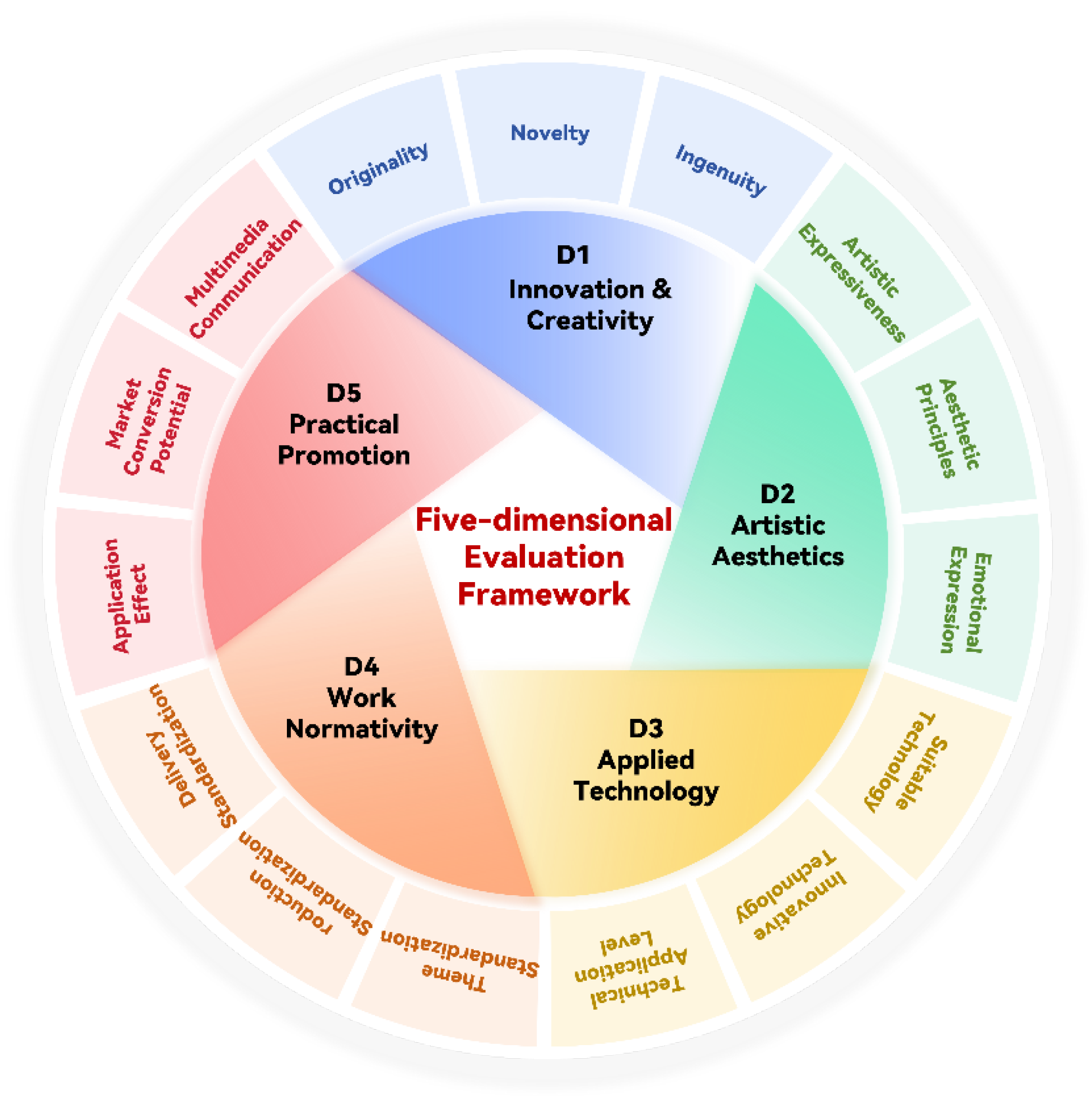
Figure 2.
Analytical workflow of the five-dimensional evaluation framework.
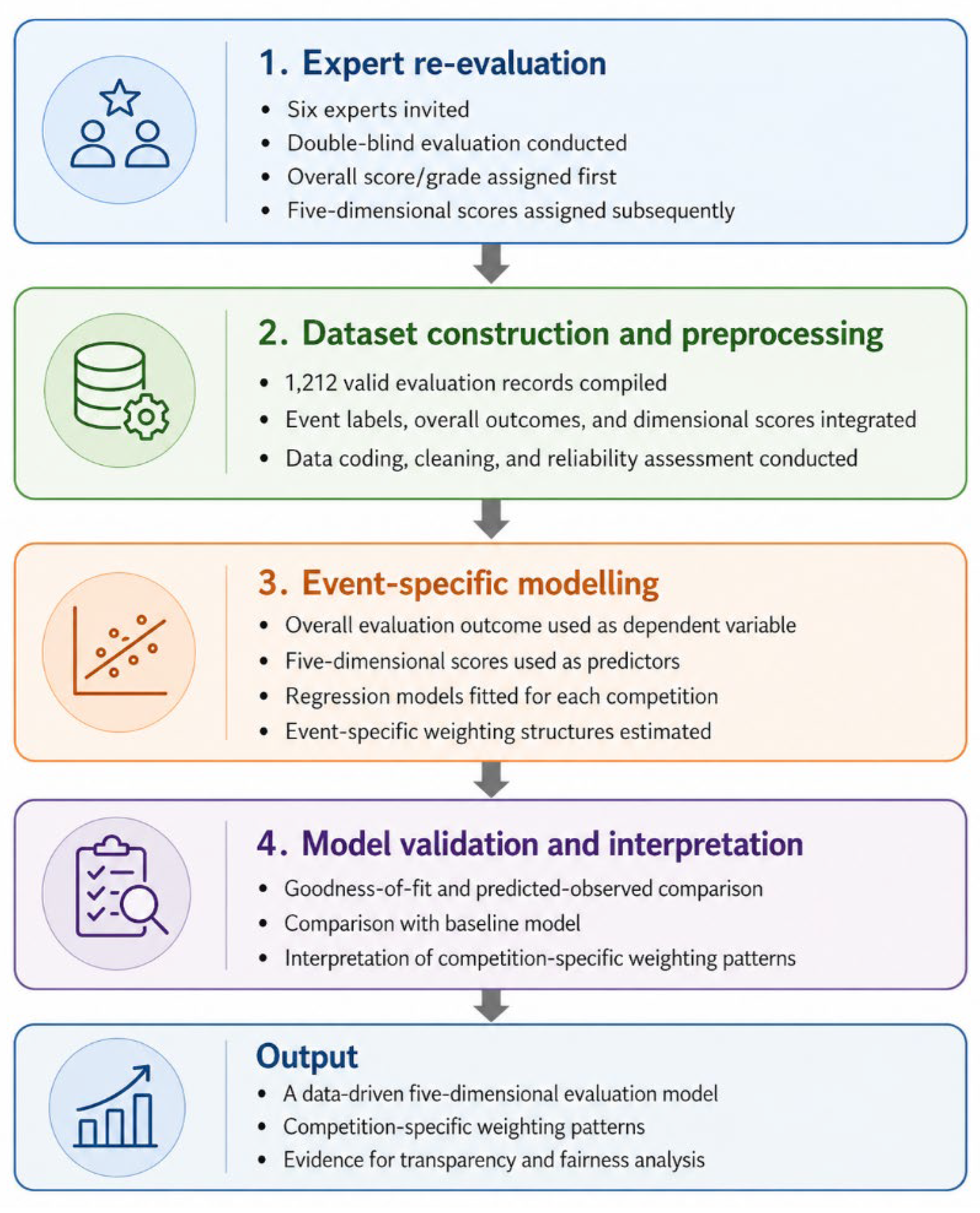
Figure 3.
Re-evaluation scores and grades of six events: (a) Score distribution and (b) Grade distribution of all works.
Figure 3.
Re-evaluation scores and grades of six events: (a) Score distribution and (b) Grade distribution of all works.
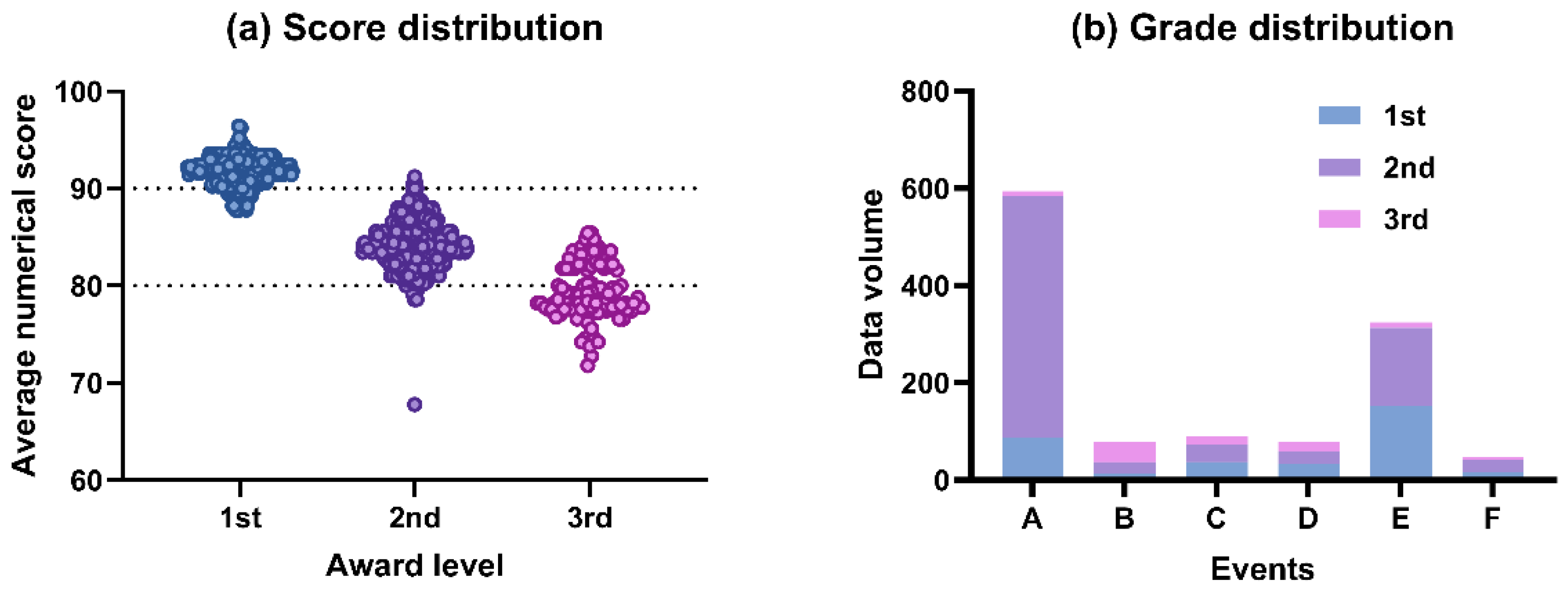
Figure 4.
Grade deviations between original and re-evaluation: (a) Grade deviation and (b) Grade inconsistency after re-evaluation.
Figure 4.
Grade deviations between original and re-evaluation: (a) Grade deviation and (b) Grade inconsistency after re-evaluation.
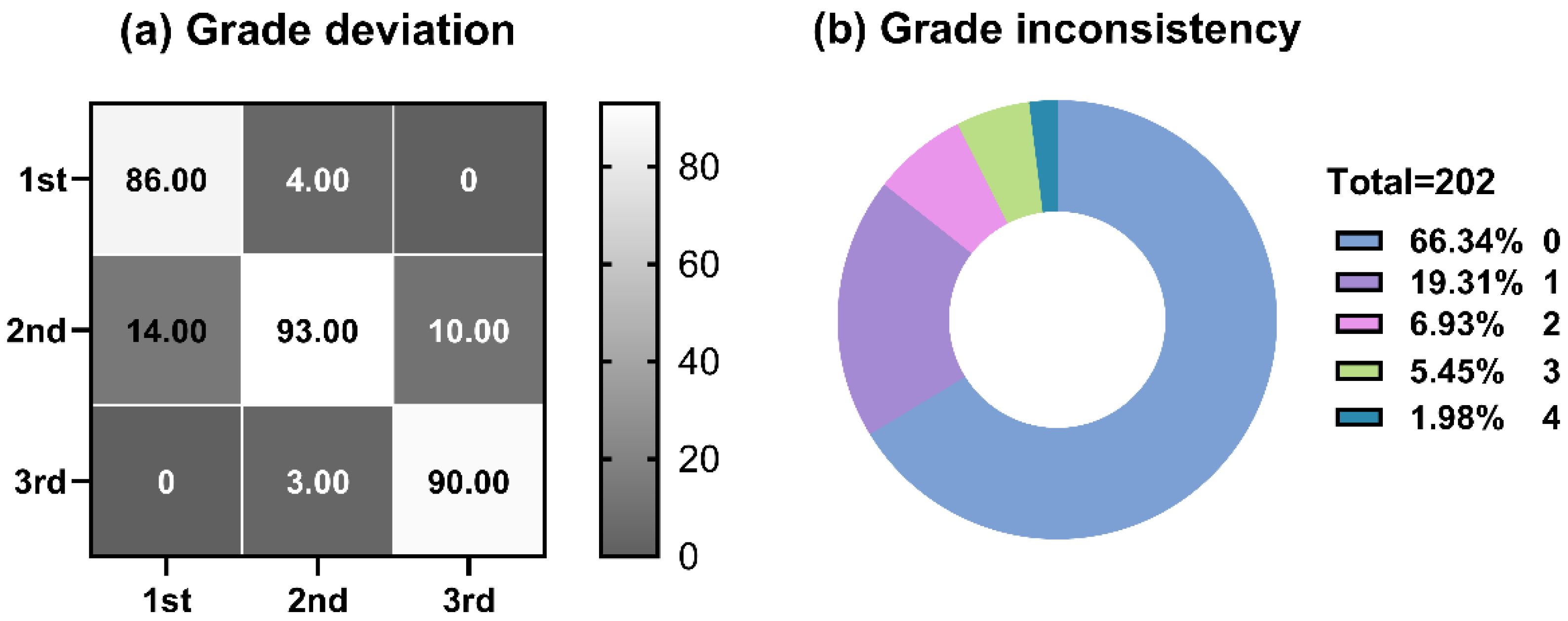
Figure 5.
Intraclass correlation coefficients of six judges.
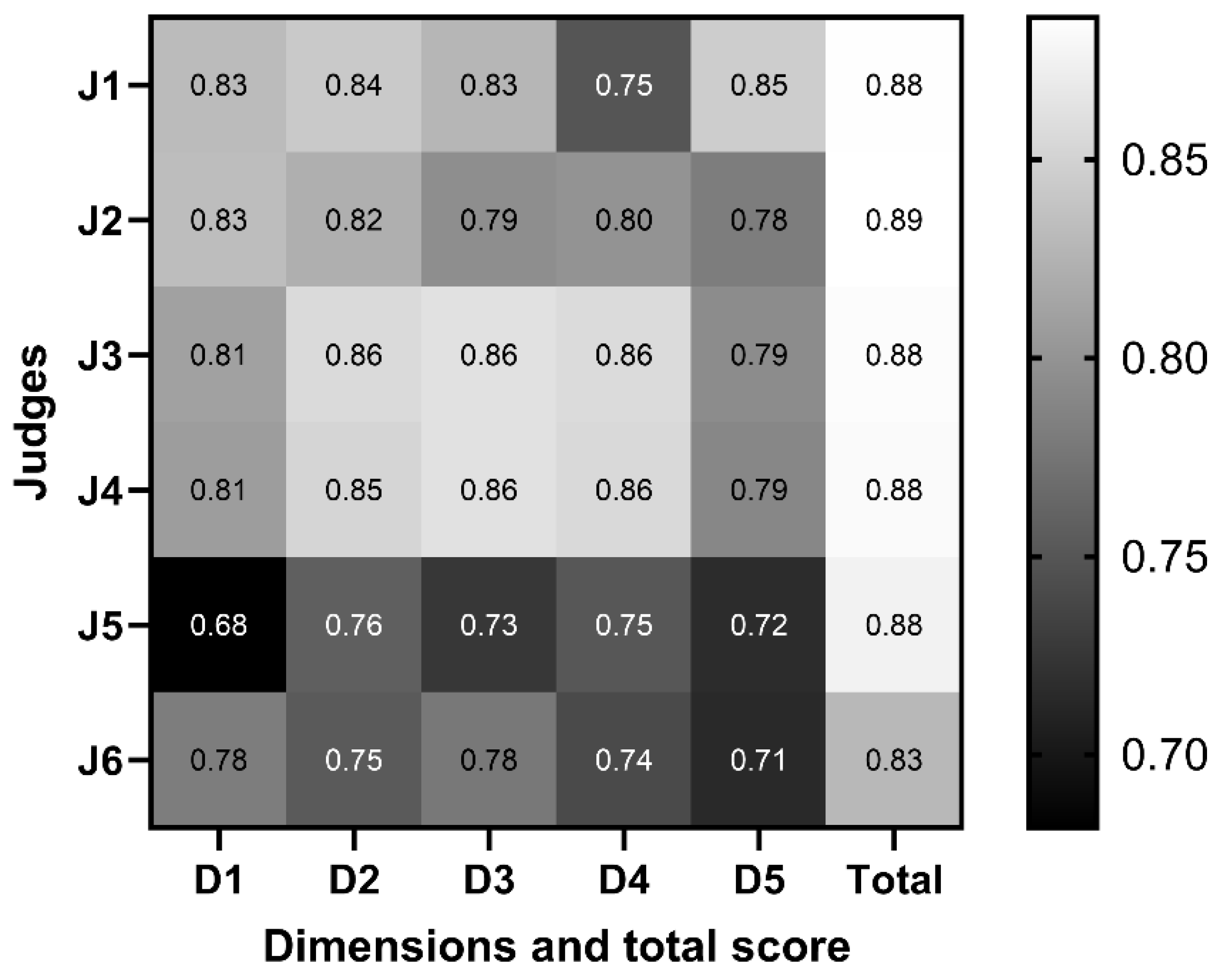
Figure 6.
Predicted versus observed composite scores.
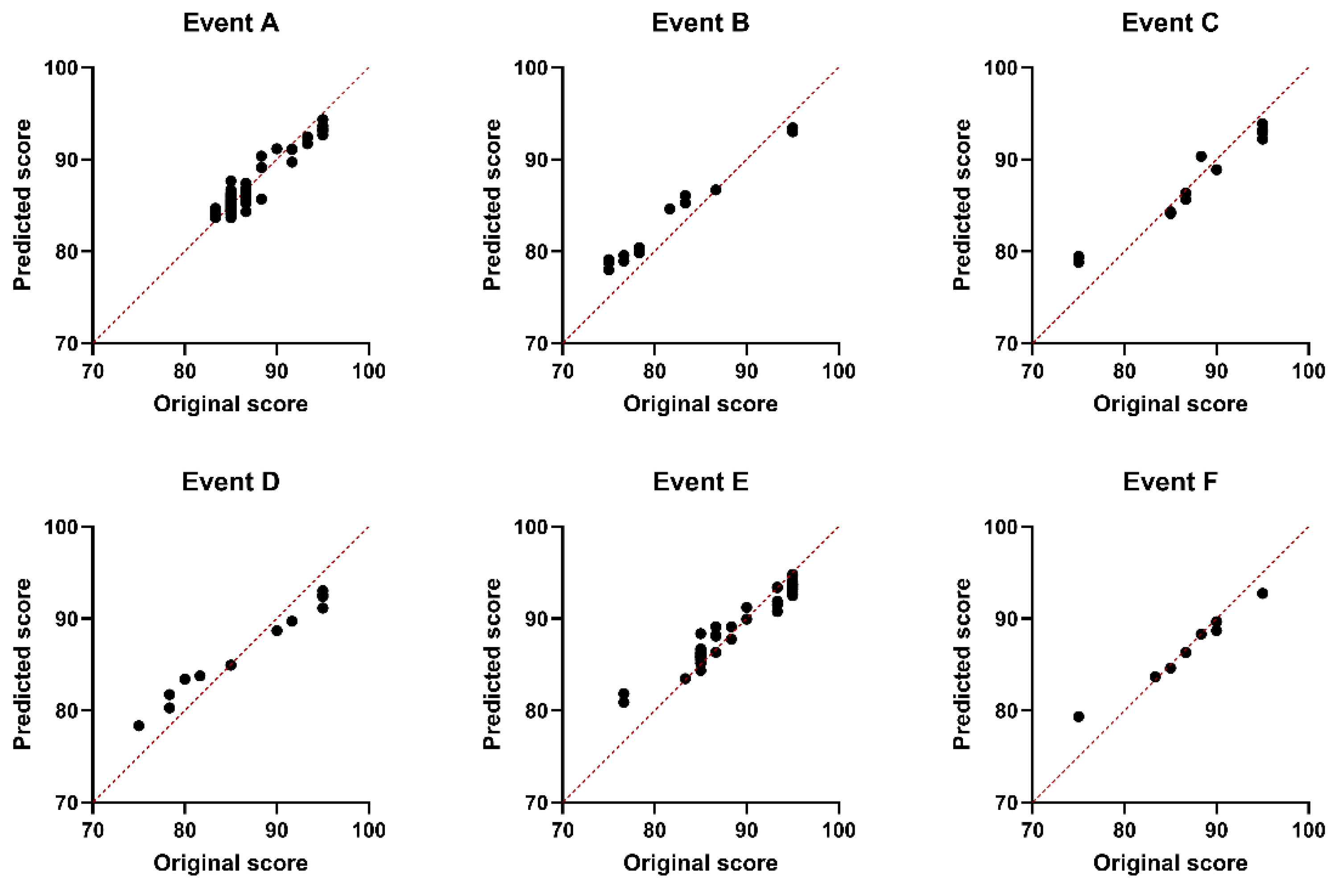
Figure 7.
Radar chart for weight comparison of the six different events.
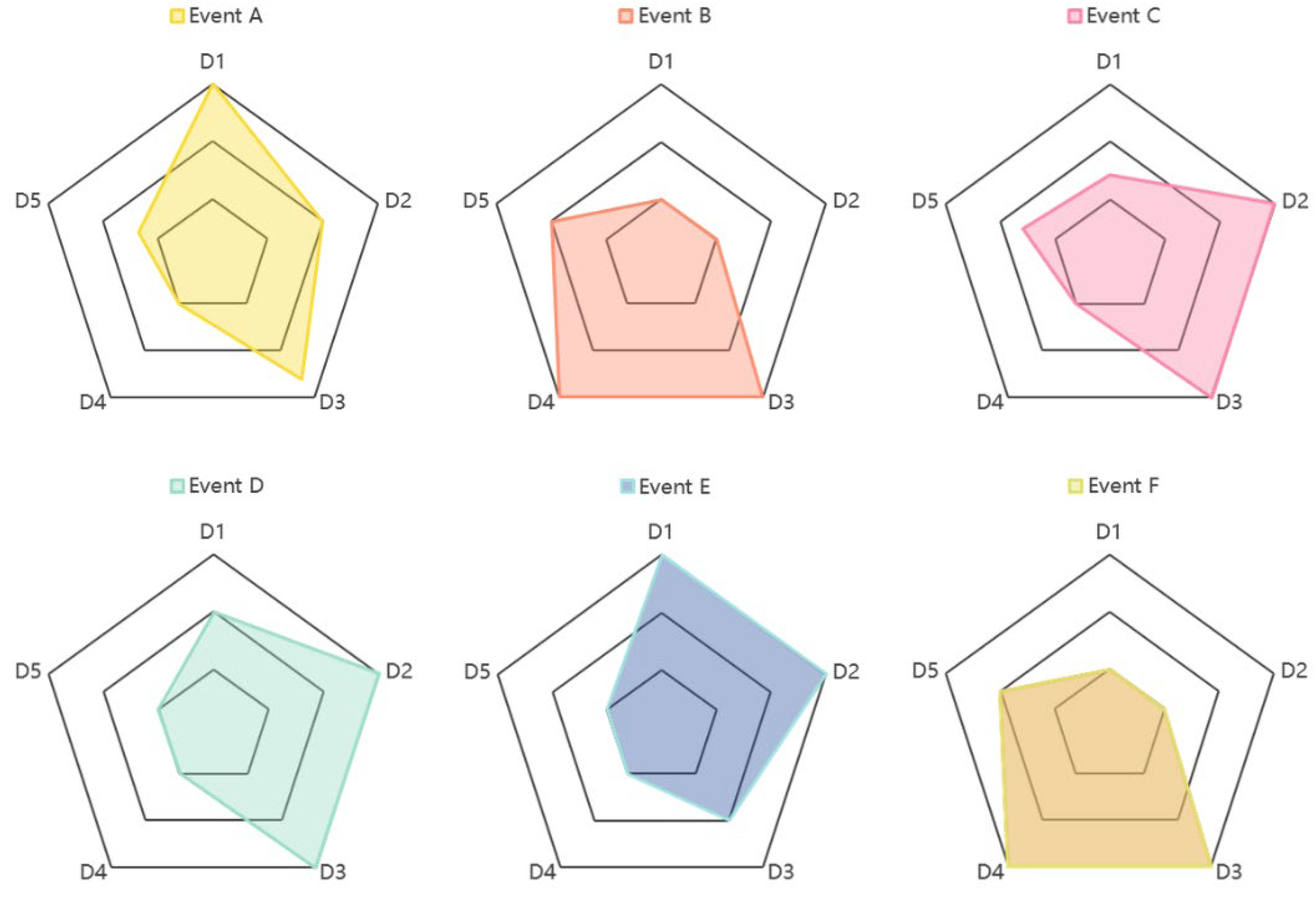

Table 1.
Mapping the evaluation criteria of six student design competitions in China onto the five-dimensional framework.
Table 1.
Mapping the evaluation criteria of six student design competitions in China onto the five-dimensional framework.
| Event | Competition name | D1 | D2 | D3 | D4 | D5 |
| A | National College Students Advertising Art Competition | Creativity; originality | Recognition | Technical feasibility | — | Promotion |
| B | Huacan Award | Creativity (30%) |
Expressive aesthetics (30%) | Technical feasibility (10%) | Normativity (20%) |
Practicality (10%) |
| C | Milan Design Week – China Exhibition | Creativity (30%) | Aesthetics (30%) | Technicality (30%) | Normativity (10%) | — |
| D | Future Designer Competition | Creativity (30%) | Aesthetics (30%) | Production quality (30%) | Normativity (10%) | — |
| E | China Good Ideas Competition | Originality (40%) |
Value concept (30%) | Model optimality (5%) |
Visual effect (10%) |
Promotion rate (15%) |
| F | China Collegiate Computer Design Competition | Creativity | Feasibility | Technical breakthroughs; code quality | — | Application scenarios |
Table 2.
Model parameters and fit goodness.
| Event | k1 | k2 | k3 | k4 | k5 | b | R2 |
| A | 0.30 | 0.20 | 0.26 | 0.10 | 0.14 | 1.47 | 0.895 |
| B | 0.10 | 0.10 | 0.30 | 0.30 | 0.20 | 0.00 | 0.855 |
| C | 0.14 | 0.30 | 0.30 | 0.10 | 0.16 | 0.20 | 0.894 |
| D | 0.20 | 0.30 | 0.30 | 0.10 | 0.10 | 0.06 | 0.880 |
| E | 0.30 | 0.30 | 0.20 | 0.10 | 0.10 | 1.40 | 0.896 |
| F | 0.10 | 0.10 | 0.30 | 0.30 | 0.20 | 0.30 | 0.893 |
| Average | 0.19 | 0.22 | 0.28 | 0.17 | 0.15 | 0.19 |
Disclaimer/Publisher’s Note: The statements, opinions and data contained in all publications are solely those of the individual author(s) and contributor(s) and not of MDPI and/or the editor(s). MDPI and/or the editor(s) disclaim responsibility for any injury to people or property resulting from any ideas, methods, instructions or products referred to in the content. |
© 2026 by the authors. Licensee MDPI, Basel, Switzerland. This article is an open access article distributed under the terms and conditions of the Creative Commons Attribution (CC BY) license (http://creativecommons.org/licenses/by/4.0/).
Copyright: This open access article is published under a Creative Commons CC BY 4.0 license, which permit the free download, distribution, and reuse, provided that the author and preprint are cited in any reuse.


