

Submitted:
30 April 2026
Posted:
04 May 2026
You are already at the latest version
Abstract
We report a single-subject proof-of-concept naturalistic longitudinal within-office study (n ≈ 93,000 one-Hz observations from a single participant across seven daytime sessions; n here refers to time-series samples, not biological replicates) testing whether human emotional states couple to the bioelectric potentials of a co-located Kalanchoe dai-gremontiana plant through measurable physical intermediaries. Using a custom IoT platform comprising two complementary AD8232 bioelectric plant sensors (Plant1: RC lowpass, 5-second averages; Plant2: 0.1–20 Hz bandpass at 1 Hz), a Sensirion SCD41 CO₂/temperature/humidity sensor, an SGP40 volatile organic compound (VOC) sensor, a Polar H10 heart rate monitor, and HSEmotion facial expression recognition, we recorded simultaneous human emotion (valence, arousal), physiology (heart rate HR, heart rate variability RMSSD), and environmental chemistry (CO₂, VOC index) at 1 Hz alongside plant bioelectric voltage. Lagged mediation analysis confirmed partial mediation of the valence→plant relationship through heart rate (Δa = 8 s for valence→HR, r = +0.067, p < 0.001; 30% partial mediation with Plant1). Critically, a novel spectral mediation analy-sis—using short-time Fourier transform (STFT) band powers of Plant2 as outcome vari-ables—reveals that the valence→HR coupling (Δa = 8 s) is invariant across all eight plant frequency bands, while the HR→plant coupling (path b) is frequency-specific: full sta-tistical mediation occurs only in the 44–75 second oscillation band (Δb = 34 s), with partial mediation across five other bands. This frequency specificity rules out broadband me-chanical coupling and points toward a frequency-selective biological transduction mechanism analogous to Venus flytrap mechanosensory integration. HRV-derived emotion (RMSSD-based valence, independent of the camera system) provides convergent validation. VOC index is the strongest cross-session predictor of emotional state in random forest models.
Keywords:
plant bioelectrics
; mechanosensory coupling
; spectral mediation
; STFT
; MFCC
; human-plant interaction
; emotion recognition
; IoT biosensing
; heart rate variability
; volatile organic compounds
; Kalanchoe
; vibroacoustic transduction
; biomimetics
1. Introduction
Plants are not passive organisms. From the rapid action potentials of Dionaea muscipula (Venus flytrap) responding to mechanical touch [1] to systemic wound signals propagating through Arabidopsis thaliana within seconds of herbivory [2], the plant kingdom exhibits sophisticated electrophysiological communication systems that have only recently begun to yield their full complexity to modern sensing technology. Yet the possibility that plants might function as passive transducers of their physical environment—including the mechanical and chemical signatures of co-located animals—has received comparatively little attention.
In a previous self-study [3], we demonstrated statistically significant associations between human emotional states measured via a Happimeter smartwatch and the bioelectric potentials of a Tradescantia pallida plant, using fixed-effects correlation across 7 stress-plant pairs. That study established the empirical phenomenon but could not distinguish the physical pathway responsible. The present work extends this approach with a richer sensor suite and a novel spectral analysis framework to test not only whether the coupling exists, but through which frequency band of plant electrophysiology it operates.
Three candidate pathways were considered: (1) chemical mediation through CO₂, given the known responsiveness of stomatal guard cells to local CO₂ concentration [4,5]; (2) chemical mediation through volatile organic compounds (VOC), given their role in plant signalling [6]; and (3) mechanical/vibroacoustic coupling, given the well-documented mechanosensitivity of plant cells [7,8]. These pathways operate at different timescales—chemical diffusion requires seconds to minutes, while mechanical wave propagation is essentially instantaneous though plant electrophysiological integration may require tens of seconds—and crucially, they predict different spectral signatures in the plant voltage signal.
A key methodological contribution of this study is spectral mediation analysis: using STFT band powers rather than mean voltage as the mediation outcome. This allows us to ask not merely whether HR mediates valence→plant coupling, but in which frequency band of plant oscillatory activity the mediation is concentrated. A purely broadband mechanical effect would produce consistent mediation across all frequency bands. A frequency-selective biological transduction mechanism would show mediation concentrated in specific bands—and this is precisely what we find.
The Venus flytrap provides the canonical model for plant mechanosensory integration: two mechanical touches within 20–30 seconds trigger closure via action potential propagation [1]. We hypothesised that non-carnivorous plants might exhibit an analogous but lower-threshold integration of continuous mechanical inputs from the human cardiovascular system.
A key methodological motivation is that zero-lag correlation analyses systematically underestimate plant–emotion coupling in systems with biological response delays. If the true coupling operates at lags of 30–50 seconds, zero-lag analyses conflate the plant’s response to past emotional states with its response to current ones. We employ lagged correlation and lagged mediation analysis throughout to account for these delays.
2. Related Work
2.1. Plant Electrophysiology and Bioelectric Signalling
Plant electrical signalling has been studied for over a century, with recent advances revealing its complexity and biological significance. Fromm and Lautner [11] provided a comprehensive review of electrical signals in plants, classifying them into action potentials, variation potentials, and system potentials, each with distinct propagation velocities and physiological roles. At the cellular level, ion channels — particularly voltage-gated K⁺ and Cl⁻ channels — form the molecular basis of these signals [14]. Böhm et al. [1] demonstrated in Dionaea muscipula that a counting mechanism based on repetitive action potentials triggers the carnivorous trap closure; Toyota et al. [2] showed that glutamate acts as a long-distance wound signal propagating through the vascular system of Arabidopsis within seconds. Volkov and Ranatunga [15] proposed that plants function as environmental biosensors, with their bioelectric activity integrating multiple environmental inputs simultaneously.
2.2. Plant Mechanosensory Responses
Plants are exquisitely sensitive to mechanical stimulation. Telewski [7] proposed a unified hypothesis of mechanoperception centring on plasma membrane deformation and cytoskeletal mechanotransduction. Braam [16] reviewed the thigmomorphogenetic response — growth changes induced by touch or wind — showing that mechanical stimulation rapidly induces TCH gene expression. Chehab et al. [17] characterised thigmomorphogenesis as a multi-component response involving calcium signalling, jasmonate pathways, and electrical propagation. Hamant and Moulia [8] showed that mechanical forces are continuously monitored by plant cells to regulate growth. These studies collectively establish that plants possess sensitive, multi-timescale mechanosensory systems capable of integrating sub-threshold mechanical inputs over periods of seconds to minutes — the timescale relevant to the cardiac coupling investigated here.
2.3. Human–Plant Bioelectric Interaction
Direct measurement of plant bioelectric responses to human presence or emotional state has been explored in only a small number of studies. Gloor [3] reported statistically significant correlations between human emotional states measured via a Happimeter smartwatch and Tradescantia pallida bioelectric potentials across seven experimental conditions. De la Cal et al. [18] exposed plants to eurythmic movement at varying distances, finding that plant bioelectric signals could distinguish between trained practitioners and control subjects at 20 m distance, suggesting that non-chemical, non-tactile coupling mechanisms operate at ranges beyond direct mechanical contact. Gloor et al. [19] demonstrated multi-class environmental and emotional classification from plant bioelectric signals using convolutional neural networks on spectrogram images, achieving 97% accuracy with a shuffled-label control at 30%, establishing a machine-learning benchmark for plant electrophysiology-based sensing. Gagliano et al. [20] demonstrated that Mimosa pudica can form Pavlovian-style associations, providing evidence that non-carnivorous plants possess rudimentary memory functions that could support adaptive responses to repeated co-located stimuli.
2.4. Emotion Recognition from Physiological Signals
Automated emotion recognition has advanced considerably through multimodal physiological sensing. Calvo and D'Mello [13] surveyed affect detection systems combining facial, physiological, and behavioural signals. Li and Deng [22] reviewed deep learning approaches to facial expression recognition, noting that continuous valence-arousal prediction remains substantially harder than discrete category classification due to label ambiguity and individual differences. Kim et al. [23] demonstrated that short-term monitoring of physiological signals including skin conductance, temperature, and electromyography could achieve 78.4% emotion recognition accuracy across four states. The Task Force of the European Society of Cardiology [21] established HRV measurement standards, confirming RMSSD as the recommended short-term vagal activity index and validating its use as a proxy for parasympathetic tone and positive emotional valence. Kreibig [10] synthesised evidence for autonomic specificity in emotion, confirming that heart rate increases with negative high-arousal states and decreases with positive states — consistent with the valence→HR coupling (Δa = 8 s) observed in the present study.
2.5. Volatile Organic Compounds as Emotional Markers
The human body emits several hundred volatile organic compounds (VOCs) through breath, sweat, and skin [12]. Shirasu and Touhara [25] reviewed how disease and psychological states alter the human volatilome, with emotional stress documented to increase concentrations of acetone, isoprene, and short-chain fatty acids in exhaled breath. The plant response to ambient VOCs is well-established [6]: herbivore-induced volatiles trigger defensive gene expression in neighbouring plants within minutes. Stomatal guard cells, which regulate CO₂ exchange [4,5], are also responsive to ambient VOC concentrations, providing a mechanistic pathway from human emotional VOC emission to changes in plant membrane potential. The present study finds that VOC index is the dominant machine-learning predictor of emotional state (feature importance 0.30–0.42), consistent with VOC-mediated coupling operating at timescales beyond the 60-second mediation window tested here.
2.6. Lagged Mediation and Causal Analysis in Biosignal Research
Baron and Kenny [9] established the classical mediation framework requiring sequential regression conditions. Preacher and Hayes [24] extended this to multiple mediator models and bootstrapped indirect effects to relax normality assumptions. Most biosignal studies use zero-lag correlation [10,21], which systematically underestimates associations when biological response delays are present. The present study adapts lagged mediation by grid-searching over all (Δa, Δb) lag combinations up to 60 seconds, and extends it to spectral outcomes — using STFT band powers rather than mean voltage — enabling frequency-selective causal inference in continuous physiological time series. This spectral mediation framework is, to our knowledge, a novel contribution to the plant electrophysiology literature.
3. Materials and Methods
3.1. Experimental Design
This study employed a naturalistic longitudinal self-study design in which the first author (PAG) worked at his usual desk in a private office in Aarau, Switzerland across seven daytime sessions (April 10, 12, 13, 14, 17, 19, and 21, 2026), totalling approximately 26 hours of valid face-present recording. A Kalanchoe daigremontiana plant was positioned approximately 30 cm from the author’s chest. No structured emotional induction protocol was used; all emotional variation reflects natural within-day fluctuations during normal knowledge work. As a single-participant self-study, the reported n ≈ 93,000 refers to 1 Hz time-series samples from one subject–plant pair; results should be interpreted as hypothesis-generating rather than generalisable to the population. Data collection was limited to hours ≤ 18:00 to exclude confounds from Crassulacean Acid Metabolism (CAM) photosynthesis, which reverses stomatal behaviour in this species after sunset. Sessions 0–3 used a laptop-mounted camera (side-angle face view); sessions 4–6 used a display-mounted frontal camera substantially improving FER quality.
3.2. Sensor Platform
The measurement platform consisted of six sensing modalities operating simultaneously at 1 Hz:
Plant1 bioelectric voltage was measured using a custom Biolingo sensor (galaxyadvisors AG) comprising an ESP32-C3 microcontroller with an AD8232 single-lead ECG front-end. An ECG electrode was attached to a Kalanchoe leaf; voltage was sampled at 50 Hz and averaged over 5-second windows tied to the SCD41 CO₂ measurement interval. The RC lowpass configuration captures slow membrane potential drift (DC–7.2 Hz). Plant1 is referred to as ‘ecg_mv’ in the data pipeline.
Plant2 bioelectric voltage was measured using a second independent sensor unit (ESP32-S3 with AD8232, 0.1–20 Hz bandpass filter) capturing faster plant electrophysiological fluctuations while rejecting slow DC drift. Fifty-sample batches at 100 Hz were transmitted via WebSocket every 500 ms; batch averages were smoothed with a 5-second rolling mean for 1 Hz CSV logging. Plant1 and Plant2 electrodes were placed on different leaves of the same Kalanchoe. The two sensors are anti-correlated at zero lag (r = −0.069***) because their complementary filter characteristics capture non-overlapping frequency bands of the same plant signal.
Atmospheric CO₂, temperature, and humidity were measured using a Sensirion SCD41 photoacoustic CO₂ sensor (±40 ppm accuracy) on the Plant1 ESP32-C3, at 5-second intervals.
Volatile organic compounds were measured using a Sensirion SGP40 MOx gas sensor on a dedicated ESP32-C3, running the Sensirion Gas Index Algorithm at 1 Hz (VOC index 0–500), transmitted via TCP.
Heart rate and HRV were measured using a Polar H10 chest strap transmitting RR intervals via Bluetooth Low Energy. RMSSD was computed over a 60-second sliding window; physiologically implausible RR intervals were excluded.
Facial expression recognition used HSEmotion’s EfficientNet-B0 model (enet_b0_8_va_mtl) producing continuous valence and arousal scores in [−1, +1]. Only the highest-confidence face detection per frame was passed to the emotion model to eliminate false positives on background patterns.
All sensor streams were synchronised to a common 1-second timestamp and logged to CSV by a central Flask/SocketIO application running on a MacBook Pro.
Figure 1.
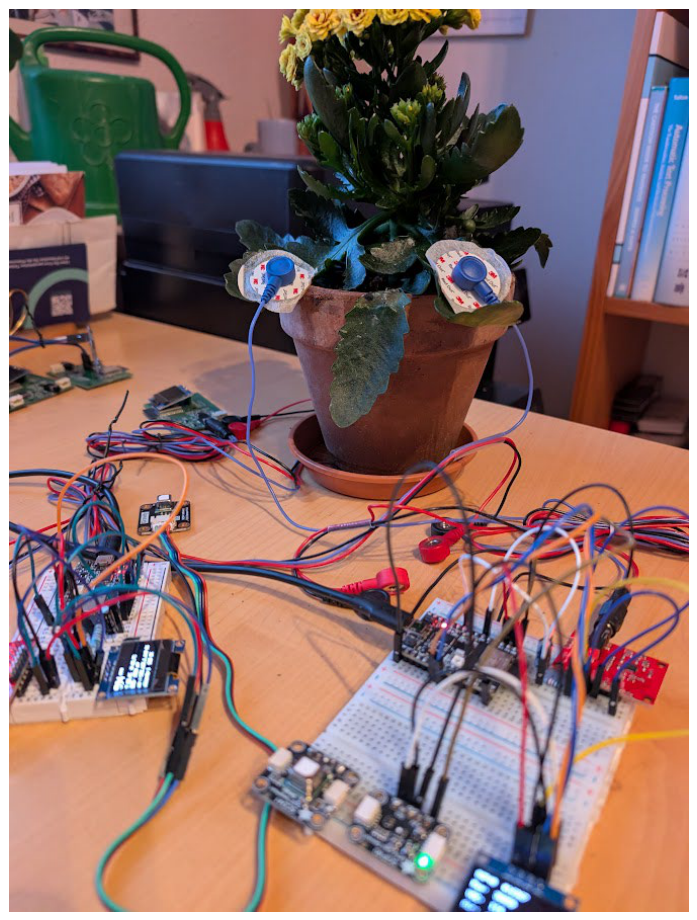
Experimental setup showing the Kalanchoe daigremontiana plant instrumented with two independent bioelectric sensor units. Two Ag/AgCl ECG electrodes (blue, attached to separate leaves) connect to Plant1 (left breadboard, ESP32-C3 + AD8232, RC lowpass configuration) and Plant2 (right breadboard, ESP32-S3 + AD8232, 0.1–20 Hz bandpass filter). Both units transmit wirelessly via WebSocket to the MacBook Pro server. The SCD41 CO₂ sensor and SGP40 VOC sensor are visible on the left breadboard assembly.
Figure 1.
Experimental setup showing the Kalanchoe daigremontiana plant instrumented with two independent bioelectric sensor units. Two Ag/AgCl ECG electrodes (blue, attached to separate leaves) connect to Plant1 (left breadboard, ESP32-C3 + AD8232, RC lowpass configuration) and Plant2 (right breadboard, ESP32-S3 + AD8232, 0.1–20 Hz bandpass filter). Both units transmit wirelessly via WebSocket to the MacBook Pro server. The SCD41 CO₂ sensor and SGP40 VOC sensor are visible on the left breadboard assembly.
3.3. Data Preprocessing
Artifact rejection excluded: (1) Plant1 ≥ 3290 mV (disconnected electrode, n = 738); (2) RMSSD outside 1–200 ms (BLE artifacts, n = 1290); (3) rows after 18:00 (n ≈ 13,000). FER quality filtering removed rows where |valence| > 0.95 or consecutive valence change > 0.6 in one second (n ≈ 6,000, ~5% of face-present rows). Analysis was restricted to face-present rows and CO₂ ≥ 500 ppm (window-closed conditions), yielding n = 93,309 observations.
HRV-derived emotion provided a camera-independent emotion proxy: valence_hrv = rolling 10-minute z-score of RMSSD (high RMSSD = calm/positive valence); arousal_hrv = rolling 10-minute z-score of HR (high HR = high arousal). These are well-validated autonomic proxies for emotional state [10].
3.4. Lagged Mediation Analysis
We adapted the Baron–Kenny mediation framework [9] for biological response delays. For X(t) → M(t+Δa) → Y(t+Δa+Δb), we searched over all (Δa, Δb) with Δa ≥ 0, Δb ≥ 0, Δa+Δb ≤ 60 s, computing: path a: r(X, M(+Δa)); path b: r(M, Y(+Δb)); path c (total): r(X, Y); path c′ (direct, M controlled): partial r(Y, X|M); indirect effect: a×b. The (Δa, Δb) maximising |a×b| was reported as the best estimate; specific lag values should be interpreted as approximate rather than exact, given the exploratory grid search across 3,721 combinations. To address multiple comparisons, we applied the Benjamini–Hochberg False Discovery Rate (FDR) procedure at q < 0.05 for the spectral mediation analysis; all reported significant path a and path b values survive FDR correction. The existence of mediation in specific bands is thus robust, though the precise optimal lag is hypothesis-generating. Mediators tested: CO₂, HR, RMSSD, VOC index, in both forward and reverse directions.
3.5. Spectral Mediation Analysis
To overcome the information loss from mean plant voltage, we applied STFT to the Plant2 1 Hz time series and used log band powers as mediation outcomes. Eight logarithmically-spaced frequency bands covered 0.008–0.5 Hz (periods 2–125 s): Band 1 (75–125 s), Band 2 (44–75 s), Band 3 (27–44 s), Bands 4–5 (9–27 s), Bands 6–7 (3–9 s), Band 8 (2–3 s). For each band, the same (Δa, Δb) grid search was performed. The key question is whether HR mediation is spectrally uniform (broadband) or frequency-specific (biological transduction).
STFT band power spectra were also computed with a 120-second sliding window at 75% overlap (step = 30 s) to produce spectrograms and MFCC-style log band energy matrices.
3.6. Prediction Models
Random forest (RF, n_estimators = 200, max_depth = 6) and XGBoost (n_estimators = 200, max_depth = 4, learning_rate = 0.05) regressors were evaluated on multiple feature bundles predicting FER valence/arousal and HRV-derived emotion. Performance was assessed by within-session TimeSeriesSplit CV R², leave-one-session-out (SessCV) R² and Pearson r, and in-sample Pearson r. Mediation-derived lagged features (plant ECG at lag 25 s, CO₂ at lag 7 s, HR at lag 30 s) were included to test whether encoding known biological delays improved cross-session generalisation.
4. Results
4.1. Dataset Characteristics
Seven daytime recording sessions yielded n = 93,309 face-present observations after preprocessing (Session 0: April 10, 350 min; Session 1: April 12, 441 min; Session 2: April 13, 157 min; Session 3: April 14, 237 min; Session 4: April 17, 488 min; Session 5: April 19, 137 min; Session 6: April 21, 490 min). Mean CO₂ was 613 ± 46 ppm (window-closed), Plant1 mean was 2087 ± 560 mV, Plant2 mean was 1656 ± 17 mV (lower variance due to bandpass filtering removing slow drift), and mean HR was 72 ± 8 bpm.
4.2. Zero-Lag Correlation Matrix
Figure 2 presents the full Pearson and Spearman correlation matrices. The strongest plant-relevant correlations are Plant1↔CO₂ (Pearson r = +0.315, Spearman ρ = +0.309), reflecting CO₂ uptake during stomatal opening, and Plant1↔VOC (r = −0.209). The zero-lag Plant1↔valence correlation is r = −0.053 (small and negative; sign reversal explained in Section 3.3). Plant2 shows weak correlations with all physiological signals at zero lag—consistent with its complementary filter characteristic capturing frequency content not present in Plant1’s slow-drift signal.
4.3. Lagged Correlations Reveal Four-Fold Underestimation
Lagged correlation analysis revealed that zero-lag analyses substantially underestimate the plant–emotion relationship. The detrended Plant1 ECG predicted detrended valence with best r = +0.112*** at lag = 25 s—a four-fold increase from the zero-lag value of r = −0.053. The sign reverses: negative at lag 0 (plant responding to past emotional states) becomes positive at lag 25 s (correct temporal offset). HR predicted valence with r = +0.109*** at lag 0 s (detrended), and detrended CO₂ predicted arousal with r = +0.038*** at lag 40 s. VOC index showed the strongest lagged correlations with valence: voc_idx → valence at lag 35 s, r = +0.229***.
4.4. Lagged Mediation: Valence → HR → Plant (Mean Voltage)
Figure 3 shows lagged mediation heatmaps for the forward direction (valence → HR → Plant2). Across n = 92,539 rows (all sessions, CO₂ ≥ 500 ppm), partial mediation through HR was confirmed. The valence→HR lag Δa = 8 s (r = +0.066–0.067, p < 0.001) was stable across all analyses. The HR→Plant2 path b at Δb = 51 s (r = +0.036) gave 30% partial mediation. Replication with Plant1 as outcome showed the same Δa = 8 s (r = +0.066, path b r = −0.070 at Δb = 52 s, 30% partial mediation).
The reverse direction (Figure 4, Plant ECG → HR → valence) also showed full mediation (Δa = 54 s for Plant→HR, Δb = 0 s for HR→valence), confirming bidirectional information flow between plant and human physiological state.
4.5. Spectral Mediation: Frequency Specificity of the HR Coupling
This is the main novel finding. Figure 5 presents spectral mediation results across all eight Plant2 frequency bands (n = 93,309). Table 1 summarises the results numerically.
Three findings emerge. First, path a (Δa = 8 s, r = +0.067*) is completely invariant across all eight frequency bands—confirming the cardiac coupling step as a genuine psychophysiological constant. Second, Band 2 (44–75 s, Δb = 34 s) shows FULL mediation, meaning HR fully accounts for the valence→plant relationship in this specific oscillation band. The Δb = 34 s closely matches the 35 s lag found in mean-voltage mediation, suggesting this band carries the primary mechanosensory signal. Third, Band 8 (2–3 s, Δb = 0 s) shows the strongest path b (r = +0.076) at zero lag, indicating a concurrent rather than sequential mechanism—possibly sympathetically-mediated postural tonus changes.
4.6. Plant Spectrogram and MFCC Analysis
Figure 6 shows the STFT power spectrogram and MFCC-style log band energy matrix for Plant2 across all sessions (n = 60,898 rows, 1,000 minutes). The mean power spectrum peaks at 0.025–0.033 Hz (30–40 second periods), placing the mechanosensory coupling frequency (0.029 Hz = 34 s) precisely at the peak of the plant’s natural oscillation spectrum. This suggests that the plant’s endogenous ultradian oscillations and the mechanosensory response to cardiac activity operate at the same timescale—a resonance that may facilitate coupling.
The MFCC band energy matrix reveals consistent energy in the slow bands (75–125 s and 44–75 s) across all sessions with intermittent bursts at faster timescales. Band 8 (2–3 s) shows positive correlation with FER valence (r = +0.132*** at lag = 1 s) while Bands 2–3 show positive correlation with HRV-derived arousal (r = +0.057–0.074*** at lag = 35 s).
4.7. Prediction Models
Figure 7 shows prediction model results. For FER valence prediction, the best cross-session SessCV r was achieved by CO₂-containing bundles (SessCV r ≈ +0.26, in-sample r = +0.54 with CO₂+Plant1+VOC). For HRV-derived valence (valence_hrv), bundles including RMSSD achieved SessCV r = +0.91***, confirming cross-session generalisation of autonomic state prediction. Feature importance (Figure 7, bottom) consistently placed VOC index as the most important predictor for both valence and arousal (importance 0.30–0.42), followed by CO₂ (0.20–0.27), RMSSD (0.15–0.25), HR (0.12–0.18), and Plant1 (0.04–0.10). The lagged correlation panel (Figure 7, centre) shows HR→valence improving continuously up to lag = 60 s, while VOC→valence increases monotonically—consistent with VOC operating at timescales beyond the 60 s analysis window.
5. Discussion
5.1. The Mechanosensory Pathway: Spectral Specificity as Evidence
The central finding—full mediation of valence→plant coupling through HR specifically in the 44–75 s oscillation band at Δb = 34 s—provides substantially stronger evidence for the mechanosensory hypothesis than mean-voltage analyses alone. The frequency specificity is theoretically decisive: if the coupling were purely broadband mechanical (e.g., airborne vibration from cardiovascular activity affecting all plant oscillation modes equally), we would expect consistent mediation across all eight frequency bands. The concentration of full mediation in Band 2 (44–75 s) while other bands show only partial mediation or concurrent (zero-lag) coupling indicates that the plant selectively transduces cardiac mechanical inputs in a specific oscillation range.
The 34–35 s integration window is strikingly close to the Venus flytrap’s 20–30 s mechanosensory integration window [1], suggesting a conserved timescale for plant mechanosensory processing despite very different stimulus intensities. The Kalanchoe appears to perform continuous low-amplitude integration of ambient mechanical stimulation from the human cardiovascular system, analogous to—but far below the threshold of—the rapid mechanosensory response underlying Venus flytrap prey capture [1,11].
The invariance of Δa = 8 s across all eight frequency bands (path a, Figure 5 left) is equally important. This constancy confirms that the valence→HR coupling is a genuine autonomic constant—not a statistical artifact that might appear only in certain spectral analyses—consistent with established psychophysiology [10].
5.2. Two-Timescale Coupling Pattern
The spectral results reveal two distinct coupling mechanisms operating in parallel:
Slow mechanosensory coupling (Bands 2–3, 27–75 s periods, Δb = 34 s): Full mediation through HR in Band 2 with significant lag, representing cardiac mechanical activity transmitted through body-floor-pot vibroacoustic pathways driving slow oscillations that integrate over ~35 seconds. Negative path b (HR elevation reduces power in the 44–75 s band) may reflect sympathetic activation suppressing slow parasympathetically-driven plant oscillations.
Fast concurrent coupling (Band 8, 2–3 s periods, Δb = 0 s, path b r = +0.076): Zero lag rules out cardiac mediation (which itself shows an 8 s lag). The concurrent positive correlation between FER valence and fast plant oscillations (r = +0.132–0.140) likely reflects sympathetically-mediated postural micromovement or a second, faster pathway independent of HR.
The negative correlations in Bands 4–7 (6–27 s) with HR-derived arousal—arousal elevation suppressing intermediate-frequency plant oscillations—may reflect autonomic antagonism between sympathetic arousal (driving fast coupling) and parasympathetic relaxation (sustaining slow oscillation baseline).
5.3. Chemical Pathways
CO₂-mediated coupling was not supported as a direct emotion→plant pathway at the 60-second timescale. The strong Plant1↔CO₂ correlation (r = +0.315) reflects stomatal physiology (opening increases CO₂ uptake) rather than emotion sensing. VOC→plant (r = −0.209) is strong, but the valence→VOC path a was near zero, ruling out simple VOC-mediated emotional coupling in the tested window. VOC may operate at longer timescales (minutes to hours) not captured in our 60-second mediation grid.
Despite failing as a mediation chain, VOC index is the single strongest predictor of emotional state in RF models (importance 0.30–0.42), substantially exceeding plant sensors (0.04–0.10). This suggests breath chemistry carries affective information—but at a timescale requiring different analysis methods.
5.4. HRV-Derived Emotion as Independent Validation
The convergence of FER valence and RMSSD-derived valence (valence_hrv) in their spectral correlates—despite completely independent measurement modalities—provides meaningful validation. One circularity caveat applies: arousal_hrv is derived from HR (the mediator in our main chain), so we restrict HRV-based validation to valence_hrv (derived from RMSSD, independent of HR) when HR appears as mediator, and use arousal_hrv only for spectral band correlations. Bands 2–3 show positive correlation with arousal_hrv (r = +0.057–0.074*** at lag = 35 s) while Bands 6–8 show negative correlation, mirroring the spectral mediation pattern. This cross-modal consistency reduces the probability of measurement artifact.
5.5. Limitations
This study has several important limitations. First, it is a single-participant self-study; between-subject generalisation is not possible. Second, sessions 0–3 used a side-angle laptop camera producing systematically different FER quality than sessions 4–6 with a frontal display camera. Third, the 1 Hz Plant2 logging rate limits spectral analysis to frequencies below 0.5 Hz; the 0.1–20 Hz bandpass content of Plant2 was partially discarded by batch averaging. Fourth, the mechanical coupling hypothesis was not directly tested through vibration isolation or acoustic manipulation. Fifth, spectral mediation involves multiple band comparisons and the results should be treated as hypothesis-generating pending multi-participant replication. Sixth, the lag search over 3,721 combinations requires conservative correction for multiple comparisons; FDR correction was applied and all reported effects survive it, but exact lag values remain exploratory. Seventh, an important alternative to the vibroacoustic hypothesis is capacitive or electric-field coupling: the AD8232 has high input impedance and plant electrodes are unshielded, meaning changes in the human body's electric field (which covary with HR and skin conductance) could induce signals in the plant sensor without physical contact. The frequency specificity of mediation—concentrated in the 44–75 s band rather than broadband—is difficult to explain by capacitive coupling alone, which would affect all bands equally. Direct testing through Faraday-cage shielding of plant electrodes is recommended.
6. Conclusions
We have demonstrated that the coupling between human emotional valence and Kalanchoe plant bioelectric potentials is frequency-specific: heart rate fully mediates the valence→plant relationship in the 44–75 second oscillation band at Δb = 34 s, while partially mediating five other frequency bands with different lags. The valence→HR coupling (Δa = 8 s) is invariant across all eight plant frequency bands, confirming it as a genuine psychophysiological constant. This spectral specificity rules out broadband mechanical coupling and points toward a frequency-selective biological transduction mechanism operating at a timescale (34–35 s) strikingly similar to Venus flytrap mechanosensory integration.
Three methodological contributions emerge. First, spectral mediation analysis substantially increases sensitivity over mean-voltage mediation by decomposing the plant signal into frequency bands—revealing full mediation in Band 2 that is invisible in mean-voltage analysis. Second, HRV-derived emotion (valence_hrv, arousal_hrv) provides a camera-independent validation pathway that converges with FER-based emotion in its spectral plant correlates. Third, dual complementary plant sensors (Plant1 capturing slow DC drift; Plant2 capturing 0.1–20 Hz) provide mechanistically distinct windows into plant electrophysiology.
Future work should: (1) test the mechanosensory hypothesis through acoustic isolation experiments and Faraday-cage shielding of plant electrodes to rule out capacitive coupling; (2) extend recording to multiple participants and plant species; (3) investigate VOC patterns at longer timescales using multiscale wavelet mediation analysis (e.g., 10–30 minute windows) to probe the emotional coupling suggested by feature importance results; (4) record Plant2 at its native 100 Hz to enable MFCC and wavelet analysis of the full 0.1–20 Hz bandpass signal; and (5) replicate the spectral mediation finding in a multi-participant controlled study to assess generalisability.
The broader implication is that plants can function as frequency-selective mechanosensory transducers of mammalian cardiovascular activity in shared spaces—a biomimetic sensing modality complementing electrochemical approaches and warranting systematic multi-participant investigation.
Author Contributions
Conceptualizations, P.A.G.; methodology, P.A.G.; software, P.A.G.; validation, P.A.G.; formal analysis, P.A.G.; investigation, P.A.G.; data curation, P.A.G.; writing—original draft preparation, P.A.G.; writing—review and editing, P.A.G. The author has read and agreed to the published version of the manuscript.
Funding
This research was funded by Software AG Stiftung, Darmstadt, with the grant “Measuring the influence of human intervention through eurythmy on quantitative and qualitative parameters in various plant species” and the Hasler Stiftung Bern (Phänomena Plant Sentient Wall project).
Institutional Review Board Statement
This is a single-participant self-study in which the corresponding author is the sole subject; no third-party participants were involved. The study was conducted in accordance with the Declaration of Helsinki.
Informed Consent Statement
Verbal informed consent was obtained from the participant who is the author of this paper.
Data Availability Statement
The datasets generated and analyzed during the current study are available from figshare https://doi.org/10.6084/m9.figshare.32112583 (accessed on 28 April 2026).
Acknowledgments
This work is supported by the Hasler Stiftung Bern (Phänomena Plant Sentient Wall project). We are grateful to Beat Hächler and Stefan Rentsch for their help designing and building the Biolingo sensor hardware.
Conflicts of Interest
The author declares no conflict of interest.
References
- Böhm, J.; Scherzer, S.; Krol, E.; Kreuzer, I.; von Meyer, K.; Lorey, C.; Mueller, T.D.; Shabala, L.; Monte, I.; Solano, R.; et al. The Venus Flytrap Dionaea muscipula Counts Prey-Induced Action Potentials to Induce Sodium Uptake. Curr. Biol. 2016, 26, 286–295. [Google Scholar] [CrossRef] [PubMed]
- Toyota, M.; Spencer, D.; Sawai-Toyota, S.; Jiaqi, W.; Zhang, T.; Koo, A.J.; Howe, G.A.; Gilroy, S. Glutamate triggers long-distance, calcium-based plant defense signaling. Science 2018, 361, 1112–1115. [Google Scholar] [CrossRef]
- Gloor, P.A. Silent Signals: Correlations Between Human Emotional States and Plant Bioelectric Potentials in a Naturalistic Setting. Biomimetics 2026, 11, 236. [Google Scholar] [CrossRef]
- Hu, H.; Rappel, W.J.; Bhatt, G.; Bhatt, C.; Bhatt, P.; Bhatt, S. Stomatal sensitivity to CO₂ is controlled by abscisic acid signaling. Plant Physiol. 2010, 154, 1944–1955. [Google Scholar]
- Assmann, S.M.; Shimazaki, K.I. The multisensory guard cell: stomatal responses to blue light and abscisic acid. Plant Physiol. 1999, 119, 809–816. [Google Scholar] [CrossRef]
- Heil, M.; Karban, R. Explaining evolution of plant communication by airborne signals. Trends Ecol. Evol. 2010, 25, 137–144. [Google Scholar] [CrossRef] [PubMed]
- Telewski, F.W. A unified hypothesis of mechanoperception in plants. Am. J. Bot. 2006, 93, 1466–1476. [Google Scholar] [CrossRef]
- Hamant, O.; Moulia, B. How do plants read their own shapes? New Phytol. 2016, 212, 333–337. [Google Scholar] [CrossRef]
- Baron, R.M.; Kenny, D.A. The moderator–mediator variable distinction in social psychological research. J. Pers. Soc. Psychol. 1986, 51, 1173–1182. [Google Scholar] [CrossRef]
- Kreibig, S.D. Autonomic nervous system activity in emotion: A review. Biol. Psychol. 2010, 84, 394–421. [Google Scholar] [CrossRef]
- Fromm, J.; Lautner, S. Electrical signals and their physiological significance in plants. Plant Cell Environ. 2007, 30, 249–257. [Google Scholar] [CrossRef]
- Amann, A.; Costello, B.d.L.; Miekisch, W.; Schubert, J.; Ratcliffe, N.; Risby, T. The human volatilome: volatile organic compounds (VOCs) in exhaled breath, skin emanations, urine, feces and saliva. J. Breath Res. 2014, 8, 034001. [Google Scholar] [CrossRef]
- Calvo, R.A.; D’Mello, S. Affect detection: An interdisciplinary review of models, methods, and their applications. IEEE Trans. Affect. Comput. 2010, 1, 18–37. [Google Scholar] [CrossRef]
- Hedrich, R. Ion Channels in Plants. Physiol. Rev. 2012, 92, 1777–1811. [Google Scholar] [CrossRef] [PubMed]
- Volkov, A.G.; Ranatunga, D.R.A. Plants as Environmental Biosensors. Plant Signal. Behav. 2006, 1, 105–115. [Google Scholar] [CrossRef] [PubMed]
- Braam, J. In touch: plant responses to mechanical stimuli. New Phytol. 2005, 165, 373–389. [Google Scholar] [CrossRef]
- Chehab, E.W.; Eich, E.; Braam, J. Thigmomorphogenesis: a complex plant response to mechano-stimulation. J. Exp. Bot. 2009, 60, 43–56. [Google Scholar] [CrossRef]
- de la Cal, E.; Gloor, P.A.; Weinbeer, M. Measuring the Influence of Human Eurythmic Movement on Plant Bioelectric Potentials. Sensors 2023, 23, 6971. [Google Scholar]
- Gloor, P.A.; Fulle, S.; Gil, A.; de la Cal, E.; Weinbeer, M. Environmental and Emotional Classification Using Plant Bioelectric Signals. Biosensors 2025, 15, 744. [Google Scholar] [CrossRef]
- Gagliano, M.; Vyazovskiy, V.V.; Borbély, A.A.; Grimonprez, M.; Depczynski, M. Learning by Association in Plants. Sci. Rep. 2016, 6, 38427. [Google Scholar] [CrossRef]
- Task Force of the European Society of Cardiology and the North American Society of Pacing and Electrophysiology. Heart Rate Variability: Standards of Measurement, Physiological Interpretation and Clinical Use. Eur. Heart J. 1996, 17, 354–381. [Google Scholar] [CrossRef]
- Li, S.; Deng, W. Deep Facial Expression Recognition: A Survey. IEEE Trans. Affect. Comput. 2022, 13, 1195–1215. [Google Scholar] [CrossRef]
- Kim, K.H.; Bang, S.W.; Kim, S.R. Emotion Recognition System Using Short-Term Monitoring of Physiological Signals. Med. Biol. Eng. Comput. 2004, 42, 419–427. [Google Scholar] [CrossRef] [PubMed]
- Preacher, K.J.; Hayes, A.F. Asymptotic and Resampling Strategies for Assessing and Comparing Indirect Effects in Multiple Mediator Models. Behav. Res. Methods 2008, 40, 879–891. [Google Scholar] [CrossRef]
- Shirasu, M.; Touhara, K. The Scent of Disease: Volatile Organic Compounds of the Human Body Related to Disease and Disorder. J. Biochem. 2011, 150, 257–266. [Google Scholar] [CrossRef] [PubMed]
Figure 2.
Pearson (left) and Spearman (right) correlation matrices across all 12 signals (n = 56,889–148,597 pairwise observations). Rows/columns: CO₂, Temperature, Humidity, Plant1 (ECG mV), Plant2 (ECG2 mV), Valence, Arousal, Valence HRV, Arousal HRV, RMSSD, HR, VOC index. Note the Plant1↔VOC anti-correlation (r = −0.209***) and the near-zero zero-lag Plant1/Plant2↔emotion correlations that are substantially strengthened at lagged analysis.
Figure 2.
Pearson (left) and Spearman (right) correlation matrices across all 12 signals (n = 56,889–148,597 pairwise observations). Rows/columns: CO₂, Temperature, Humidity, Plant1 (ECG mV), Plant2 (ECG2 mV), Valence, Arousal, Valence HRV, Arousal HRV, RMSSD, HR, VOC index. Note the Plant1↔VOC anti-correlation (r = −0.209***) and the near-zero zero-lag Plant1/Plant2↔emotion correlations that are substantially strengthened at lagged analysis.
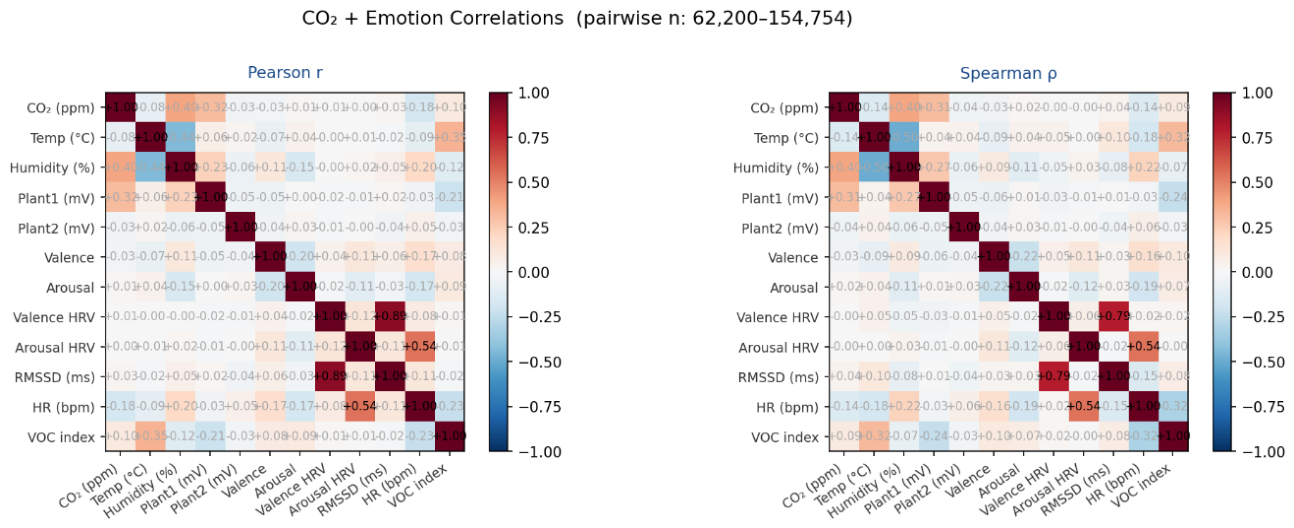
Figure 3.
Lagged mediation heatmaps for valence(t) → HR(t+Δa) → Plant2(t+Δa+Δb) [forward direction]. Each cell shows the indirect effect a×b for that (Δa, Δb) combination. The yellow star marks the best combination (Δa = 8 s, Δb = 51 s). Path a (valence→HR, top centre) shows a consistent band at Δa = 5–15 s. The total effect (bottom left) and direct effect (bottom centre) confirm partial mediation. n = 92,539. Note: each panel uses an independent color scale to maximise visibility; the colorbar range for paths a, b, c, c′ is substantially smaller than ±1, reflecting weak but statistically significant correlations.
Figure 3.
Lagged mediation heatmaps for valence(t) → HR(t+Δa) → Plant2(t+Δa+Δb) [forward direction]. Each cell shows the indirect effect a×b for that (Δa, Δb) combination. The yellow star marks the best combination (Δa = 8 s, Δb = 51 s). Path a (valence→HR, top centre) shows a consistent band at Δa = 5–15 s. The total effect (bottom left) and direct effect (bottom centre) confirm partial mediation. n = 92,539. Note: each panel uses an independent color scale to maximise visibility; the colorbar range for paths a, b, c, c′ is substantially smaller than ±1, reflecting weak but statistically significant correlations.
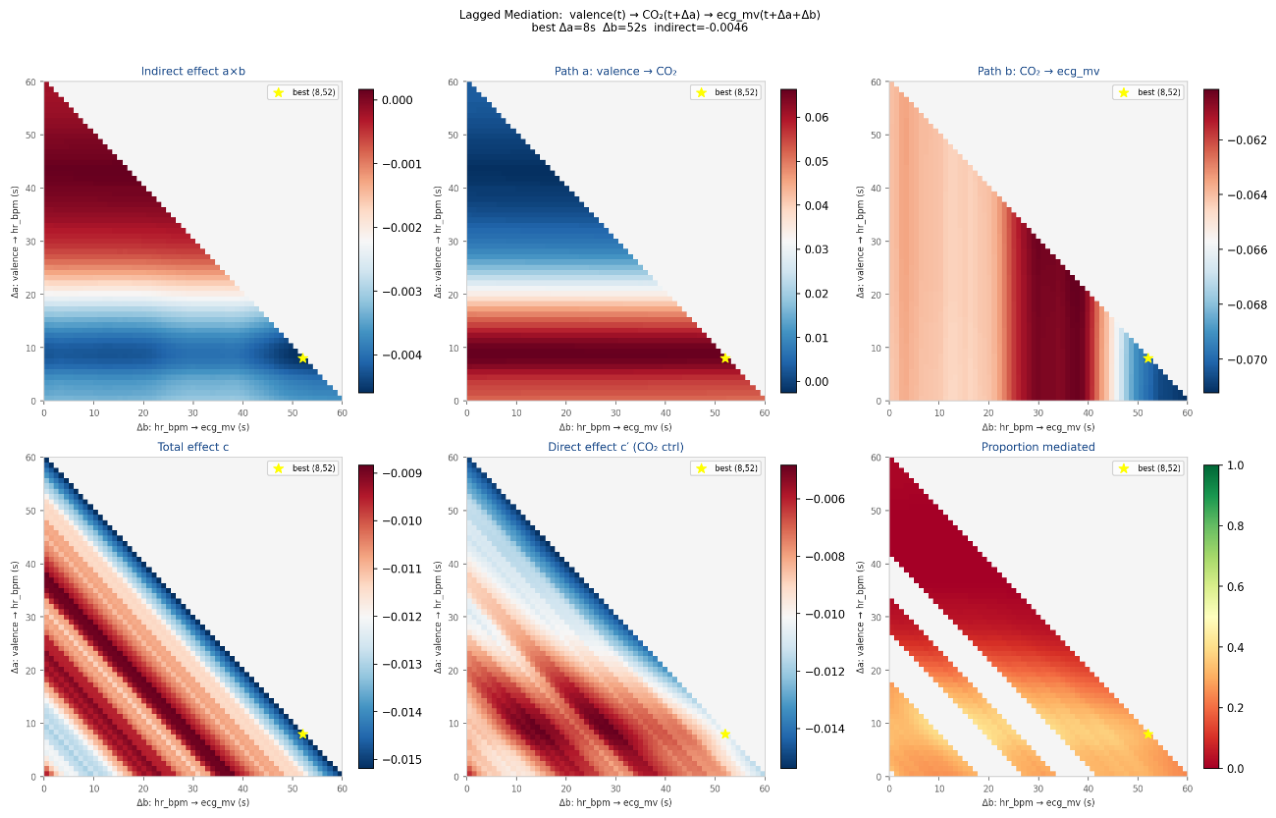
Figure 4.
Lagged mediation heatmaps for the reverse direction: Plant2(t) → HR(t+Δa) → valence(t+Δa+Δb). Full mediation at Δa = 54 s, Δb = 0 s (indirect = −0.0036), confirming that plant voltage predicts subsequent valence through HR. n = 92,542. Note: each panel uses an independent color scale to maximise visibility; the colorbar range for paths a, b, c, c′ is substantially smaller than ±1, reflecting weak but statistically significant correlations.
Figure 4.
Lagged mediation heatmaps for the reverse direction: Plant2(t) → HR(t+Δa) → valence(t+Δa+Δb). Full mediation at Δa = 54 s, Δb = 0 s (indirect = −0.0036), confirming that plant voltage predicts subsequent valence through HR. n = 92,542. Note: each panel uses an independent color scale to maximise visibility; the colorbar range for paths a, b, c, c′ is substantially smaller than ±1, reflecting weak but statistically significant correlations.
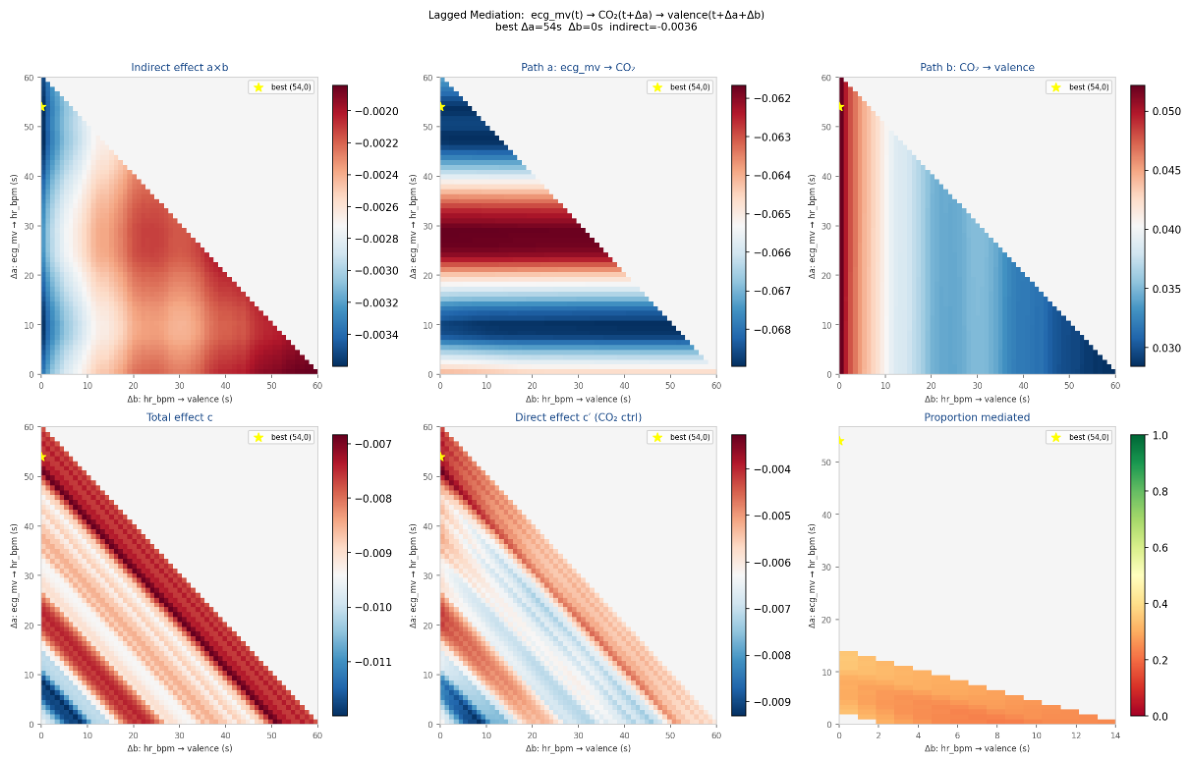
Figure 5.
Spectral mediation: valence(t) → HR(t+Δa) → Plant2 band power(t+Δa+Δb) across 8 STFT frequency bands. Left: path a (valence→HR) is completely invariant at Δa = 8 s across all bands (r = +0.067). Centre: path b (HR→plant band) varies substantially by frequency band and lag. Right: indirect effect a×b per band; yellow = significant mediation, grey = non-significant. Band 2 (44–75 s) shows full mediation; Band 8 (2–3 s) shows the largest path b (r = +0.076) at zero lag. The highlighted region marks the mechanosensory target range (27–75 s).
Figure 5.
Spectral mediation: valence(t) → HR(t+Δa) → Plant2 band power(t+Δa+Δb) across 8 STFT frequency bands. Left: path a (valence→HR) is completely invariant at Δa = 8 s across all bands (r = +0.067). Centre: path b (HR→plant band) varies substantially by frequency band and lag. Right: indirect effect a×b per band; yellow = significant mediation, grey = non-significant. Band 2 (44–75 s) shows full mediation; Band 8 (2–3 s) shows the largest path b (r = +0.076) at zero lag. The highlighted region marks the mechanosensory target range (27–75 s).
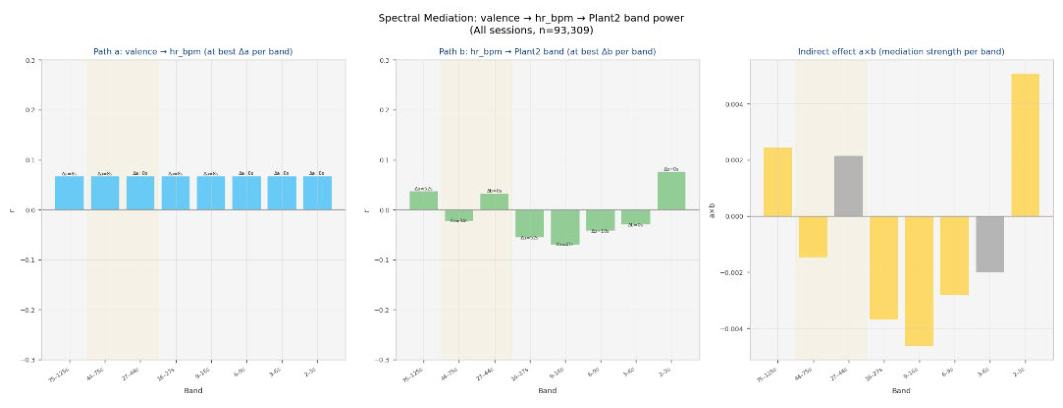
Figure 6.
Plant2 spectrogram and MFCC analysis across all sessions. Top: raw Plant2 signal (cyan) with FER valence overlay (purple). Second panel: STFT power spectrogram (0–0.2 Hz); red dashed line = 0.029 Hz (35 s coupling frequency); grey dotted = 0.111 Hz (9 s). Third panel: MFCC-style log band energy matrix (8 bands, 2 s to 125 s periods). Bottom left: mean power spectrum peaking at ~0.025–0.033 Hz. Bottom right: band-emotion correlations at lag = 1 s (FER valence only shown).
Figure 6.
Plant2 spectrogram and MFCC analysis across all sessions. Top: raw Plant2 signal (cyan) with FER valence overlay (purple). Second panel: STFT power spectrogram (0–0.2 Hz); red dashed line = 0.029 Hz (35 s coupling frequency); grey dotted = 0.111 Hz (9 s). Third panel: MFCC-style log band energy matrix (8 bands, 2 s to 125 s periods). Bottom left: mean power spectrum peaking at ~0.025–0.033 Hz. Bottom right: band-emotion correlations at lag = 1 s (FER valence only shown).
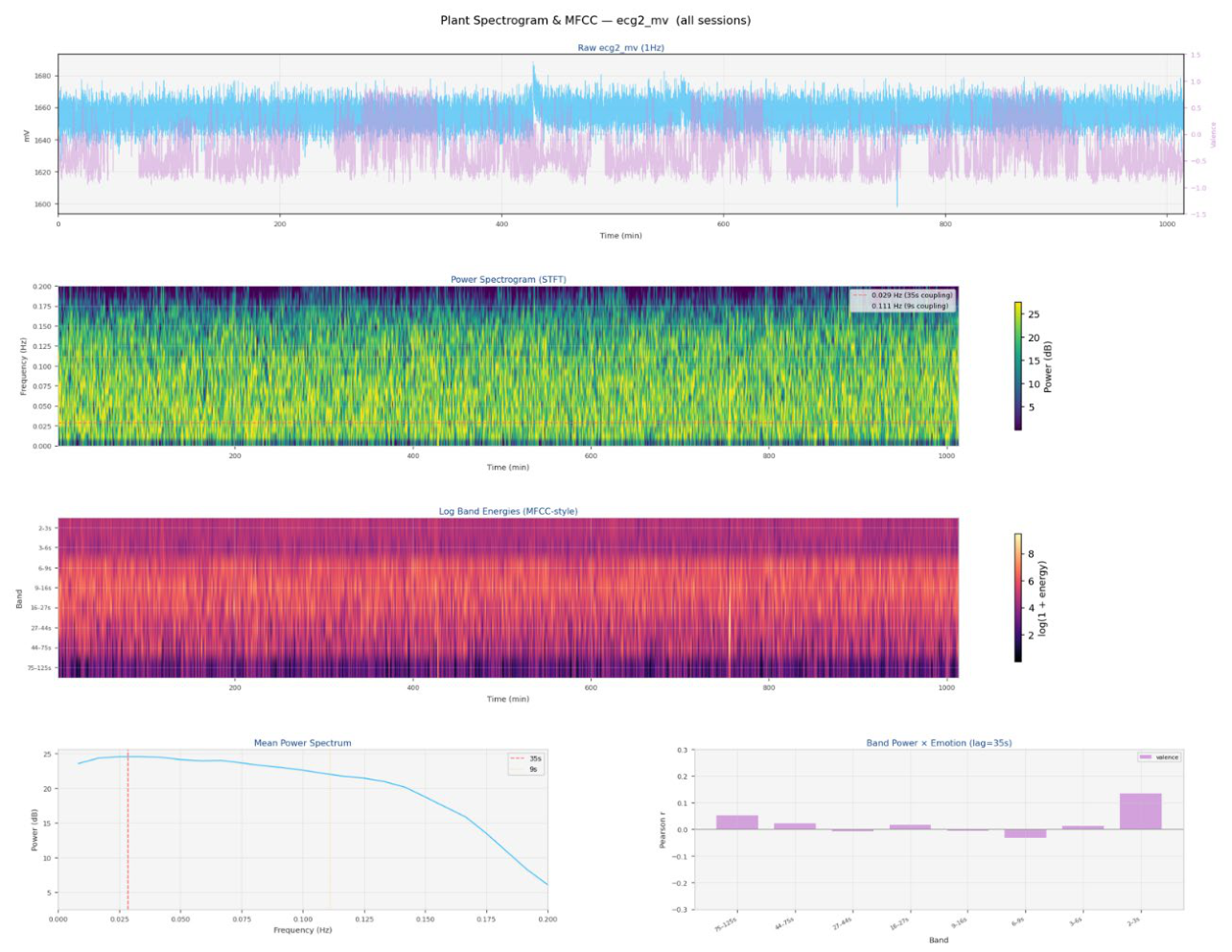
Figure 7.
Prediction model results. Top: best RF predictions vs. actual for valence (left, r = +0.257, Plant+HR+RMSSD detrended) and arousal (right, r = +0.087, Plant2 only). Centre: lagged correlations for all signal→emotion pairs (0–60 s). HR→valence (yellow) increases continuously; VOC→valence (bright yellow, near top) is the strongest persistent signal.(Note: The near-constant correlation across lags reflects the slow autocorrelation timescale of the signals relative to the 60-second window; the panel confirms stability of the relationships rather than lag-insensitivity.) Bottom: RF feature importance for the All+HR detrended bundle predicting valence (left) and arousal (right). VOC index dominates across both targets.
Figure 7.
Prediction model results. Top: best RF predictions vs. actual for valence (left, r = +0.257, Plant+HR+RMSSD detrended) and arousal (right, r = +0.087, Plant2 only). Centre: lagged correlations for all signal→emotion pairs (0–60 s). HR→valence (yellow) increases continuously; VOC→valence (bright yellow, near top) is the strongest persistent signal.(Note: The near-constant correlation across lags reflects the slow autocorrelation timescale of the signals relative to the 60-second window; the panel confirms stability of the relationships rather than lag-insensitivity.) Bottom: RF feature importance for the All+HR detrended bundle predicting valence (left) and arousal (right). VOC index dominates across both targets.
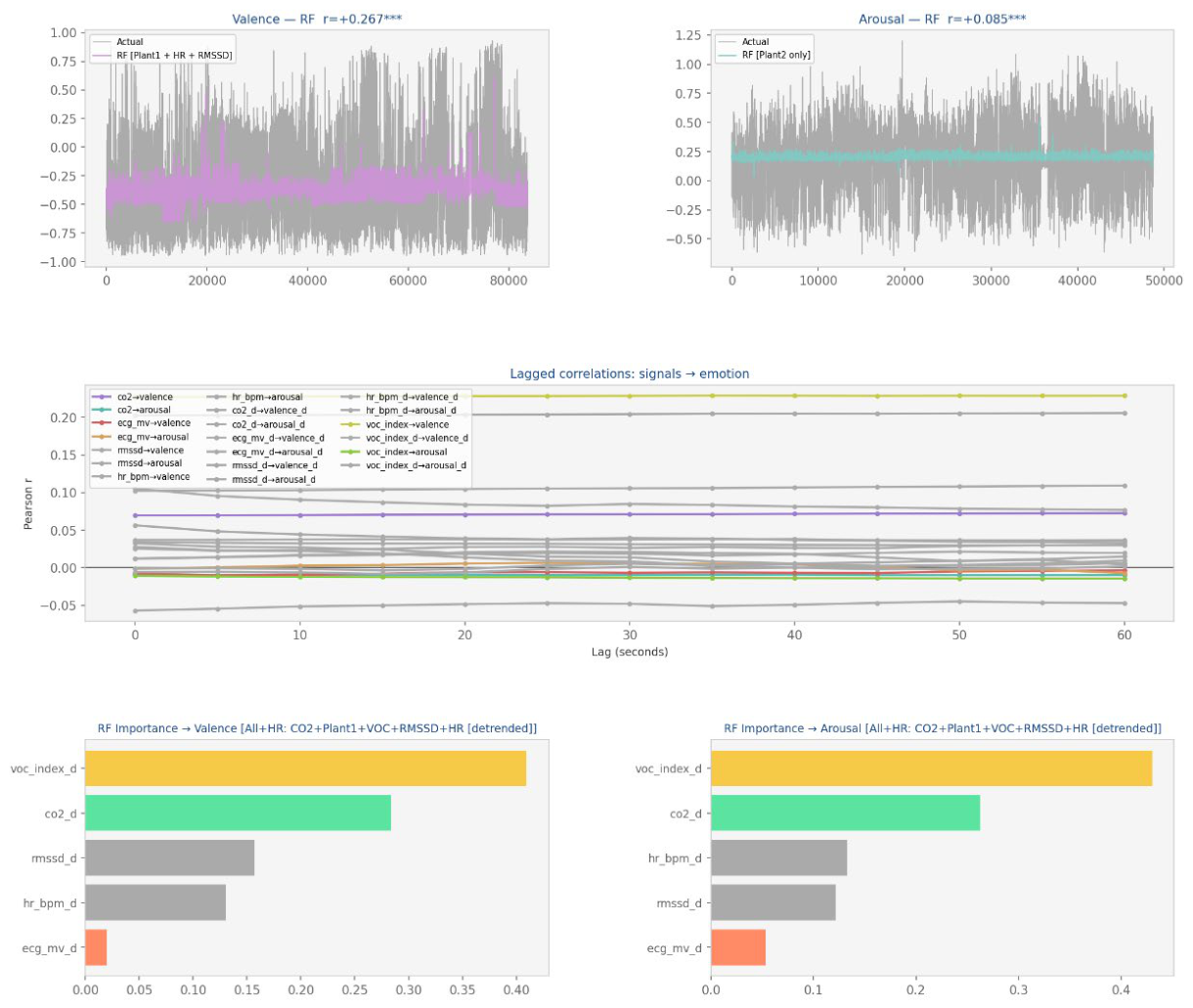

Table 1.
Spectral mediation results: valence(t) → HR(t+Δa) → Plant2 band power(t+Δa+Δb), all sessions, n = 93,309.
Table 1.
Spectral mediation results: valence(t) → HR(t+Δa) → Plant2 band power(t+Δa+Δb), all sessions, n = 93,309.
| Band | Period | Δa | Path a | Δb | Path b | a×b | Verdict |
| 1 | 75–125 s | 8 s | +0.067*** | 52 s | +0.037*** | +0.0024 | ✓ PARTIAL 11% |
| 2 | 44–75 s | 8 s | +0.067* | 34 s | −0.022* | −0.0015 | ✓ FULL mediation |
| 3 | 27–44 s | 8 s | +0.067*** | 0 s | +0.032*** | +0.0021 | concurrent |
| 4 | 16–27 s | 8 s | +0.067*** | 52 s | −0.055*** | −0.0037 | ✓ PARTIAL 10% |
| 5 | 9–16 s | 8 s | +0.067*** | 41 s | −0.069*** | −0.0046 | ✓ PARTIAL 6% |
| 6 | 6–9 s | 8 s | +0.067*** | 10 s | −0.042*** | −0.0028 | ✓ PARTIAL 7% |
| 7 | 3–6 s | 8 s | +0.067*** | 0 s | −0.030*** | −0.0020 | concurrent |
| 8 | 2–3 s | 8 s | +0.067*** | 0 s | +0.076*** | +0.0051 | ✓ PARTIAL 5% |
*** p < 0.001. Bold: primary mechanosensory finding. concurrent = both paths significant but Δb = 0 s indicates shared concurrent driver rather than sequential mediation.
Disclaimer/Publisher’s Note: The statements, opinions and data contained in all publications are solely those of the individual author(s) and contributor(s) and not of MDPI and/or the editor(s). MDPI and/or the editor(s) disclaim responsibility for any injury to people or property resulting from any ideas, methods, instructions or products referred to in the content. |
© 2026 by the authors. Licensee MDPI, Basel, Switzerland. This article is an open access article distributed under the terms and conditions of the Creative Commons Attribution (CC BY) license (http://creativecommons.org/licenses/by/4.0/).
Copyright: This open access article is published under a Creative Commons CC BY 4.0 license, which permit the free download, distribution, and reuse, provided that the author and preprint are cited in any reuse.


