

Submitted:
30 April 2026
Posted:
01 May 2026
You are already at the latest version
Abstract
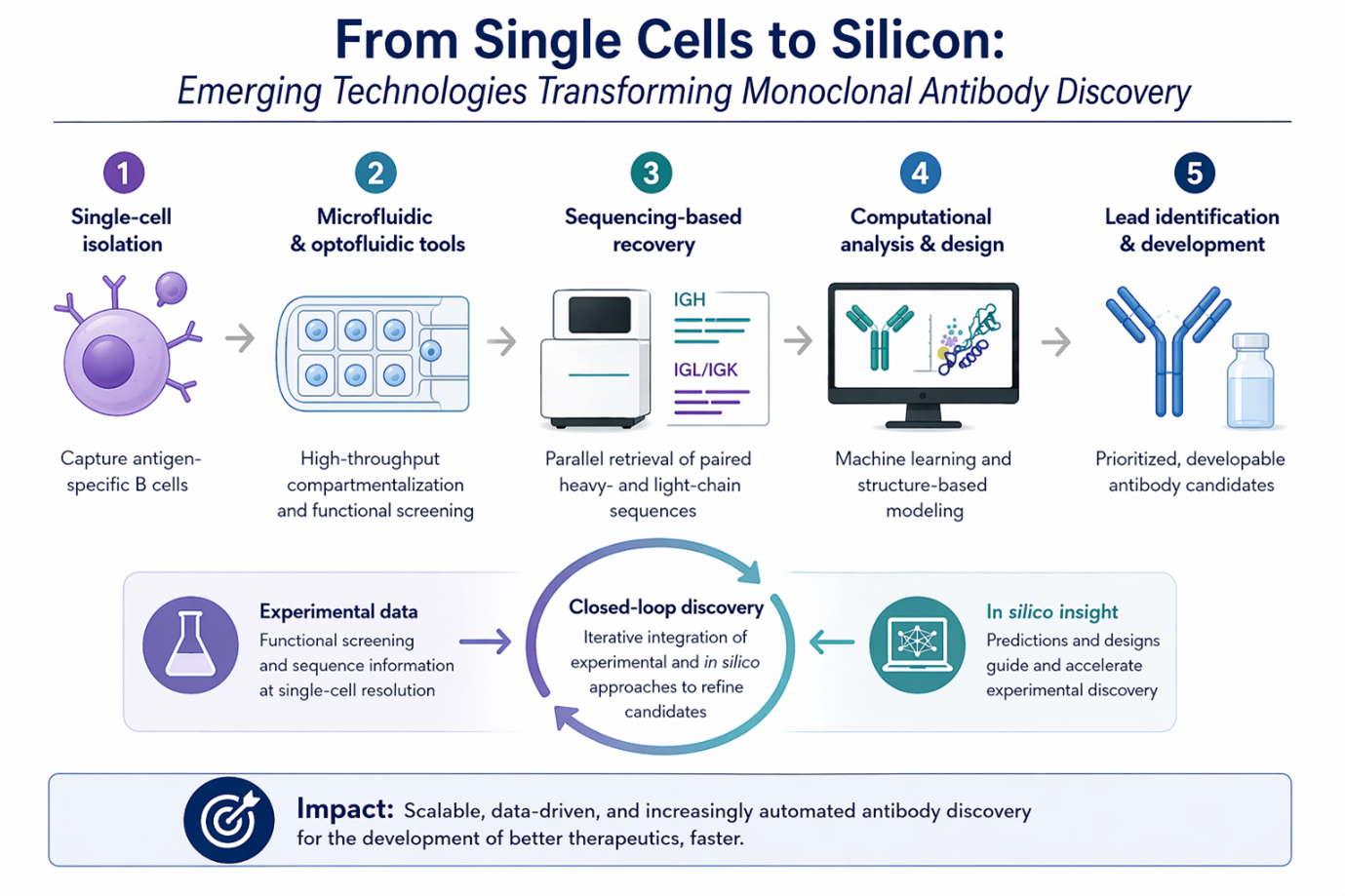
Monoclonal antibody (mAb) discovery has been transformed by advances in single-cell technologies, microfluidics, high-throughput sequencing, and computational design. Modern platforms enable the interrogation of large numbers of individual B cells, directly linking antibody sequence with antigen specificity and functional activity. Microfluidic and optofluidic systems now support high-throughput compartmentalisation and functional screening of antibody-secreting cells, while sequencing-based approaches allow parallel recovery of paired heavy- and light-chain sequences. These developments have shifted antibody discovery from binding-based selection toward function-first paradigms, enabling the rapid identification of diagnostic and therapeutically relevant antibodies. Integration with computational tools, including machine learning and structure-based modeling, has further enabled the emergence of closed-loop discovery pipelines, in which experimental and in silico methods iteratively refine candidates. This review summarises key advances in single-cell microtools over the last decade and highlights how the convergence of experimental and computational technologies is reshaping antibody discovery toward scalable, data-driven, and increasingly automated platforms.
Keywords:
microfluidics
; microtools
; monoclonal antibody discovery
; in silico discovery
; single cell analysis
; artificial intelligence
; machine learning
Copyright: This open access article is published under a Creative Commons CC BY 4.0 license, which permit the free download, distribution, and reuse, provided that the author and preprint are cited in any reuse.


