

Submitted:
30 April 2026
Posted:
02 May 2026
You are already at the latest version
Abstract
In this work, a numerical investigation of an organic light-emitting diode (OLED) based on a bilayer architecture is presented, with particular emphasis on the influence of ZnO nanoparticles (ZNPs) concentration on charge transport, recombination dynamics, exci-ton formation, and luminescence performance. The studied device consists of a hole injec-tion layer combined with an electron transport and emissive layer based on Alq₃ doped with ZNPs. The impact of ZNPs concentration has been explicitly introduced into carrier mobility, dielectric permittivity, Langevin recombination rate, and radiative exciton decay. The simulation results show that increasing ZNPs concentration enhances charge bal-ance, recombination efficiency, exciton density, and luminescence power. Furthermore, the variation of ZNPs concentration from 0% to 10% in Alq₃ polymer layer increases the electron charge density from 0.65 x 1021cm-3 to 1.4 x 1021cm-3, the recombination rate from 1.25 x1025 cm-3 s-1 to 12.5 x1025 cm-3 s-1, the exciton density from 0.05 x 1015cm-3 to 0.75 x 1015cm-3 and the power of luminescence from 0.015W/μm2 to 0.75W/μm2. Since, the per-formance of Alq3-ZNPs-OLED is tenfold higher than of Alq3-OLED pure. These findings demonstrate that the incorporation of ZNPs is a key parameter for ameliorate and opti-mizing OLED performance which can serve many optoelectronic designs.
Keywords:
ZNPs concentration effect
; carrier charge density
; langevin recombination
; exciton density
; luminance power
1. Introduction
OLEDs have been widely studied due to their promising applications in flat-panel displays and solid-state lighting, including smartphones, televisions, and flexible electronic devices [1,2,3,4]. OLED technology offers several advantages such as high brightness, low operating voltage, wide viewing angle, fast response time, and mechanical flexibility [5,6]. Improving charge balance and recombination efficiency within the emissive layer remains a central challenge for enhancing OLED performance. One effective approach involves incorporating inorganic nanoparticles into organic transport layers. Among these materials, ZNPs have attracted considerable attention due to their wide bandgap, high electron mobility, chemical stability, and favorable energy-level alignment with organic semiconductors [7,8,9,10]. Further, with its substantial exciton binding energy of 60 meV, ZNPs stands out as a premier nanoparticle for next-generation technology. Its inherent transparency, combined with the fact that its binding energy far exceeds thermal energy at room temperature (kBT ≈26 meV), ensures highly efficient light emission and stable performance. These characteristics, alongside its chemical stability and non-toxic nature, make ZNP an ideal, cost-effective candidate for diverse optoelectronic and photonic applications, including UV-OLEDs [11,12,13]. Hower, the performance of polymer-based OLEDs is often limited by the intrinsic disparity between charge carriers, where the electron current is significantly lower than the hole current due to the poor electron mobility of organic materials. This dissymmetry leads to inefficient recombination and reduced device performance. The incorporation of ZNPs into the polymer matrix provides an effective strategy to overcome this limitation, as ZNPs acts as an electron donor and transport enhancer. By improving electron injection and mobility, ZNPs helps restore charge balance between electrons and holes, thereby enhancing recombination efficiency, exciton generation, and overall device performance. In this study, we focus exclusively on a bilayer OLED structure (ITO /Alq₃:ZnO /LiF /Al) in which ZNPs are incorporated into Tris(8-hydroxyquinoline) aluminum (Alq₃) electron transport and emissive layers. Note that Alq₃ polymer is one of the most widely used organic materials in organic light-emitting diodes (OLEDs), owing to its good stability, its low bandgap (2.4–2.7 eV), and its strong electron-transport capability [14,15,16]. Unlike comparative studies involving doping and multiple device configurations of Alq3-OLED, the present work isolates the effect of ZNP concentration on electrical transport, recombination mechanisms, exciton formation, and luminescence power. The ZNP concentration is explicitly introduced into the numerical model to clarify its role in governing Alq3:ZNPs-OLED performance.
2. Device structure and physical model
2.1. Device structure
Figure 1 shows the schematic view of the OLED structure composed as: ITO/Hole Injection Layer (HIL) (50 nm)/Alq₃:ZnO (50 nm)/Electron Layer/LiF/Al. The origin of the spatial coordinate is defined at the beginning of the hole injection layer, and the position axis extends across the active layers toward the cathode. The region between and corresponds to the vicinity of the HIL/Alq₃:ZnO interface, where charge carrier recombination and exciton generation are most pronounced. The mean goal of the incorporation of ZNPs within the Alq₃ layer is to enhances electron transport and to improved charge balance and efficient light emission in this region.
2.2. Theoretical model
The theoretical approach based on electrical transport has been extensively used for many organic optoelectronic devices such OLED, photovoltaic cell,…,[15,16,17,18,19], but the effect of the incorporation of inorganic nanoparticles on the performance of these optoelectronic devices has hitherto not been reported. In this work, we introduce a theoretical approach to study the effect ZNPs concentration on the carrier’s injection density, exciton density, recombination and luminescent rate of bilayer OLED structure (ITO /Alq₃:ZnO /LiF /Al) in which ZNPs are incorporated into the Alq₃ electron transport and emissive layer. Furthermore, based on our previous works [20,21,22], we apply the continuity equations for both electron and hole, charge carriers transport through both drift and diffusion currents, Pool-Frenkel equations for mobility, Langevin equation for the recombination rate and the continuity equation for the exciton density.
The electric field distribution inside the OLED-ZNP is governed by Poisson’s equation:
The applied voltage is related to the internal electric field by [23,24]:
where and are the applied voltage and the built-in potential, and is the total thickness of the Alq₃:ZNPs layers.
The electron and hole current densities are expressed as:
(4) (5)
where, are the electrons/holes carrier mobility, are the respective diffusion coefficients.
The electron mobility enhancement induced by ZNPs is modeled as:
where represents the ZnO-induced mobility enhancement factor and are the electrons/holes Pool-Frenkel factor [23,24,25]. The Langevin recombination rate is given by:
The continuity equations are given by:
(8)
(9)
The radiative decay rate is enhanced by ZNPs:
The Langevin recombination rate increases with ZNPs concentration due to the combined effect of enhanced electron mobility and modified dielectric screening. Consequently, a higher density of excitons is generated, which directly contributes to enhanced light emissions.
The power of luminescence density is expressed as:
3. Results and Discussion
It is well known that the analytical solution of the ensemble of previous spatiotemporal equations is often not practicable and, in many cases, impossible. Thus, we have used numerical resolutions with an applied voltage varied from 0 to 8 V, we give in Figure 2 the I-V characteristics of ITO /Alq₃:ZnO /LiF /Al OLED structure. All the numerical values of parameters used in the calculation are presented in Table 1.
The simulation results of I-V show a monotonic increase in the current voltage characteristics with ZNPs concentration. The incorporation of ZNPs leads to a significant modification of the electrical and optical properties of (ITO /Alq₃:ZnO /LiF /Al). Increasing ZNP concentration enhances electron mobility, resulting in improved charge balance within the emissive layer. We notice that when the current set to 50 mA, the operating voltage of the Alq3-OLED pure is 5 V while for the same operating voltage the current of Alq₃:ZnO devices reached 85 mA, 125 mA, 250 mA and 265 mA for 2% to 10% ZNP concentration respectively. Moreover, for Alq3-OLED pure the result is in good agreement with previously reported study [15,16,17,18,19]. It is important to note that for higher ZNP concentration (≈10%), the current increase tends toward saturation, suggesting carrier imbalance and possible trap-assisted recombination.
These results confirm that ZNP concentration plays a dominant role in tuning charge transport in fluorescent OLED (ITO /Alq₃:ZnO /LiF /Al). Hower, the spatial distributions of charge carrier density for (ITO /Alq₃:ZnO /LiF /Al) with varying ZNP concentrations (0–10%) are illustrated in Figure 3(a,b). In the pristine device (0% ZnO), the charge carriers are strongly localized at the HIL/ETL interface (≈50 nm), with a pronounced imbalance between holes and electrons due to the low electron mobility in the Alq₃ layer, resulting in a narrow and inefficient recombination zone. Upon incorporation of ZNPs, the electron mobility is significantly enhanced, leading to an increase in electron density and a progressive improvement in charge balance. At intermediate concentrations (2–5%), the overlap between electron and hole distributions becomes more pronounced, yielding a broader and more symmetric carrier profile.
This improvement directly translates into a substantial increase in the Langevin recombination rate, as shown in Figure 4(a,b), where both the peak magnitude and spatial extension of the recombination zone are enhanced. The optimal regime is observed for ZnO concentrations in the range of 5–8%, where the near-equilibrium condition maximizes the bimolecular recombination process. Consequently, the exciton density (Figure 5(a)) exhibits a significant increase and extends over a wider region (~30 nm), indicating an enlarged emission zone and improved radiative efficiency. However, at higher ZnO concentration (10%), an excess of electrons leads to a deviation from charge balance, slightly reducing (Figure 4(b)) the effective recombination despite the high mobility.
These results demonstrate that ZNPs play a crucial role in tuning charge transport and recombination dynamics, with an optimal concentration window that maximizes exciton generation and overall device performance.
position from the anode for ZNPs concentrations (0%, 2%, 5%, 8%, 10%). (b) Evolution of the maximum peak as a function ZNPs concentrations.
The maximum electron density increases with ZnO concentration, while the hole density slightly decreases, leading to an optimal charge balance around 5% ZnO. At higher concentrations, electron dominance is observed, indicating a shift toward an electron-rich transport regime.
The evolution of the Langevin recombination rate with ZNP concentration provides key insight into the charge transport and recombination dynamics of (ITO /Alq₃:ZnO /LiF /Al). As shown in Figure 4, the spatial distribution of the recombination rate exhibits a pronounced peak located near the HIL/ETL interface (≈50 nm), corresponding to the maximum overlap between electron and hole densities.
In the absence of ZnO (0%), the recombination rate is relatively low and highly localized, which is primarily attributed to the limited electron mobility and the resulting imbalance between charge carriers. Upon incorporation of ZNPs, the recombination rate increases significantly in both magnitude and spatial extent. This enhancement originates from the improvement in electron transport, which leads to a more efficient overlap between electron and hole populations, thereby increasing the bimolecular recombination probability governed by the Langevin mechanism.
A more detailed analysis of the maximum recombination peak as a function of ZnO concentration reveals a non-linear behavior. Specifically, the peak recombination rate increases rapidly from 0% to intermediate ZnO concentrations (2–5%), reflecting the progressive establishment of charge balance within the device. The maximum is reached in the range of 5–8% ZnO, where the condition is approximately satisfied, leading to optimal recombination efficiency. Beyond this range, at higher ZnO concentration (10%), the recombination peak exhibits a tendency toward saturation or slight reduction. This behavior can be attributed to the emergence of an electron-dominated regime (), which limits the product despite the continued increase in electron mobility.
Consequently, the recombination efficiency no longer improves and may even degrade slightly due to charge imbalance. Generally, these results demonstrate that ZNPs play a crucial role in modulating the Langevin recombination process by tuning both carrier mobility and charge balance. An optimal ZnO concentration window (5–8%) is identified, where the recombination rate is maximized, leading to enhanced exciton generation and improved device performance.
The singlet exciton density follows the same spatial and compositional trends as the Langevin recombination rate, with a peak localized near the HIL/ETL interface where electron–hole recombination is most efficient. In the pristine device (0% ZnO), the exciton density is relatively low and confined to a narrow region due to poor charge balance. This is in good agreement with previous references [15,16,17,18,19].
The incorporation of ZNPs leads to a significant increase in exciton density and a broadening of the emission zone, as a result of improved electron transport and enhanced overlap between charge carriers. The maximum exciton density is observed at intermediate ZnO concentrations (5–8%), where near-optimal charge balance is achieved. At higher ZnO content (10%), a slight reduction in exciton density is observed, which can be attributed to carrier imbalance and possible quenching effects.
Overall, ZnO incorporation enhances exciton generation and spatial distribution, with an optimal concentration range that maximizes radiative recombination. The maximum singlet exciton density increases with ZnO concentration due to improved electron transport and enhanced charge balance, reaching an optimal value around 5–8%. Beyond this concentration, a slight decrease is observed (Figure 5(b)), attributed to carrier imbalance and possible exciton quenching effects.
Figure 6.
Power of luminescence density calculated for different ZNPS concentrations.
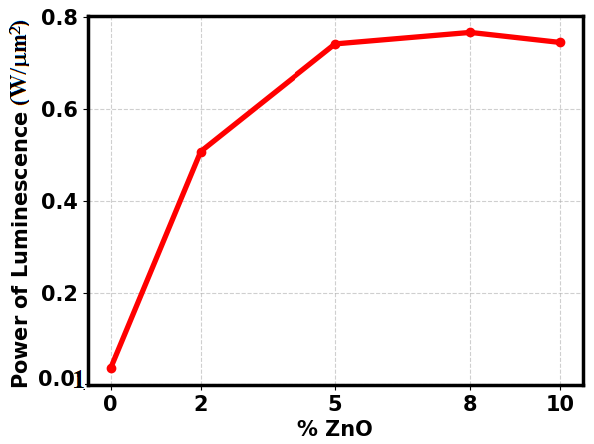
The power of luminescence increases rapidly from 0% to ~5% ZnO due to improved charge balance and recombination. A maximum is reached around 5–8% ZnO, corresponding to optimal exciton generation. At 10% ZnO, a slight decrease appears, attributed to electron–hole imbalance and possible quenching effects. These results for power of luminescence can aid future experimental steps, particularly for the choice of favorable concentration.
4. Conclusions
The incorporation of ZNPs significantly improves the electron transport in the ETL layer, leading to enhanced charge balance at the HIL/ETL interface. This results in an increase in the electron density, Langevin recombination rate, exciton density and luminescence power. An optimal ZnO concentration (5–8%) ensures maximum overlap between electrons and holes, yielding the highest recombination efficiency and exciton generation. However, excessive concentration of ZNPs leads to carrier imbalance, reducing device performance. Finally, the results of this work provide a better understanding of the incorporation of ZNPs with Alq3 polymer may serve for many technologies applications in optoelectronic devices, especially for the OLED based on hybrid organic-inorganic materials.
Author Contributions
Conceptualization, N.M. and S.R.; methodology, N.M.; validation, N.M., and H.B.; formal analysis, N.M.; investigation, N.M.; writing—original draft preparation, N.M.; writing—review and editing, S.R.; supervision, H.B. All authors have read and agreed to the published version of the manuscript.
Funding
This research received no external funding.
Data Availability Statement
All data generated or analyzed during this study are included in this published article.
Acknowledgments
The authors thank Habib Bouchriha for his help with this article.
Conflicts of Interest
We declare that there are no conflicts of interest that could have influenced the research findings presented in this paper.
References
- Tang, C.W.; VanSlyke, S.A. Organic electroluminescent diodes. Appl. Phys. Lett. 1987, 51, 913–915. [Google Scholar] [CrossRef]
- Brütting, W.; Berleb, S.; Mückl, A.G. Device physics of organic light-emitting diodes based on molecular materials. Org. Electron. 2001, 2, 1–36. [Google Scholar] [CrossRef]
- Hung, L.S.; Chen, C.H. Recent progress of molecular organic electroluminescent materials and devices. Mater. Sci. Eng. R 2002, 39, 143–222. [Google Scholar] [CrossRef]
- Moliton, A. Organic and Polymeric Optoelectronics; Springer: Berlin, Germany, 2011. [Google Scholar] [CrossRef]
- Staudigel, J.; Stößel, M.; Steuber, F.; Simmerer, J.; Winnacker, A. Charge carrier transport in multilayer OLEDs. J. Appl. Phys. 1999, 86, 3895–3903. [Google Scholar] [CrossRef]
- Adachi, C.; Tsutsui, T.; Saito, S. Organic electroluminescent devices with improved efficiency. Appl. Phys. Lett. 1990, 57, 531–533. [Google Scholar] [CrossRef]
- Brütting, W. Physics of Organic Semiconductors; Wiley-VCH: Weinheim, Germany, 2005. [Google Scholar]
- Narayan, K.; Varadharajaperumal, S.; Rao, G.M.; Varma, M.M.; Srinivas, T. Transport properties of Alq₃-based OLEDs. Curr. Appl. Phys. 2013, 13, 18–24. [Google Scholar] [CrossRef]
- Weichsel, C.; et al. Charge recombination and exciton formation in OLEDs. Phys. Rev. B 2012, 86, 075204. [Google Scholar] [CrossRef]
- Özgür, Ü.; et al. A comprehensive review of ZnO materials and devices. J. Appl. Phys. 2005, 98, 041301. [Google Scholar] [CrossRef]
- Anaya-Zavaleta, J.C.; Ledezma-Pérez, A.S.; Gallardo-Vega, C.; Rodríguez-Hernández, J.; Alvarado-Canché, C.N.; García-Casillas, P.E.; de León, A.; Herrera-May, A.L. ZnO Nanoparticles by Hydrothermal Method: Synthesis and Characterization. Technologies 2025, 13, 18. [Google Scholar] [CrossRef]
- Kausar, H.; Nor, A. S.; Bahri, D.; Muhamad, K. Y.; Ahmad, A. M. Results Phys. 2020, 16, 102829. [CrossRef]
- Wang, Z.; Long, Z.; Zhifeng, S.; Xiaochuan, X.; Xiangping, L.; Xin, D.; Yuchun, C.; Baolin, Z.; Guotong, D. Appl. Surf. Sci. 2011, 257, 4685. [CrossRef]
- Saeed, A.; Alshahrie, A.; Salah, N.J. Mater. Sci. Mater. Electron 2020, 31, 22179. [Google Scholar] [CrossRef]
- Mehdi, S.; Amraoui, R.; Aissat, A. Dig. J. Nanomater. Biostructures 2022, 17, 781. [CrossRef]
- Debsharma, M.; Pramanik, T.; Daka, C.; Mukherjee, R. J. Phys. Conf. Ser. 2022, 2267, 012159. [CrossRef]
- Mo, B. Opt. Laser Technol. 2015, 68, 202. [CrossRef]
- Baranovskii, S.; et al. Chem. Rev. 2017, 117, 711. [CrossRef]
- Jin, Ruifa. Comptes Rendus Chim. 2015, 18, 954. [CrossRef]
- Mastour, N.; Mejatty, N.; Bouchriha, M.H. Superlattices Microstruct. 2015, 82, 461. [CrossRef]
- Mastour, N.; Bouchriha, N.H. Phys. Lett. A 2016, 380, 3866. [CrossRef]
- Mastour, N.; Ben Hamed, Z.; Benchaabane, A.; Sanhoury, M. A.; Kouki, F. Org. Electron. 2013, 14 2093. [CrossRef]
- Yadav, R.A.K.; Dubey, D.K.; Chen, S.Z.; Liang, T.W.; Jou, J.H. Sci. Rep. 2020, 10, 9915. [CrossRef]
- Salehi, A.; Dong, C.; Shin, D.H.; Zhu, L.; Papa, C.; Bui, A.T.; Castellano, F.N.; So, F. Nature.
- Communications 2019, 10, 2305. [CrossRef]
- Perucco, B.; Reinke, N. A.; Rezzonico, D.; Knapp, E.; Harkema, S.; Ruhstaller, B. Org. Elect. 2012, 13, 1827. [CrossRef]
- Mastour, N.; Zitouni, O.; Ridene, S. Electronics 2024, 13(21), 4142. [CrossRef]
- Liu, N.; Mei, S.; Sun, D.; et al. ZnO nanoparticle-assisted charge transport in OLEDs. Micromachines 2019, 10, 344. [Google Scholar] [CrossRef]
- Salehi, A.; Dong, C.; Shin, D.H.; et al. High-efficiency OLEDs using metal oxide nanoparticles. Nat. Commun. 2019, 10, 2305. [Google Scholar] [CrossRef]
- Minagawa, M.; Tsuchida, Y.; Takahashi, K.; Takahashi, A. ZnO electron transport layers for OLEDs. ITE Trans. MTA 2015, 3, 127–134. [Google Scholar] [CrossRef]
- Yadav, R.A.K.; Dubey, D.K.; Chen, S.Z.; Jou, J.H. Numerical modeling of exciton dynamics in OLEDs. Sci. Rep. 2020, 10, 9915. [Google Scholar] [CrossRef] [PubMed]
- Hung, L.S.; Tang, C.W. Interface engineering with LiF in OLEDs. Appl. Phys. Lett. 1997, 32 70, 152–154. [Google Scholar] [CrossRef]
- Kido, J.; Hongawa, K.; Okuyama, K.; Nagai, K. Bright blue OLEDs using cathode modification. Appl. Phys. Lett. 1998, 73, 2866–2868. [Google Scholar] [CrossRef]
Figure 1.
ZNPs are uniformly dispersed within the Alq₃ layer. The volume concentration of ZNPs is denoted by . This layer simultaneously serves as the electron transport layer and the emissive layer.
Figure 1.
ZNPs are uniformly dispersed within the Alq₃ layer. The volume concentration of ZNPs is denoted by . This layer simultaneously serves as the electron transport layer and the emissive layer.
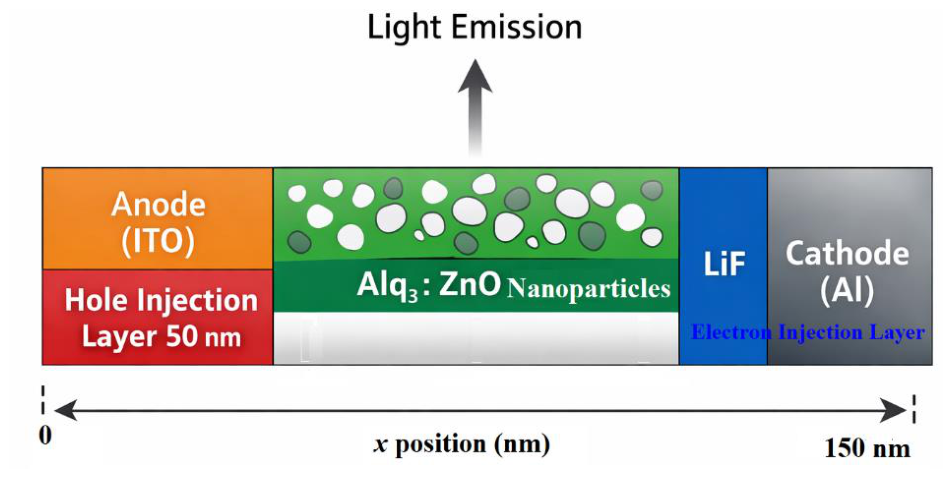
Figure 2.
Current–voltage characteristics of(ITO /Alq₃:ZnO /LiF /Al)OLED for different ZNPs concentrations (0–10%).
Figure 2.
Current–voltage characteristics of(ITO /Alq₃:ZnO /LiF /Al)OLED for different ZNPs concentrations (0–10%).
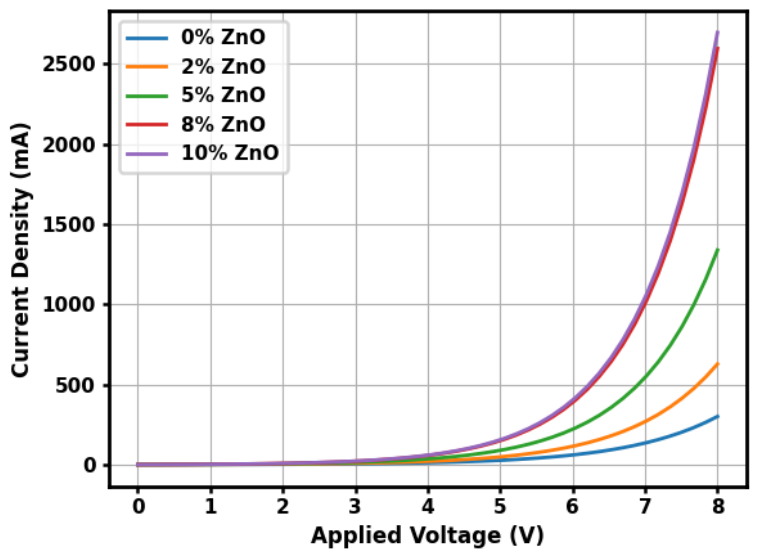
Figure 3.
(a) Electron (solid lines) and hole (dashed lines) densities as a function of
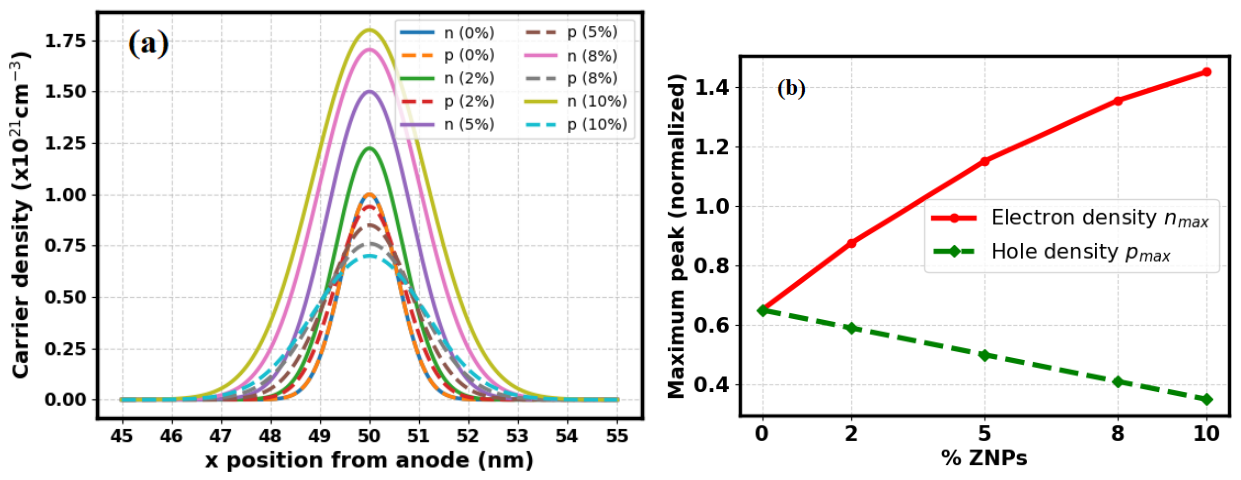
Figure 4.
(a) Langevin recombination rate calculated and (b) maximum recombination peak for different ZNPS concentrations.
Figure 4.
(a) Langevin recombination rate calculated and (b) maximum recombination peak for different ZNPS concentrations.
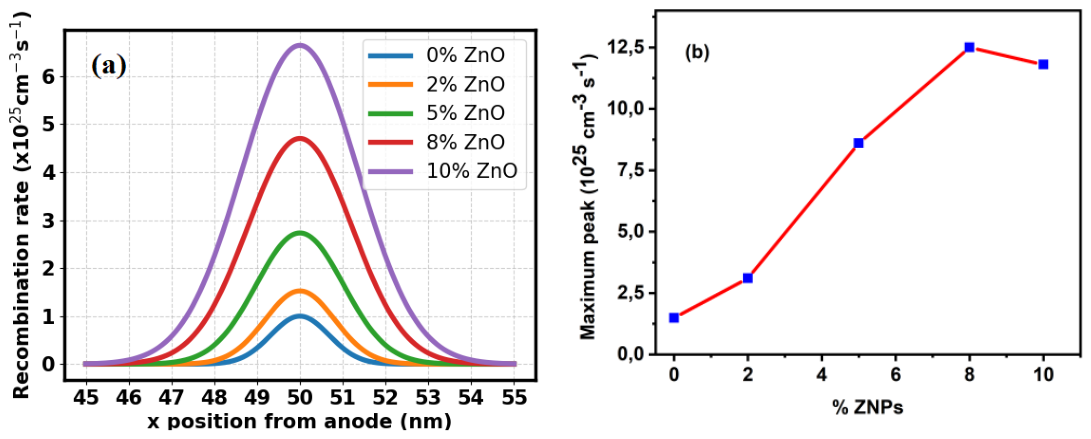
Figure 5.
(a) Exciton density calculated (b) maximum exciton density peak for different ZNPS concentrations.
Figure 5.
(a) Exciton density calculated (b) maximum exciton density peak for different ZNPS concentrations.
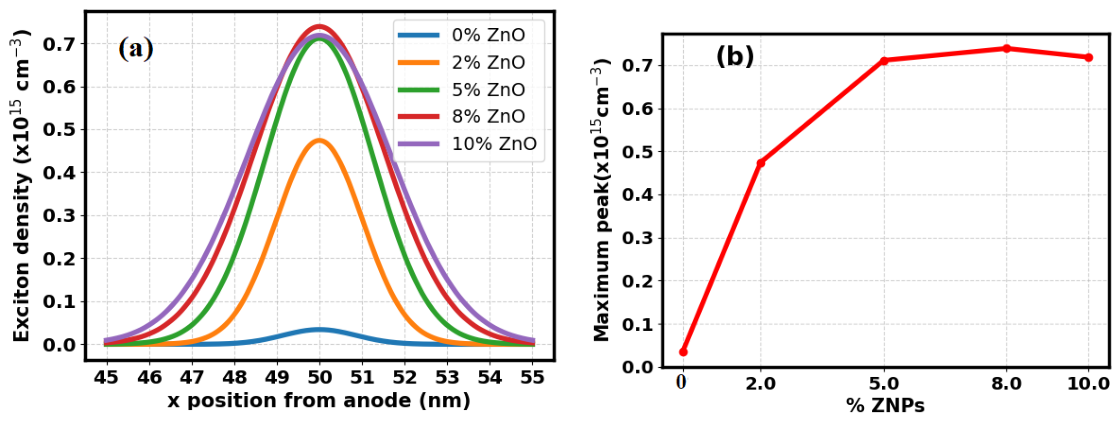

Table 1.
Electronic energy levels, thermal properties, and charge transport parameters of materials used for (ITO/HIL/Alq₃:ZnO/LiF/Al) OLED.
Table 1.
Electronic energy levels, thermal properties, and charge transport parameters of materials used for (ITO/HIL/Alq₃:ZnO/LiF/Al) OLED.
| Material / Layer | HOMO (eV) | LUMO (eV) | Tg (°C) | Electron Mobility μe (cm²·V⁻¹·s⁻¹) | Hole Mobility μh (cm²·V⁻¹·s⁻¹) | Ref. |
| ITO (Anode) | −4.7 (WF) | — | — | — | — | [1,2] |
| Hole Injection Layer (HIL) | −5.4 | −2.3 | ~95 | ~1 × 10⁻⁸ | ~1 × 10⁻⁴ | [3,4,5] |
| Alq₃ (host material) | −5.7 | −3.0 | ~175 | 1.5 × 10⁻⁷ | ~1 × 10⁻⁸ | [6,7,8,9] |
| ZNPs | −7.6 | −4.2 | >300 | 10⁻³–10⁻² | ~1 × 10⁻⁶ | [10,11,12,13,14,15,16,17] |
| Alq₃:ZnO nanocomposite (effective) | −5.7 | −3.1 to −3.3 | ~180 | 10⁻⁶–10⁻⁴* | ~1 × 10⁻⁸ | [27,28,29] |
| LiF (Electron Injection Layer) | −13.6 | −0.9 | — | — | — | [29,32] |
| Al (Cathode) | −4.3 (WF) | — | — | — | — | [1,2] |
Disclaimer/Publisher’s Note: The statements, opinions and data contained in all publications are solely those of the individual author(s) and contributor(s) and not of MDPI and/or the editor(s). MDPI and/or the editor(s) disclaim responsibility for any injury to people or property resulting from any ideas, methods, instructions or products referred to in the content. |
© 2026 by the authors. Licensee MDPI, Basel, Switzerland. This article is an open access article distributed under the terms and conditions of the Creative Commons Attribution (CC BY) license (http://creativecommons.org/licenses/by/4.0/).
Copyright: This open access article is published under a Creative Commons CC BY 4.0 license, which permit the free download, distribution, and reuse, provided that the author and preprint are cited in any reuse.


