

Submitted:
29 April 2026
Posted:
30 April 2026
You are already at the latest version
Abstract
Tropical forests are facing escalating deforestation, while forest degradation, driven by a complex interplay of human-induced factors, emerges as an additional and compounding threat. In this context, regulated selective logging persists as an alternative to conciliate forest protection and economic development. This study synthesizes current knowledge on the impacts of logging, focusing on research trends, geographic distribution, ecological topics, and key variables like logging intensity, time since logging, and number of logging cycles. Since the 1970s, 641 papers listed on the Scopus platform have demonstrated a sharp increase in publication activity over the past five years, followed by a tendency toward stabilization. Papers were concentrated in Brazil and Malaysia, with few papers coming from other countries, particularly from Africa. Notably, 47% of the studies did not report logging intensity, and one-third focused almost exclusively on its impacts on forest physical structure, damage, or biomass—leaving a wide range of other topics largely unexplored until 2022. We refer to 13 topics with less than 20 studies in total, such as nutrient cycling, non-timber forest products, biological invasion, and key biological taxa. Herbs, epiphytes, fish and amphibians were among the least investigated taxa across the regions. Furthermore, when controlling variables like region and logging intensity, most ecological topics had fewer than five dedicated studies. Research remains largely restricted to similar scenarios: first-cycle logging in old-growth forests, leaving substantial knowledge gaps. As logging operations are expected to increase, we argue for a (1) mandatory long-term monitoring in logging regulations; (2) public access to monitoring data, reports and information related to regulated logging; (3) a global platform to exchange experience as long-term monitoring, better practices, silvicultural approaches and sustainability assessment; (4) alignment among regulatory and certification agencies on sustainability standards; (5) capacity building initiatives; and (6) long-term experiments devoted to logging sustainability and better practices.
Keywords:
biodiversity
; forest degradation
; sustainability
; systematic review
; tropical forests
1. Introduction
Tropical forests persist as a central concern in multilateral global agendas focused on socioenvironmental issues, including the Sustainable Development Goals (SDG; Swamy et al., 2018. This reflects the tropical forest protagonism relative to biodiversity conservation, climate regulation, food security, social reproduction of traditional communities and indigenous people just to mention a few contributions (Muthee et al., 2022; Swamy et al., 2018). Such an immense concern results from contributions or key roles played for global sustainability, but also due to the fact that this irreplaceable ecosystem continues to be converted into other forms of land use (e.g., crop/cattle production) or experience degradation via a combination of human drivers such as intensive/illegal logging, mining and wildfires among the more pervasive forces (Lewis et al., 2015). In the last three decades both deforestation and forest degradation covered 218.7 and 106.5 million ha respectively (Vancutsem et al., 2021) resulting in a significant reduction in carbon storage capacity (Mitchard, 2018).
Over the past decades, numerous strategies have been proposed to enhance the socioeconomic incentives for keeping forests standing and promoting their sustainable use, benefiting a wide array of local and global stakeholders. These strategies aim to reconcile forest integrity and the provision of ecosystem services with economic activities and social development. Within this framework, selective “low-impact” logging (hereafter referred to as regulated logging) has emerged as a promising approach to achieve these objectives (Putz et al., 2008; Karsenty, 2017). The foundation of regulated logging lies in limiting harvest intensity, both in terms of the number of trees removed and the volume of timber extracted, combined with predefined intervals between logging cycles (e.g., 25–30 years), as established by legislative frameworks (Sist, 2000). Accordingly, selective logging practices that regulate extraction intensity and incorporate forest damage mitigation measures have been promoted as long-term ventures, wherein ecological sustainability is not only a legal requirement but also a moral obligation aligned with global sustainability goals (Lindenmayer et al., 2012). However, the extent to which these goals have been effectively realized remains contested (see Sist et al., 2021; Tritsch et al., 2020).
Since the 70`s there has been a boon of commercial and industrial operations particularly those in public or communal lands via forestry concessions implemented by governments and organizations (Schwab et al., 2001; Poudyal et al., 2018). Starting in Asia/Africa, forestry concessions spread across all continents and continues to grow (Gustafsson et al., 2007; Tegegne et al., 2019). While selective logging is also adopted in private lands, industrial-scale operations across public lands respond to most of the forest submitted to this source of disturbance (Hensbergen, 2016). It is not uncommon concessions exceeding 100.000 hectares of forest for logging (see Chan, 2017) with public concessions achieving millions of hectares globally (Hensbergen, 2016). In Brazil, regulated logging via public concessions started in 2007 following the regulation approval by federal agencies (the Law on Public Forest Management; Law 11,284/2006) and the number of federal concessions is expected to increase rapidly in the near future (see also Azevedo-Ramos et al., 2015).
As expected, industrial-scaled regulated logging continues to attract the attention of the research community and other stakeholders, which has investigated forest responses or the impacts imposed by this alternative of tropical forest exploitation relative to biodiversity persistence and provision of ecosystem services associated with forest integrity (Bicknell et al., 2015; Edwards et al., 2012; Gatti et al., 2014). Accordingly, a small set of reviews on logging impacts (e.g., soil, carbon, tree species richness) is already available (Chiti et al., 2016; Romero et al., 2021; Han et al., 2021). However, the contracts/legislation supporting regulated logging have not been fully scrutinized, while it has been claimed, alleged or assumed to be sustainable (e.g., “sustainable forest management”) by those in charge of it from governmental agencies to companies (Siry et al., 2005; Torres-Rojo et al., 2016; SFB, 2019; Capanema et al., 2022). Apparently, there has been a “green signal” for regulated logging initiatives with or without the support from literature. As a support, we refer to reports declaring (1) both negligible impacts or a positive response from particular taxonomy groups, particularly community-level attributes such as species richness and relative abundances (see Bicknell et al., 2015), and (2) the perspective that forest biomass and exploited populations are able to recovery after the next cycle of logging (Poudyal et al., 2018; Sist et al., 2021).
We already know that the outstanding biodiversity of tropical forests is locally and regionally arranged into complex food webs connecting a myriad of interdependent ecological groups with contrasting levels of sensitivity to human disturbances and potential disruptions in species interactions (Barlow et al., 2007; Schulze et al., 2004). Briefly, biodiversity response from population to community level is highly influenced by (1) biota evolutionary history (Tilman, 2015), (2) both the historical and contemporary disturbance regime (Alroy, 2017), (3) forest type (i.e., evergreen vs seasonal; Orihuela et al., 2015), and (4) landscape spatial configuration, particularly forest cover (i.e., the 30-40%-threshold), structural connectivity and the old-growth/edge-affected habitat ratio (Carrara et al., 2015). Finally, taxonomic/ecological groups exhibit different time-lag responses (Metzger et al., 2009). Logging concessions are spatially inserted into dynamic landscapes relative to both land use and climate conditions, while they cover forest with distinct evolutionary and ecological conditions from Asia to the Neotropical region.
It is reasonable to expect that accumulated knowledge so far exhibits immense bias and gaps. In fact, most recent reviews and meta-analyses cover a limited set of logging impacts (some biological groups and ecological processes have been little or never investigated) and apparently do not consider the key explanatory variables (e.g., logging intensity and cycles) for logging impacts as mentioned earlier (see Putz et al., 2008; Han et al., 2021; Sist et al., 2021). In this paper we examine the coverage by the available literature via papers between the years 1970 to 2021 on regulated logging impacts across topics from biodiversity conservation to provision of ecosystem services. Topics are arranged through regions, time and logging-related variables affecting forest response such as the number of logging operations/cycles, time elapsed since the last logging operation and logging intensity. By assigning papers across multiple categories, we intend (1) to document temporal and spatial asymmetries but also potential knowledge “gaps” across an immense variety of topics dialoguing with forest integrity, sustainability and certification, (2) question the empirical support for the alleged sustainability claimed by the stakeholders in charge of logging regulations but also by loggers, and (3) recommend a set of instruments in order to reduce gaps and enhance logging accountability relative to long-term ecological sustainability.
2. Methods
2.1. Search Strategy and Selection Process
The literature review on tropical forest regulated logging was adapted from the Preferred Reporting Items for Systematic Reviews and Meta-Analyses (PRISMA) as “a set of guidelines that were released to provide more sophisticated and uniform standards for the reporting of integrated literature or systematic reviews” (Page et al., 2021). The data were obtained in June 2022 through the Scopus database, in which we applied a search query for the selected terms across title, abstract, and keywords by all documents since 1970. Review started in the 70s as selective logging via public concession or following environmental regulation start to gain relevance with literature emerging and becoming accessible, particularly in Asia, along this decade (see Gustafsson et al., 2007). Terms were inserted in the query as follows: (TITLE-ABS-KEY (logging AND "tropical forest*") OR TITLE-ABS-KEY ("selective logging" AND "tropical forest*") OR TITLE-ABS-KEY ("logging impacts" AND "tropical forest*") OR TITLE-ABS-KEY ("timber exploitation" AND "tropical forest*") AND PUBYEAR > 1969. The quotes were used to ensure that the terms returned precisely as they were entered in the query, and the asterisks (*) at the end of the word ‘forest’ to include the alternative plural forms. We downloaded the resulting list of publications into a CSV file, containing the following general information: (1) authors, (2) title, (3) abstract, (4) publication year; (5) source title, (6) document type; and (6) DOI (Table 1). Our database is available on GitHub (github.com/miralaba/logging scientiometrics).
Further, abstracts were screened to extract key information (see next session). Through this step, we also excluded documents that are unrelated to selective logging and/or only contributed to a general debate (Table 1). Briefly, our query selected 1499 documents and resulted in a final dataset of 641 documents. Only 89 (~6%) documents were either books, book chapters, editorials or notes. Data was mostly extracted by JC and were reviewed and discussed by at least two of the other authors (LSM, MT and MFB) before completion.
Book chapters, notes, technical papers, theses and conference proceedings were not included since (1) they are difficult to assess, and (2) it is impossible to guarantee they were submitted to a peer-review process and have been exposed to the criticisms by the global community. Documents that did not represent original research such as comments, letters and editorials were also excluded. Exclusions were carried out based on document type general information (Table 1). Finally, like any other review based on the literature available on web platforms, our procedures privileged English language publications. We acknowledge that these exclusions might have eliminated some studies based on original and interesting data. However, it was inevitable based on the reasons already informed, and we do not believe that these restrictions supported a “false” scenario relative to knowledge gaps.
2.2. Variables and Categories for Assessing Logging Impacts
Data extraction was performed manually by screening the documents at the abstract level and methods to cover three basic aspects relative to the research focused on the impacts posed by regulated logging and thus identify potential gaps but also the coverage by the accumulated knowledge so far. Precisely each article was assigned into mutually excluding categories relative to “explanatory” and response “variables”. As explanatory variables we refer to region and associated countries, number of logging events/rounds, time elapsed since the last event and logging intensity as detailed in Table 2. Categories largely reflect research coverage, frequency and terminology presented by the articles. Thereby they can be considered arbitrary to some extent with ecological meanings not necessarily exclusive of each category. However, these categories are useful to describe research incidence across gradients of conditions or contexts through which logging impacts express (e.g., time elapsed since the last logging round) and accumulate (number of logging round and logging intensity); e.g., the long-term impacts posed by consecutive logging rounds (Ernst et al., 2006; Picard et al., 2012). This is crucial to calibrate our current knowledge on logging impacts and probably question the assumption or presumable sustainability by regulated logging initiatives, which have been frequently asserted/alleged by stakeholders such as governmental agencies and logging corporations (Bawa & Seidler, 1998; Eve, 2000; Torres-Rojo et al., 2016). “Presumable sustainability” (rather than proved) is a potent argument to expand logging concessions via “Sustainable Forest Management Plans” across the last tract of old-growth forests, including the Amazon region (Capanema et al., 2022). Response variables covered a list of processes related to logging impacts (including assessment), which were distributed into four major categories as follows: Species richness and community organization, ecosystem level process, socioeconomic aspects and analytical tools (see Table 3). Major topics and issues roughly represented what was available in the literature by published papers rather than being a previous selection intending to cover all relevant issues as this perspective is still to be developed. However, they represent basic/key topics to account for logging sustainability by covering biodiversity, forest integrity, ecosystem functioning and services.
Some abstracts did not provide all the information, and, in this case, we searched across the methods section. In the case the target information was absent, unclear and/or we have not access to the methods section, the document was assigned as missing data (NA). Furthermore, a document was represented by more than one row in the database in the case (1) the study area covered more than one country [or region], and (2) more than one logging effect was examined. The information extracted from each document and the metadata with the appropriate category description is available on GitHub (github.com/miralaba/logging scientiometrics). We evaluated the temporal trend by organizing the documents by year of publication, assessed the geographic distribution and measured the frequency of the information extracted by region. All analyses were done in R (R Core Team, 2022).
2.3. Potential Limitations and Caveats
Our review was based on a systematic and validated procedure, while our search was limited to the Scopus platform. However, Scopus’ extensive coverage of nearly 28,000 active titles, stands as a widely recognized and comprehensive repository, minimizing the potential impact on the robustness of our review’s conclusions. By restricting search to papers available via public platforms, we assumed that they provide a good proxy to the current accumulated knowledge on the impacts by selective logging in tropical forests.
3. Results
3.1. Temporal and Spatial Trends
We detected a clear trend of increasing knowledge production since the beginning of the 70`s with a relative stabilization or even decline in the last years (Figure 1A). Briefly, four periods emerged: (1) before 1990, very few studies (less than one per year), which were conducted in Malaysia and Indonesia; (2) between 1990 and 2000, a considerable increase in the number of publications, reaching around 21 articles published in 2000; (3) between 2000 and 2015, an average of 20 publications per year was maintained; and (4) after 2015 another increase leading to an average of 40 publications per year, although 2020-2021 indicated an stabilization trend (Figure 1A). Publication or knowledge production through our focal period was spatially concentrated in Neotropics (41%), followed by Asia (36%), but with a little contribution from Africa (16%). Brazil (n = 138), Malaysia (n = 120), Indonesia (n = 52), Bolivia (n = 32), Uganda (n = 31) being the top five countries (Figure 1B). Controlling the original cover by tropical forests there were much more publications in the Neotropics and Asia than in Africa. In fact, Dipterocarps forests in Malaysia and Indonesia and the Amazon forests emerged as hotspots relative to publications, i.e., 48% of all publications.
3.2. Logging Impacts
We were able to identify a major group of 29 effect-related topics or response variables among the 641 documents screened, although classificatory arrangements or alternative categories might have been used. One-third of the papers examined (almost exclusively) the impacts of logging on forest physical structure/damage/ biomass (n = 203, ~32%, Figure 2). Detection techniques (n = 61), ecosystem productivity (55) and temporal dynamic/expansion of logging operations (52) were topics addressed by more than 50 documents each. Altogether, 228 documents (~36%) assessed the impacts of logging on biodiversity; most of them addressing community-level impacts across major taxa. In this context, the main targets were birds (n = 48), some invertebrate groups (43), and tree species (33). A long list of topics received negligible attention until 2022. We refer to 13 topics (almost half of the topics) with less than 20 studies in total, such as nutrient cycling, non-timber forest products, biological invasion and key biological taxa. Herbs, epiphytes, fishes and amphibians were among the least investigated taxa across the regions (i.e., less than 5 documents each), regardless of the extreme diversity of these taxa with the presence of groups very sensitive to changes in forest microclimate and stream conditions. It is even worse by considering the geographic coverage: 12 topics with 1-5 studies in Africa, 11 in continental Asia, 12 in insular Asia and nine in the Neotropics (Figure 2).
Although studies examining logging impacts collectively covered a wide range of topics/response variables, we were unable to extract critical information to properly evaluate logging impacts from a substantial number of them. For instance, around 13% of accessed documents (n=81) did not explicitly mention the time elapsed since logging operation occurred (Figure 3A). This missing information is even worse relative to the number of logging events already carried out in the research spot (22%, n = 140, Figure 3B) or about logging intensity (47%, 303, Figure 3C). Considering the available information (1) almost a half of the studies were conducted in spots elapsed 10 years or less since the logging occurred (n = 280, Figure 3A), (2) in the context of the first logging event; i.e. the exploitation of the old-growth forest and the forest premium (415, Figure 3B), and (3) with forest stands being submitted to a logging operation of low-medium intensities (239, Figure 3C).
Finally, by distributing the papers into relevant topics to examine forest response or logging impacts (i.e. time elapsed since the last operation, logging intensity and the number of logging rounds/cycles) a concerning scenario emerged (Figure 4). First, several studies did not control the time elapsed since the last logging operation; i.e., it was not clearly informed in the paper. Second, by controlling this key force, the number of studies per categories of logging intensity, ecological process and region rarely exceed five papers (what does not permit any meta-analysis). Please note, very little was produced relative to seed dispersal, a key process in the context of forest regeneration and further logging cycles. Third, very little information was available on the impacts after the second cycle of logging. Finally, Africa exhibited the worse scenario, but even Asia and the Neotropics produced a chart with immense gaps for most of the response variables.
4. Discussion
Our results suggest that selective logging continues to receive attention from researchers, although the publication peak has already occurred in 2016 following a tangible increment in the number of published articles starting in 2012. Although the absolute number of papers might be considered expressive (i.e., 641 papers) the available information on the impacts posed by selective logging on biodiversity persistence, ecosystem functioning and services is geographically biased as research appears to be concentrated in Indonesia/Malaysia (Dipterocarp forests) and Brazil/Bolivia (particularly Amazon forests) with much less information coming from Africa. Papers are also biased relative to taxonomic groups (mammals, birds and trees rather than other groups) and processes across all levels of ecological organization from population to ecosystem level. In fact, logging impacts on above ground biomass and carbon stocks still dominate the literature as documented here. Moreover, key taxonomic groups and ecosystem level processes remain poorly investigated, particularly in the case the number of logging events, logging intensity and time elapsed since the last event are considered. In other words, as few studies are properly comparable, there are little opportunities for meta-analysis and synthesis by controlling the factors modulating logging impacts. Finally, research appears to be concentrated into the same ecological context or scenario: first round across old-growth forests in the aftermath of logging operations.
While logging operations are considered “harmful” (Lindenmayer et al., 2020), selective logging has been acknowledged as ecologically sustainable or posing little impacts (Senior et al., 2018) since ecosystem processes are resilient to logging (Ewers et al., 2015) and species richness is not altered across several taxonomic groups (Kpan et al., 2021; Willott et al.,1999). Thereby, logged forests are perceived as biodiversity repositories and a key source of ecosystem services of both local and global relevance (Cerullo and Edwards, 2018). Here we do not intend to examine in which extension logging impacts (see Maiwald et al., 2020) are supported by empirical evidence in the case the key modulating forces are considered: time since logging operation, logging intensity, and the number of logging cycles (Burivalova et al., 2015; Leverkus et al. 2021). However, we can provide at least three general statements based on our findings to qualify our current level of uncertainty. First, research concentration on initial impacts/impacts by the first cycle in old-growth forests does not guarantee the lack of significant impacts as time elapses and additional cycles are imposed on logged forests. Note that selective logging, across both public forest concession (usually industrial logging) or communal forests are planned to impose several cycles. See for instance lag impacts on tree mortality due to logging (Amaral et al., 2019).
Second, there is an insufficient number of papers controlling for impact drivers to extract generalizations relative to a larger number of ecological processes such as seed dispersal, particularly seed dispersal by vertebrates (see Carvalho et al., 2022), biological invasion and pollination, just to mention a few. Generalizations on logging impacts must be interpreted with caution and long-term sustainability is still an open question. Third, assuming cross-forest differences relative to resilience or sensitivity to human disturbances, selective logging in Africa, the leader region in industrial logging (Laporte et al., 2007), is occurring into a completely blind context as we consider available literature coming from this continent (see Figure 4). Although cross-forest differences relative to reliance to logging have not been examined yet, we already know that tropical forests do not exhibit the same level of resilience relative to human disturbances from habitat fragmentation to climate changes (Ciemer et al., 2019; Cole et al., 2014; Huntingford et al., 2013). Briefly, historical disturbance regime (both natural and anthropogenic), physical heterogeneity supporting plant functional diversity and current climate conditions influence not only the impact intensity but also the speed forests recovery towards pre-disturbance conditions, i.e., resilience (Ciemer et al., 2019; Hollunder et al., 2022; Levine et al., 2016; Adolf et al., 2020). In some extension both historic and contemporary conditions result in biotas (as an evolutionary unity) supporting distinct forest-dependent/disturbance-adapted species ratio, a key attribute relative to resilience (Cole et al., 2014; Filgueiras et al., 2021). In other words, forest resilience to long-term selective logging must be examined at each biota submitted to.
Regardless of current knowledge, uncertainty relative to the long-term ecological sustainability of selective logging is also amplified by the ecological context logging operations are unlike to occur in the near future. We refer to a transition from landscapes/regions covered by old-growth forests (i.e. biodiversity-friendly landscapes Melo et al., 2013) towards human-modified landscapes/regions dominated by process leading to forest degradation such as the synergetic combination of habitat loss (i.e., deforestation), edge-impacts, defaunation, illegal logging and intense drought (Lapola et al., 2023). In other words, logging operation spots will be soon or later embedded into landscapes dominated by edge-affected habitats or degraded/desiccated forests (see Silva Jr. et al., 2020), while exposed to climate changes such as more intense/frequents droughts (Lovejoy and Nobre, 2018). In addition to higher vulnerability to wildfires produced by logging per se (Lindenmayer et al., 2020), logging operations will occur into ecological contexts favoring disturbance-adapted species rather than the old-growth assemblages consisting of forest-dependent species such as edge-affected habitats; i.e., the bulk of tropical biodiversity (Filgueiras et al., 2021; Tabarelli et al., 2012). In fact, logging favors the proliferation of disturbance-adapted species even in the landscapes still dominated by old-growth forests (Jackson et al., 2002; Sist et al., 2000).
It implies that a substantial portion of the evidence in support of logging sustainability provided so far has limited utility as the regional landscapes are changing rapidly toward ecological contexts across which even forest persistence is now questionable as tipping points or intense forest degradation approaches (Forzieri et al., 2022; Lapola et al., 2023; Staal et al., 2020; Verbesselt et al., 2016). In synthesis, regulated logging via presumable sustainable approaches operates and continues to expand under a high level of uncertainty, which emerges from the current knowledge gaps (see Bawa & Seidler, 1998; do Prado Capanema et al., 2022; Eve, 2000; Sist & Ferreira, 2007; Torres-Rojo et al., 2016) plus those posed by changes in the ecological context logging are expected to occur. We refer to the old-growth forest transition towards human-modified landscapes (i.e., reduce forest cover and the predominance of edge-affected habitats at regional scale), which are now exposed to climate changes and thus providing the perfect context for forest degradation (Lapola et al., 2023), including transitions towards non-forest vegetation (Lovejoy and Nobre, 2018).
It is true that regulated selective logging (via public concessions or not) is a potential instrument to (1) incorporate undesignated public lands to governance, (2) reduce illegal logging operations while establish basic standards to be accomplished by the forestry sector, (3) create economic opportunities for several stakeholders, including traditional communities, and (4) protect forests against illegal activities or replacement by other land uses (Karsenty, 2017; Ribeiro et al., 2020). Brazil, thanks to the Amazon region, still contains the largest old-growth tropical timber reserve (Richardson and Peres, 2016), with public forest concessions (from federal to state level) perceived by decision-makers as a key instrument to exploit such a “renewable” resource (SFB, 2020; Capanema et al., 2022). To reduce uncertainty and honestly assign regulated logging as potentially sustainable (as self-declared by regulating agencies) we recommend: (1) long-term monitoring programs as a mandatory component of logging regulation to be followed by both public and private operations; (2) public access to monitoring data, reports and information related to regulated logging via web platforms supported by loggers; (3) a global platform to exchange experience, including criteria for long-term monitoring, better practices, silvicultural approaches and sustainability assessment; (4) agreement among regulation and certification agencies relative to sustainability assessment, including a basic set of variables relative to biodiversity persistence, forest integrity, ecosystem functioning and services and socioeconomic issues; (5) capacity building program to qualify stakeholders (including the staff of logging corporations) relative to sustainability assessment; and (6) long-term experiments devoted to logging sustainability and better practices by research institutions. We hope this review stimulates logging research considering the new challenges imposed by rapid land-use and accelerating climate changes, with the establishment of robust criteria and instruments to account for sustainability.
Funding
This research received no external funding.
Data Availability Statement
The data presented in this study are openly available in [GitHub] at [https://github.com/miralaba/logging_scientiometrics/blob/main/data/20230801_bd_cienciometria.xlsx], reference number [20230801].
Acknowledgments
MFB (88887.687909/2022-00; PDJ scholarship), JVC (159820/2021-9), MT (317630/2023-7, PCI scholarship) and ALA (88887.510254/2020-00, Auxílio 805/2020, Programa Amazônia Legal) thanks CAPES.
Conflicts of Interest
The authors declare no conflict of interest.
References
- Addo-Fordjour, P.; Ofosu-Bamfo, B.; Kwofie, F.; Akyea-Bobi, N.; Rahman, F. A.; Amoah, E. Changes in liana community structure and functional traits along a chronosequence of selective logging in a moist semi-deciduous forest in Ghana. Plant Ecology & Diversity 2020, 13(1), 75–84. [Google Scholar] [CrossRef]
- Adekunle, V. A. J.; Olagoke, A. O.; Ogundare, L. F. Logging Impacts in Tropical Lowland Humid Forest on Tree Species Diversity and Environmental Conservation. Journal of Sustainable Forestry 2010, 29(5), 517–538. [Google Scholar] [CrossRef]
- Adolf, C.; Tovar, C.; Kühn, N.; Behling, H.; Berrío, J. C.; Dominguez-Vázquez, G.; Figueroa-Rangel, B.; Gonzalez-Carranza, Z.; Islebe, G. A.; Hooghiemstra, H.; Neff, H.; Olvera-Vargas, M.; Whitney, B.; Wooller, M. J.; Willis, K. J. Identifying drivers of forest resilience in long-term records from the Neotropics. Biology Letters 2020, 16(4), 20200005. [Google Scholar] [CrossRef] [PubMed]
- Alroy, J. Impacts of habitat disturbance on tropical forest biodiversity. PNAS 2017, 114(23), 6056–6061. [Google Scholar] [CrossRef]
- Amaral, M.R.M.; Lima, A.J.N.; Higuchi, F.G.; Santos, J.; Higuchi, N. Dynamics of tropical forest twenty-five years after experimental logging in Central Amazon mature forest. Forests 2019, 10(2), 89. [Google Scholar] [CrossRef]
- Azevedo-Ramos, C.; Silva, J.N.M.; Merry, F. The evolution of Brazilian forest concessions. Elementa: Science for the Anthropocene 2015, 3, 000048. [Google Scholar] [CrossRef]
- Baraloto, C.; Hérault, B.; Paine, C.E.T.; Massot, H.; Blanc, L.; Bonal, D.; Molino, J.; Nicolini, E. A.; Sabatier, D. Contrasting taxonomic and functional responses of a tropical tree community to selective logging. Journal of Applied Ecology 2012, 49(4), 861–870. [Google Scholar] [CrossRef]
- Barlow, J.; et al. Quantifying the biodiversity value of tropical primary, secondary, and plantation forests. PNAS 2007, 104(47), 18555–18560. [Google Scholar] [CrossRef]
- Bawa, K. S.; Seidler, R. Natural Forest Management and Conservation of Biodiversity in Tropical Forests. Conservation Biology 1998, 12(1), 46–55. [Google Scholar] [CrossRef]
- Benítez, Á.; Prieto, M.; González, Y.; Aragón, G. Impacts of tropical montane forest disturbance on epiphytic macrolichens. Science of The Total Environment 2012, 441, 169–175. [Google Scholar] [CrossRef]
- Bicknell, J.E.; Struebig, M.J.; Zoe, G. Davies Reconciling timber extraction with biodiversity conservation in tropical forests using reduced-impact logging. Journal of Applied Ecology 2015, 52(2), 379–388. [Google Scholar] [CrossRef]
- Boissier, O.; Feer, F.; Henry, P.; Forget, P. Modifications of the rain forest frugivore community are associated with reduced seed removal at the community level. Ecological Applications 2020, 30(4). [Google Scholar] [CrossRef]
- Brasil. Lei nº 11.284, de 2 de março de 2006; Diário Oficial da União, 2006. Available online: https://www.planalto.gov.br/ccivil_03/_ato2004-2006/2006/lei/l11284.htm.
- Brodie, J. F.; Giordano, A. J.; Zipkin, E. F.; Bernard, H.; Mohd-Azlan, J.; Ambu, L. Correlation and persistence of hunting and logging impacts on tropical rainforest mammals. Conservation Biology 2015, 29(1), 110–121. [Google Scholar] [CrossRef]
- Burivalova, Z.; Lee, T.M.; Giam, X.; Sekercioglu, C.; Wilcove, D.S.; Koh, L.P. Avian responses to selective logging shaped by species traits and logging practices. Proceedings R. Soc. B 2015, 282, 1808. [Google Scholar] [CrossRef] [PubMed]
- Carrara, E.; Arroyo-Rodríguez, V.; Vega-Rivera, J.H.; Schondube, J.E.; Freitas, S.M.; Fahrig, F. Impact of landscape composition and configuration on forest specialist and generalist bird species in the fragmented Lacandona rainforest, Mexico. Biological Conservation 2015, 184, 117–126. [Google Scholar] [CrossRef]
- Carvalho, E.A.R.; Hawes, J.E.; Haugaasen, T. Potential losses of animal-dispersed trees due to selective logging in Amazonian forest concessions. Trees, Forest and People 2022, 9, 100316. [Google Scholar] [CrossRef]
- Castro, A. B.; Bobrowiec, P. E. D.; Castro, S. J.; Rodrigues, L. R. R.; Fadini, R. F. Influence of reduced-impact logging on Central Amazonian bats using a before-after-control-impact design. Animal Conservation 2022, 25(2), 311–322. [Google Scholar] [CrossRef]
- Cerullo, G.R.; Edwards, D.P. Actively restoring resilience in selectively logged tropical forests. Journal of Applied Ecology 2018, 56(1), 107–118. [Google Scholar] [CrossRef]
- Chan, B. Southeast Asian Forest Concessions: small steps forward. International Forestry Review 2017, 19(4), 27–35. [Google Scholar] [CrossRef]
- Chiti, T.; Perugini, L.; Vespertino, D.; Valentini, R. Effect of selective logging on soil organic carbon dynamics in tropical forests in central and western Africa. Plant and Soil 2016, 399(1–2), 283–294. [Google Scholar] [CrossRef]
- Ciemer, C.; Boers, N.; Hirota, M.; Kurths, J.; Müller-Hansen, F.; Oliveira, R.S.; Winkelmann, R. Higher resilience to climatic disturbances in tropical vegetation exposed to more variable rainfall. Nature Geoscience 2019, 12, 174–179. [Google Scholar] [CrossRef]
- Cole, L.E.S.; Bhagwa, S.A.; Willis, K.J. Recovery and resilience of tropical forests after disturbance. Nature Communications 2014, 5, 3906. [Google Scholar] [CrossRef] [PubMed]
- Cosset, C. C. P.; Gilroy, J. J.; Tomassi, S.; Benedick, S.; Nelson, L.; Cannon, P. G.; Messina, S.; Kaputa, M.; Fandrem, M.; Madrid, R. S.; Lello-Smith, A.; Pavan, L.; King, B.; Fogliano, R.; Hackney, T. B.; Gerald, E.; Chai, J. Y.-W.; Cros, E.; Chong, Y. Y.; Edwards, D. P. Impacts of tropical selective logging on local-scale movements of understory birds. Biological Conservation 2021, 264, 109374. [Google Scholar] [CrossRef]
- Costa, F.; Magnusson, W. Selective logging impacts on abundance, diversity, and composition of tropical understory herbs. Ecological Applications 2002, 12(3), 807–819. [Google Scholar] [CrossRef]
- de Moura, R. S.; Noriega, J. A.; Cerboncini, R. A. S.; Vaz-de-Mello, F. Z.; Klemann Junior, L. Dung beetles in a tight-spot, but not so much: Quick recovery of dung beetles assemblages after low-impact selective logging in Central Brazilian Amazon. Forest Ecology and Management 2021, 494, 119301. [Google Scholar] [CrossRef]
- Dionisio, L. F. S. Efeitos a médio prazo da exploração seletiva no crescimento, mortalidade e recrutamento de Manilkara huberi (Ducke) A. Chev. em uma floresta mazônica. Scientia Forestalis 2020, 48(125). [Google Scholar] [CrossRef]
- do Prado Capanema, V.; Escada, M. I. S.; Andrade, P. R.; Landini, L. G. Assessing logging legislation parameters and forest growth dissimilarities in the Brazilian Amazon. Forest Ecology and Management 2022, 513, 120170. [Google Scholar] [CrossRef]
- Duclos, V.; Boudreau, S.; Chapman, C. A. Shrub Cover Influence on Seedling Growth and Survival Following Logging of a Tropical Forest. Biotropica 2013, 45(4), 419–426. [Google Scholar] [CrossRef]
- Edwards, D.P.; Woodcock, P.; Edwards, F.A.; Larsen, T.H.; Hsu, W.W.; Benedick, S.; Wilcove, D.S. Reduced-impact logging and biodiversity conservation: a case study from Borneo. Ecological Applications 2012, 22(2), 561–71. [Google Scholar] [CrossRef]
- Ernst, R.; Linsenmair, K. E.; Rödel, M.-O. Diversity erosion beyond the species level: Dramatic loss of functional diversity after selective logging in two tropical amphibian communities. Biological Conservation 2006, 133(2), 143–155. [Google Scholar] [CrossRef]
- Eve, E. How Well Does Brazil’s Environmental Law Work in Practice? Environmental Impact Assessment and the Case of the Itapiranga Private Sustainable Logging Plan. Environmental Management 2000, 26(3), 251–267. [Google Scholar] [CrossRef]
- Ewers, et al. Logging cuts the functional importance of invertebrates in tropical rainforest. Nature Communications 2015, 6, 6836. [Google Scholar] [CrossRef]
- Filgueiras, B. K. C.; Peres, C. A.; Melo, F. P. L.; Leal, I. R.; Tabarelli, M. Winner–Loser Species Replacements in Human-Modified Landscapes. Trends in Ecology & Evolution 2021, 36(6), 545–555. [Google Scholar] [CrossRef]
- Forzieri, G.; Dakos, V.; McDowell, N.G.; Ramdane, A.; Cescatt, A. Emerging signals of declining forest resilience under climate change. Nature 2022, 608, 534–539. [Google Scholar] [CrossRef] [PubMed]
- Fredericksen, N. J.; Fredericksen, T. S. Impacts of selective logging on amphibians in a Bolivian tropical humid forest. Forest Ecology and Management 2004, 191(1–3), 275–282. [Google Scholar] [CrossRef]
- Gatti, R.C.; Castaldi, S.; Lindsell, J.; Coomes, D.A.; Marchetti, M.; Maesano, M.; Di Paola, A.; Paparella, F.; Valentini, R. The impact of selective logging and clearcutting on forest structure, tree diversity and above-ground biomass of African tropical forests. Ecological Research 2014, 30(1), 119–132. [Google Scholar] [CrossRef]
- Gustafsson, L., Nasi, R., R.A., D., Nguyen Hoang Nghia, D., S., E., M., D.P., D., H., P., & Pham Quang Thu. (2007). Logging for the ark: improving the conservation value of production forests in South East Asia; Center for International Forestry Research (CIFOR), 2007. [CrossRef]
- H., & Brodie, J. F. (2019). The influence of logging on vertebrate responses to mast fruiting. Journal of Animal Ecology 2019, 88(6), 892–902. [CrossRef]
- Han, X.; Huang, J.; Yao, J.; Xu, Y.; Ding, Y.; Zang, R. Impacts of logging on the ecological strategy spectrum of a tropical montane rain forest. Ecological Indicators 2021, 128, 107812. [Google Scholar] [CrossRef]
- van Hensbergen, B. Forest concessions: Past, present and future? FAO Forestry Policy and Institutions Working Paper; Rome, 2016. [Google Scholar] [CrossRef]
- Hollunder, R.K.; Garbin, M.L.; Scarano, F.R.; Mariotte, P. Regional and local determinants of drought resilience in tropical forests. Ecology and Evolution 2022, 12(5), e8943. [Google Scholar] [CrossRef]
- Huntingford, et al. Simulated resilience of tropical rainforests to CO2-induced climate change. Nature Geosciences 2013, 6, 268–273. [Google Scholar] [CrossRef]
- Jackson, S.M.; Fredericksen, T.S.; Malcolm, J.R. Area disturbed and residual stand damage following logging in a Bolivian tropical forest. Forest Ecology and Management 2002, 166(1-3), 271–283. [Google Scholar] [CrossRef]
- Karsenty, A. The World Bank’s endeavours to reform the forest concessions’ regime in Central Africa: lessons from 25 years of efforts. International Forestry Review 2017, 19(S2), 64–79. [Google Scholar] [CrossRef]
- Kpan, T. F.; Ernst, R.; Rödel, M.-O. Follow the forest: Slow resilience of West African rainforest frog assemblages after selective logging. Forest Ecology and Management 2021, 497, 119489. [Google Scholar] [CrossRef]
- Lapola, D. M.; Pinho, P.; Barlow, J.; Aragão, L. E. O. C.; Berenguer, E.; Carmenta, R.; Liddy, H. M.; Seixas, H.; Silva, C. V. J.; Silva-Junior, C. H. L.; Alencar, A. A. C.; Anderson, L. O.; Armenteras, D.; Brovkin, V.; Calders, K.; Chambers, J.; Chini, L.; Costa, M. H.; Faria, B. L.; Walker, W. S. The drivers and impacts of Amazon forest degradation. Science 2023, 379(6630). [Google Scholar] [CrossRef] [PubMed]
- Laporte, N. T.; Stabach, J. A.; Grosch, R.; Lin, T. S.; Goetz, S. J. Expansion of Industrial Logging in Central Africa. Science 2007, 316(5830), 1451–1451. [Google Scholar] [CrossRef]
- Lavery, T. H.; Posala, C. K.; Tasker, E. M.; Fisher, D. O. Ecological generalism and resilience of tropical island mammals to logging: A 23 year test. Global Change Biology 2020, 26(6), 3285–3293. [Google Scholar] [CrossRef] [PubMed]
- Leverkus, A. B.; Polo, I.; Baudoux, C.; Thorn, S.; Gustafsson, L.; Rubio de Casas, R. Resilience impacts of a secondary disturbance: Meta-analysis of salvage logging impacts on tree regeneration. Journal of Ecology 2021, 109(9), 3224–3232. [Google Scholar] [CrossRef]
- Levine, N. M.; Zhang, K.; Longo, M.; Baccini, A.; Phillips, O. L.; Lewis, S. L.; Alvarez-Dávila, E.; Segalin de Andrade, A. C.; Brienen, R. J. W.; Erwin, T. L.; Feldpausch, T. R.; Monteagudo Mendoza, A. L.; Nuñez Vargas, P.; Prieto, A.; Silva-Espejo, J. E.; Malhi, Y.; Moorcroft, P. R. Ecosystem heterogeneity determines the ecological resilience of the Amazon to climate change. Proceedings of the National Academy of Sciences 2016, 113(3), 793–797. [Google Scholar] [CrossRef]
- Lewis, S. L.; Edwards, D. P.; Galbraith, D. Increasing human dominance of tropical forests. Science 2015, 349(6250), 827–832. [Google Scholar] [CrossRef]
- Lima, R. Y.; Azevedo-Ramos, C. Environmental management assessment in state forest concessions in the Brazilian Amazon. Environmental Science & Policy 2023, 148, 103547. [Google Scholar] [CrossRef]
- Lindenmayer, D. B.; Franklin, J. F.; Lõhmus, A.; Baker, S. C.; Bauhus, J.; Beese, W.; Brodie, A.; Kiehl, B.; Kouki, J.; Pastur, G. M.; Messier, C.; Neyland, M.; Palik, B.; Sverdrup-Thygeson, A.; Volney, J.; Wayne, A.; Gustafsson, L. A major shift to the retention approach for forestry can help resolve some global forest sustainability issues. Conservation Letters 2012, 5(6), 421–431. [Google Scholar] [CrossRef]
- Lindenmayer, D. B.; Kooyman, R. M.; Taylor, C.; Ward, M.; Watson, J. E. M. Recent Australian wildfires made worse by logging and associated forest management. Nature Ecology & Evolution 2020, 4(7), 898–900. [Google Scholar] [CrossRef]
- Lovejoy, T. E.; Nobre, C. Amazon Tipping Point. Science Advances 2018, 4(2). [Google Scholar] [CrossRef] [PubMed]
- Maiwald, M. J.; Mohd-Azlan, J.; Brodie, J. F. Resilience of terrestrial mammals to logging in an active concession in Sarawak, Borneo. Mammalia 2021, 85(2), 115–122. [Google Scholar] [CrossRef]
- Malcolm, J. R.; Ray, J. C. Influence of Timber Extraction Routes on Central African Small-Mammal Communities, Forest Structure, and Tree Diversity. Conservation Biology 2000, 14(6), 1623–1638. [Google Scholar] [CrossRef]
- Martin-Smith, K. Biodiversity patterns of tropical freshwater fish following selective timber extraction: A case study from Sabah, Malaysia. Italian Journal of Zoology 1998, 65(sup1), 363–368. [Google Scholar] [CrossRef]
- Melo, F. P. L.; Arroyo-Rodríguez, V.; Fahrig, L.; Martínez-Ramos, M.; Tabarelli, M. On the hope for biodiversity-friendly tropical landscapes. Trends in Ecology & Evolution 2013, 28(8), 462–468. [Google Scholar] [CrossRef]
- Metzger, J. P.; Martensen, A. C.; Dixo, M.; Bernacci, L. C.; Ribeiro, M. C.; Teixeira, A. M. G.; Pardini, R. Time-lag in biological responses to landscape changes in a highly dynamic Atlantic forest region. Biological Conservation 2009, 142(6), 1166–1177. [Google Scholar] [CrossRef]
- Milodowski, D. T.; Coomes, D. A.; Swinfield, T.; Jucker, T.; Riutta, T.; Malhi, Y.; Svátek, M.; Kvasnica, J.; Burslem, D. F. R. P.; Ewers, R. M.; Teh, Y. A.; Williams, M. The impact of logging on vertical canopy structure across a gradient of tropical forest degradation intensity in Borneo. Journal of Applied Ecology 2021, 58(8), 1764–1775. [Google Scholar] [CrossRef]
- Mitchard, E. T. A. The tropical forest carbon cycle and climate change. Nature 2018, 559, 527–534. [Google Scholar] [CrossRef]
- Muthee, K.; Duguma, L.; Wainaina, P.; Minang, P.; Nzyoka, J. A Review of Global Policy Mechanisms Designed for Tropical Forests Conservation and Climate Risks Management. Frontiers in Forests and Global Change 2022, 4. [Google Scholar] [CrossRef]
- Orihuela, R. L. L.; Peres, C. A.; Mendes, G.; Jarenkow, J. A.; Tabarelli, M. Markedly Divergent Tree Assemblage Responses to Tropical Forest Loss and Fragmentation across a Strong Seasonality Gradient. PLOS ONE 2015, 10(8), e0136018. [Google Scholar] [CrossRef] [PubMed]
- Page, M. J.; McKenzie, J. E.; Bossuyt, P. M.; Boutron, I.; Hoffmann, T. C.; Mulrow, C. D.; Shamseer, L.; Tetzlaff, J. M.; Akl, E. A.; Brennan, S. E.; Chou, R.; Glanville, J.; Grimshaw, J. M.; Hróbjartsson, A.; Lalu, M. M.; Li, T.; Loder, E. W.; Mayo-Wilson, E.; McDonald, S.; Moher, D. The PRISMA 2020 statement: an updated guideline for reporting systematic reviews. BMJ 2021, n71. [Google Scholar] [CrossRef] [PubMed]
- Pereira, C. A.; Tabarelli, M.; Barros, M. F.; Vieira, I. C. G. Restoring fire-degraded social forests via biocultural approaches: a key strategy to safeguard the Amazon legacy. Restoration Ecology 2023, 31(8). [Google Scholar] [CrossRef]
- Picard, N.; Gourlet-Fleury, S.; Forni, É. Estimating damage from selective logging and implications for tropical forest management. Canadian Journal of Forest Research 2012, 42(3), 605–613. [Google Scholar] [CrossRef]
- Piponiot, C.; Derroire, G.; Descroix, L.; Mazzei, L.; Rutishauser, E.; Sist, P.; Hérault, B. Assessing timber volume recovery after disturbance in tropical forests – A new modelling framework. Ecological Modelling 2018, 384, 353–369. [Google Scholar] [CrossRef]
- Piponiot, C.; Rutishauser, E.; Derroire, G.; Putz, F. E.; Sist, P.; West, T. A. P.; Descroix, L.; Guedes, M. C.; Coronado, E. N. H.; Kanashiro, M.; Mazzei, L.; d’Oliveira, M. V. N.; Peña-Claros, M.; Rodney, K.; Ruschel, A. R.; de Souza, C. R.; Vidal, E.; Wortel, V.; Hérault, B. Optimal strategies for ecosystem services provision in Amazonian production forests. Environmental Research Letters 2019, 14(12), 124090. [Google Scholar] [CrossRef]
- Poudyal, B.; Maraseni, T.; Cockfield, G. Evolutionary dynamics of selective logging in the tropics: A systematic review of impact studies and their effectiveness in sustainable forest management. Forest Ecology and Management 2018, 430, 166–175. [Google Scholar] [CrossRef]
- Putz, F. E.; Sist, P.; Fredericksen, T.; Dykstra, D. Reduced-impact logging: Challenges and opportunities. Forest Ecology and Management 2008, 256(7), 1427–1433. [Google Scholar] [CrossRef]
- R Core Team. R: A language and environment for statistical computing. R Foundation for Statistical Computing, Vienna, Austria; 2022. Available online: https://www.R-project.org/.
- Ribeiro, J. R.; Azevedo-Ramos, C.; Nascimento dos Santos, R. B. Impact of forest concessions on local jobs in central amazon. Trees, Forests and People 2020, 2, 100021. [Google Scholar] [CrossRef]
- Richardson, V. A.; Peres, C. A. Temporal Decay in Timber Species Composition and Value in Amazonian Logging Concessions. PLOS ONE 2016, 11(7), e0159035. [Google Scholar] [CrossRef]
- Rist, L.; Shanley, P.; Sunderland, T.; Sheil, D.; Ndoye, O.; Liswanti, N.; Tieguhong, J. The impacts of selective logging on non-timber forest products of livelihood importance. Forest Ecology and Management 2012, 268, 57–69. [Google Scholar] [CrossRef]
- Romero, F. M. B.; Jacovine, L. A. G.; Torres, C. M. M. E.; Ribeiro, S. C.; de Morais Junior, V. T. M.; da Rocha, S. J. S. S.; Romero, R. A. B.; Gaspar, R. de O.; Velasquez, S. I. S.; Staudhammer, C. L.; Ferreira Neto, J. A.; Vidal, E.; Fearnside, P. M. Forest Management with Reduced-Impact Logging in Amazonia: Estimated Aboveground Volume and Carbon in Commercial Tree Species in Managed Forest in Brazil’s State of Acre. Forests 2021, 12(4), 481. [Google Scholar] [CrossRef]
- Salo, M.; Toivonen, T. Tropical Timber Rush in Peruvian Amazonia: Spatial Allocation of Forest Concessions in an Uninventoried Frontier. Environmental Management 2009, 44(4), 609–623. [Google Scholar] [CrossRef] [PubMed]
- Schleuning, M.; Farwig, N.; Peters, M. K.; Bergsdorf, T.; Bleher, B.; Brandl, R.; Dalitz, H.; Fischer, G.; Freund, W.; Gikungu, M. W.; Hagen, M.; Garcia, F. H.; Kagezi, G. H.; Kaib, M.; Kraemer, M.; Lung, T.; Naumann, C. M.; Schaab, G.; Templin, M.; Böhning-Gaese, K. Forest Fragmentation and Selective Logging Have Inconsistent Impacts on Multiple Animal-Mediated Ecosystem Processes in a Tropical Forest. PLoS ONE 2011, 6(11), e27785. [Google Scholar] [CrossRef]
- Schulze, C. H.; Waltert, M.; Kessler, P. J. A.; Pitopang, R.; Veddeler, D.; Mühlenberg, M.; Gradstein, S. R.; Leuschner, C.; Steffan-Dewenter, I.; Tscharntke, T. BIODIVERSITY INDICATOR GROUPS OF TROPICAL LAND-USE SYSTEMS: COMPARING PLANTS, BIRDS, AND INSECTS. Ecological Applications 2004, 14(5), 1321–1333. [Google Scholar] [CrossRef]
- Schwab, O.; Pulkki, R.; Bull, G.Q. Reduced Impact Logging in Tropical Forests: Literature synthesis, analysis and prototype statistical framework; 2001; Available online: https://www.fao.org/3/ae359e/ae359e03.htmFood and Agriculture organization of the United Nations (FAO), Rome, Italy, Forest Production Division, Working Paper Series FOP/08.
- Schwartz, G.; Pereira, P. C. G.; Siviero, M. A.; Pereira, J. F.; Ruschel, A. R.; Yared, J. A. G. Enrichment planting in logging gaps with Schizolobium parahyba var. amazonicum (Huber ex Ducke) Barneby: A financially profitable alternative for degraded tropical forests in the Amazon. Forest Ecology and Management 2017, 390, 166–172. [Google Scholar] [CrossRef]
- Senior, R. A.; Hill, J. K.; Benedick, S.; Edwards, D. P. Tropical forests are thermally buffered despite intensive selective logging. Global Change Biology 2018, 24(3), 1267–1278. [Google Scholar] [CrossRef]
- SFB. Brazilian forests at a glance: 2019. Serviço Florestal Brasileiro. 2019. Available online: https://snif.florestal.gov.br/images/pdf/publicacoes/Brazilian_Forests_2019_Ingles.pdf.
- SFB. Documentos - Concessões florestais. 2020. Available online: https://www.florestal.gov.br/.
- Silva Junior, C. H. L.; Pessôa, A. C. M.; Carvalho, N. S.; Reis, J. B. C.; Anderson, L. O.; Aragão, L. E. O. C. The Brazilian Amazon deforestation rate in 2020 is the greatest of the decade. Nature Ecology & Evolution 2020, 5(2), 144–145. [Google Scholar] [CrossRef]
- Siry, J. P.; Cubbage, F. W.; Ahmed, M. R. Sustainable forest management: global trends and opportunities. Forest Policy and Economics 2005, 7(4), 551–561. [Google Scholar] [CrossRef]
- SIST, P. Reduced-impact logging in the tropics : objectives, principles and impacts. The International Forestry Review 2000, 2(1), 3–10. Available online: http://www.jstor.org/stable/42609931.
- Sist, P.; Piponiot, C.; Kanashiro, M.; Pena-Claros, M.; Putz, F. E.; Schulze, M.; Verissimo, A.; Vidal, E. Sustainability of Brazilian forest concessions. Forest Ecology and Management 2021, 496, 119440. [Google Scholar] [CrossRef]
- Staal, A.; Fetzer, I.; Wang-Erlandsson, L.; Bosmans, J. H. C.; Dekker, S. C.; van Nes, E. H.; Rockström, J.; Tuinenburg, O. A. Hysteresis of tropical forests in the 21st century. Nature Communications 2020, 11(1), 4978. [Google Scholar] [CrossRef] [PubMed]
- Swamy, L.; Drazen, E.; Johnson, W. R.; Bukoski, J. J. The future of tropical forests under the United Nations Sustainable Development Goals. Journal of Sustainable Forestry 2018, 37(2), 221–256. [Google Scholar] [CrossRef]
- Tabarelli, M.; Peres, C. A.; Melo, F. P. L. The ‘few winners and many losers’ paradigm revisited: Emerging prospects for tropical forest biodiversity. Biological Conservation 2012, 155, 136–140. [Google Scholar] [CrossRef]
- Tchiofo Lontsi, R.; Corre, M. D.; Iddris, N. A.; Veldkamp, E. Soil greenhouse gas fluxes following conventional selective and reduced-impact logging in a Congo Basin rainforest. Biogeochemistry 2020, 151(2–3), 153–170. [Google Scholar] [CrossRef]
- Tegegne, Y.; Cramm, M.; Van Brusselen, J.; Linhares-Juvenal, T. Forest Concessions and the United Nations Sustainable Development Goals: Potentials, Challenges and Ways Forward. Forests 2019, 10(1), 45. [Google Scholar] [CrossRef]
- Tilman, D. Biodiversity: From evolutionary origins to ecosystem functioning. Contributions to Science 2015. [Google Scholar] [CrossRef]
- Torres-Rojo, J. M.; Moreno-Sánchez, R.; Mendoza-Briseño, M. A. Sustainable Forest Management in Mexico. Current Forestry Reports 2016, 2(2), 93–105. [Google Scholar] [CrossRef]
- Tritsch, I.; Le Velly, G.; Mertens, B.; Meyfroidt, P.; Sannier, C.; Makak, J.-S.; Houngbedji, K. Do forest-management plans and FSC certification help avoid deforestation in the Congo Basin? Ecological Economics 2020, 175, 106660. [Google Scholar] [CrossRef]
- Vancutsem, C.; Achard, F.; Pekel, J.-F.; Vieilledent, G.; Carboni, S.; Simonetti, D.; Gallego, J.; Aragão, L. E. O. C.; Nasi, R. Long-term (1990–2019) monitoring of forest cover changes in the humid tropics. Science Advances 2021, 7(10). [Google Scholar] [CrossRef]
- Vasconcelos, H. L.; Vilhena, J. M. S.; Caliri, G. J. A. Responses of ants to selective logging of a central Amazonian forest. Journal of Applied Ecology 2000, 37(3), 508–514. [Google Scholar] [CrossRef]
- Verbesselt, J.; Umlauf, N.; Hirota, M.; Holmgren, M.; Van Nes, E. H.; Herold, M.; Zeileis, A.; Scheffer, M. Remotely sensed resilience of tropical forests. Nature Climate Change 2016, 6(11), 1028–1031. [Google Scholar] [CrossRef]
- Verissimo, A.; Barreto, P.; Mattos, M.; Tarifa, R.; Uhl, C. Logging impacts and prospects for sustainable forest management in an old Amazonian frontier: The case of Paragominas. Forest Ecology and Management 1992, 55(1–4), 169–199. [Google Scholar] [CrossRef]
- Vonesh, J. R. Patterns of Richness and Abundance in a Tropical African Leaf-litter Herpetofauna 1. Biotropica 2001, 33(3), 502–510. [Google Scholar] [CrossRef]
- Willott, S. J.; Lim, D. C.; Compton, S. G.; Sutton, S. L. Impacts of Selective Logging on the Butterflies of a Bornean Rainforest. Conservation Biology 1999, 14(4), 1055–1065. Available online: http://www.jstor.org/stable/2642003. [CrossRef]
Figure 1.
(A) The number of papers addressing selective logging impacts in tropical forests from 1970 to 2021. (B) World map highlighting the countries supporting research on selective logging impacts. Colors inform the number of documents/studies reported.
Figure 1.
(A) The number of papers addressing selective logging impacts in tropical forests from 1970 to 2021. (B) World map highlighting the countries supporting research on selective logging impacts. Colors inform the number of documents/studies reported.
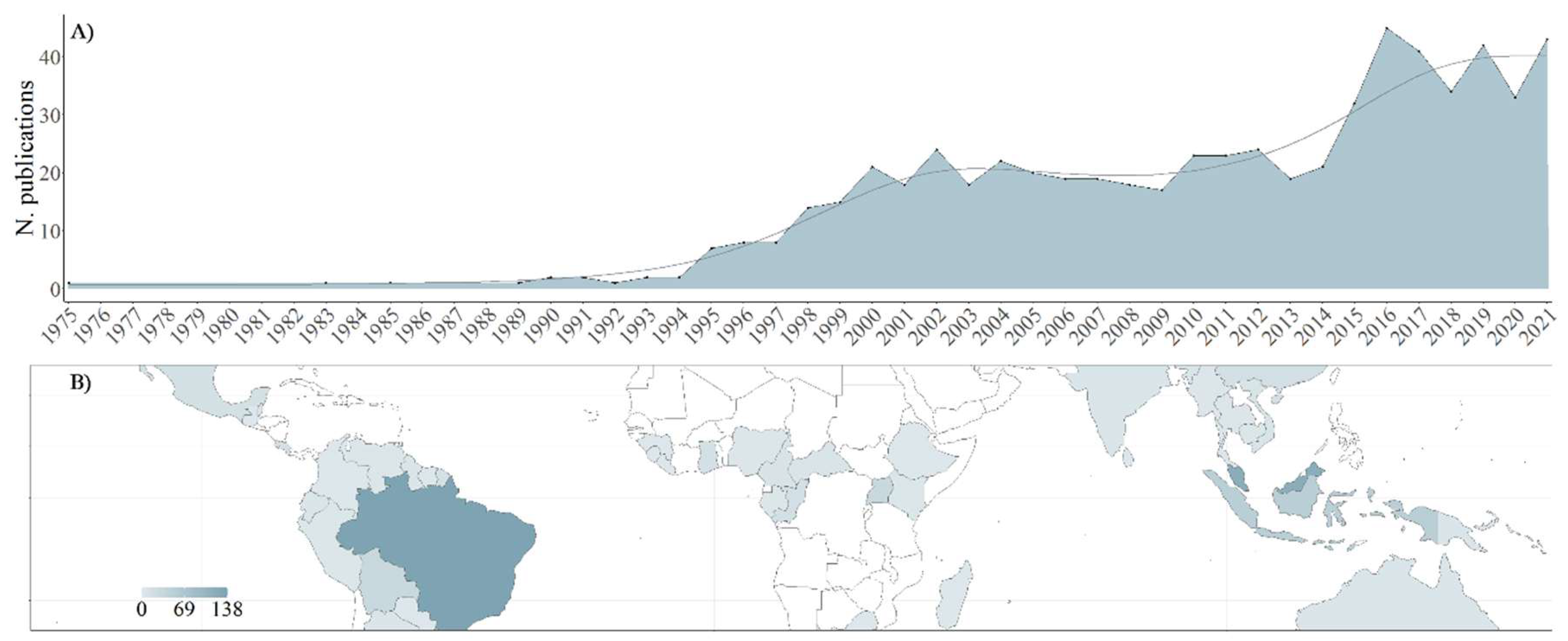
Figure 2.
Number of papers per topic/impacts posed by selective logging on tropical forests across the four major regions plus papers addressing more than one region (Pantropical). Papers from 1970 to 2021 available in the Scopus platform and selected according to criteria in Table 1. Vertical dashed line represents a threshold to highlight the topics with less than 20 publications.
Figure 2.
Number of papers per topic/impacts posed by selective logging on tropical forests across the four major regions plus papers addressing more than one region (Pantropical). Papers from 1970 to 2021 available in the Scopus platform and selected according to criteria in Table 1. Vertical dashed line represents a threshold to highlight the topics with less than 20 publications.
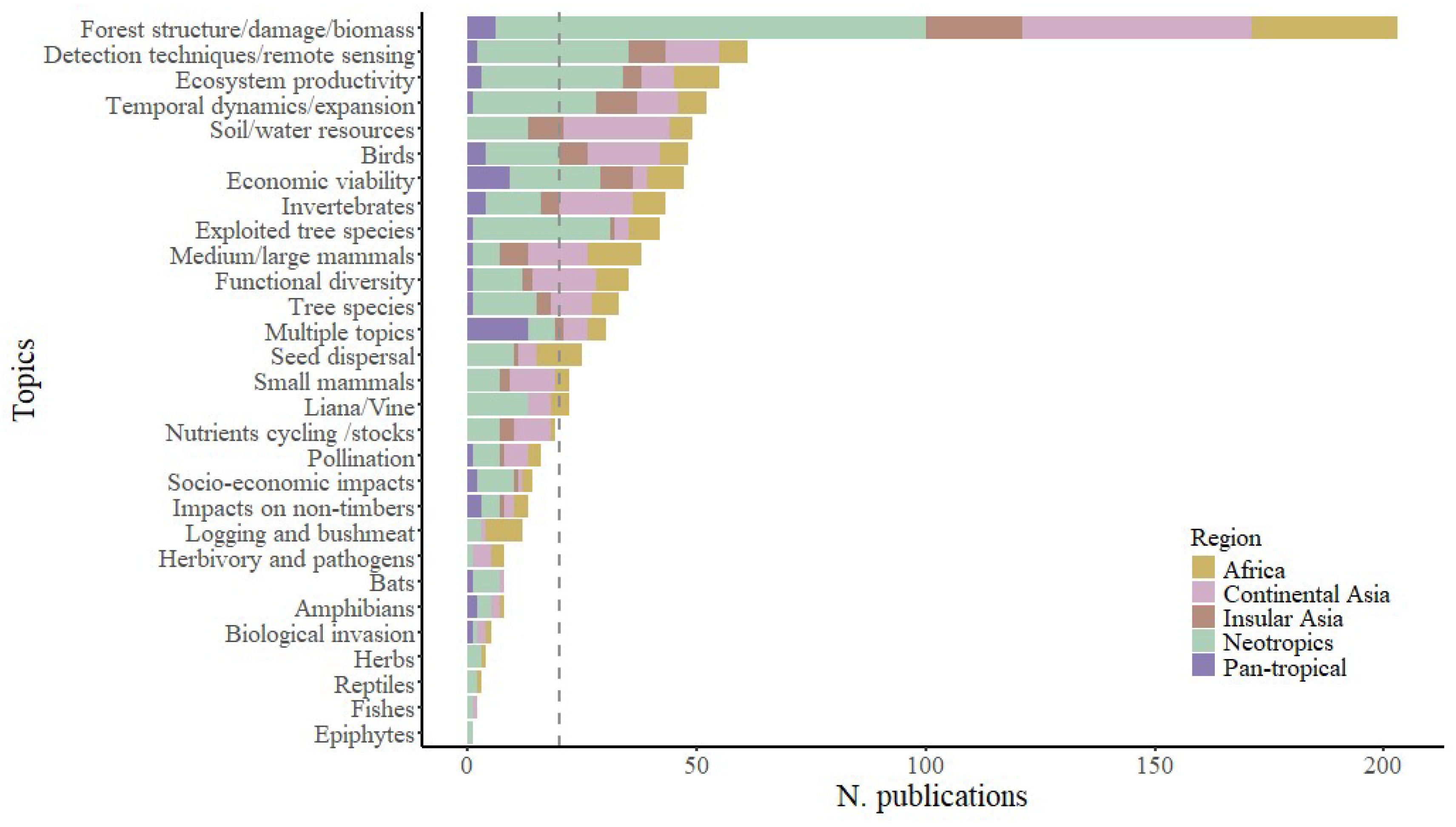
Figure 3.
Number of papers addressing the impacts by selective logging classified according to effect drivers and the tropical major regions. For Intensity (C), low values correspond to 30 m3 or less; medium, 31-50 m3; and high intensity is more than 50 m3. Papers from 1970 to 2021 available in the Scopus platform and selected according to criteria in Table 1.
Figure 3.
Number of papers addressing the impacts by selective logging classified according to effect drivers and the tropical major regions. For Intensity (C), low values correspond to 30 m3 or less; medium, 31-50 m3; and high intensity is more than 50 m3. Papers from 1970 to 2021 available in the Scopus platform and selected according to criteria in Table 1.
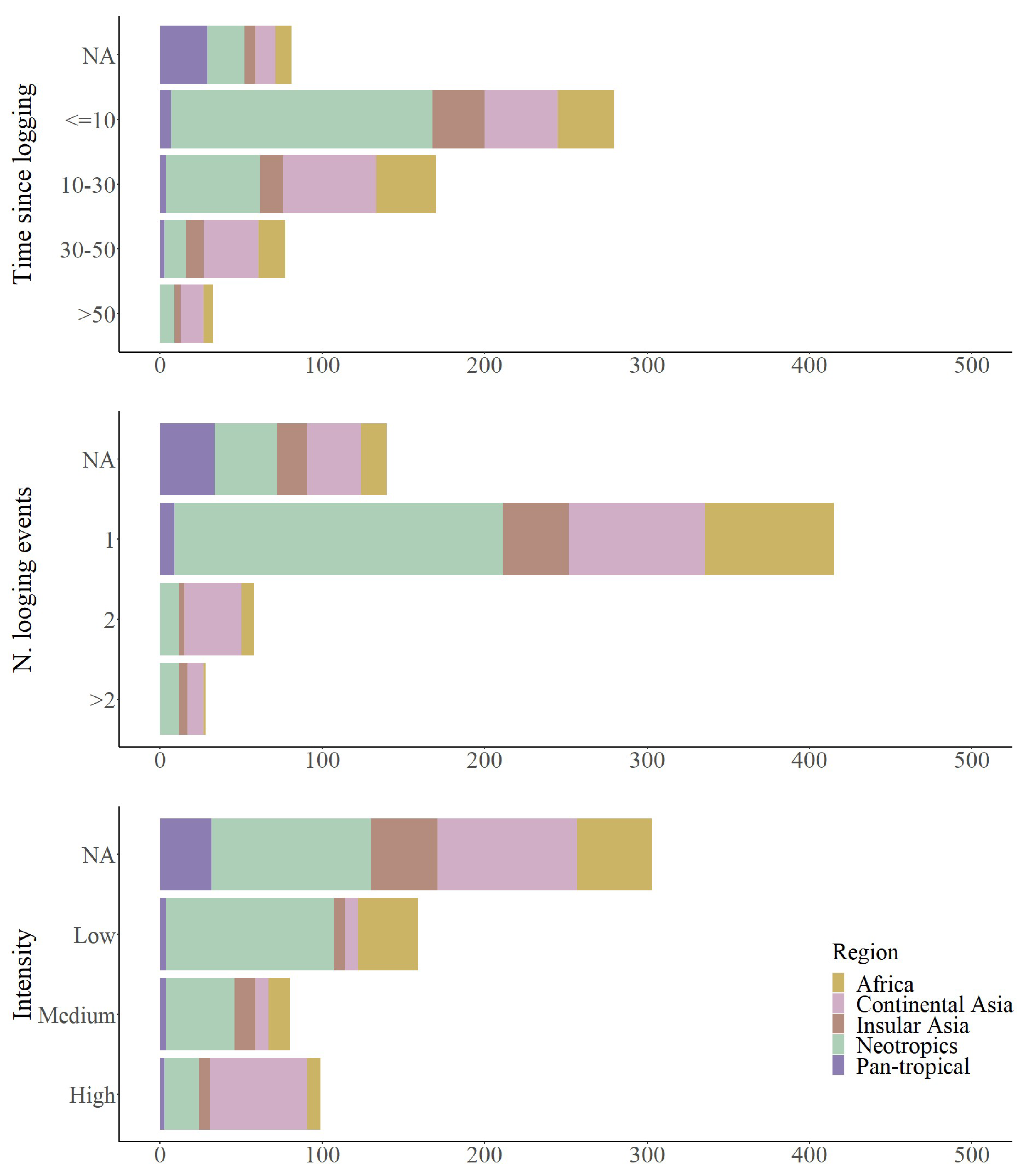
Figure 4.
Number of papers addressing the impacts by selective logging classified according to particular impacts (left), time since logging (bottom) and the number of logging cycles (right), across the major tropical regions. Papers from 1970 to 2021 available in the Scopus platform and selected according to criteria in Table 1.
Figure 4.
Number of papers addressing the impacts by selective logging classified according to particular impacts (left), time since logging (bottom) and the number of logging cycles (right), across the major tropical regions. Papers from 1970 to 2021 available in the Scopus platform and selected according to criteria in Table 1.
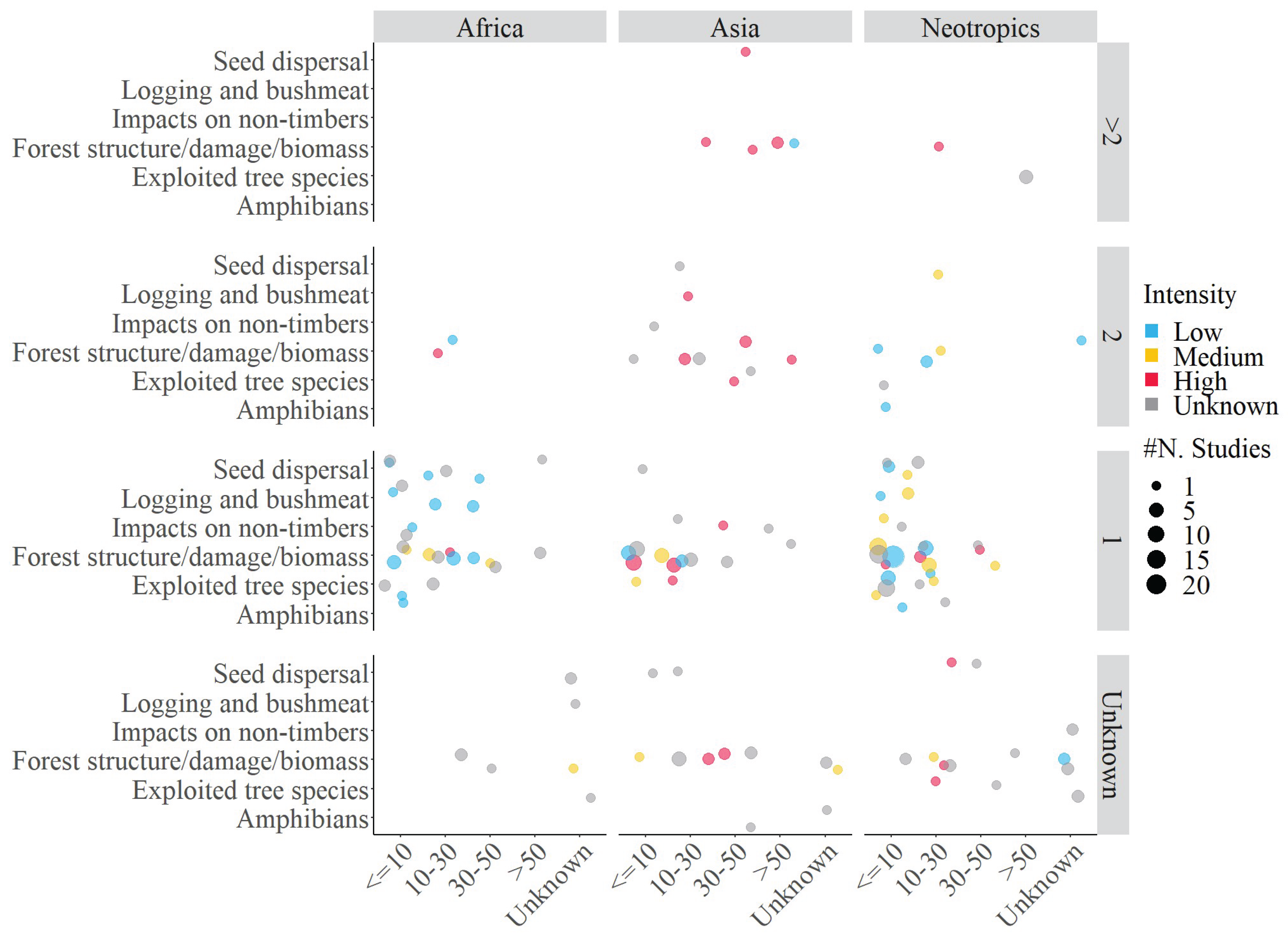

Table 1.
Review approach: Query, exclusion and inclusion criteria.
|
Identification # Query |
(TITLE-ABS-KEY (logging AND "tropical forest*") OR TITLE-ABS-KEY ("selective logging" AND "tropical forest*") OR TITLE-ABS-KEY ("logging impacts" AND "tropical forest*") OR TITLE-ABS-KEY ("timber exploitation" AND "tropical forest*") AND PUBYEAR > 1969 |
1499 |
| Screening & Eligibility | Unrelated to selective logging | -638 |
| Publications that involve a general debate | -71 | |
| Publications that do not represent original research (e.g., comments, letters, editorials) | -9 | |
| Grey literature (e.g., book chapters, notes, technical papers, theses and conference proceedings) | -140 | |
| Inclusion | Full scoping | 641 |
Table 2.
Variables, categories and description used to classify the articles involved in this review.
Table 2.
Variables, categories and description used to classify the articles involved in this review.
| Variables | Categories | Description |
|---|---|---|
| Regions | Neotropical | Brazil, French Guiana, Ecuador, Colombia, Suriname, Venezuela, Bolivian... |
| Africa | Ghana, Congo, Uganda Kenya, Gabon, Nigeria... |
|
| Continental Asia | India, Malasia, Vietna, Thailand, Camboja, Laos, Myamar, China... | |
| Insular Asia | Indonésia, Borneo, Filipinas... | |
| Pan-Tropical | More than one region | |
| No. of logging events | 1 | First cycle |
| 2 | Second cycle | |
| > 2 | More than two cycles | |
| Time elapsed since the last logging event | ≤ 10 | Less than 10 years |
| 10-30 | Between 10 and 30 years | |
| 30-50 | Between 30 and 50 years | |
| > 50 | More than 50 years | |
| Logging intensity | low | ≤ 30 m³ / ≤ 4 ind. ha-1 |
| medium | 31-50 m³ / 5-10 ind. ha-1 | |
| high | > 50 m³ / > 10 ind. ha-1 |
Table 3.
Major topics, main issue and suggested reading covered by the reviewed articles.
| Major topics | Main issue | Suggested reading |
|---|---|---|
| Species richness and community organization | Amphibians | (Fredericksen & Fredericksen, 2004) |
| Birds | (Cosset et al., 2021) | |
| Bats | (Castro et al., 2022) | |
| Epiphytes | (Benítez et al., 2012) | |
| Exploited tree species | (Dionisio, 2020) | |
| Fishes | (Martin-Smith, 1998) | |
| Herbivory and pathogens | (Duclos et al., 2013) | |
| Herbs | (Costa & Magnusson, 2002) | |
| Invertebrates | (Moura et al., 2021) | |
| Liana/Vine | (Addo-Fordjour et al., 2020) | |
| Medium/large mammals | (Granados et al., 2019) | |
| Small mammals | (Malcolm & Ray, 2000) | |
| Reptiles | (Vonesh, 2001) | |
| Tree species | (Adekunle et al., 2010) | |
| Ecosystem level processes | Forest structure/damage/biomass | (Romero et al., 2021) |
| Functional diversity | (Han et al., 2021) | |
| Nutrients cycling /stocks | (Tchiofo Lontsi et al., 2020) | |
| Pollination | (Schleuning et al., 2011) | |
| Seed dispersal | (Boissier et al., 2020) | |
| Soil/water resources | (Chiti et al., 2016) | |
| Biological invasion | (Veldman et al., 2009) | |
| Socioeconomic aspects | Logging and bushmeat | (Brodie et al., 2015) |
| Ecosystem productivity | (Piponiot et al., 2019) | |
| Impacts on non-timbers | (Rist et al., 2012) | |
| Economic viability | (Krueger, 2004) | |
| Socio-economic impacts | (Schwartz et al., 2017) | |
| Analytical tools | Temporal dynamics/expansion | (Lima et al., 2019) |
| Detection techniques/remote sensing | (Milodowski et al., 2021) |
Disclaimer/Publisher’s Note: The statements, opinions and data contained in all publications are solely those of the individual author(s) and contributor(s) and not of MDPI and/or the editor(s). MDPI and/or the editor(s) disclaim responsibility for any injury to people or property resulting from any ideas, methods, instructions or products referred to in the content. |
© 2026 by the authors. Licensee MDPI, Basel, Switzerland. This article is an open access article distributed under the terms and conditions of the Creative Commons Attribution (CC BY) license.
Copyright: This open access article is published under a Creative Commons CC BY 4.0 license, which permit the free download, distribution, and reuse, provided that the author and preprint are cited in any reuse.


