

Submitted:
29 April 2026
Posted:
30 April 2026
You are already at the latest version
Abstract
The outermost region of the Solar System is called Oort cloud which is the Solar systems’ reservoir of long-period comets that extends to distances up to 200 000 au from the Sun. Long-period comets can be injected towards the inner Solar System due to galactic tides and passing stars. While galactic tides are effective on long time scales, perturbations of stellar flybys are short-term effects that have not only occurred in the past. Gaia observations confirmed that the solar system will experience a close flyby of the K-type star Gliese 710 in about 1.3 Myrs. This star will probably pass at a distance of about 10500 au to the Sun. When crossing the Oort cloud this 0.6 solar mass star will perturb the long-period comets especially those objects that are close to Gliese 710’s trajectory. In this numerical investigation, we use our recently developed GPU based N-body code GANBISS and study the orbits of some hundred million test-comets for the time of the stellar flyby which takes about 64000 years. The simulations show that the stellar passage generates cometary streams - which either transport comets into the inner solar system or scatter a huge amount of comets into interstellar space.
Keywords:
Oort cloud
; long-period comets
; stellar flyby
1. Introduction
Our solar system is surrounded by a hypothetical cloud of comets that may extend up to 200000 au, known as the Oort cloud, named after the Dutch astronomer J. Oort, who suggested in 1950 that there might be a reservoir of long-period comets far beyond the planets in order to explain the observations of long-period comets [1]. This idea was originally proposed by the Estonian astronomer E.J. Öpik in 1932, which is why it is also called the Öpik-Oort cloud. However, this theory has not yet been confirmed but is widely accepted. In 1986 Heisler & Tremaine showed the influence of galactic tides on the cometary dynamics in this region [2]. Afterwards, many studies were dedicated either to estimate the number of comets in the Oort cloud (see e.g. [3,4]) or to investigate the origin of the Oort cloud – see e.g. [5,6,7,8] or the review articles [9,10,11] that provide an excellent overview of the current knowledge regarding the formation and evolution of Oort cloud as well as additional references.
Since we cannot directly observe comets in the Oort cloud, our knowledge is based on the analysis of observed long-period comets (see e.g. [12]), which also provide clues about the structure of the Oort cloud ([13,14,15,16]). In principle, it can be distinguished between an inner and an outer Oort cloud where the latter is the spherical Öpik-Oort cloud which extends from to au. For the inner Oort cloud there are two models:
(i) A spherical inner cloud between 2 000 and 5 000 au which is called Hills-Oort cloud [17]. It is fully thermalized and contains a larger number of comets than the Öpik-Oort cloud; or
(ii) An inner disk, which extends up to 10 000 au and is aligned with the ecliptic.
Without observation, it is not possible to determine which model reflects reality. But, if the hypothetical planet 9 is found, then the inner disk model can be ruled out [18].
However, recently Nesvorny et al. [5] published a numerical study where they showed an interesting new feature for the inner Oort cloud: A spiral structure that formed during the first hundred million years after the formation of the solar system and has existed for billions of years. So far, it has not been analyzed whether, or to what extent, planet 9 or a passing star might influence the spiral structure. In the present study we focus on the Öpik-Oort cloud where the K-type star Gliese 710 will pass through in about 1.29 million years without entering the inner Oort cloud, therefore, we did not specify the model of the inner Oort cloud.
The dynamics in the outer region of the Oort Cloud is characterized by the interaction of forces between galactic tides and passing stars, which together inject long-period comets into the inner Solar System [19]. Thus, the study of stellar passages is of great interest as such events – even if they are rare – can enhance comet showers which could increase the impact risk on Earth. Since Gliese 710 will approach within 10 500 au of the Sun, reaching thus the inner edge of the spherical Oort cloud, it very likely triggers comet streams in both directions – toward the Sun and into the interstellar space.
This K star is still about 19 pc away, has a brightness of magnitudes, and can be observed with a telescope in the constellation Serpens Cauda. Its approach to the Sun was first mentioned by Garcia-Sanches et al. in 1997 at the 23rd IAU meeting in Kyoto where the encounter with the solar system was found in Hipparcos data (see [20]). Observations of the European spacecraft Gaia confirmed the flyby of Gliese 710 in all data releases (DR1 - DR3). In 2022 Bailer-Jones [21] showed that according to Gaia DR3, this flyby will be the closest within the next 12 million years and there has been a similar stellar flyby in the past of the G3 star HD 7977 about 2.8 million years ago. This stellar passage was found in Gaia DR2 with an encounter distance of about au to the Sun which is much smaller using Gaia DR3, namely au [21]. However, in the study by Dybczyński et al. in 2022 [22] a mean flyby distance of au has been published using Gaia EDR3.
In the case of Gliese 710 as well, the various observations yield different flyby distances from the Sun:
(i) Gaia DR1 indicated an encounter distance to the Sun of 13 365 au in about 1.35 Myrs [23];
(ii) Gaia DR2 suggested a flyby distance of au from the Sun [24];
Here, we should also mention a study [25], which combined Hipparcos data, Gaia observations and numerical calculations, resulting in a flyby distance of Gliese 710 of au from the Sun.
(iii) Gaia DR3 changed the flyby distance and time to about 10 500 au and 1.294 million years, respectively.
The last distance was calculated by ourselves and was used for this study. Note that a similar value for the flyby distance was published by [26]. Using the flyby parameters of Gaia DR3, we studied the motion of 168 million comets which will be influenced by the passage of Gliese 710 through the Oort cloud. For the first time, a GPU N-body code [27] was used to compute the dynamical behavior of the comets perturbed by the stellar flyby. In this study, we first describe the dynamical model, the numerical method, and the initial configuration of the Oort cloud comets. Then we show the perturbations of the stellar flyby which trigger comet streams of nearly 5 000 objects into the observable region of the solar system. More than 1000 of these objects indicated that they would approach the Sun to distances close to or inside the orbit of Earth. However, if we also take into account the perturbations caused by the planets of the outer solar system, it becomes clear that the gas giants prevent comets from entering the inner solar system.
2. Dynamical System
Gliese 710 has about 0.6 solar mass and approaches the solar systems with a velocity of 14.4 km/s which is much slower than stars in the solar neighborhood [19]. With respect to the Sun, the K star moves along a hyperbolic orbit, which appears as a straight line due to its high eccentricity (see Figure 1 left panel). In the right panel of Figure 1 the distance from the Sun is shown from the moment Gliese 710 enters the purple shaded region which denotes the semi-major axis range of the Öpik-Oort cloud ( to au).
Of course we are aware of the fact that the Oort cloud may extend to distances from the Sun up to 200 000 au as cometary orbits with semi-major axes of 100 000 au might have high eccentricities (close to 1) so that these comets will populate also the region outside the purple shaded area in the right panel of Figure 1. However, in this area, the density of objects continues to decrease, and the further away we are from the Sun, the more effective the influence of the galactic environment becomes. Since we only want to analyze the influence of the passing star, we will limit ourselves to the purple shaded area in this study.
The right panel of Figure 1 indicates that the K star only needs 64 000 years to cross this region when considering a flyby distance to the Sun of 10 500 au which resulted from Gaia DR3. This distance vary greatly depending on the observations. We used the values from Gaia DR3, as these were the latest observational data available when this study was conducted.
Since Gliese 710 is currently pc away from the Sun thus, we first propagated its orbit to the distance of 100 000 au from the Sun, which led to the initial orbital data for Gliese 710 (Table 1) for our fly-by study.
As Oort Cloud model we usually considered an inner disk which extends up to 10 000 au followed by a spherical cloud up to 100 000 au (in semi-major axis). According to the data from Gaia DR3 it seems that the orbit of Gliese 710 is inclined with respect to the solar systems’ ecliptic, which would be important if the star enters the disk of the Oort cloud.
In our numerical study we considered Oort cloud comets with semi-major axes a between 10 000 and 100 000 au with a uniform distribution in orbital energy . The eccentricity encompasses all possible values for elliptic motion, but also parabolic and hyperbolic trajectories. To figure out the perturbations of the passing star we considered in our sample only objects with peri-center distances au. The initial inclinations (i) were randomly chosen between 0 and 180 degrees. All other angles (longitude of ascending node , argument of peri-apsis and mean anomaly M) were between 0 and 360 degrees.
Assuming that there are 600 billion (or even 1 trillion) comets larger than 1 km (see [28] or [29] in the Oort Cloud, restrictions must be made, as such a large number of objects (even if they are massless) cannot be processed in numerical simulations within a reasonable time even with a GPU N-body code. First at all, our investigation was limited to the region that will be directly exposed to the influence of Gliese 710 when it passes by the Sun. In order to achieve in our numerical simulations approximately the same object density like in the Oort Cloud (which we assumed to be 0.0002), we proceeded as follows:
(i) We divided the spherical Oort cloud into 4 shells; and
(ii) We did not consider the entire Oort Cloud, but only the sphere of influence (SOI) of Gliese 710 along its trajectory.
In each shell the SOI of Gliese 710 was filled with 42 million objects and was computed separately.

Table 2.
Shell structure of the spherical Oort cloud defined for our numerical simulations.
| Shell | Extension [au] |
|---|---|
| Spherical cloud shell S1: | |
| Spherical cloud shell S2: | |
| Spherical cloud shell S3: | |
| Spherical cloud shell S4: |
2.1. The Sphere of Influence
The sphere of influence (SOI) is defined as the region around a celestial body where its gravity dominates over the gravitational influence of other bodies. Thus, in this area the gravitational perturbations from the Sun are negligible, so that a two-body approximation could be used to calculate the cometary orbits.
We are using the term “sphere of influence” here in a more general context and study its extension around Gliese 710 using different approaches.
(i) SOI as know in celestial mechanics:
The area of the SOI is determined by the radius:
where d is the distance of Gliese 710 from the Sun, m and are the masses of a planet or in our case Gliese 710 and the Sun, respectively.
In orbit dynamics, the SOI is mainly used to switch between reference frames, making it easier to transform trajectories relative to the Sun into trajectories relative to a planet. The application to Gliese 710 with au yielded a quite large SOI (see Table 3), where the area is most likely also influenced by the Sun.
(ii) Hill radius:
Another option to determine the area influenced by Gliese 710 is the Hill sphere which is defined by:
where , and are again the distance, the mass of Gliese 710 and the mass of the Sun. Generally, the Hill sphere defines the region where a satellite’s orbit is stable against perturbation from a larger, distant body. If we apply it to Gliese 710, Table 3 shows that the resulting area still crosses the midpoint of the distance from the Sun. Thus, the influence of the sun would not be negligible in this region.
(iii) Lagrange point :
The Lagrange points to are equilibrium positions in the restricted three body problem where a small object can maintain a constant position relative to the two larger masses (for details, we refer to [30]). to are called collinear equilibrium points that have their positions along the connecting line of the two masses and . In our study, is of special interest as it separates the region between the two stars in two areas so that the third body moves either around the Sun () or around the secondary ( i.e. Gliese 710).
For the determination of the position of it is not possible to use the simple "Hill sphere" approximation if the two mass are similar. According to [30]), the distance of relative to the secondary star – which is Gliese 710 can be calculated by:
where and with solar mass . Thus, for the Sun and Gliese 710 at 10500 au, the position of is between the two stars, about 4361 au from Gliese 710 and about 6139 au from the Sun. The resulting areas do not overlap and thus provide a better and more realistic result for the sphere of influence of Gliese 710.
(iv) S-type stability:
Finally, we considered the Sun and Gliese 710 as a binary star system and applied the stability limits of the S-type motion ([31,32]) for a distance of 10 500 au between the two stars; assuming zero eccentricity as the first approximation and , the study [32] yields a stability radius of 2 310 au. Similarly, the stability region around the Sun is 3 392 au (for ).
We must, of course, point out here that the S-type stability limits were determined for the bound motion of binary stars, which is not the case for Gliese 710. However, we used the known limits to define a region around Gliese 710 where gravitational perturbations from the Sun can be ruled out.
A comparison of the size of the SOI of Gliese 710 when applying the various methods is shown in Table 3.
The size of the areas in Table 3 for the various approaches make clear that the first two methods ( and ) cannot be applied to objects of similar mass – as both defined areas extend beyond the midpoint of the Sun–Gliese 710 distance so that we cannot rule out the gravitational influence of the Sun.
Based on the various stability studies of binary stars that have been carried out in our group, we have chosen the value of the S-type stability limit to be the most reasonable solution. Here, both stars have spheres of influence that do not overlap, and there is a region in between where the gravitational forces of both stars are at work, which can lead to chaotic motion of the comets. Furthermore, by using a radius of 2310 au for the SOI, we can more easily achieve an object density that might, to some extent, be close to a realistic one.
3. Numerical Method
Even though the Oort Cloud contains billions or possibly a trillion comets, the distance between the objects1 is so large that interactions between the comets can be ruled out. Therefore, our numerical investigation can be reduced to the restricted problem where only the Sun and Gliese 710 are massive bodies and the comets are mass-less objects which do not interact and have no influence on the orbits of the two stars.
To calculate all interactions in the N-body and the restricted N-body problems, we use our recently developed GPU N-body code GANBISS2. In addition to the calculation of the interactions of all N massive bodies, the code also calculates their effects on the M massless bodies at each timestep. The equation of motion for a massive body unde the influence of all other massive bodies is as follows:
where and are the respective position vectors and its scalar distance, and k the Gaussian gravitational constant. The computational complexity of the N-body problem scales with , since the influence of all other objects must be calculated for each object.
The equations of motion for the restricted N-body problem are written slightly differently, since the interactions between the massless objects can be neglected. Therefore, the equation of motion for a massless object under the influence of N massive objects is written as follows:
The computational complexity scales therefore with .
To solve the equation of motion, the Bulirsch-Stoer method [33] with adaptive step size control is used. For the computations, a value of is used for the error tolerance. The calculations were performed on NVIDA A100 and NVIDIA A40 and allowed the calculation of million massless objects.
3.1. Initial Set-Up of Oort Cloud Comets
As mentioned earlier, we have set the radius for Gliese 710’s SOI to 2 300 au for our study. Thus, the SOI corresponds to the stability zone of Gliese 710 when considering a binary star system (together with the Sun) with stellar distance of 10 500 au. Figure 2 shows the initial distribution of the comets in the SOI of Gliese 710 along its trajectory where the different colors denote the different shells (S1-S4) as discussed in Section 2. The orange section shows the outermost shell S4, where Gliese 710 enters the Oort Cloud at 100 000 au. The purple area (S1) at the bottom marks the encounter distance of 10 500 au of Gliese 710 to the Sun. The red line on the cylinder marks the path through which Gliese 710 will pass.
4. Results
When Gliese 710 passes through the cylinder shown in Figure 2, the comets are subjected to gravitational perturbations that alter their orbits. The extent of the immediate impact caused by the stellar flyby is shown in Figure 3. As before, the different colors represent the objects of the various shells. The yellow dot indicates the position of the Sun, and the red line marks the path of Gliese 710 passed through. The data in this figure correspond to the moment when the K-type star is at 10 500 au, i.e., at the closest distance to the Sun in its current orbit.
After Gliese 710’s passage, the comets are no longer arranged symmetrically around the red line. There is a very strong dispersion toward the positive x-axis, which actually extends to 100 million au — though this is not visible here, as we want to focus on the near end of the passage path. Objects located so far beyond the boundary of the Oort Cloud are no longer bound to the solar system and are thus classified as interstellar objects (ISOs), which travel freely through the galaxy. Changes along the y-axis appear to occur in the region of the negative x-axis, where a stream of objects toward the sun is visible. Some inward moving comets are also visible on the positive x-axis – see, e.g., the yellow dots in the blue region. Changes in the z direction are most evident for the orange and blue dots, where Gliese 710’s passage — and thus its gravitational disturbances — occurred some time ago. This means that in the inner regions (green and purple dots), such changes may not become visible later, when Gliese 710 is farther out again.
A detailed overview of the effects of Gliese 710 perturbations in the various directions of the coordinate vector is shown in Figure 4. The left top panel of Figure 4 shows the perturbations in the x-y plane where the cometary streams in y direction towards the Sun are better visible than in the 3D Figure 3. It shows that most comets move towards the Sun along a line at x=0 au. This stream points towards the location of the Sun which differs from the path of the passing star. Both top panels of Figure 4 show a strong scattering along the positive x-axis, which indicates cometary flows into interstellar space. In z-direction (Figure 4 right top panel) there is some spread of comets of the outermost shell (orange dots) visible that are probable attracted by Gliese 710 before entering the Oort cloud. Furthermore, both figures show that the comets closest to the Sun (purple region) have been shifted in the negative x-direction when Gliese 710 passes at 10 500 au, which is probably caused by the combined force of Sun and Gliese 710. In the bottom panel — which shows the y-z plane — the original cylinder is still the best preserved. The spread in the z-direction is more clearly visible here, although it is small compared to the extent in the positive x-axis direction. But it shows, that not only comets of the outermost shell (orange area) are scattered out in z-direction but also some objects from the other shells.
Analyzing the 168 million cometary orbits that were distributed in the SOI of Gliese 710, of which about 100 million objects were initially on bound orbits and 68 million objects on parabolic and hyperbolic orbits, the passage led to the following result:
- From the 168 million test comets in the SOI of Gliese 710 about 90 million escaped, namely all that moved initially in hyperbolic and parabolic orbits and in addition 22 million of the initially bound objects.
-
66 614 Objects indicate perihelion distances q < 70 au after Gliese 710’s passage where
- −
- 33 912 objects comets are immediately heading toward the Sun;
- −
- 23 991 objects are still in their initial shells but show a motion in the direction to the Sun; and
- −
- 8 711 objects have orbits that point outward.
4.1. Perihelion Distances of Oort Cloud Comets After the Passage of Gliese 710
Figure 5 shows all comets with perihelion distances au after Gliese 710’s passage. The different colors indicate objects of the different shells and the horizontal lines mark either the location of Jupiter (red line) or that of Earth (blue line). According to our study about 4 900 objects could enter the observable region of the solar system, i.e. au which is indicated by the red line. From the 4 900 comets, 4326 are immediately heading the Sun, and 574 objects move first outward. Moreover, 1 074 comets indicated perihelion distances within 1.2 au of which 26 Objects have a perihelion close to Earth’s orbit.
It is well known that comets with q < 70 au enter the region where the gravitational influence of the gas giants (Jupiter to Neptune) becomes significant. Consequently, the outer solar system must be included in the calculations to determine the future evolution of their orbits. Our computations of the dynamical evolution of the 4326 comets with au that are immediately heading the Sun finally show that only those comets with initial semi-major axes au could enter the observable range (see Figure 6). In other words, even though it appears, after Gliese 710’s passage, that comets from all shells are expected to enter the observable region, the gravitational influence of the planets apparently prevents comets from the outer regions (blue and orange dots) from doing so.
This means that significantly fewer comets enter the observable range than indicated by the flyby results.
4.2. Comets with q in the Observable Region
Consequently, we calculated the trajectories of objects with au over one million years and selected those objects that, during the calculation period, reached distances from the Sun of less than 50 au (see Figure 7). The simulation of the cometary orbits was carried out in the gravitational field of the outer solar system for one million years with output every 100 years, and it shows that about 183 objects approached the solar system to distances au. The horizontal line in Figure 7 marks the distance of Jupiter from the Sun, which is currently considered to be the boundary of the observable region.
Since all comets were originally located beyond 5 000 au, it took some 100 000 years for objects to reach the outer solar system, which can be clearly seen in Figure 7. The cumulative distribution of r shows that half of the objects in Figure 7 were able to enter the planetary system, i.e. AU. To the right of the plot is a color scale that indicates the perihelion distance of the objects at the time shown in the graph. This scale shows that the perihelion distances of all objects are well within the observable region, i.e. under the horizontal line. Although all the objects in Figure 7 have a perihelion within au, only 7 objects entered this region during the calculation period considered. This indicates that comet streams might exist in direction to the inner solar system probably over several million years – where the elongated ellipses of the comets will bring them from far out toward the Sun.
In Figure 8 we show the changes in q for the plotted time relative to the initial value. Negative values move q closer to the Sun, and positive values move it farther away. The color scale shows that for most comets, the perihelion distances do not change significantly (green and orange dots). 11 objects (blue dots) show the largest changes in q towards the Sun, and for three objects (red dots), q has been moved further outwards due to the gravitational influence of the planets.
5. Discussion
Our numerical study of the stellar flyby of the K-type star Gliese 710 in about 1.29 Myrs was performed to figure out the direct effects of the stellar perturbation on the dynamics of long-period comets in the Oort cloud. Previous studies on this topic have used the impulse approximation (see e.g. [13,19,22,34,35]), whereas in this study we performed N-body simulations. We applied the restricted problem (i.e. the comets are massless) because we had to consider 168 million objects. Even though, only objects within the sphere of influence along the star’s path toward the Sun were taken into account, but these are undoubtedly the objects that were most severely affected, since they were closest to the star. Furthermore, all comets initially had perihelion distances greater than 70 AU, which meant that the planets of the outer solar system did not need to be included in the calculations; therefore, changes in the comets’ dynamical behavior could be attributed to perturbations caused by the passing star.
The results shown in Section 4 are, in effect, snapshots taken at the time of Gliese 710’s next closest approach to the Sun – i.e., when the star is at 10 500 au from the Sun. In our study, we could show that the passage of Gliese 710 might cause strong cometary streams into the interstellar space – or more precisely, more than half of the comets (%) in the SOI were ejected from the solar system and only comets on initially bound orbits could survive the stellar passage. In contrast, the cometary stream heading toward the Sun is very small and accounts for less than one-tenth of a percent of the objects in the SOI. Nevertheless, the number of comets moving toward the Sun as a result of the stellar flyby seems enormous — namely, more than 66 000. Of these, nearly 5 000 comets indicated to enter the observable region; and of these more than 1 000 objects have a perihelion distance au and thus might come close to our Earth or cross Earth’s orbit.
However, for objects moving toward the Sun, one must also take the influence of the planets into account, which is necessary when q < 70 au. If we consider the dynamical evolution of approximately 5 000 cometary orbits in the outer Solar System, the number of observable comets is reduced due to planetary influences. It turns out that, in fact, only comets with an initial semi-major axis of less than 50 000 au can enter the observable region. Our calculations show that, after the flyby, it takes around 400 000 years for the first of the comets that have been deflected towards the Sun to reach the region of Neptune. It takes 600 000 to 700 000 years before the first comet enters the observable region.
Our calculations of cometary orbits covered a period of one million years and showed that, during this time, 183 comets entered the Solar System (at distances of < 50 AU). Of these, 7 comets reached the observable region. Examining the dynamical evolution of cometary orbits over a longer period requires taking into account galactic tides, which play an important role in long-term analyzes. The interplay of stellar perturbations and galactic tides has been analyzed for Oort cloud comets in a series of papers by H. Rickman, G. Valsecchi, M. Fouchard, M. Sailenfest, A. Higuchi and others (see [13,14,15,34,35]). We are, of course, aware that the influence of galactic tides must also be taken into account when studying long-period comets over a long time.
This study used, for the first time, N-body simulations to demonstrate the perturbations in the Oort cloud caused by a stellar flyby. Moreover, we selected an object density within the passing star’s sphere of influence that, based on our understanding of the Oort cloud, can be considered approximately realistic. Our computations have shown that more than half of the comets within the passing star’s sphere of influence were scattered into the interstellar space, nearly 5 000 comets would enter the observable region after the flyby, and more than thousand of these comets could approach Earth or cross its orbit, posing a potential threat.
However, further calculations of the comet streams directed toward the Sun changed this result significantly: Only objects with semi-major axes within 50 000 au can enter the observable region. And the consideration of planetary perturbations showed that finally only a few objects enter the near-Earth region – as shown in Figure 9 which presents the number of comets with perihelion distances in the vicinity of the terrestrial planets.
Figure 9 shows that at the beginning of the computations over one million years about 17 comets had their perihelion distances somewhere in the inner solar system between the Sun and the asteroid belt except between Venus and Earth. However, after computations including planetary perturbations, only three objects were found with perihelion distances between Mars and the asteroid belt – this is indicated by the hatched area in Figure 9.
Hence, our computations revealed that the gas giants protect us from cometary streams originating in the outer regions of the Oort Cloud. This result is in good agreement with the study by [12] on the Jupiter-Saturn barrier, which causes a sharp decline in the influx of new comets into Earth’s neighborhood.
This numerical study has shown that there is no risk of a comet impact on Earth, at least for a million years following the flyby of Gliese 710. However, in order to assess the full extent of the potential risk, long-term calculations are required that also take into account the influence of galactic tides. This will be investigated in a future study.
Author Contributions
Conceptualization, E.PL. and B.L.; methodology, E.PL.; software, M.Z..; validation, E.PL., M.Z. and B.L.; formal analysis, E.PL.; investigation, B.L. and .M.Z.; resources, M.Z. and B.L.; data curation, E.PL., M.Z. and B.L.; writing—original draft preparation, E.PL.; writing—review and editing, E.Pl. and M.Z.; visualization, E.PL. and M.Z.; supervision, E.PL.; project administration, E.PL.; funding acquisition, E.PL. All authors have read and agreed to the published version of the manuscript.
Funding
This research was funded in whole by the Austrian Science Fund (FWF) P33351-N.
Data Availability Statement
The data underlying this article is available in Phaidra, at https://phaidra.univie.ac.at/o:2328635.
Acknowledgments
The authors want to thank Dr. D. Hestroffer for determining the orbital data of Gliese 710 from Gaia DR3; Dr. M. Fouchard and Dr. M. Sailenfest for helpful discussion about the dynamics of Oort cloud comets. The computational results have been achieved using the Austrian Scientific Computing (ASC) infrastructure (projects 71637, 71686, 70320).
References
- Oort, J.H. The structure of the cloud of comets surrounding the Solar System and a hypothesis concerning its origin. Bull. Astron. Inst. Neth. 1950, 11, 91–110.
- Heisler, J.; Tremaine, S. The influence of the Galactic tidal field on the Oort comet cloud. 1986, 65, 13–26. https://doi.org/10.1016/0019-1035(86)90060-6. [CrossRef]
- Kaib, N.A.; Quinn, T. Reassessing the Source of Long-Period Comets. Science 2009, 325, 1234, [arXiv:astro-ph.EP/0912.1645]. https://doi.org/10.1126/science.1172676. [CrossRef]
- Brasser, R.; Morbidelli, A. Oort cloud and Scattered Disc formation during a late dynamical instability in the Solar System. 2013, 225, 40–49, [arXiv:astro-ph.EP/1303.3098]. https://doi.org/10.1016/j.icarus.2013.03.012. [CrossRef]
- Nesvorný, D.; Dones, L.; Vokrouhlický, D.; Levison, H.F.; Beaugé, C.; Faherty, J.; Emmart, C.; Parker, J.P. A Spiral Structure in the Inner Oort Cloud. 2025, 983, 74. https://doi.org/10.3847/1538-4357/adbf9b. [CrossRef]
- Obidowski, J.C.; Webb, J.J.; Portegies Zwart, S.; Cai, M.X. Oort Cloud Formation and Evolution in Star Clusters. 2025, 987, 29, [arXiv:astro-ph.EP/2505.17246]. https://doi.org/10.3847/1538-4357/add92c. [CrossRef]
- Portegies Zwart, S.; Torres, S.; Cai, M.X.; Brown, A.G.A. Oort cloud Ecology. II. the chronology of the formation of the Oort cloud. 2021, 652, A144, [arXiv:astro-ph.EP/2105.12816]. https://doi.org/10.1051/0004-6361/202040096. [CrossRef]
- Vokrouhlický, D.; Nesvorný, D.; Dones, L. Origin and Evolution of Long-period Comets. 2019, 157, 181, [arXiv:astro-ph.EP/1904.00728]. https://doi.org/10.3847/1538-3881/ab13aa. [CrossRef]
- Morbidelli, A. Origin and Dynamical Evolution of Comets and their Reservoirs. arXiv e-prints 2005, pp. astro–ph/0512256, [arXiv:astro-ph/astro-ph/0512256]. https://doi.org/10.48550/arXiv.astro-ph/0512256. [CrossRef]
- Dones, L.; Brasser, R.; Kaib, N.; Rickman, H. Origin and Evolution of the Cometary Reservoirs. 2015, 197, 191–269. https://doi.org/10.1007/s11214-015-0223-2. [CrossRef]
- Rickman, H. Cometary Dynamics—Formation and Evolution of the Oort Cloud. Astronomy 2026, 5. https://doi.org/10.3390/astronomy5020008. [CrossRef]
- Fernández, J.A. Long-Period Comets and the Oort Cloud. Earth Moon and Planets 2002, 89, 325–343. https://doi.org/10.1023/A:1021571108658. [CrossRef]
- Fouchard, M.; Rickman, H.; Froeschlé, C.; Valsecchi, G.B. On the present shape of the Oort cloud and the flux of ;new; comets. 2017, 292, 218–233. https://doi.org/10.1016/j.icarus.2017.01.013. [CrossRef]
- Fouchard, M.; Rickman, H.; Froeschlé, C.; Valsecchi, G.B. Distribution of long-period comets: comparison between simulations and observations. 2017, 604, A24. https://doi.org/10.1051/0004-6361/201630343. [CrossRef]
- Fouchard, M.; Higuchi, A.; Ito, T.; Maquet, L. The “memory” of the Oort cloud. 2018, 620, A45. https://doi.org/10.1051/0004-6361/201833435. [CrossRef]
- Fouchard, M.; Higuchi, A.; Ito, T. What long-period comets tell us about the Oort Cloud. 2023, 676, A104. https://doi.org/10.1051/0004-6361/202243728. [CrossRef]
- Hills, J.G. Comet showers and the steady-state infall of comets from the Oort cloud. 1981, 86, 1730–1740. https://doi.org/10.1086/113058. [CrossRef]
- Nesvorný, D.; Vokrouhlický, D.; Dones, L.; Levison, H.F.; Kaib, N.; Morbidelli, A. Origin and Evolution of Short-period Comets. 2017, 845, 27, [arXiv:astro-ph.EP/1706.07447]. https://doi.org/10.3847/1538-4357/aa7cf6. [CrossRef]
- Rickman, H.; Fouchard, M.; Froeschlé, C.; Valsecchi, G.B. Injection of Oort Cloud comets: the fundamental role of stellar perturbations. Celestial Mechanics and Dynamical Astronomy 2008, 102, 111–132, [arXiv:astro-ph/0804.2560]. https://doi.org/10.1007/s10569-008-9140-y. [CrossRef]
- García-Sánchez, J.; Preston, R.A.; Jones, D.L.; Weissman, P.R.; Lestrade, J.F.; Latham, D.W.; Stefanik, R.P. Stellar Encounters with the Oort Cloud Based on HIPPARCOS Data. 1999, 117, 1042–1055. https://doi.org/10.1086/300723. [CrossRef]
- Bailer-Jones, C.A.L. Stars That Approach within One Parsec of the Sun: New and More Accurate Encounters Identified in Gaia Data Release 3. 2022, 935, L9, [arXiv:astro-ph.SR/2207.06258]. https://doi.org/10.3847/2041-8213/ac816a. [CrossRef]
- Dybczyński, P.A.; Berski, F.; Tokarek, J.; Podlewska-Gaca, E.; Langner, K.; Bartczak, P. Important stellar perturbers found during the StePPeD database update based on Gaia EDR3 data. 2022, 664, A123, [arXiv:astro-ph.SR/2206.11047]. https://doi.org/10.1051/0004-6361/202243853. [CrossRef]
- Berski, F.; Dybczyński, P.A. Gliese 710 will pass the Sun even closer. Close approach parameters recalculated based on the first Gaia data release. 2016, 595, L10. https://doi.org/10.1051/0004-6361/201629835. [CrossRef]
- de la Fuente Marcos, R.; de la Fuente Marcos, C. An Independent Confirmation of the Future Flyby of Gliese 710 to the Solar System Using Gaia DR2. Research Notes of the American Astronomical Society 2018, 2, 30, [arXiv:astro-ph.EP/1805.02644]. https://doi.org/10.3847/2515-5172/aac2d0. [CrossRef]
- de la Fuente Marcos, R.; de la Fuente Marcos, C. An Independent Confirmation of the Future Flyby of Gliese 710 to the Solar System Using Gaia DR2. Research Notes of the American Astronomical Society 2018, 2, 30, [arXiv:astro-ph.EP/1805.02644]. https://doi.org/10.3847/2515-5172/aac2d0. [CrossRef]
- de la Fuente Marcos, R.; de la Fuente Marcos, C. An Update on the Future Flyby of Gliese 710 to the Solar System Using Gaia DR3: Flyby Parameters Reproduced, Uncertainties Reduced. Research Notes of the American Astronomical Society 2022, 6, 136. https://doi.org/10.3847/2515-5172/ac7b95. [CrossRef]
- Zimmermann, M.; Pilat-Lohinger, E. GANBISS: a new GPU accelerated N-body code for binary star systems. Celestial Mechanics and Dynamical Astronomy 2023, 135, 33. https://doi.org/10.1007/s10569-023-10147-2. [CrossRef]
- Francis, P.J. The Demographics of Long-Period Comets. 2005, 635, 1348–1361, [arXiv:astro-ph/astro-ph/0509074]. https://doi.org/10.1086/497684. [CrossRef]
- Levison, H.F.; Duncan, M.J.; Brasser, R.; Kaufmann, D.E. Capture of the Sun’s Oort Cloud from Stars in Its Birth Cluster. Science 2010, 329, 187–190. https://doi.org/10.1126/science.1187535. [CrossRef]
- Murray, C.D.; Dermott, S.F. Solar System Dynamics; 1999. https://doi.org/10.1017/CBO9781139174817. [CrossRef]
- Holman, M.J.; Wiegert, P.A. Long-Term Stability of Planets in Binary Systems. 1999, 117, 621–628, [arXiv:astro-ph/astro-ph/9809315]. https://doi.org/10.1086/300695. [CrossRef]
- Pilat-Lohinger, E.; Dvorak, R. Stability of S-type Orbits in Binaries. Celestial Mechanics and Dynamical Astronomy 2002, 82, 143–153. https://doi.org/10.1023/A:1014586308539. [CrossRef]
- Stoer, J.; Bulirsch, R. Introduction to Numerical Analysis; Springer-Verlag: New York, 1980. https://doi.org/https://doi.org/10.1007/978-1-4757-5592-3. [CrossRef]
- Fouchard, M.; Rickman, H.; Froeschlé, C.; Valsecchi, G.B. The last revolution of new comets: the role of stars and their detectability. 2011, 535, A86. https://doi.org/10.1051/0004-6361/201116514. [CrossRef]
- Higuchi, A.; Kokubo, E. Effect of Stellar Encounters on Comet Cloud Formation. 2015, 150, 26, [arXiv:astro-ph.EP/1507.00502]. https://doi.org/10.1088/0004-6256/150/1/26. [CrossRef]
| 1 | It is assumed that the distance between comets is about 16 au |
| 2 | GANBISS stands for "GPU-accelerated N-body code for binary star systems".,Zimmermann2023 |
Figure 1.
Left panel shows te trajectory of Gliese 710 during the flyby and right panel displays the distance to the Sun.
Figure 1.
Left panel shows te trajectory of Gliese 710 during the flyby and right panel displays the distance to the Sun.
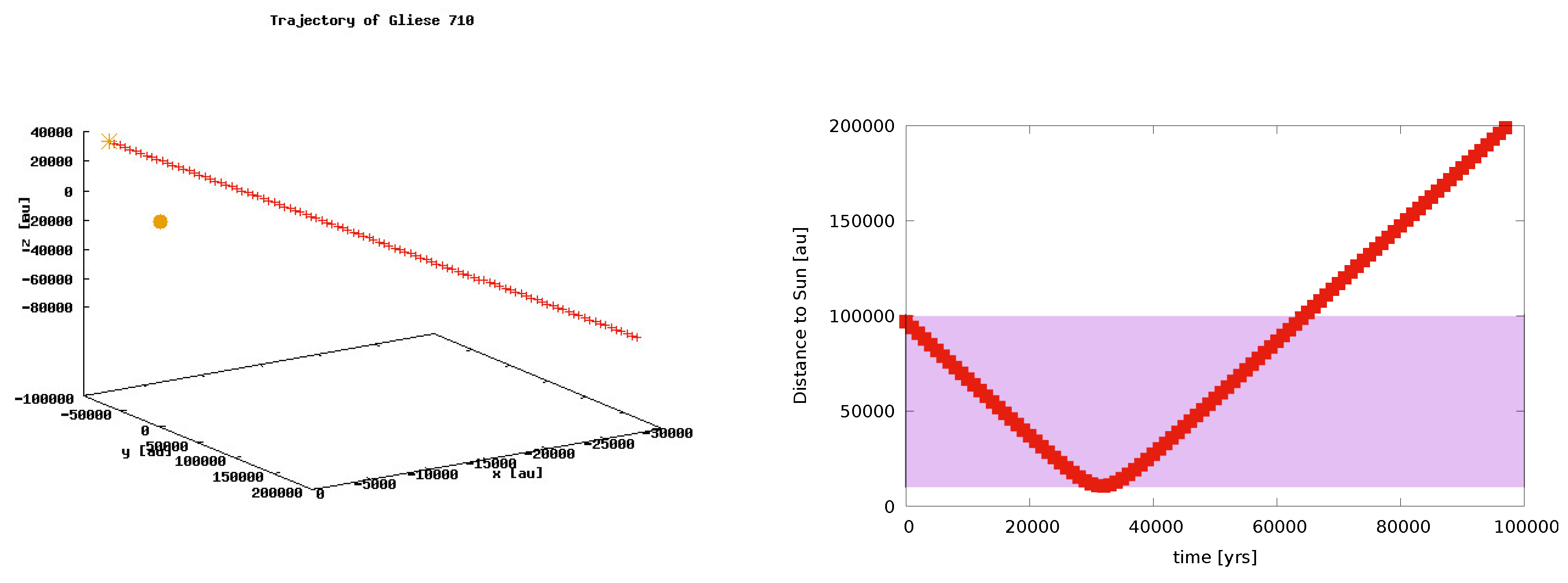
Figure 2.
Initial set-up of Oort cloud comets in the SOI along the path of Gliese 710 (red line). Different colors indicate the different shells: S1 purple, S2 green, S3 blue and S4 orange. (x, y, z) are the heliocentric coordinates. The yellow dot denotes the location of the Sun.
Figure 2.
Initial set-up of Oort cloud comets in the SOI along the path of Gliese 710 (red line). Different colors indicate the different shells: S1 purple, S2 green, S3 blue and S4 orange. (x, y, z) are the heliocentric coordinates. The yellow dot denotes the location of the Sun.
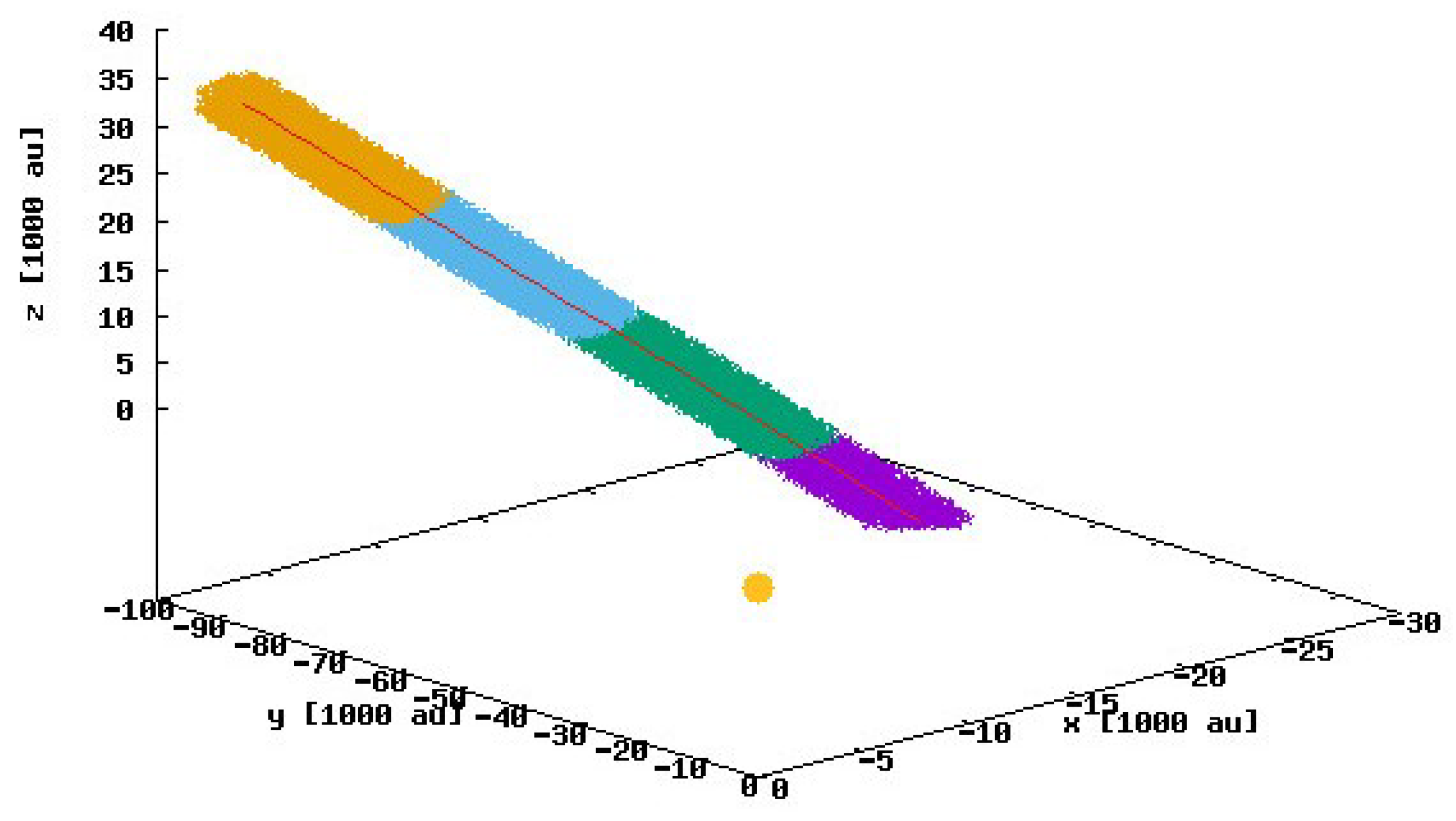
Figure 3.
Oort cloud comets in the considered SOI after Gliese 710’s flyby.
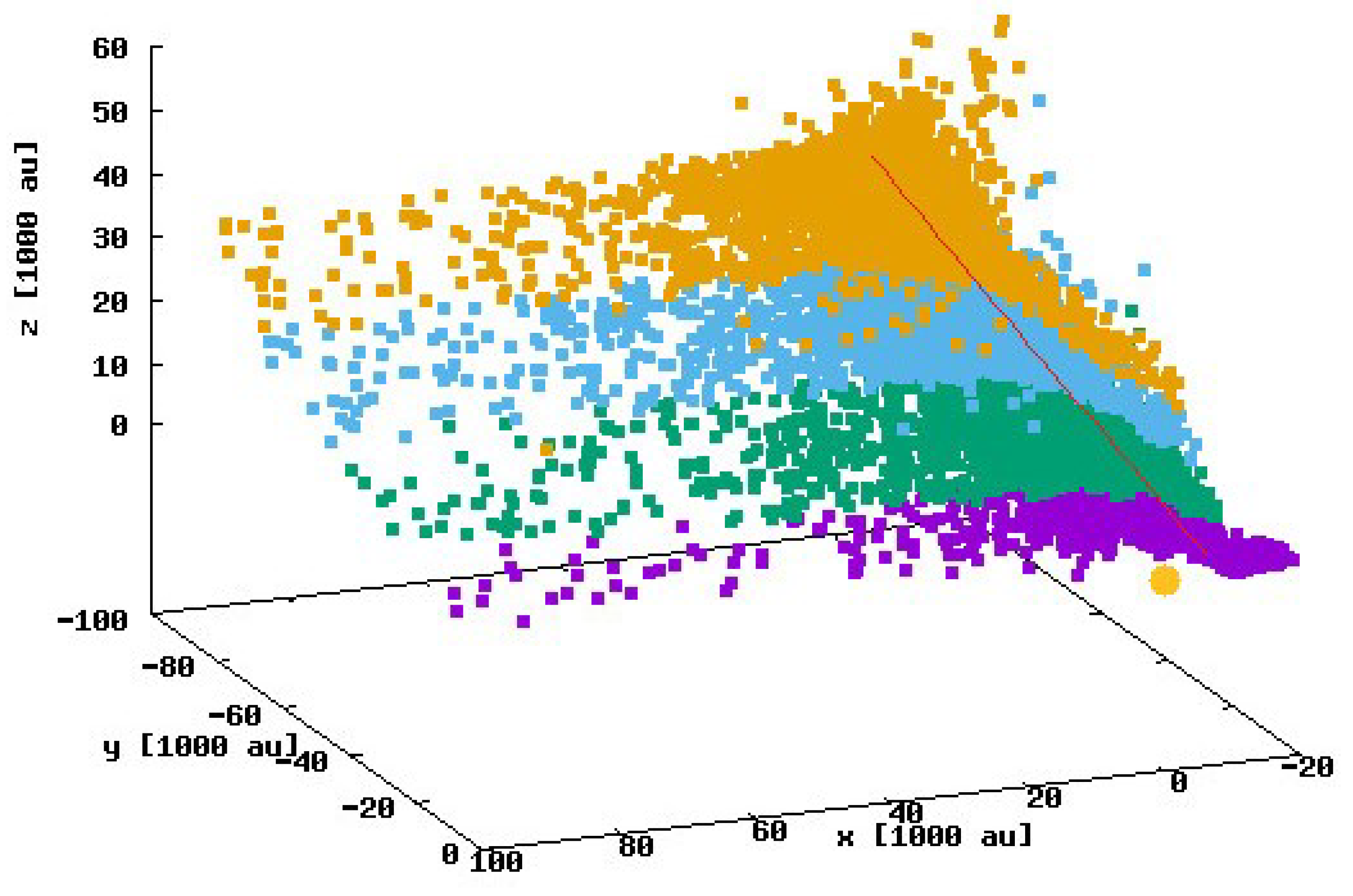
Figure 4.
Perturbation of comets in the plane (top left panel), planet (top right panel) and plane (bottom panel). The red line marks the path of Gliese 710 in all panels and the golden dot indicates the location of the Sun.
Figure 4.
Perturbation of comets in the plane (top left panel), planet (top right panel) and plane (bottom panel). The red line marks the path of Gliese 710 in all panels and the golden dot indicates the location of the Sun.
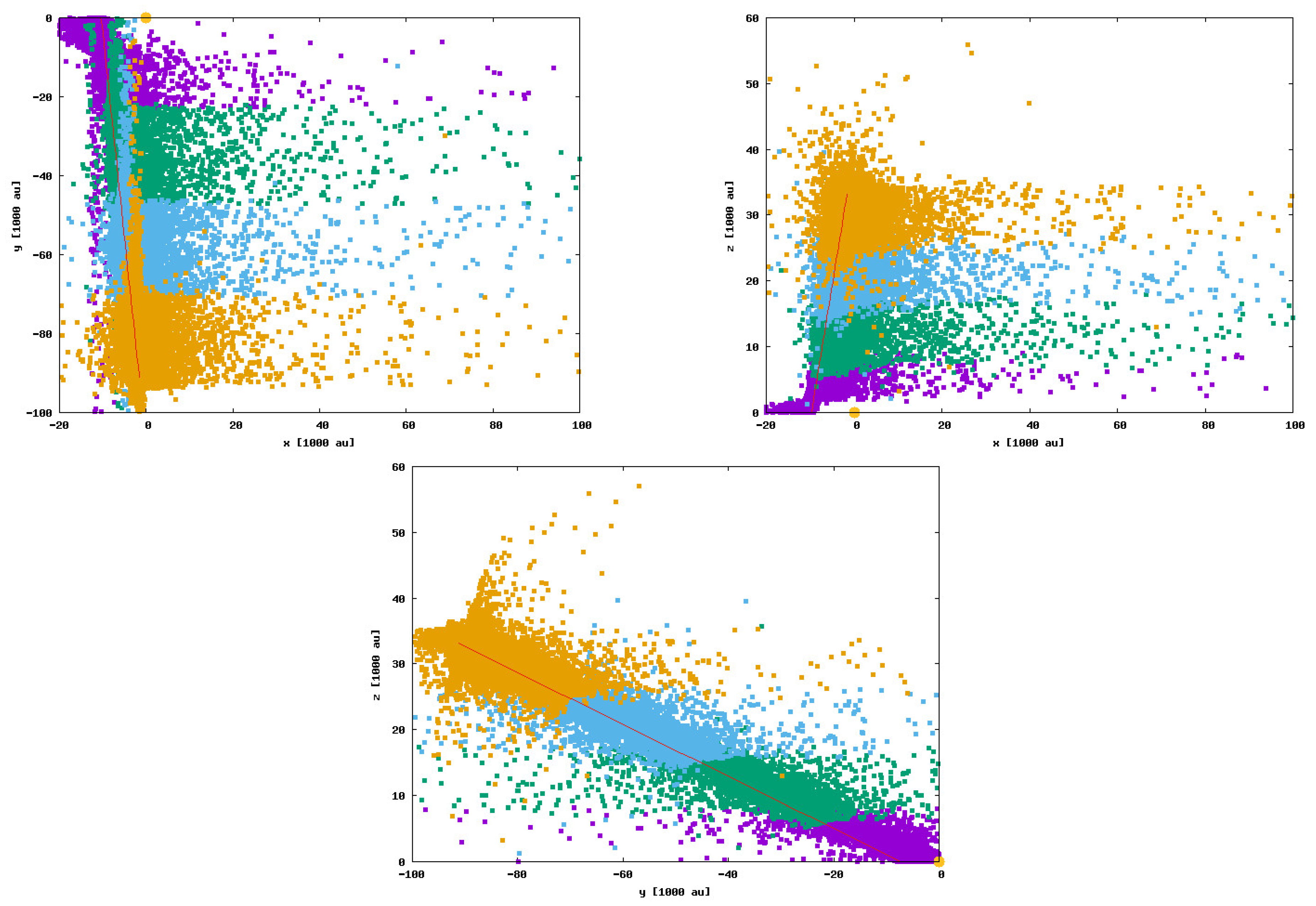
Figure 5.
All Oort cloud comets with perihelion distance au after Gliese 710’s flyby.
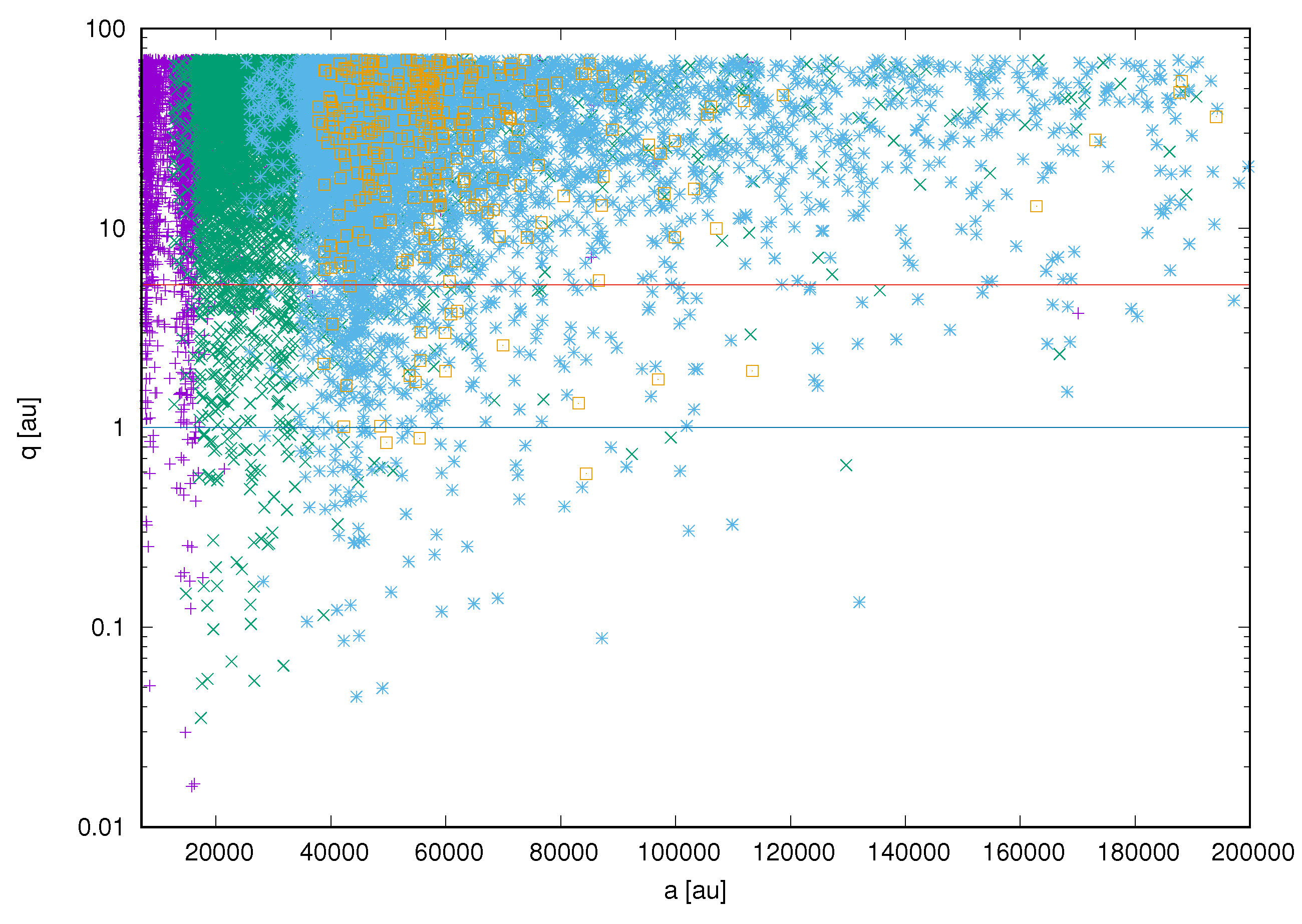
Figure 6.
Initial semi-major axis versus perihelion distances (log scale) of Oort cloud comets that were computed for 1 million years using the outer Solar system (i.e. Sun and the planets Jupiter to Neptune) as dynamical model.
Figure 6.
Initial semi-major axis versus perihelion distances (log scale) of Oort cloud comets that were computed for 1 million years using the outer Solar system (i.e. Sun and the planets Jupiter to Neptune) as dynamical model.
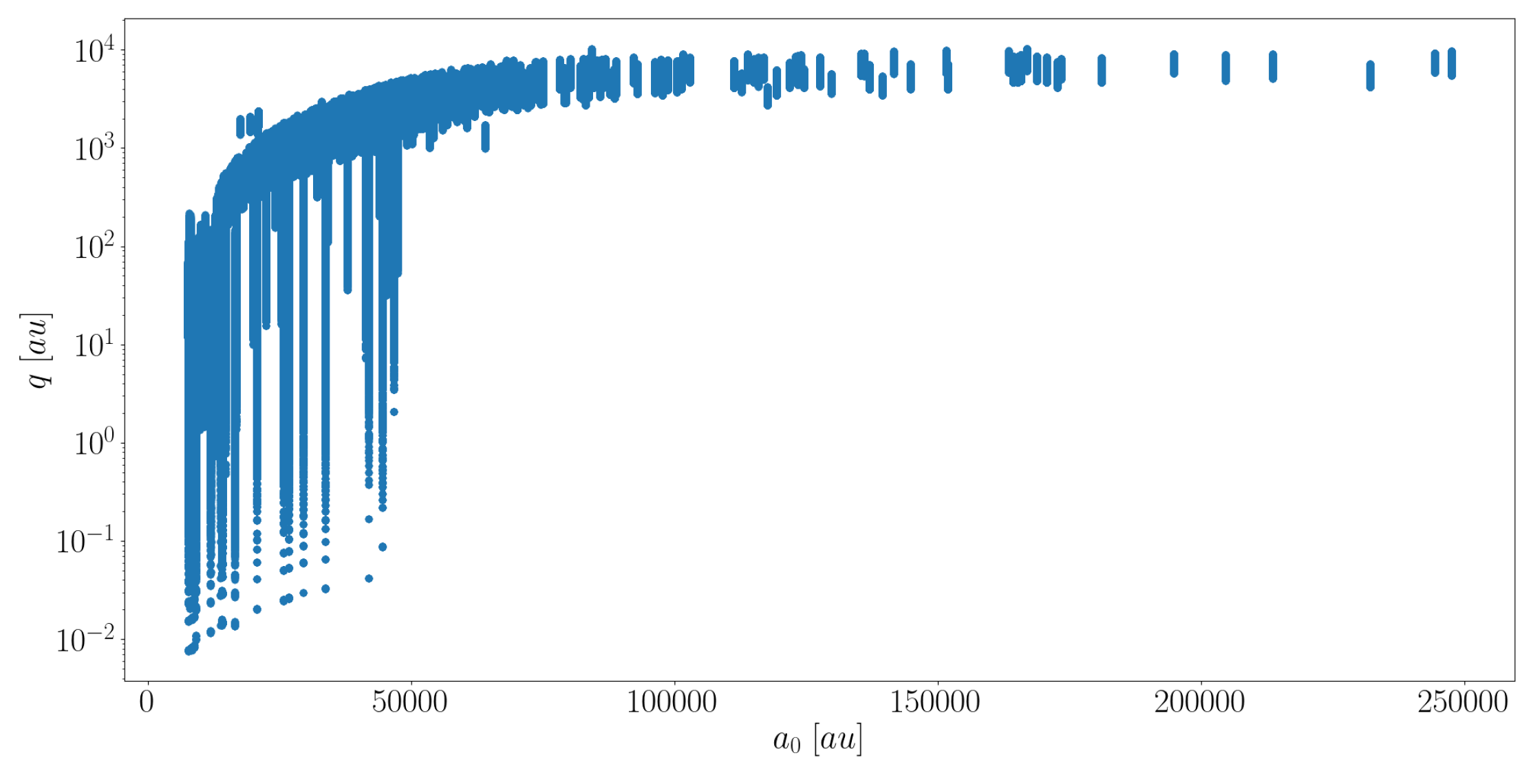
Figure 7.
Comets with distances au within 1 Myrs after the passage of Gliese 710 at 10500 au. The horizontal line labels the boundary of the observable region and the colors indicate the perihelion distances of the objects.
Figure 7.
Comets with distances au within 1 Myrs after the passage of Gliese 710 at 10500 au. The horizontal line labels the boundary of the observable region and the colors indicate the perihelion distances of the objects.
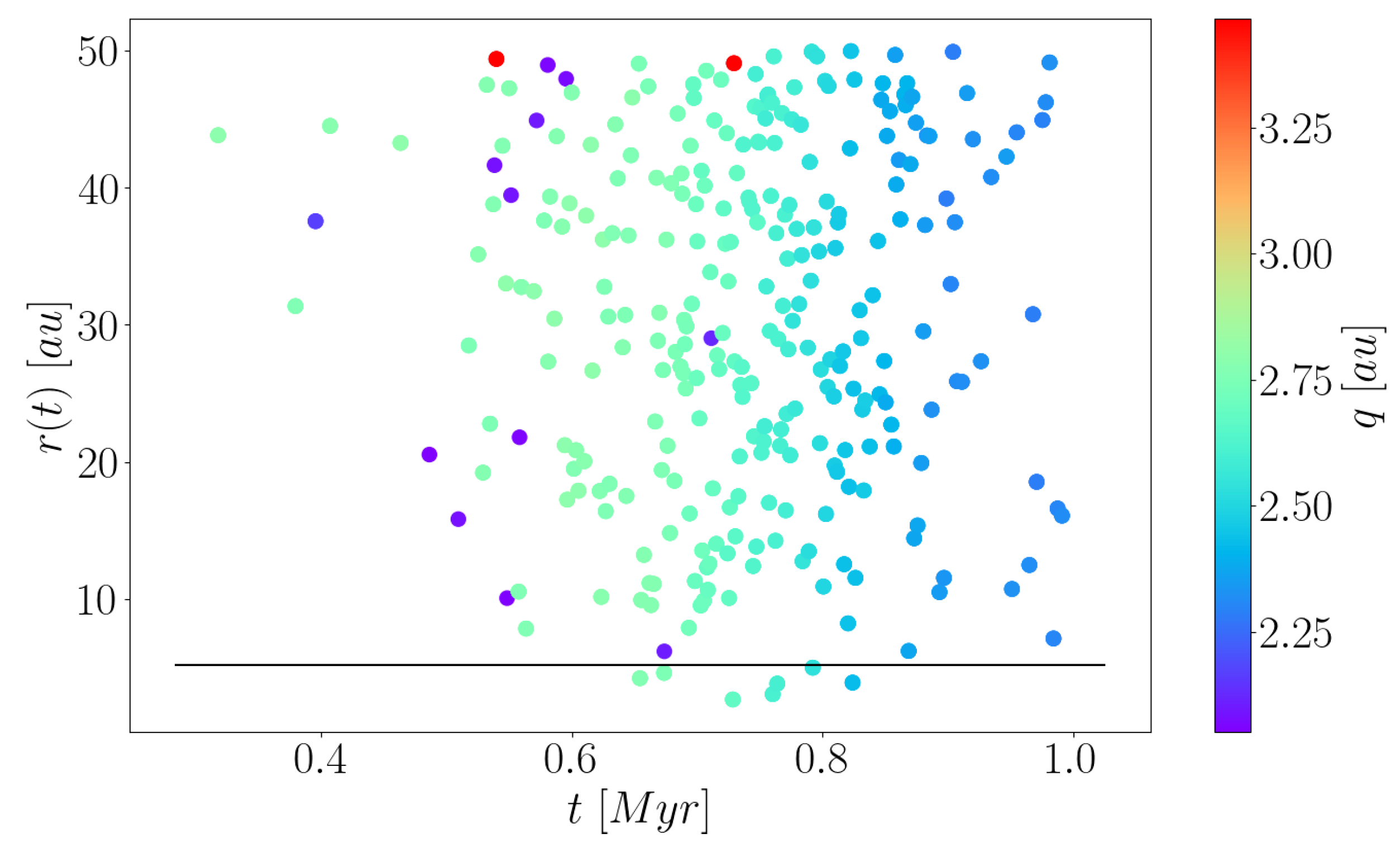
Figure 8.
Comets with distances au within 1 Myrs after the passage of Gliese 710 at 10500 au. The horizontal line labels the upper border of the observable region and the colors indicate changes of the perihelion distances of the objects.
Figure 8.
Comets with distances au within 1 Myrs after the passage of Gliese 710 at 10500 au. The horizontal line labels the upper border of the observable region and the colors indicate changes of the perihelion distances of the objects.
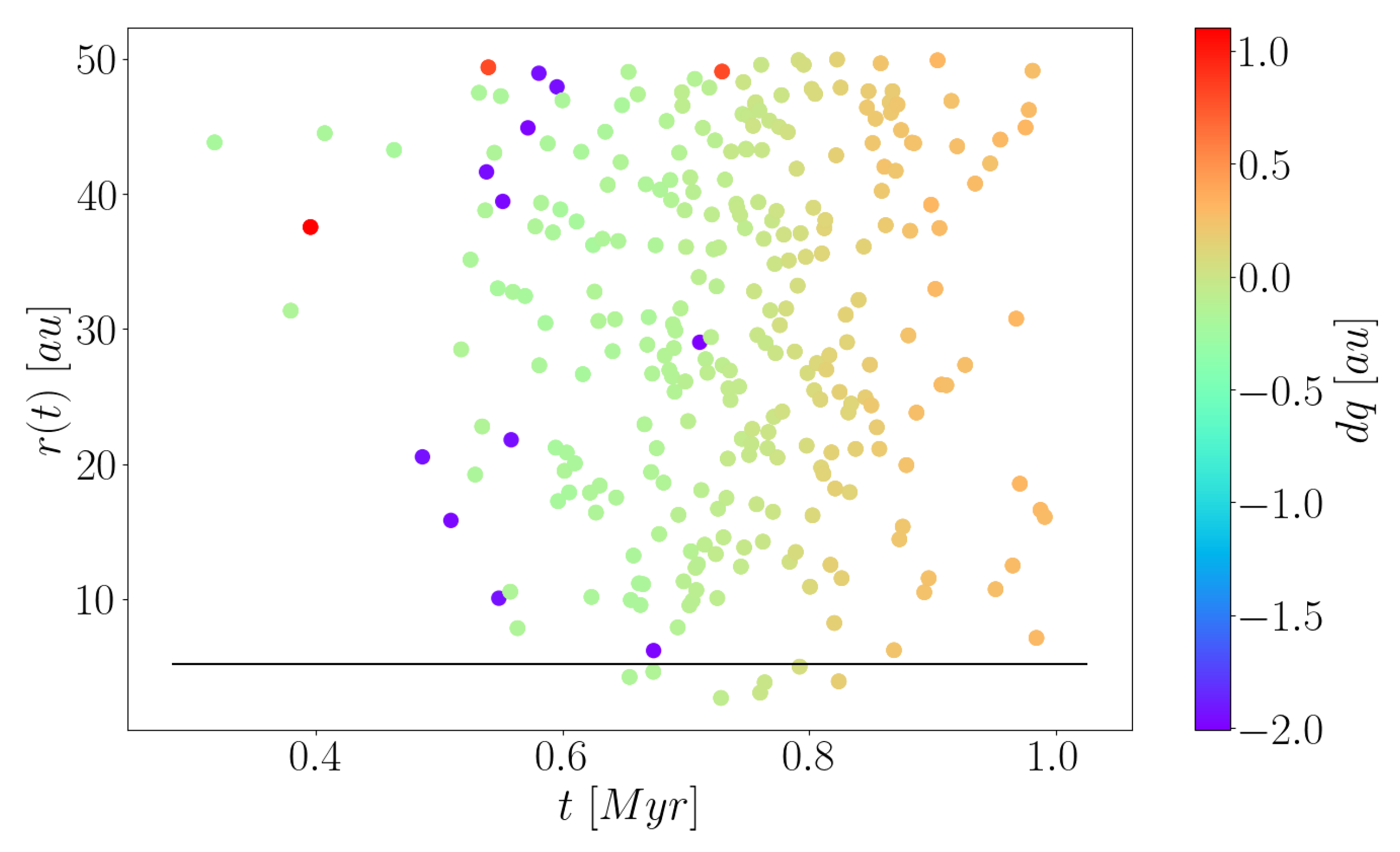
Figure 9.
Perihelion distances of Oort cloud comets within Earth orbit.
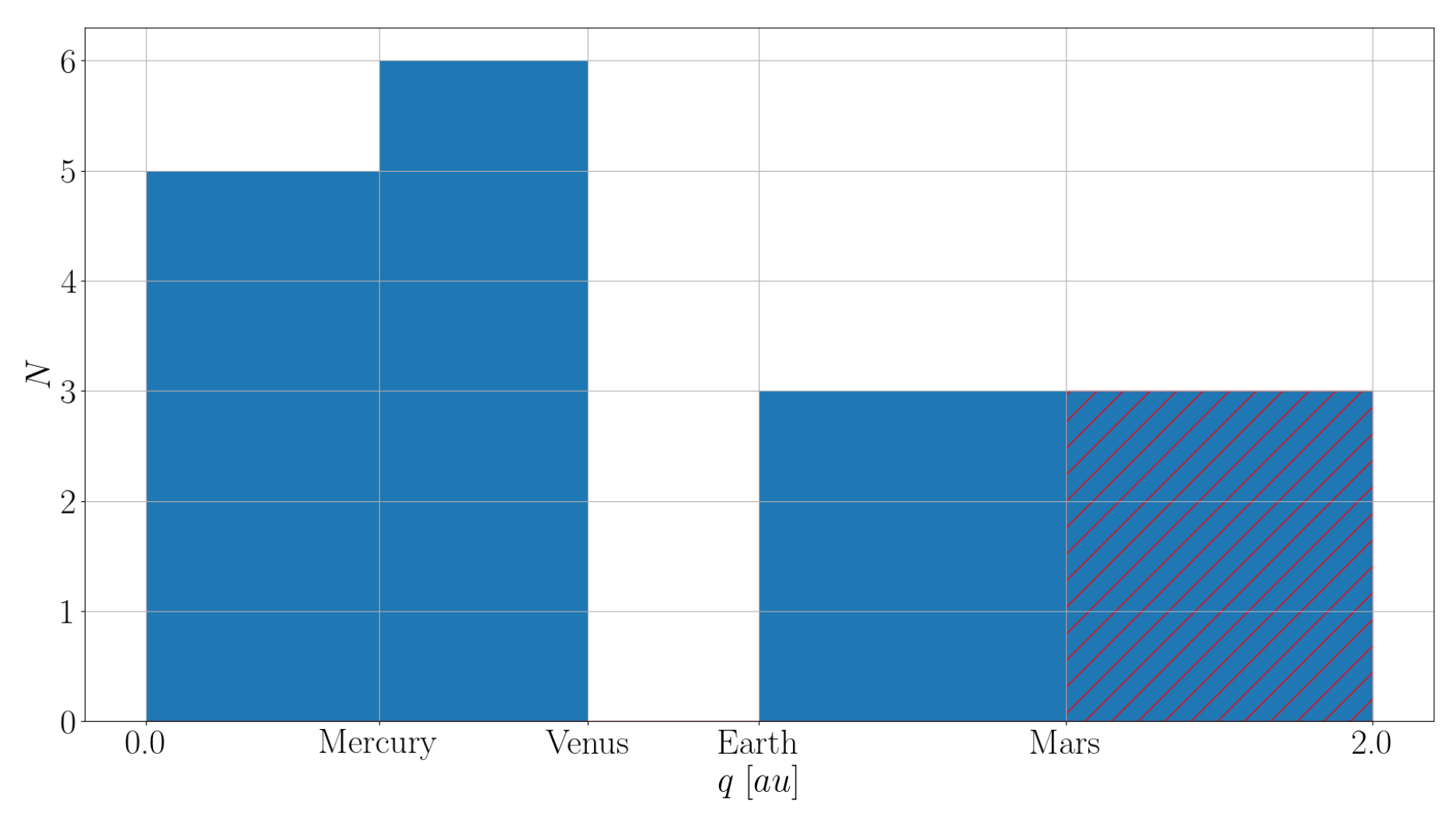
Table 1.
Initial position and velocity data of Gliese 710 with respect to the Sun for the flyby study determined from Gaia DR3.
Table 1.
Initial position and velocity data of Gliese 710 with respect to the Sun for the flyby study determined from Gaia DR3.
| Position | Velocity |
|---|---|
Table 3.
Radius of SOI around Gliese 710 for the encounter distance au to the Sun.
| Method | Extension [au] |
|---|---|
| 8 560 | |
| 6 140 | |
| 4 361 | |
| 2 310 |
Disclaimer/Publisher’s Note: The statements, opinions and data contained in all publications are solely those of the individual author(s) and contributor(s) and not of MDPI and/or the editor(s). MDPI and/or the editor(s) disclaim responsibility for any injury to people or property resulting from any ideas, methods, instructions or products referred to in the content. |
© 2026 by the authors. Licensee MDPI, Basel, Switzerland. This article is an open access article distributed under the terms and conditions of the Creative Commons Attribution (CC BY) license (http://creativecommons.org/licenses/by/4.0/).
Copyright: This open access article is published under a Creative Commons CC BY 4.0 license, which permit the free download, distribution, and reuse, provided that the author and preprint are cited in any reuse.


