

Submitted:
29 April 2026
Posted:
30 April 2026
You are already at the latest version
Abstract
Sulforaphane (SFN), a bioactive compound sourced from cruciferous vegetables, offers significant antioxidant and anti-inflammatory benefits yet, its stability in animal feed is a challenge. Nanotechnology-based encapsulation, specifically ionic gelation, has demonstrated efficacy in improving the stability and bioavailability of SFN. This review examines the application of natural polymers such as chitosan and alginate in ionic gelation for the encapsulation of SFN. It also discusses how these polymers can prevent SFN from degrading while traversing the digestive tract. Encapsulated SFN has shown enhanced nutritional absorption, elevated immune responses, and reduced oxidative stress in animals. However, challenges persist in identifying optimal methods for encapsulating various species, including enhancing encapsulation effectiveness, particle size, and controlled release mechanisms. Additionally, regulatory concerns regarding the safety and environmental impacts of nanoparticles in feed must be addressed. Future research should focus on improving encapsulation techniques and ensuring the safe application of SFN-loaded nanocarriers in livestock feed.
Keywords:
nanotechnology
; sulforaphane
; bioavailability
; ionic gelation
; encapsulation
; feed additives
1. Introduction
Sustainable livestock production has become a critical focus in light of the increasing global demand for animal-derived products and the need to reduce the environmental footprint of animal farming. Efficient use of feed resources is central to achieving sustainability in this sector. One promising bioactive compound, sulforaphane (SFN), is recognized for its antioxidant, anti-inflammatory, and anticancer properties, making it a potential addition to livestock feed [1,2]. However, despite its therapeutic potential, SFN faces a significant challenge due to its physicochemical instability and low bioavailability when used in feed. The compound's inherent instability, especially under the digestive conditions in livestock, limits its bioavailability and prevents it from exerting its full beneficial effects [3,4]. This issue is compounded by the complexity of the digestive system in livestock, which makes it difficult for bioactive compounds like SFN to maintain efficacy after ingestion [5].
Nanoencapsulation is widely recognized as a promising strategy to improve the bioavailability of bioactive compounds. By encapsulating SFN within nanocarriers, researchers aim to enhance its stability and control its release over time, addressing its instability issues [6,7]. While several studies have investigated nanoencapsulation as a solution to improve SFN's bioavailability, many of these efforts fail to consider an engineering perspective tailored to the complexities of feed systems [8]. Moreover, there is often a lack of understanding about how the encapsulation process interacts with the diverse components of feed, which could affect the bioactive compound's stability and functionality [9]. Therefore, there is a clear gap in the literature regarding the systematic design of nanoencapsulation specifically for the delivery of SFN in livestock feed [10]. These materials are not only biocompatible but also provide inherent tunability, making ionic gelation an ideal platform for the encapsulation of sensitive bioactive compounds like SFN [11]. Previous studies have shown that ionic gelation can improve the stability of bioactive compounds in feed systems, but the current body of knowledge remains fragmented. While there is evidence that ionic gelation can improve SFN stability, a systematic framework linking the design principles of ionic gelation to its stability and efficacy outcomes in feed has yet to be fully established [12,13]. Furthermore, the specific interactions between gelation materials and SFN within the complex feed matrix require further investigation to optimize delivery systems [14].
Figure 1.
A systematic review of nanotechnology applications in livestock feed and nutrition.
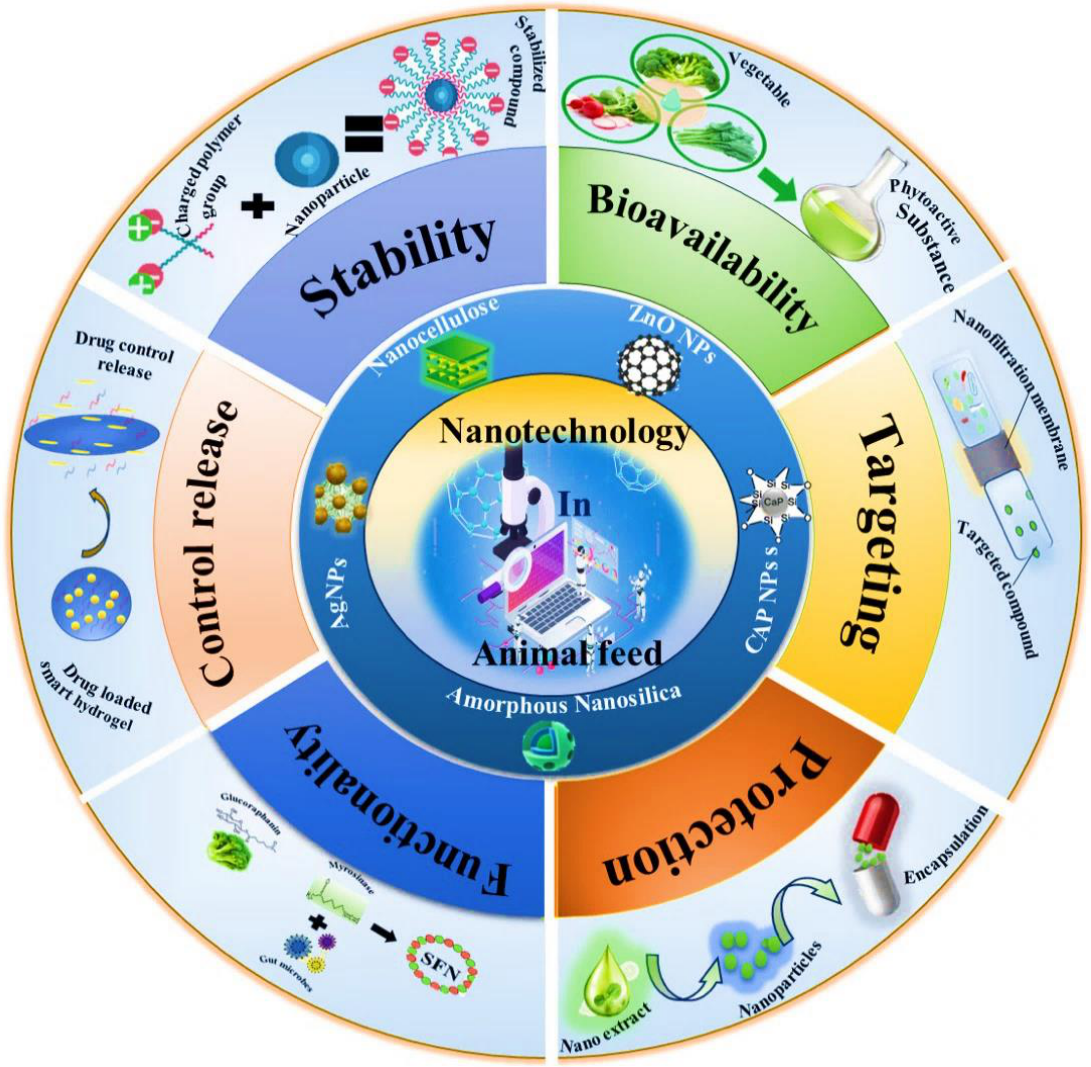
The central thesis of this review is that ionic gelation represents a rational and designable platform for the controlled delivery of SFN in livestock feed. This review will present a detailed exploration of the design principles underlying ionic gelation, followed by its application to engineer SFN stability. This paper will further address the efficacy of these systems, demonstrating how ionic gelation-based formulations can enhance the bioavailability and therapeutic potential of SFN in feed systems. Finally, this work consolidates examine practical strategies for integrating ionic gelation-based SFN delivery systems into commercial feed formulations, bridging the gap between laboratory findings and real-world applications in the livestock industry [15,16]. Through this comprehensive approach, we aim to establish a systematic framework for the application of ionic gelation in enhancing SFN’s efficacy in livestock feed.
2. Ionic Gelation as an Engineering Framework for Nano-Delivery
2.1. Principle of Ionic Gelation
Ionic gelation is a prevalent technique in nanotechnology for the fabrication of hydrogels and nanoparticles. It employs ionic interactions to connect polymer chains, forming a network structure. This technology is noteworthy due to its simplicity, efficacy with biological entities, and potential applications in medication administration, tissue engineering, and biosensors. The fundamental concept of ionic gelation is employing multivalent ions to cross-link biopolymer chains via electrostatic interactions. This creates a three-dimensional network architecture. The ionic strength, pH, and quantity of cross-linker can significantly alter this process. This affords substantial control over the characteristics of the resulting gel [17,18].
Ionic gelation operates by forming physical cross-links via ionic interactions rather than covalent connections. Chitosan, a cationic polymer, can interact with multivalent anions such as tripolyphosphate (TPP) to form nanoparticles by ionic crosslinking. The degree of gelation and the physicochemical properties of the resulting particles, including size, charge, and stability, are influenced by variables such as polymer concentration, crosslinker ratio, pH, and ionic strength [19]. A recent study demonstrated that homogenization and precise pH regulation can reduce particle size from 68 to 77 nm, enhancing their stability and dispersibility. This is particularly significant for environmental and biological applications [20]. Ionic gelation is commonly utilized with several biopolymers alongside chitosan. Gellan gum has been utilized to fabricate nanoparticles using ionic gelation, employing barium chloride as a crosslinking agent. These nanoparticles displayed appropriate size, zeta potential, and controlled drug release properties, illustrating the versatility of this method across many polymer types [21]. Composite gels composed of xanthan gum crosslinked with chromium (III) acetate and reinforced with nanoparticles such as SiO₂ and Al₂O₃ exhibited enhanced gel strength. This demonstrates the fabrication of nanocomposite ionic gels for industrial applications, such as sealing leaks in oil wells [22]. Ionic gelation facilitates the creation of dual-crosslinked (Figure 2) or modified nanoparticles that exhibit enhanced performance. A study demonstrated that covalently and ionically crosslinked chitosan nanoparticles, utilizing genipin and TPP, exhibited improved stability and novel antibacterial characteristics via quorum sensing suppression, thereby expanding the applicability of this approach [23]. Additionally, scalable technologies such as static mixing have been developed to facilitate ionic gelation on a large scale, enabling the consistent and repeatable production of chitosan nanoparticles [24].
2.2. Application for Sulforaphane Encapsulation
Ionic gelation is an effective method for encapsulating sulforaphane, employing a gentle, aqueous technique that avoids high temperatures and chemical solvents that may degrade this delicate molecule. Sulforaphane is recognized for its instability, rapidly degrading when subjected to heat, oxygen, and variations in pH. Ionic gelation encapsulation forms protective polymeric matrices that preserve bioactivity even in mild conditions [27]. This approach has been demonstrated to significantly prolong the shelf life of sulforaphane and ensure its safety throughout storage and transit through the digestive system. Biopolymers such as sodium alginate, chitosan, and carrageenan are frequently employed to produce ionic gels. Alginate, a negatively charged polymer derived from brown seaweed, forms gels upon interaction with divalent cations such as calcium. Chitosan is a cationic polymer derived from crab shells. Upon interaction with alginate or other anionic polymers, it generates robust, biocompatible gels. These polymers are environmentally friendly, decompose organically, and are frequently utilized in food and pharmaceuticals. The majority of studies on sulforaphane encapsulation have examined several techniques, including spray drying and coacervation. Nonetheless, the principles of ionic gelation remain significant and are considered effective methods for stabilizing sulforaphane [28].
2.3. Advantages of Ionic Gelation
Ionic gelation enhances the stability of encapsulated compounds such as sulforaphane. The polymeric coating formed during gelation safeguards sulforaphane from environmental challenges such as heat, oxidation, and pH fluctuations, which are recognized for rapidly degrading its bioactive properties [29]. Ionic gelation facilitates controlled release, which is crucial for maximizing the therapeutic benefits of sulforaphane. For example, encapsulated sulforaphane can be released in the intestines, where its bioavailability is enhanced and absorption is facilitated [30]. Furthermore, encapsulation via ionic gelation enhances resistance to environmental degradation. This entails safeguarding sulforaphane from degradation caused by heat or oxygen during production or storage. Studies consistently show that encapsulated sulforaphane has superior absorption and extended pharmacological effects compared to its unencapsulated counterpart [31]. The biodegradability of alginate-chitosan matrices enhances their safety for application in food and pharmaceuticals health Advantages of Sulforaphane in the animal Sector.
3. Engineering Stability: Encapsulation Design and Protective Performance
3.1. Nano Extraction of Sulforaphane
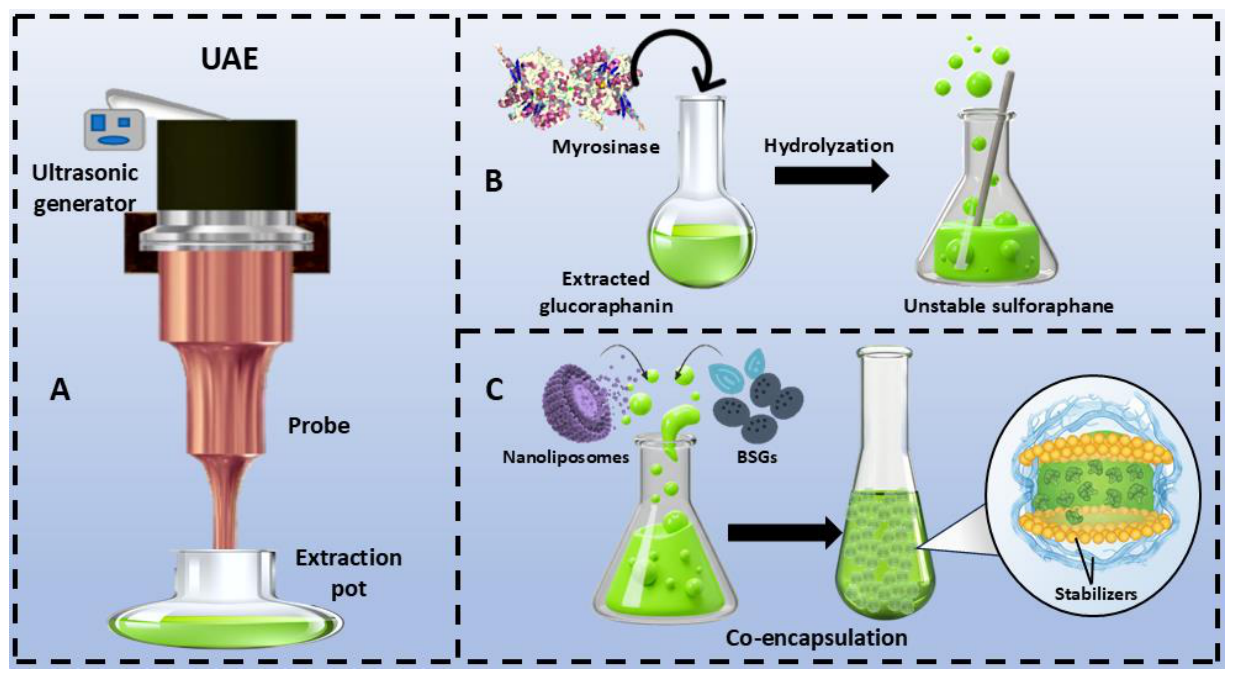
Ultrasonic-assisted extraction (UAE), is a prevalent method for extracting sulforaphane from broccoli seed or sprout extracts. This technique shown in Figure 3A enhances both the yield and purity of the active ingredient [32]. The efficacy of UAE is attributed to sonic cavitation, which accelerates mass transfer and facilitates the enzymatic degradation of glucoraphanin, the precursor of sulforaphane as shown in Figure 3B. This indicates that the UAE can significantly enhance and expedite the extraction process [33]. Additional investigations demonstrated that ultrasonic treatment enhanced sulforaphane extraction efficiency by 2.7 times compared to conventional shaking methods, hence validating the method's efficacy [34].
These findings have also been corroborated by large-scale industrial applications. Patents delineate ultrasonication combined with enzymatic hydrolysis and solvent extraction as an economical, scalable, and selective method for producing high-purity sulforaphane [35,36]. The combination of UAE with techniques like microwave pretreatment or optimized solvent ratios further boosts the sulforaphane yield, making it a reliable method for both laboratory and commercial extraction processes [37]. The UAE is a rapid, efficient, and reproducible method for obtaining sulforaphane from broccoli-derived sources. This explains its increasing popularity in the pharmaceutical and nutraceutical sectors.
Figure 3.
Overview of the process for enhancing the bioavailability of sulforaphane from broccoli. (A). UAE (ultrasound-assisted extraction) of broccoli to extract glucoraphanin. Modified from [41] licensed under CC BY 4.0. (B). The enzyme-mediated transformation of glucoraphanin into sulforaphane [42]. (C). Enhancing and stabilizing sulforaphane through co-encapsulation with nanoliposomes and basil seed gum to improve its bioavailability [43].
Figure 3.
Overview of the process for enhancing the bioavailability of sulforaphane from broccoli. (A). UAE (ultrasound-assisted extraction) of broccoli to extract glucoraphanin. Modified from [41] licensed under CC BY 4.0. (B). The enzyme-mediated transformation of glucoraphanin into sulforaphane [42]. (C). Enhancing and stabilizing sulforaphane through co-encapsulation with nanoliposomes and basil seed gum to improve its bioavailability [43].
3.2. Enzymatic Hydrolysis of Glucoraphanin
Myrosinase can hydrolyze glucoraphanin enzymatically to release active sulforaphane. The enzymatic hydrolysis of glucoraphanin by myrosinase is a crucial process in the natural production of sulforaphane, a bioactive compound recognized for its potent antioxidant and anticancer properties. Myrosinase, present in broccoli and other cruciferous vegetables, accelerates this reaction when the cells are disrupted via during cutting or mastication. This converts glucoraphanin, which is typically inactive, into sulforaphane. Research has demonstrated that activated myrosinase significantly improves the bioavailability of sulforaphane. A study indicated that glucoraphanin, when provided with endogenous plant myrosinase, had 3 to 4 times more bioavailability compared to its administration without myrosinase [6]. Biotechnological advancements have facilitated the synthesis of recombinant myrosinase enzymes, such as Rmyr from Rahnella inusitata, capable of converting glucoraphanin to sulforaphane with an efficiency of 92% in under 10 minutes [38]. Genetically engineered yeast cells capable of producing myrosinase demonstrated around 100% effectiveness in converting glucoraphanin from broccoli seeds into sulforaphane, even after many uses [39]. Moreover, alternative sources of myrosinase, such as Chinese flowering cabbage, have been examined, revealing effective conversion of glucoraphanin to sulforaphane under optimal pH and temperature conditions [40]. These data collectively confirm that enzymatic hydrolysis by myrosinase is a natural, scalable, and efficient method for generating sulforaphane from glucoraphanin.
3.3. Enrichment of Sulforaphane
Co-encapsulation of sulforaphane (SFN) with stabilizers such as lecithin and plant-derived gums has emerged as an effective method to enhance its stability and bioactivity. Sulforaphane is recognized for its anticancer and antioxidant properties; yet, it is highly unstable due to its sensitivity to variations in pH, temperature, and enzymatic activity. Azarashkan et al (2022). conducted a study demonstrating that encapsulating sulforaphane-enriched broccoli sprout extract in lecithin-based nanoliposomes, further stabilized with basil seed gum (BSG), significantly enhanced its stability and controlled release (Figure 3C). The optimal formulation exhibited a diminutive particle size (39.6 nm), a substantial zeta potential (−71.16 mV), and an exceptional encapsulation efficiency (97.96%). This co-encapsulation facilitated the release of the medication in the intestines, potentially enhancing its bioavailability [30].
García-Saldaña et al. effectively microencapsulated sulforaphane using a combination of gelatin, gum Arabic, and pectin through a method known as complex coacervation. These biopolymer complexes prevented the degradation of SFN and maintained its functional integrity, achieving encapsulation rates of 80% [28]. Zambrano et al. found that employing gum Arabic to encapsulate sulforaphane in oil-in-water emulsions enhanced its stability at elevated temperatures by sixfold and reduced its susceptibility to degradation under heat [44]. The findings indicate that incorporating lecithin and plant-derived gums, such as basil seed gum, gum Arabic, or pectin in co-encapsulation techniques significantly enhances sulforaphane's stability and bioactivity by protecting it from environmental degradation and improving its controlled release properties.
3.4. Encapsulation of Sulforaphane via Ionic Gelation
Chitosan and sodium tripolyphosphate (TPP) are two well studied ionic gelation techniques that effectively encapsulate bioactive compounds such as sulforaphane. Chitosan, a naturally occurring polysaccharide with a positive charge, interacts with TPP, which possesses a negative charge, to form stable nanoparticles or microcapsules in aqueous solutions at room temperature. This method is effective for thermolabile compounds such as sulforaphane, which may decompose when subjected to high temperatures or aggressive chemicals. The chitosan-TPP system offers numerous advantages, including biocompatibility, biodegradability, and mucoadhesiveness, rendering it ideal for oral or mucosal delivery systems [45]. Studies demonstrate that ionic gelation can produce nanoparticles ranging from 100 to 500 nm, with surface charges (zeta potentials) between +20 and +40 mV, indicating considerable colloidal stability [46]. Encapsulation efficiencies over 60% have been achieved, even for compounds with limited water solubility or high degradation susceptibility [47]. While individual synthesis of ionic gelation encapsulation have been reported separately such as alginate-SFN homogenization [48] (Figure 4A), calcium chloride gelation [49] (Figure 4B), and chitosan coating [50] (Figure 4C) complete, integrated synthesis of the SFN-loaded alginate-chitosan encapsulation system as depicted in Figure 4A–D is not directly supported by any single published study. Therefore, the proposed sequential synthesis from homogenization to post-processing (Figure 4) represents a novel contribution of this paper, offering a unified encapsulation strategy to improve SFN bioavailability and stability [51].
However, there is a lack of precise studies that capitalize on encapsulating SFN using IG for animal feed. This study reported enhanced stability and bio accessibility of SFN, suggesting that IG could serve as a reliable encapsulation technique to protect SFN from degradation and enhance its delivery in biological systems [51,52]. Table 1, demonstrate a comparative summary of key synthesis parameters for nanochitosan-based encapsulation systems, with emphasis on ionic gelation and related methods.
Chitosan nanoparticles with scanning electron microscopy (SEM) as a secondary size characterization method in addition to DLS. SEM images were taken for CNPs synthesized with a homogenizer and purified with syringe filtration, as this procedure proved to be effective of formulating <100 nm CNPs with low polydispersity. The CNPs displayed a circular morphology, similar to literature, and were split into two size populations, with average sizes of 75 ± 8 nm and 33 ± 11 nm [58] (Figure 5A). Figure 5B FT-IR analysis evidently demonstrates that chitosan can be successfully functionalized with silica to form stable nanohybrids, and further complexed with Cytosine-phosphodiester-guanine oligodeoxynucleotides (CpG ODNs) through interactions involving its amide groups [59]. These spectral changes confirm the ability of chitosan nanoparticles to act as effective nanocarriers, preserving their chemical functionality while integrating bioactive molecules [58,60]. Thus, chitosan nanoparticles should be highly recognized not only as a biocompatible scaffold but also as a flexible platform for delivering immunostimulatory oligonucleotides in vaccine or immunotherapy applications. It has been reported that a chitosan/silica CpG ODN nanohybrid showed cell viability similar to the control group after 24 h and 48 h incubation using the WST-1 assay, thus indicating good biocompatibility and low toxicity [60]. Additionally, ionic chitosan gels prepared with tripolyphosphate were reported as biocompatible with low toxicity in mouse fibroblast-like NIH-3T3 cells during 24 h and 72 h incubation [61]. In line with these results, the current study assessed the cytotoxicity of chitosan nanoparticles to RAW-Blue cells utilizing the CCK-8 assay, as illustrated in Figure 5C. The cells were kept in a nanoparticle solution for four hours at different concentrations. The nanoparticles did not significantly affect cell viability; instead, cell viability increased in direct correlation with nanoparticle dilution [62]. These findings indicate that chitosan nanoparticles are safe and possess significant potential as a vehicle for CpG ODN delivery. In general, looking at how toxic carriers are in drug delivery systems is still important to make sure nanoparticles are safe.
4. Measurable Efficacy in Animal Models
4.1. Quantifying Enhanced Bioavailability and Systemic Delivery
The primary objective is to enhance bioavailability. The reactive isothiocyanate bond in SFN renders it unstable, leading to rapid degradation in the digestive system and significantly hindering its distribution throughout the body [63]. Ionic gelation encapsulation effectively addresses this issue by creating a protective barrier. Chitosan-alginate systems designed for gastric resistance and intestinal release in feed models have demonstrated significantly improved recovery of intact SFN and its metabolites in plasma compared to the unencapsulated form [64]. The primary method to enhance the bioavailability of SFN, a crucial element in the efficacy of feed additives, is to optimize its release profile and safeguard it from degradation [65].
4.2. Modulation of Health and Resilience Markers
Sulforaphane is a recognized stimulator of the Nrf2 (nuclear factor erythroid 2-related factor 2) signaling pathway in biomedical literature (Figure 6). This route enhances the function of cellular antioxidant defense mechanisms and mitigates oxidative stress [66,67]. Concurrently, SFN is reported to inhibit Nuclear Factor kappa-light-chain-enhancer of activated B cells (NF-κB) signaling, resulting in reduced levels of proinflammatory cytokines. A recent study of goat mammary epithelial cells shown that SFN mitigated H₂O₂-induced oxidative stress and apoptosis by activating the AMPK and Nrf2 signaling pathways [68]. These mechanistic findings validate the concept that SFN can alleviate oxidative stress in animal tissues.
In this effort, sulforaphane demonstrated a dose-dependent protective effect against oxidative stress. As shown in Figure 7A, treatment with SFN at concentrations of 1.25, 2.5, and 5 µM significantly mitigated hydrogen peroxide (H₂O₂)-induced cellular damage in HeLa cells, confirming its potent antioxidant capacity. Sulforaphane alone showed no toxicity. SFN + H₂O₂ groups showed significantly higher viability than H₂O₂ alone. Data are means ± SEM (n = 3), p < 0.05, p < 0.01 vs. H₂O₂ only [73]. In this process, ELISA quantification of IL-6 and TNF-α secretion in Nrf2-overexpressing HGFs treated with LPS ± sulforaphane. Nrf2 overexpression enhanced SFN's ability to suppress both cytokines, further supporting that SFN mitigates inflammation via an Nrf2-dependent pathway. Data are presented in Figure 7B as means ± SE of three independent experiments, p < 0.05, p < 0.01 [74]. This reveals that sulforaphane's suppression of IL-6 and TNF-α is enhanced in Nrf2-overexpressing cells. Beyond its antioxidant and anti-inflammatory properties, sulforaphane (SFN) exhibits direct antibacterial effects through a unique anti-virulence mechanism. At sub-MIC concentrations (2 μg/mL) levels that do not inhibit bacterial growth, SFN significantly reduced Salmonella Typhimurium invasion of HeLa cells by 46% and intracellular replication within macrophages by 55% [75]. These findings indicate that SFN disrupts the bacterial Type III Secretion System (TTSS), which is essential for host cell invasion and intracellular survival. This anti-virulence strategy is particularly advantageous because it reduces pathogenicity without imposing selective pressure for antibiotic resistance, distinguishing SFN from conventional bactericidal agents (Figure 7C). The researchers attributed these benefits to the activation of the Nrf2-ARE pathway and the inhibition of NF-κB pathways. The results suggest that including SFN (or its precursors) into animal feed may enhance animals' capacity to manage oxidative stress, inflammation, and mycotoxins, thus improving their health and resilience.
Besides its preventative qualities, increasing data suggests that SFN may directly influence growth and muscle development. In porcine satellite (muscle stem) cells, SFN treatment enhanced cellular proliferation, modified the expression of myogenic regulatory proteins, reduced histone deacetylase (HDAC) activity, and increased the acetylation of histones H3/H4. The research demonstrated the overexpression of SMAD7 as a downstream effector and the alteration of microRNAs that target SMAD7. The researchers observed that SFN's epigenetic effects may be advantageous for modulating muscle growth in swine [76]. This in vitro work indicates a molecular connection suggesting that SFN (or other compounds) may influence muscle development or tissue repair in animals, transcending simple protective roles.
In vivo, this yields measurable health advantages: a decrease in oxidative stress markers, an elevation in endogenous antioxidant enzymes, and a reduction in circulating pro-inflammatory cytokines [77,78]. In a pig model, dietary supplementation of SFN (1 g/kg) significantly diminished hepatic oxidative stress and augmented the NRF2/GPX4/HO-1 antioxidant pathway while suppressing inflammatory pathways, including IL-6-JAK-STAT3 signaling [79]. This indicates that effective delivery ensures the appropriate dosage of the medicine reaches the correct tissues to exert systemic immunomodulatory and hepatoprotective effects, which is strongly correlated with dosage efficacy [80]. Furthermore, SFN has proven efficacy in mitigating specific feed-related toxicities. In porcine intestinal cells, SFN alleviated deoxynivalenol (DON)-induced cytotoxicity by regulating spermine metabolism, decreasing oxidative stress, and lowering apoptosis, thus establishing a theoretical foundation for its use against mycotoxins [81,82].
4.3. Species-Specific Delivery Challenges and Outcomes
All animals metabolize SFN, but the intestinal milieu dictates its encapsulation [83]. Getting the maximum efficiency of Sulforaphane SFN into the animal system has barriers, its inherent chemical instability during gastrointestinal transit and feed processing. Critically, SFN degradation follows relationship with pH: SFN is stable under acidic conditions but degrades rapidly under neutral to alkaline pH environment. This fundamental property dictates the degradation challenges across the different animal digestive systems [84]. Wu et al. (2023) investigated the effect of pH on Sulforaphane stability at different temperatures (Wu et al., 2023; see Table 1 in their paper). For better clarity on these trends, the data obtained have been replotted as line graphs in Figure 8. As shown in Figure 8 A–D, SFN was quite stable at low pH values and temperatures. At pH 2.2, even after heating at 60 °C for 6 h, more than 95.1% of SF was retained. However, retention decreased as pH and temperature increased. When the pH increased to 6.0, even at a temperature of 60 °C, 32.1% of SFN was lost within 6 hours. After 6 hours at 90 °C and pH 6.0, 6.0% of SFN remained (Figure 8D). Overall, increasing pH from 3.0 to 5.0 hastened SFN degradation, indicating that SFN is unstable at high temperatures, especially under high pH conditions [85]. In other words, SFN is more heat-stable in acidic food products.
A notable difference lies in the source of bioactivation. In non-ruminants, plant-derived myrosinase is typically inactivated in the stomach, and the production of SFN mostly relies on the hydrolysis of glucoraphanin by the gut microbiota [86].
In ruminants, the issue is exacerbated by the intricate microbial population of the rumen, which can rapidly decompose or alter unprotected compounds. To demonstrate efficacy, one must establish that it safeguards the rumen. Encapsulation techniques must effectively manage ruminal fermentation while disintegrating in the abomasum. This indicates that a universal release profile is ineffective; the system must be tailored to navigate or use the species-specific microbial ecosystem to ensure bioavailability beyond the rumen or intestines [87]. Recent strategies emphasize the employment of microbial-targeted delivery methods encapsulated in oxidized konjac glucomannan microspheres to directly enhance gut capabilities for making SFN, hence improving utilization rates [88].
Enhanced performance measures provide as the most compelling evidence. Research indicates that the health advantages of nano-encapsulated SFN yield tangible outcomes. Incorporating SFN into the diet of pigs has been shown to enhance their growth rate and increase liver cell production [89,90]. In broilers, analogous delivery systems have demonstrated superior physiological outcomes in challenge models, indicating an approach to enhance their resilience and productivity [78]. These benefits are attributed to reduced metabolic depletion caused by inflammation and oxidative stress. The effectiveness of these benefits is largely dependent on the stability of the encapsulated substance within the feed matrix during storage, as a product that degrades after manufacture would not ensure dependable field performance [79].
5. Considerations and Safety Regulatory
5.1. Regulations on Nanotechnology in Feed Additives
Nanotechnology is increasingly utilized in agricultural, animal feed, and food production. Examples include nano-encapsulated agrochemicals, antimicrobial coatings, and intelligent food packaging. These novel concepts provide the potential for enhanced efficiency and sustainability; nevertheless, they also engender safety and ethical concerns. Various nations possess distinct regulations concerning nanotechnology. The European Union (EU) is the sole entity where existing regulations on food, feed, and chemicals have been amended to incorporate nanotechnology. Conversely, non-EU countries such as the U.S. often govern nanomaterials within the framework of broader chemical and food safety regulations. They frequently depend on industry directives and voluntary adherence [91,92]. They frequently depend on industry directives and voluntary adherence [93]. A 2023 analysis indicates that the EU possesses technical sophistication; nonetheless, it remains deficient in legal consistency, particularly with transparency, accountability, and stakeholder inclusion [94]. In Table 2, it gives the necessary information pertaining the guidelines of nanotechnology in feed additives.
The Food and Drug Administration (USFDA) regulates the majority of regulations concerning nanotechnology in food and agriculture in the United States. The FDA evaluates nano-enabled products according to existing rules, such as the Federal Food, Drug, and Cosmetic Act, despite the absence of specific nano legislation in the U.S. It has advised makers to communicate promptly when nanoscale alterations may impact safety or efficacy [95]. These are not legally enforceable, and their enforcement largely relies on conventional risk-based evaluations. The Environmental Protection Agency (EPA) is responsible for ensuring the safety of nanomaterials, particularly when utilized in pesticides or released into the environment. Despite ongoing study, U.S. regulatory authorities continue to encounter issues with incomplete data and the absence of standardized testing methodologies for nanoscale substances [96].
The European Food Safety Authority (EFSA) operates within a more structured and meticulous framework. The EFSA is responsible for conducting nano-specific risk evaluations prior to the sale of products inside the EU. This is particularly applicable to novel foods, feed additives, biocides, and substances that interact with food [91]. The EFSA operates within a more structured and meticulous framework. The EFSA is responsible for conducting nano-specific risk evaluations prior to the sale of products inside the EU. This is particularly applicable to novel foods, feed additives, biocides, and substances that interact with food [93]. Experts assert that despite improvements, it remains essential to enhance capacity, standardize practices across nations, and engage the public to effectively address the risks and ethical concerns associated with nanotechnology in food systems [92,94].
5.2. Major Challenges for Approval of Nanotechnology in Animal Feed
Numerous scientific, regulatory, and methodological challenges must be addressed prior to the application of nanoparticles in animal feed. A significant issue is the lack of standardized, nano-specific testing methodologies; traditional toxicological methods often fail to consider the unique properties of nanoparticles, such as altered bioavailability, surface reactivity, and the potential for bioaccumulation in animal tissues. Regulatory bodies like the EFSA require data on particle size, toxicokinetic, genotoxicity, and chronic oral toxicity; however, established approaches for producing this data are often inadequate [97,98]. Compounding the issue, numerous nano-enabled feed applications remain in the experimental or research phase, indicating a lack of sufficient long-term safety data for both animals and humans consuming the products [99].
A significant issue is the variation of regulations throughout different regions of the world, coupled with insufficient coordination among nations. The EU has incorporated nano-specific controls into its feed legislation, whereas most non-EU countries, notably the U.S., govern nanoparticles under general food and chemical safety laws that do not explicitly address nanoscale characteristics [91,100]. This fragmented approach complicates international trade and creates ambiguity for developers. In the United States, the FDA has issued certain rules regarding nanoparticles; however, a regulatory framework for nanotechnology in feed is absent, and there is insufficient collaboration among regulators, industry, and academics. [101]. The absence of centralized databases, labeling rules, and defined post-market monitoring methods complicates transparency and risk management. Consequently, regulatory ambiguity remains a significant obstacle to the approval and safe utilization of nano-enabled feed items, despite their increasing innovation.
5.3. Toxicity and Safety
Nanotechnology in animal feed has possible advantages as well as significant safety hazards for both animals and humans. Engineered nanomaterials (ENMs) facilitate nutrient absorption in animals, enhance their resistance to infections, and improve feed efficiency. However, because of their little size and reactive surface area, they can pose a threat. Nanoparticles can infiltrate animal systems through ingestion, inhalation, or skin exposure, potentially accumulating in organs such as the liver, spleen, and lungs, which may lead to oxidative stress, inflammation, or carcinogenic consequences [102]. The ability of nanoparticles to penetrate biological membranes and infiltrate cells increases the risk of genotoxic and metabolic disruptions [103]. Research indicates that nanoparticles might adversely affect reproductive health and the development of progeny in animals, highlighting another aspect of reproductive toxicity [104]. Indirect exposure to animal products presents a considerable risk to human health, especially due to the inadequate understanding of the breakdown or accumulation of nanomaterials in the food chain [105]. Moreover, whereas acute toxicity is frequently negligible, prolonged exposure, particularly via inhalation, has been demonstrated to adversely affect the lungs and other bodily systems [106]. Moreover, whereas acute toxicity is frequently negligible, prolonged exposure, particularly via inhalation, has been demonstrated to adversely affect the lungs and other bodily systems [107]. This complicates the determination of safe exposure levels for both humans and animals.

Table 2.
Regulatory Criteria for Nanomaterial Approval in Animal Feed.
| Parameter | Why It Matters | Regulatory Enforcement / Guidance | Reference |
|---|---|---|---|
| Particle size distribution | Determines whether material qualifies as a nanomaterial (<100 nm for 50%+ particles) | EU definition: ≥50% of particles by number must be 1–100 nm to qualify as a nanomaterial | [108,109] |
| Surface area (BET method) | High surface area influences reactivity and bioavailability | Required for nanomaterial identification in EFSA and OECD guidelines | [110] |
| Agglomeration and aggregation state | Affects particle behavior in biological systems and toxicity | EFSA requires evaluation in relevant media (e.g., feed matrix or digestive fluids) | [111] |
| Solubility and dissolution rate | Determines whether particles persist at nanoscale in the GI tract | Essential to decide whether nanospecific risk assessment is needed | [112] |
| Shape and aspect ratio | Rods, tubes, and fibers may behave differently than spheres | Required in OECD testing guidance and EFSA assessment | [113] |
| Surface charge (zeta potential) | Affects interaction with cells and proteins | Recommended by EFSA for risk and biointeraction studies | [114] |
| Impurities and chemical composition | Trace contaminants can influence toxicity and regulatory acceptance | EFSA and OECD require full elemental/chemical profiling | [113] |
| Bioavailability | Critical for feed effectiveness and systemic exposure | Often evaluated through in vitro or in vivo digestion models | [97] |
| Stability in biological media | Affects reliability of exposure and toxicity predictions | Testing in feed and GI-like conditions is recommended | [111] |
| Genotoxicity | Required for safety clearance of nanomaterials | EFSA: in vitro genotoxicity, 90-day rodent toxicity, toxicokinetic | [97,112] |
Innovative approaches to ensure the safety and legality of nanotechnology in animal feed involve a combination of regulatory frameworks, risk assessments, and practices that foster sustained innovation. An increasing body of research emphasizes the necessity for explicit regulations to govern the growing application of nanomaterials in feed; due to the potential health and environmental risks they present. Regulatory frameworks are evolving globally. Prior to the sale of a product, firms must demonstrate the safety of nano-based feed additives through systematic risk assessments. This review includes the assessment of nanoparticle bioavailability, accumulation, and possible toxicity in both cattle and humans consuming animal products [100]. It is recommended that industrial feed manufacturers implement frameworks such as Good Manufacturing Practice (GMP) and Hazard Analysis and Critical Control Points (HACCP) to maintain elevated safety standards and monitor contamination risks [115]. Moreover, research has supported the integration of a “Safe-and-Sustainable-by-Design” approach in nanomaterial manufacturing. This entails examining safety and environmental impacts from the inception of the design process to ensure the product's durability and regulatory compliance [116]. Researchers have emphasized the necessity for targeted investigations into the effects of nano-feed additives on specific animal species, as the existing data are insufficient for thorough regulatory assessments [117]. These strategies collaborate to ensure that emerging technologies comply with health, environmental, and legal standards.
6. Future Direction and Opportunities
Prospects and trajectories for the future Advancements in the delivery of sulforaphane hinge on the development of more stable and efficient nanocarrier systems capable of overcoming SFN's inadequate solubility, instability, and rapid degradation. Recent research has explored many novel materials for nanoencapsulation, including PEGylated iron oxide-gold core-shell nanoparticles, which enabled the co-delivery of SFN and curcumin, leading to enhanced cellular uptake and synergistic anticancer effects [118]. Biocompatible technologies, such as broccoli membrane vesicles and silk fibroin nanoparticles [119] have been engineered for targeted and pH-sensitive release, thereby augmenting SFN bioavailability and cytotoxicity against cancer cells while minimizing damage to healthy tissues [120], micellar nanocarriers like mPEG–PCL [121], and solid lipid nanoparticles [122], provide other potential platforms that enhance the modulation of SFN release kinetics and therapeutic efficacy.
Current research necessitates the enhancement of encapsulation efficiency, release profiles, and targeting specificity of nanocarriers via advanced formulations such as dual-drug systems or polymer-lipid hybrids [123]. Innovations like prolamin-based composites [124] and microencapsulation with gelatin-pectin complexes [28] show promise in food-grade delivery applications. Encapsulation within hydrogels [125] or coating with basil seed gum [30] further improve mucosal adhesion and controlled intestinal release. Future research should also prioritize in vivo validation and toxicological profiling of these systems in human models, bridging the gap between bench research and clinical applications. The use of plant-derived vesicles [126] as both carriers and bioactive agents opens novel avenues for natural and multifunctional delivery systems. These future directions collectively aim to enhance the clinical potential of sulforaphane in treating cancer, inflammation, and other chronic diseases.
Nanotechnology possesses the capacity to revolutionize large-scale animal feed production by enhancing nutrient efficacy, improving animal health, and benefiting the environment. The use of nano-sized minerals such as selenium, zinc, and copper in cow feed has demonstrated significant potential for enhancing growth, immune response, and reproductive function by increasing mineral bioavailability and reducing interactions compared to conventional feed forms [127]. Nano-encapsulation technologies have been effectively employed to enhance nutrient absorption in the rumen, hence improving the digestion and assimilation of feed components [128]. Nanotechnology enables the development of functional feed additives with antibacterial, antioxidant, and growth-promoting properties. This alternative surpasses antibiotics and addresses the global issue of antimicrobial resistance [129]. The significance of these new concepts is underscored by the anticipated quadrupling of feed demand by 2050, driven by population growth and shifts in dietary preferences. Nanotechnology is crucial for enhancing food production efficiency, reducing waste, and ensuring sustainability in food production. Future research should focus on augmenting the scalability of these technologies, exploring novel approaches to reduce manufacturing costs, enhance safety protocols, and ascertain the long-term impacts on animal health and the environment. Investing in the research and development of novel nanomaterials, such as plant-derived nano-carriers, may address issues of bioavailability and toxicity, enhancing the safety and efficacy of feed solutions.
7. Conclusion
Nanotechnology-driven encapsulation methods for sulforaphane (SFN) highlight numerous significant discoveries and their implications for animal health and sustainability. A notable outcome is the substantial potential of nanoencapsulated SFN as a functional feed addition to improve animal health. Nanocarriers such as chitosan and basil seed gum enhance the stability, bioavailability, and controlled release of SFN within the gastrointestinal tract. This advancement allows SFN to execute its antioxidant and anti-inflammatory roles, improving immune responses, nutrient absorption, and resistance to oxidative stress and toxins, such as mycotoxins. SFN has been demonstrated to influence muscle development in pigs, suggesting its potential utility in promoting growth and tissue repair beyond mere protection.
The impact on cattle health is severely detrimental. The significance of SFN in regulating oxidative stress, inflammation, and mycotoxin issues in animals is crucial for enhancing resilience, reducing illness incidence, and improving overall productivity. This promptly enhances the sustainability of livestock production by promoting healthier animals and reducing the reliance on antibiotics or other chemicals. Nanotechnology can mitigate pollution by enhancing feed efficiency and improving nutrient absorption in plants. This reduces waste and promotes more sustainable agricultural practices.
The evaluation indicates that additional study is necessary to address several issues, despite the good results. This includes the improvement of encapsulation efficiency, release kinetics, and targeting specificity of SFN-loaded nanocarriers for different animal species. There is an urgent necessity for in vivo validation of these technologies and the establishment of regulations to ensure their safety, utility, and minimal environmental impact. The research suggests that further exploration of plant-based nanocarriers and enhanced formulations could produce safer and more effective feed additives, thereby advancing animal welfare and sustainability in livestock agriculture.
Declaration of competing interest
The authors declare that they have no known competing financial interests or personal relationships that could have to influence the work reported in this paper.
Data availability
No data was used for the research described in the article.
Acknowledgments
This work was supported by the National Center of Technology Innovation for Dairy (2025-KFKT-016), the Jiangsu Natural Science Foundation (Grant number BK20240916), the Project of Yangzhou Lvyang Golden Phoenix Talent Plan 1086 (137013446), the Top Talents Award Plan of Yangzhou University (2023), National Key Research and Development Program of China (2024YFD1300204).
References
- Bouranis, J.A.; Wong, C.P.; Beaver, L.M.; Uesugi, S.L.; Papenhausen, E.M.; Choi, J.; Davis, E.W., 2nd; Da Silva, A.N.; Kalengamaliro, N.; Chaudhary, R.; et al. Sulforaphane Bioavailability in Healthy Subjects Fed a Single Serving of Fresh Broccoli Microgreens. Foods 2023, 12. [Google Scholar] [CrossRef]
- Egner, P.; Chen, J.G.; Wang, J.B.; Wu, Y.; Sun, Y.; Lu, J.; Zhu, J.; Zhang, Y.H.; Chen, Y.-S.; Friesen, M.; et al. Bioavailability of Sulforaphane from Two Broccoli Sprout Beverages: Results of a Short-term, Cross-over Clinical Trial in Qidong, China. Cancer Prev. Res. 2011, 4, 384–395. [Google Scholar] [CrossRef]
- Clarke, J.; Hsu, A.; Riedl, K.; Bella, D.; Schwartz, S.; Stevens, J.; Ho, E. Bioavailability and inter-conversion of sulforaphane and erucin in human subjects consuming broccoli sprouts or broccoli supplement in a cross-over study design. Pharmacol. Res. 2011, 64 5, 456–463. [Google Scholar] [CrossRef]
- Abukhabta, S.; Ghawi, S.K.; Karatzas, K.; Charalampopoulos, D.; McDougall, G.; Allwood, W.; Verrall, S.; Lavery, S.; Latimer, C.; Pourshahidi, L.; et al. Sulforaphane-enriched extracts from glucoraphanin-rich broccoli exert antimicrobial activity against gut pathogens in vitro and innovative cooking methods increase in vivo intestinal delivery of sulforaphane. Eur. J. Nutr. 2020, 60, 1263–1276. [Google Scholar] [CrossRef] [PubMed]
- Bouranis, J.; Beaver, L.; Wong, C.; Choi, J.; Hamer, S.; Davis, E.; Brown, K.; Jiang, D.; Sharpton, T.; Stevens, J.; et al. Sulforaphane and Sulforaphane-Nitrile Metabolism in Humans Following Broccoli Sprout Consumption: Inter-individual Variation, Association with Gut Microbiome Composition, and Differential Bioactivity. Mol. Nutr. Food Res. 2023. [Google Scholar] [CrossRef] [PubMed]
- Fahey, J.; Fahey, J.; Holtzclaw, W.; Wehage, S.; Wade, K.; Stephenson, K.; Talalay, P.; Talalay, P. Sulforaphane Bioavailability from Glucoraphanin-Rich Broccoli: Control by Active Endogenous Myrosinase. PLoS ONE 2015, 10. [Google Scholar] [CrossRef] [PubMed]
- Yepes-Molina, L.; Carvajal, M. Nanoencapsulation of sulforaphane in broccoli membrane vesicles and their in vitro antiproliferative activity. Pharm. Biol. 2021, 59, 1490–1504. [Google Scholar] [CrossRef]
- Zhang, Y.; Zhao, X.; Liu, Y.; Yang, X. Sulforaphane and ophthalmic diseases. Food Sci. Nutr. 2024, 12, 5296–5311. [Google Scholar] [CrossRef]
- Van Steenwijk, H.; Winter, E.; Knaven, E.; Brouwers, J.; Van Baardwijk, M.; Van Dalum, J.; Luijendijk, T.; Van Osch, F.; Troost, F.; Bast, A.; et al. The beneficial effect of sulforaphane on platelet responsiveness during caloric load: a single-intake, double-blind, placebo-controlled, crossover trial in healthy participants. Front. Nutr. 2023, 10. [Google Scholar] [CrossRef]
- Somers, D.; Kushner, D.; McKinnis, A.; Mehmedovic, D.; Flame, R.; Arnold, T. Epigenetic weapons in plant-herbivore interactions: Sulforaphane disrupts histone deacetylases, gene expression, and larval development in Spodoptera exigua while the specialist feeder Trichoplusia ni is largely resistant to these effects. PLoS ONE 2023, 18. [Google Scholar] [CrossRef]
- Detsi, A.; Kavetsou, E.; Kostopoulou, I.; Pitterou, I.; Pontillo, A.R.N.; Tzani, A.; Christodoulou, P.; Siliachli, A.; Zoumpoulakis, P. Nanosystems for the Encapsulation of Natural Products: The Case of Chitosan Biopolymer as a Matrix. Pharmaceutics 2020, 12, 669. [Google Scholar] [CrossRef]
- Zambrano, V.; Bustos, R.; Mahn, A. Insights about stabilization of sulforaphane through microencapsulation. Heliyon 2019, 5. [Google Scholar] [CrossRef] [PubMed]
- Šantić, A.; Brinkkötter, M.; Portada, T.; Frkanec, L.; Cremer, C.; Schönhoff, M.; Moguš-Milanković, A. Supramolecular ionogels prepared with bis(amino alcohol)oxamides as gelators: ionic transport and mechanical properties. RSC Adv. 2020, 10, 17070–17078. [Google Scholar] [CrossRef] [PubMed]
- De Azevedo, E.S.; Noreña, C.Z. External ionic gelation as a tool for the encapsulation and stability of betacyanins from Bougainvillea glabra bracts extract in a food model. J. Food Process. Preserv. 2021. [Google Scholar] [CrossRef]
- Elzayat, A.; Adam-Cervera, I.; Albus, M.; Cháfer, A.; Badia, J.; Pérez-Pla, F.; Muñoz-Espí, R. Polysaccharide/Silica Microcapsules Prepared via Ionic Gelation Combined with Spray Drying: Application in the Release of Hydrophilic Substances and Catalysis. Polymers 2023, 15. [Google Scholar] [CrossRef]
- Farahmand, A.; Ghorani, B.; Emadzadeh, B.; Sarabi-Jamab, M.; Emadzadeh, M.; Modiri, A.; Tucker, N. Millifluidic-assisted ionic gelation technique for encapsulation of probiotics in double-layered polysaccharide structure. Food Res. Int. 2022, 160, 111699. [Google Scholar] [CrossRef] [PubMed]
- Paoletti, S.; Donati, I. Comparative Insights into the Fundamental Steps Underlying Gelation of Plant and Algal Ionic Polysaccharides: Pectate and Alginate. Gels 2022, 8, 784. [Google Scholar] [CrossRef]
- Yusefi, M.; Shameli, K.; Kia, P.; Hamrayev, H. Facile Fabrication of Polysaccharide Nanocomposites Using Ionic Gelation Method. J. Res. Nanosci. Nanotechnol. 2021. [Google Scholar] [CrossRef]
- Shard, P.; Sharma, D.; Bhatia, A. Optimization and effects of physico-chemical parameters on synthesis of Chitosan Nanoparticles by Ionic Gelation Technique. Int. J. Drug Deliv. 2014, 6, 58–63. [Google Scholar]
- Van Bavel, N.; Issler, T.; Pang, L.; Anikovskiy, M.; Prenner, E. A Simple Method for Synthesis of Chitosan Nanoparticles with Ionic Gelation and Homogenization. Molecules 2023, 28. [Google Scholar] [CrossRef]
- Sharma, R. Formulation and Characterization of Atenolol-loaded Gellan Gum Nanoparticles. Indian J. Pharm. Sci. 2021. [Google Scholar] [CrossRef]
- Yudhowijoyo, A.; Rafati, R.; Haddad, A.S.; Pokrajac, D.; Manzari, M. Developing Nanocomposite Gels from Biopolymers for Leakage Control in Oil and Gas Wells. Day 3 Thu, September 05, 2019 2019. [Google Scholar] [CrossRef]
- Vila-Sanjurjo, C.; Hembach, L.; Netzer, J.; Remuñán-López, C.; Vila-Sanjurjo, A.; Goycoolea, F. Covalently and ionically, dually crosslinked chitosan nanoparticles block quorum sensing and affect bacterial cell growth on a cell-density dependent manner. J. Colloid Interface Sci. 2020, 578, 171–183. [Google Scholar] [CrossRef]
- Dong, Y.; Ng, W.; Shen, S.; Kim, S.; Tan, R. Scalable ionic gelation synthesis of chitosan nanoparticles for drug delivery in static mixers. Carbohydr. Polym. 2013, 94 2, 940–945. [Google Scholar] [CrossRef]
- Yammine, J.; Chihib, N.-E.; Gharsallaoui, A.; Ismail, A.; Karam, L. Advances in essential oils encapsulation: development, characterization and release mechanisms. Polym. Bull. 2024, 81, 3837–3882. [Google Scholar] [CrossRef]
- da Silva, B.D.; Bernardes, P.C.; Pinheiro, P.F.; Fantuzzi, E.; Roberto, C.D. Chemical composition, extraction sources and action mechanisms of essential oils: Natural preservative and limitations of use in meat products. Meat Sci. 2021, 176, 108463. [Google Scholar] [CrossRef]
- Zambrano, V.; Bustos, R.; Mahn, A. Insights about stabilization of sulforaphane through microencapsulation. Heliyon 2019, 5, e02951. [Google Scholar] [CrossRef]
- García-Saldaña, J.; Campas-Baypoli, O.; López-Cervantes, J.; Sánchez-Machado, D.; Cantú-Soto, E.; Rodríguez-Ramirez, R. Microencapsulation of sulforaphane from broccoli seed extracts by gelatin/gum arabic and gelatin/pectin complexes. Food Chem. 2016, 201, 94–100. [Google Scholar] [CrossRef]
- Wu, Y.; Zou, L.; Mao, J.-W.; Huang, J.; Liu, S. Stability and encapsulation efficiency of sulforaphane microencapsulated by spray drying. Carbohydr. Polym. 2014, 102, 497–503. [Google Scholar] [CrossRef] [PubMed]
- Azarashkan, Z.; Motamedzadegan, A.; Ghorbani-Hasansaraei, A.; Rahaiee, S.; Biparva, P. Improvement of the Stability and Release of Sulforaphane-enriched Broccoli Sprout Extract Nanoliposomes by Co-encapsulation into Basil Seed Gum. Food Bioprocess Technol. 2022, 15, 1573–1587. [Google Scholar] [CrossRef]
- Pai, S.; Rizvi, S.; D'Souza, M. Development of sulforaphane-encapsulated microspheres for cancer epigenetic therapy. Int. J. Pharm. 2010, 386 1-2, 114–121. [Google Scholar] [CrossRef] [PubMed]
- Yepes Molina, L.; Carvajal, M. Nanoencapsulation of sulforaphane in broccoli membrane vesicles and their in vitro antiproliferative activity. Pharm. Biol. 2021, 59, 1490–1504. [Google Scholar] [CrossRef]
- Liu, Y.; Zhang, D.; Li, X.; Xiao, J.; Guo, L. Enhancement of ultrasound-assisted extraction of sulforaphane from broccoli seeds via the application of microwave pretreatment. Ultrason. Sonochemistry 2022, 87. [Google Scholar] [CrossRef]
- Choi, A.R.; Lee, G.-S.; Chae, H. Effects of ultrasonication on the analysis of sulforaphane content in vegetables. Korea Acad.-Ind. Coop. Soc. 2008, 9, 794–799. [Google Scholar] [CrossRef]
- Liang, H.; Li, C.; Yuan, Q.; Vriesekoop, F. Separation and Purification of Sulforaphane from Broccoli Seeds by Solid Phase Extraction and Preparative High-Performance Liquid Chromatography. J. Agric. Food Chem. 2007, 55, 8047–8053. [Google Scholar] [CrossRef] [PubMed]
- Hafezian, S.M.; Azizi, S.N.; Biparva, P.; Bekhradnia, A. High-efficiency purification of sulforaphane from the broccoli extract by nanostructured SBA-15 silica using solid-phase extraction method. J. Chromatogr. B Anal. Technol. BioMed Life Sci. 2019, 1108, 1–10. [Google Scholar] [CrossRef]
- Wang, X.; Song, F.; Yang, Y. Orthogonal experimental design optimizes the compound extraction process of sulforaphane from broccoli seeds. 2019. [Google Scholar]
- Wang, L.; Jiang, H.; Qiu, Y.; Dong, Y.; Hamouda, H.; Balah, M.; Mao, X. Biochemical Characterization of a Novel Myrosinase Rmyr from Rahnella inusitata for High-Level Preparation of Sulforaphene and Sulforaphane. J. Agric. Food Chem. 2022. [Google Scholar] [CrossRef]
- Wang, L.; Hamouda, H.; Dong, Y.; Jiang, H.; Quan, Y.; Chen, Y.; Liu, Y.; Wang, J.; Balah, M.; Mao, X. High-level and reusable preparation of sulforaphane by yeast cells expressing myrosinase. Food Chem. X 2023, 18, 100668. [Google Scholar] [CrossRef]
- Sangkret, S.; Pongmalai, P.; Devahastin, S.; Chiewchan, N. Enhanced production of sulforaphane by exogenous glucoraphanin hydrolysis catalyzed by myrosinase extracted from Chinese flowering cabbage (Brassica rapa var. parachinensis). Sci. Rep. 2019, 9. [Google Scholar] [CrossRef] [PubMed]
- Panda, D.; Manickam, S. Cavitation technology—The future of greener extraction method: A review on the extraction of natural products and process intensification mechanism and perspectives. Appl. Sci. 2019, 9, 766. [Google Scholar] [CrossRef]
- Fahey, J.W.; Holtzclaw, W.D.; Wehage, S.L.; Wade, K.L.; Stephenson, K.K.; Talalay, P. Sulforaphane Bioavailability from Glucoraphanin-Rich Broccoli: Control by Active Endogenous Myrosinase. PLoS ONE 2015, 10, e0140963. [Google Scholar] [CrossRef] [PubMed]
- Azarashkan, Z.; Farahani, S.; Abedinia, A.; Akbarmivehie, M.; Motamedzadegan, A.; Heidarbeigi, J.; Hayaloğlu, A.A. Co-encapsulation of broccoli sprout extract nanoliposomes into basil seed gum: effects on in vitro antioxidant, antibacterial and anti-Listeria activities in ricotta cheese. Int. J. Food Microbiol. 2022, 376, 109761. [Google Scholar] [CrossRef]
- Zambrano, V.; Bustos, R.; Arozarena, Y.; Mahn, A. Optimization of a Microencapsulation Process Using Oil-in-Water (O/W) Emulsion to Increase Thermal Stability of Sulforaphane. Foods 2023, 12. [Google Scholar] [CrossRef] [PubMed]
- Di Santo, M.; Antoni, C.L.D.; Rubio, A.D.; Alaimo, A.; Pérez, O. Chitosan-tripolyphosphate nanoparticles designed to encapsulate polyphenolic compounds for biomedical and pharmaceutical applications - A review. Biomed. Pharmacother. Biomed. Pharmacother. 2021, 142, 111970. [Google Scholar] [CrossRef]
- Malagutti, E.; Pinho, S.G.B.; Thomazini, M.; Tapia-Blácido, D.; Tosi, M.M. Optimizing Encapsulation of Active Compounds of Carrot By-Product in TPP-Chitosomes. Foods 2024, 13. [Google Scholar] [CrossRef]
- Kim, E.; Baek, Y.; Yoo, H.; Lee, J.-S.; Lee, H. Chitosan-Tripolyphosphate Nanoparticles Prepared by Ionic Gelation Improve the Antioxidant Activities of Astaxanthin in the In Vitro and In Vivo Model. Antioxidants 2022, 11. [Google Scholar] [CrossRef]
- Gadziński, P.; Froelich, A.; Jadach, B.; Wojtyłko, M.; Tatarek, A.; Białek, A.; Krysztofiak, J.; Gackowski, M.; Otto, F.; Osmałek, T. Ionotropic Gelation and Chemical Crosslinking as Methods for Fabrication of Modified-Release Gellan Gum-Based Drug Delivery Systems. Pharmaceutics 2022, 15, 108. [Google Scholar] [CrossRef]
- Guerra-Valle, M.; Petzold, G.; Orellana-Palma, P. Optimization of Encapsulation by Ionic Gelation Technique of Cryoconcentrated Solution: A Response Surface Methodology and Evaluation of Physicochemical Characteristics Study. Polymers 2022, 14, 1031. [Google Scholar] [CrossRef] [PubMed]
- Meyer-Déru, L.; David, G.; Auvergne, R. Chitosan chemistry review for living organisms encapsulation. Carbohydr. Polym. 2022, 295, 119877. [Google Scholar] [CrossRef]
- Öner, B.; Köprüalan, Ö.; Sumer Okkali, G.; Sarıkahya, N.; Sahin-Nadeem, H.; KaymakErtekin, F. Isolation, Purification, Structural Characterization, and Encapsulation of Sulforaphane from Cabbage Seeds Using the Ionic Gelation Method. Food Bioprocess Technol. 2025, 18, 9891–9911. [Google Scholar] [CrossRef]
- Alizadeh, H.; Ahmadi, M.; Heydari Shayesteh, O. On chip synthesis of a pH sensitive gefitinib anticancer drug nanocarrier based on chitosan/alginate natural polymers. Sci. Rep. 2024, 14, 772. [Google Scholar] [CrossRef]
- Zhao, L.; Yang, G.; Shi, Y.; Su, C.; Chang, J. Co-delivery of Gefitinib and chloroquine by chitosan nanoparticles for overcoming the drug acquired resistance. J. Nanobiotechnology 2015, 13, 57. [Google Scholar] [CrossRef] [PubMed]
- Lai, K.-C.; Chueh, F.-S.; Hsiao, Y.-T.; Cheng, Z.-Y.; Lien, J.-C.; Liu, K.-C.; Peng, S.-F.; Chung, J.-G. Gefitinib and curcumin-loaded nanoparticles enhance cell apoptosis in human oral cancer SAS cells in vitro and inhibit SAS cell xenografted tumor in vivo. Toxicol. Appl. Pharmacol. 2019, 382, 114734. [Google Scholar] [CrossRef]
- Jin, M.; Li, S.; Wu, Y.; Li, D.; Han, Y. Construction of chitosan/alginate nano-drug delivery system for improving dextran sodium sulfate-induced colitis in mice. Nanomaterials 2021, 11, 1884. [Google Scholar] [CrossRef]
- Li, P.; Dai, Y.-N.; Zhang, J.-P.; Wang, A.-Q.; Wei, Q. Chitosan-alginate nanoparticles as a novel drug delivery system for nifedipine. Int. J. Biomed. Sci. IJBS 2008, 4, 221. [Google Scholar] [CrossRef]
- Zhang, T.; Bao, J.; Zhang, M.; Ge, Y.; Wei, J.; Li, Y.; Wang, W.; Li, M.; Jin, Y. Chemo-photodynamic therapy by pulmonary delivery of gefitinib nanoparticles and 5-aminolevulinic acid for treatment of primary lung cancer of rats. Photodiagnosis Photodyn. Ther. 2020, 31, 101807. [Google Scholar] [CrossRef] [PubMed]
- Van Bavel, N.; Issler, T.; Pang, L.; Anikovskiy, M.; Prenner, E.J. A Simple Method for Synthesis of Chitosan Nanoparticles with Ionic Gelation and Homogenization. Molecules 2023, 28, 4328. [Google Scholar] [CrossRef]
- Chen, S.; Osaka, A.; Hayakawa, S.; Tsuru, K.; Fujii, E.; Kawabata, K. Microstructure evolution in Stöber-type silica nanoparticles and their in vitro apatite deposition. J. Sol.-Gel Sci. Technol. 2008, 48, 322–335. [Google Scholar] [CrossRef]
- Chen, S.; Zhang, H.; Chinnathambi, S.; Hanagata, N. Synthesis of novel chitosan–silica/CpG oligodeoxynucleotide nanohybrids with enhanced delivery efficiency. Mater. Sci. Eng. C 2013, 33, 3382–3388. [Google Scholar] [CrossRef] [PubMed]
- Sacco, P.; Brun, F.; Donati, I.; Porrelli, D.; Paoletti, S.; Turco, G. On the Correlation between the Microscopic Structure and Properties of Phosphate-Cross-Linked Chitosan Gels. ACS Appl. Mater. Interfaces 2018, 10, 10761–10770. [Google Scholar] [CrossRef]
- Iswanti, F.C.; Nurulita, I.; Djauzi, S.; Sadikin, M.; Witarto, A.B.; Yamazaki, T. Preparation, characterization, and evaluation of chitosan-based nanoparticles as CpG ODN carriers. Biotechnol. Biotechnol. Equip. 2019, 33, 390–396. [Google Scholar] [CrossRef]
- Wang, Y.; Zhang, Y.; Li, X.; Luo, L.; Ning, F.; Liu, T.; Li, J. Lactobacillus plantarum increase the sulforaphane formation efficiency via microbial-targeted delivery system in vivo. Food Biosci. 2024, 62, 105544. [Google Scholar] [CrossRef]
- Zhang, Y.; Zhang, W.; Zhao, Y.; Peng, R.; Zhang, Z.; Xu, Z.; Simal-Gandara, J.; Yang, H.; Deng, J. Bioactive sulforaphane from cruciferous vegetables: advances in biosynthesis, metabolism, bioavailability, delivery, health benefits, and applications. Crit. Rev. Food Sci. Nutr. 2025, 65, 3027–3047. [Google Scholar] [CrossRef]
- Mangla, B.; Javed, S.; Sultan, M.H.; Kumar, P.; Kohli, K.; Najmi, A.; Alhazmi, H.A.; Al Bratty, M.; Ahsan, W. Sulforaphane: A review of its therapeutic potentials, advances in its nanodelivery, recent patents, and clinical trials. Phyther. Res. 2021, 35, 5440–5458. [Google Scholar] [CrossRef] [PubMed]
- Cascajosa-Lira, A.; Prieto, A.I.; Pichardo, S.; Jos, A.; Cameán, A.M. Protective effects of sulforaphane against toxic substances and contaminants: A systematic review. Phytomedicine 2024, 130, 155731. [Google Scholar] [CrossRef] [PubMed]
- Houghton, C.A. Sulforaphane: Its "Coming of Age" as a Clinically Relevant Nutraceutical in the Prevention and Treatment of Chronic Disease. Oxid. Med. Cell Longev. 2019, 2019, 2716870. [Google Scholar] [CrossRef]
- Shao, D.; Gao, Z.; Zhao, Y.; Fan, M.; Zhao, X.; Wei, Q.; Pan, M.; Ma, B. Sulforaphane Suppresses H(2)O(2)-Induced Oxidative Stress and Apoptosis via the Activation of AMPK/NFE2L2 Signaling Pathway in Goat Mammary Epithelial Cells. Int. J. Mol. Sci. 2023, 24. [Google Scholar] [CrossRef]
- Taguchi, K.; Yamamoto, M. The KEAP1–NRF2 System in Cancer. Front. Oncol. 2017, 7–2017. [Google Scholar] [CrossRef]
- Ahmed, S.M.U.; Luo, L.; Namani, A.; Wang, X.J.; Tang, X. Nrf2 signaling pathway: Pivotal roles in inflammation. Biochim. Et. Biophys. Acta (BBA) -Mol. Basis Dis. 2017, 1863, 585–597. [Google Scholar] [CrossRef]
- Ruhee, R.T.; Suzuki, K. The integrative role of sulforaphane in preventing inflammation, oxidative stress and fatigue: A review of a potential protective phytochemical. Antioxidants 2020, 9, 521. [Google Scholar] [CrossRef]
- Wei, L.-Y.; Zhang, J.-K.; Zheng, L.; Chen, Y. The functional role of sulforaphane in intestinal inflammation: a review. Food Funct. 2022, 13, 514–529. [Google Scholar] [CrossRef]
- Shao, D.; Gao, Z.; Zhao, Y.; Fan, M.; Zhao, X.; Wei, Q.; Pan, M.; Ma, B. Sulforaphane Suppresses H2O2-Induced Oxidative Stress and Apoptosis via the Activation of AMPK/NFE2L2 Signaling Pathway in Goat Mammary Epithelial Cells. Int. J. Mol. Sci. 2023, 24, 1070. [Google Scholar] [CrossRef]
- Liu, Y.; Li, T.; Liao, Y.; Chen, J.; Sheng, Y.; Zhao, Y.; He, Z.; Tang, H.; Wang, Y.; Bian, Z.; et al. Novel therapeutic approach in periodontitis: Sulforaphane attenuates disease progression via Nrf2-mediated antioxidant defense. Int. Immunopharmacol. 2025, 161, 115002. [Google Scholar] [CrossRef] [PubMed]
- Danish Rizvi, S.M.; Abu Lila, A.S.; Moin, A.; Khafagy, E.S.; Rajab, A.A.H.; Hegazy, W.A.H.; Bendary, M.M. Sulforaphane Is Not Only a Food Supplement: It Diminishes the Intracellular Survival and Colonization of Salmonella enterica. ACS Omega 2025, 10, 2969–2977. [Google Scholar] [CrossRef]
- Zhang, R.; Neuhoff, C.; Yang, Q.; Cinar, M.U.; Uddin, M.J.; Tholen, E.; Schellander, K.; Tesfaye, D. Sulforaphane Enhanced Proliferation of Porcine Satellite Cells via Epigenetic Augmentation of SMAD7. Animals 2022, 12, 1365. [Google Scholar] [CrossRef]
- Zhang, L.; Wang, S.; Zhang, Y.; Li, F.; Yu, C. Sulforaphane alleviates lung ischemia-reperfusion injury through activating Nrf-2/HO-1 signaling. Exp. Ther. Med. 2023, 25, 265. [Google Scholar] [CrossRef]
- Thiruvengadam, M.; Venkidasamy, B.; Subramanian, U.; Samynathan, R.; Shariati, M.A.; Rebezov, M.; Girish, S.; Thangavel, S.; Dhanapal, A.R.; Fedoseeva, N.; et al. Bioactive Compounds in Oxidative Stress-Mediated Diseases: Targeting the NRF2/ARE Signaling Pathway and Epigenetic Regulation. Antioxidants 2021, 10. [Google Scholar] [CrossRef]
- Liu, L.; Chen, D.; Yu, B.; Luo, Y.; Huang, Z.; Zheng, P.; Mao, X.; Yu, J.; Luo, J.; Yan, H.; et al. Influences of Selenium-Enriched Yeast on Growth Performance, Immune Function, and Antioxidant Capacity in Weaned Pigs Exposure to Oxidative Stress. BioMed Res. Int. 2021, 2021. [Google Scholar] [CrossRef]
- Merz, T.; Denoix, N.; Wigger, D.; Waller, C.; Wepler, M.; Vettorazzi, S.; Tuckermann, J.; Radermacher, P.; McCook, O. The Role of Glucocorticoid Receptor and Oxytocin Receptor in the Septic Heart in a Clinically Relevant, Resuscitated Porcine Model With Underlying Atherosclerosis. Front. Endocrinol. 2020, 11. [Google Scholar] [CrossRef] [PubMed]
- Wohlert, A.; Pézsa, N.P.; Móritz, A.; Jerzsele, Á.; Farkas, O.; Pászti-Gere, E. Luteolin and Chrysin Could Prevent E. coli Lipopolysaccharide-Ochratoxin A Combination-Caused Inflammation and Oxidative Stress in In Vitro Porcine Intestinal Model. Anim. An. Open Access J. From MDPI 2022, 12. [Google Scholar] [CrossRef] [PubMed]
- Hu, R.; He, Z.; Liu, M.; Tan, J.; Zhang, H.; Hou, D.; He, J.; Wu, S. Dietary protocatechuic acid ameliorates inflammation and up-regulates intestinal tight junction proteins by modulating gut microbiota in LPS-challenged piglets. J. Anim. Sci. Biotechnol. 2020, 11. [Google Scholar] [CrossRef] [PubMed]
- Kang, J.; Kim, H.-D.; Park, S.-Y.; Pan, J.G.; Kim, J.H.; Yum, D. Dietary Supplementation With a Bacillus Superoxide Dismutase Protects Against &ggr;-Radiation-induced Oxidative Stress and Ameliorates Dextran Sulphate Sodium-induced Ulcerative Colitis in Mice. J. Crohn's Colitis 2018, 12, 860. [Google Scholar] [CrossRef]
- Zhu, W.; Cremonini, E.; Mastaloudis, A.F.; Mitchell, A.E.; Bornhorst, G.M.; Oteiza, P.I. Optimization of sulforaphane bioavailability from a glucoraphanin-rich broccoli seed extract in a model of dynamic gastric digestion and absorption by Caco-2 cell monolayers. Food Funct. 2025, 16, 314–328. [Google Scholar] [CrossRef]
- Wu YuanFeng, W.Y.; Mao JianWei, M.J.; You YuRu, Y.Y.; Liu ShiWang, L.S. Study on degradation kinetics of sulforaphane in broccoli extract. 2014. [Google Scholar]
- Wang, Z.-J.; Jiang, Q.; Li, P.; Shi, P.; Liu, C.; Wang, W.; Huang, K.; Yin, Y.; Huang, P. The Water Extract of Ampelopsis grossedentata Alleviates Oxidative Stress and Intestinal Inflammation. Antioxidants 2023, 12. [Google Scholar] [CrossRef]
- Yuan, Z.; Huang, L.; Hu, Z.; Deng, J.; Duan, Y.; Jiang, Q.; Tan, B.e.; Ma, X.; Zhang, C.; Tang, X. Lactobacillus fermentum ZC529 Protects Intestinal Epithelial Barrier Integrity by Activating the Keap1-Nrf2 Signaling Pathway and Inhibiting the NF-κB Signaling Pathway. Antioxidants 2025, 14, 732. [Google Scholar] [CrossRef] [PubMed]
- Liu, W.; Guo, K. Tannic acid alleviates ETEC K88-induced intestinal damage through regulating the p62-keap1-Nrf2 and TLR4-NF-κB-NLRP3 pathway in IPEC-J2 cells. J. Sci. Food Agric. 2024, 104, 5186–5196. [Google Scholar] [CrossRef]
- Kim, M.J.; Zhang, T.; Kim, K.-N.; Bae, G.-W.; Yoon, S.; Yue, Y.; Wu, X.; Park, S. Alleviation of Cognitive and Physical Fatigue with Enzymatic Porcine Placenta Hydrolysate Intake through Reducing Oxidative Stress and Inflammation in Intensely Exercised Rats. Biology 2022, 11. [Google Scholar] [CrossRef]
- Liu, J.; Chandaka, G.; Zhang, R.; Parfenova, H. Acute antioxidant and cytoprotective effects of sulforaphane in brain endothelial cells and astrocytes during inflammation and excitotoxicity. Pharmacol. Res. Perspect. 2020, 8. [Google Scholar] [CrossRef]
- Amenta, V.; Aschberger, K.; Arena, M.; Bouwmeester, H.; Moniz, F.B.; Brandhoff, P.; Gottardo, S.; Marvin, H.; Mech, A.; Pesudo, L.Q.; et al. Regulatory aspects of nanotechnology in the agri/feed/food sector in EU and non-EU countries. Regul. Toxicol. Pharmacol. RTP 2015, 73 1, 463–476. [Google Scholar] [CrossRef]
- Gupta, N. 2 Nanotechnology in agrifood sector: Ethical, regulatory, and governance landscape in EU. In Ethics in Nanotechnology; 2021. [Google Scholar] [CrossRef]
- Aschberger, K.; Gottardo, S.; Amenta, V.; Arena, M.; Moniz, F.; Bouwmeester, H.; Brandhoff, P.; Mech, A.; Pesudo, L.; Rauscher, H.; et al. Nanomaterials in Food - Current and Future Applications and Regulatory Aspects. J. Phys. Conf. Ser. 2015, 617. [Google Scholar] [CrossRef]
- Sodano, V. Nanotechnology and Food System: Assessing the European Union Regulatory System. Eur. J. Dev. Stud. 2023. [Google Scholar] [CrossRef]
- Allan, J.; Belz, S.; Hoeveler, A.; Hugas, M.; Okuda, H.; Patri, A.; Rauscher, H.; Silva, P.; Slikker, W.; Sokull-Kluettgen, B.; et al. Regulatory landscape of nanotechnology and nanoplastics from a global perspective. Regul. Toxicol. Pharmacol. 2021, 122. [Google Scholar] [CrossRef]
- Murashov, V.; Schulte, P.; Geraci, C.; Howard, J. Regulatory approaches to worker protection in nanotechnology industry in the USA and European union. Ind. Health 2011, 49 3, 280–296. [Google Scholar] [CrossRef] [PubMed]
- Sauer, U. Eating Nanomaterials: Cruelty-free and Safe? The EFSA Guidance on Risk Assessment of Nanomaterials in Food and Feed. Altern. To Lab. Anim. 2011, 39, 567–575. [Google Scholar] [CrossRef]
- Xavier, M.; Parente, I.; Rodrigues, P.; Cerqueira, M.; Pastrana, L.; Gonçalves, C. Safety and fate of nanomaterials in food: The role of in vitro tests. Trends Food Sci. Technol. 2021, 109, 593–607. [Google Scholar] [CrossRef]
- Peters, R.; Bouwmeester, H.; Gottardo, S.; Amenta, V.; Arena, M.; Brandhoff, P.; Marvin, H.; Mech, A.; Moniz, F.; Pesudo, L.; et al. Nanomaterials for products and application in agriculture, feed and food. Trends Food Sci. Technol. 2016, 54, 155–164. [Google Scholar] [CrossRef]
- Kumari, R.; Suman, K.; Karmakar, S.; Mishra, V.; Lakra, S.G.; Saurav, G.; Mahto, B. Regulation and safety measures for nanotechnology-based agri-products. Front. Genome Ed. 2023, 5. [Google Scholar] [CrossRef] [PubMed]
- Shah, S.; Nene, S.; Rangaraj, N.; Raghuvanshi, R.; Singh, S.; Srivastava, S. Bridging the gap: academia, industry and FDA convergence for nanomaterials. Drug Dev. Ind. Pharm. 2020, 46, 1735–1746. [Google Scholar] [CrossRef]
- Elmanakhly, M.E.; Rizk, M.; Shaaban, M. Nanotechnology risk, toxicity and its effect on safety and human health. 2021, 33–37. [Google Scholar] [CrossRef]
- D, R.; Rao, P. Nanoparticles: Is Toxicity a Concern? EJIFCC 2011, 22, 92–101. [Google Scholar]
- Joshi, S.; Kaushik, U. Nanoparticles And Reproductive Toxicity: An Overview; 2013. [Google Scholar]
- Zibaei, A.; Jafari, S. Safety and toxicity aspects of food nanoparticles. In Safety and Regulatory Issues of Nanoencapsulated Food Ingredients; 2021. [Google Scholar] [CrossRef]
- Stern, S.; McNeil, S. Nanotechnology safety concerns revisited. Toxicol. Sci. An. Off. J. Soc. Toxicol. 2008, 101 1, 4–21. [Google Scholar] [CrossRef]
- Boyes, W. Safety Assessment of Nanotechnology Products. 2014, 9, 34–43. [Google Scholar] [CrossRef]
- Thomas, L.; Gert, R.; Douglas, G.; Luigi, C.; François, R.; Peter, G.; Christoph, K. Requirements on measurements for the implementation of the European Commission definition of the term 'nanomaterial'. 2012. [Google Scholar] [CrossRef]
- Rauscher, H.; Sokull-Kluettgen, B.; Stamm, H. The European Commission's recommendation on the definition of nanomaterial makes an impact. Nanotoxicology 2012, 7, 1195–1197. [Google Scholar] [CrossRef]
- Rasmussen, K.; Rauscher, H.; Mech, A.; Sintes, J.R.; Gilliland, D.; González, M.; Kearns, P.; Moss, K.; Visser, M.; Groenewold, M.; et al. Physico-chemical properties of manufactured nanomaterials - Characterisation and relevant methods. An outlook based on the OECD Testing Programme. Regul. Toxicol. Pharmacol. 2018, 92, 8–28. [Google Scholar] [CrossRef] [PubMed]
- Yuhui. 1. Characterization of Nanomaterials in Nanotoxicological Analyses. 2016, 1–21. [Google Scholar] [CrossRef]
- More, S.; Bampidis, V.; Benford, D.; Bragard, C.; Halldorsson, T.; Hernandez-Jerez, A.; Bennekou, S.; Koutsoumanis, K.; Lambré, C.; Machera, K.; et al. Guidance on technical requirements for regulated food and feed product applications to establish the presence of small particles including nanoparticles. EFSA J. 2021, 19. [Google Scholar] [CrossRef]
- Bushell, M.; Beauchemin, S.; Kunc, F.; Gardner, D.; Ovens, J.; Toll, F.; Kennedy, D.; Nguyen, K.; Vladisavljevic, D.; Rasmussen, P.; et al. Characterization of Commercial Metal Oxide Nanomaterials: Crystalline Phase, Particle Size and Specific Surface Area. Nanomaterials 2020, 10. [Google Scholar] [CrossRef] [PubMed]
- Catita, J. Challenges in Nanomaterial Characterization - From Definition to Analysis. Adv. Exp. Med. Biol. 2022, 1357, 3–17. [Google Scholar] [CrossRef]
- Speedy, A.; Battaglia, D. Safety of feed and animal products. 2019, 99–103. [Google Scholar]
- Gottardo, S.; Mech, A.; Drbohlavová, J.; Małyska, A.; Bøwadt, S.; Sintes, J.R.; Rauscher, H. Towards safe and sustainable innovation in nanotechnology: State-of-play for smart nanomaterials. Nanoimpact 2021, 21. [Google Scholar] [CrossRef] [PubMed]
- Reddy, P.R.K.; Yasaswini, D.; Reddy, P.; Zeineldin, M.; Adegbeye, M.; Hyder, I. Applications, challenges, and strategies in the use of nanoparticles as feed additives in equine nutrition. Vet. World 2020, 13, 1685–1696. [Google Scholar] [CrossRef] [PubMed]
- Danafar, H.; Sharafi, A.; Kheiri, S.; Manjili, H.K. Co -delivery of Sulforaphane and Curcumin with PEGylated Iron Oxide-Gold Core Shell Nanoparticles for Delivery to Breast Cancer Cell Line. Iran. J. Pharm. Res. IJPR 2018, 17, 480–494. [Google Scholar] [CrossRef]
- Kiadeh, S.G.H.; Rahaiee, S.; Azizi, H.; Govahi, M. The synthesis of broccoli sprout extract-loaded silk fibroin nanoparticles as efficient drug delivery vehicles: development and characterization. Pharm. Dev. Technol. 2024, 29, 359–370. [Google Scholar] [CrossRef]
- Essien, E.N.; Revi, N.; Khatri, V.; Liu, S.; Van Thiel, G.; Bijukumar, D. Methotrexate and Sulforaphane loaded PBA-G5-PAMAM dendrimers as a combination therapy for anti-inflammatory response in an intra-articular joint arthritic animal model. Int. J. Pharm. 2023, 123150. [Google Scholar] [CrossRef]
- Danafar, H.; Sharafi, A.; Manjili, H.K.; Andalib, S. Sulforaphane delivery using mPEG–PCL co-polymer nanoparticles to breast cancer cells. Pharm. Dev. Technol. 2017, 22, 642–651. [Google Scholar] [CrossRef]
- Thakkar, A.; Chenreddy, S.; Thio, A.; Khamas, W.; Wang, J.; Prabhu, S. Preclinical systemic toxicity evaluation of chitosan-solid lipid nanoparticle-encapsulated aspirin and curcumin in combination with free sulforaphane in BALB/c mice. Int. J. Nanomed. 2016, 11, 3265–3276. [Google Scholar] [CrossRef]
- Mangla, B.; Neupane, Y.; Singh, A.; Kumar, P.; Shafi, S.; Kohli, K. Lipid-nanopotentiated combinatorial delivery of tamoxifen and sulforaphane: ex vivo, in vivo and toxicity studies. Nanomedicine 2020. [Google Scholar] [CrossRef]
- Wang, L.; Rose, D.; Rao, P.; Zhang, Y. Development of prolamin-based composite nanoparticles for controlled-release of sulforaphane. J. Agric. Food Chem. 2019. [Google Scholar] [CrossRef]
- Hemati, H.; Haghiralsadat, F.; Hemati, M.; Sargazi, G.; Razi, N. Design and Evaluation of Liposomal Sulforaphane-Loaded Polyvinyl Alcohol/Polyethylene Glycol (PVA/PEG) Hydrogels as a Novel Drug Delivery System for Wound Healing. Gels 2023, 9. [Google Scholar] [CrossRef] [PubMed]
- Yepes-Molina, L.; Pérez-Jiménez, M.I.; Martínez-Esparza, M.; Teruel, J.; Ruiz-Alcaraz, A.; García-Peñarrubia, P.; Carvajal, M. Membrane Vesicles for Nanoencapsulated Sulforaphane Increased Their Anti-Inflammatory Role on an In Vitro Human Macrophage Model. Int. J. Mol. Sci. 2022, 23. [Google Scholar] [CrossRef] [PubMed]
- Abdelnour, S.; Alagawany, M.; Hashem, N.; Farag, M.; Alghamdi, E.; Hassan, F.; Bilal, R.; Elnesr, S.; Dawood, M.; Nagadi, S.; et al. Nanominerals: Fabrication Methods, Benefits and Hazards, and Their Applications in Ruminants with Special Reference to Selenium and Zinc Nanoparticles. Anim. An. Open Access J. From MDPI 2021, 11. [Google Scholar] [CrossRef]
- Rajendran, D.; Ezhuthupurakkal, P.B.; Lakshman, R.; Gowda, N.; Manimaran, A.; Rao, S. Application of encapsulated nano materials as feed additive in livestock and poultry: a review. Vet. Res. Commun. 2022, 46, 315–328. [Google Scholar] [CrossRef]
- Idowu, A.O.; Ojebiyi, O.; Lateef, A.; Odunsi, A.; Ola, A.; Akinola, A.O. APPLICATIONS OF NANOTECHNOLOGY IN ANIMAL NUTRITION: A REVIEW. Sci. Technol. Nanomater. 2024. [Google Scholar] [CrossRef]
Figure 2.
Diagram illustrates the process of ionic gelation. Adapted from [25]. Licensed under CC BY 4.0. Image colors were enhanced. Bioactive chemicals are incorporated into a carrier solution. The combination is subsequently poured into an ionic solution, causing droplets to rapidly crosslink into spherical gel particles [26].
Figure 2.
Diagram illustrates the process of ionic gelation. Adapted from [25]. Licensed under CC BY 4.0. Image colors were enhanced. Bioactive chemicals are incorporated into a carrier solution. The combination is subsequently poured into an ionic solution, causing droplets to rapidly crosslink into spherical gel particles [26].
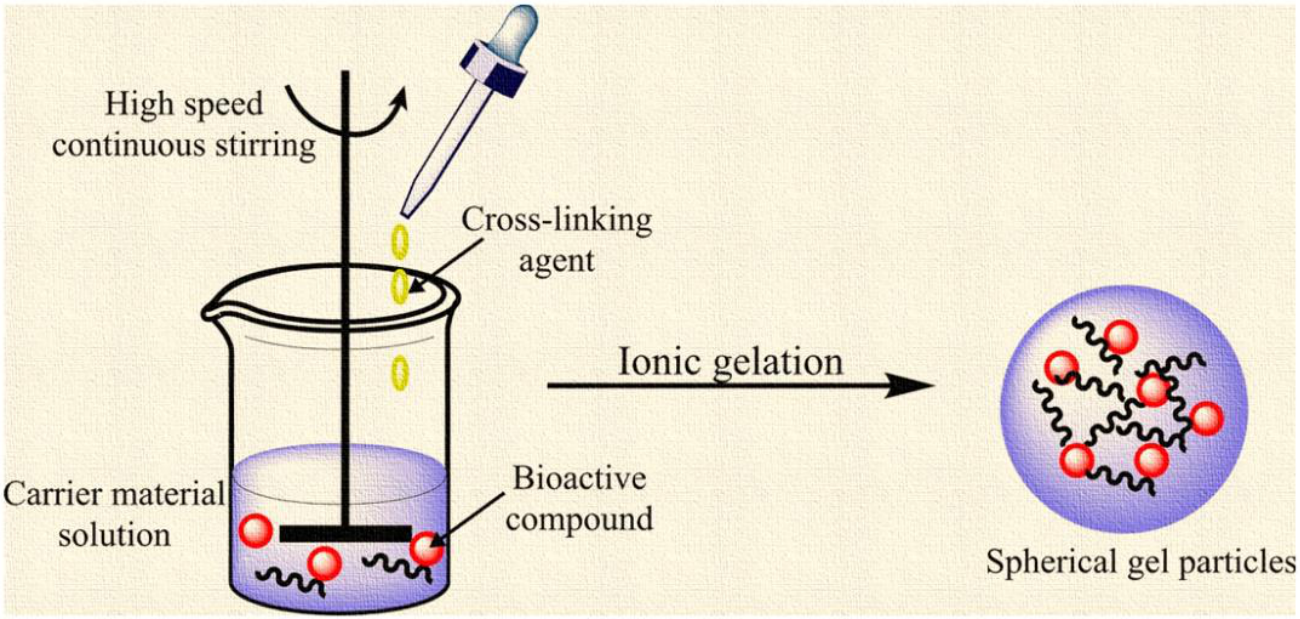
Figure 4.
(A) Sodium alginate is blended with SFN dissolved together with vegetable oil, yielding a homogenized alginate- SFN mixture [48]. (B) Dispensing and gelation process is done by drop size the calcium-alginate mixture in a bath of calcium chloride (CaCl2) [49]. (C) Secondary coating using chitosan forms a polyelectrolytes complex that improves mechanical strength, reduce permeability and offers a better protection to the encapsulated agent [50]. (D) Post processing, the coated capsules are collected, centrifuge to remove excess supernatant and put to dry under suitable condition. SFN, a polyphenol has been encapsulated using ionic gelation to improve its bio accessibility and stability [51].
Figure 4.
(A) Sodium alginate is blended with SFN dissolved together with vegetable oil, yielding a homogenized alginate- SFN mixture [48]. (B) Dispensing and gelation process is done by drop size the calcium-alginate mixture in a bath of calcium chloride (CaCl2) [49]. (C) Secondary coating using chitosan forms a polyelectrolytes complex that improves mechanical strength, reduce permeability and offers a better protection to the encapsulated agent [50]. (D) Post processing, the coated capsules are collected, centrifuge to remove excess supernatant and put to dry under suitable condition. SFN, a polyphenol has been encapsulated using ionic gelation to improve its bio accessibility and stability [51].
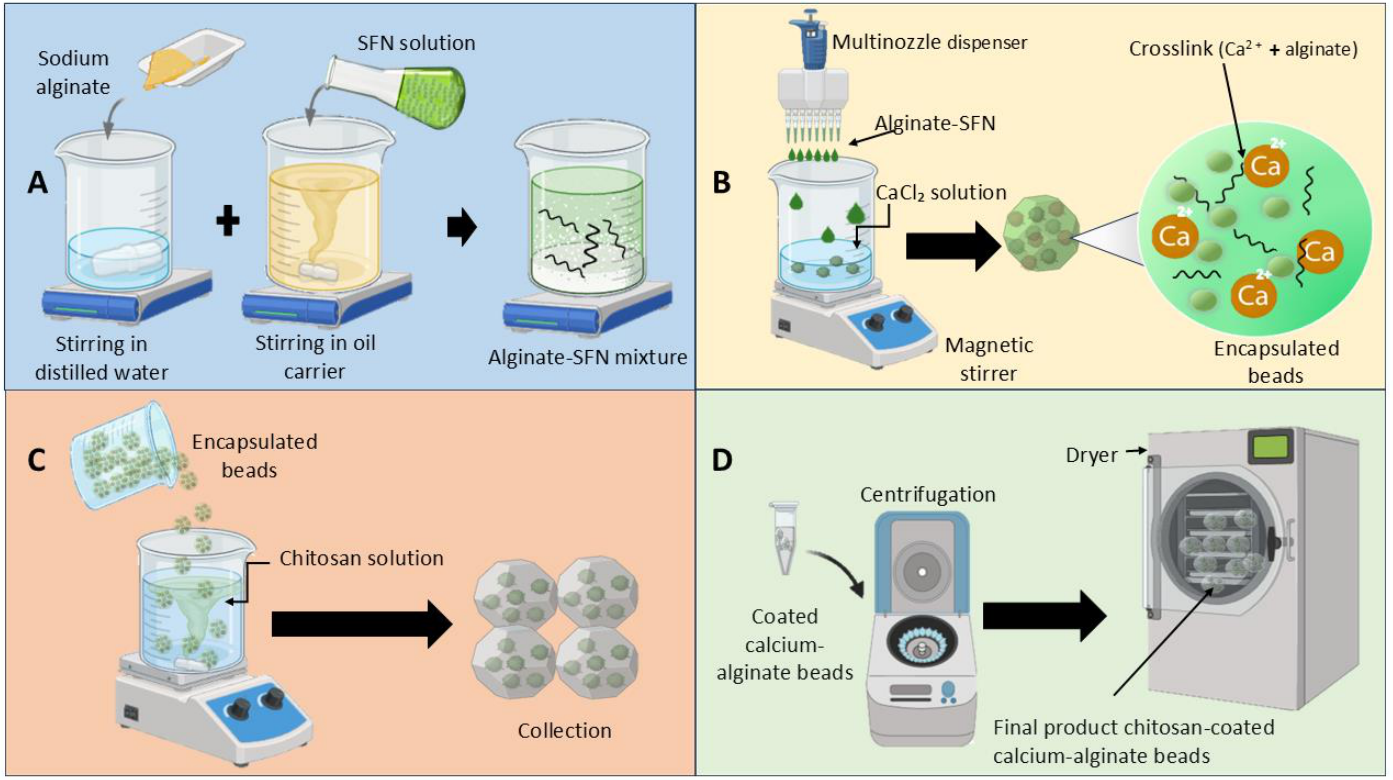
Figure 5.
(A) Scanning electron microscopy (SEM) characterization of chitosan nanoparticles (CNPs) after synthesis via homogenization and subsequent purification by filtration. Reproduced from [58]. Licensed under CC BY 4.0. (B) Fourier-transform infrared (FT-IR) spectra of a) pristine chitosan, b) chitosan–silica nanohybrids, and c) chitosan–silica/CpG ODN nanohybrids. Reproduced from [60] with permission from Elsevier. Copyright (2013). (C) Assessment of chitosan nanoparticle cytotoxicity in RAW-Blue murine macrophages using the CCK-8 assay. Reproduced from [62]. Licensed under CC BY 4.0. .
Figure 5.
(A) Scanning electron microscopy (SEM) characterization of chitosan nanoparticles (CNPs) after synthesis via homogenization and subsequent purification by filtration. Reproduced from [58]. Licensed under CC BY 4.0. (B) Fourier-transform infrared (FT-IR) spectra of a) pristine chitosan, b) chitosan–silica nanohybrids, and c) chitosan–silica/CpG ODN nanohybrids. Reproduced from [60] with permission from Elsevier. Copyright (2013). (C) Assessment of chitosan nanoparticle cytotoxicity in RAW-Blue murine macrophages using the CCK-8 assay. Reproduced from [62]. Licensed under CC BY 4.0. .
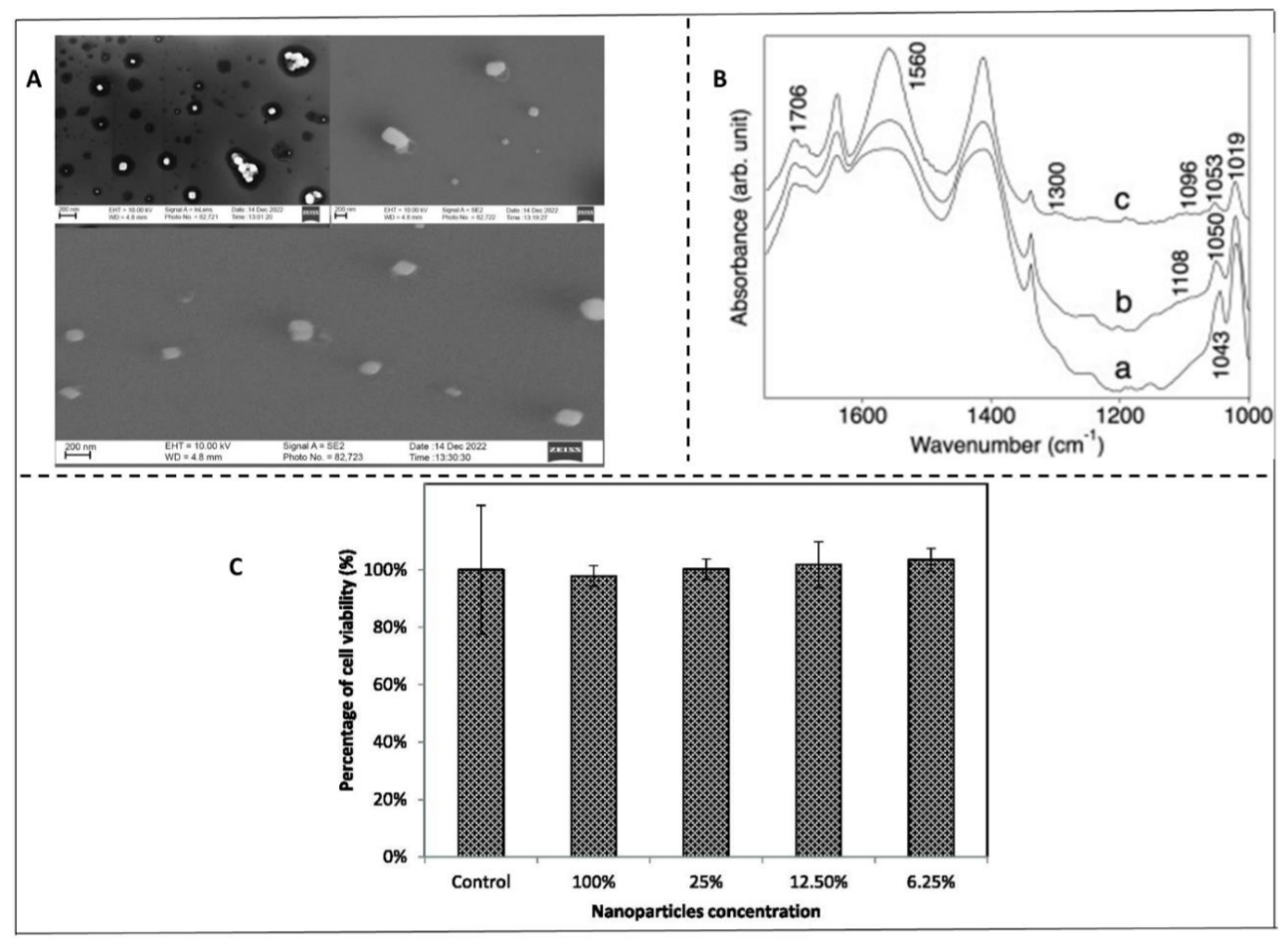
Figure 6.
Mechanistic overview of sulforaphane’s bidirectional modulation of nrf2 and nf-κb pathways in cellular homeostasis. Sulforaphane change on the Nrf2/ARE pathway, which aid in the production of antioxidant proteins and phase II detoxification enzymes [69,70]. Concurrently, SFN stops the NF-κB pathway, which regulates anti-inflammatory gene expression and inhibits the progression of inflammation [71,72].
Figure 6.
Mechanistic overview of sulforaphane’s bidirectional modulation of nrf2 and nf-κb pathways in cellular homeostasis. Sulforaphane change on the Nrf2/ARE pathway, which aid in the production of antioxidant proteins and phase II detoxification enzymes [69,70]. Concurrently, SFN stops the NF-κB pathway, which regulates anti-inflammatory gene expression and inhibits the progression of inflammation [71,72].
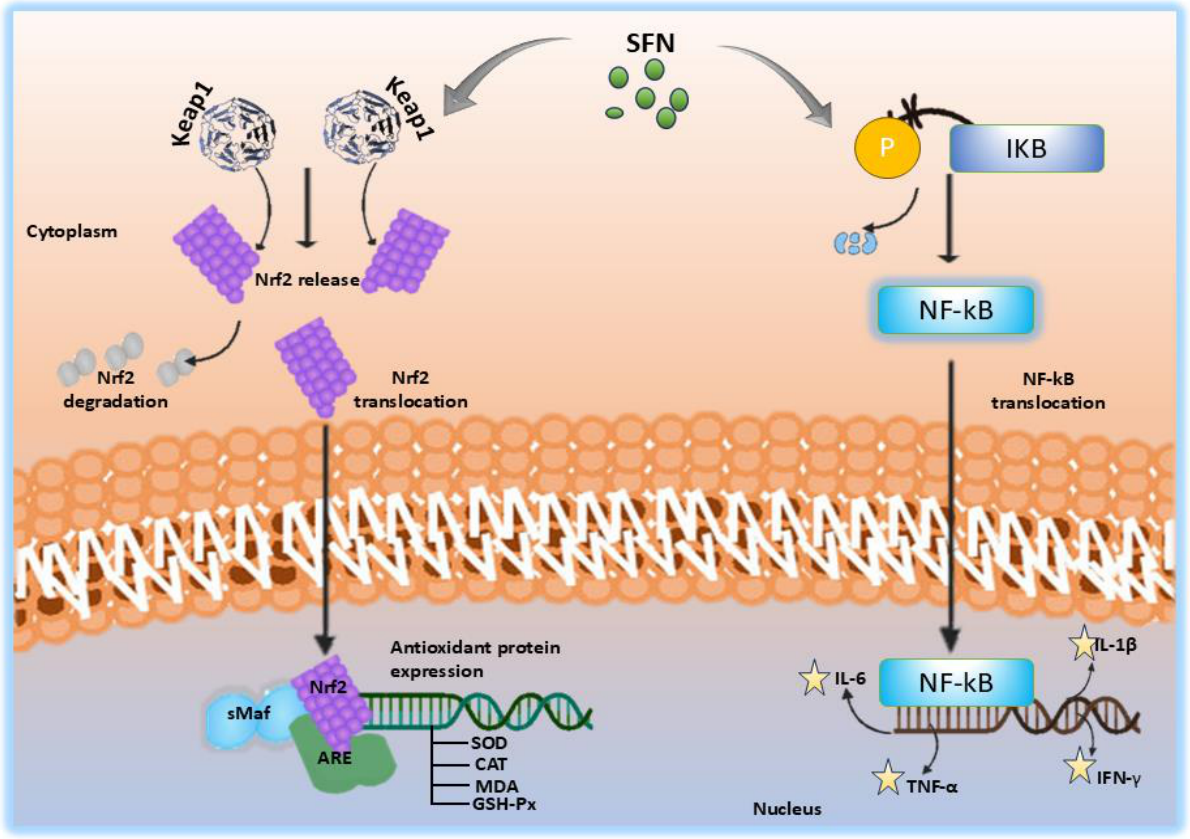
Figure 7.
(A) Sulforaphane (SFN) boosted the antioxidant defense system in primary goat mammary epithelial cells (GMECs. Reproduced from [73]. Licensed under CC BY 4.0. (B) Sulforaphane exerts anti-inflammatory effects through an Nrf2-dependent mechanism in LPS-stimulated HGFs. Reproduced from [74] with permission from Elsevier. Copyright (2025). (C) SFN exerts antibacterial effects by targeting bacterial virulence mechanisms rather than direct growth inhibition. Reproduced from [75]. Licensed under CC BY- NC-ND 4.0.
Figure 7.
(A) Sulforaphane (SFN) boosted the antioxidant defense system in primary goat mammary epithelial cells (GMECs. Reproduced from [73]. Licensed under CC BY 4.0. (B) Sulforaphane exerts anti-inflammatory effects through an Nrf2-dependent mechanism in LPS-stimulated HGFs. Reproduced from [74] with permission from Elsevier. Copyright (2025). (C) SFN exerts antibacterial effects by targeting bacterial virulence mechanisms rather than direct growth inhibition. Reproduced from [75]. Licensed under CC BY- NC-ND 4.0.
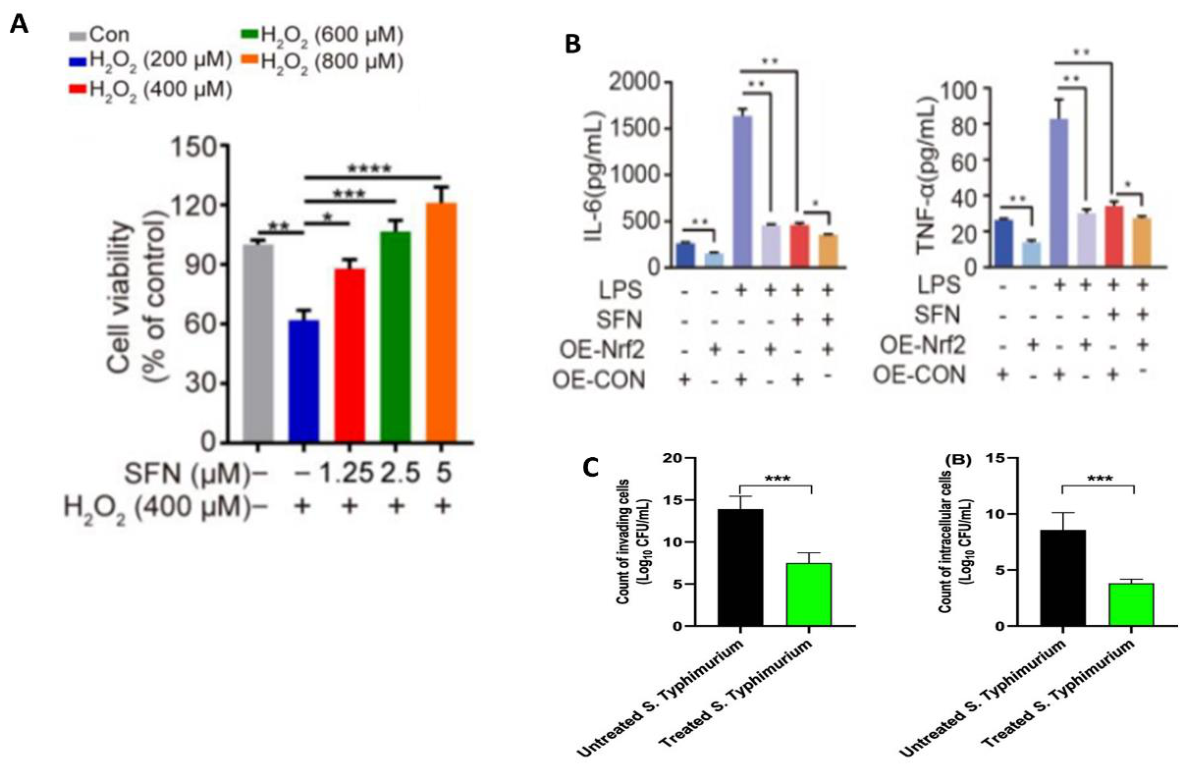
Figure 8.
Sulforaphane retention over 6 h under various pH and temperature conditions. Data from Table 1 of [85] were extracted and replotted as line graphs in panels (A)–(D) as indicated.
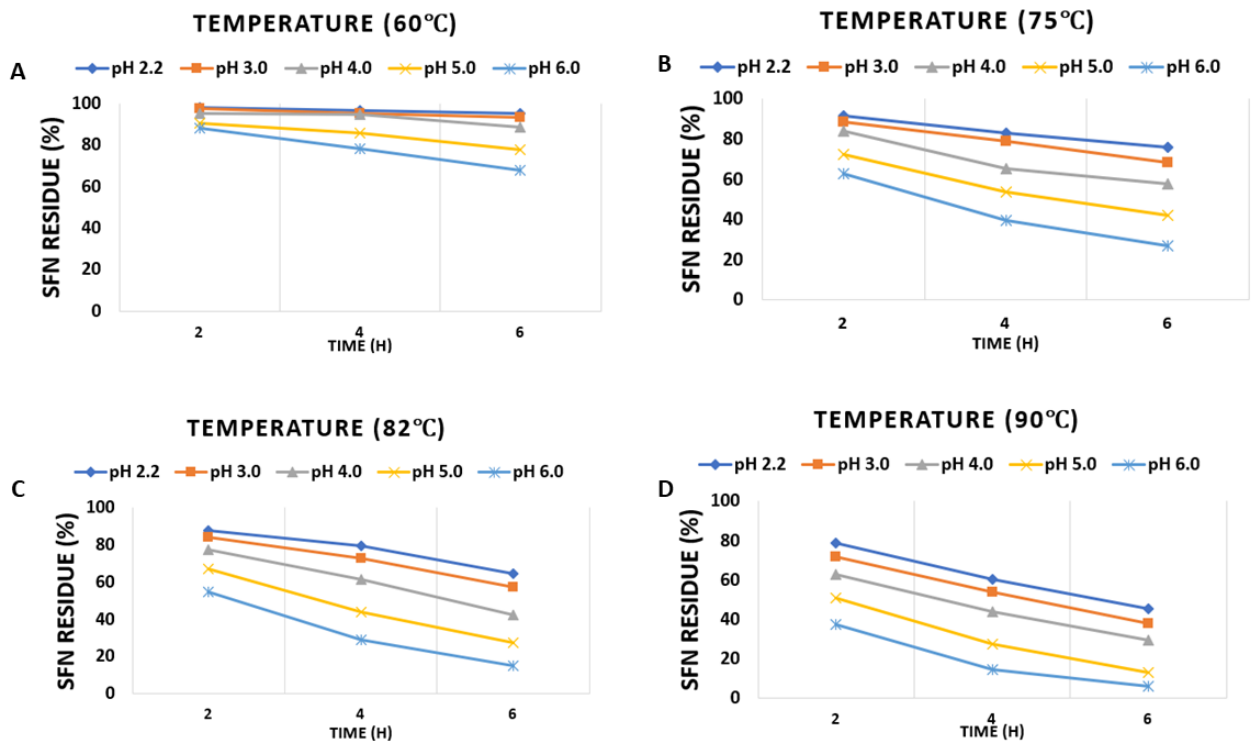
Table 1.
Gefitinib nanocarrier comparison: conventional methods versus microfluidics-assisted chitosan-alginate self-assembly.
Table 1.
Gefitinib nanocarrier comparison: conventional methods versus microfluidics-assisted chitosan-alginate self-assembly.
| Synthesis method | Nanocarrier main components | Synthesis time (min) | Loading capacity (mg g⁻¹) | Encapsulation efficiency (%) | Nanocarrier size (nm) | Ref. |
|---|---|---|---|---|---|---|
| Microfluidics-assisted self-assembly | Chitosan + alginate | 5 | 50.2 | 68.4 | 5.3 | [52] |
| Ionic gelation | Chitosan + TPP | 60 | – | 80.7 | 80.8 | [53] |
| Emulsion solvent evaporation | PLGA + γ-PGA | 240 | – | 89.5 | 548.5 | [54] |
| Emulsification solvent volatilization | PLGA + chitosan + alginate | 300 | 256.7 | 87.23 | 255 | [55] |
| Ionic pre-gelation + complexation | Chitosan + alginate | 90 | 6.8 | – | 20–50 | [56] |
| Emulsion solvent evaporation | PLGA + PVA | 300 | – | – | 222 | [57] |
Poly(lactic-co-glycolic) acid (PLGA); Polyvinyl alcohol (PVA); γ-Polyglutamic acid (γ-PGA).
Disclaimer/Publisher’s Note: The statements, opinions and data contained in all publications are solely those of the individual author(s) and contributor(s) and not of MDPI and/or the editor(s). MDPI and/or the editor(s) disclaim responsibility for any injury to people or property resulting from any ideas, methods, instructions or products referred to in the content. |
© 2026 by the authors. Licensee MDPI, Basel, Switzerland. This article is an open access article distributed under the terms and conditions of the Creative Commons Attribution (CC BY) license (http://creativecommons.org/licenses/by/4.0/).
Copyright: This open access article is published under a Creative Commons CC BY 4.0 license, which permit the free download, distribution, and reuse, provided that the author and preprint are cited in any reuse.


