Submitted:
29 April 2026
Posted:
02 May 2026
You are already at the latest version
Abstract

Keywords:
1. Introduction
1.1. Background on Functional Beverages and CBD Use
1.2. Significance of CBD-Infused Water for Health and Wellness
1.3. Knowledge Gap: Limited Data on Microbial Safety, Chemical Stability and Production Methods
1.4. Study Objectives and Novelty
2. Materials and Methods
2.1. Source of CBD and Bottled Water
2.2. Preparation and Clean-Room Bottling Procedures
2.3. Microbial Analysis
2.4. Chemical Analysis
- CBD Quantification: Cannabidiol content in the beverage was accurately determined by high, performance liquid chromatography (HPLC). Calibration curves were made from CBD standards, and the measurements were taken three times to ensure accuracy and reproducibility.
- Detection of Degradation Products: The samples were periodically checked to find the possible CBD degradation products that could have been formed due to storage, exposure to light, or temperature changes. The chemical stability was studied by comparing chromatographic profiles with reference standards.
- Physicochemical Parameters:
- pH: To determine the acidity/alkalinity level, a pH meter was used, which was first calibrated,
- Total Solids: The amount of dissolved matter was evaluated by gravimetric methods according to the standards.
- Water Activity (aw): It was measured to determine the likelihood of microbial growth and to evaluate the stability of the product.
2.5. Storage and Stability Testing Procedures
2.6. Data Analysis/Statistical Methods
- Microbial data: Total plate counts, yeasts and molds enumeration together with pathogen screening results were used to check for significant differences between the storage intervals.
- Chemical and physicochemical data: Concentrations of CBD, degradation products, pH, total solids and water activity were measured throughout the storage time and their changes were analyzed by the one way analysis of variance (ANOVA) to find out the impact of time on product stability.
- Post hoc tests: If necessary, Tukeys or Bonferroni tests were conducted to determine significant pairwise differences between time points.
- Trend analysis: To evaluate the correlation between the duration of storage and the variations in CBD concentration, physicochemical properties and microbial load, the methods of linear regression or correlation analysis were employed.
3. Results
3.1. Microbial Counts over Time
3.2. CBD Concentration and Stability Data
- Temperature Impact: While minimal degradation occurs at 4 °C, higher temperatures (e.g., 37 °C–40 °C) significantly increase degradation and the formation of degradation products [18].
- Storage Conditions: Stability is best maintained in the dark at lower temperatures. At 4 °C in the dark, minimal degradation is observed over 29 days [19].
3.3. Physicochemical Parameters
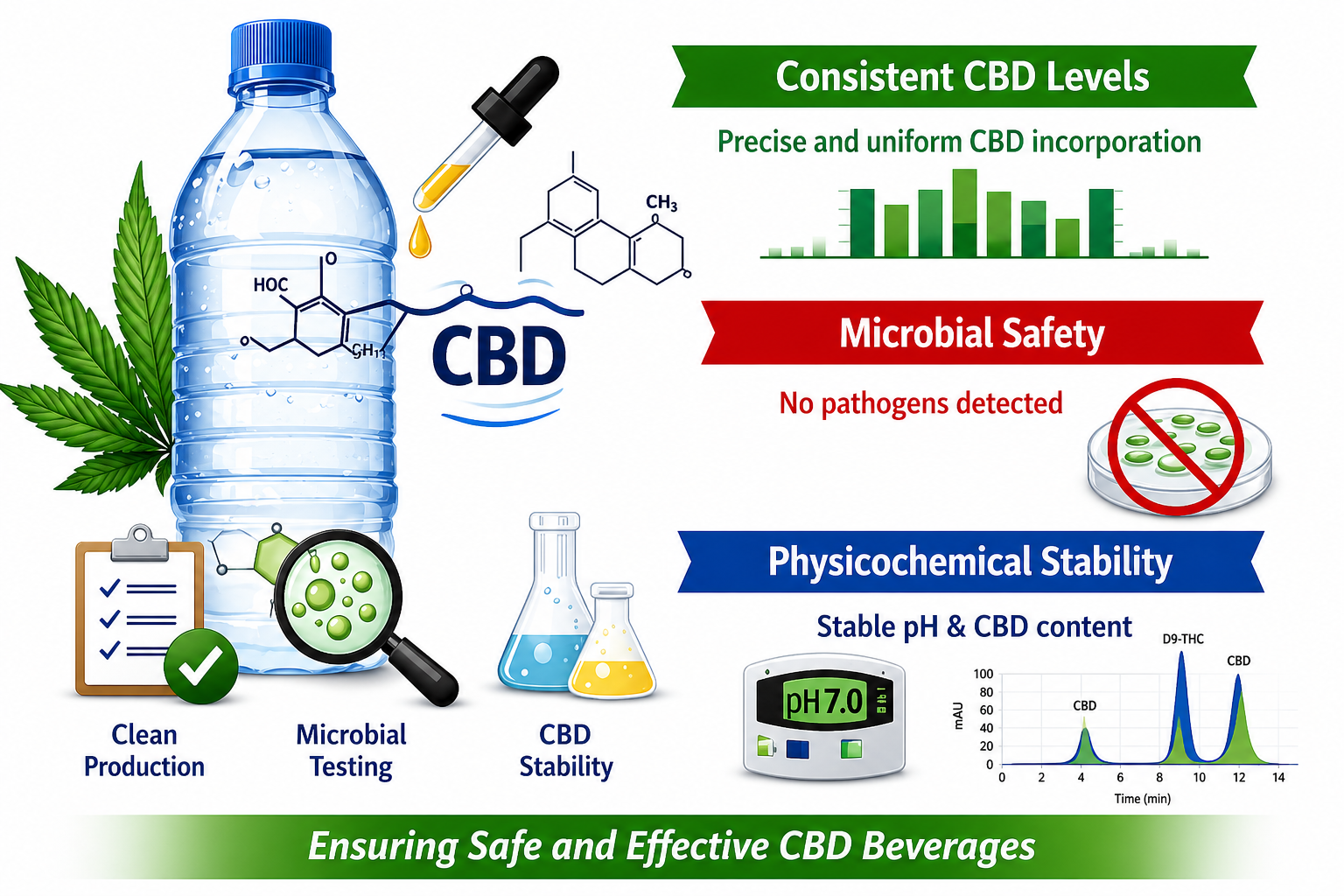
- pH: The CBD infused water kept a steady pH level during storage (from 6. 8 to 7. 0), which shows that the addition of CBD and the storage conditions did not significantly change the acidity or alkalinity of the water [21].
- Total Dissolved Solids (TDS): The TDS readings did not change over time, which indicates that the dissolved components were evenly distributed and that there was no precipitation or major compositional changes [6].
- Water Activity (aw): The water activity stayed very high (>0. 99), which is normal for water-based drinks, but no microorganisms grew as the production was sterile and the storage conditions were controlled [22].
4. Discussion
4.1. Interpretation of Microbial and Chemical Stability Results
4.2. Role of CBD Incorporation Method in Product Safety and Consistency
4.3. Comparison with Other Functional Beverage Studies
4.4. Implications for Production, Consumer Safety and Shelf-Life
5. Conclusion
5.1. Summary of Main Findings
5.2. Practical Applications for Beverage Manufacturers, Regulators and Researchers
- -
- To Beverage Manufacturers: Findings show that the establishment of standard CBD dosing, the use of sterilized bottling facilities and the implementation of storage under controlled conditions are the key factors in the manufacture of beverages with consistent levels of cannabidiol which are chemically stable and microbiologically safe. Producers may implement these procedures to create trustworthy products, enhance the shelf life and earn consumer confidence.
- -
- To Regulators and Food Safety Authorities: This research offers scientific data concerning the microbial and chemical safety of cannabinoid, infused beverages thus facilitating the formulation of regulations and norms regarding their manufacturing, labeling and storage. In this way, it helps both regulatory compliance and public health.
- -
- To Researchers: This research offers a detailed method of analysis that is reproducible for the measurement of the stability of CBD, evaluation of microbial safety and the determination of various physicochemical properties of functional beverages. Researchers may further develop this study to include bioavailability, health impacts on consumers or the utilization of other bioactive compounds thus contributing to the expansion of knowledge in the field of functional beverage development.
5.3. Recommendations for Standardizing CBD Beverage Production
Institutional Review Board Statement
Informed Consent Statement
Data Availability Statement
Acknowledgments
Conflicts of Interest
References
- Giri, N. A.; Sakhale, B. K.; Nirmal, N. P. Functional beverages: an emerging trend in beverage world. Recent Front. Phytochem. 2023, 123–142. [Google Scholar] [CrossRef]
- Bagheri, H.; Akhavan-Mahdavi, S.; Sarabi-Aghdam, V.; Mirarab Razi, S.; Singh Beniwal, A.; Rashidinejad, A. Targeted dairy fortification: leveraging bioactive compounds to enhance nutritional value. Crit. Rev. Food Sci. Nutr. 2026, 66(2), 295–319. [Google Scholar] [CrossRef]
- Tihăuan, B. M.; Onisei, T.; Slootweg, W.; Gună, D.; Iliescu, C.; Chifiriuc, M. C. Cannabidiol-A friend or a foe? Eur. J. Pharm. Sci. 2025, 107036. [Google Scholar] [CrossRef]
- Martínez, V.; Iriondo De-Hond, A.; Borrelli, F.; Capasso, R.; Del Castillo, M.D.; Abalo, R. Cannabidiol and Other Non-Psychoactive Cannabinoids for Prevention and Treatment of Gastrointestinal Disorders: Useful Nutraceuticals? Int. J. Mol. Sci. 2020, 21(9), 3067. [Google Scholar] [CrossRef] [PubMed] [PubMed Central]
- Fordjour, E.; Manful, C. F.; Khalsamehta, T. S.; Armah, A.; Cheema, M.; Thomas, R. Cannabis-infused foods: phytonutrients, health, and safe product innovations. Compr. Rev. Food Sci. Food Saf. 2024, 23(5), e70021. [Google Scholar] [CrossRef]
- Muta, T.; Khetan, R.; Song, Y.; Garg, S. Optimising Cannabidiol Delivery: Improving Water Solubility and Permeability Through Phospholipid Complexation. Int. J. Mol. Sci. 2025, 26(6), 2647. [Google Scholar] [CrossRef]
- PARLAK KHALILY, M. E. L. E. K. Improving the water solubility of cannabidiol using a peptide carrier. Turk. J. Chem. 2024, 48(2), 229–236. [Google Scholar] [CrossRef] [PubMed]
- Lachenmeier, D. W.; Sproll, C.; Walch, S. G. Does cannabidiol (CBD) in food supplements pose a serious health risk? Consequences of the European food safety authority (EFSA) clock stop regarding novel food authorisation. Psychoactives 2023, 2(1), 66–75. [Google Scholar] [CrossRef]
- Staples, A. J. Canning cannabis: Consumer preferences for CBD-and THC-infused beverages. J. Wine Econ. 2024, 19(4), 313–334. [Google Scholar] [CrossRef]
- Cásedas, G.; Yarza-Sancho, M. D.; López, V. Cannabidiol (CBD): a systematic review of clinical and preclinical evidence in the treatment of pain. Pharmaceuticals 2024, 17(11), 1438. [Google Scholar] [CrossRef] [PubMed]
- Hoch, E.; Volkow, N. D.; Friemel, C. M.; Lorenzetti, V.; Freeman, T. P.; Hall, W. Cannabis, cannabinoids and health: a review of evidence on risks and medical benefits. Eur. Arch. Psychiatry Clin. Neurosci. 2025, 275(2), 281–292. [Google Scholar] [CrossRef]
- Astray, G.; Mejuto, J. C.; Xiao, J.; Simal-Gandara, J. Benefits, toxicity and current market of cannabidiol in edibles. Crit. Rev. Food Sci. Nutr. 2023, 63(22), 5800–5812. [Google Scholar] [CrossRef] [PubMed]
- Hossain, K. R.; Alghalayini, A.; Valenzuela, S. M. Current challenges and opportunities for improved cannabidiol solubility. Int. J. Mol. Sci. 2023, 24(19), 14514. [Google Scholar] [CrossRef] [PubMed]
- Selvaraj, S.; Nawfer, N.; Dharmawansa, K. S.; Redha, A. A.; Rupasinghe, H. V. Recent advances in cannabidiol (CBD) extraction: a review of potential eco-friendly solvents and advanced technologies. Green. Anal. Chem. 2025, 100270. [Google Scholar] [CrossRef]
- Nyland, C. R.; Moyer, D. C. Regulating for safety: Cannabidiol dose in food: A review. J. Food Prot. 2022, 85(9), 1355–1369. [Google Scholar] [CrossRef]
- Johnson, D. A.; Hogan, M.; Marriot, R.; Heaney, L. M.; Bailey, S. J.; Clifford, T.; James, L. J. A comparison of advertised versus actual cannabidiol (CBD) content of oils, aqueous tinctures, e-liquids and drinks purchased in the UK. J. Cannabis Res. 2023, 5(1), 28. [Google Scholar] [CrossRef]
- Schwarzenberg, A.; Carpenter, H.; Wright, C.; Bayazeid, O.; Brokl, M. Characterizing the degradation of cannabidiol in an e-liquid formulation. Sci. Rep. 2022, 12(1), 20058. [Google Scholar] [CrossRef]
- Schwarzenberg, A.; Carpenter, H.; Wright, C.; Bayazeid, O.; Brokl, M. Characterizing the degradation of cannabidiol in an e-liquid formulation. Sci. Rep. 2022, 12(1), 20058. [Google Scholar] [CrossRef] [PubMed]
- Lumu, S.; Hatterman-Valenti, H.; Hammed, A.; Monono, E. Effect of short-term storage on cannabinoid content of dried floral hemp (Cannabis sativa L) inflorescence. J. Appl. Res. Med. Aromat. Plants 2024, 42, 100567. [Google Scholar] [CrossRef]
- Kosović, E.; Sýkora, D.; Kuchař, M. Stability study of cannabidiol in the form of solid powder and sunflower oil solution. Pharmaceutics 2021, 13(3), 412. [Google Scholar] [CrossRef]
- Pillai, S. K.; Kera, N. H.; Kleyi, P.; de Beer, M.; Magwaza, M.; Ray, S. S. Stability, biofunctional, and antimicrobial characteristics of cannabidiol isolate for the design of topical formulations. Soft Matter 2024, 20(10), 2348–2360. [Google Scholar] [CrossRef]
- Tapia, M. S.; Alzamora, S. M.; Chirife, J. Effects of water activity (aw) on microbial stability as a hurdle in food preservation. Water Act. Foods Fundam. Appl. 2020, 323–355. [Google Scholar] [CrossRef]
- Osiripun, V.; Labua, S. Effects of thermal processing on cannabidiol degradation in cannabidiol-infused pomegranate juice and evaluation of its antioxidant property. J. Curr. Sci. Technol. 2023, 13(1), 107–117. Available online: https://ph04.tci-thaijo.org/index.php/JCST/article/view/209.
- Sokra, I.; Meta, H.; Somaly, S. Advances in beverage preservation: Modern techniques to delay microbial and chemical spoilage. J. Agric. Technol. 2026, 2(2), 66‒75. [Google Scholar] [CrossRef]
- Sridhar, A.; Ponnuchamy, M.; Kumar, P. S.; Kapoor, A. Food preservation techniques and nanotechnology for increased shelf life of fruits, vegetables, beverages and spices: a review. Environ. Chem. Lett. 2021, 19(2), 1715–1735. [Google Scholar] [CrossRef]
- Boyar, K. Cannabis microbial testing: Methodologies and considerations. In Recent advances in the science of cannabis; CRC Press, 2021; pp. 131–160. [Google Scholar] [CrossRef]
- Fraguas-Sánchez, A. I.; Fernández-Carballido, A.; Martin-Sabroso, C.; Torres-Suárez, A. I. Stability characteristics of cannabidiol for the design of pharmacological, biochemical and pharmaceutical studies. J. Chromatogr. B 2020, 1150, 122188. [Google Scholar] [CrossRef] [PubMed]
- Ogwu, M. C.; Ogunsola, O. A. Physicochemical methods of food preservation to ensure food safety and quality. In Food safety and quality in the global south; Springer Nature Singapore: Singapore, 2024; pp. 263–298. [Google Scholar] [CrossRef]
- Charles, A. P. R.; Chen, B.; Rao, J. Cannabidiol (CBD) as an emerging nutraceutical ingredient from industrial hemp: Regulation, production, extraction, nutraceutical properties, and functionality. Crit. Rev. Food Sci. Nutr. 2025, 65(28), 6030–6052. [Google Scholar] [CrossRef]
- Wilson, J.; Simpson, T.; Spelman, K. Total cannabidiol (CBD) concentrations and yields from traditional extraction methods: Percolation vs. maceration. Front. Pharmacol. 2022, 13, 886993. [Google Scholar] [CrossRef] [PubMed]
- Patel, P.; Garala, K. K.; Singh, S.; Prajapati, B. G.; Raval, M. Natural Protein and Lipid Carriers as Food Grade Nanocages for Delivering Bioactive Compounds with Improved Therapeutic Efficacy: A Review. Curr. Med. Chem. 2025, 32(31), 6723–6739. [Google Scholar] [CrossRef]
- Anderson, N. M.; Benyathiar, P.; Mishra, D. K. Aseptic processing and packaging. In Food safety engineering; Springer International Publishing: Cham, 2020; pp. 661–692. [Google Scholar] [CrossRef]
- Condurso, C.; Merlino, M.; Miller, A.; Di Rosa, A. R.; Accetta, F.; Leonardi, M.; Gervasi, T. Developing Novel Plant-Based Probiotic Beverages: A Study on Viability and Physicochemical and Sensory Stability. Foods 2025, 14(12), 2148. [Google Scholar] [CrossRef] [PubMed]
- Vasudevan, S.; Chengaiyan, J. G. Ensuring Beverage Excellence: A Quality Control Guide. Food Sci. Eng. 2025, 38–53. [Google Scholar] [CrossRef]
- Bartončíková, M.; Lapčíková, B.; Lapčík, L.; Valenta, T. Hemp-Derived CBD used in food and food supplements. Molecules 2023, 28(24), 8047. [Google Scholar] [CrossRef] [PubMed]
| Storage Time | Total Plate Count (CFU/mL) | Yeast & Mold (CFU/mL) | Pathogen Screening* |
| Day 0 | < 1 - 10 | < 1 | Negative |
| Day 7 | 10 - 100 | < 1 - 10 | Negative |
| Day 14 | 100 - 1000 | 10 - 50 | Negative |
| Day 21 | 1000 - 5000 | 50 - 100 | Negative |
| Day 28 | 1000 - 10000 | 50 - 200+ | Negative ** |
| Storage Condition | Initial Concentration (%) | Final Conc. (28-30 days) | % Change (Mean ± SD) |
| 4 °C / Dark | 100% (Baseline) | ~95–98% | -2% to -5% (minimal) |
| Room Temp / Dark | 100% (Baseline) | ~90–95% | -5% to -10% |
| 37 °C / Light | 100% (Baseline) | ~80–85% | -15% to -20% |
| Storage Time (Months) | pH | Total Dissolved Solids (TDS) (mg/L) | Water Activity (aw) |
| 0 (Initial) | 6.60 ± 0.12 | 110.5 ± 5.2 | 0.992 ± 0.002 |
| 1 | 6.78 ± 0.15 | 112.0 ± 4.8 | 0.991 ± 0.003 |
| 3 | 6.55 ± 0.18 | 115.2 ± 6.1 | 0.992 ± 0.002 |
| 6 | 6.50 ± 0.20 | 118.5 ± 5.5 | 0.991 ± 0.001 |
Disclaimer/Publisher’s Note: The statements, opinions and data contained in all publications are solely those of the individual author(s) and contributor(s) and not of MDPI and/or the editor(s). MDPI and/or the editor(s) disclaim responsibility for any injury to people or property resulting from any ideas, methods, instructions or products referred to in the content. |
© 2026 by the authors. Licensee MDPI, Basel, Switzerland. This article is an open access article distributed under the terms and conditions of the Creative Commons Attribution (CC BY) license (http://creativecommons.org/licenses/by/4.0/).