
Submitted:
29 April 2026
Posted:
30 April 2026
You are already at the latest version
Abstract
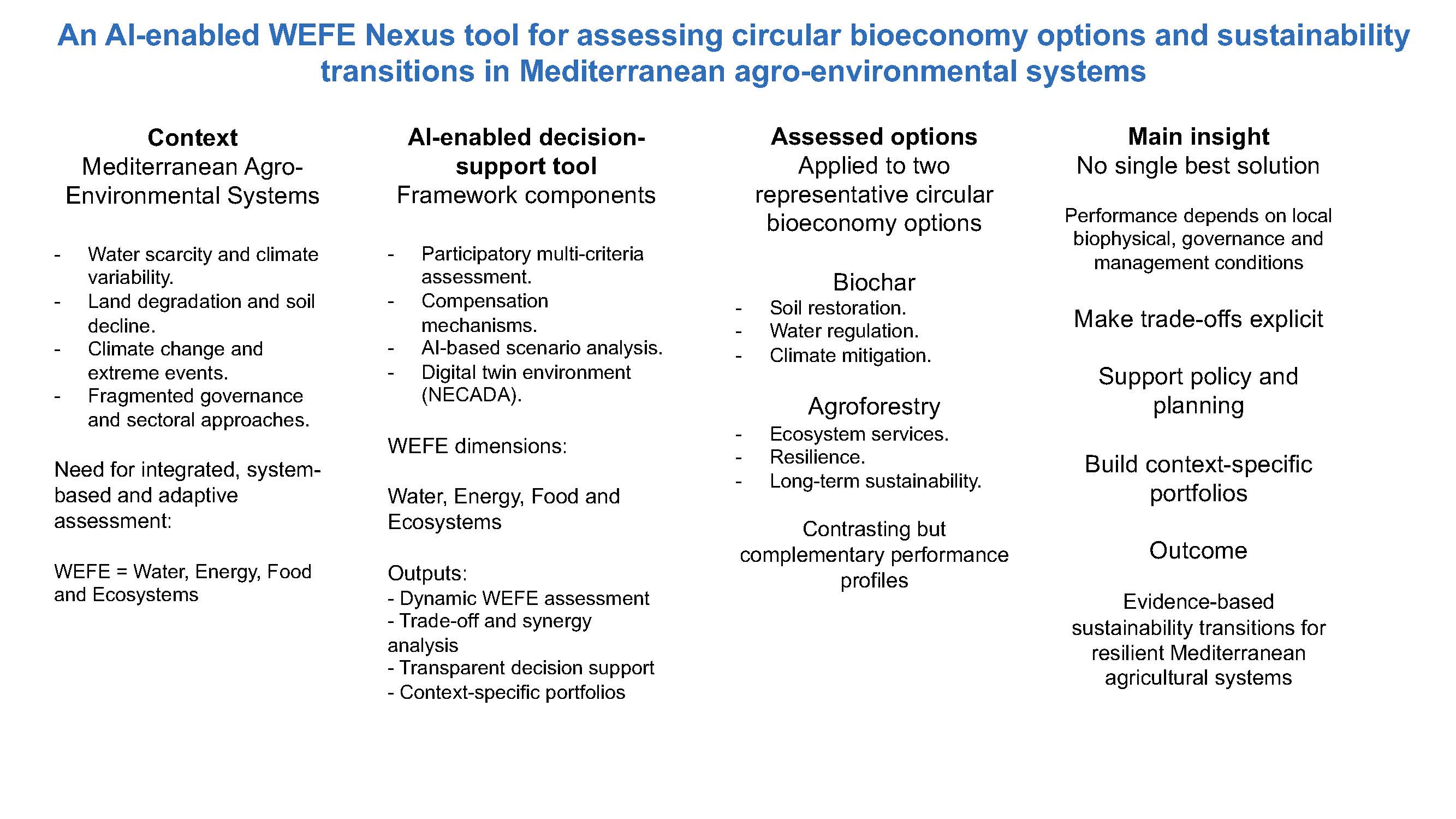
Transitioning to a circular bioeconomy in agro-environmental systems requires decision-support approaches able to address interdependencies across water, energy, food, and ecosystems (WEFE), especially in Mediterranean regions affected by climate variability, water scarcity, land degradation, and fragmented governance. However, the practical operationalization of the WEFE Nexus remains limited by methodological constraints and insufficient integration of dynamic analysis. This study presents an AI-enabled decision-support tool designed to support the implementation of circular bioeconomy solutions within the WEFE Nexus. The framework integrates participatory multi-criteria assessment, compensation mechanisms, and artificial intelligence-based scenario analysis within the NECADA digital twin environment, enabling the assessment of elements under uncertainty. Developed and applied within the “Ensuring fair NEXUS transition for climate change adaptation and sustainable development implementation based on coupled nature-based systems and bioeconomy (SureNexus)” project, the tool was used to assess two circular bioeconomy solutions, biochar and agroforestry, across Mediterranean agro-environmental contexts. Results show complementary performance profiles: biochar provides targeted benefits for soil restoration, water regulation, and climate mitigation, whereas agroforestry generates broader system-level effects that enhance ecosystem services, resilience, and long-term sustainability. These findings highlight the value of context-specific solution portfolios and show that AI-enabled WEFE tools can support evidence-based policy and planning for sustainability transitions.
Keywords:
sustainability transitions
; WEFE Nexus
; circular bioeconomy
; artificial intelligence
; agroforestry
; climate resilience
Copyright: This open access article is published under a Creative Commons CC BY 4.0 license, which permit the free download, distribution, and reuse, provided that the author and preprint are cited in any reuse.


